REVIEW 4 major objections 6 minor 21 references
Finding a Wolf in Sheep's Clothing: Combating Adversarial Text-To-Image Prompts with Text Summarization
T0 review · 4 major / 6 minor · reviewed 2026-08-11 · deepseek-v4-flash
Pith's one-line read Adding a text-summarization step before content classification lifts detection of DACA-obfuscated text-to-image prompts from 94% to 98% F1 for the encoder classifier.
desk verdict Summarization-before-moderation is a plausible, cheap defense against DACA, but the headline gain over a strong baseline rests on a handful of test examples and the 'inoculation' claim is statistically thin. read the letter →
The pith
A machine-rendered reading of the paper's core claim, the machinery that carries it, and where it could break.
The reading
What carries the argument
The load-bearing mechanism is a two-layer pipeline: first, an abstractive summarizer compresses the obfuscated prompt into a single descriptive sentence, discarding narrative padding; second, a binary classifier labels that summary as appropriate or inappropriate. The paper compares two summarizers (a BART-based encoder fine-tuned on dialogue summaries, and the GPT-4o LLM) and two classifiers (a DistilBERT-based inappropriate-text classifier and GPT-4o). DACA, the named attack being countered, works by instructing an LLM to split a prompt into components (characters, actions, properties, scene) and re-contextualize them in a benign story; summarization inverts that by stripping the story back to the component facts. The LIME interpretability analysis is a secondary instrument that shows summaries produce more coherent feature attributions.
What would settle it
Run the same encoder-classifier comparison on a larger set of DACA-obfuscated inappropriate prompts (several hundred) with repeated train/test splits and report 95% confidence intervals for the F1 difference; if the summarized-minus-raw interval includes zero or reverses, the inoculation claim is not supported.
Extended reading notes
Core claim
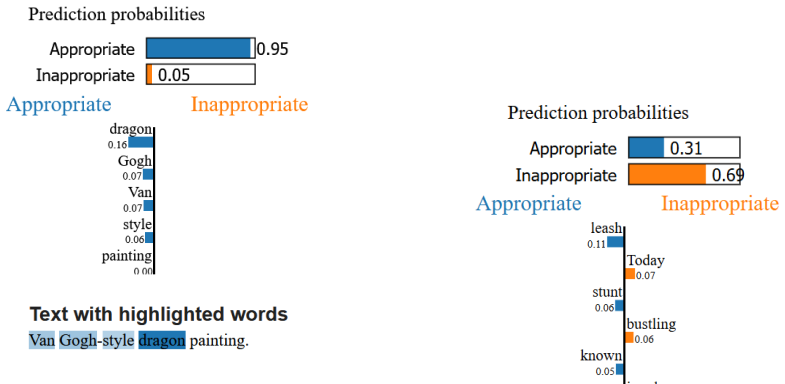
The central claim is that direct text summarization removes the linguistic padding that DACA adds, exposing the underlying sensitive content to a classifier. The paper establishes this by showing that fine-tuning an encoder classifier on summaries of obfuscated prompts yields 98% F1 on the inappropriate class, exceeding the 94% F1 it achieves on raw obfuscated text; a GPT-4o classifier improves from 49% F1 on raw obfuscated prompts to 81% F1 on summaries generated by the same model. Human annotation of LIME explanations also rates summaries as producing better-grounded classification decisions than raw obfuscated texts. The authors frame this as inoculation: training content detectors on summarized variants makes them robust to DACA-style obfuscation.
Load-bearing premise
The load-bearing premise is that the 58 obfuscation attempts excluded as failures (11 percent of 550) do not correlate with content type, and that the roughly 25 inappropriate test examples support the reported F1 differences; if either fails, the four-point gain of the encoder classifier could vanish.
Editorial extensions
If this is right
- A moderation pipeline can insert a summarization step before its existing content filter and improve detection of DACA-style prompts without changing the filter's architecture.
- Fine-tuning a content classifier on summarized prompt variants outperforms training it on raw obfuscated text: 98% vs 94% F1 for the encoder classifier.
- The LLM classifier gains the most from pre-summarization, rising from 49% F1 on raw obfuscated prompts to 81% on LLM-generated summaries.
- Classification of summarized prompts produces higher-quality LIME explanations than classification of raw obfuscated prompts.
- The new ATTIP dataset of 940 raw, obfuscated, and summarized prompts gives the field a benchmark for studying DACA defenses.
Reading between the lines
- Beyond DACA, the same summarize-then-filter pattern should blunt other narrative-based obfuscation attacks, since it targets the padding mechanism rather than specific wording; this is an untested extension.
- The four-point F1 gain over the strong encoder baseline (98% vs 94%) should be re-measured on a larger inappropriate-prompt set with confidence intervals, because the test set contains only about 25 inappropriate examples.
- The error analysis shows DACA can change ground-truth content (e.g., adding a violent scene to an appropriate prompt), so a fully robust defense may need to treat summary-induced label changes as new content rather than as failures.
Editorial analysis
A structured set of objections, weighed in public.
Referee Report
Summary. The paper proposes a two-stage defense against the Divide-and-Conquer Attack (DACA) on text-to-image models: first summarize the user prompt with either a small encoder model (BART-large-CNN-SAMSum) or GPT-4o, then classify the summary as appropriate or inappropriate with a fine-tuned DistilBERT classifier or GPT-4o. The authors construct the ATTIP dataset (N=940) by taking 100 inappropriate prompts from VBCDE-100 and 900 appropriate prompts from DiffusionDB, obfuscating all inappropriate and half of the appropriate prompts with GPT-3.5, and excluding 58 obfuscation failures. They report F1 scores on the inappropriate class: the encoder classifier improves from 0.94 on raw obfuscated prompts to 0.98 on encoder summaries, and the GPT-4o classifier improves from 0.49 to 0.81 on GPT-4o summaries. The paper interprets these results as evidence that pre-classification text summarization can inoculate content detection models against stepwise DACA obfuscations.
Significance. If the reported effect is real, the proposed method is attractive because it is simple, model-agnostic, and can be inserted as a preprocessing step in existing content-moderation pipelines. The paper is commendably honest about its limitations, and the error analysis with LIME explanations and inter-annotator agreement (Cohen's kappa = 0.82) is a useful contribution. The ATTIP dataset, if shared responsibly, could serve as a benchmark for future defenses. However, the empirical support is currently too weak for the strength of the claims: the headline gains rest on a per-class test set of roughly two dozen positive examples, a single random split, and a GPT-4o baseline whose precision on raw obfuscated prompts is only 0.33. The stress-test concern about sampling noise is real and is not addressed by the manuscript.
major comments (4)
- [Abstract; §5.1, Tables 1 and 2] The abstract's claim of a "31%" F1 improvement is computed from the GPT-4o classifier in Table 2 (F1 rises from 0.49 on raw prompts to 0.81 on GPT-4o summaries), not from the stronger encoder classifier. The encoder classifier, which is the better-performing system and the one highlighted in the conclusion, improves only from 0.94 to 0.98 F1 in Table 1. Reporting the 31% figure without specifying the baseline is misleading; the abstract and Section 5 should report both comparisons and state whether the improvement is in percentage points or relative terms.
- [§5.1, Table 1] The reported F1 improvement from 0.94 to 0.98 for the encoder classifier is not statistically grounded. The table shows no confidence intervals, no multiple seeds, and no per-condition positive counts. Because every inappropriate prompt in ATTIP is DACA-obfuscated and the test set is 25% of the data, the inappropriate class contains at most about 25 test examples; the recall increase from 0.92 to 1.00 corresponds to a change of roughly two instances. The paper needs bootstrap confidence intervals or multiple train/test splits, along with confusion matrices, to establish that the observed difference is not sampling noise.
- [§3 (failure exclusions)] The dataset construction excludes 58 of 550 obfuscated prompts (11%) as failures, but the paper does not report how many failures occurred among inappropriate versus appropriate prompts. This matters because if the LLM refused to obfuscate inappropriate prompts at a higher rate, the remaining obfuscated inappropriate set is an easier, biased subset, and the comparison between raw and summarized prompts is no longer representative of the original DACA attack distribution. The authors should report failure counts by ground-truth label and include a sensitivity analysis that imputes failures under a worst-case assumption.
- [§4.2, §5] The evaluation uses only the authors' own ATTIP dataset, with a single split and no independent obfuscation set. The paper should at least report the number of positive examples in each test condition and the distribution of summary lengths or qualities, so readers can judge whether the classifier improvements come from a small handful of examples. Evaluating on an independently generated DACA-style obfuscation set, or comparing against an existing defense such as GuardT2I, would substantially strengthen the claim that summarization is a general inoculation mechanism.
minor comments (6)
- [Abstract] The sentence "utilize a large language model" should be "uses a large language model," and the phrase "improved F1 score performance by 31%" should specify whether this is relative improvement or percentage points and against which classifier baseline.
- [§3] The word "assimilation" in "the assimilation of a baseline dataset" should be "assembly" or "construction." Also, "a randomly selected subset of the 1.8M unique prompts" should clarify whether the 900 prompts were sampled without replacement from the DiffusionDB set.
- [§3] The sentence about the train/test/validation split should state explicitly that the split was stratified by obfuscation status and ground-truth label, since the subsequent F1 calculations depend on the inappropriate class being evenly distributed across the three sets.
- [§4.2] The text says "the encoder classifier was trained on the encoder and GPT-4o summaries associated with the members of the pre-defined train set," but it is unclear whether two separate encoder classifiers were trained (one per summary type) or one classifier was trained on a mixture. This should be clarified, as it affects the interpretation of Table 1.
- [§4.3] There is a typo in the sentence "a 10% sample of was randomly selected"; the word "prompts" is missing. Also, Figure 2 reports percentages for LIME label distributions but does not provide raw counts, which would be useful given the small sample size.
- [§6] The phrase "the inappropriate-only test set from the ATTIP baseline dataset" is confusing, since the test set includes appropriate prompts as well; the authors should say "the inappropriate class of the ATTIP test set."
Circularity Check
No significant circularity: the evaluation is empirical, with an independent train/test split and no fitted parameter renamed as a prediction.
full rationale
The paper's central claim is empirical: text summarization before binary classification improves detection of DACA-obfuscated prompts. The derivation chain is (i) assemble ATTIP from VBCDE-100 inappropriate prompts and DiffusionDB appropriate prompts, (ii) apply DACA to create obfuscated variants, (iii) summarize with two fixed pretrained summarizers, (iv) fine-tune or run classifiers on raw and summarized variants, and (v) measure F1 on a held-out test split. No equation defines the outcome in terms of a fitted input; the encoder classifier is trained on summaries but evaluated on a disjoint test set, and GPT-4o is used with fixed in-context examples. The '31%' and '98%' figures are measured performance values, not quantities forced by construction. The exclusion of 58 failed obfuscations and the small number of inappropriate test examples are statistical-robustness concerns, not circularity. The paper contains no load-bearing self-citations; reliance on the authors' own ATTIP dataset is a benchmark-construction choice, and the train/test split keeps the evaluation independent. The limitation section honestly narrows the scope to DACA, which further supports a non-circular reading. No step reduces to its own input by definition, so the appropriate circularity score is 0.
Assumptions & free parameters
assumptions (3)
- domain assumption DACA obfuscation preserves the ground-truth label of a prompt: inappropriate stays inappropriate and appropriate stays appropriate.
- domain assumption The DACA obfuscation implementation from Deng and Chen (2024) is correctly reproduced, and the 58 excluded failures are not content-selective.
- domain assumption The off-the-shelf summarizers (BART-large-CNN-SAMSum and GPT-4o) preserve the harmful core of a prompt while removing narrative padding.
Cite this review
Pith. "Pith review of Finding a Wolf in Sheep's Clothing: Combating Adversarial Text-To-Image Prompts with Text Summarization." pith.science (2026). https://pith.science/paper/5JE6I5Z3
@misc{pith2026241212212,
  author       = {Pith},
  title        = {Pith review of: Finding a Wolf in Sheep's Clothing: Combating Adversarial Text-To-Image Prompts with Text Summarization},
  year         = {2026},
  howpublished = {\url{https://pith.science/paper/5JE6I5Z3}},
  note         = {Machine review of arXiv:2412.12212}
}
abstract
Text-to-image models are vulnerable to the stepwise "Divide-and-Conquer Attack" (DACA) that utilize a large language model to obfuscate inappropriate content in prompts by wrapping sensitive text in a benign narrative. To mitigate stepwise DACA attacks, we propose a two-layer method involving text summarization followed by binary classification. We assembled the Adversarial Text-to-Image Prompt (ATTIP) dataset ($N=940$), which contained DACA-obfuscated and non-obfuscated prompts. From the ATTIP dataset, we created two summarized versions: one generated by a small encoder model and the other by a large language model. Then, we used an encoder classifier and a GPT-4o classifier to perform content moderation on the summarized and unsummarized prompts. When compared with a classifier that operated over the unsummarized data, our method improved F1 score performance by 31%. Further, the highest recorded F1 score achieved (98%) was produced by the encoder classifier on a summarized ATTIP variant. This study indicates that pre-classification text summarization can inoculate content detection models against stepwise DACA obfuscations.
Figures


Figures from the paper (2 more)

Reference graph
Works this paper leans on
-
[1]
online" 'onlinestring :=
ENTRY address archivePrefix author booktitle chapter edition editor eid eprint eprinttype howpublished institution journal key month note number organization pages publisher school series title type volume year doi pubmed url lastchecked label extra.label sort.label short.list INTEGERS output.state before.all mid.sentence after.sentence after.block STRING...
-
[2]
write newline
" write newline "" before.all 'output.state := FUNCTION n.dashify 't := "" t empty not t #1 #1 substring "-" = t #1 #2 substring "--" = not "--" * t #2 global.max substring 't := t #1 #1 substring "-" = "-" * t #2 global.max substring 't := while if t #1 #1 substring * t #2 global.max substring 't := if while FUNCTION word.in bbl.in capitalize " " * FUNCT...
-
[3]
James Betker, Gabriel Goh, Li Jing, Tim Brooks, Jianfeng Wang, Linjie Li, Long Ouyang, Juntang Zhuang, Joyce Lee, Yufei Guo, Wesam Manassra, Prafulla Dhariwal, Casey Chu, Yunxin Jiao, and Aditya Ramesh. 2024. https://cdn.openai.com/papers/dall-e-3.pdf Improving image generation with better captions
work page 2024
-
[4]
Yimo Deng and Huangxun Chen. 2024. https://arxiv.org/abs/2312.07130 Divide-and-conquer attack: Harnessing the power of llm to bypass safety filters of text-to-image models . Preprint, arXiv:2312.07130
arXiv 2024
-
[5]
Bogdan Gliwa, Iwona Mochol, Maciej Biesek, and Aleksander Wawer. 2019. https://doi.org/10.18653/v1/D19-5409 SAMS um corpus: A human-annotated dialogue dataset for abstractive summarization . In Proceedings of the 2nd Workshop on New Frontiers in Summarization, pages 70--79, Hong Kong, China. Association for Computational Linguistics
-
[6]
Ziyi Kou, Shichao Pei, Yijun Tian, and Xiangliang Zhang. 2023. https://doi.org/10.24963/ijcai.2023/109 Character as pixels: A controllable prompt adversarial attacking framework for black-box text guided image generation models . In Proceedings of the Thirty-Second International Joint Conference on Artificial Intelligence, IJCAI-23 , pages 983--990. Inter...
-
[7]
Mike Lewis, Yinhan Liu, Naman Goyal, Marjan Ghazvininejad, Abdelrahman Mohamed, Omer Levy, Ves Stoyanov, and Luke Zettlemoyer. 2019. https://arxiv.org/abs/1910.13461 Bart: Denoising sequence-to-sequence pre-training for natural language generation, translation, and comprehension . Preprint, arXiv:1910.13461
arXiv 2019
-
[8]
Michelle Li. 2022. Fine-tuned distilbert for nsfw inappropriate text classification. https://huggingface.co/michellejieli/inappropriate_text_classifier?not-for-all-audiences=true. Accessed: 2024-07-30
work page 2022
Show all 21 references
-
[9]
Han Liu, Yuhao Wu, Shixuan Zhai, Bo Yuan, and Ning Zhang. 2023. https://doi.org/10.1109/CVPR52729.2023.01972 Riatig: Reliable and imperceptible adversarial text-to-image generation with natural prompts . In 2023 IEEE/CVF Conference on Computer Vision and Pattern Recognition (C...
2023
-
[10]
Yi Liu, Guowei Yang, Gelei Deng, Feiyue Chen, Yuqi Chen, Ling Shi, Tianwei Zhang, and Yang Liu. 2024. https://arxiv.org/abs/2402.12100 Groot: Adversarial testing for generative text-to-image models with tree-based semantic transformation . Preprint, arXiv:2402.12100
2024 arXiv
-
[11]
OpenAI. 2022. Openai gpt-3.5 turbo api. https://platform.openai.com/docs/models/gpt-3-5-turbo. Accessed: 2024-07-30
2022
-
[12]
OpenAI, Josh Achiam, Steven Adler, Sandhini Agarwal, Lama Ahmad, Ilge Akkaya, Florencia Leoni Aleman, Diogo Almeida, Janko Altenschmidt, Sam Altman, Shyamal Anadkat, Red Avila, Igor Babuschkin, Suchir Balaji, Valerie Balcom, Paul Baltescu, Haiming Bao, Mohammad Bavarian, Jeff ...
2024 arXiv
-
[13]
philschmid. 2022. bart-large-cnn-samsum. https://huggingface.co/philschmid/bart-large-cnn-samsum#bart-large-cnn-samsum. Accessed: 2024-07-30
2022
-
[14]
Yiting Qu, Xinyue Shen, Xinlei He, Michael Backes, Savvas Zannettou, and Yang Zhang. 2023. https://doi.org/10.1145/3576915.3616679 Unsafe diffusion: On the generation of unsafe images and hateful memes from text-to-image models . In Proceedings of the 2023 ACM SIGSAC Conferenc...
2023
-
[15]
Bhaktipriya Radharapu and Harish Krishna. 2023. https://doi.org/10.1109/CAI54212.2023.10413929 Taxonomy of adversarial attacks on text-to-image generative models . In 2023 IEEE Conference on Artificial Intelligence (CAI), pages 374--376
2023
-
[16]
Javier Rando, Daniel Paleka, David Lindner, Lennart Heim, and Florian Tramèr. 2022. https://arxiv.org/abs/2210.04610 Red-teaming the stable diffusion safety filter . Preprint, arXiv:2210.04610
2022 arXiv
-
[17]
Patrick Schramowski, Manuel Brack, Bj\"orn Deiseroth, and Kristian Kersting. 2023. Safe latent diffusion: Mitigating inappropriate degeneration in diffusion models. In Proceedings of the IEEE/CVF Conference on Computer Vision and Pattern Recognition (CVPR), pages 22522--22531
2023
-
[18]
Hoyun Song, Soo Hyun Ryu, Huije Lee, and Jong Park. 2021. https://doi.org/10.18653/v1/2021.conll-1.43 A large-scale comprehensive abusiveness detection dataset with multifaceted labels from R eddit . In Proceedings of the 25th Conference on Computational Natural Language Learn...
2021 doi
-
[19]
Wang, Evan Montoya, David Munechika, Haoyang Yang, Benjamin Hoover, and Duen Horng Chau
Zijie J. Wang, Evan Montoya, David Munechika, Haoyang Yang, Benjamin Hoover, and Duen Horng Chau. 2022. https://arxiv.org/abs/2210.14896 DiffusionDB : A large-scale prompt gallery dataset for text-to-image generative models . arXiv:2210.14896 [cs]
2022 arXiv
-
[20]
Zongyu Wu, Hongcheng Gao, Yueze Wang, Xiang Zhang, and Suhang Wang. 2024. https://arxiv.org/abs/2402.10882 Universal prompt optimizer for safe text-to-image generation . Preprint, arXiv:2402.10882
2024 arXiv
-
[21]
Yijun Yang, Ruiyuan Gao, Xiao Yang, Jianyuan Zhong, and Qiang Xu. 2024. https://arxiv.org/abs/2403.01446 Guardt2i: Defending text-to-image models from adversarial prompts . Preprint, arXiv:2403.01446
2024 arXiv
Reviewed August 11, 2026 · model on record in the stance chip above.
Discussion (0). Continue with ORCID to comment.