Cross-Source Supervision for Bone Infection Segmentation in Dual-Modality PET-CT
Pith reviewed 2026-05-20 22:17 UTC · model grok-4.3
The pith
Training parallel models on high-sensitivity and high-specificity expert annotations lets each internalize a different diagnostic philosophy for PET-CT bone infection segmentation.
A machine-rendered reading of the paper's core claim, the machinery that carries it, and where it could break.
Core claim
The cross-evaluation matrix quantitatively reveals how models successfully internalize distinct expert diagnostic philosophies, providing a robust, diversity-preserving paradigm for clinical AI deployment in bone infection segmentation.
What carries the argument
A decoupled dual-source learning framework that trains parallel models independently on high-sensitivity and high-specificity expert annotations.
If this is right
- Multimodal early fusion of PET metabolic and CT anatomical signals yields measurable gains in segmentation accuracy at the patient level.
- Patient-level 3D volumetric evaluation and cross-validation eliminate over-optimistic results caused by inter-slice correlation.
- Models exhibit performance patterns that align with the specific clinical intent of their training annotations.
- The approach replaces forced consensus with preserved diagnostic diversity for safer clinical AI use.
Where Pith is reading between the lines
- Clinics could run both models at inference and select or combine outputs depending on whether missing a lesion or avoiding false alarms matters more for the case.
- The same dual-source pattern could be tested on other medical segmentation tasks where multiple experts disagree systematically rather than randomly.
- If the two models are later averaged or switched at test time, overall robustness might increase beyond either model alone.
Load-bearing premise
That expert annotations produced under high-sensitivity versus high-specificity clinical goals are sufficiently distinct and free of annotation artifacts or noise.
What would settle it
A cross-evaluation matrix in which each model shows no measurable performance advantage when tested on annotations matching its training source compared with the opposite source.
Figures


read the original abstract
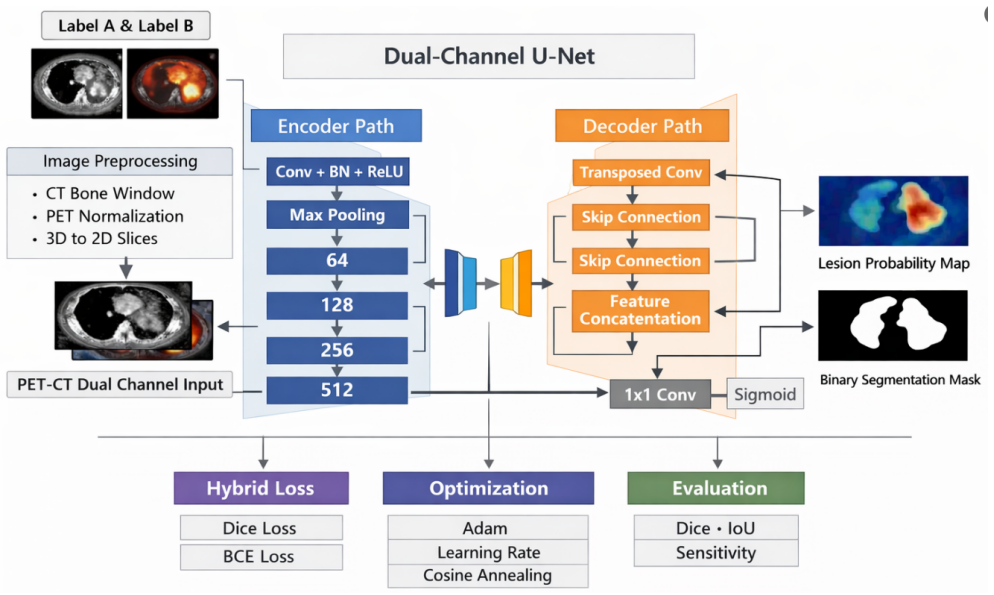
Early and accurate diagnosis and lesion localization of bone infections are crucial for clinical treatment. PET-CT integrates anatomical information from CT with metabolic information from PET, making it an important imaging modality for diagnosing bone infections. However, accurate lesion segmentation remains challenging due to indistinct lesion boundaries and inconsistencies in annotations generated by different experts or automated systems. In this work, we investigate multimodal segmentation of bone infections under annotation discrepancy. We develop a bimodal end-to-end segmentation framework that integrates PET metabolic signals and CT bone-window anatomy through an early-fusion multimodal representation.To mitigate performance inflation caused by inter-slice correlation in small datasets, this study discards traditional two-dimensional evaluation methods and implements a rigorous patient-level 3D volumetric evaluation and cross-validation. Furthermore, instead of forcing a singular consensus, we propose a decoupled dual-source learning framework where parallel models are trained on independent expert annotations driven by high-sensitivity and high-specificity clinical intents. Experimental results objectively report performance variations at the patient level (Mean + SD and Mean - SD), demonstrating the effectiveness of multimodal PET-CT fusion. The cross-evaluation matrix quantitatively reveals how models successfully internalize distinct expert diagnostic philosophies, providing a robust, diversity-preserving paradigm for clinical AI deployment in bone infection segmentation.
Editorial analysis
A structured set of objections, weighed in public.
Referee Report
Summary. The paper presents a bimodal end-to-end segmentation framework for bone infections in PET-CT images that performs early fusion of PET metabolic and CT anatomical signals. To address annotation discrepancies, it introduces a decoupled dual-source learning approach that trains separate models on independent expert annotations driven by high-sensitivity versus high-specificity clinical intents. The work emphasizes patient-level 3D volumetric evaluation and cross-validation to mitigate inter-slice correlation in small datasets, and reports a cross-evaluation matrix intended to show that the models internalize distinct diagnostic philosophies.
Significance. If the cross-evaluation results are shown to reflect genuine internalization of clinically distinct philosophies rather than annotation artifacts, the approach offers a practical way to preserve diagnostic diversity in medical segmentation models. This could be valuable for clinical AI deployment where multiple valid expert perspectives exist, moving beyond forced consensus annotations.
major comments (2)
- [Results] Results section on cross-evaluation matrix: the claim that the matrix 'quantitatively reveals' successful internalization of distinct expert diagnostic philosophies lacks supporting controls such as inter-annotator agreement statistics, operational definitions of the high-sensitivity and high-specificity annotation criteria, or noise-injection baselines. Without these, observed patient-level performance variations (Mean ± SD) could equally arise from fitting label inconsistencies rather than philosophy capture, directly undermining the central claim.
- [Methods] Methods section describing the decoupled dual-source framework: no details are given on how the two annotation sources were generated or validated for systematic differences tied to clinical intent (e.g., boundary criteria or lesion inclusion rules). This makes it impossible to rule out that the cross-matrix simply captures dataset-specific noise or random inter-expert variability.
minor comments (2)
- [Abstract] Abstract: the phrasing 'performance variations at the patient level (Mean + SD and Mean - SD)' is nonstandard and should be clarified to conventional Mean ± SD reporting with explicit numerical values and error bars.
- [Results] The manuscript would benefit from a table or figure explicitly showing the cross-evaluation matrix with all numerical entries and statistical significance tests.
Simulated Author's Rebuttal
We thank the referee for the detailed and constructive feedback on our manuscript. We have addressed each of the major comments below and will make appropriate revisions to strengthen the paper.
read point-by-point responses
-
Referee: [Results] Results section on cross-evaluation matrix: the claim that the matrix 'quantitatively reveals' successful internalization of distinct expert diagnostic philosophies lacks supporting controls such as inter-annotator agreement statistics, operational definitions of the high-sensitivity and high-specificity annotation criteria, or noise-injection baselines. Without these, observed patient-level performance variations (Mean ± SD) could equally arise from fitting label inconsistencies rather than philosophy capture, directly undermining the central claim.
Authors: We acknowledge the validity of this concern. The cross-evaluation matrix is intended to show performance differences consistent with the distinct clinical intents, but we agree that without additional controls, alternative explanations cannot be fully ruled out. In the revised manuscript, we will provide operational definitions of the high-sensitivity and high-specificity annotation criteria. We will also add a noise-injection baseline to the experiments to compare against random variations. For inter-annotator agreement, we will include any available statistics from the annotation process. revision: partial
-
Referee: [Methods] Methods section describing the decoupled dual-source framework: no details are given on how the two annotation sources were generated or validated for systematic differences tied to clinical intent (e.g., boundary criteria or lesion inclusion rules). This makes it impossible to rule out that the cross-matrix simply captures dataset-specific noise or random inter-expert variability.
Authors: We thank the referee for pointing this out. The manuscript briefly mentions independent expert annotations driven by clinical intents, but we recognize that more explicit details are necessary. In the revised Methods section, we will elaborate on the generation of the two annotation sources, including specific boundary criteria and lesion inclusion rules for each intent, as well as any steps taken to validate systematic differences. revision: yes
Circularity Check
No circularity: empirical framework rests on experimental outcomes
full rationale
The paper describes an empirical bimodal segmentation framework trained on independent high-sensitivity and high-specificity expert annotations, followed by patient-level 3D cross-evaluation. No equations, derivations, or first-principles results are presented that reduce to fitted parameters or inputs by construction. Central claims about internalizing distinct diagnostic philosophies are grounded in reported performance variations (Mean ± SD) and the cross-evaluation matrix rather than definitional equivalence or self-citation chains. The work is self-contained against external benchmarks with no load-bearing self-referential steps.
Axiom & Free-Parameter Ledger
axioms (2)
- domain assumption Early fusion of PET metabolic signals and CT bone-window anatomy produces a useful multimodal representation for segmentation
- domain assumption Independent expert annotations driven by high-sensitivity versus high-specificity intents are sufficiently distinct to train meaningfully different models
Lean theorems connected to this paper
-
IndisputableMonolith/Cost/FunctionalEquation.leanwashburn_uniqueness_aczel unclear?
unclearRelation between the paper passage and the cited Recognition theorem.
decoupled dual-source learning framework where parallel models are trained on independent expert annotations driven by high-sensitivity and high-specificity clinical intents... cross-evaluation matrix quantitatively reveals how models successfully internalize distinct expert diagnostic philosophies
-
IndisputableMonolith/Foundation/DimensionForcing.leanalexander_duality_circle_linking unclear?
unclearRelation between the paper passage and the cited Recognition theorem.
early physical fusion of CT anatomical constraints and PET metabolic guidance via a channel-stacking strategy
What do these tags mean?
- matches
- The paper's claim is directly supported by a theorem in the formal canon.
- supports
- The theorem supports part of the paper's argument, but the paper may add assumptions or extra steps.
- extends
- The paper goes beyond the formal theorem; the theorem is a base layer rather than the whole result.
- uses
- The paper appears to rely on the theorem as machinery.
- contradicts
- The paper's claim conflicts with a theorem or certificate in the canon.
- unclear
- Pith found a possible connection, but the passage is too broad, indirect, or ambiguous to say the theorem truly supports the claim.
Reference graph
Works this paper leans on
-
[1]
S Bhattacharjee, A Ram, and B Maramattom Varkey. Use of pet ct scan for earlier diagnosis of central skull-base osteomyelitis–a step beyond conventional mri scan.Journal of the Neurological Sciences, 405:79–80, 2019. 1
work page 2019
-
[2]
Improving pet-ct image segmentation via deep multi-modality data aug- mentation
Kaiyi Cao, Lei Bi, Dagan Feng, and Jinman Kim. Improving pet-ct image segmentation via deep multi-modality data aug- mentation. InInternational Workshop on Machine Learning for Medical Image Reconstruction, pages 145–152. Springer,
-
[3]
Piezoelectric nanofiber-based intelligent hearing sys- tem.Science Advances, 11(19):eadl2741, 2025
Jinke Chang, Thomas Maltby, Amirbahador Moineddini, Daqian Shi, Lei Wu, Jishizhan Chen, Jianshu Yu, Jef- frey Hung, Giuseppe Viola, Antonio Vilches, and Wenhui Song. Piezoelectric nanofiber-based intelligent hearing sys- tem.Science Advances, 11(19):eadl2741, 2025. 1, 2
work page 2025
-
[4]
Solebo, Daqian Shi, Jinge Wu, and Paul Taylor
Boyu Chen, Ameenat L. Solebo, Daqian Shi, Jinge Wu, and Paul Taylor. Minuscule cell detection in as-oct images with progressive field-of-view focusing, 2025. 3, 8
work page 2025
-
[5]
Rzcr: Zero-shot character recog- nition via radical-based reasoning
Xiaolei Diao, Daqian Shi, Hao Tang, Qiang Shen, Yanzeng Li, Lei Wu, and Hao Xu. Rzcr: Zero-shot character recog- nition via radical-based reasoning. InProceedings of the Thirty-Second International Joint Conference on Artificial Intelligence (IJCAI-23), pages 654–662. International Joint Conferences on Artificial Intelligence, 2023. 2
work page 2023
-
[6]
Zhaoshuo Diao, Huiyan Jiang, and Tianyu Shi. A spatial squeeze and multimodal feature fusion attention network for multiple tumor segmentation from pet–ct volumes.Engi- neering Applications of Artificial Intelligence, 121:105955,
-
[7]
Giovanni Foti, Chiara Longo, Claudia Sorgato, Eugenio Si- mone Oliboni, Cristina Mazzi, Leonardo Motta, Giulia Bertoli, and Stefania Marocco. Osteomyelitis of the lower limb: diagnostic accuracy of dual-energy ct versus mri.Di- agnostics, 13(4):703, 2023. 2
work page 2023
-
[8]
Andor WJM Glaudemans and Alberto Signore. Fdg-pet/ct in infections: the imaging method of choice?European Jour- nal of Nuclear Medicine and Molecular Imaging, 37(10): 1986–1991, 2010. 2
work page 1986
-
[9]
Thomas Gross, Achim H Kaim, Pietro Regazzoni, and An- dreas F Widmer. Current concepts in posttraumatic os- teomyelitis: a diagnostic challenge with new imaging op- tions.Journal of Trauma and Acute Care Surgery, 52(6): 1210–1219, 2002. 2
work page 2002
-
[10]
Alain Jungo, Raphael Meier, Ekin Ermis, Marcela Blatti- Moreno, Evelyn Herrmann, Roland Wiest, and Mauricio Reyes. On the effect of inter-observer variability for a re- liable estimation of uncertainty of medical image segmen- tation. InInternational Conference on Medical Image Com- puting and Computer-Assisted Intervention (MICCAI), pages 682–690. Spring...
work page 2018
-
[11]
Fcc: Feature clusters compres- sion for long-tailed visual recognition
Jian Li, Ziyao Meng, Daqian Shi, Rui Song, Xiaolei Diao, Jingwen Wang, and Hao Xu. Fcc: Feature clusters compres- sion for long-tailed visual recognition. InProceedings of the IEEE/CVF Conference on Computer Vision and Pattern Recognition (CVPR), pages 24080–24089, 2023. 2, 3
work page 2023
-
[12]
Medl-u: Uncertainty-aware 3d automatic annotation based on evidential deep learning
Helbert Paat, Qing Lian, Weilong Yao, and Tong Zhang. Medl-u: Uncertainty-aware 3d automatic annotation based on evidential deep learning. InIEEE International Con- ference on Robotics and Automation (ICRA), pages 13976– 13982. IEEE, 2024. 3, 7
work page 2024
-
[13]
Daqian Shi, Ting Wang, Hao Xing, and Hao Xu. A learning path recommendation model based on a multidimensional knowledge graph framework for e-learning.Knowledge- Based Systems, 195:105618, 2020. 2
work page 2020
-
[14]
Charformer: A glyph fusion based attentive framework for high-precision character image de- noising
Daqian Shi, Xiaolei Diao, Lida Shi, Hao Tang, Yang Chi, Chuntao Li, and Hao Xu. Charformer: A glyph fusion based attentive framework for high-precision character image de- noising. InProceedings of the 30th ACM International Con- ference on Multimedia, pages 1147–1155. ACM, 2022. 3
work page 2022
-
[15]
Daqian Shi, Xiaoyue Li, and Fausto Giunchiglia. Kae: A property-based method for knowledge graph alignment and extension.Journal of Web Semantics, 82:100832, 2024. 2
work page 2024
-
[16]
Daqian Shi, Xiaolei Diao, Xu Chen, and C ´edric M. John. Competitive distillation: A simple learning strategy for im- proving visual classification, 2025. 4
work page 2025
-
[17]
Pet/ct in muscu- loskeletal infection.Seminars in Musculoskeletal Radiology, 11(04):353–364, 2007
Klaus Strobel and Katrin DM Stumpe. Pet/ct in muscu- loskeletal infection.Seminars in Musculoskeletal Radiology, 11(04):353–364, 2007. 5
work page 2007
-
[18]
Tugce Telli, M ´elanie Desaulniers, Thomas Pyka, Federico Caobelli, Sophia Forstmann, Lale Umutlu, Wolfgang P Fendler, Axel Rominger, Ken Herrmann, and Robert Seifert. What role does pet/mri play in musculoskeletal disorders? Seminars in Nuclear Medicine, 55(2):277–289, 2025. 2, 4
work page 2025
-
[19]
Fei Wang, Chao Cheng, Weiwei Cao, Zhongyi Wu, Heng Wang, Wenting Wei, Zhuangzhi Yan, and Zhaobang Liu. Mfcnet: A multi-modal fusion and calibration networks for 3d pancreas tumor segmentation on pet-ct images.Comput- ers in Biology and Medicine, 155:106657, 2023. 4, 5
work page 2023
-
[20]
Siqiu Wang, Rebecca Mahon, Elisabeth Weiss, Nuzhat Jan, Ross James Taylor, Philip Reed McDonagh, Bridget Quinn, and Lulin Yuan. Automated lung cancer segmentation us- ing a pet and ct dual-modality deep learning neural net- work.International Journal of Radiation Oncology* Biol- ogy* Physics, 115(2):529–539, 2023. 2, 5
work page 2023
-
[21]
Heng Wu, Xiao Ma, Haijian Li, Qiao Wu, Zhenyu Jiang, Tianyu Xi, Yi Shou, and Pei Han. Pet/mri as a complement to pet/ct in chronic osteomyelitis with soft-tissue involvement: implications for surgical outcomes.European Journal of Nu- clear Medicine and Molecular Imaging, 53(5):3213–3225,
-
[22]
Knowlab at radsum23: comparing pre-trained language models in radiology report summarization
Jinge Wu, Daqian Shi, Abul Hasan, and Honghan Wu. Knowlab at radsum23: comparing pre-trained language models in radiology report summarization. InThe 22nd Workshop on Biomedical Natural Language Processing and BioNLP Shared Tasks, pages 535–540, 2023. 2
work page 2023
-
[23]
Jinge Wu, Yunsoo Kim, Daqian Shi, David Cliffton, Fenglin Liu, and Honghan Wu. Slava-cxr: Small language and vision assistant for chest x-ray report automation.arXiv preprint arXiv:2409.13321, 2024. 2
-
[24]
Zhenghui Xiao, Haihua Cai, Yue Wang, Ruixue Cui, Li Huo, Elaine Yuen-Phin Lee, Ying Liang, Xiaomeng Li, Zhanli Hu, Long Chen, et al. Deep learning for predicting epidermal growth factor receptor mutations of non-small cell lung can- cer on pet/ct images.Quantitative Imaging in Medicine and Surgery, 13(3):1286, 2023. 5, 6
work page 2023
-
[25]
Mts-net: research on multi-modal, multi-task, multi-stage tumor segmentation model for pet/ct
Yongwei Zheng, Zhanquan Sun, Suyun Chen, Hongliang Fu, Chaoli Wang, and Ji Zhu. Mts-net: research on multi-modal, multi-task, multi-stage tumor segmentation model for pet/ct. Applied Intelligence, 55(12):870, 2025. 2, 3, 6, 8
work page 2025
-
[26]
Weijian Zhu, Sirui Zhou, Jinming Zhang, Li Li, Pin Liu, and Wei Xiong. Differentiation of native vertebral osteomyeli- tis: a comprehensive review of imaging techniques and fu- ture applications.Medical Science Monitor, 30:e943168–1,
discussion (0)
Sign in with ORCID, Apple, or X to comment. Anyone can read and Pith papers without signing in.