A Boundary--Residue Incidence Coalgebra for Associahedral Scattering Forms
Pith reviewed 2026-06-29 00:38 UTC · model grok-4.3
The pith
The boundary-residue incidence coalgebra on the associahedron encodes nested planar factorization channels of tree-level scalar amplitudes.
A machine-rendered reading of the paper's core claim, the machinery that carries it, and where it could break.
Core claim
For the Stasheff associahedron K_n whose faces are indexed by non-crossing dissections of an (n+1)-gon, the incidence coproduct records all intermediate nested planar factorisation channels of the corresponding tree-level scalar amplitude. The residue of the canonical form on a face labelled by a dissection factorises as the exterior product of canonical forms on the lower associahedra associated with the resulting subpolygons.
What carries the argument
The boundary-residue incidence coalgebra defined on the face poset of a positive geometry, where the coproduct is built from boundary residues to capture nested factorization channels.
If this is right
- The coproduct organizes all recursive planar factorization channels in the amplitude.
- Residues on faces provide a direct algebraic encoding of sub-amplitudes on subpolygons.
- The same incidence mechanism applies to loop geometries like the one-loop halohedron.
- It offers a topological bridge to cellular spacetime structures via barycentric subdivisions.
Where Pith is reading between the lines
- This coalgebra might allow recursive computation of higher-point amplitudes by repeated application of the coproduct.
- The structure could connect to other combinatorial objects used in scattering amplitudes beyond the planar case.
- Extension to non-planar logarithmic strata might unify factorization descriptions across planar and non-planar sectors.
Load-bearing premise
The residue of the canonical form on each face of the associahedron factorises exactly as the exterior product of the canonical forms on the lower associahedra corresponding to the subpolygons.
What would settle it
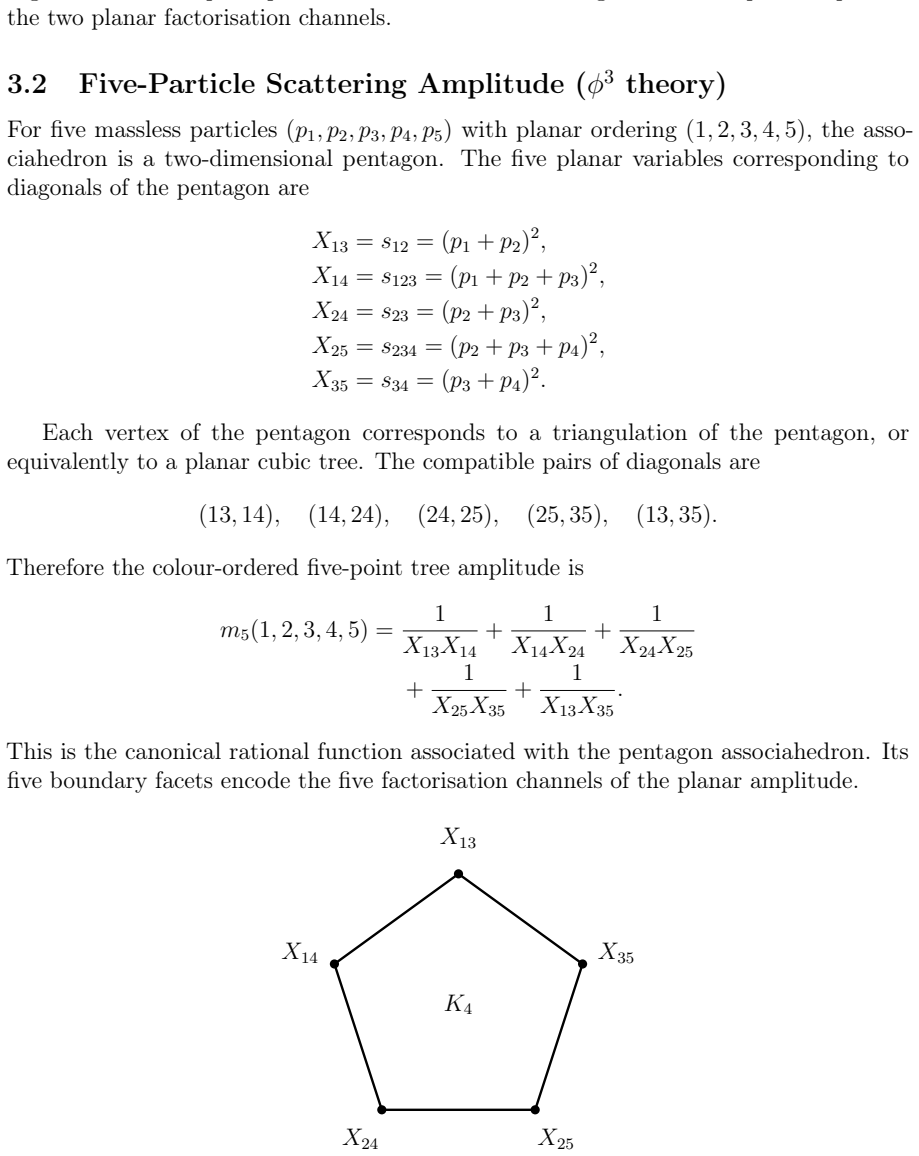
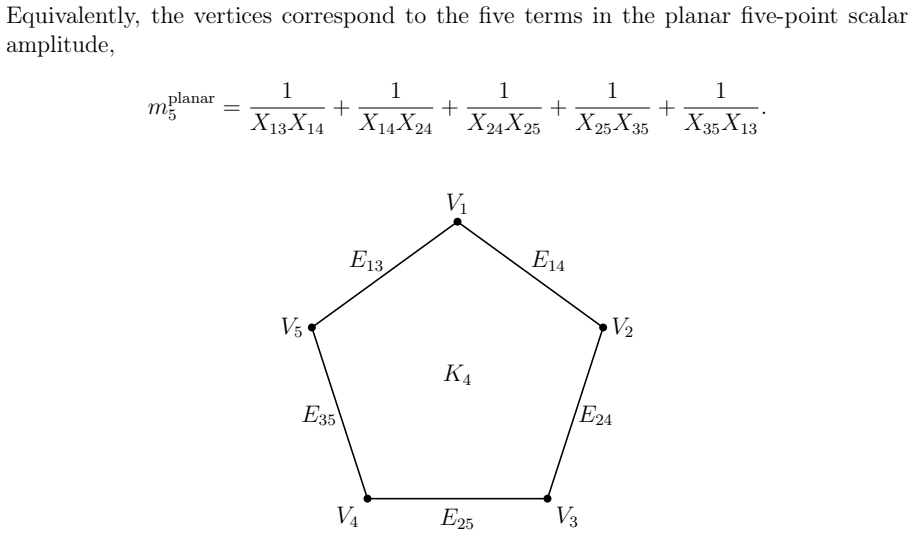
An explicit calculation for the pentagon associahedron K_4 showing that the residue on a specific dissection face does not equal the exterior product of the lower forms would falsify the factorization property.
Figures

read the original abstract
We introduce a boundary--residue incidence coalgebra associated with the face poset of a positive geometry and apply it to associahedral scattering forms. The construction is motivated by the analogy between the Connes--Kreimer coproduct on Feynman graphs and the recursive residue structure of canonical forms. For the Stasheff associahedron \(K_n\), whose faces are indexed by non-crossing dissections of an \((n+1)\)-gon, we prove that the incidence coproduct records all intermediate nested planar factorisation channels of the corresponding tree-level scalar amplitude. The residue of the canonical form on a face labelled by a dissection factorises as the exterior product of canonical forms on the lower associahedra associated with the resulting subpolygons. We illustrate the construction explicitly for the pentagon associahedron \(K_4\), corresponding to the five-point planar scalar amplitude. We then formulate a loop-level extension: whenever a planar loop integrand is represented by a positive geometry, the associahedral face poset is replaced by the boundary poset of the corresponding loop geometry. The one-loop halohedron gives a concrete scalar example, while in the non-planar case we define the associated incidence coalgebra at the level of logarithmic singularity strata. Finally, we compare the boundary--residue coalgebra with the cellular incidence coalgebra of a triangulated or regular CW spacetime. The face poset of a finite regular CW complex reconstructs its barycentric subdivision, and hence its underlying polyhedron, while in positive geometry the same incidence mechanism organises canonical-form residues. This yields an incidence-first bridge between cellular spacetime topology and positive-geometric amplitude factorisation, without assuming that metric or causal data are determined by topology.
Editorial analysis
A structured set of objections, weighed in public.
Referee Report
Summary. The manuscript introduces a boundary-residue incidence coalgebra on the face poset of a positive geometry, motivated by the analogy with the Connes-Kreimer coproduct. For the Stasheff associahedron K_n (faces indexed by non-crossing dissections of an (n+1)-gon), it proves that the incidence coproduct encodes all intermediate nested planar factorization channels of the corresponding tree-level scalar amplitude, and that the residue of the canonical form on a face labeled by a dissection factorizes as the exterior product of canonical forms on the lower associahedra of the resulting subpolygons. The construction is illustrated explicitly for the pentagon case K_4; a loop-level extension replaces the poset by the boundary poset of the corresponding loop geometry (with the one-loop halohedron as scalar example and a definition at the level of logarithmic singularity strata for non-planar cases); finally the construction is compared to the cellular incidence coalgebra of a regular CW complex.
Significance. If the stated factorization holds, the work supplies a combinatorial incidence mechanism that directly organizes canonical-form residues in positive geometry, yielding an incidence-first bridge to amplitude factorization that parallels Connes-Kreimer structures while remaining independent of metric or causal data. The explicit verification supplied for K_4 together with the definitional loop-level replacement constitute concrete, checkable content.
minor comments (2)
- The comparison in the final section between the boundary-residue coalgebra and the cellular incidence coalgebra would benefit from an explicit statement of the precise functorial difference: how the former organises residues while the latter reconstructs the barycentric subdivision.
- Notation for the coproduct and the residue operation should be introduced with a short table or diagram in the opening sections to make the compatibility between the poset incidence and the exterior-product factorization immediately visible.
Simulated Author's Rebuttal
We thank the referee for their positive summary of the manuscript, the assessment of its significance, and the recommendation for minor revision. No specific major comments appear in the report.
Circularity Check
No significant circularity; derivation is self-contained with explicit proof
full rationale
The paper defines the incidence coalgebra on the face poset of the associahedron and states a theorem that the residue of the canonical form factorises as the exterior product of lower-dimensional forms, with explicit verification supplied for the pentagon case K_4. This supplies the claimed compatibility directly rather than assuming it or reducing it to a fit or prior self-citation. The loop-level extension is presented as a definitional replacement of the poset. No load-bearing steps reduce by construction to inputs; the central claims rest on the poset structure and the stated proof, which is independent of the result itself.
Axiom & Free-Parameter Ledger
axioms (2)
- domain assumption The residue of the canonical form on a face labelled by a dissection factorises as the exterior product of canonical forms on the lower associahedra
- standard math Faces of the Stasheff associahedron K_n are indexed by non-crossing dissections of an (n+1)-gon
invented entities (1)
-
boundary-residue incidence coalgebra
no independent evidence
Reference graph
Works this paper leans on
-
[1]
Aguiar, M., and Mahajan, S.,Monoidal Functors, Species and Hopf Algebras, CRM Monograph Series29, American Mathematical Society, Providence, 2010
2010
-
[2]
Ambjørn, J., Jurkiewicz, J., and Loll, R.,Dynamically triangulating Lorentzian quantum gravity, Nucl. Phys. B610(2001), 347–382
2001
-
[3]
Arkani-Hamed, N., Bai, Y., He, S., and Yan, G.,Scattering forms and the positive geometry of kinematics, color and the worldsheet, JHEP05(2018), 096
2018
-
[4]
Arkani-Hamed, N., Bai, Y., and Lam, T.,Positive geometries and canonical forms, JHEP11(2017), 039
2017
-
[5]
L., Cachazo, F., Caron-Huot, S., and Trnka, J.,The all-loop integrand for scattering amplitudes in planarN = 4SYM, JHEP01(2011), 041
Arkani-Hamed, N., Bourjaily, J. L., Cachazo, F., Caron-Huot, S., and Trnka, J.,The all-loop integrand for scattering amplitudes in planarN = 4SYM, JHEP01(2011), 041
2011
-
[6]
On the Singularity Structure of Maximally Supersymmetric Scattering Amplitudes
Arkani-Hamed, N., Bourjaily, J. L., Cachazo, F., and Trnka, J.,On the singularity structure of maximally supersymmetric scattering amplitudes, arXiv:1410.0354
work page internal anchor Pith review Pith/arXiv arXiv
-
[7]
Arkani-Hamed, N., Hodges, A., and Trnka, J.,Positive amplitudes in the amplituhe- dron, arXiv:1412.8478
work page internal anchor Pith review Pith/arXiv arXiv
-
[8]
L., Cachazo, F., Goncharov, A
Arkani-Hamed, N., Bourjaily, J. L., Cachazo, F., Goncharov, A. B., Postnikov, A., and Trnka, J.,Grassmannian Geometry of Scattering Amplitudes, Cambridge University Press, Cambridge, 2016
2016
-
[9]
Arkani-Hamed, N., and Trnka, J.,The amplituhedron, JHEP10(2014), 030
2014
-
[10]
Quantum Grav.21(2004), R53–R152
Ashtekar, A., and Lewandowski, J.,Background independent quantum gravity: A status report, Class. Quantum Grav.21(2004), R53–R152
2004
-
[11]
Bern, Z., Carrasco, J. J. M., and Johansson, H.,New relations for gauge-theory amplitudes, Phys. Rev. D78(2008), 085011
2008
-
[12]
Bern, Z., Herrmann, E., Litsey, S., Stankowicz, J., and Trnka, J.,Logarithmic singularities and maximally supersymmetric amplitudes, arXiv:1412.8584. 25
work page internal anchor Pith review Pith/arXiv arXiv
-
[13]
Bern, Z., Herrmann, E., Litsey, S., Stankowicz, J., and Trnka, J.,Evidence for a nonplanar amplituhedron, arXiv:1512.08591
work page internal anchor Pith review Pith/arXiv arXiv
-
[14]
Björner, A.,Posets, regular CW complexes and Bruhat order, European J. Combin. 5(1984), 7–16
1984
-
[15]
D.,Space-time as a causal set, Phys
Bombelli, L., Lee, J., Meyer, D., and Sorkin, R. D.,Space-time as a causal set, Phys. Rev. Lett.59(1987), 521–524
1987
-
[16]
Number Theory Phys.2(2008), 637–718
Bloch, S., and Kreimer, D.,Mixed Hodge structures and renormalization in physics, Commun. Number Theory Phys.2(2008), 637–718
2008
-
[17]
Britto, R., Cachazo, F., Feng, B., and Witten, E.,Direct proof of tree-level recursion relation in Yang–Mills theory, Phys. Rev. Lett.94(2005), 181602
2005
-
[18]
Brown, F. C. S.,Multiple zeta values and periods of moduli spacesM0,n, Ann. Sci. Éc. Norm. Supér.42(2009), 371–489
2009
-
[19]
Y.,Scattering of massless particles in arbitrary dimensions, Phys
Cachazo, F., He, S., and Yuan, E. Y.,Scattering of massless particles in arbitrary dimensions, Phys. Rev. Lett.113(2014), 171601
2014
-
[20]
Y.,Scattering equations and Kawai–Lewellen–Tye orthogonality, Phys
Cachazo, F., He, S., and Yuan, E. Y.,Scattering equations and Kawai–Lewellen–Tye orthogonality, Phys. Rev. D90(2014), 065001
2014
-
[21]
L.,Coxeter complexes and graph-associahedra, Topology Appl.153(2006), 2155–2168
Carr, M., and Devadoss, S. L.,Coxeter complexes and graph-associahedra, Topology Appl.153(2006), 2155–2168
2006
-
[22]
Chapoton, F., Fomin, S., and Zelevinsky, A.,Polytopal realizations of generalized associahedra, Canad. Math. Bull.45(2002), 537–566
2002
-
[23]
Connes, A., and Kreimer, D.,Hopf algebras, renormalization and noncommutative geometry, Commun. Math. Phys.199(1998), 203–242
1998
-
[24]
Connes, A., and Kreimer, D.,Renormalization in quantum field theory and the Riemann–Hilbert problem I: The Hopf algebra structure of graphs and the main theorem, Commun. Math. Phys.210(2000), 249–273
2000
-
[25]
Connes, A., and Kreimer, D.,Renormalization in quantum field theory and the Riemann–Hilbert problem II: Theβ-function, diffeomorphisms and the renormalization group, Commun. Math. Phys.216(2001), 215–241
2001
-
[26]
L.,Tessellations of moduli spaces and the mosaic operad, Homology Homotopy Appl.1(1999), 91–114
Devadoss, S. L.,Tessellations of moduli spaces and the mosaic operad, Homology Homotopy Appl.1(1999), 91–114
1999
-
[27]
L.,A space of cyclohedra, Discrete Comput
Devadoss, S. L.,A space of cyclohedra, Discrete Comput. Geom.29(2003), 61–75
2003
-
[28]
Calculating Scattering Amplitudes Efficiently
Dixon, L. J.,Calculating scattering amplitudes efficiently, inQCD and Beyond, TASI 1995, arXiv:hep-ph/9601359
work page internal anchor Pith review Pith/arXiv arXiv 1995
-
[29]
Elvang, H., and Huang, Y.-t.,Scattering Amplitudes in Gauge Theory and Gravity, Cambridge University Press, Cambridge, 2015
2015
-
[30]
P.,Space-time approach to quantum electrodynamics, Phys
Feynman, R. P.,Space-time approach to quantum electrodynamics, Phys. Rev.76 (1949), 769–789. 26
1949
-
[31]
M., Kapranov, M
Gelfand, I. M., Kapranov, M. M., and Zelevinsky, A. V.,Discriminants, Resultants, and Multidimensional Determinants, Birkhäuser, Boston, 1994
1994
- [32]
-
[33]
Grünbaum, B.,Convex Polytopes, 2nd ed., Graduate Texts in Mathematics221, Springer, New York, 2003
2003
-
[34]
W., and Ellis, G
Hawking, S. W., and Ellis, G. F. R.,The Large Scale Structure of Space-Time, Cambridge University Press, Cambridge, 1973
1973
-
[35]
Hatcher, A.,Algebraic Topology, Cambridge University Press, Cambridge, 2002
2002
-
[36]
Hodges, A.,Eliminating spurious poles from gauge-theoretic amplitudes, JHEP05 (2013), 135
2013
-
[37]
’t Hooft, G., and Veltman, M.,Regularization and renormalization of gauge fields, Nucl. Phys. B44(1972), 189–213
1972
-
[38]
A., and Rota, G.-C.,Coalgebras and bialgebras in combinatorics, Stud
Joni, S. A., and Rota, G.-C.,Coalgebras and bialgebras in combinatorics, Stud. Appl. Math.61(1979), 93–139
1979
-
[39]
Kreimer, D.,On the Hopf algebra structure of perturbative quantum field theories, Adv. Theor. Math. Phys.2(1998), 303–334
1998
-
[40]
Lam, T.,Totally nonnegative Grassmannian and Grassmann polytopes, Current Developments in Mathematics2014(2016), 51–152
2016
-
[41]
W.,The associahedron and triangulations of then-gon, European J
Lee, C. W.,The associahedron and triangulations of then-gon, European J. Combin. 10(1989), 551–560
1989
-
[42]
Loday, J.-L.,Realization of the Stasheff polytope, Arch. Math. (Basel)83(2004), 267–278
2004
-
[43]
O.,Hopf algebra of the planar binary trees, Adv
Loday, J.-L., and Ronco, M. O.,Hopf algebra of the planar binary trees, Adv. Math. 139(1998), 293–309
1998
-
[44]
Loday, J.-L., and Vallette, B.,Algebraic Operads, Grundlehren der mathematischen Wissenschaften346, Springer, Berlin, 2012
2012
-
[45]
Mac Lane, S.,Categories for the Working Mathematician, 2nd ed., Graduate Texts in Mathematics5, Springer, New York, 1998
1998
-
[46]
Manolescu, C.,Pin(2)-equivariant Seiberg–Witten Floer homology and the triangula- tion conjecture, J. Amer. Math. Soc.29(2016), 147–176
2016
-
[47]
Mizera, S.,Combinatorics and topology of Kawai–Lewellen–Tye relations, JHEP08 (2017), 097
2017
-
[48]
R.,Elements of Algebraic Topology, Addison–Wesley, Menlo Park, CA, 1984
Munkres, J. R.,Elements of Algebraic Topology, Addison–Wesley, Menlo Park, CA, 1984
1984
-
[49]
J., and Taylor, T
Parke, S. J., and Taylor, T. R.,An amplitude forn-gluon scattering, Phys. Rev. Lett. 56(1986), 2459–2460. 27
1986
-
[50]
Penrose, R.,Gravitational collapse and space-time singularities, Phys. Rev. Lett.14 (1965), 57–59
1965
-
[51]
1: Two-Spinor Calculus and Relativistic Fields, Cambridge University Press, Cambridge, 1984
Penrose, R., and Rindler, W.,Spinors and Space-Time, Vol. 1: Two-Spinor Calculus and Relativistic Fields, Cambridge University Press, Cambridge, 1984
1984
-
[52]
2: Spinor and Twistor Methods in Space-Time Geometry, Cambridge University Press, Cambridge, 1986
Penrose, R., and Rindler, W.,Spinors and Space-Time, Vol. 2: Spinor and Twistor Methods in Space-Time Geometry, Cambridge University Press, Cambridge, 1986
1986
-
[53]
E., and Schroeder, D
Peskin, M. E., and Schroeder, D. V.,An Introduction to Quantum Field Theory, Addison–Wesley, Reading, MA, 1995
1995
-
[54]
1–2, Cambridge University Press, Cambridge, 1998
Polchinski, J.,String Theory, Vols. 1–2, Cambridge University Press, Cambridge, 1998
1998
-
[55]
Postnikov, A.,Total positivity, Grassmannians, and networks, arXiv:math/0609764
work page internal anchor Pith review Pith/arXiv arXiv
-
[56]
Postnikov, A.,Permutohedra, associahedra, and beyond, Int. Math. Res. Not. IMRN 2009, no. 6, 1026–1106
2009
-
[57]
Regge, T.,General relativity without coordinates, Nuovo Cimento19(1961), 558–571
1961
-
[58]
Theory of Möbius functions, Z
Rota, G.-C.,On the foundations of combinatorial theory I. Theory of Möbius functions, Z. Wahrscheinlichkeitstheorie Verw. Gebiete2(1964), 340–368
1964
-
[59]
Rovelli, C.,Quantum Gravity, Cambridge University Press, Cambridge, 2004
2004
-
[60]
Rovelli, C., and Smolin, L.,Spin networks and quantum gravity, Phys. Rev. D52 (1995), 5743–5759
1995
- [61]
-
[62]
Salvatori, G., and Cacciatori, S.,Hyperbolic geometry and amplituhedra in1 + 2 dimensions, arXiv:1803.05809
work page internal anchor Pith review Pith/arXiv arXiv
-
[63]
R.,Incidence Hopf algebras, J
Schmitt, W. R.,Incidence Hopf algebras, J. Pure Appl. Algebra96(1994), 299–330
1994
-
[64]
S.,Grassmannians and cluster algebras, Proc
Scott, J. S.,Grassmannians and cluster algebras, Proc. London Math. Soc.92(2006), 345–380
2006
-
[65]
Algebraic Combin.22(2005), 189–210
Speyer, D., and Williams, L.,The tropical totally positive Grassmannian, J. Algebraic Combin.22(2005), 189–210
2005
-
[66]
P.,Enumerative Combinatorics, Volume 1, 2nd ed., Cambridge Studies in Advanced Mathematics49, Cambridge University Press, Cambridge, 2011
Stanley, R. P.,Enumerative Combinatorics, Volume 1, 2nd ed., Cambridge Studies in Advanced Mathematics49, Cambridge University Press, Cambridge, 2011
2011
-
[67]
Stanley, R.P.,Enumerative Combinatorics, Volume 2, CambridgeStudiesinAdvanced Mathematics62, Cambridge University Press, Cambridge, 1999
1999
-
[68]
D.,Homotopy associativity ofH-spaces I, II, Trans
Stasheff, J. D.,Homotopy associativity ofH-spaces I, II, Trans. Amer. Math. Soc. 108(1963), 275–292, 293–312
1963
-
[69]
thesis, Université de Paris, 1951
Tamari, D.,Monoides préordonnés et chaînes de Malcev, Ph.D. thesis, Université de Paris, 1951. 28
1951
-
[70]
Weinberg, S.,The Quantum Theory of Fields, Volume I: Foundations, Cambridge University Press, Cambridge, 1995
1995
-
[71]
Whitehead, J. H. C.,Combinatorial homotopy I, II, Bull. Amer. Math. Soc.55(1949), 213–245, 453–496
1949
-
[72]
Witten, E.,Perturbative gauge theory as a string theory in twistor space, Commun. Math. Phys.252(2004), 189–258
2004
-
[73]
M.,Lectures on Polytopes, Graduate Texts in Mathematics152, Springer, New York, 1995
Ziegler, G. M.,Lectures on Polytopes, Graduate Texts in Mathematics152, Springer, New York, 1995
1995
-
[74]
P.,Operads and quantum gravity, Reports on Mathematical Physics55(2005), no
Zois, I. P.,Operads and quantum gravity, Reports on Mathematical Physics55(2005), no. 3, 377–401. 29
2005
discussion (0)
Sign in with ORCID, Apple, or X to comment. Anyone can read and Pith papers without signing in.