CMB Test of the Higgs Origin of Dark-Photon Dark Matter
Pith reviewed 2026-06-30 03:08 UTC · model grok-4.3
The pith
CMB isocurvature distinguishes Higgs-origin dark-photon dark matter from other histories even at fixed mass, mixing, and abundance.
A machine-rendered reading of the paper's core claim, the machinery that carries it, and where it could break.
Core claim
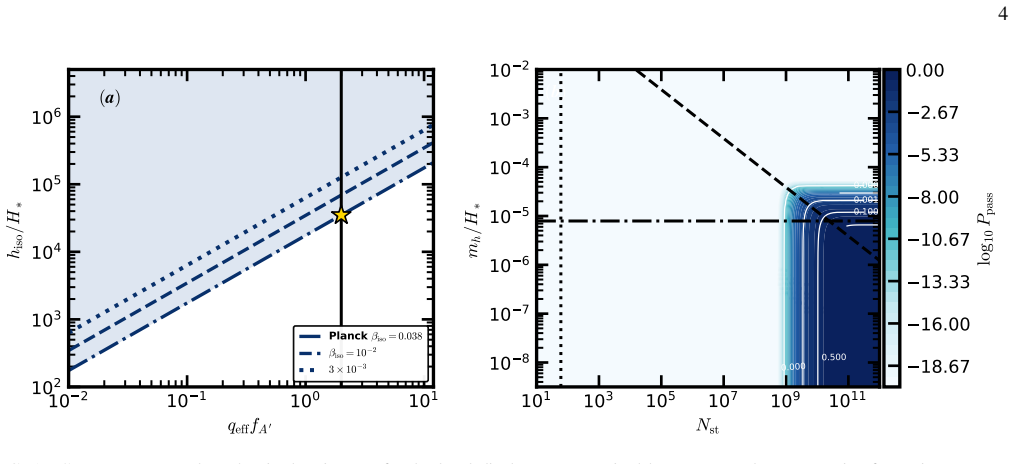
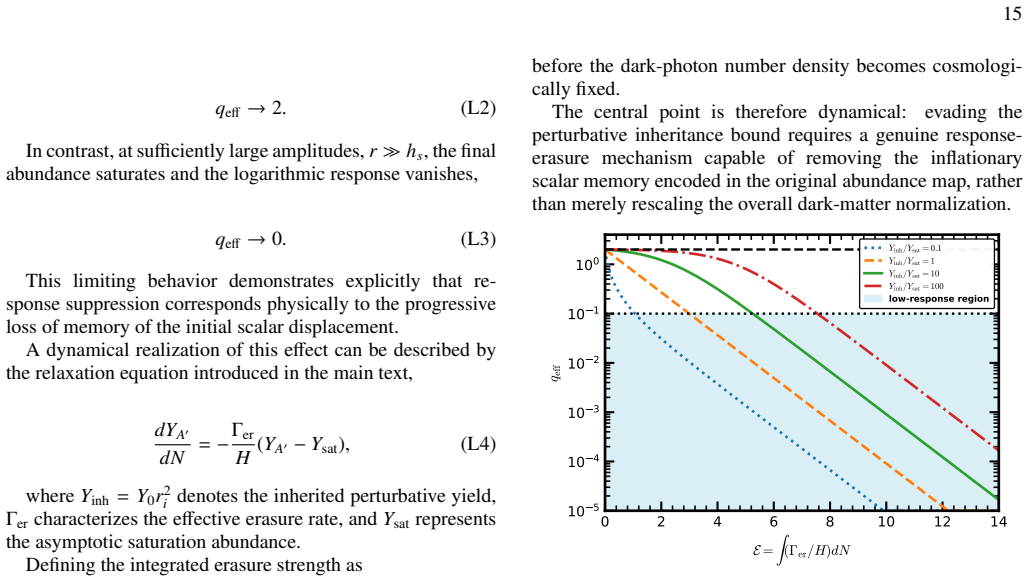
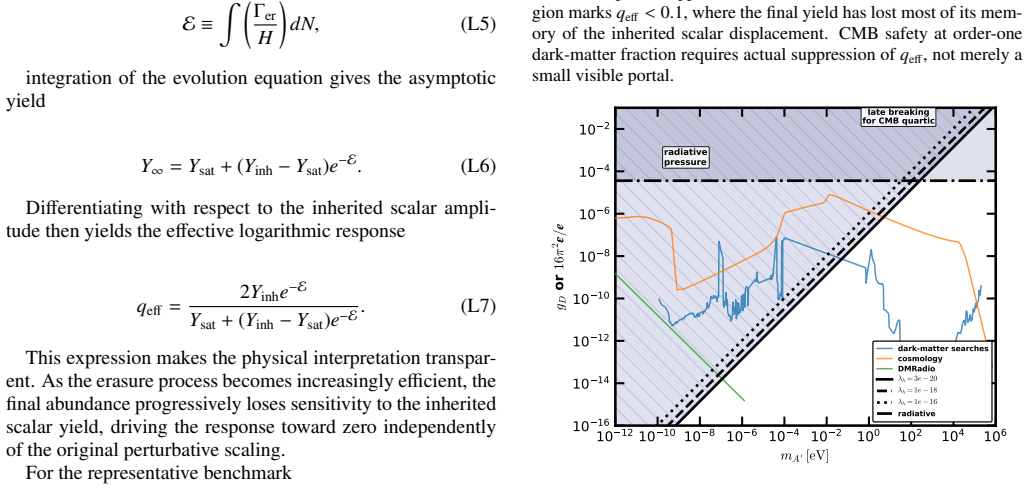
Two models sharing the same dark-photon mass, kinetic mixing, and present-day abundance can generate different CDM isocurvature signatures if their hidden-scalar evolution differs. The logarithmic response of the final abundance to the inflationary displacement obeys q_eff greater than or equal to 2 for every perturbative inheritance branch with conserved comoving yield. Therefore a perturbative branch that accounts for the full relic density through h to A-prime A-prime requires an initial coherent displacement exceeding 3.5 times 10 to the 4 times H star, an amplitude ordinary inflationary fluctuations cannot supply.
What carries the argument
The model-independent response formalism that defines the effective exponent q_eff as the logarithmic derivative of the final dark-photon yield with respect to the initial dark-Higgs displacement.
If this is right
- Any perturbative inheritance branch with conserved comoving yield necessarily satisfies q_eff at least 2.
- A perturbative channel producing the full dark-matter abundance through h to A-prime A-prime requires an initial coherent displacement exceeding 3.5 times 10 to the 4 times H star.
- Ordinary stochastic fluctuations over O(60) inflationary e-folds are exponentially unlikely to generate the required field amplitude.
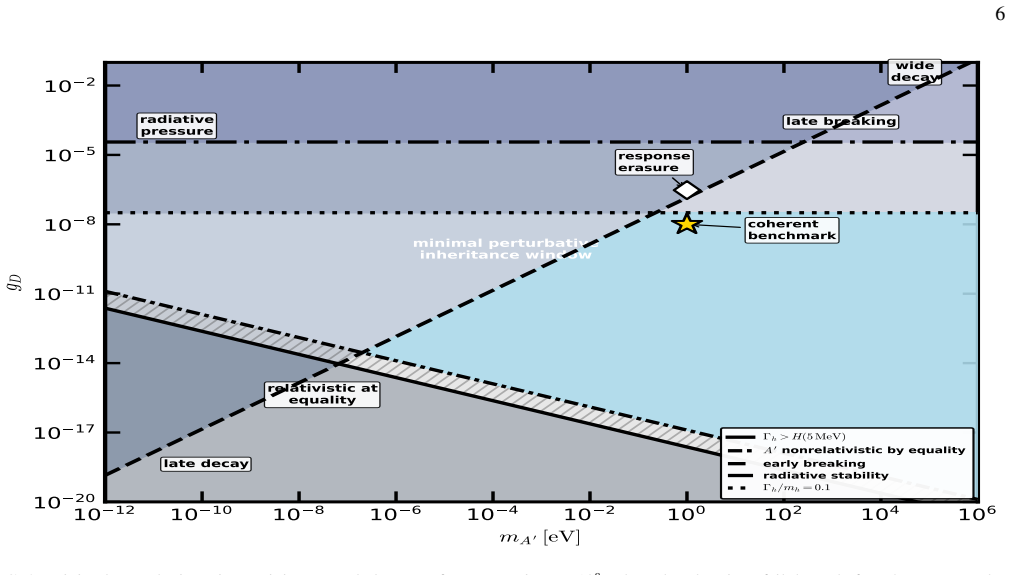
- Viable Higgsed dark-photon scenarios therefore require either subdominant abundance, coherent initial conditions, suppression of the inherited scalar response prior to freeze-out, or sufficiently cold momentum evolution of the produced vector population.
Where Pith is reading between the lines
- Model builders seeking a full Higgs-origin abundance for dark-photon dark matter may need to invoke non-perturbative production channels to remain consistent with CMB data.
- Future isocurvature searches could directly map the allowed parameter space of hidden-sector scalar displacements.
- The same response formalism could be applied to other scalar-decay channels that source vector or fermion dark matter.
Load-bearing premise
The production follows a perturbative inheritance branch in which the comoving yield is conserved and the model-independent response formalism applies without prior suppression of the inherited scalar response before freeze-out.
What would settle it
A future CMB measurement of the CDM isocurvature amplitude that implies q_eff less than 2 for a dark-photon candidate whose entire abundance is produced by perturbative Higgs decays.
Figures
read the original abstract
Existing laboratory, astrophysical, and direct-detection searches constrain the kinetic-mixing portal $\epsilon$ of dark-photon dark matter but do not determine the cosmological origin of the relic abundance. We show that cosmic microwave background (CMB) isocurvature provides an independent probe of Higgsed dark-photon production histories: two models with identical $(m_{\Ap},\epsilon)$ and identical present-day abundance can produce distinct cold-dark-matter (CDM) isocurvature signatures if their hidden-scalar evolution differs. The relevant observable is the logarithmic response of the final dark-photon abundance to the inflationary dark-Higgs displacement. We develop a model-independent response formalism and demonstrate that any perturbative inheritance branch with conserved comoving yield necessarily satisfies $\qeff\ge2$. Consequently, a perturbative branch accounting for the full dark-matter abundance through $h\to\Ap\Ap$ requires an initial coherent displacement exceeding $3.5\times10^4H_*$, while ordinary stochastic fluctuations over $\mathcal{O}(60)$ inflationary e-folds are exponentially unlikely to generate the required field amplitude. Viable Higgsed dark-photon scenarios therefore require either subdominant abundance, coherent initial conditions, suppression of the inherited scalar response prior to freeze-out, or sufficiently cold momentum evolution of the produced vector population.
Editorial analysis
A structured set of objections, weighed in public.
Referee Report
Summary. The manuscript claims that CMB isocurvature provides an independent probe of Higgsed dark-photon dark matter production histories. It develops a model-independent response formalism for the logarithmic response of the final dark-photon abundance to the inflationary dark-Higgs displacement, demonstrating that any perturbative inheritance branch with conserved comoving yield necessarily satisfies q_eff >=2. Consequently, a perturbative branch accounting for the full DM abundance via h -> A' A' requires an initial coherent displacement exceeding 3.5 x 10^4 H_*, which is exponentially unlikely from ordinary stochastic fluctuations over O(60) inflationary e-folds. Viable scenarios therefore require subdominant abundance, coherent initial conditions, suppression of the inherited scalar response prior to freeze-out, or sufficiently cold momentum evolution of the produced vector population.
Significance. If the central derivation holds, the result supplies a new cosmological test capable of distinguishing otherwise degenerate production mechanisms for dark-photon DM that share the same (m_A', epsilon) and present-day abundance. The model-independent character of the response formalism together with the explicit enumeration of four evasion conditions constitutes a clear, usable framework for assessing hidden-sector models.
major comments (1)
- [Abstract] Abstract: the claim that any perturbative inheritance branch with conserved comoving yield necessarily satisfies q_eff >=2 (and the associated numerical threshold 3.5e4 H_*) is load-bearing for the central conclusion, yet the abstract supplies only an outline without the explicit steps, equations, or intermediate relations of the response formalism. Independent verification of the bound is therefore not possible from the provided text.
minor comments (1)
- The abstract introduces q_eff and the response formalism without a concise inline definition; a one-sentence parenthetical gloss in the abstract (or an early equation in the main text) would improve readability.
Simulated Author's Rebuttal
We thank the referee for their careful reading of the manuscript and for identifying this point about the abstract. We respond to the major comment below.
read point-by-point responses
-
Referee: [Abstract] Abstract: the claim that any perturbative inheritance branch with conserved comoving yield necessarily satisfies q_eff >=2 (and the associated numerical threshold 3.5e4 H_*) is load-bearing for the central conclusion, yet the abstract supplies only an outline without the explicit steps, equations, or intermediate relations of the response formalism. Independent verification of the bound is therefore not possible from the provided text.
Authors: We agree that the abstract, as currently written, presents the central claim at a summary level without the intermediate relations or steps of the response formalism. The full model-independent derivation establishing q_eff >=2 for perturbative branches with conserved comoving yield, together with the numerical threshold, appears in Sections 3 and 4. To address the referee's concern, we will revise the abstract to include a concise statement of the key relation that enforces the bound, while remaining within typical length constraints. This change will be incorporated in the resubmitted version. revision: yes
Circularity Check
No significant circularity identified
full rationale
The paper's central result is a model-independent response formalism deriving that any perturbative inheritance branch with conserved comoving yield satisfies q_eff >=2, leading to the requirement of large initial coherent displacement for full abundance via h to A' A'. This bound is presented as following directly from production history and yield conservation rather than from any fitted parameter, self-citation chain, or ansatz smuggled in via prior work. The abstract enumerates explicit evasion conditions, confirming the derivation does not reduce to its own inputs by construction. No load-bearing step matches the enumerated circularity patterns.
Axiom & Free-Parameter Ledger
axioms (1)
- domain assumption Standard assumptions of single-field inflation and perturbative production in hidden sectors with conserved comoving yield.
Reference graph
Works this paper leans on
- [1]
-
[2]
A. E. Nelson and J. Scholtz, Phys. Rev. D84, 103501 (2011), arXiv:1105.2812 [hep-ph]
work page internal anchor Pith review Pith/arXiv arXiv 2011
-
[3]
P. Arias, D. Cadamuro, M. Goodsell, J. Jaeckel, J. Redondo, and A. Ringwald, JCAP06(06), 013, arXiv:1201.5902 [hep-ph]
work page internal anchor Pith review Pith/arXiv arXiv
-
[4]
P. W. Graham, J. Mardon, and S. Rajendran, Phys. Rev. D93, 103520 (2016), arXiv:1504.02102 [hep-ph]
work page internal anchor Pith review Pith/arXiv arXiv 2016
-
[5]
Holdom, Phys
B. Holdom, Phys. Lett. B166, 196 (1986)
1986
-
[6]
Probing Hidden Sector Photons through the Higgs Window
M. Ahlers, J. Jaeckel, J. Redondo, and A. Ringwald, Phys. Rev. D78, 075005 (2008), arXiv:0807.4143 [hep-ph]
work page internal anchor Pith review Pith/arXiv arXiv 2008
-
[7]
H. An, M. Pospelov, and J. Pradler, Phys. Lett. B725, 190 (2013), arXiv:1302.3884 [hep-ph]
work page internal anchor Pith review Pith/arXiv arXiv 2013
- [8]
- [9]
-
[10]
P. Agrawal, N. Kitajima, M. Reece, T. Sekiguchi, and F. Taka- hashi, Phys. Lett. B801, 135136 (2020), arXiv:1810.07188 [hep-ph]
-
[11]
R. T. Co, A. Pierce, Z. Zhang, and Y . Zhao, Phys. Rev. D99, 075002 (2019), arXiv:1810.07196 [hep-ph]
work page internal anchor Pith review Pith/arXiv arXiv 2019
-
[12]
J. A. Dror, K. Harigaya, and V . Narayan, Phys. Rev. D99, 035036 (2019), arXiv:1810.07195 [hep-ph]
work page internal anchor Pith review Pith/arXiv arXiv 2019
-
[13]
A. J. Long and L.-T. Wang, Phys. Rev. D99, 063529 (2019), arXiv:1901.03312 [hep-ph]
work page internal anchor Pith review Pith/arXiv arXiv 2019
-
[14]
Nakayama, JCAP10(10), 019, arXiv:1907.06243 [hep-ph]
K. Nakayama, JCAP10(10), 019, arXiv:1907.06243 [hep-ph]
-
[15]
N. Kitajima and K. Nakayama, JCAP07(07), 014, arXiv:2303.04287 [hep-ph]
-
[16]
N. Kitajima, S. Nakagawa, F. Takahashi, and W. Yin, Phys. Lett. B862, 139304 (2025), arXiv:2410.17964 [hep-ph]
-
[17]
Preskill, M
J. Preskill, M. B. Wise, and F. Wilczek, Phys. Lett. B120, 127 (1983)
1983
-
[18]
L. F. Abbott and P. Sikivie, Phys. Lett. B120, 133 (1983)
1983
-
[19]
Dine and W
M. Dine and W. Fischler, Phys. Lett. B120, 137 (1983)
1983
-
[20]
A. D. Linde, Phys. Lett. B158, 375 (1985)
1985
-
[21]
Seckel and M
D. Seckel and M. S. Turner, Phys. Rev. D32, 3178 (1985)
1985
-
[22]
D. H. Lyth, Phys. Lett. B236, 408 (1990)
1990
-
[23]
A. A. Starobinsky and J. Yokoyama, Phys. Rev. D50, 6357 (1994), arXiv:astro-ph/9407016
work page internal anchor Pith review Pith/arXiv arXiv 1994
-
[24]
R. J. Hardwick, V . Vennin, C. T. Byrnes, J. Torrado, and D. Wands, JCAP10(10), 018, arXiv:1701.06473 [astro- ph.CO]
work page internal anchor Pith review Pith/arXiv arXiv
-
[25]
T. Markkanen, A. Rajantie, and T. Tenkanen, Phys. Rev. D98, 123532 (2018), arXiv:1811.02586 [astro-ph.CO]
work page internal anchor Pith review Pith/arXiv arXiv 2018
- [26]
-
[27]
N. Bellomo, K. V . Berghaus, and K. K. Boddy, Phys. Rev. D 107, 083529 (2023), arXiv:2210.15691 [hep-ph]
- [28]
-
[29]
Controlled Penumbral Inflation from Monodromic Valleys
Pirzada and T. Li, arXiv e-prints , arXiv:2605.10197 (2026), arXiv:2605.10197 [hep-ph]
work page internal anchor Pith review Pith/arXiv arXiv 2026
-
[30]
Dilaton-Flattened Axion Inflation
Pirzada, A. Muhammad, T. Li, I. Khan, and M. Khan, arXiv e- prints , arXiv:2604.15194 (2026), arXiv:2604.15194 [hep-ph]
work page internal anchor Pith review Pith/arXiv arXiv 2026
- [31]
- [32]
-
[33]
Planck 2018 results. X. Constraints on inflation
Y . Akramiet al.(Planck), Astron. Astrophys.641, A10 (2020), arXiv:1807.06211 [astro-ph.CO]
work page internal anchor Pith review Pith/arXiv arXiv 2020
-
[34]
Planck 2018 results. VI. Cosmological parameters
N. Aghanimet al.(Planck), Astron. Astrophys.641, A6 (2020), arXiv:1807.06209 [astro-ph.CO]
work page internal anchor Pith review Pith/arXiv arXiv 2020
-
[35]
Dvorkinet al., arXiv e-prints , arXiv:2203.07064 (2022), arXiv:2203.07064 [hep-ph]
C. Dvorkinet al., arXiv e-prints , arXiv:2203.07064 (2022), arXiv:2203.07064 [hep-ph]
-
[36]
T. Montandon, G. Patanchon, and B. van Tent, JCAP01(01), 004, arXiv:2007.05457 [astro-ph.CO]. 9
-
[37]
J. Valiviita, Phys. Rev. D95, 123515 (2017), arXiv:1701.07039 [astro-ph.CO]
work page internal anchor Pith review Pith/arXiv arXiv 2017
-
[38]
Pirzada, Y . Gao, and Q. Yang, arXiv e-prints , arXiv:2602.06922 (2026), arXiv:2602.06922 [hep-ph]
-
[39]
Post-Inflationary Quenched Production of Axion SU(2) Dark Matter
I. Khan, Pirzada, and G. Mustafa, arXiv e-prints , arXiv:2604.07044 (2026), arXiv:2604.07044 [hep-ph]
work page internal anchor Pith review Pith/arXiv arXiv 2026
-
[40]
P. Bode, J. P. Ostriker, and N. Turok, Astrophys. J.556, 93 (2001), arXiv:astro-ph/0010389
work page internal anchor Pith review Pith/arXiv arXiv 2001
-
[41]
M. Viel, G. D. Becker, J. S. Bolton, and M. G. Haehnelt, Phys. Rev. D88, 043502 (2013), arXiv:1306.2314 [astro-ph.CO]
work page internal anchor Pith review Pith/arXiv arXiv 2013
-
[42]
V . Iršiˇc, M. Viel, M. G. Haehnelt, J. S. Bolton, S. Cristiani, G. D. Becker, V . D’Odorico, G. Cupani, T.-S. Kim, T. A. M. Berg,et al., Phys. Rev. D96, 023522 (2017), arXiv:1702.01764 [astro-ph.CO]
work page internal anchor Pith review Pith/arXiv arXiv 2017
-
[43]
B. Villasenor, B. Robertson, P. Madau, and E. Schneider, Phys. Rev. D108, 023502 (2023), arXiv:2209.14220 [astro-ph.CO]
-
[44]
P. W. Graham and A. Scherlis, Phys. Rev. D98, 035017 (2018), arXiv:1805.07362 [hep-ph]
work page internal anchor Pith review Pith/arXiv arXiv 2018
-
[45]
A. Chatrchyan and G. Servant, JCAP06(06), 036, arXiv:2211.15694 [hep-ph]
-
[46]
Bosonic super-WIMPs as keV-scale dark matter
M. Pospelov, A. Ritz, and M. B. V oloshin, Phys. Rev. D78, 115012 (2008), arXiv:0807.3279 [hep-ph]
work page internal anchor Pith review Pith/arXiv arXiv 2008
-
[47]
H. An, M. Pospelov, and J. Pradler, Phys. Rev. Lett.111, 041302 (2013), arXiv:1304.3461 [hep-ph]
work page internal anchor Pith review Pith/arXiv arXiv 2013
-
[48]
Direct Detection of Sub-GeV Dark Matter
R. Essig, J. Mardon, and T. V olansky, Phys. Rev. D85, 076007 (2012), arXiv:1108.5383 [hep-ph]
work page internal anchor Pith review Pith/arXiv arXiv 2012
-
[49]
Essiget al., arXiv e-prints , arXiv:2203.08297 (2022), arXiv:2203.08297 [hep-ph]
R. Essiget al., arXiv e-prints , arXiv:2203.08297 (2022), arXiv:2203.08297 [hep-ph]
-
[50]
S. D. McDermott, H. H. Patel, and H. Ramani, Phys. Rev. D97, 073005 (2018), arXiv:1705.00619 [hep-ph]
work page internal anchor Pith review Pith/arXiv arXiv 2018
-
[51]
L. J. Hall, K. Jedamzik, J. March-Russell, and S. M. West, JHEP03(03), 080, arXiv:0911.1120 [hep-ph]
work page internal anchor Pith review Pith/arXiv arXiv
-
[52]
G. Franciolini and D. Racco, Phys. Rev. D 10.1103/xjvh-tpjw (2026), arXiv:2603.02322 [hep-ph]. Appendix A: Scope and notation In this Supplemental Material, we present the derivations underlying the results discussed in the main text and sum- marize the assumptions entering the semi-analytic benchmark analysis. Throughout the paper, we denote byH ∗ the Hu...
discussion (0)
Sign in with ORCID, Apple, or X to comment. Anyone can read and Pith papers without signing in.