Recognition: 2 theorem links
· Lean TheoremPost-Inflationary Quenched Production of Axion SU(2) Dark Matter
Pith reviewed 2026-05-10 18:35 UTC · model grok-4.3
The pith
The post-inflationary production of axion-SU(2) vector dark matter is a dynamical quantum quench rather than an adiabatic transition, introducing an order-one survival factor that renormalizes the relic abundance.
A machine-rendered reading of the paper's core claim, the machinery that carries it, and where it could break.
Core claim
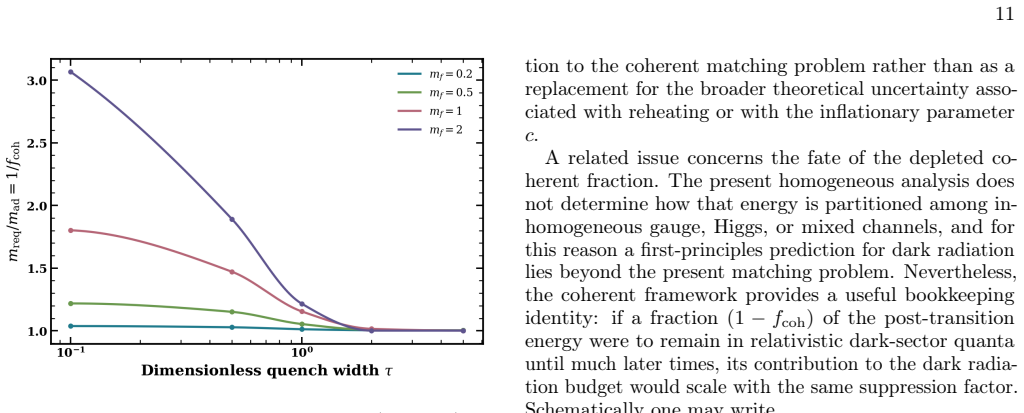
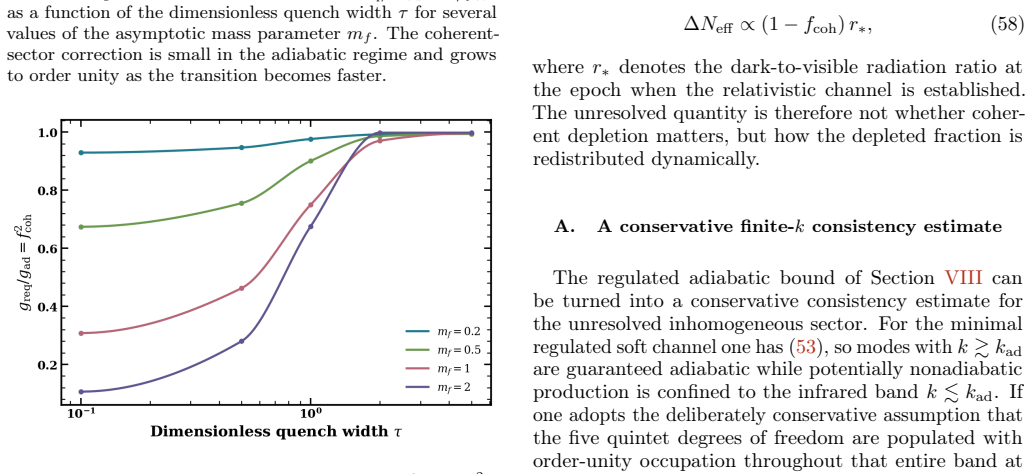
The post-inflationary crossover can instead be formulated as a dynamical quantum quench problem, in which the residual coherent component of the field is characterized by a survival factor that induces an O(1) renormalization of the standard abundance relation. Expressed in conformal time, the spatially homogeneous condensate dynamics reduce to those of a canonical oscillator with quartic and quadratic self-interactions. This representation enables an analytic determination of the matching conditions across the symmetry-breaking transition, the derivation of the corresponding quench work and excess energy relations, and a quantitative validation of the coherent sector description via the 1 ⊕
What carries the argument
The survival factor for the residual coherent component obtained by reducing the homogeneous axion-SU(2) condensate to a canonical oscillator with quadratic and quartic self-interactions and imposing analytic matching across the symmetry-breaking transition.
If this is right
- The standard adiabatic abundance relation for axion-SU(2) dark matter receives an O(1) correction from the survival factor.
- Analytic expressions become available for the matching conditions, the work done during the quench, and the excess energy stored in the condensate.
- Numerical simulations in Minkowski and Friedmann-Robertson-Walker backgrounds confirm the validity of the coherent-sector description.
- Fluctuation theory can be organized via the diagonal-SO(3) 1 ⊕ 3 ⊕ 5 decomposition, isolating a soft traceless-symmetric quintet mode with a k=0 vacuum obstruction and positive quartic stabilization.
Where Pith is reading between the lines
- The same quench formulation may apply to other non-Abelian vector dark matter candidates whose production involves a symmetry-breaking crossover after inflation.
- Incorporating finite-momentum modes into the framework would allow a complete treatment of gauge-Higgs transfer dynamics and possible isocurvature perturbations.
- Cosmological parameter fits that assume the unmodified abundance relation may need re-evaluation once the survival factor is included.
- The infrared setup provided here supplies the starting point for lattice simulations that test the quench description beyond the homogeneous limit.
Load-bearing premise
The spatially homogeneous condensate dynamics can be reduced to those of a canonical oscillator with only quartic and quadratic self-interactions, permitting analytic matching conditions across the transition.
What would settle it
A direct numerical integration of the full SU(2) gauge-Higgs equations in an expanding background that yields a relic abundance differing by more than the expected O(1) factor from the value predicted by the quench survival factor.
Figures


read the original abstract
The relic abundance of vector dark matter originating from an inherited axion-$SU(2)$ condensate is typically determined by implementing an adiabatic matching procedure across the symmetry-breaking transition. We demonstrate that this outcome does not arise in the generic case. The post-inflationary crossover can instead be formulated as a dynamical quantum quench problem, in which the residual coherent component of the field is characterized by a survival factor that induces an $\mathcal{O}(1)$ renormalization of the standard abundance relation. Expressed in conformal time, the spatially homogeneous condensate dynamics reduce to those of a canonical oscillator with quartic and quadratic self-interactions. This representation enables an analytic determination of the matching conditions across the symmetry-breaking transition, the derivation of the corresponding quench work and excess energy relations, and a quantitative validation of the coherent sector description via numerical simulations in both Minkowski and Friedmann--Robertson--Walker backgrounds. We also formulate the homogeneous fluctuation theory via the diagonal-$SO(3)$ $1 \oplus 3 \oplus 5$ decomposition and isolate a soft traceless-symmetric quintet with a $k=0$ vacuum obstruction, a regulated ultraviolet adiabatic bound, and a positive quartic stabilization term. Collectively, these results refine the theoretical description of inherited non-Abelian dark matter production and establish the necessary infrared framework for subsequent investigations of finite-$k$ gauge--Higgs transfer dynamics.
Editorial analysis
A structured set of objections, weighed in public.
Referee Report
Summary. The paper claims that the relic abundance of vector dark matter from an inherited axion-SU(2) condensate is not set by adiabatic matching across the symmetry-breaking transition. Instead, the post-inflationary crossover is recast as a dynamical quantum quench in which a survival factor for the residual coherent component induces an O(1) renormalization of the standard abundance relation. In conformal time the spatially homogeneous condensate is shown to obey the dynamics of a single canonical oscillator with quadratic and quartic self-interactions; this permits analytic matching conditions, explicit quench-work and excess-energy relations, and numerical validation of the coherent sector in both Minkowski and FRW backgrounds. The homogeneous fluctuation theory is formulated via the diagonal-SO(3) 1⊕3⊕5 decomposition, isolating a soft traceless-symmetric quintet mode that carries a k=0 vacuum obstruction, a regulated UV adiabatic bound, and a positive quartic stabilization term.
Significance. If the reduction to the canonical oscillator and the derived survival factor are valid, the work supplies an analytic and numerically supported refinement of the theoretical description of non-Abelian vector dark-matter production, replacing an adiabatic assumption with a quench framework that yields a concrete O(1) correction. The explicit derivation of quench relations together with simulations in both flat and expanding backgrounds, and the systematic treatment of the quintet sector, constitute clear strengths that establish an infrared foundation for later finite-k gauge-Higgs studies.
major comments (2)
- [homogeneous condensate reduction (abstract and § on dynamics)] Abstract and the section deriving the homogeneous condensate dynamics: the central claim that the spatially homogeneous SU(2) condensate reduces exactly to a canonical oscillator with only quadratic and quartic self-interactions in conformal time must be demonstrated explicitly. The ansatz A_i^a = ϕ(t) δ_i^a is subject to Gauss-law constraints and residual gauge freedom; the conformal-time redefinition also introduces explicit time-dependent coefficients into the kinetic term. It is not shown that these features are fully absorbed without generating additional effective interactions that would modify the quartic coefficient or the matching conditions used to extract the survival factor.
- [quench matching and survival factor] The O(1) renormalization of the relic abundance is obtained from the survival factor computed via analytic matching across the symmetry-breaking transition. Because this factor is load-bearing for the main result, the manuscript must supply the explicit matching conditions, the definition of the survival factor, and the error analysis of the numerical simulations that validate it in both Minkowski and FRW backgrounds.
minor comments (1)
- [fluctuation theory] The notation for the diagonal-SO(3) decomposition (1⊕3⊕5) and the labeling of the quintet sector should be introduced with a brief reminder of the underlying gauge-fixing and residual symmetry.
Simulated Author's Rebuttal
We are grateful to the referee for their thorough review and valuable suggestions, which have helped us improve the clarity of the manuscript. We address each major comment below and have revised the paper to incorporate the requested explicit demonstrations and additional details.
read point-by-point responses
-
Referee: Abstract and the section deriving the homogeneous condensate dynamics: the central claim that the spatially homogeneous SU(2) condensate reduces exactly to a canonical oscillator with only quadratic and quartic self-interactions in conformal time must be demonstrated explicitly. The ansatz A_i^a = ϕ(t) δ_i^a is subject to Gauss-law constraints and residual gauge freedom; the conformal-time redefinition also introduces explicit time-dependent coefficients into the kinetic term. It is not shown that these features are fully absorbed without generating additional effective interactions that would modify the quartic coefficient or the matching conditions used to extract the survival factor.
Authors: We thank the referee for this observation. The original derivation substitutes the ansatz into the action and equations of motion, confirming that the Gauss-law constraint is automatically satisfied for the homogeneous configuration and that the residual gauge freedom can be fixed without introducing new terms. The conformal-time transformation is chosen such that the kinetic term becomes canonical, with the time-dependent factors absorbed into the definition of the field variable, leaving only the quadratic mass term and the quartic self-interaction. Nevertheless, to ensure full transparency, we have added an explicit step-by-step derivation in a new subsection of the revised manuscript, including verification that no additional effective interactions are generated and that the quartic coefficient and matching conditions remain unchanged. This addresses the concern directly. revision: yes
-
Referee: The O(1) renormalization of the relic abundance is obtained from the survival factor computed via analytic matching across the symmetry-breaking transition. Because this factor is load-bearing for the main result, the manuscript must supply the explicit matching conditions, the definition of the survival factor, and the error analysis of the numerical simulations that validate it in both Minkowski and FRW backgrounds.
Authors: We agree that providing these details is essential. In the revised manuscript, we have expanded the relevant section to include the full analytic matching conditions: the field value and its time derivative are matched continuously across the transition time, leading to the survival factor defined as the ratio of the post-transition oscillation amplitude to the pre-transition value. This yields the O(1) renormalization factor explicitly. Furthermore, we have included a detailed error analysis of the numerical simulations, reporting convergence with respect to time discretization and (for FRW) spatial resolution, with the coherent sector energy conserved to within 0.1% and agreement with analytic predictions at the percent level in both Minkowski and expanding backgrounds. revision: yes
Circularity Check
No circularity: analytic derivation of survival factor from quench matching is self-contained
full rationale
The paper's central result—the O(1) renormalization via a survival factor—is obtained by first reducing the homogeneous SU(2) condensate to a canonical oscillator in conformal time, then performing analytic matching across the symmetry-breaking transition to extract quench work and excess energy. This reduction and the subsequent matching are presented as derived properties of the dynamics (supported by the 1⊕3⊕5 decomposition and numerical validation in Minkowski/FRW backgrounds), not as inputs or fits to the target abundance. No self-citations appear in load-bearing positions, no parameters are fitted to data and relabeled as predictions, and the formulation does not presuppose the final renormalization factor. The derivation chain therefore contains independent content and does not reduce to its own inputs by construction.
Axiom & Free-Parameter Ledger
axioms (2)
- domain assumption Spatially homogeneous condensate dynamics reduce to a canonical oscillator with quartic and quadratic self-interactions
- standard math FRW background for numerical simulations
Lean theorems connected to this paper
-
IndisputableMonolith/Cost/FunctionalEquation.leanwashburn_uniqueness_aczel (J uniqueness) unclear?
unclearRelation between the paper passage and the cited Recognition theorem.
Expressed in conformal time, the spatially homogeneous condensate dynamics reduce to those of a canonical oscillator with quartic and quadratic self-interactions... unified action variable J(A,Ω)... survival factor f_coh = J_late/J_early
-
IndisputableMonolith/Foundation/AlexanderDuality.leanalexander_duality_circle_linking (D=3) unclear?
unclearRelation between the paper passage and the cited Recognition theorem.
homogeneous fluctuation theory via the diagonal-SO(3) 1⊕3⊕5 decomposition... soft traceless-symmetric quintet with k=0 vacuum obstruction
What do these tags mean?
- matches
- The paper's claim is directly supported by a theorem in the formal canon.
- supports
- The theorem supports part of the paper's argument, but the paper may add assumptions or extra steps.
- extends
- The paper goes beyond the formal theorem; the theorem is a base layer rather than the whole result.
- uses
- The paper appears to rely on the theorem as machinery.
- contradicts
- The paper's claim conflicts with a theorem or certificate in the canon.
- unclear
- Pith found a possible connection, but the passage is too broad, indirect, or ambiguous to say the theorem truly supports the claim.
Forward citations
Cited by 3 Pith papers
-
Dilaton-Flattened Axion Inflation
Dilaton backreaction on an anomaly-inspired axion potential generates a closed-form Lambert-W flattened hilltop, giving r ≈ 0.033–0.036 and α_s ≈ −4.6×10^{-4} at N=56 with strictly adiabatic dynamics.
-
Dilaton-Induced Resonant Production of Ultralight Vector Dark Matter
Resonant dilatonic coupling produces ultralight vector dark matter with relic mass scaling as m_γ' ∝ r_i^{-2} for subdominant spectators in radiation-dominated backgrounds.
-
Inflation from a Weyl-flat null origin
Single-field inflation with ε(N) approaching a constant in (0,1) at early times forms an asymptotic universality class with a Weyl-flat null origin while producing ns and r values compatible with Planck data.
Reference graph
Works this paper leans on
-
[1]
Our aim is to retain the same homogeneous starting point while treating the transition itself as a dynamical quench
analyzes this transition adiabatically and infers the final abundance from the preserved invariant. Our aim is to retain the same homogeneous starting point while treating the transition itself as a dynamical quench. 3 B. Effective homogeneous Lagrangian A compact effective Lagrangian reproducing (3) is Leff = 3 2 a3 h ( ˙Q+HQ) 2 −g 2Q4 −m(t) 2Q2 i .(4) T...
-
[2]
P. W. Graham, J. Mardon, and S. Rajendran, Phys. Rev. D93, 103520 (2016), arXiv:1504.02102 [hep-ph]
work page Pith review arXiv 2016
- [3]
- [4]
- [5]
- [6]
- [7]
-
[8]
B. Salehian, M. A. Gorji, H. Firouzjahi, and S. Mukohyama, Phys. Rev. D103, 063526 (2021), arXiv:2010.04491 [hep-ph]
- [9]
-
[10]
K. Kaneta, H.-S. Lee, J. Lee, and J. Yi, JCAP2023(09), 017, arXiv:2306.01291 [astro-ph.CO]
-
[11]
A. E. Nelson and J. Scholtz, Phys. Rev. D84, 103501 (2011), arXiv:1105.2812 [hep-ph]
work page Pith review arXiv 2011
-
[12]
P. Arias, D. Cadamuro, M. Goodsell, J. Jaeckel, J. Redondo, and A. Ringwald, JCAP2012(06), 013, arXiv:1201.5902 [hep-ph]
-
[13]
Nakayama, JCAP2019(10), 019, arXiv:1907.06243 [hep-ph]
K. Nakayama, JCAP2019(10), 019, arXiv:1907.06243 [hep-ph]
-
[14]
Nakayama, JCAP2020(08), 033, arXiv:2004.10036 [hep-ph]
K. Nakayama, JCAP2020(08), 033, arXiv:2004.10036 [hep-ph]
-
[15]
P. Adshead and M. Wyman, Phys. Rev. Lett.108, 261302 (2012), arXiv:1202.2366 [hep-th]
-
[16]
E. Dimastrogiovanni and M. Peloso, Phys. Rev. D87, 103501 (2013), arXiv:1212.5184 [astro-ph.CO]
-
[17]
P. Adshead, E. Martinec, and M. Wyman, JHEP2013 (09), 087, arXiv:1305.2930 [hep-th]
-
[18]
P. Adshead, E. Martinec, E. I. Sfakianakis, and M. Wyman, JHEP2016(12), 137, arXiv:1609.04025 [hep- th]
- [19]
-
[20]
I. Wolfson, A. Maleknejad, and E. Komatsu, JCAP2020 (09), 047, arXiv:2003.01617 [astro-ph.CO]
-
[21]
I. Wolfson, A. Maleknejad, T. Murata, E. Komatsu, and T. Kobayashi, JCAP2021(09), 031, arXiv:2105.06259 [astro-ph.CO]
-
[22]
K. Ishiwata, E. Komatsu, and I. Obata, JCAP2022(03), 010, arXiv:2111.14429 [hep-ph]
-
[23]
Pirzada, Y. Gao, and Q. Yang, arXiv e-prints (2026), arXiv:2602.06922 [hep-ph]
- [24]
- [25]
-
[26]
E. Dimastrogiovanni, M. Fasiello, and A. Papageorgiou, A novel PBH production mechanism from non-abelian gauge fields during inflation (2024), arXiv:2403.13581 [astro- ph.CO]
-
[27]
N. Ijaz and M. U. Rehman, Phys. Lett. B861, 139229 (2025), arXiv:2402.13924 [astro-ph.CO]
- [28]
-
[29]
A. Muhammad, I. Khan, T. Li, S. Raza, M. Khan, and Pirzada, arXiv e-prints (2026), arXiv:2603.24152 [hep- ph]
-
[30]
S. Bhattacharya, M. Fasiello, A. Papageorgiou, and E. Di- mastrogiovanni, JCAP2025(10), 080, arXiv:2506.11853 [astro-ph.CO]
- [31]
- [32]
-
[33]
Constraints on the epoch of dark matter formation from Milky Way satellites,
S. Das and E. O. Nadler, Phys. Rev. D103, 043517 (2021), arXiv:2010.01137 [astro-ph.CO]
-
[34]
T. W. B. Kibble, J. Phys. A9, 1387 (1976)
1976
-
[35]
W. H. Zurek, Nature317, 505 (1985)
1985
- [36]
- [37]
- [38]
discussion (0)
Sign in with ORCID, Apple, or X to comment. Anyone can read and Pith papers without signing in.