Matter-Wave Interferometers as Open-System Dark Matter Detectors
Pith reviewed 2026-06-28 21:32 UTC · model grok-4.3
The pith
Matter-wave interferometers detect dark matter through phase shifts and decoherence between separated wavepackets even without measurable energy loss.
A machine-rendered reading of the paper's core claim, the machinery that carries it, and where it could break.
Core claim
Dark matter scattering off matter-wave interferometers produces phase and decoherence signals formulated in an open effective field theory using the Schwinger-Keldysh formalism; for elastic spin-independent scattering the decoherence channel acquires Bose enhancement or Pauli blocking factors while the phase shift remains at most linear in the dark matter occupation number, and retaining the dark matter coherence time allows the framework to span Markovian and non-Markovian dynamics over a broad mass range with systematic corrections beyond the heavy-probe limit.
What carries the argument
Open effective field theory for dark matter-matter-wave interferometer interactions formulated via the Schwinger-Keldysh formalism, which treats the dark matter as an environment inducing phase and decoherence.
If this is right
- Decoherence rates acquire novel Bose enhancement or Pauli blocking factors from the dark matter distribution.
- Phase shifts remain at most linear in the dark matter occupation number.
- The description applies to both Markovian and non-Markovian regimes across a wide range of dark matter masses.
- Corrections beyond the heavy-probe limit are systematically organized within the same framework.
Where Pith is reading between the lines
- This channel could reach dark matter masses or couplings where conventional detectors see no signal because energy transfer is too small.
- The asymmetry between phase and decoherence channels may allow separation of dark matter signals from other environmental noise sources.
- Similar open-system modeling could extend to other spatially extended quantum sensors for hidden-sector particles.
Load-bearing premise
The Schwinger-Keldysh open effective field theory accurately captures the elastic spin-independent dark matter interactions with the interferometer without missing effects.
What would settle it
A precision measurement of phase shift or decoherence rate in a controlled matter-wave interferometer that deviates from the predicted linear dependence on dark matter occupation number or from the presence of Bose/Pauli factors at the expected level.
Figures
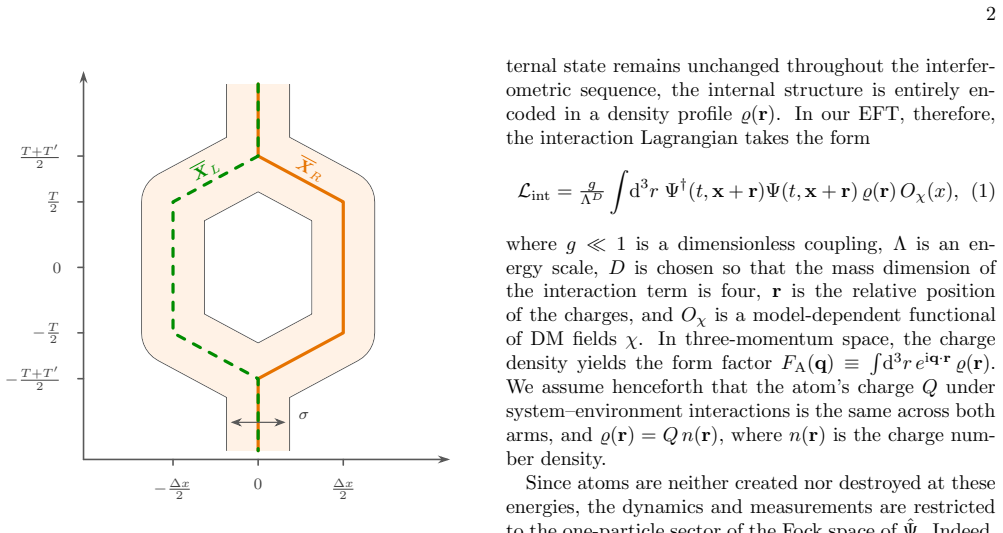
read the original abstract
Matter-wave interferometers (MWIs) offer a uniquely quantum route to dark matter (DM) detection: DM can reveal itself through phase and decoherence between spatially separated wavepackets, even when negligible energy deposition or resolvable recoil occurs. We formulate these effects in an open effective field theory for MWIs using the Schwinger-Keldysh formalism, which highlights a structural asymmetry between the two detection channels. For elastic spin-independent DM scattering, decoherence inherits novel Bose enhancement or Pauli blocking factors, while the phase is at most linear in the DM occupation number. By retaining the DM's coherence time, this framework spans Markovian and non-Markovian dynamics across a wide range of DM masses, and systematically organizes corrections beyond the heavy-probe limit.
Editorial analysis
A structured set of objections, weighed in public.
Referee Report
Summary. The paper claims that matter-wave interferometers (MWIs) provide a quantum detection channel for dark matter (DM) via phase shifts and decoherence between spatially separated wavepackets, even without measurable energy deposition or recoil. Using the Schwinger-Keldysh formalism, it constructs an open effective field theory for elastic spin-independent DM scattering that exhibits a structural asymmetry: decoherence rates acquire Bose enhancement or Pauli blocking factors while the phase shift remains at most linear in DM occupation number. Retaining the DM coherence time allows the framework to interpolate between Markovian and non-Markovian regimes over a wide mass range and to organize corrections beyond the heavy-probe limit.
Significance. If the derivations hold, the work supplies a parameter-free structural prediction (Bose/Pauli factors appear only in decoherence) that distinguishes the two channels and could be tested with existing or near-term interferometers. The Schwinger-Keldysh treatment of the open system is a clear strength, systematically incorporating quantum statistics and non-Markovian effects without ad-hoc assumptions. This organizes a new class of DM signatures that are inaccessible to classical detectors and extends the reach of precision interferometry into the low-mass DM regime.
minor comments (2)
- [Abstract] Abstract: the phrase 'systematically organizes corrections beyond the heavy-probe limit' would be clearer if the manuscript explicitly identifies which higher-order terms in the probe mass are retained versus discarded.
- The manuscript would benefit from a short table or paragraph contrasting the Markovian and non-Markovian limits for a representative DM mass to illustrate the retained coherence-time dependence.
Simulated Author's Rebuttal
We thank the referee for their positive assessment of the manuscript and for recommending acceptance. The referee's summary correctly identifies the central results: the open-system formulation via Schwinger-Keldysh, the structural asymmetry between phase-shift and decoherence channels, and the incorporation of Bose/Pauli factors together with non-Markovian effects.
Circularity Check
No significant circularity detected
full rationale
The derivation formulates an open EFT for MWIs via the standard Schwinger-Keldysh contour and derives the phase/decoherence asymmetry directly from the interaction Hamiltonian for elastic spin-independent scattering, retaining DM coherence time as an explicit parameter to cover Markovian/non-Markovian regimes. No fitted inputs are relabeled as predictions, no self-citation chain carries the central structural claim, and the asymmetry (Bose/Pauli factors in decoherence vs. at most linear phase) follows from the formalism without reduction to the paper's own inputs by construction. The result is self-contained against external benchmarks.
Axiom & Free-Parameter Ledger
Reference graph
Works this paper leans on
-
[1]
A. Arvanitaki, P. W. Graham, J. M. Hogan, S. Rajen- dran, and K. Van Tilburg, Phys. Rev. D97, 075020 (2018), arXiv:1606.04541 [hep-ph]
Pith/arXiv arXiv 2018
-
[2]
L. Badurina, D. Blas, and C. McCabe, Phys. Rev. D105, 023006 (2022), arXiv:2109.10965 [astro-ph.CO]
arXiv 2022
-
[3]
L. Badurina, A. Beniwal, and C. McCabe, Phys. Rev. D 108, 083016 (2023), arXiv:2306.16477 [hep-ph]
arXiv 2023
-
[4]
Badurinaet al., JCAP05, 011, arXiv:1911.11755 [astro-ph.CO]
L. Badurinaet al., JCAP05, 011, arXiv:1911.11755 [astro-ph.CO]
arXiv 1911
-
[5]
A. Banerjee, G. Perez, M. Safronova, I. Savoray, and A. Shalit, JHEP10, 042, arXiv:2211.05174 [hep-ph]
-
[6]
D. Blas, J. Carlton, and C. McCabe, Phys. Rev. D111, 115020 (2025), arXiv:2412.14282 [hep-ph]
arXiv 2025
- [7]
-
[8]
P. W. Graham, D. E. Kaplan, J. Mardon, S. Rajendran, W. A. Terrano, L. Trahms, and T. Wilkason, Phys. Rev. D97, 055006 (2018), arXiv:1709.07852 [hep-ph]
Pith/arXiv arXiv 2018
-
[9]
P. W. Graham, D. E. Kaplan, J. Mardon, S. Rajendran, and W. A. Terrano, Phys. Rev. D93, 075029 (2016), arXiv:1512.06165 [hep-ph]
Pith/arXiv arXiv 2016
-
[10]
Abeet al.(MAGIS-100), Quantum Sci
M. Abeet al.(MAGIS-100), Quantum Sci. Technol.6, 044003 (2021), arXiv:2104.02835 [physics.atom-ph]
arXiv 2021
-
[11]
Y. Zhou, R. Ranson, M. Panagiotou, and C. Overstreet, Phys. Rev. A110, 033313 (2024), arXiv:2406.00716 [physics.atom-ph]
arXiv 2024
-
[12]
C. J. Riedel, Phys. Rev. D88, 116005 (2013), arXiv:1212.3061 [quant-ph]
Pith/arXiv arXiv 2013
-
[13]
C. J. Riedel and I. Yavin, Phys. Rev. D96, 023007 (2017), arXiv:1609.04145 [quant-ph]
Pith/arXiv arXiv 2017
-
[14]
Y. Du, C. Murgui, K. Pardo, Y. Wang, and K. M. Zurek, Phys. Rev. D106, 095041 (2022), arXiv:2205.13546 [hep- ph]
arXiv 2022
-
[15]
L. Badurina, C. Murgui, and R. Plestid, Phys. Rev. A 110, 033311 (2024), arXiv:2402.03421 [quant-ph]
arXiv 2024
-
[16]
L. Badurina, Y. Du, V. S. H. Lee, Y. Wang, and K. M. Zurek, Phys. Rev. D112, 063014 (2025), arXiv:2505.00781 [hep-ph]
arXiv 2025
-
[17]
L. Badurina, D. Blas, J. Ellis, and S. A. R. Ellis, Phys. Rev. D113, 092004 (2026), arXiv:2507.17825 [hep-ph]
Pith/arXiv arXiv 2026
-
[18]
M. R. Gallis and G. N. Fleming, Phys. Rev. A42, 38 (1990)
1990
-
[19]
K. Hornberger and J. E. Sipe, Phys. Rev. A68, 012105 (2003), arXiv:quant-ph/0303094
Pith/arXiv arXiv 2003
-
[20]
Breuer and F
H.-P. Breuer and F. Petruccione,The Theory of Open Quantum Systems(Oxford University Press, 2007)
2007
-
[21]
L. V. Keldysh, Sov. Phys. JETP20, 1018 (1965)
1965
-
[22]
J. S. Schwinger, J. Math. Phys.2, 407 (1961)
1961
-
[23]
Haehl and M
F. Haehl and M. Rangamani, Schwinger–keldysh formal- ism, inRecords from the S-Matrix Marathon: Selected Topics on Scattering Amplitudes, edited by N. Arkani- Hamed, M. Giroux, H. S. Hannesdottir, S. Mizera, and C. Pasiecznik (Springer Nature Switzerland, Cham,
-
[24]
M. P. Blencowe, Phys. Rev. Lett.111, 021302 (2013), arXiv:1211.4751 [quant-ph]
Pith/arXiv arXiv 2013
- [25]
- [26]
-
[27]
K. M. Zurek, Phys. Lett. B826, 136910 (2022), arXiv:2012.05870 [hep-th]
arXiv 2022
-
[28]
J. Wilson-Gerow, A. Dugad, and Y. Chen, Phys. Rev. D 110, 045002 (2024), arXiv:2405.00804 [hep-th]
arXiv 2024
-
[29]
C. DeLisle and P. C. E. Stamp, Phys. Rev. A110, 022223 (2024), arXiv:2211.05813 [quant-ph]
arXiv 2024
-
[30]
C. Burrage, C. K¨ ading, P. Millington, and J. Min´ aˇ r, Phys. Rev. D100, 076003 (2019), arXiv:1812.08760 [hep- th]
arXiv 2019
-
[31]
B. L. Hu, J. P. Paz, and Y.-h. Zhang, Phys. Rev. D45, 2843 (1992)
1992
-
[32]
B. L. Hu, J. P. Paz, and Y. Zhang, Phys. Rev. D47, 1576 (1993)
1993
-
[33]
By atom here we mean either a composite/macroscopic object, such as a gold nanosphere, or a single fundamen- tal atom
-
[34]
Badurina and K
L. Badurina and K. M. Zurek, (in preparation)
-
[35]
Weiss,Quantum Dissipative Systems(World Scien- tific, 2021)
U. Weiss,Quantum Dissipative Systems(World Scien- tific, 2021)
2021
-
[36]
O. Corradini, C. Schubert, J. P. Edwards, and N. Ahma- diniaz (2015) arXiv:1512.08694 [hep-th]
arXiv 2015
-
[37]
J. Glick and T. Kovachy, AVS Quantum Sci.8, 024402 (2026), arXiv:2407.11446 [physics.atom-ph]
Pith/arXiv arXiv 2026
-
[38]
R. P. Feynman and F. L. Vernon, Jr., Annals Phys.24, 118 (1963)
1963
-
[39]
Note that the influence action manifestly satisfies the non–equilibrium constraintS IF[X+,X −] = 0 forX + = X −, which reflects trace preservation [?]
-
[40]
A. K. Drukier, K. Freese, and D. N. Spergel, Phys. Rev. D33, 3495 (1986)
1986
-
[41]
D. Y. Cheong, N. L. Rodd, and L.-T. Wang, Phys. Rev. D111, 015028 (2025), arXiv:2408.04696 [hep-ph]
arXiv 2025
-
[42]
E. A. Calzetta and B.-L. B. Hu,Nonequilibrium Quantum Field Theory(Oxford University Press, 2009)
2009
-
[43]
M. Schlosshauer, Phys. Rept.831, 1 (2019), arXiv:1911.06282 [quant-ph]
arXiv 2019
-
[44]
S. Knapen, T. Lin, and K. M. Zurek, Phys. Rev. D96, 115021 (2017), arXiv:1709.07882 [hep-ph]
Pith/arXiv arXiv 2017
-
[45]
Chou, Z.-b
K.-c. Chou, Z.-b. Su, B.-l. Hao, and L. Yu, Phys. Rept. 118, 1 (1985)
1985
-
[46]
Breuer and F
H.-P. Breuer and F. Petruccione, Phys. Rev. A63, 032102 (2001)
2001
-
[47]
A. A. Geraci and A. Derevianko, Phys. Rev. Lett.117, 261301 (2016), arXiv:1605.04048 [physics.atom-ph]
Pith/arXiv arXiv 2016
- [48]
-
[49]
L. Badurina, V. Gibson, C. McCabe, and J. Mitchell, Phys. Rev. D107, 055002 (2023), arXiv:2211.01854 [hep- ph]
arXiv 2023
-
[50]
Kasevich and S
M. Kasevich and S. Chu, Phys. Rev. Lett.67, 181 (1991)
1991
-
[51]
Kamenev,Field Theory of Non-Equilibrium Systems 7 (Cambridge University Press, 2011)
A. Kamenev,Field Theory of Non-Equilibrium Systems 7 (Cambridge University Press, 2011). 8 Matter–Wave Interferometers as Open–System Dark–Matter Detectors Supplemental Material Leonardo Badurina and Kathryn M. Zurek This Supplemental Material collects the technical results that underlie the main text. We use the conventions xµxµ =t 2 − |x|2 R ¯ dnp= R dn...
2011
discussion (0)
Sign in with ORCID, Apple, or X to comment. Anyone can read and Pith papers without signing in.