REVIEW 3 major objections 6 minor 2 cited by
Quantum thermalization of Quark-Gluon Plasma
T0 review · 3 major / 6 minor · reviewed 2026-08-12 · deepseek-v4-flash
Pith's one-line read A lattice simulation of the Schwinger model shows that strong coupling makes all four components of the quark Wigner function thermalize, while weak coupling leaves the scalar and axial-vector components out of equilibrium.
desk verdict Solid finite-system ETH study in the Schwinger model with an interesting Wigner-function pattern, but the scar mechanism is asserted rather than shown. read the letter →
The pith
A machine-rendered reading of the paper's core claim, the machinery that carries it, and where it could break.
The reading
What carries the argument
The load-bearing object is the lattice Schwinger Hamiltonian with staggered fermions, a single independent gauge-link operator at the boundary with electric-field cutoff $\Lambda=2$, and the four gauge-invariant Wigner operators built from the fermion two-point correlator: scalar $\hat{w}_s$, pseudoscalar $\hat{w}_p$, vector $\hat{w}_0$, and axial-vector $\hat{w}_1$. On the lattice these Wigner operators are discrete Fourier transforms of non-local fermion bilinears, so their expectation values give momentum-resolved quark and antiquark distributions without any weak-coupling assumption. The argument then runs through the eigenstate thermalization hypothesis: ETH holds when the diagonal matrix elements $\langle E_n|\hat{w}_i|E_n\rangle$ form a smooth band as a function of energy $E_n$, and it fails when the band splits. The split is caused by an athermal, parity-even tower of quantum many-body scar states $|Q_\alpha\rangle$ with equally spaced energies $E_0+\alpha m(1+O(g/m))$; parity selection makes this tower invisible to parity-odd operators, which is why pseudoscalar and vector components still thermalize.
What would settle it
Fix $m/g=2$ and $ag=1/2$, then compute the diagonal matrix elements $\langle E_n|\hat{w}_s(p=0)|E_n\rangle$ for larger lattice sizes in the full Hilbert space rather than the 400-state truncation. If the five sub-bands merge into a single smooth band as $N$ grows, the claimed ETH violation disappears; if they remain separated and the long-time average of $\hat{w}_s$ stays outside the microcanonical band, the scar mechanism is confirmed.
Extended reading notes
Core claim
The central claim is that the massive Schwinger model, a 1+1-dimensional stand-in for QCD, thermalizes or fails to thermalize in an operator-dependent way. With zero bare mass, which on this lattice means an effective mass $m_{\rm eff}=g/16$ and hence strong coupling, the long-time averages of all four Wigner-function components $\hat{w}_s$, $\hat{w}_p$, $\hat{w}_0$, and $\hat{w}_1$ agree with microcanonical and canonical ensemble averages within thermal fluctuations. At $m=2g$, the weak-coupling case, the pseudoscalar and vector components still thermalize, but the scalar and axial-vector components do not: their long-time averages remain outside the thermal band. The authors attribute the failure to a parity-even tower of quantum many-body scar states that violates the eigenstate thermalization hypothesis for parity-even operators, and they confirm the mechanism by setting $\theta=\pi/2$, where the mass term becomes parity-odd and the thermalization behavior of the scalar and pseudoscalar components swaps. Entanglement entropy and Boltzmann entropy support the same division: both saturate at strong coupling and oscillate without saturating at weak coupling.
Load-bearing premise
The finite, truncated lattice Schwinger model with 20 sites and only the 400 lowest eigenstates is assumed to represent the thermalization behavior of a real quark-gluon plasma, so that the mass- and theta-dependence found here would survive the continuum limit and the move to 3+1 dimensions.
Editorial extensions
If this is right
- At strong coupling, thermalization occurs by a time $t\sim 2/g$, which the authors map to roughly $4\,\mathrm{fm}/c$ when the lightest meson is identified with the pion, the same order of magnitude as the phenomenological starting time of hydrodynamics in heavy-ion collisions.
- In the weakly coupled or heavy-quark regime, the scalar component (quark number) and axial-vector component (chirality) remain out of equilibrium, so heavy quarks such as charm in a low-energy collision would not be described by a thermal distribution.
- Thermalization is not a property of the Hamiltonian alone: the parity of the observable decides whether the eigenstate thermalization hypothesis applies, with parity-even operators being the vulnerable ones.
- The topological vacuum controls which observables equilibrate: at $\theta=\pi/2$ the scalar and pseudoscalar components swap their thermalization behavior.
- Entanglement entropy and Boltzmann entropy both confirm the strong-coupling thermalization and weak-coupling failure, but neither entropy captures the thermalization of the pseudoscalar component, so entropy alone is an incomplete diagnostic of quantum thermalization.
Reading between the lines
- If the parity selection rule survives in 3+1D QCD, pseudoscalar meson multiplicities should appear thermal even in systems where quark-number or chirality distributions do not; the paper's closing discussion points toward this possibility.
- A sharper test would apply the same four-component Wigner decomposition to a 2+1D SU(2) lattice gauge theory: the prediction is that increasing the fermion mass makes the parity-even scalar component fail to thermalize while the parity-odd pseudoscalar component keeps thermalizing.
- The truncation to 400 eigenstates could be checked by full diagonalization at intermediate lattice sizes beyond N=14; if the five sub-bands in the scalar component persist in the full Hilbert space, the quantum-many-body-scar explanation is on firmer ground.
Editorial analysis
A structured set of objections, weighed in public.
Referee Report
Summary. The paper studies quantum thermalization in the massive Schwinger model on a lattice as a tractable proxy for quark-gluon plasma. The authors simulate real-time evolution of four components of the spatially averaged Wigner function, compare long-time averages to microcanonical and canonical ensemble predictions, and test the eigenstate thermalization hypothesis. They report that at strong coupling (m=0) all components thermalize, while at weak coupling (m=2g) the scalar and axial-vector components fail to thermalize, a failure they attribute to quantum many-body scars; at θ=π/2 they find that the scalar and pseudoscalar components swap their thermalization behavior. They also present entanglement entropy and Boltzmann entropy results consistent with these conclusions.
Significance. If the central claims hold, this is a valuable demonstration of operator-dependent thermalization in a gauge theory, linking ETH/QMBS concepts to a QCD-like model and providing a falsifiable prediction about θ-vacuum effects. The paper's strengths include a parameter-free thermal comparison (no fitted parameters), direct eigenstate and time-evolution data, consistency checks across N=8–14, and a physically motivated observable (the Wigner function) with connections to heavy-ion phenomenology. The finite-system evidence for the thermalization pattern is solid, but the causal mechanism attributed to QMBS is not directly verified, which is the main weakness.
major comments (3)
- [Section IV, Eqs. (18)–(19), Fig. 4] The claim that the ETH violation for ws and w1 at m=2g is caused by quantum many-body scars is not directly verified. The paper constructs the free-fermion scar tower |Qα⟩ in Eqs. (18)–(19) and asserts that it persists with O(g/m) corrections when the gauge field is coupled, but no overlap |⟨Qα|En⟩|² is computed, no equally spaced energy tower is demonstrated in the coupled spectrum, and for m=2g the correction is O(1) rather than small. The circumstantial evidence—sub-bands, quantized ⟨ψψ⟩ values, and correlations between ws and w1—is also consistent with an approximate conserved pair number producing fragmented weak ETH. Since the abstract's central claim ('thermalization fails progressively as a consequence of the gradually increased significance of quantum many-body scar states') rests on this attribution, the missing overlap and level-spacing checks are load-bearing. I recommend computing the overlaps for N=14 and quantifying the athermal fraction as a function of m/g.
- [Section IV, Fig. 4] The 'progressive' mass dependence asserted in the abstract is not quantified. Figure 4 visually shows that sub-bands appear as m increases, but no quantitative measure of scar significance (e.g., variance of diagonal matrix elements within an energy window, participation ratio, or overlap fraction) is provided as a function of m/g. Without such a measure, the statement that scars become 'gradually more significant' remains a qualitative impression. A quantitative diagnostic would make the central claim testable and would also help distinguish the QMBS mechanism from other weak-ETH scenarios.
- [Section IV, Fig. 6] The θ=π/2 swap of scalar and pseudoscalar thermalization is demonstrated only in the diagonal matrix elements (Fig. 6), not in real-time evolution. The paper's operational definition of thermalization is based on long-time averages, as in Figs. 2 and 3, and the 'more importantly' claim about the topological vacuum would be strengthened by direct time-evolution data at θ=π/2 for at least one representative component. Alternatively, the authors should explicitly state that the swap is an ETH-based prediction and that dynamical verification is left for future work.
minor comments (6)
- [Section I] There is a typo in the first paragraph: 'meansurements' should be 'measurements'.
- [Section III, Eq. (12)] The symbol N is used both for the number of lattice sites and for the number of states inside the microcanonical energy shell. Using a different symbol, e.g., N_shell, would avoid confusion.
- [Section IV, Eq. (18)] The definition of Q†_α is hard to parse; the meaning of 'perm.' in the subscript and the product over I_i (identity operators) should be stated more explicitly.
- [Figure 3 caption] The caption says the momentum is chosen separately for each curve so that each has the most significant deviation, but the figure does not indicate which momentum corresponds to each curve. Please add this information to the caption.
- [Section IV, Fig. 4 caption] The notation ⟨ŵ⟩_n is introduced in the caption but used in the text before the reader reaches the figure. Define it explicitly in the text, e.g., in the paragraph introducing Fig. 4.
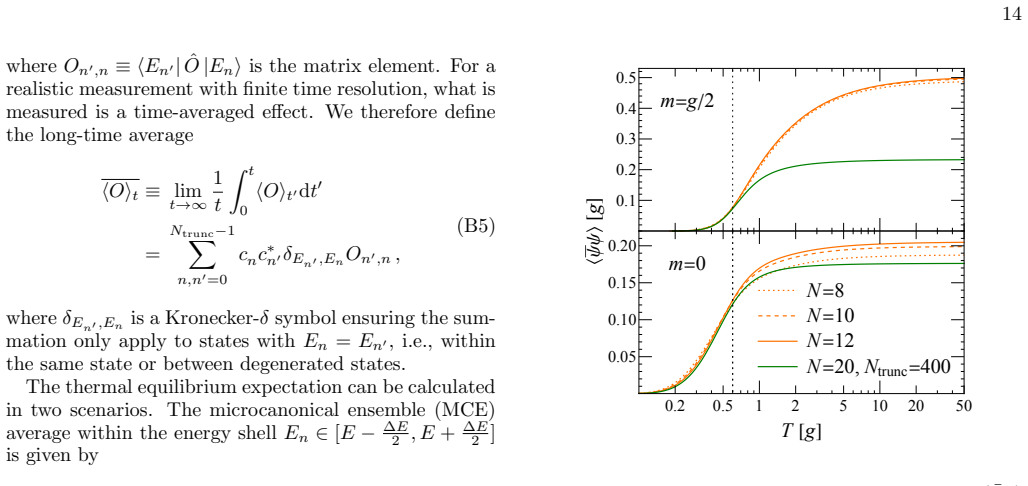
- [Appendix B, Fig. 9] The truncation validation for the canonical ensemble is shown for m=0 and m=g/2 but not for the weakly coupled m=2g case, which is the key non-thermalization scenario. A similar check for m=2g would strengthen confidence in the N=20 truncated results used in the main text.
Circularity Check
No significant circularity: the thermalization comparison is self-contained, and the few self-citations are peripheral rather than load-bearing.
full rationale
The central numerical claim compares long-time averages of the Wigner functions against microcanonical and canonical averages constructed independently from the lattice Hamiltonian (Eqs. (12)-(13)); no fitted parameter enters the comparison. The initial state is deliberately engineered away from thermal equilibrium in Appendix D, so the observed approach to the thermal bands is not imposed by construction. Appendix B independently validates the Ntrunc=400 truncation against full diagonalization for N=8, 10, and 12, so the Hilbert-space restriction is checked rather than assumed. The only self-citations are peripheral: Sec. II cites Refs. [72,78] (sharing author S. Shi) to support the choice of lattice spacing a=1/(2g), and Ref. [14] is one item in a hydrodynamic-attractor literature list; none of these supplies a result to which the paper's Wigner thermalization derivation reduces. The QMBS attribution is imported from the external Ref. [103] and, as the skeptic notes, is under-verified because no eigenstate overlap is computed; but missing verification is a correctness concern, not circularity. The theta=pi/2 swap follows from the chiral rotation used to derive Eq. (4) and is presented as a numerical consistency check rather than a fitted prediction. No step was found in which an output equals an input by definition.
Assumptions & free parameters
free parameters (7)
- Lattice spacing a =
1/(2g)
- Gauge field truncation Λ =
2
- Lattice size N =
20 main; 14 for ETH scans
- Eigenstate truncation Ntrunc =
400
- Fermion mass m/g =
0, 0.5, 1, 1.5, 2
- θ angle =
0 and π/2
- Initial-state targets f_s, f_0, f_1, f_p =
not specified
assumptions (6)
- standard math Unitary time evolution and the ETH framework apply to the lattice Schwinger model observables.
- domain assumption The massive Schwinger model is a faithful proxy for QCD quark-gluon plasma because both have confinement and chiral symmetry breaking.
- domain assumption The staggered-fermion Jordan-Wigner lattice Hamiltonian with Gauss law and periodic boundary conditions correctly represents the continuum Schwinger model.
- ad hoc to paper Truncating the gauge field to Λ=2 and the Hilbert space to Ntrunc=400 lowest eigenstates preserves the thermalization physics.
- ad hoc to paper The free-fermion QMBS tower persists in the interacting lattice Hamiltonian with O(g/m) corrections and causes the observed band structure.
- domain assumption The scalar Wigner function approximates the quark plus antiquark phase-space distribution, so its thermalization is a valid proxy for QGP thermalization.
Cite this review
Pith. "Pith review of Quantum thermalization of Quark-Gluon Plasma." pith.science (2026). https://pith.science/paper/5MMZJYMP
@misc{pith2026241200662,
  author       = {Pith},
  title        = {Pith review of: Quantum thermalization of Quark-Gluon Plasma},
  year         = {2026},
  howpublished = {\url{https://pith.science/paper/5MMZJYMP}},
  note         = {Machine review of arXiv:2412.00662}
}
read the original abstract
The thermalization of quark gluon plasma created in relativistic heavy-ion collisions is a crucial theoretical question in understanding the onset of hydrodynamics, and in a broad sense, a key step to the exploration of thermalization in isolated quantum systems. Addressing this problem theoretically, in a first principle manner, requires a real-time, non-perturbative method. To this end, we carry out a fully quantum simulation on a classical hardware, of a massive Schwinger model, which well mimics QCD as it shares the important properties such as confinement and chiral symmetry breaking. We focus on the real-time evolution of the Wigner function, namely, the two-point correlation function, which approximates quark momentum distribution. In the context of the eigenstate thermalization hypothesis and the evolution of entropy, our solution reveals the emergence of quantum thermalization in quark-gluon plasma with a strong coupling constant, while thermalization fails progressively as a consequence of the gradually increased significance of quantum many-body scar states in a more weakly coupled system. More importantly, we observe the non-trivial role of the topological vacuum in thermalization, as the thermalization properties differ dramatically in the parity-even and parity-odd components of the Wigner function.
Figures


Figures from the paper (9 more)




Forward citations
Cited by 2 Pith papers
-
Quantum simulating multi-particle processes in high energy nuclear physics: dijet production and color (de)coherence
A quantum-circuit framework maps partonic cross-sections for multi-particle QCD processes in media, benchmarked on dipole formation and antenna radiation at leading order.
- Thermalization from quantum entanglement: jet simulations in the massive Schwinger model
Reference graph
Works this paper leans on
-
[1]
Shuryak, Strongly coupled quark-gluon plasma in heavy ion collisions, Rev
E. Shuryak, Strongly coupled quark-gluon plasma in heavy ion collisions, Rev. Mod. Phys.89, 035001 (2017), arXiv:1412.8393 [hep-ph]
arXiv 2017
-
[2]
M. P. Heller and M. Spalinski, Hydrodynamics Be- yond the Gradient Expansion: Resurgence and Re- summation, Phys. Rev. Lett. 115, 072501 (2015), arXiv:1503.07514 [hep-th]
arXiv 2015
-
[3]
M. P. Heller, R. A. Janik, and P. Witaszczyk, Hydrody- namic Gradient Expansion in Gauge Theory Plasmas, Phys. Rev. Lett. 110, 211602 (2013), arXiv:1302.0697 [hep-th]
arXiv 2013
-
[4]
Romatschke, Relativistic Fluid Dynamics Far From Local Equilibrium, Phys
P. Romatschke, Relativistic Fluid Dynamics Far From Local Equilibrium, Phys. Rev. Lett.120, 012301 (2018), arXiv:1704.08699 [hep-th]
arXiv 2018
-
[5]
P. Romatschke, Relativistic Hydrodynamic Attractors with Broken Symmetries: Non-Conformal and Non- Homogeneous, JHEP 12, 079, arXiv:1710.03234 [hep- th]
-
[6]
J.-P. Blaizot and L. Yan, Fluid dynamics of out of equi- librium boost invariant plasmas, Phys. Lett. B 780, 283 (2018), arXiv:1712.03856 [nucl-th]
arXiv 2018
-
[7]
Spali´ nski, On the hydrodynamic attractor of Yang–Mills plasma, Phys
M. Spali´ nski, On the hydrodynamic attractor of Yang–Mills plasma, Phys. Lett. B 776, 468 (2018), arXiv:1708.01921 [hep-th]
arXiv 2018
-
[8]
V. E. Ambrus, S. Busuioc, J. A. Fotakis, K. Gallmeis- ter, and C. Greiner, Bjorken flow attractors with trans- verse dynamics, Phys. Rev. D 104, 094022 (2021), arXiv:2102.11785 [nucl-th]
arXiv 2021
Show all 114 references
-
[9]
Kurkela, W
A. Kurkela, W. van der Schee, U. A. Wiedemann, and B. Wu, Early- and Late-Time Behavior of Attractors in Heavy-Ion Collisions, Phys. Rev. Lett. 124, 102301 (2020), arXiv:1907.08101 [hep-ph]
2020 arXiv
-
[10]
Almaalol, A
D. Almaalol, A. Kurkela, and M. Strickland, Nonequi- librium Attractor in High-Temperature QCD Plasmas, Phys. Rev. Lett. 125, 122302 (2020), arXiv:2004.05195 [hep-ph]
2020 arXiv
-
[11]
Blaizot and L
J.-P. Blaizot and L. Yan, Emergence of hydrodynamical behavior in expanding ultra-relativistic plasmas, Annals Phys. 412, 167993 (2020), arXiv:1904.08677 [nucl-th]
2020 arXiv
-
[12]
Blaizot and L
J.-P. Blaizot and L. Yan, Analytical attractor for Bjorken flows, Phys. Lett. B 820, 136478 (2021), arXiv:2006.08815 [nucl-th]
2021 arXiv
-
[13]
Blaizot and L
J.-P. Blaizot and L. Yan, Attractor and fixed points in Bjorken flows, Phys. Rev. C 104, 055201 (2021), arXiv:2106.10508 [nucl-th]
2021 arXiv
-
[14]
Chen and S
S. Chen and S. Shi, Attractor for 1+1D viscous hy- drodynamics with general rapidity distribution, (2024), arXiv:2407.15209 [hep-ph]
2024 arXiv
-
[15]
Baier, A
R. Baier, A. H. Mueller, D. Schiff, and D. T. Son, ’Bot- tom up’ thermalization in heavy ion collisions, Phys. Lett. B 502, 51 (2001), arXiv:hep-ph/0009237
2001 arXiv
-
[16]
Kurkela and Y
A. Kurkela and Y. Zhu, Isotropization and hydrody- namization in weakly coupled heavy-ion collisions, Phys. Rev. Lett. 115, 182301 (2015), arXiv:1506.06647 [hep- ph]
2015 arXiv
-
[17]
Blaizot, F
J.-P. Blaizot, F. Gelis, J.-F. Liao, L. McLerran, and R. Venugopalan, Bose–Einstein Condensation and Thermalization of the Quark Gluon Plasma, Nucl. Phys. A 873, 68 (2012), arXiv:1107.5296 [hep-ph]
2012 arXiv
-
[18]
Blaizot, J
J.-P. Blaizot, J. Liao, and L. McLerran, Gluon Trans- port Equation in the Small Angle Approximation and the Onset of Bose-Einstein Condensation, Nucl. Phys. A 920, 58 (2013), arXiv:1305.2119 [hep-ph]
2013 arXiv
-
[19]
Berges and D
J. Berges and D. Sexty, Bose condensation far from equilibrium, Phys. Rev. Lett. 108, 161601 (2012), arXiv:1201.0687 [hep-ph]
2012 arXiv
-
[20]
Berges, K
J. Berges, K. Boguslavski, S. Schlichting, and R. Venu- gopalan, Universality far from equilibrium: From super- fluid Bose gases to heavy-ion collisions, Phys. Rev. Lett. 114, 061601 (2015), arXiv:1408.1670 [hep-ph]
2015 arXiv
-
[21]
Blaizot, B
J.-P. Blaizot, B. Wu, and L. Yan, Quark production, Bose–Einstein condensates and thermalization of the quark–gluon plasma, Nucl. Phys. A 930, 139 (2014), arXiv:1402.5049 [hep-ph]
2014 arXiv
-
[22]
Z. Xu, K. Zhou, P. Zhuang, and C. Greiner, Thermaliza- tion of gluons with Bose-Einstein condensation, Phys. Rev. Lett. 114, 182301 (2015), arXiv:1410.5616 [hep- ph]
2015 arXiv
-
[23]
Martinez and M
M. Martinez and M. Strickland, Dissipative Dynamics of Highly Anisotropic Systems, Nucl. Phys. A 848, 183 (2010), arXiv:1007.0889 [nucl-th]
2010 arXiv
-
[24]
Martinez, R
M. Martinez, R. Ryblewski, and M. Strickland, Boost- Invariant (2+1)-dimensional Anisotropic Hydrodynam- ics, Phys. Rev. C 85, 064913 (2012), arXiv:1204.1473 [nucl-th]
2012 arXiv
-
[25]
Ryblewski and W
R. Ryblewski and W. Florkowski, Highly-anisotropic hydrodynamics in 3+1 space-time dimensions, Phys. Rev. C 85, 064901 (2012), arXiv:1204.2624 [nucl-th]
2012 arXiv
-
[26]
Strickland, J
M. Strickland, J. Noronha, and G. Denicol, Anisotropic nonequilibrium hydrodynamic attractor, Phys. Rev. D 97, 036020 (2018), arXiv:1709.06644 [nucl-th]
2018 arXiv
-
[27]
Strickland, The non-equilibrium attractor for kinetic theory in relaxation time approximation, JHEP12, 128, arXiv:1809.01200 [nucl-th]
M. Strickland, The non-equilibrium attractor for kinetic theory in relaxation time approximation, JHEP12, 128, arXiv:1809.01200 [nucl-th]
-
[28]
Romatschke and U
P. Romatschke and U. Romatschke, Relativistic Fluid Dynamics In and Out of Equilibrium, Cambridge Mono- graphs on Mathematical Physics (Cambridge University Press, 2019) arXiv:1712.05815 [nucl-th]
2019 arXiv
-
[29]
Berges, M
J. Berges, M. P. Heller, A. Mazeliauskas, and R. Venu- gopalan, QCD thermalization: Ab initio approaches and interdisciplinary connections, Rev. Mod. Phys. 93, 035003 (2021), arXiv:2005.12299 [hep-th]
2021 arXiv
-
[30]
Gelis and S
F. Gelis and S. Hauksson, Isotropization of a longitudi- nally expanding system of scalar fields in the 2PI for- malism, JHEP 08, 135, arXiv:2403.11908 [hep-ph]
-
[31]
Alqahtani, M
M. Alqahtani, M. Nopoush, and M. Strickland, Rela- tivistic anisotropic hydrodynamics, Prog. Part. Nucl. Phys. 101, 204 (2018), arXiv:1712.03282 [nucl-th]
2018 arXiv
-
[32]
Florkowski, M
W. Florkowski, M. P. Heller, and M. Spalinski, New theories of relativistic hydrodynamics in the LHC era, Rept. Prog. Phys. 81, 046001 (2018), arXiv:1707.02282 [hep-ph]
2018 arXiv
-
[33]
Shen and L
C. Shen and L. Yan, Recent development of hydrody- namic modeling in heavy-ion collisions, Nucl. Sci. Tech. 31, 122 (2020), arXiv:2010.12377 [nucl-th]
2020 arXiv
-
[34]
J. M. Deutsch, Quantum statistical mechanics in a closed system, Phys. Rev. A 43, 2046 (1991)
1991
-
[35]
Srednicki, Chaos and Quantum Thermalization, Phys
M. Srednicki, Chaos and Quantum Thermalization, Phys. Rev. E 50, 10.1103/PhysRevE.50.888 (1994), arXiv:cond-mat/9403051
1994 arXiv
-
[36]
Rigol, V
M. Rigol, V. Dunjko, and M. Olshanii, Thermalization and its mechanism for generic isolated quantum sys- 18 tems, Nature 452, 854 (2008), arXiv:0708.1324 [cond- mat.stat-mech]
2008 arXiv
-
[37]
Rigol, Breakdown of Thermalization in Finite One- Dimensional Systems, Phys
M. Rigol, Breakdown of Thermalization in Finite One- Dimensional Systems, Phys. Rev. Lett. 103, 100403 (2009), arXiv:0904.3746 [cond-mat.stat-mech]
2009 arXiv
-
[38]
Biroli, C
G. Biroli, C. Kollath, and A. M. L¨ auchli, Effect of Rare Fluctuations on the Thermalization of Isolated Quan- tum Systems, Phys. Rev. Lett. 105, 250401 (2010)
2010
-
[39]
A. M. Kaufman, M. E. Tai, A. Lukin, M. Rispoli, R. Schittko, P. M. Preiss, and M. Greiner, Quan- tum thermalization through entanglement in an isolated many-body system, Science 353, 794–800 (2016)
2016
-
[40]
Mori, Weak eigenstate thermalization with large de- viation bound (2016), arXiv:1609.09776 [cond-mat.stat- mech]
T. Mori, Weak eigenstate thermalization with large de- viation bound (2016), arXiv:1609.09776 [cond-mat.stat- mech]
2016 arXiv
-
[41]
P. W. Anderson, Absence of Diffusion in Certain Ran- dom Lattices, Phys. Rev. 109, 1492 (1958)
1958
-
[42]
Bernien, S
H. Bernien, S. Schwartz, A. Keesling, H. Levine, A. Om- ran, H. Pichler, S. Choi, A. S. Zibrov, M. Endres, M. Greiner, V. Vuleti´ c, and M. D. Lukin, Probing many- body dynamics on a 51-atom quantum simulator, Na- ture 551, 579–584 (2017)
2017
-
[43]
Schecter and T
M. Schecter and T. Iadecola, Weak Ergodicity Breaking and Quantum Many-Body Scars in Spin-1 XY Magnets, Phys. Rev. Lett. 123, 147201 (2019), arXiv:1906.10131 [cond-mat.str-el]
2019 arXiv
-
[44]
G.-X. Su, H. Sun, A. Hudomal, J.-Y. Desaules, Z.-Y. Zhou, B. Yang, J. C. Halimeh, Z.-S. Yuan, Z. Papi´ c, and J.-W. Pan, Observation of many-body scarring in a Bose-Hubbard quantum simulator, Phys. Rev. Res. 5, 023010 (2023), arXiv:2201.00821 [cond-mat.quant-gas]
2023 arXiv
-
[45]
T. Mori, T. N. Ikeda, E. Kaminishi, and M. Ueda, Ther- malization and prethermalization in isolated quantum systems: a theoretical overview, J. Phys. B 51, 112001 (2018), arXiv:1712.08790 [cond-mat.stat-mech]
2018 arXiv
-
[46]
D’Alessio, Y
L. D’Alessio, Y. Kafri, A. Polkovnikov, and M. Rigol, From quantum chaos and eigenstate thermalization to statistical mechanics and thermodynamics, Adv. Phys. 65, 239 (2016), arXiv:1509.06411 [cond-mat.stat-mech]
2016 arXiv
-
[47]
Nandkishore and D
R. Nandkishore and D. A. Huse, Many body localiza- tion and thermalization in quantum statistical mechan- ics, Ann. Rev. Condensed Matter Phys. 6, 15 (2015), arXiv:1404.0686 [cond-mat.stat-mech]
2015 arXiv
-
[48]
Ueda, Quantum equilibration, thermalization and prethermalization in ultracold atoms, Nature Rev
M. Ueda, Quantum equilibration, thermalization and prethermalization in ultracold atoms, Nature Rev. Phys. 2, 669 (2020)
2020
-
[49]
Moudgalya, B
S. Moudgalya, B. A. Bernevig, and N. Regnault, Quan- tum many-body scars and Hilbert space fragmentation: a review of exact results, Rept. Prog. Phys. 85, 086501 (2022), arXiv:2109.00548 [cond-mat.str-el]
2022 arXiv
-
[50]
Serbyn, D
M. Serbyn, D. A. Abanin, and Z. Papi´ c, Quantum many-body scars and weak breaking of ergodicity, Na- ture Phys. 17, 675 (2021), arXiv:2011.09486 [quant-ph]
2021 arXiv
-
[51]
J. S. Schwinger, Gauge Invariance and Mass. 2., Phys. Rev. 128, 2425 (1962)
1962
-
[52]
J. H. Lowenstein and J. A. Swieca, Quantum electrody- namics in two-dimensions, Annals Phys. 68, 172 (1971)
1971
-
[53]
Jayewardena, SCHWINGER MODEL ON S(2), Helv
C. Jayewardena, SCHWINGER MODEL ON S(2), Helv. Phys. Acta 61, 636 (1988)
1988
-
[54]
A. V. Smilga, On the fermion condensate in Schwinger model, Phys. Lett. B 278, 371 (1992)
1992
-
[55]
Adam, Instantons and vacuum expectation values in the Schwinger model, Z
C. Adam, Instantons and vacuum expectation values in the Schwinger model, Z. Phys. C 63, 169 (1994)
1994
-
[56]
Adam, Massive Schwinger model within mass pertur- bation theory, Annals Phys
C. Adam, Massive Schwinger model within mass pertur- bation theory, Annals Phys. 259, 1 (1997), arXiv:hep- th/9704064
1997
-
[57]
S. R. Coleman, More About the Massive Schwinger Model, Annals Phys. 101, 239 (1976)
1976
-
[58]
Adam, The Schwinger mass in the massive Schwinger model, Phys
C. Adam, The Schwinger mass in the massive Schwinger model, Phys. Lett. B 382, 383 (1996), arXiv:hep- ph/9507331
1996
-
[59]
Adam, General bound state structure of the mas- sive Schwinger model, Phys
C. Adam, General bound state structure of the mas- sive Schwinger model, Phys. Lett. B 382, 111 (1996), arXiv:hep-th/9602175
1996 arXiv
-
[60]
Adam, The boson-boson bound state in the massive Schwinger model, Z
C. Adam, The boson-boson bound state in the massive Schwinger model, Z. Phys. C 74, 727 (1997), arXiv:hep- ph/9601227
1997
-
[61]
C. W. Bauer et al., Quantum Simulation for High- Energy Physics, PRX Quantum 4, 027001 (2023), arXiv:2204.03381 [quant-ph]
2023 arXiv
-
[62]
C. W. Bauer, Z. Davoudi, N. Klco, and M. J. Savage, Quantum simulation of fundamental parti- cles and forces, Nature Rev. Phys. 5, 420 (2023), arXiv:2404.06298 [hep-ph]
2023 arXiv
-
[63]
N. Klco, E. F. Dumitrescu, A. J. McCaskey, T. D. Morris, R. C. Pooser, M. Sanz, E. Solano, P. Lougov- ski, and M. J. Savage, Quantum-classical computation of Schwinger model dynamics using quantum comput- ers, Phys. Rev. A 98, 032331 (2018), arXiv:1803.03326 [quant-ph]
2018 arXiv
-
[64]
R. C. Farrell, M. Illa, A. N. Ciavarella, and M. J. Savage, Scalable Circuits for Preparing Ground States on Dig- ital Quantum Computers: The Schwinger Model Vac- uum on 100 Qubits, PRX Quantum 5, 020315 (2024), arXiv:2308.04481 [quant-ph]
2024 arXiv
-
[65]
R. C. Farrell, M. Illa, A. N. Ciavarella, and M. J. Sav- age, Quantum simulations of hadron dynamics in the Schwinger model using 112 qubits, Phys. Rev. D 109, 114510 (2024), arXiv:2401.08044 [quant-ph]
2024 arXiv
-
[66]
T. V. Zache, N. Mueller, J. T. Schneider, F. Jen- drzejewski, J. Berges, and P. Hauke, Dynamical Topo- logical Transitions in the Massive Schwinger Model with a θ Term, Phys. Rev. Lett. 122, 050403 (2019), arXiv:1808.07885 [quant-ph]
2019 arXiv
-
[67]
Ikeda, D
K. Ikeda, D. E. Kharzeev, and Y. Kikuchi, Real- time dynamics of Chern-Simons fluctuations near a critical point, Phys. Rev. D 103, L071502 (2021), arXiv:2012.02926 [hep-ph]
2021 arXiv
-
[68]
D. E. Kharzeev and Y. Kikuchi, Real-time chiral dy- namics from a digital quantum simulation, Phys. Rev. Res. 2, 023342 (2020), arXiv:2001.00698 [hep-ph]
2020 arXiv
-
[69]
W. A. de Jong, K. Lee, J. Mulligan, M. P losko´ n, F. Ringer, and X. Yao, Quantum simulation of nonequilibrium dynamics and thermalization in the Schwinger model, Phys. Rev. D 106, 054508 (2022), arXiv:2106.08394 [quant-ph]
2022 arXiv
-
[70]
X.-D. Xie, X. Guo, H. Xing, Z.-Y. Xue, D.-B. Zhang, and S.-L. Zhu (QuNu), Variational thermal quantum simulation of the lattice Schwinger model, Phys. Rev. D 106, 054509 (2022), arXiv:2205.12767 [quant-ph]
2022 arXiv
-
[71]
Belyansky, S
R. Belyansky, S. Whitsitt, N. Mueller, A. Fahimniya, E. R. Bennewitz, Z. Davoudi, and A. V. Gorshkov, High-Energy Collision of Quarks and Mesons in the Schwinger Model: From Tensor Networks to Cir- cuit QED, Phys. Rev. Lett. 132, 091903 (2024), arXiv:2307.02522 [quant-ph]. 19
2024 arXiv
-
[72]
Florio, D
A. Florio, D. Frenklakh, K. Ikeda, D. Kharzeev, V. Ko- repin, S. Shi, and K. Yu, Real-Time Nonperturbative Dynamics of Jet Production in Schwinger Model: Quan- tum Entanglement and Vacuum Modification, Phys. Rev. Lett. 131, 021902 (2023), arXiv:2301.11991 [hep- ph]
2023 arXiv
-
[73]
Florio, Two-fermion negativity and confinement in the Schwinger model, Phys
A. Florio, Two-fermion negativity and confinement in the Schwinger model, Phys. Rev. D 109, L071501 (2024), arXiv:2312.05298 [hep-th]
2024 arXiv
-
[74]
J. a. Barata, W. Gong, and R. Venugopalan, Realtime dynamics of hyperon spin correlations from string frag- mentation in a deformed four-flavor Schwinger model, Phys. Rev. D 109, 116003 (2024), arXiv:2308.13596 [hep-ph]
2024 arXiv
-
[75]
Ikeda, D
K. Ikeda, D. E. Kharzeev, R. Meyer, and S. Shi, De- tecting the critical point through entanglement in the Schwinger model, Phys. Rev. D 108, L091501 (2023), arXiv:2305.00996 [hep-ph]
2023 arXiv
-
[76]
Ikeda, D
K. Ikeda, D. E. Kharzeev, and S. Shi, Nonlinear chi- ral magnetic waves, Phys. Rev. D 108, 074001 (2023), arXiv:2305.05685 [hep-ph]
2023 arXiv
-
[77]
K. Lee, J. Mulligan, F. Ringer, and X. Yao, Liouvillian dynamics of the open Schwinger model: String breaking and kinetic dissipation in a thermal medium, Phys. Rev. D 108, 094518 (2023), arXiv:2308.03878 [quant-ph]
2023 arXiv
-
[78]
Florio, D
A. Florio, D. Frenklakh, K. Ikeda, D. E. Kharzeev, V. Korepin, S. Shi, and K. Yu, Quantum real-time evo- lution of entanglement and hadronization in jet produc- tion: Lessons from the massive Schwinger model, Phys. Rev. D 110, 094029 (2024), arXiv:2404.00087 [hep-ph]
2024 arXiv
-
[79]
Ghim and M
D. Ghim and M. Honda, Digital Quantum Simula- tion for Spectroscopy of Schwinger Model, PoS LA T- TICE2023, 213 (2024), arXiv:2404.14788 [hep-lat]
2024 arXiv
-
[80]
T. Li, X. Guo, W. K. Lai, X. Liu, E. Wang, H. Xing, D.-B. Zhang, and S.-L. Zhu (QuNu), Partonic collinear structure by quantum computing, Phys. Rev. D 105, L111502 (2022), arXiv:2106.03865 [hep-ph]
2022 arXiv
-
[81]
T. Li, X. Guo, W. K. Lai, X. Liu, E. Wang, H. Xing, D.-B. Zhang, and S.-L. Zhu (QuNu), Exploring light- cone distribution amplitudes from quantum comput- ing, Sci. China Phys. Mech. Astron. 66, 281011 (2023), arXiv:2207.13258 [hep-ph]
2023 arXiv
-
[82]
T. Li, W. K. Lai, E. Wang, and H. Xing (QuNu), Scattering amplitude from quantum computing with reduction formula, Phys. Rev. D 109, 036025 (2024), arXiv:2301.04179 [hep-ph]
2024 arXiv
-
[83]
A. M. Czajka, Z.-B. Kang, H. Ma, and F. Zhao, Quan- tum simulation of chiral phase transitions, JHEP 08, 209, arXiv:2112.03944 [hep-ph]
-
[84]
Carena, H
M. Carena, H. Lamm, Y.-Y. Li, and W. Liu, Im- proved Hamiltonians for Quantum Simulations of Gauge Theories, Phys. Rev. Lett. 129, 051601 (2022), arXiv:2203.02823 [hep-lat]
2022 arXiv
-
[85]
Yao, SU(2) gauge theory in 2+1 dimensions on a plaquette chain obeys the eigenstate thermaliza- tion hypothesis, Phys
X. Yao, SU(2) gauge theory in 2+1 dimensions on a plaquette chain obeys the eigenstate thermaliza- tion hypothesis, Phys. Rev. D 108, L031504 (2023), arXiv:2303.14264 [hep-lat]
2023 arXiv
-
[86]
Ebner, B
L. Ebner, B. M¨ uller, A. Sch¨ afer, C. Seidl, and X. Yao, Eigenstate thermalization in (2+1)-dimensional SU(2) lattice gauge theory, Phys. Rev. D 109, 014504 (2024), arXiv:2308.16202 [hep-lat]
2024 arXiv
-
[87]
Ikeda, Z.-B
K. Ikeda, Z.-B. Kang, D. E. Kharzeev, W. Qian, and F. Zhao, Real-time chiral dynamics at finite tem- perature from quantum simulation, JHEP 10, 031, arXiv:2407.21496 [hep-ph]
-
[88]
Hayata and Y
T. Hayata and Y. Hidaka, String-net formulation of Hamiltonian lattice Yang-Mills theories and quantum many-body scars in a nonabelian gauge theory, JHEP 09, 126, arXiv:2305.05950 [hep-lat]
-
[89]
Hayata, Y
T. Hayata, Y. Hidaka, and K. Nishimura, Dense QCD2 with matrix product states, JHEP 07, 106, arXiv:2311.11643 [hep-lat]
-
[90]
Hidaka and A
Y. Hidaka and A. Yamamoto, Quantum circuit for Z3 lattice gauge theory at nonzero baryon density, (2024), arXiv:2409.17349 [hep-lat]
2024 arXiv
-
[91]
S. Wu, W. Du, X. Zhao, and J. P. Vary, Efficient and precise quantum simulation of ultrarelativistic quark- nucleus scattering, Phys. Rev. D 110, 056044 (2024), arXiv:2404.00819 [quant-ph]
2024 arXiv
-
[92]
Carena, H
M. Carena, H. Lamm, Y.-Y. Li, and W. Liu, Quantum error thresholds for gauge-redundant digitizations of lat- tice field theories, Phys. Rev. D 110, 054516 (2024), arXiv:2402.16780 [hep-lat]
2024 arXiv
-
[93]
W. Qian, M. Li, C. A. Salgado, and M. Kreshchuk, Ef- ficient Quantum Simulation of QCD Jets on the Light Front, (2024), arXiv:2411.09762 [hep-ph]
2024 arXiv
-
[94]
Rajagopal and F
K. Rajagopal and F. Wilczek, Static and dynamic criti- cal phenomena at a second order QCD phase transition, Nucl. Phys. B 399, 395 (1993), arXiv:hep-ph/9210253
1993 arXiv
-
[95]
J. B. Kogut and L. Susskind, Hamiltonian Formulation of Wilson’s Lattice Gauge Theories, Phys. Rev. D 11, 395 (1975)
1975
-
[96]
Susskind, Lattice Fermions, Phys
L. Susskind, Lattice Fermions, Phys. Rev. D 16, 3031 (1977)
1977
-
[97]
Jordan and E
P. Jordan and E. P. Wigner, About the Pauli exclusion principle, Z. Phys. 47, 631 (1928)
1928
-
[98]
A. F. Shaw, P. Lougovski, J. R. Stryker, and N. Wiebe, Quantum Algorithms for Simulating the Lattice Schwinger Model, Quantum 4, 306 (2020), arXiv:2002.11146 [quant-ph]
2020 arXiv
-
[99]
Brenes, M
M. Brenes, M. Dalmonte, M. Heyl, and A. Scardic- chio, Many-body localization dynamics from gauge invariance, Phys. Rev. Lett. 120, 030601 (2018), arXiv:1706.05878 [cond-mat.str-el]
2018 arXiv
-
[100]
Dempsey, I
R. Dempsey, I. R. Klebanov, S. S. Pufu, and B. Zan, Discrete chiral symmetry and mass shift in the lattice Hamiltonian approach to the Schwinger model, Phys. Rev. Res. 4, 043133 (2022), arXiv:2206.05308 [hep-th]
2022 arXiv
-
[101]
Smith, J
A. Smith, J. Knolle, D. Kovrizhin, and R. Moessner, Disorder-free localization, Physical Review Letters 118, 10.1103/physrevlett.118.266601 (2017)
2017 doi
-
[102]
Papaefstathiou, A
I. Papaefstathiou, A. Smith, and J. Knolle, Disorder-free localization in a simple U (1) lattice gauge theory, Phys. Rev. B 102, 165132 (2020), arXiv:2003.12497 [cond- mat.str-el]
2020 arXiv
-
[103]
Desaules, D
J.-Y. Desaules, D. Banerjee, A. Hudomal, Z. Papi´ c, A. Sen, and J. C. Halimeh, Weak ergodicity breaking in the Schwinger model, Phys. Rev. B 107, L201105 (2023), arXiv:2203.08830 [cond-mat.str-el]
2023 arXiv
-
[104]
Calabrese and J
P. Calabrese and J. Cardy, Entanglement entropy and conformal field theory, J. Phys. A 42, 504005 (2009), arXiv:0905.4013 [cond-mat.stat-mech]
2009 arXiv
-
[105]
Everett et al
D. Everett et al. (JETSCAPE), Phenomenological con- straints on the transport properties of QCD matter with data-driven model averaging, Phys. Rev. Lett.126, 242301 (2021), arXiv:2010.03928 [hep-ph]
2021 arXiv
-
[106]
Everett et al
D. Everett et al. (JETSCAPE), Multisystem Bayesian constraints on the transport coefficients of QCD mat- 20 ter, Phys. Rev. C 103, 054904 (2021), arXiv:2011.01430 [hep-ph]
2021 arXiv
-
[107]
G. Nijs, W. van der Schee, U. G¨ ursoy, and R. Snellings, Bayesian analysis of heavy ion collisions with the heavy ion computational framework Trajectum, Phys. Rev. C 103, 054909 (2021), arXiv:2010.15134 [nucl-th]
2021 arXiv
-
[108]
G. Nijs, W. van der Schee, U. G¨ ursoy, and R. Snellings, Transverse Momentum Differential Global Analysis of Heavy-Ion Collisions, Phys. Rev. Lett. 126, 202301 (2021), arXiv:2010.15130 [nucl-th]
2021 arXiv
-
[109]
Andronic, F
A. Andronic, F. Beutler, P. Braun-Munzinger, K. Redlich, and J. Stachel, Statistical hadronization of heavy flavor quarks in elementary collisions: Suc- cesses and failures, Phys. Lett. B 678, 350 (2009), arXiv:0904.1368 [hep-ph]
2009 arXiv
-
[110]
Redlich, A
K. Redlich, A. Andronic, F. Beutler, P. Braun- Munzinger, and J. Stachel, Canonical Statistical Model and hadron production in e+ e- annihilations, J. Phys. G 36, 064021 (2009), arXiv:0903.1610 [hep-ph]
2009 arXiv
-
[111]
F. Becattini, An Introduction to the Statistical Hadronization Model, in International School on Quark- Gluon Plasma and Heavy Ion Collisions: past, present, future (2009) arXiv:0901.3643 [hep-ph]
2009 arXiv
-
[112]
Andronic, P
A. Andronic, P. Braun-Munzinger, K. Redlich, and J. Stachel, Decoding the phase structure of QCD via particle production at high energy, Nature 561, 321 (2018), arXiv:1710.09425 [nucl-th]
2018 arXiv
-
[113]
He and R
M. He and R. Rapp, Charm-Baryon Production in Proton-Proton Collisions, Phys. Lett. B 795, 117 (2019), arXiv:1902.08889 [nucl-th]
2019 arXiv
-
[114]
S. Chen, S. Shi, and L. Yan, in progress,
Reviewed August 12, 2026 · model on record in the stance chip above.
Discussion (0). Continue with ORCID to comment.