REVIEW 3 major objections 5 minor 191 references
What is Ethical: AIHED Driving Humans or Human-Driven AIHED? A Conceptual Framework enabling the Ethos of AI-driven Higher education
T0 review · 3 major / 5 minor · reviewed 2026-08-08 · deepseek-v4-flash
Pith's one-line read This paper claims that ethical AI in higher education requires human intelligence embedded in every phase of the AI lifecycle, and proposes the HD-AIHED framework to do that.
desk verdict A coherent five-phase governance framework undermined by a circular validation and a direct contradiction between deferred testing and claimed empirical success. read the letter →
The pith
A machine-rendered reading of the paper's core claim, the machinery that carries it, and where it could break.
The reading
What carries the argument
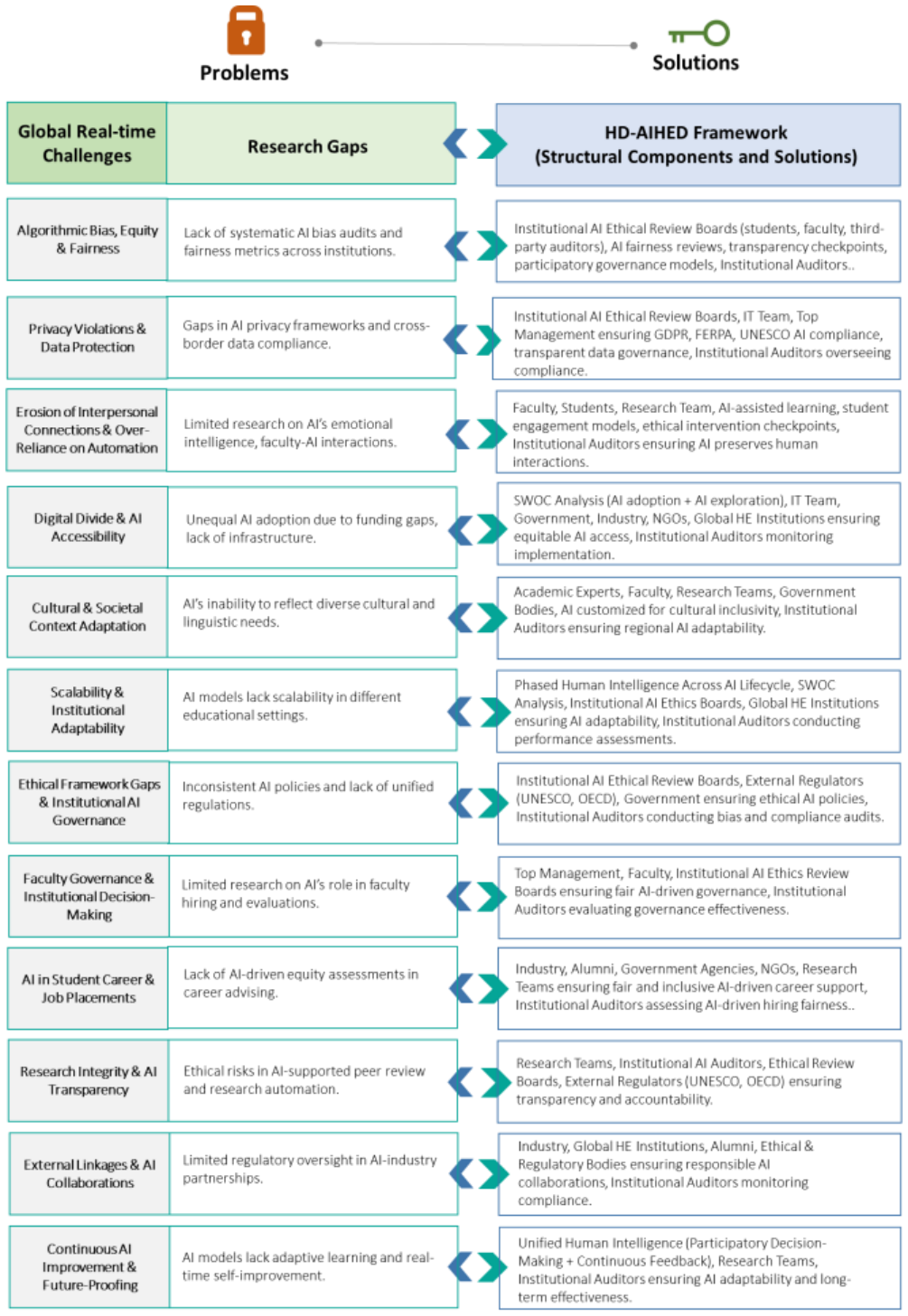
The central object is the HD-AIHED (Human-Driven AI in Higher Education) framework. It is a governance workflow in which five Human Intelligence layers (HI1–HI5) correspond to the AI lifecycle phases of adoption, design, deployment, evaluation, and exploration; decision-making points (DM) set strategic direction, and feedback loops (FB1–FB12) carry continuous corrections between layers. The framework also embeds a SWOC (Strengths, Weaknesses, Opportunities, Challenges) analysis at the adoption and exploration phases and assigns the AI Ethical Review Board, students, faculty, administrators, and external stakeholders specific governance roles.
What would settle it
An empirical falsifier would be a comparative pilot in which institutions using the framework show no reduction in documented algorithmic bias incidents, privacy complaints, or stakeholder trust gaps relative to matched institutions using standard AI procurement over a two-to-three-year period. A simpler check: if the mapping of university AI applications into the five phases can be reproduced by independent coders only when they are told the phase names, the framework may be imposing its categories rather than explaining the cases.
Extended reading notes
Core claim
The paper's central claim is that ethical AI in higher education is not achieved by choosing better algorithms alone but by embedding human oversight into the entire AI lifecycle. The HD-AIHED framework maps five 'phased human intelligences' onto the five AI lifecycle phases—critical evaluation at adoption, resource selection at design, barrier removal at deployment, outcome evaluation, and future-scope planning—and connects them with feedback loops and decision-making checkpoints. The author maintains that this arrangement ensures accountability, inclusivity, transparency, and ethical compliance, and that it can be adapted to both well-resourced and under-resourced institutions.
Load-bearing premise
The framework's validity rests on the assumption that a non-systematic synthesis of English-language secondary sources, plus the author's mapping of university AI tools into the five phases, is enough evidence that the model works across diverse institutional contexts.
Editorial extensions
If this is right
- A university adopting HD-AIHED would run a structured readiness and SWOC review before buying or building any AI tool, rather than piloting tools first.
- Bias and privacy risks would be checked at each phase, with designated humans—not the AI system—holding final approval through decision-making checkpoints.
- Feedback loops would make AI systems continuously revised by student and faculty input, so the framework is designed to adapt as institutional needs change.
- The same five-phase structure could be used by institutions in different regions, with each phase's criteria adjusted to local infrastructure and regulatory context.
- Establishing AI ethical review boards would become a standard governance requirement, giving students a formal role in AI oversight.
Reading between the lines
- The framework's five phases are general enough that they could be applied outside higher education, for example to AI adoption in schools or public-sector agencies, though the paper does not make that claim.
- A natural test of the model would compare two otherwise similar universities, one using HD-AIHED and one using standard AI procurement, across several semesters; the paper does not report such data.
- The model's heavy reliance on stakeholder participation may be easier to implement in institutions with strong administrative capacity than in underfunded ones, so the scalability claim may depend on institutional readiness rather than on the framework itself.
- The quantitative SEM validation proposed in the paper could serve as the empirical check: if the hypothesized paths between the five phases and ethical outcomes do not hold in survey data, the framework's causal logic would need revision.
Signed reviews
Editorial analysis
A structured set of objections, weighed in public.
Referee Report
Summary. The manuscript proposes the Human-Driven AI in Higher Education (HD-AIHED) framework, a conceptual five-phase model for integrating human oversight into AI adoption, design, deployment, evaluation, and exploration in higher education. The framework includes stakeholder participation, SWOC analysis, AI ethical review boards, feedback loops, and alignment with UNESCO/OECD/GDPR standards. The paper synthesizes secondary literature and a set of institutional examples to argue that the framework can address algorithmic bias, privacy risks, governance gaps, and scalability challenges. It claims in the abstract and in Section 5.3 to ensure ethical AI governance and institutional sustainability, and Section 7.3 asserts that all research objectives, including empirical validation, have been met.
Significance. The conceptual contribution is potentially useful: the five-phase structure is coherent, the stakeholder taxonomy is comprehensive, and the emphasis on human oversight, dynamic feedback, and alignment with global ethical frameworks addresses recognized gaps in AI governance in higher education. The paper also provides a concrete future research agenda, including a structural equation modeling design. However, these strengths are undermined by a direct internal contradiction concerning validation: the manuscript simultaneously states that empirical testing is future work and that empirical validation has been successfully completed. The only evidence offered for validation is a mapping exercise that uses the framework's own categories, which cannot provide independent confirmation. If the overclaims are removed and the framework is repositioned as an untested conceptual proposal, the paper could make a modest but useful contribution. As it stands, the central claims of empirical support and guaranteed ethical outcomes are unsupported.
major comments (3)
- [§2.6, §2.7, §7.3] There is a direct internal contradiction regarding empirical validation. Section 2.6 states that 'future empirical testing is required to evaluate the HD-AIHED model’s applicability,' and Section 2.7 concedes reliance on secondary data and the need for longitudinal and experimental studies. Yet Section 7.3 asserts 'This study successfully meets its research objectives,' which include RQ3's mandate to 'develop and empirically validate' the framework. No empirical data are reported anywhere in the manuscript. This contradiction matters because the abstract's claim that the model 'bridges AI research gaps, addresses global real-time challenges, and provides tailored, scalable, and ethical strategies' depends on the validation claim.
- [§2.5, §6.2, Table 8] The purported validation is circular. Section 2.5 lists 'Testing Real-World AI Applications' and 'Analyzing Case Studies of Real-World Challenges' as validation activities, but the only concrete artifact is Table 8, which maps AI applications at named universities into the framework's own five phase columns (Adoption, Design, Deployment, Evaluation, Exploration). Because the columns are the framework's categories, the exercise cannot fail: every application can be assigned to a phase. There are no outcome metrics, no baseline comparisons, no counterfactual cases, and no inter-rater protocol. Section 6.2 therefore overstates the evidence when it says the mapping 'offers a validated framework.'
- [§6.2, Table 8] Table 8 presents institution-specific AI applications (e.g., 'University of Cambridge – AI-Powered Campus Energy Optimization,' 'Oxford University – AI-Powered Emotional Intelligence Analysis') without any citations or sources. These entries are presented as empirical cases, but the reader cannot verify that the named institutions deployed these specific tools or that the described inputs and phases correspond to reality. Without verifiable sources, the mapping cannot serve as evidence for the framework's applicability or effectiveness.
minor comments (5)
- [§6.2, §7.2.1] There are two tables numbered 'Table 8' in the manuscript: one in Section 6.2 and one in Section 7.2.1. Renumber the second table.
- [§7.1] Section 7.1 refers to 'The AIED-HDMFB model,' an acronym that appears nowhere else in the paper. This is presumably a typo for HD-AIHED and should be corrected.
- [§3.4.1, §5.2.5] The text contains repeated passages: Section 3.4.1 has three near-identical paragraphs starting 'Global platforms like Coursera and edX...', and Section 5.2.5 repeats the same sentence about Institutional AI Ethical Review Boards twice. These should be consolidated.
- [Throughout] Citation style is inconsistent: some citations use bracketed numbers, others use author–year (e.g., 'Singh, 2024', '(Bond et al., 2024)'), and some are phrased awkwardly like 'as [35] notes.' Standardize the citation format.
- [§5.2, §5.2.7] Figure callouts are confusing: Section 5.2 refers to 'the accompanying Figure 2' when describing the integrated system, but Figure 2 is titled 'Structural Components of Framework'; Section 5.2.7 refers to Figure 4 in a way that seems to describe Figure 5. Check all figure cross-references.
Circularity Check
The central validation claim is self-definitional: Table 8 labels known university AI applications with the framework's own five phases and then calls this mapping a validated framework; the promised empirical testing is deferred to future work.
-
self definitional
[Section 6.2, Table 8]
"By applying the HD-AIHED Model, this strategic mapping offers a validated framework to navigate AI adoption complexities... Each AI application is evaluated through five key phases—Adoption, Design, Deployment, Evaluation, and Exploration—providing a structured approach to overcoming institutional barriers and ethical challenges."
The phases used to 'evaluate' each case are the framework's own structural components, and Table 8's columns are exactly Adoption, Design, Deployment, Evaluation, and Exploration. Sorting institutions into those categories is a relabeling exercise, not a test: the exercise cannot fail because any AI application can be described in these terms. No success criteria, outcome metrics, baseline comparisons, or counterfactual cases are specified. Consequently the statement that the mapping 'offers a validated framework' is entailed by the classification procedure itself rather than by independent evidence, making the validation self-definitional.
full rationale
HD-AIHED is a conceptual synthesis rather than a model with fitted parameters, and I found no load-bearing self-citation chain: the cited UNESCO/OECD/NIST/EU materials are external standards, not prior work by this author. The framework's internal design is therefore not circular in the derivation sense. The circularity burden is concentrated in the validation step: Section 6.2 and Table 8 claim a 'validated framework' by mapping universities' AI tools into the framework's own five phases, which is a guaranteed-success relabeling rather than an empirical check. The paper itself acknowledges in Section 2.6 that 'future empirical testing is required to evaluate the HD-AIHED model’s applicability' and in Section 2.7 that reliance on secondary data introduces 'limitations regarding empirical validation,' yet Section 7.3 states 'This study successfully meets its research objectives,' including RQ3's 'develop and empirically validate' mandate. I treat that as an evidentiary gap and internal inconsistency, not a further circular reduction. Since no equations or fitted parameters are involved and the framework does have independent conceptual content from the literature synthesis, the overall circularity score is moderate rather than severe.
Assumptions & free parameters
assumptions (4)
- domain assumption A qualitative meta-synthesis of selected secondary sources can generate a valid conceptual framework for AI governance in higher education.
- domain assumption English-language academic literature, policy reports, and case studies are representative of global AIHED challenges.
- domain assumption Human oversight at each AI lifecycle phase is sufficient to prevent or mitigate algorithmic bias, privacy violations, and ethical failures.
- domain assumption Existing global ethics frameworks such as UNESCO, OECD, and GDPR are appropriate benchmarks for evaluating institutional AI adoption.
Cite this review
Pith. "Pith review of What is Ethical: AIHED Driving Humans or Human-Driven AIHED? A Conceptual Framework enabling the Ethos of AI-driven Higher education." pith.science (2026). https://pith.science/paper/5SSGO3O6
@misc{pith2026250304751,
  author       = {Pith},
  title        = {Pith review of: What is Ethical: AIHED Driving Humans or Human-Driven AIHED? A Conceptual Framework enabling the Ethos of AI-driven Higher education},
  year         = {2026},
  howpublished = {\url{https://pith.science/paper/5SSGO3O6}},
  note         = {Machine review of arXiv:2503.04751}
}
read the original abstract
The rapid integration of Artificial Intelligence (AI) in Higher Education (HE) is transforming personalized learning, administrative automation, and decision-making. However, this progress presents a duality, as AI adoption also introduces ethical and institutional challenges, including algorithmic bias, data privacy risks, and governance inconsistencies. To address these concerns, this study introduces the Human-Driven AI in Higher Education (HD-AIHED) Framework, ensuring compliance with UNESCO and OECD ethical standards. This conceptual research employs a qualitative meta-synthesis approach, integrating qualitative and quantitative studies to identify patterns, contradictions, and gaps in AI adoption within HE. It reinterprets existing datasets through theoretical and ethical lenses to develop governance frameworks. The study applies a participatory integrated co-system, Phased Human Intelligence, SWOC analysis, and AI ethical review boards to assess AI readiness and governance strategies for universities and HE institutions. The HD-AIHED model bridges AI research gaps, addresses global real-time challenges, and provides tailored, scalable, and ethical strategies for diverse educational contexts. By emphasizing interdisciplinary collaboration among stakeholders, this study envisions AIHED as a transparent and equitable force for innovation. The HD-AIHED framework ensures AI acts as a collaborative and ethical enabler rather than a disruptive replacement for human intelligence while advocating for responsible AI implementation in HE.
Figures


Figures from the paper (3 more)


Reference graph
Works this paper leans on
-
[1]
Life 3.0: Being human in the age of artificial intelligence
Tegmark M. Life 3.0: Being human in the age of artificial intelligence. Vintage; 2018
2018
-
[2]
Being human in the age of artificial intelligence
Tegmark M. Being human in the age of artificial intelligence. 2019
2019
-
[3]
Artificial intelligence for real
Brynjolfsson BYE, McAfee A. Artificial intelligence for real. Harv Bus Rev. 2017;July: 1 –31. Available: https://starlab-alliance.com/wp-content/uploads/2017/09/AI-Article.pdf
2017
-
[4]
Intelligence Unleashed: An argument for AI in Education
Luckin R, Holmes W. Intelligence Unleashed: An argument for AI in Education. UCL Knowledge Lab: London, UK. . 2016. Available: https://www.pearson.com/content/dam/corporate/global/pearson- dot- com/files/innovation/Intelligence-Unleashed-Publication.pdf
2016
-
[5]
Artificial intelligence in education promises and implications for teaching and learning
Holmes W, Bialik M, Fadel C. Artificial intelligence in education promises and implications for teaching and learning. Center for Curriculum Redesign; 2019
2019
-
[6]
Systematic review of research on artificial intelligence applications in higher education–where are the educators? Int J Educ Technol High Educ
Zawacki-Richter O, Marín VI, Bond M, Gouverneur F. Systematic review of research on artificial intelligence applications in higher education–where are the educators? Int J Educ Technol High Educ. 2019;16: 1–27
2019
-
[8]
A unified framework of five principles for AI in society
Floridi L, Cowls J. A unified framework of five principles for AI in society. Mach Learn city Appl Archit urban Des. 2022; 535–545
2022
-
[9]
AI Governance in Higher Education: Case Studies of Guidance at Big Ten Universities
Wu C, Zhang H, Carroll JM. AI Governance in Higher Education: Case Studies of Guidance at Big Ten Universities. Futur Internet. 2024;16. doi:10.3390/fi16100354
Show all 191 references
-
[10]
A meta systematic review of artificial intelligence in higher education: a call for increased ethics, collaboration, and rigour
Bond M, Khosravi H, De Laat M, Bergdahl N, Negrea V, Oxley E, et al. A meta systematic review of artificial intelligence in higher education: a call for increased ethics, collaboration, and rigour. Int J Educ Technol High Educ. 2024;21. doi:10.1186/s41239-023-00436-z
2024 doi
-
[11]
Artificial intelligence in higher education: the state of the field
Crompton H, Burke D. Artificial intelligence in higher education: the state of the field. Int J Educ Technol High Educ. 2023;20. doi:10.1186/s41239-023-00392-8
2023 doi
-
[12]
Artificial intelligence in intelligent tutoring systems toward sustainable education: a systematic review
Lin CC, Huang AYQ, Lu OHT. Artificial intelligence in intelligent tutoring systems toward sustainable education: a systematic review. Smart Learn Environ. 2023;10. doi:10.1186/s40561-023-00260-y
2023 doi
-
[13]
AI in education: A review of personalized learning and educational technology
Oyebola Olusola Ayeni, Nancy Mohd Al Hamad, Onyebuchi Nneamaka Chisom, Blessing Osawaru, Ololade Elizabeth Adewusi. AI in education: A review of personalized learning and educational technology. GSC Adv Res Rev. 2024;18: 261–271. doi:10.30574/gscarr.2024.18.2.0062
2024 doi
-
[14]
Challenges for the future of educational data mining: The Baker learning analytics prizes
Baker RS. Challenges for the future of educational data mining: The Baker learning analytics prizes. J Educ data Min. 2019;11: 1–17
2019
-
[15]
Exploring the Potential Impact of Artificial Intelligence (AI) on International Students in Higher Education: Generative AI, Chatbots, Analytics, and International Student Success
Wang T, Lund BD, Marengo A, Pagano A, Mannuru NR, Teel ZA, et al. Exploring the Potential Impact of Artificial Intelligence (AI) on International Students in Higher Education: Generative AI, Chatbots, Analytics, and International Student Success. Appl Sci. 2023;13. doi:10.3390...
2023 doi
-
[16]
Sizing the prize: What’s the real value of AI for your business and how can you capitalise? PwC; 2019
PwC. Sizing the prize: What’s the real value of AI for your business and how can you capitalise? PwC; 2019. Available: https://www.pwc.com/gx/en/issues/analytics/assets/pwc-ai-analysis-sizing-the-prize-report.pdf
2019
-
[17]
The Impact of AI and LMS Integration on the Future of Higher Education: Opportunities, Challenges, and Strategies for Transformation
Alotaibi NS. The Impact of AI and LMS Integration on the Future of Higher Education: Opportunities, Challenges, and Strategies for Transformation. Sustain. 2024;16. doi:10.3390/su162310357
2024 doi
-
[18]
What’s Next in Higher Education: The AI Revolution 2030
Lytras MD, Serban AC, Alkhaldi A, Aldosemani T, Malik S. What’s Next in Higher Education: The AI Revolution 2030. In: Lytras MD, Serban AC, Alkhaldi A, Malik S, Aldosemani T, editors. Digital Transformation in Higher Education, Part A. Emerald Publishing Limited; 2024. pp. 155...
2024 doi
-
[19]
Digital Education Council Global AI Student Survey 2024 AI or Not AI : What Students Want
Digital Education Council. Digital Education Council Global AI Student Survey 2024 AI or Not AI : What Students Want. 2024. Available: https://www.digitaleducationcouncil.com/post/digital-education-council- global-ai-student-survey-2024
2024
-
[20]
Fairness, Accountability, Transparency, and Ethics (FATE) in Artificial Intelligence (AI) and higher education: A systematic review
Memarian B, Doleck T. Fairness, Accountability, Transparency, and Ethics (FATE) in Artificial Intelligence (AI) and higher education: A systematic review. Comput Educ Artif Intell. 2023;5: 100152. doi:10.1016/j.caeai.2023.100152
2023
-
[21]
Artificial Intelligence (AI) in Higher Education: Growing Academic Integrity and Ethical Concerns
Khatri BB, Karki PD. Artificial Intelligence (AI) in Higher Education: Growing Academic Integrity and Ethical Concerns. Nepal J Dev Rural Stud. 2023;20: 1–7. doi:10.3126/njdrs.v20i01.64134
2023 doi
-
[22]
Generative AI and Higher Education: Trends, Challenges, and Future Directions from a Systematic Literature Review
Batista J, Mesquita A, Carnaz G. Generative AI and Higher Education: Trends, Challenges, and Future Directions from a Systematic Literature Review. Inf. 2024;15. doi:10.3390/info15110676
2024 doi
-
[23]
Ethical artificial intelligence for teaching-learning in higher education
Airaj M. Ethical artificial intelligence for teaching-learning in higher education. Educ Inf Technol. 2024;29: 17145–17167. doi:10.1007/s10639-024-12545 -x
2024 doi
-
[24]
Exploring the impact of artificial intelligence on higher education: The dynamics of ethical, social, and educational implications
Al-Zahrani AM, Alasmari TM. Exploring the impact of artificial intelligence on higher education: The dynamics of ethical, social, and educational implications. Humanit Soc Sci Commun. 2024;11: 1 –12. doi:10.1057/s41599-024-03432-4 56 of 63
2024 doi
-
[25]
Human -centred learning analytics and AI in education: A systematic literature review
Alfredo R, Echeverria V, Jin Y, Yan L, Swiecki Z, Gašević D, et al. Human -centred learning analytics and AI in education: A systematic literature review. Comput Educ Artif Intell. 2024;6. doi:10.1016/j.caeai.2024.100215
2024
-
[26]
Guidance for generative AI in education and research
Holmes W, Miao F. Guidance for generative AI in education and research. UNESCO Publishing; 2023. Available: https://unesdoc.unesco.org/ark:/48223/pf0000386693.locale=en
2023
-
[27]
Artificial intelligence index report 2023
Maslej N, Fattorini L, Brynjolfsson E, Etchemendy J, Ligett K, Lyons T, et al. Artificial intelligence index report 2023. arXiv Prepr arXiv231003715. 2023
2023
-
[28]
Impact of Artificial Intelligence (AI) in Addressing Students at-Risk Challenges in Higher Education (HE)
Hamid OH. Impact of Artificial Intelligence (AI) in Addressing Students at-Risk Challenges in Higher Education (HE). The Evolution of Artificial Intelligence in Higher Education: Challenges, Risks, and Ethical Considerations. Emerald Publishing Limited; 2024. pp. 183–194
2024
-
[29]
AI Index Report 2023: Measuring trends in Artificial Intelligence
Stanford University. AI Index Report 2023: Measuring trends in Artificial Intelligence. AI Index Rep. 2023. Available: https://aiindex.stanford.edu/report/
2023
-
[30]
The educational value of artificial intelligence in higher education: a 10-year systematic literature review
Marengo A, Pagano A, Pange J, Soomro KA. The educational value of artificial intelligence in higher education: a 10-year systematic literature review. Interact Technol Smart Educ. 2024
2024
-
[31]
Recommendation on the Ethics of Artificial Intelligence
UNESCO. Recommendation on the Ethics of Artificial Intelligence. Paris: UNESCO; 2021
2021
-
[32]
Everyone wants to do the model work, not the data work
Sambasivan N, Kapania S, Highfill H, Akrong D, Paritosh P, Aroyo LM. “Everyone wants to do the model work, not the data work”: Data Cascades in High-Stakes AI. Proceedings of the 2021 CHI Conference on Human Factors in Computing Systems. New York, NY, USA: Association for Comp...
2021
-
[33]
Six Human- Centered Artificial Intelligence Grand Challenges
Ozmen Garibay O, Winslow B, Andolina S, Antona M, Bodenschatz A, Coursaris C, et al. Six Human- Centered Artificial Intelligence Grand Challenges. Int J Hum Comput Interact. 2023;39: 391 –437. doi:10.1080/10447318.2022.2153320
2023
-
[34]
Ethical Aspects of the Impact of AI: the Status of Humans in the Era of Artificial Intelligence
Rakowski R, Polak P, Kowalikova P. Ethical Aspects of the Impact of AI: the Status of Humans in the Era of Artificial Intelligence. Society. 2021;58: 196–203. doi:10.1007/s12115-021 -00586-8
2021 doi
-
[35]
Technopoly: The surrender of culture to technology
Postman N. Technopoly: The surrender of culture to technology. Vintage; 2011
2011
-
[36]
More than tools? Making sense of the ongoing digitizations of higher education
Castañeda L, Selwyn N. More than tools? Making sense of the ongoing digitizations of higher education. Int J Educ Technol High Educ. 2018;15. doi:10.1186/s41239-018-0109-y
2018 doi
-
[37]
A systematic review of literature reviews on artificial intelligence in education (AIED): a roadmap to a future research agenda
Mustafa MY, Tlili A, Lampropoulos G, Huang R, Jandrić P, Zhao J, et al. A systematic review of literature reviews on artificial intelligence in education (AIED): a roadmap to a future research agenda. Smart Learning Environments. Springer Nature Singapore; 2024. doi:10.1186/s4...
2024 doi
-
[38]
Artificial Intelligence Integration: Pedagogical Strategies and Policies at Leading Universities
Alqahtani N, Wafula Z. Artificial Intelligence Integration: Pedagogical Strategies and Policies at Leading Universities. Innov High Educ. 2024. doi:10.1007/s10755-024-09749-x
2024 doi
-
[40]
Ethics of AI in Education: Towards a Community-Wide Framework
Holmes W, Porayska-Pomsta K, Holstein K, Sutherland E, Baker T, Shum SB, et al. Ethics of AI in Education: Towards a Community-Wide Framework. Int J Artif Intell Educ. 2022;32: 504 –526. doi:10.1007/s40593-021-00239-1
2022 doi
-
[41]
Educause Horizon report: 2019 Higher Education edition
Alexander B, Ashford-Rowe K, Barajas-Murphy N, Dobbin G, Knott J, McCormack M, et al. Educause Horizon report: 2019 Higher Education edition. 2019
2019
-
[42]
The question concerning technology
Heidegger M. The question concerning technology. 1977
1977
-
[43]
The question concerning technology
Heidegger M. The question concerning technology. Readings Philos Technol. 2009; 9 –24
2009
-
[44]
AI ethics as a complex and multifaceted challenge: decoding educators’ AI ethics alignment through the lens of activity theory
Kamali J, Alpat MF, Bozkurt A. AI ethics as a complex and multifaceted challenge: decoding educators’ AI ethics alignment through the lens of activity theory. Int J Educ Technol High Educ. 2024;21: 1 –20
2024
-
[45]
A Social Perspective on AI in the Higher Education System: A Semisystematic Literature Review
Alshahrani BT, Pileggi SF, Karimi F. A Social Perspective on AI in the Higher Education System: A Semisystematic Literature Review. Electron. 2024;13: 1–27. doi:10.3390/electronics13081572
2024 doi
-
[46]
Meta‐synthesis method for qualitative research: a literature review
Walsh D, Downe S. Meta‐synthesis method for qualitative research: a literature review. J Adv Nurs. 2005;50: 204–211
2005
-
[47]
Introduction To Theorygenerating Meta- Synthesis Research
Finfgeld-Connett D. Introduction To Theorygenerating Meta- Synthesis Research. A Guid to Qual Meta- Synthesis. 2018; 1–12. doi:10.4324/9781351212793-1
2018 doi
-
[48]
Secondary analysis of qualitative data: An overview
Heaton J. Secondary analysis of qualitative data: An overview. Hist Soc Res Sozialforsch. 2008; 33 –45
2008
-
[49]
Qualitative meta‐synthesis: a question of dialoguing with texts
Zimmer L. Qualitative meta‐synthesis: a question of dialoguing with texts. J Adv Nurs. 2006;53: 311– 318
2006
-
[50]
OECD principles on artificial intelligence
OECD. OECD principles on artificial intelligence. OECD Paris, France; 2019
2019
-
[51]
Ethics of Autonomous and Intelligent Systems
IEEE. Ethics of Autonomous and Intelligent Systems. New York: IEEE; 2020
2020
-
[52]
Technology acceptance model
Davis FD, Bagozzi RP, Warshaw PR. Technology acceptance model. J Manag Sci. 1989;35: 982 –1003
1989
-
[53]
Diffusion of innovations, 5th edn London
Rogers EM. Diffusion of innovations, 5th edn London. UK Free Press. 2003. 57 of 63
2003
-
[54]
Technology acceptance model 3 and a research agenda on interventions
Venkatesh V, Bala H. Technology acceptance model 3 and a research agenda on interventions. Decis Sci. 2008;39: 273–315
2008
-
[55]
Reflections on the transition from elite to mass to universal access: Forms and phases of higher education in modern societies since WWII
Trow M. Reflections on the transition from elite to mass to universal access: Forms and phases of higher education in modern societies since WWII. International handbook of higher education. Springer; 2007. pp. 243–280
2007
-
[56]
The forms of capital.(1986)
Bourdieu P. The forms of capital.(1986). Cult theory An Anthol. 2011;1: 949
1986
-
[57]
Handbook for synthesizing qualitative research
Sandelowski M, Barroso J. Handbook for synthesizing qualitative research. springer publishing company; 2006
2006
-
[58]
Meta-ethnography: Synthesizing qualitative studies
Noblit GW. Meta-ethnography: Synthesizing qualitative studies. Stage Publ. 1988
1988
-
[59]
Synthesizing qualitative research: choosing the right approach
Hannes K, Lockwood C. Synthesizing qualitative research: choosing the right approach. John Wiley & Sons; 2011
2011
-
[60]
Algorithmic bias: review, synthesis, and future research directions
Kordzadeh N, Ghasemaghaei M. Algorithmic bias: review, synthesis, and future research directions. Eur J Inf Syst. 2022;31: 388–409
2022
-
[61]
SDG 4, Academic In tegrity and Artificial Intelligence: Clash or Win-Win Cooperation? Sustainability
Artyukhov A, Wołowiec T, Artyukhova N, Bogacki S, Vasylieva T. SDG 4, Academic In tegrity and Artificial Intelligence: Clash or Win-Win Cooperation? Sustainability. 2024;16: 8483
2024
-
[62]
ARTIFICIAL INTELLIGENCE DUALITY
Heintz F. ARTIFICIAL INTELLIGENCE DUALITY. Comput Think Educ K-12 Artif Intell Lit Phys Comput. 2022;143
2022
-
[63]
AI Risk Management Framework
NIST. AI Risk Management Framework. Gaithersburg: National Institute of Standards and Technology; 2023
2023
-
[64]
Methods for the thematic synthesis of qualitative research in systematic reviews
Thomas J, Harden A. Methods for the thematic synthesis of qualitative research in systematic reviews. BMC Med Res Methodol. 2008;8: 1–10
2008
-
[65]
Overlooking the conceptual framework
Leshem S, Trafford V. Overlooking the conceptual framework. Innov Educ Teach Int. 2007;44: 93 –105
2007
-
[66]
Academic and Administrative Role of Artificial Intelligence in Education
Ahmad SF, Alam MM, Rahmat MK, Mubarik MS, Hyder SI. Academic and Administrative Role of Artificial Intelligence in Education. Sustain. 2022;14: 1–11. doi:10.3390/su14031101
2022 doi
-
[67]
Hu S, Ke F, Vyo rtkina D, Hu P, Luby S, O’Shea J. Artificial Intelligence in Higher Education: Applications, Challenges, and Policy Development and Further Considerations BT - Higher Education: Handbook of Theory and Research: Volume 40. In: Perna LW, editor. Cham: Springer Na...
2025 doi
-
[68]
Algorithmic bias in education
Baker RS, Hawn A. Algorithmic bias in education. Int J Artif Intell Educ. 2022; 1 –41
2022
-
[69]
Keeping artificial intelligence real: The importance of AI governance
Singh N. Keeping artificial intelligence real: The importance of AI governance. McKinsey & Company
-
[71]
A Definition of Artificial Intelligence
Dobrev D. A Definition of Artificial Intelligence. 2012; 1 –7. Available: http://arxiv.org/abs/1210.1568
2012 arXiv
-
[72]
Artificial intelligence: a modern approach
Russell SJ, Norvig P. Artificial intelligence: a modern approach. Pearson; 2016
2016
-
[74]
Evolution and Revolution in Artificial Intelligence in Education
Roll I, Wylie R. Evolution and Revolution in Artificial Intelligence in Education. Int J Artif Intell Educ. 2016;26: 582–599. doi:10.1007/s40593-016-0110-3
2016 doi
-
[75]
Application and theory gaps during the rise of Artificial Intelligence in Education
Chen X, Xie H, Zou D, Hwang GJ. Application and theory gaps during the rise of Artificial Intelligence in Education. Comput Educ Artif Intell. 2020;1: 100002. doi:10.1016/j.caeai.2020.100002
2020
-
[76]
A Retrospective Analysis of Artificial Intelligence in Education ( AIEd ) Studies : Perspectives , Learning Theories , Challenges , and Emerging Oppor tunities
Mohammed AT, Velander J, Milrad M. A Retrospective Analysis of Artificial Intelligence in Education ( AIEd ) Studies : Perspectives , Learning Theories , Challenges , and Emerging Oppor tunities. Springer Nature Singapore; 2024. doi:10.1007/978-981 -97-8638-1
2024 doi
-
[77]
How technology is shaping learning in higher education
Claudio S, Sirois J, Owen K, Marya V, Krishnan C, Brasca C. How technology is shaping learning in higher education. McKinsey Co. 2022; 1–9. Available: https://www.mckinsey.com/industries/education/our- insights/how-technology-is-shaping-learning-in-higher-education
2022
-
[78]
Artificial Intelligence Adoption in the Post COVID-19 New-Normal and Role of Smart Technologies in Transforming Business: a Review
Agarwal P, Swami S, Malhotra SK. Artificial Intelligence Adoption in the Post COVID-19 New-Normal and Role of Smart Technologies in Transforming Business: a Review. J Sci Technol Policy Manag. 2024;15: 506–529. doi:10.1108/JSTPM-08-2021-0122
2024 doi
-
[79]
Intelligence unleashed: An argument for AI in education
Luckin R, Holmes W. Intelligence unleashed: An argument for AI in education. 2016
2016
-
[80]
Artificial Intelligence Index Report 2024
Perrault R, Clark J. Artificial Intelligence Index Report 2024. 2024
2024
-
[81]
Artificial Intelligence (AI) in Education Market Report
Grand View Research. Artificial Intelligence (AI) in Education Market Report. 2025. Available: https://www.grandviewresearch.com/industry-analysis/artificial-intelligence- ai-education-market-report 58 of 63
2025
-
[82]
Pearson 2024 End of Year AI Report for Higher Education
Anon. Pearson 2024 End of Year AI Report for Higher Education. Pearson; 2024
2024
-
[83]
Marques-Cobeta N. Artificial Intelligence in Education: Unveiling Opportunities and Challenges BT - Innovation and Technologies for the Digital Transformation of Education: European and Latin American Perspectives. In: García-Peñalvo FJ, Sein-Echaluce ML, Fidalgo-Blanco Á, edi...
2024 doi
-
[84]
Artificial intelligence in education: Opportunities and challenges for a new era
Luckin R, Holmes W, Griffiths M, Forcier LB. Artificial intelligence in education: Opportunities and challenges for a new era. Educ Technol. 2021;61: 16–22
2021
-
[85]
A conceptual framework for human –AI hybrid adaptivity in education
Holstein K, Aleven V, Rummel N. A conceptual framework for human –AI hybrid adaptivity in education. Lecture Notes in Computer Science (including subseries Lecture Notes in Artificial Intelligence and Lectur e Notes in Bioinformatics). Springer International Publishing; 2020. ...
2020 doi
-
[86]
Managing the Strategic Transformation of Higher Education through Artificial Intelligence
George B, Wooden O. Managing the Strategic Transformation of Higher Education through Artificial Intelligence. Adm Sci. 2023;13. doi:10.3390/admsci13090196
2023 doi
-
[87]
Institutional Policies on Artificial Intelligence in University Learning, Teaching and Research
Spivakovsky O V., Omelchuk SA, Kobets V V., Valko N V., Malchykova DS. Institutional Policies on Artificial Intelligence in University Learning, Teaching and Research. Inf Technol Learn Tools. 2023;97: 181–202. doi:10.33407/itlt.v97i5.5395
2023 doi
-
[88]
A comprehensive AI policy education framework for university teaching and learning
Chan CKY. A comprehensive AI policy education framework for university teaching and learning. Int J Educ Technol High Educ. 2023;20: 38
2023
-
[89]
Being a university
Barnett R. Being a university. Routledge; 2010
2010
-
[90]
2021 AI Index Report
Zhang D, Mishra S, Brynjolfsson E, Etchemendy J, Ganguli D, Grosz B, et al. 2021 AI Index Report. AI Index Steer Committee, Stanford Univ Human-Centered Artif Intell Institute, Stanford Univ. 2021; 1 –222. Available: https://aiindex.stanford.edu/report/
2021
-
[91]
Diffusion of innovations
Rogers EM, Singhal A, Quinlan MM. Diffusion of innovations. An integrated approach to communication theory and research. Routledge; 2014. pp. 432–448
2014
-
[92]
Constructive evolution: Origins and development of Piaget’s thought
Chapman M. Constructive evolution: Origins and development of Piaget’s thought. Cambridge University Press; 1988
1988
-
[93]
Humon Development Celebrating Divergence: Piaget and Vygotsky1
Bruner J. Humon Development Celebrating Divergence: Piaget and Vygotsky1. Hum Dev. 1997;40: 63 –73
1997
-
[94]
The AI index 2021 annual report
Zhang D, Mishra S, Brynjolfsson E, Etchemendy J, Ganguli D, Grosz B, et al. The AI index 2021 annual report. arXiv Prepr arXiv210306312. 2021
2021
-
[95]
Creative Applications of Artificial Intelligence in Education
Urmeneta A, Romero M. Creative Applications of Artificial Intelligence in Education. Springer Nature; 2024
2024
-
[96]
Advantages and Disadvantages of Using Artificial Intelligence in Higher Education
Arsen’eva N V, Putyatina LM, Tarasova N V, Tikhonov G V. Advantages and Disadvantages of Using Artificial Intelligence in Higher Education. Russ Eng Res. 2024;44: 1687 –1690. doi:10.3103/S1068798X24702794
2024 doi
-
[97]
Enhancing accessibility to analytics courses in higher education through AI, simulation, and e-collaborative tools
Osorio C, Fuster N, Chen W, Men Y, Juan AA. Enhancing accessibility to analytics courses in higher education through AI, simulation, and e-collaborative tools. Information. 2024;15: 430
2024
-
[98]
Integration of AI Training in the Field of Higher Education in the Republic of Bulgaria: An Overview
Simeonov S, Feradov F, Marinov A, Abu-Alam T. Integration of AI Training in the Field of Higher Education in the Republic of Bulgaria: An Overview. Educ Sci. 2024;14. doi:10.3390/educsci14101063
2024 doi
-
[99]
Leveraging ICT and Generative AI in Higher Education for Sustainable Development: The Case of a Lebanese Private University
Boustani NM, Sidani D, Boustany Z. Leveraging ICT and Generative AI in Higher Education for Sustainable Development: The Case of a Lebanese Private University. Adm Sci. 2024;14. doi:10.3390/admsci14100251
2024 doi
-
[100]
Artificial Intelligence in Higher Education: A Predictive Model for Academic Performance
Pacheco-Mendoza S, Guevara C, Mayorga-Albán A, Fernández-Escobar J. Artificial Intelligence in Higher Education: A Predictive Model for Academic Performance. Educ Sci. 2023;13. doi:10.3390/educsci13100990
2023 doi
-
[101]
Applicability of ChatGPT in Assisting to Solve Higher Order Problems in Pathology
Sinha RK, Deb Roy A, Kumar N, Mondal H. Applicability of ChatGPT in Assisting to Solve Higher Order Problems in Pathology. Cureus. 2023;15. doi:10.7759/cureus.35237
2023 doi
-
[102]
Artificial Intelligence in Africa: Emerging Challenges
Ade-Ibijola A, Okonkwo C. Artificial Intelligence in Africa: Emerging Challenges. Responsible AI in Africa: Challenges and Opportunities. Springer; 2023. pp. 101–117. Available: https://link.springer.com/chapter/10.1007/978-3-031-08215-3_5#citeas
2023 doi
-
[103]
Artificial intelligence in education: A systematic literature review
Wang S, Wang F, Zhu Z, Wang J, Tran T, Du Z. Artificial intelligence in education: A systematic literature review. Expert Syst Appl. 2024;252: 124167. doi:https://doi.org/10.1016/j.eswa.2024.124167
2024
-
[104]
Intelligent educational technologies in individual learning: a systematic literature review
Kerimbayev N, Adamova K, Shadiev R, Altinay Z. Intelligent educational technologies in individual learning: a systematic literature review. Smart Learn Environ. 2025;12: 1 –30. doi:10.1186/s40561-024- 00360-3
2025 doi
-
[105]
Artificial Intelligence Tool Adoption in Higher Education : A Structural Equation Modeling Approach to Understanding Impact Factors among Economics Students
Sova R, Tudor C, Tartavulea CV, Dieaconescu RI. Artificial Intelligence Tool Adoption in Higher Education : A Structural Equation Modeling Approach to Understanding Impact Factors among Economics Students. Electronics. 2024;13: 3632
2024
-
[106]
The Evolution of Administrative Information Systems: Assessing the Revolutionary Impact of Artificial Intelligence
Mahmood NZ, Ahmed SR, Al-Hayaly AF, Algburi S, Rasheed J. The Evolution of Administrative Information Systems: Assessing the Revolutionary Impact of Artificial Intelligence. 2023 7th International Symposium on Multidisciplinary Studies and Innovative Technologies (ISMSIT). 202...
2023
-
[107]
University of Melbourne saves 10,000 hours annually with Automation Anywhere
Automation Anywhere. University of Melbourne saves 10,000 hours annually with Automation Anywhere
-
[108]
AI-Driven Intelligent Data Analytics and Predictive Analysis in Industry 4.0: Transforming Knowledge, Innovation, and Efficiency
Zong Z, Guan Y. AI-Driven Intelligent Data Analytics and Predictive Analysis in Industry 4.0: Transforming Knowledge, Innovation, and Efficiency. J Knowl Econ. 2024; 1–40
2024
-
[109]
Available: https://www.automationanywhere.com/resources/customer-stories/university- of-melbourne- aau
-
[110]
The Role of AI Implementation in Higher Education in Achieving the Sustainable Development Goals: A Case Study from Slovenia
Ferk Savec V, Jedrinović S. The Role of AI Implementation in Higher Education in Achieving the Sustainable Development Goals: A Case Study from Slovenia. Sustain. 2025;17: 1 –22. doi:10.3390/su17010183
2025 doi
-
[111]
Artificial intelligence in innovation research: A systematic review, conceptual framework, and future research directions
Mariani MM, Machado I, Magrelli V, Dwivedi YK. Artificial intelligence in innovation research: A systematic review, conceptual framework, and future research directions. Technovation. 2023;122: 102623. doi:10.1016/j.technovation.2022.102623
2023
-
[112]
Inclusion and equity as a paradigm shift for artificial intelligence in education
Roscoe RD, Salehi S, Nixon N, Worsley M, Piech C, Luckin R. Inclusion and equity as a paradigm shift for artificial intelligence in education. Artificial Intelligence in STEM Education. CRC Press; 2022. pp. 359 –374
2022
-
[113]
A review of the application of artificial intelligence in South African Higher Education
Funda V, Piderit R. A review of the application of artificial intelligence in South African Higher Education. 2024 Conf Inf Commun Technol Soc ICTAS 2024 - Proc. 2024; 44 –50. doi:10.1109/ICTAS59620.2024.10507113
2024
-
[114]
The fourth industrial revolution
Schwab K. The fourth industrial revolution. Crown Currency; 2017
2017
-
[115]
Inclusivity and Accessibility in Digital Communication Tools: Case Study of AI- Enhanced Platforms in INDONESIA
Gemiharto I, CMS S. Inclusivity and Accessibility in Digital Communication Tools: Case Study of AI- Enhanced Platforms in INDONESIA. J Pewarta Indones. 2024;6: 78–88. doi:10.25008/jpi.v6i1.154
2024 doi
-
[116]
Higher education strategy in digital transformation
Mohamed Hashim MA, Tlemsani I, Matthews R. Higher education strategy in digital transformation. Educ Inf Technol. 2022;27: 3171–3195. doi:10.1007/s10639-021 -10739-1
2022 doi
-
[117]
Artificial Intelligence-Enabled Intelligent Assistant for Personalized and Adaptive Learning in Higher Education
Sajja R, Sermet Y, Cikmaz M, Cwiertny D, Demir I. Artificial Intelligence-Enabled Intelligent Assistant for Personalized and Adaptive Learning in Higher Education. 2023; 1–23. doi:10.3390/info15100596
2023 doi
-
[118]
Opportunities and Challenges for Artificial Intelligence in India
Kalyanakrishnan S, Panicker RA, Natarajan S, Rao S. Opportunities and Challenges for Artificial Intelligence in India. Proceedings of the 2018 AAAI/ACM Conference on AI, Ethics, and Society. New York, NY, USA: Association for Computing Machinery; 2018. pp. 164–170. doi:10.1145...
2018
-
[119]
Artificial intelligence and education in China
Knox J. Artificial intelligence and education in China. Learn Media Technol. 2020;45: 298 –311. doi:10.1080/17439884.2020.1754236
2020
-
[120]
State of the education report for India, 2022: artificial intelligence in education; here, there and everywhere
World Economic Forum. State of the education report for India, 2022: artificial intelligence in education; here, there and everywhere. World Economic Forum; 2022. Available: https://unesdoc.unesco.org/ark:/48223/pf0000382661
2022
-
[121]
Artificial intelligence in Indian higher education institutions: a quantitative study on adoption and perceptions
Sharma S, Singh G, Sharma CS, Kapoor S. Artificial intelligence in Indian higher education institutions: a quantitative study on adoption and perceptions. Int J Syst Assur Eng Manag. 2024. doi:10.1007/s13198-023- 02193-8
2024 doi
-
[124]
Universities and Artificial Intelligence
Rios-Campos C, Zambrano EOG, Cantos MFM, Anchundia-Gómez O, León MEC, Moya GEM, et al. Universities and Artificial Intelligence. South Florida J Dev. 2024;5: e4016. doi:10.46932/sfjdv5n6- 010
2024 doi
-
[125]
Artificial intelligence applications in Latin American higher education: a systematic review
Salas-Pilco SZ, Yang Y. Artificial intelligence applications in Latin American higher education: a systematic review. Int J Educ Technol High Educ. 2022;19: 21. doi:10.1186/s41239-0 22-00326-w
2022 doi
-
[126]
Recommendation on the Ethics of AI
UNESCO. Recommendation on the Ethics of AI. Unesco. 2021; 1 –21. Available: https://unesdoc.unesco.org/ark:/48223/pf0000380455
2021
-
[127]
The Ethics of Artificial Intelligence
Thagard P. The Ethics of Artificial Intelligence. Bots Beasts. 2021; 225 –248. doi:10.7551/mitpress/14102.003.0010
2021 doi
-
[128]
National Strategy for Artificial Intelligence
Aayog N. National Strategy for Artificial Intelligence. New Delhi: NITI Aayog; 2018
2018
-
[129]
Responsible AI: Principles and Practices
NASSCOM. Responsible AI: Principles and Practices. New Delhi: National Association of Software and Service Companies; 2021
2021
-
[130]
Artificial intelligence and the transformation of higher education institutions: A systems approach
Katsamakas E, Pavlov O V, Saklad R. Artificial intelligence and the transformation of higher education institutions: A systems approach. Sustainability. 2024;16: 6118
2024
-
[131]
Department of Education
U.S. Department of Education. Guidelines for AI in Education. Washington, D.C.: Department of Education; 2021
2021
-
[132]
EU Artificial Intelligence Act
European Commission. EU Artificial Intelligence Act. Brussels: European Commission; 2021
2021
-
[133]
Ethics Guidelines for Trustworthy AI
European Commission. Ethics Guidelines for Trustworthy AI. Brussels: European Commission; 2019
2019
-
[134]
Notes from the AI frontier : Tackling bias in AI ( and in humans )
Silberg J, Ma nyika J. Notes from the AI frontier : Tackling bias in AI ( and in humans ). Mckinsey Glob Inst. 2019; 1–8. Available: https://www.mckinsey.com/~/media/mckinsey/featured insights/artificial intelligence/tackling bias in artificial intelligence and in humans/mgi-t...
2019
-
[135]
Ethical AI in Practice
GPAI. Ethical AI in Practice. Montreal: Global Partnership on AI; 2020. 60 of 63
2020
-
[136]
Artificial intelligence in education: Challenges and opportunities for sustainable development
Pedro F, Subosa M, Rivas A, Valverde P. Artificial intelligence in education: Challenges and opportunities for sustainable development. 2019
2019
-
[137]
From ethical AI frameworks to tools: a review of approaches
Prem E. From ethical AI frameworks to tools: a review of approaches. AI Ethics. 2023;3: 699 –716. doi:10.1007/s43681-023-00258-9
2023 doi
-
[138]
The influence of AI text generators on critical thinking skills in UK business schools
Essien A, Bukoye OT, O’Dea X, Kremantzis M. The influence of AI text generators on critical thinking skills in UK business schools. Stud High Educ. 2024;49: 865–882. doi:10.1080/03075079.2024.2316881
2024
-
[139]
Siri, Siri, in my hand: Who’s the fairest in the land? On the interpretations, illustrations, and implications of artificial intelligence
Kaplan A, Haenlein M. Siri, Siri, in my hand: Who’s the fairest in the land? On the interpretations, illustrations, and implications of artificial intelligence. Bus Horiz. 2019;62: 15 –25. doi:10.1016/j.bushor.2018.08.004
2019 doi
-
[140]
Automated feedback is nice and human presence makes it better: Teachers’ perceptions of feedback by means of an e-portfolio enhanced with learning analytics
Hunt P, Leijen Ä, van der Schaaf M. Automated feedback is nice and human presence makes it better: Teachers’ perceptions of feedback by means of an e-portfolio enhanced with learning analytics. Educ Sci. 2021;11. doi:10.3390/educsci11060278
2021 doi
-
[141]
Digital technologies in support of students learning in higher education: Literature review
Pinto M, Leite C. Digital technologies in support of students learning in higher education: Literature review. Digit Educ Rev. 2020; 343–360. doi:10.1344/DER.2020.37.343-360
2020 doi
-
[142]
The optimistic future of Artificial Intelligence in higher education
Escotet MÁ. The optimistic future of Artificial Intelligence in higher education. Prospects. 2023. doi:10.1007/s11125-023 -09642-z
2023 doi
-
[143]
Foundation models such as ChatGPT through the prism of the UNESCO Recommendation on the Ethics of Artificial Intelligence
UNESCO. Foundation models such as ChatGPT through the prism of the UNESCO Recommendation on the Ethics of Artificial Intelligence. 2023; 13
2023
-
[144]
Introduction to the AI Index Report 2024
Stanford University. Introduction to the AI Index Report 2024. 2024
2024
-
[145]
Adaptive learning using artificial intelligence in e-learning: a literature review
Gligorea I, Cioca M, Oancea R, Gorski A-T, Gorski H, Tudorache P. Adaptive learning using artificial intelligence in e-learning: a literature review. Educ Sci. 2023;13: 1216
2023
-
[146]
Evolution, topics and relevant research methodologies in Business Intelligence and Data Analysis in the Academic Management of Higher Education Institutions
Correa-Peralta M, Vinueza-Martínez J, Castillo-Heredia L. Evolution, topics and relevant research methodologies in Business Intelligence and Data Analysis in the Academic Management of Higher Education Institutions. A literature review. Results Eng. 2024; 103782. doi:https://d...
2024
-
[147]
Proliferation of Artificial Intelligence Tools: Adaptation Strategies in the Higher Education Sector
Alordiah CO. Proliferation of Artificial Intelligence Tools: Adaptation Strategies in the Higher Education Sector. Propellers J Educ. 2023;2: 53–65. Available: https://ijvocter.com/pjed/article/view/68
2023
-
[148]
No person is an island: Unpacking the work and after-work consequences of interacting with artificial intelligence
Tang PM, Koopman J, Mai KM, De Cremer D, Zhang JH, Reynders P, et al. No person is an island: Unpacking the work and after-work consequences of interacting with artificial intelligence. J Appl Psychol. 2023
2023
-
[149]
Adoption of artificial intelligence in higher education: an empirical study of the UTAUT model in Indian universities
Sharma S, Singh G. Adoption of artificial intelligence in higher education: an empirical study of the UTAUT model in Indian universities. Int J Syst Assur Eng Manag. 2024. doi:10.1007/s13198- 024-02558-7
2024 doi
-
[150]
Ethical Questions Raised by AI-Supported Mentoring in Higher Education
Köbis L, Mehner C. Ethical Questions Raised by AI-Supported Mentoring in Higher Education. Front Artif Intell. 2021;4: 1–9. doi:10.3389/frai.2021.624050
2021
-
[151]
The who, why, and how of ai-based chatbots for learning and teaching in higher education: A systematic review
MA W, MA W, HU Y, BI X. The who, why, and how of ai-based chatbots for learning and teaching in higher education: A systematic review. Educ Inf Technol. 2024. doi:10.1007/s10639- 024-13128-6
2024 doi
-
[152]
Lopez M, Gonzalez I. Artificial Intelligence Is Not Human: The Legal Determination of Inventorship and Co- Inventorship, the Intellectual Property of AI Inventions, and the Development of Risk Management Guidelines. J Pat Trademark Off Soc’y. 2024;104: 135
2024
-
[153]
Artificial Intelligence and the Future of Work: Job Shifting Not Job Loss
George AS. Artificial Intelligence and the Future of Work: Job Shifting Not Job Loss. Partners Univers Innov Res Publ. 2024;2: 17–37
2024
-
[154]
Automation, work and the achievement gap
Danaher J, Nyholm S. Automation, work and the achievement gap. AI Ethics. 2021;1: 227 –237. doi:10.1007/s43681-020 -00028-x
2021 doi
-
[155]
Using AI at Work Makes Us Lonelier and Less Healthy
Cremer D De, Koopman J. Using AI at Work Makes Us Lonelier and Less Healthy. In: Havard Business Review [Internet]. 2024 [cited 26 Dec 2024]. Available: https://hbr.org/2024/06/research-using- ai-at-work- makes-us-lonelier-and-less-healthy
2024
-
[156]
A panoramic view and swot analysis of artificial intelligence for achieving the sustainable development goals by 2030: progress and prospects
Palomares I, Martínez-Cámara E, Montes R, García-Moral P, Chiachio M, Chiachio J, et al. A panoramic view and swot analysis of artificial intelligence for achieving the sustainable development goals by 2030: progress and prospects. Applied Intelligence. 2021. doi:10.1007/s1048...
2021 doi
-
[157]
AI hyped? A horizon scan of discourse on artificial intelligence in education (AIED) and development
Nemorin S, Vlachidis A, Ayerakwa HM, Andriotis P. AI hyped? A horizon scan of discourse on artificial intelligence in education (AIED) and development. Learn Media Technol. 2023;48: 38 –51. doi:10.1080/17439884.2022.2095568
2023
-
[158]
Embedding Values in Artificial Intelligence (AI) Systems
van de Poel I. Embedding Values in Artificial Intelligence (AI) Systems. Minds Mach. 2020;30: 385 –409. 61 of 63 doi:10.1007/s11023-020-09537-4
2020 doi
-
[159]
Challenges and Opportunities for Sustainable Development Education Sector
UNESCO. Challenges and Opportunities for Sustainable Development Education Sector. UNESCO Work Pap Educ Policy, No 7 Fr Pedró (Ed) . 2019; 1–48. Available: https://en.unesco.org/themes/education-policy-
2019
-
[160]
Human-centered artificial intelligence in education: Seeing the invisible through the visible
Yang SJH, Ogata H, Matsui T, Chen NS. Human-centered artificial intelligence in education: Seeing the invisible through the visible. Comput Educ Artif Intell. 2021;2: 100008. doi:10.1016/j.caeai.2021.100008
2021
-
[161]
Conceptual and theoretical frameworks in research
Crawford LM. Conceptual and theoretical frameworks in research. Research Design and Methods: An Applied Guide for the Scholar-Practitioner. 2019. pp. 35–48. Available: https://uk.sagepub.com/sites/default/files/upm-binaries/105274_ch03_14.pdf
2019
-
[162]
Artificial Intelligence in Education: Challenges and Opportunities for Sustainable Development Education Sector United Nations Educational, Scientific and Cultural Organization
Pedro F, Subosa M, Rivas A, Valverde P. Artificial Intelligence in Education: Challenges and Opportunities for Sustainable Development Education Sector United Nations Educational, Scientific and Cultural Organization. Minist Educ. 2019; 1–46. Available: https://en.unesco.org/t...
2019
-
[163]
Human centered artificial intelligence: Weaving UX into algorithmic decision making
Bond RR, Mulvenna M, Wang H. Human centered artificial intelligence: Weaving UX into algorithmic decision making. RoCHI 2019 Int Conf Human-Computer Interact. 2019; 2 –9. Available: https://pure.ulster.ac.uk/en/publications/human-centered-artificial-intelligence-weaving- ux-in...
2019
-
[164]
Students as customers in higher education: The (controversial) debate needs to end
Guilbault M. Students as customers in higher education: The (controversial) debate needs to end. J Retail Consum Serv. 2016; 0–1. doi:10.1016/j.jretconser.2017.03.006
2016 doi
-
[165]
Prolegomena to a white paper on an ethical framework for a good AI society
Cowls J, Floridi L. Prolegomena to a white paper on an ethical framework for a good AI society. 2018
2018
-
[166]
Towards a Code of Ethics for Artificial Intelligence
Boddington P. Towards a Code of Ethics for Artificial Intelligence. Springer; 2017
2017
-
[167]
Customer Satisfaction and the Services Marketing Mix
Yelkur R. Customer Satisfaction and the Services Marketing Mix. J Prof Serv Mark. 2000;21: 105 –115. doi:10.1300/J090v21n01
2000 doi
-
[168]
The Ethical Dimensions of AI Development in the Future of Higher Education: Balancing Innovation with Responsibility
Ojha M, kumar Mishra A, Kandpal V, Singh A. The Ethical Dimensions of AI Development in the Future of Higher Education: Balancing Innovation with Responsibility. Ethical Dimensions of AI Development. IGI Global; 2025. pp. 401–436
2025
-
[169]
Artificial intelligence for education: Knowledge and its assessment in AI- enabled learning ecologies
Cope B, Kalantzis M, Searsmith D. Artificial intelligence for education: Knowledge and its assessment in AI- enabled learning ecologies. Educ Philos Theory. 2021;53: 1229–1245. doi:10.1080/00131857.2020.1728732
2021
-
[170]
Artificial Intelligence Potential in Higher Education Institutions Enhanced Learning Environment in Romania and Serbia
Bucea-Manea- țoniş R, Kuleto V, Gudei SCD, Lianu C, Lianu C, Ilić MP, et al. Artificial Intelligence Potential in Higher Education Institutions Enhanced Learning Environment in Romania and Serbia. Sustain. 2022;14: 1–18. doi:10.3390/su14105842
2022 doi
-
[171]
The Fourth Education Revolution Reconsidered: Will Artificial Intelligence Enrich Or Diminish Humanity? Legend Press Ltd; 2020
Seldon A, Abidoye O, Metcalf T. The Fourth Education Revolution Reconsidered: Will Artificial Intelligence Enrich Or Diminish Humanity? Legend Press Ltd; 2020
2020
-
[172]
Integration of Artificial Intelligence for educational excellence and innovation in higher education institutions
Murdan AP, Halkhoree R. Integration of Artificial Intelligence for educational excellence and innovation in higher education institutions. 2024 1st International Conference on Smart Energy Systems and Artificial Intelligence (SESAI). IEEE; 2024. pp. 1–6
2024
-
[173]
Unveiling the Potential: Experts’ Perspectives on Artificial Intelligence Integration in Higher Education
Slimi Z, Villarejo- Carballido B. Unveiling the Potential: Experts’ Perspectives on Artificial Intelligence Integration in Higher Education. Eur J Educ Res. 2024;13
2024
-
[174]
Artificial intelligence in higher education
Lukichyov PM, Chekmarev OP. Artificial intelligence in higher education. Russ J Innov Econ. 2023;13: 485 – 502
2023
-
[175]
Perceptions about the future of integrating emerging technologies into higher education—the case of robotics with artificial intelligence
Leoste J, Jõgi L, Õun T, Pastor L, San Martín López J, Grauberg I. Perceptions about the future of integrating emerging technologies into higher education—the case of robotics with artificial intelligence. Computers. 2021;10. doi:10.3390/computers10090110
2021 doi
-
[176]
Designing for complementarity: Teacher and student needs for orchestration support in AI-enhanced classrooms
Holstein K, McLaren BM, Aleven V. Designing for complementarity: Teacher and student needs for orchestration support in AI-enhanced classrooms. Artificial Intelligence in Education: 20th International Conference, AIED 2019, Chicago, IL, USA, June 25-29, 2019, Proceedings, Part...
2019
-
[177]
Machine Learning and Human Intelligence
Luckin R. Machine Learning and Human Intelligence. The future of education for the 21st century. UCL institute of education press; 2018
2018
-
[178]
Investigating the adoption of AI in higher education: a study of public universities in Indonesia
Helmiatin, Hidayat A, Kahar MR. Investigating the adoption of AI in higher education: a study of public universities in Indonesia. Cogent Educ. 2024;11: 2380175
2024
-
[179]
The dark side of artificial intelligence in higher education
Ivanov S. The dark side of artificial intelligence in higher education. Serv Ind J. 2023;43: 1055 –1082
2023
-
[180]
Artificial Intelligence (AI): Multidisciplinary perspectives on emerging challenges, opportunities, and agenda for research, practice and policy
Dwivedi YK, Hughes L, Ismagilova E, Aarts G, Coombs C, Crick T, et al. Artificial Intelligence (AI): Multidisciplinary perspectives on emerging challenges, opportunities, and agenda for research, practice and policy. Int J Inf Manage. 2021;57. doi:10.1016/j.ijinfomgt.2019.08.002
2021 doi
-
[181]
Machine Learning and Human Intelligence: The Future of Education for the 21st Century
Luckin R. Machine Learning and Human Intelligence: The Future of Education for the 21st Century. UCL IOE Press. 2018. Available: https://eric.ed.gov/?id=ED584840
2018
-
[182]
An HCAI Methodological Framework: Putting It Into Action to Enable Human-Centered AI
Xu W, Member IEEE S, Gao Z, Dainoff M. An HCAI Methodological Framework: Putting It Into Action to Enable Human-Centered AI. arXiv Prepr arXiv231116027. 2023. Available: https://arxiv.org/abs/2311.16027v3 62 of 63
2023 arXiv
-
[183]
Artificial Intelligence-New Horizon in Indian Higher Education
Bhatnagar H. Artificial Intelligence-New Horizon in Indian Higher Education. J Learn Teach Digit Age. 2020;2020: 30–34
2020
-
[184]
A unified framework of five principles for AI in society
Floridi L, Cowls J. A unified framework of five principles for AI in society. Mach Learn City Appl Archit Urban Des. 2022; 535–545. doi:10.1002/9781119815075.ch45
2022 doi
-
[185]
Artificial Intelligence (AI): Multidisciplinary perspectives on emerging challenges, opportunities, and agenda for research, practice and policy
Dwivedi YK, Hughes L, Ismagilova E, Aarts G, Coombs C, Crick T, et al. Artificial Intelligence (AI): Multidisciplinary perspectives on emerging challenges, opportunities, and agenda for research, practice and policy. Int J Inf Manage. 2021;57: 101994
2021
-
[186]
A systematic review of AI role in the educational system based on a proposed conceptual framework
Xu W, Ouyang F. A systematic review of AI role in the educational system based on a proposed conceptual framework. Educ Inf Technol. 2022;27: 4195–4223. doi:10.1007/s10639-021-10774-y
2022 doi
-
[187]
Strategies for Integrating Generative AI into Higher Education: Navigating Challenges and Leveraging Opportunities
Kurtz G, Amzalag M, Shaked N, Zaguri Y, Kohen-Vacs D, Gal E, et al. Strategies for Integrating Generative AI into Higher Education: Navigating Challenges and Leveraging Opportunities. Educ Sci. 2024;14. doi:10.3390/educsci14050503
2024 doi
-
[188]
Artificial Intelligence in Critical Infrastructure Systems
Laplante P, Amaba B. Artificial Intelligence in Critical Infrastructure Systems. Computer (Long Beach Calif) . 2021;54: 14–24. doi:10.1109/MC.2021.3055892
2021
-
[189]
Explainable AI: from black box to glass box
Rai A. Explainable AI: from black box to glass box. J Acad Mark Sci. 2020;48: 137 –141. doi:10.1007/s11747-019 -00710-5
2020 doi
-
[190]
Multivariate data analysis
Hair JF. Multivariate data analysis. 2009
2009
-
[191]
Threats to critical infrastructure from AI and human intelligence
Chaudhry J, Pathan ASK, Rehmani MH, Bashir AK. Threats to critical infrastructure from AI and human intelligence. J Supercomput. 2018;74: 4865–4866. doi:10.1007/s11227-018-2614-0
2018 doi
-
[192]
Handbook of quantitative methods for educational research
Teo T. Handbook of quantitative methods for educational research. Springer Science & Business Media; 2014
2014
-
[193]
A methodological review of structural equation modelling in higher education research
Green T. A methodological review of structural equation modelling in higher education research. Stud High Educ. 2016;41: 2125–2155. doi:10.1080/03075079.2015.1021670
2016
-
[194]
Principles and practice of structural equation modelling (4th ed.)
Kline RB. Principles and practice of structural equation modelling (4th ed.). Methodol Soc Sci. 2015; 1 –554
2015
-
[195]
Structural Equation Modeling With AMOS
Byrne BM. Structural Equation Modeling With AMOS. Structural Equation Modeling With AMOS. 2013. doi:10.4324/9781410600219
2013 doi
-
[197]
Cutoff criteria for fit indexes in covariance structure analysis: Conventional criteria versus new alternatives
Hu L, Bentler PM. Cutoff criteria for fit indexes in covariance structure analysis: Conventional criteria versus new alternatives. Struct Equ Model a Multidiscip J. 1999;6: 1–55. 63 of 63
1999
-
[2024]
Available: https://www.mckinsey.com/capabilities/mckinsey-digital/our-insights/keeping-artificial- intelligence-real
Reviewed August 8, 2026 · model on record in the stance chip above.
Discussion (0). Continue with ORCID to comment.