REVIEW 5 major objections 6 minor 6 cited by
Floquet driven long-range interactions induce super-extensive scaling in quantum batteries
T0 review · 5 major / 6 minor · reviewed 2026-08-12 · deepseek-v4-flash
Pith's one-line read A single periodic drive and long-range spin couplings can make quantum battery power scale superlinearly with system size.
desk verdict A solid, honest QB paper with a real O(N^2) bound and an analytic solvable model, but the super-extensive scaling claim rests on per-N frequency optimization and short fits; the abstract oversells it as 'genuine quantum advantage'. read the letter →
The pith
A machine-rendered reading of the paper's core claim, the machinery that carries it, and where it could break.
The reading
What carries the argument
The mechanism is a two-step square-wave Floquet drive $J(t) = \pm J$ alternating every half period $T/2$, acting through a long-range XY Hamiltonian with coordination number $Z$ and power-law fall-off $\alpha$, Kac-normalized by $\mathcal{N} = \sum_{r=1}^{Z} r^{-\alpha}$. The Floquet unitary is $U_F = e^{-i(H_B - H_{\mathrm{int}})T/2} e^{-i(H_B + H_{\mathrm{int}})T/2}$, and the paper bounds instantaneous power through $|P_{\mathrm{ins}}(nT)| \le \|[H_F, H_B]\|$. The load-bearing structural fact comes from the Floquet-Magnus expansion: the $k$-th order term is a sum of nested commutators producing at most $(k+1)$-body interactions, and once $k \ge N$ the interactions saturate at $N$-body, generating the $N^2$ contribution in the bound. For the extended XY model, the Jordan-Wigner transformation yields an exact mode-by-mode work formula $W(nT) = \sum_k 2 h_z (1 - (n^z_k)^2) \sin^2(n \cos^{-1} u^0_k)$, which lets the authors test the scaling at larger $N$ than direct evolution allows.
What would settle it
Fix a single drive frequency (for example the optimal frequency for $N=8$) and compute $\langle P\rangle^\omega_{\max}$ for $N=4$ to $N=10^4$ using the exactly solvable extended XY model. If the fitted exponent drops to 1 as $N$ grows, or if the exponent found by re-optimizing $\omega$ for each $N$ differs significantly from the exponent at fixed $\omega$, then the claimed super-extensive scaling is a finite-size or re-optimization effect rather than a genuine asymptotic advantage.
Extended reading notes
Core claim
The central claim is Theorem 1: for a battery Hamiltonian $H_B = h_z \sum_j \sigma^z_j$ initialized in its product ground state, and a charging Hamiltonian $H_{\mathrm{ch}}(t) = H_B + H_{\mathrm{int}}(t)$ with long-range two-body interactions $H_{\mathrm{int}}(t) = \sum_{i<j, |i-j|\le Z} \frac{J(t)}{\mathcal{N}|i-j|^\alpha}(\sigma^x_i\sigma^x_j + \gamma \sigma^y_i\sigma^y_j)$ under square-wave modulation, the stroboscopic instantaneous power obeys $|P_{\mathrm{ins}}(nT)| \le a N^\eta + bN + c$ with $\eta \le 2$. The proof bounds $|P_{\mathrm{ins}}|$ by $\|[H_F, H_B]\|$, expands the Floquet Hamiltonian $H_F$ in the Floquet-Magnus series, and isolates an $N^2$ contribution that appears once nested commutators generate $N$-body terms. The paper also reports numerical evidence that the frequency-optimized maximum average power $\langle P\rangle^\omega_{\max}$ follows $\langle P\rangle^\omega_{\max} \sim aN^\eta + b$ with $\eta > 1$ (up to about $1.68$ for $\alpha = 0.5$, $\gamma=-1$, $h_z/J \ll 1$), while exponents fall to roughly $1$ for short-range ($\alpha > 2$) or low-coordination ($Z=2$) chargers.
Load-bearing premise
The load-bearing premise is that fitting $\langle P\rangle^\omega_{\max}$ to $aN^\eta + b$ over small to moderate system sizes, with the drive frequency optimized separately for each $N$, correctly identifies a true super-linear trend; the analytic theorem only proves an $O(N^2)$ upper bound and does not by itself establish $\eta > 1$.
Editorial extensions
If this is right
- A quantum battery can achieve super-extensive power scaling without any explicit many-body term in the battery Hamiltonian; the needed resource sits entirely in the long-range two-body charger under periodic driving.
- The regime that matters is the paramagnetic phase with $h_z/J \ll 1$, low fall-off rate ($\alpha \le 2$), and coordination number close to $N-1$; outside this regime the scaling falls back to linear.
- Frequency optimization is essential: maximum average power vanishes in both the adiabatic limit $\omega \to 0$ and the high-frequency limit $\omega \to \infty$, so the advantage lives at intermediate Floquet frequencies.
- The quadratic upper bound is not tight for asymptotically large systems: factorial denominators in the Floquet-Magnus expansion suppress the $N^2$ term as $N$ grows, so the super-linear advantage is a finite-size effect at moderate, experimentally accessible sizes.
Reading between the lines
- The evidence for $\eta > 1$ is numerical power-law fitting over small-to-moderate $N$ with the frequency re-optimized at each size; a rigorous lower bound on $\langle P\rangle^\omega_{\max}$ would be needed to certify that the exponent is not a finite-size artifact.
- A clean test is to fix one drive frequency (say the optimum for $N=8$) and repeat the scaling analysis: if the fitted exponent drops toward 1, the per-$N$ frequency optimization is doing much of the work.
- Real chargers start from thermal rather than pure states; checking whether $\eta$ survives at finite temperature would test whether the advantage is robust outside the zero-temperature polarized initial state.
- The authors connect the advantage to entanglement distribution; a direct test would be to compute a bipartite entanglement or mutual information measure during charging and check whether its growth rate tracks the power exponent.
Signed reviews
Editorial analysis
A structured set of objections, weighed in public.
Referee Report
Summary. The manuscript proposes that long-range interacting spin chains under square-wave Floquet driving can charge a non-interacting spin battery with super-extensive scaling of power. Section II states Theorem 1, an upper bound on the stroboscopic instantaneous power, |P_ins(nT)| ≤ aN^η + bN + c with η ≤ 2, obtained via a Floquet-Magnus expansion (Eq. (8)). The main numerical evidence is the quantity ⟨P⟩^ω_max = max_{n,ω} W(nT)/(nT) (Eq. (A6)), which is fitted to aN^η + b for N up to 12 (Fig. 2), 100 (Fig. 3), or 200 (Fig. 1), yielding exponents up to about 1.68 in the paramagnetic phase for low α and high coordination number Z. The paper also solves the extended XY model analytically and notes, after Eq. (8), that the super-extensive advantage washes away for very large N.
Significance. If the claimed super-extensive scaling were established for a fixed driving protocol, the work would be a useful contribution to the quantum battery literature, showing that Floquet engineering combined with long-range interactions can overcome the absence of super-extensive scaling reported for periodic charging in Ref. [65]. The manuscript deserves credit for the analytic Floquet-Magnus bound, the analytic treatment of the extended XY model, and the explicit admission that the advantage is finite-size. However, the central claim is not proven by Theorem 1 and currently rests on small-N fits combined with per-system-size frequency optimization; these weaknesses prevent the paper from supporting its strongest conclusions as written.
major comments (5)
- [Sec. II, Theorem 1 and Eq. (8)] Theorem 1 only provides an upper bound on instantaneous power; it does not establish that the instantaneous power or the maximum average power actually grows super-linearly. The abstract's statement that the upper bound scales quadratically is accurate, but the claim that the maximum average power 'can achieve the super-extensive scaling' is inferred solely from the numerical fits of ⟨P⟩^ω_max. Since |⟨P(nT)⟩| ≤ max_n |P_ins(nT)|, the upper bound cannot rule out η = 1. A rigorous lower bound, or an analytic derivation of the fitted exponent, is needed to support the central claim.
- [Sec. II A and Eq. (A6)] The definition of ⟨P⟩^ω_max maximizes over the driving frequency separately for each N. This means the scaling comparison is made across a family of optimized Floquet drives, not a single physical driving scheme. If the optimal frequency ω_opt(N) shifts systematically with N, the reported exponent may reflect resonance tuning with system size rather than an intrinsic many-body charging enhancement. Please report ω_opt(N) as a function of N for the main parameter sets and demonstrate that a fixed, N-independent frequency (for example, one in the high-frequency regime) still yields η > 1 over the same N range.
- [Fig. 2 and Fig. 4] The most dramatic exponent, η ≈ 1.68 for α = 0.5 in Fig. 2, is extracted from a small number of points in the range N = 4 to 12 using the three-parameter fit aN^η + b, with no error bars, confidence intervals, or residual analysis. Over such a short interval, the fit cannot distinguish a genuine power law from a smooth finite-size crossover, especially because the paper's own Note after Eq. (8) states that the advantage washes away for large N. Please provide bootstrap or least-squares uncertainties, the effective local exponent d ln⟨P⟩^ω_max / d ln N, and the largest N at which η > 1 remains distinguishable from η = 1.
- [Appendix D and Fig. 3] The analytic solution of the extended XY model gives a closed expression for W(nT), but the scaling conclusion in Fig. 3 still rests on fitting ⟨P⟩^ω_max after per-N frequency optimization. Since the exact formula is available, it should be used to test the scaling more directly: compute the exponent over a wider N range without the offset b, and check whether the super-linear behavior persists when the frequency is fixed to a common value rather than optimized separately for each N.
- [Eq. (8) and the Note after Eq. (8)] The proof of Theorem 1 contains an unquantified assertion that 'the factor inside the third bracket does not scale with N-1 (especially when N is moderate).' That bracket is an infinite sum involving binomial coefficients and factorial denominators; without a controlled estimate of its N-dependence, the conclusion that the right-hand side scales as N^2 is not rigorously established. Moreover, the Note concedes that the advantage diminishes with increasing N, so the observed behavior is explicitly finite-size. The abstract and conclusions should state this finite-size crossover clearly rather than presenting super-extensive scaling as an asymptotic property.
minor comments (6)
- [Abstract] The phrase 'the maximum average power which is a lower bound of the instantaneous power' is imprecise; the average power is bounded above by the maximum instantaneous power, so it would be clearer to say that the average power cannot exceed the maximum instantaneous power.
- [Sec. II A and Eq. (A6)] The quantity ⟨P⟩^ω_max is used in the main text from Sec. II A onward but is defined only in Appendix A; it should be defined when first introduced in the main text.
- [Figs. 1 and 3] The fitted curves are indicated only by annotations such as '∼ N^1.28' without displaying the fitted function, the data points with error bars, or the residuals; including fit parameters, uncertainties, and goodness-of-fit measures in the captions or text would make the evidence more transparent.
- [Sec. III A] The heading contains a typo: 'inetraction' should be 'interaction'.
- [Eq. (B4)] In Eq. (B4), an inequality is written for operators or commutators without taking norms; the inequality is only meaningful for scalar quantities such as operator norms, and this should be corrected.
- [Introduction and Ref. [65]] The discussion of Ref. [65] states that periodic charging does not lead to super-extensive scaling; since the present protocol differs by including long-range interactions and, crucially, by optimizing over the frequency in Eq. (A6), the text should clarify which ingredient is responsible for the difference.
Circularity Check
No significant circularity; the analytical upper bound is derived in-paper and the super-extensive scaling is presented as an explicit empirical fit, not as a prediction forced by construction.
full rationale
The central analytic result (Theorem 1 and Eq. (8)) is self-contained: starting from the stated battery Hamiltonian H_B = h_z Σ σ^z_j and the long-range XY charging Hamiltonian with square-wave Floquet driving, the paper uses the Floquet-Magnus expansion and triangle inequalities to bound nested commutators, obtaining |P_ins(nT)| ≤ N[...] + N²[...]. That is a derivation from the stated Hamiltonian, not an input restated as an output. The super-extensive claim is then supported by least-squares fits of ⟨P⟩^ω_max = aN^η + b to numerically computed values (Figs. 1–4); fitting a scaling exponent to data is empirical characterization, and the fitted η is reported as the observed scaling rather than as an independent prediction, so no fitted parameter is renamed as a new result. The per-system-size maximization over ω defining ⟨P⟩^ω_max is introduced explicitly in Appendix A, Eq. (A6), and is a legitimate performance quantifier; optimizing over a control parameter before studying its N-dependence is not equivalent to assuming the scaling. The self-citations in the paper (e.g., Refs. [24–26,73,89]) are contextual and non-load-bearing; the main external inputs—the power bound from Ref. [9], the Floquet-Magnus expansion [81], and the Kac normalization [77]—are independent. The manuscript's Note after Eq. (8) explicitly concedes that the advantage washes away in the thermodynamic limit; this undercuts the abstract's 'genuine quantum advantage' wording and is an inference-strength limitation, but it is not a circular step. No specific equation-to-equation reduction or fitted-input-called-prediction step can be exhibited from the text.
Assumptions & free parameters
free parameters (3)
- scaling exponent eta =
1.0 to 1.68 depending on model and parameters
- fit offset b =
-2.24 (Fig. 1 example)
- optimal driving frequency omega_opt(N) =
N-dependent (not reported in detail)
assumptions (4)
- domain assumption Convergence of Floquet-Magnus expansion for the square-wave drive
- standard math Bound on instantaneous power from Ref. [9]: |P(t)| <= sum_k k||H_ch|| ||Hs - Es_min||
- domain assumption The Kac-normalized LR Hamiltonian with open or periodic boundary conditions is an appropriate charger model and the ground state of HB is the initial state
- ad hoc to paper Maximization over driving frequency is a valid definition of charging power
Cite this review
Pith. "Pith review of Floquet driven long-range interactions induce super-extensive scaling in quantum batteries." pith.science (2026). https://pith.science/paper/5TH7V5BS
@misc{pith2026241200921,
  author       = {Pith},
  title        = {Pith review of: Floquet driven long-range interactions induce super-extensive scaling in quantum batteries},
  year         = {2026},
  howpublished = {\url{https://pith.science/paper/5TH7V5BS}},
  note         = {Machine review of arXiv:2412.00921}
}
read the original abstract
Achieving quantum advantage in energy storage and power extraction is a primary objective in the design of quantum-based batteries. We explore how long-range (LR) interactions in conjunction with Floquet driving can improve the performance of quantum batteries, particularly when the battery is initialized in a fully polarized state. In particular, we analytically prove that the upper bound of the instantaneous power obtained through this system-charger duo scales quadratically with moderate system-size. By optimizing the driving frequency, we demonstrate that the maximum average power which is a lower bound of the instantaneous power can achieve the super-extensive scaling with system-size, thereby providing genuine quantum advantage. Further, we illustrate that the inclusion of either two-body or many-body interaction terms in the LR charging Hamiltonian leads to a scaling benefit. We also discover that a super-linear scaling in power results from increasing the strength of interaction compared to the transverse magnetic field and the range of interaction with low fall-off rate, highlighting the advantageous role of long-range interactions in optimizing quantum battery charging.
Figures


Figures from the paper (4 more)


Forward citations
Cited by 6 Pith papers
-
Floquet thermalization by power-law induced permutation symmetry breaking
Tuning interaction range in a kicked spin chain from all-to-all to nearest-neighbor produces an intermediate regime that thermalizes to the full Hilbert space, between a symmetric chaotic phase and an integrable phase.
-
Power-law-graded Ising Interactions Stabilize Time Crystals Realizing Quantum Energy Storage and Sensing
Power-law-graded Ising interactions stabilize discrete time crystals in Floquet-driven spin-1/2 chains, yielding superlinear energy storage as a quantum battery and superextensive quantum Fisher information for timing...
-
Catalytic Stabilization of Ergotropy and Backflow Suppression in Open Many-Body Quantum Batteries
A dissipative auxiliary mode placed between charger and battery suppresses energy backflow and raises the steady-state extractable work in simulated open quantum batteries.
-
Fluctuation in energy extraction from quantum batteries: How open should the system be to control it?
For fixed quantum batteries, random unitary, CPTP, and general quantum maps extract the same average energy, but fluctuations vanish only in a Cesàro limit over auxiliary dimensions; finite-ancilla scalings are 1/n (C...
-
Constructive impact of Wannier-Stark field on environment-boosted quantum batteries
A Wannier-Stark field in the charger increases maximum power of Hubbard-model quantum batteries above a threshold, and can make bosonic batteries beat fermionic ones.
-
Bridging continuous control and Floquet driving for charging many-body spin chains
Continuously driven and periodically kicked spin-chain quantum batteries are connected by Floquet/Trotter limits, with kicked-Ising models giving exact charging dynamics and partial robustness to noise.
Reference graph
Works this paper leans on
-
[65]
Floquet analysis of a superradiant many-qutrit refrigerator,
Dmytro Kolisnyk, Friedemann Queißer, Gernot Schaller, and Ralf Sch¨utzhold, “Floquet analysis of a superradiant many-qutrit refrigerator,” Phys. Rev. Appl.21, 044050 (2024)
work page 2024
-
[1]
N N −2X i=0 (i + 2) k − 1 i ! + N 2 k−1X i=N −1 k − 1 i !# = N
Detailed proof of Theorem 1 Let us consider the aforementioned battery Hamiltonian HB charged using the Hch = HB + H LR int (Eq. (A1)). Following the results in ref. [9] |P (t)| ≤ NX k=1 k||Hch|| ||Hs − Esmin ||, |P (nT )| ≤ NX k=1 k||H F ch|| ||Hs − Esmin ||, (B2) 7 where H F ch is the time-independent Floquet Hamiltonian. In our case, ||Hs − Es) min|| i...
-
[2]
We use two parameters to vary the range of interactions in order to analyze the characteristic response of power calculated for a normal- ized work
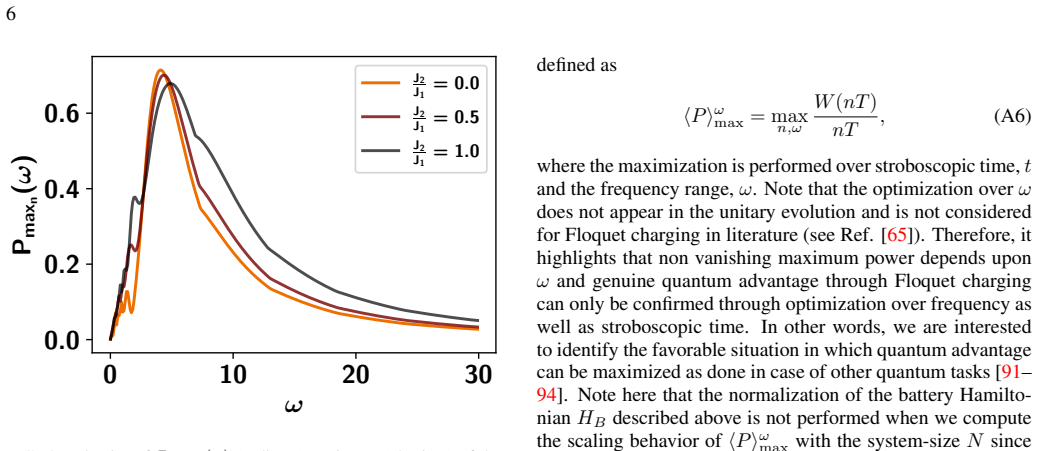
Response of power with variable range interactions For physical systems like ion traps [58, 67–69], the variable- range interactions appear naturally in the system. We use two parameters to vary the range of interactions in order to analyze the characteristic response of power calculated for a normal- ized work. (A) Power-law fall-off rate coefficient, α....
-
[3]
Gain in power with NNN interacting charger We establish here that although short-range interaction can be beneficial to enhance the power of the QB, super- extensive scaling can only be attained with LR interactions. More precisely, we focus here on the trade-off relation be- tween nearest-neighbor and next-nearest neighbor interaction strengths present i...
-
[4]
J1 X j (σy j σx j+1 + σx j σy j+1) + J2 X j (σy j σx j+2 + σx j σy j+2) # H F2 = − T 2 3 (1 − γ)hz
No benefit in scaling with NNN interactions To perform the scaling analysis analytically, we will derive the time-independent Floquet Hamiltonian for the charging by using Floquet-Magnus expansion (FME) [50, 81, 95]. Since the charging Hamiltonian is periodic in time, i.e., Hch(t) = Hch(t + T ), we invoke Floquet theory to study the dynam- ics of the quan...
-
[5]
Entanglement boost for ex- tractable work from ensembles of quantum batteries,
Robert Alicki and Mark Fannes, “Entanglement boost for ex- tractable work from ensembles of quantum batteries,” Phys. Rev. E 87, 042123 (2013)
2013
-
[6]
Quantum batteries,
Francesco Campaioli, Felix A. Pollock, and Sai Vinjanampa- thy, “Quantum batteries,” in Thermodynamics in the Quantum Regime: Fundamental Aspects and New Directions , edited by Felix Binder, Luis A. Correa, Christian Gogolin, Janet Anders, and Gerardo Adesso (Springer International Publishing, Cham,
-
[7]
Colloquium: Quantum batteries,
Francesco Campaioli, Stefano Gherardini, James Q. Quach, Marco Polini, and Gian Marcello Andolina, “Colloquium: Quantum batteries,” Rev. Mod. Phys.96, 031001 (2024)
2024
Show all 100 references
-
[8]
How small can thermal machines be? the smallest possible refrig- erator,
Noah Linden, Sandu Popescu, and Paul Skrzypczyk, “How small can thermal machines be? the smallest possible refrig- erator,” Phys. Rev. Lett.105, 130401 (2010)
2010
-
[9]
Quantum thermal transistor,
Karl Joulain, J ´er´emie Drevillon, Youn `es Ezzahri, and Jose Ordonez-Miranda, “Quantum thermal transistor,” Phys. Rev. Lett. 116, 200601 (2016)
2016
-
[10]
Quantum mechanical carnot engine,
Carl M Bender, Dorje C Brody, and Bernhard K Meister, “Quantum mechanical carnot engine,” Journal of Physics A: Mathematical and General 33, 4427–4436 (2000)
2000
-
[11]
Quantum thermodynamic cycles and quantum heat engines,
H. T. Quan, Yu-xi Liu, C. P. Sun, and Franco Nori, “Quantum thermodynamic cycles and quantum heat engines,” Phys. Rev. E 76, 031105 (2007)
2007
-
[12]
Gemmer, M
G. Gemmer, M. Michel, and G. Mahler, Quantum Thermody- namics (Springer, New York, 2004)
2004
-
[13]
Quantum charging advantage cannot be extensive without global opera- tions,
Ju-Yeon Gyhm, Dominik ˇSafr´anek, and Dario Rosa, “Quantum charging advantage cannot be extensive without global opera- tions,” Phys. Rev. Lett.128, 140501 (2022)
2022
-
[14]
Hamiltonian k-locality is the key resource for powerful quantum battery charging,
Anupam Sarkar and Sibasish Ghosh, “Hamiltonian k-locality is the key resource for powerful quantum battery charging,” (2025), arXiv:2501.12000 [quant-ph]
2025 arXiv
-
[15]
Genuine quantum advantage in non- linear bosonic quantum batteries,
Gian Marcello Andolina, Vittoria Stanzione, Vittorio Giovan- netti, and Marco Polini, “Genuine quantum advantage in non- linear bosonic quantum batteries,” (2024), arXiv:2409.08627 [quant-ph]
2024 arXiv
-
[16]
High-power collective charging of a solid-state quantum battery,
Dario Ferraro, Michele Campisi, Gian Marcello Andolina, Vit- torio Pellegrini, and Marco Polini, “High-power collective charging of a solid-state quantum battery,” Phys. Rev. Lett.120, 117702 (2018)
2018
-
[17]
Quantum versus classical many-body batteries,
Gian Marcello Andolina, Maximilian Keck, Andrea Mari, Vit- torio Giovannetti, and Marco Polini, “Quantum versus classical many-body batteries,” Phys. Rev. B99, 205437 (2019)
2019
-
[18]
Stable adiabatic quantum batteries,
Alan C. Santos, Barı s ¸ C ¸ akmak, Steve Campbell, and Nikolaj T. Zinner, “Stable adiabatic quantum batteries,” Phys. Rev. E 100, 032107 (2019)
2019
-
[19]
Quantum advantage in the charg- ing process of sachdev-ye-kitaev batteries,
Davide Rossini, Gian Marcello Andolina, Dario Rosa, Matteo Carrega, and Marco Polini, “Quantum advantage in the charg- ing process of sachdev-ye-kitaev batteries,” Phys. Rev. Lett.125, 236402 (2020)
2020
-
[20]
Bounds on the capac- ity and power of quantum batteries,
Sergi Juli `a-Farr´e, Tymoteusz Salamon, Arnau Riera, Manaben- dra N. Bera, and Maciej Lewenstein, “Bounds on the capac- ity and power of quantum batteries,” Phys. Rev. Res. 2, 023113 (2020)
2020
-
[21]
Spin-chain model of a many-body quantum battery,
Thao P. Le, Jesper Levinsen, Kavan Modi, Meera M. Parish, and Felix A. Pollock, “Spin-chain model of a many-body quantum battery,” Phys. Rev. A97, 022106 (2018)
2018
-
[22]
Enhancement in the performance of a quantum battery by ordered and disor- dered interactions,
Srijon Ghosh, Titas Chanda, and Aditi Sen(De), “Enhancement in the performance of a quantum battery by ordered and disor- dered interactions,” Phys. Rev. A101, 032115 (2020)
2020
-
[23]
Fast charging of a quantum battery assisted by noise,
Srijon Ghosh, Titas Chanda, Shiladitya Mal, and Aditi Sen(De), “Fast charging of a quantum battery assisted by noise,” Phys. Rev. A 104, 032207 (2021)
2021
-
[24]
Dimensional enhancements in a quantum battery with imperfections,
Srijon Ghosh and Aditi Sen(De), “Dimensional enhancements in a quantum battery with imperfections,” Phys. Rev. A 105, 022628 (2022)
2022
-
[25]
Local passivity and entangle- ment in shared quantum batteries,
Kornikar Sen and Ujjwal Sen, “Local passivity and entangle- ment in shared quantum batteries,” Phys. Rev. A 104, L030402 (2021)
2021
-
[26]
Ultrafast charging in a two-photon dicke quantum bat- tery,
Alba Crescente, Matteo Carrega, Maura Sassetti, and Dario Fer- raro, “Ultrafast charging in a two-photon dicke quantum bat- tery,” Phys. Rev. B102, 245407 (2020)
2020
-
[27]
Enhancing coherent energy transfer between quantum de- vices via a mediator,
Alba Crescente, Dario Ferraro, Matteo Carrega, and Maura Sas- setti, “Enhancing coherent energy transfer between quantum de- vices via a mediator,” Phys. Rev. Res.4, 033216 (2022)
2022
-
[28]
Quantum battery with ultracold atoms: Bosons versus fermions,
Tanoy Kanti Konar, Leela Ganesh Chandra Lakkaraju, Srijon Ghosh, and Aditi Sen(De), “Quantum battery with ultracold atoms: Bosons versus fermions,” Phys. Rev. A 106, 022618 (2022)
2022
-
[29]
Multimode advantage in continuous-variable quantum batteries,
Tanoy Kanti Konar, Ayan Patra, Rivu Gupta, Srijon Ghosh, and Aditi Sen(De), “Multimode advantage in continuous-variable quantum batteries,” Phys. Rev. A110, 022226 (2024)
2024
-
[30]
Quantum battery with non-hermitian charging,
Tanoy Kanti Konar, Leela Ganesh Chandra Lakkaraju, and Aditi Sen (De), “Quantum battery with non-hermitian charging,” Phys. Rev. A 109, 042207 (2024)
2024
-
[31]
Positive and non-positive measurements in en- ergy extraction from quantum batteries,
Paranjoy Chaki, Aparajita Bhattacharyya, Kornikar Sen, and Ujjwal Sen, “Positive and non-positive measurements in en- ergy extraction from quantum batteries,” arXiv (2024), 10.48550/arXiv.2404.18745, 2404.18745
-
[32]
Performance of quantum batteries with correlated and uncorrelated chargers,
Mohammad B. Arjmandi, Abbas Shokri, Esfandyar Faizi, and Hamidreza Mohammadi, “Performance of quantum batteries with correlated and uncorrelated chargers,” Phys. Rev. A 106, 13 062609 (2022)
2022
-
[33]
Vacuum-enhanced charging of a quantum battery,
Tiago F. F. Santos, Yohan Vianna de Almeida, and Marcelo F. Santos, “Vacuum-enhanced charging of a quantum battery,” Phys. Rev. A 107, 032203 (2023)
2023
-
[34]
Auxiliary-assisted stochastic en- ergy extraction from quantum batteries,
Paranjoy Chaki, Aparajita Bhattacharyya, Kornikar Sen, and Ujjwal Sen, “Auxiliary-assisted stochastic en- ergy extraction from quantum batteries,” arXiv (2023), 10.48550/arXiv.2307.16856, 2307.16856
2023 doi
-
[35]
Universal and complete extraction for energy-invariant catal- ysis in quantum batteries versus no uncorrelated state- invariant catalysis,
Paranjoy Chaki, Aparajita Bhattacharyya, and Ujjwal Sen, “Universal and complete extraction for energy-invariant catal- ysis in quantum batteries versus no uncorrelated state- invariant catalysis,” arXiv (2024), 10.48550/arXiv.2409.14153, 2409.14153
-
[36]
Artificial intelli- gence discovery of a charging protocol in a micromaser quantum battery,
Carla Rodr ´ıguez, Dario Rosa, and Jan Olle, “Artificial intelli- gence discovery of a charging protocol in a micromaser quantum battery,” Phys. Rev. A108, 042618 (2023)
2023
-
[37]
Sunburst quantum ising battery,
Akash Mitra and Shashi C. L. Srivastava, “Sunburst quantum ising battery,” Phys. Rev. A110, 012227 (2024)
2024
-
[38]
Charging by quantum measure- ment,
Jia-shun Yan and Jun Jing, “Charging by quantum measure- ment,” Phys. Rev. Appl.19, 064069 (2023)
2023
-
[39]
Remote charging and degradation suppression for the quantum battery,
Wan-Lu Song, Hai-Bin Liu, Bin Zhou, Wan-Li Yang, and Jun- Hong An, “Remote charging and degradation suppression for the quantum battery,” Phys. Rev. Lett.132, 090401 (2024)
2024
-
[40]
Topological quantum batteries,
Zhi-Guang Lu, Guoqing Tian, Xin-You L ¨u, and Cheng Shang, “Topological quantum batteries,” (2024), arXiv:2405.03675 [quant-ph]
2024 arXiv
-
[41]
Experimental investigation of coherent ergotropy in a sin- gle spin system,
Zhibo Niu, Yang Wu, Yunhan Wang, Xing Rong, and Jiangfeng Du, “Experimental investigation of coherent ergotropy in a sin- gle spin system,” Phys. Rev. Lett.133, 180401 (2024)
2024
-
[42]
Ergotropy, bound en- ergy and entanglement in 1d long range kitaev model,
Akash Mitra and Shashi C. L. Srivastava, “Ergotropy, bound en- ergy and entanglement in 1d long range kitaev model,” (2024), arXiv:2408.05063 [cond-mat.str-el]
2024 arXiv
-
[43]
Extractable energy from quantum superposition of cur- rent states,
Francesco Perciavalle, Davide Rossini, Juan Polo, and Luigi Amico, “Extractable energy from quantum superposition of cur- rent states,” Quantum Sci. Technol.10, 025046 (2025)
2025
-
[44]
Charging quantum batteries via indefinite causal order: Theory and experiment,
Gaoyan Zhu, Yuanbo Chen, Yoshihiko Hasegawa, and Peng Xue, “Charging quantum batteries via indefinite causal order: Theory and experiment,” Phys. Rev. Lett.131, 240401 (2023)
2023
-
[45]
Many-body localized quantum batteries,
Davide Rossini, Gian Marcello Andolina, and Marco Polini, “Many-body localized quantum batteries,” Phys. Rev. B 100, 115142 (2019)
2019
-
[46]
Localiza- tion effects in disordered quantum batteries,
Mohammad B. Arjmandi, Hamidreza Mohammadi, Andreia Saguia, Marcelo S. Sarandy, and Alan C. Santos, “Localiza- tion effects in disordered quantum batteries,” Phys. Rev. E 108, 064106 (2023)
2023
-
[47]
Beneficial and detrimental entanglement for quantum battery charging,
Ju-Yeon Gyhm and Uwe R. Fischer, “Beneficial and detrimental entanglement for quantum battery charging,” A VS Quantum Sci. 6, 012001 (2024)
2024
-
[48]
Exper- imental analysis of energy transfers between a quantum emitter and light fields,
I. Maillette de Buy Wenniger, S. E. Thomas, M. Maffei, S. C. Wein, M. Pont, N. Belabas, S. Prasad, A. Harouri, A. Lemaˆıtre, I. Sagnes, N. Somaschi, A. Auff `eves, and P. Senellart, “Exper- imental analysis of energy transfers between a quantum emitter and light fields,” (2023...
2023 arXiv
-
[49]
Superconducting transmon qubit-resonator quantum battery,
Fu-Quan Dou and Fang-Mei Yang, “Superconducting transmon qubit-resonator quantum battery,” Phys. Rev. A 107, 023725 (2023)
2023
-
[50]
Optimal charging of a superconducting quantum battery,
Chang-Kang Hu, Jiawei Qiu, Paulo J P Souza, Jiahao Yuan, Yuxuan Zhou, Libo Zhang, Ji Chu, Xianchuang Pan, Ling Hu, Jian Li, Yuan Xu, Youpeng Zhong, Song Liu, Fei Yan, Dian Tan, R Bachelard, C J Villas-Boas, Alan C Santos, and Dapeng Yu, “Optimal charging of a superconducting q...
2022
-
[51]
Ibm quantum platforms: A quantum bat- tery perspective,
Giulia Gemme, Michele Grossi, Dario Ferraro, Sofia Vallecorsa, and Maura Sassetti, “Ibm quantum platforms: A quantum bat- tery perspective,” Batteries8 (2022), 10.3390/batteries8050043
2022 doi
-
[52]
Superab- sorption in an organic microcavity: Toward a quantum battery,
James Q. Quach, Kirsty E. McGhee, Lucia Ganzer, Dominic M. Rouse, Brendon W. Lovett, Erik M. Gauger, Jonathan Keeling, Giulio Cerullo, David G. Lidzey, and Tersilla Virgili, “Superab- sorption in an organic microcavity: Toward a quantum battery,” Sci. Adv. 8 (2022), 10.1126/sc...
2022 doi
-
[53]
Experimental investigation of a quantum battery using star-topology nmr spin systems,
Jitendra Joshi and T. S. Mahesh, “Experimental investigation of a quantum battery using star-topology nmr spin systems,” Phys. Rev. A 106, 042601 (2022)
2022
-
[54]
Uni- versal high-frequency behavior of periodically driven systems: from dynamical stabilization to Floquet engineering,
Marin Bukov, Luca D’Alessio, and Anatoli Polkovnikov, “Uni- versal high-frequency behavior of periodically driven systems: from dynamical stabilization to Floquet engineering,” Adv. Phys. (2015)
2015
-
[55]
High-frequency ap- proximation for periodically driven quantum systems from a Floquet-space perspective,
Andr ´e Eckardt and Egidijus Anisimovas, “High-frequency ap- proximation for periodically driven quantum systems from a Floquet-space perspective,” New J. Phys.17, 093039 (2015)
2015
-
[56]
Floquet States in Open Quantum Systems,
Takashi Mori, “Floquet States in Open Quantum Systems,” Annu. Rev. Condens. Matter Phys. , 35–56 (2023)
2023
-
[57]
Floquet topological phase transitions in a periodically quenched dimer,
Milad Jangjan, Luis E. F. Foa Torres, and Mir Vahid Hos- seini, “Floquet topological phase transitions in a periodically quenched dimer,” Phys. Rev. B106, 224306 (2022)
2022
-
[58]
Prethermalization in periodically driven nonre- ciprocal many-body spin systems,
Adam J. McRoberts, Hongzheng Zhao, Roderich Moessner, and Marin Bukov, “Prethermalization in periodically driven nonre- ciprocal many-body spin systems,” Phys. Rev. Res. 5, 043008 (2023)
2023
-
[59]
From quantum chaos to quantum thermalization,
Luca D’Alessio, Yonatan Kafri, Anatoli Polkovnikov, and Mar- cos Rigol, “From quantum chaos to quantum thermalization,” in AIP Conference Proceedings (AIP Publishing, 2016)
2016
-
[60]
Many- body physics with ultracold gases,
Immanuel Bloch, Jean Dalibard, and Wilhelm Zwerger, “Many- body physics with ultracold gases,” Rev. Mod. Phys. 80, 885– 964 (2008)
2008
-
[61]
Realization of the hofstadter hamiltonian with ul- tracold atoms in optical lattices,
M. Aidelsburger, M. Atala, M. Lohse, J. T. Barreiro, B. Paredes, and I. Bloch, “Realization of the hofstadter hamiltonian with ul- tracold atoms in optical lattices,” Phys. Rev. Lett. 111, 185301 (2013)
2013
-
[62]
Colloquium: Atomic quantum gases in peri- odically driven optical lattices,
Andr ´e Eckardt, “Colloquium: Atomic quantum gases in peri- odically driven optical lattices,” Rev. Mod. Phys. 89, 011004 (2017)
2017
-
[63]
Unified light-matter floquet theory and its application to quan- tum communication,
Georg Engelhardt, Sayan Choudhury, and W. Vincent Liu, “Unified light-matter floquet theory and its application to quan- tum communication,” Phys. Rev. Res.6, 013116 (2024)
2024
-
[64]
Quantum computing Floquet energy spectra,
Benedikt Fauseweh and Jian-Xin Zhu, “Quantum computing Floquet energy spectra,” Quantum 7, 1063 (2023)
2023
-
[66]
Floquet quantum thermal transistor,
Nikhil Gupt, Srijan Bhattacharyya, Bikash Das, Subhadeep Datta, Victor Mukherjee, and Arnab Ghosh, “Floquet quantum thermal transistor,” Phys. Rev. E106, 024110 (2022)
2022
-
[67]
Performance limits of multilevel and multipartite quantum heat machines,
Wolfgang Niedenzu, David Gelbwaser-Klimovsky, and Ger- shon Kurizki, “Performance limits of multilevel and multipartite quantum heat machines,” Phys. Rev. E92, 042123 (2015)
2015
-
[68]
Cooperative many- body enhancement of quantum thermal machine power,
Wolfgang Niedenzu and Gershon Kurizki, “Cooperative many- body enhancement of quantum thermal machine power,” New J. Phys. 20, 113038 (2018)
2018
-
[69]
Periodically driven many-body quantum battery,
Saikat Mondal and Sourav Bhattacharjee, “Periodically driven many-body quantum battery,” Phys. Rev. E105, 044125 (2022)
2022
-
[70]
Validity of many- body approximation methods for a solvable model: (i). exact solutions and perturbation theory,
H.J. Lipkin, N. Meshkov, and A.J. Glick, “Validity of many- body approximation methods for a solvable model: (i). exact solutions and perturbation theory,” Nuclear Physics62, 188–198 (1965)
1965
-
[71]
Single-qubit quantum memory exceeding ten-minute coher- 14 ence time,
Ye Wang, Mark Um, Junhua Zhang, Shuoming An, Ming Lyu, Jing-Ning Zhang, L.-M. Duan, Dahyun Yum, and Kihwan Kim, “Single-qubit quantum memory exceeding ten-minute coher- 14 ence time,” Nat. Photonics 11, 646–650 (2017)
2017
-
[72]
Manipulation and detection of a trapped yb+ hyperfine qubit,
S. Olmschenk, K. C. Younge, D. L. Moehring, D. N. Matsuke- vich, P. Maunz, and C. Monroe, “Manipulation and detection of a trapped yb+ hyperfine qubit,” Phys. Rev. A76, 052314 (2007)
2007
-
[73]
Riemann zeros from Floquet engineering a trapped-ion qubit,
Ran He, Ming-Zhong Ai, Jin-Ming Cui, Yun-Feng Huang, Yong-Jian Han, Chuan-Feng Li, Guang-Can Guo, G. Sierra, and C. E. Creffield, “Riemann zeros from Floquet engineering a trapped-ion qubit,” npj Quantum Inf. 7, 1–6 (2021)
2021
-
[74]
Entan- glement entropy for the long-range ising chain in a transverse field,
Thomas Koffel, M. Lewenstein, and Luca Tagliacozzo, “Entan- glement entropy for the long-range ising chain in a transverse field,” Phys. Rev. Lett.109, 267203 (2012)
2012
-
[75]
Kitaev chains with long-range pair- ing,
Davide V odola, Luca Lepori, Elisa Ercolessi, Alexey V . Gor- shkov, and Guido Pupillo, “Kitaev chains with long-range pair- ing,” Phys. Rev. Lett.113, 156402 (2014)
2014
-
[76]
Nonclassical correlations in subsystems of globally entangled quantum states,
Chandan Mahto, Vijay Pathak, Ardra K. S., and Anil Shaji, “Nonclassical correlations in subsystems of globally entangled quantum states,” Phys. Rev. A106, 012427 (2022)
2022
-
[77]
Better sensing with variable-range interactions,
Monika, Leela Ganesh Chandra Lakkaraju, Srijon Ghosh, and Aditi Sen De, “Better sensing with variable-range interactions,” (2023), arXiv:2307.06901 [quant-ph]
2023 arXiv
-
[78]
Entanglement of weighted graphs uncovering transitions in variable-range interacting models,
Debkanta Ghosh, Keshav Das Agarwal, Pritam Halder, and Aditi Sen(De), “Entanglement of weighted graphs uncovering transitions in variable-range interacting models,” Phys. Rev. A 110, 022431 (2024)
2024
-
[79]
Control- lable floquet topological phases in the magnetic ladder system,
Xu-Jin Wang, Lu Zhang, Liang Yan, and Jie-Yun Yan, “Control- lable floquet topological phases in the magnetic ladder system,” New Journal of Physics 26, 033016 (2024)
2024
-
[80]
Quasienergy band engineering and broadband dy- namic localization in photonic lattices with long-range interac- tion,
Stefano Longhi, Felix Dreisow, Matthias Heinrich, Thomas Pertsch, Andreas T ¨unnermann, Stefan Nolte, and Alexander Szameit, “Quasienergy band engineering and broadband dy- namic localization in photonic lattices with long-range interac- tion,” Phys. Rev. A82, 053813 (2010)
2010
-
[81]
On the van der Waals Theory of the Vapor-Liquid Equilibrium. I. Discussion of a One-Dimensional Model,
M. Kac, G. E. Uhlenbeck, and P. C. Hemmer, “On the van der Waals Theory of the Vapor-Liquid Equilibrium. I. Discussion of a One-Dimensional Model,” J. Math. Phys. 4, 216–228 (1963)
1963
-
[82]
Finite-size scaling expo- nents of the lipkin-meshkov-glick model,
S ´ebastien Dusuel and Julien Vidal, “Finite-size scaling expo- nents of the lipkin-meshkov-glick model,” Phys. Rev. Lett. 93, 237204 (2004)
2004
-
[83]
En- tanglement dynamics in the lipkin-meshkov-glick model,
Julien Vidal, Guillaume Palacios, and Claude Aslangul, “En- tanglement dynamics in the lipkin-meshkov-glick model,” Phys. Rev. A 70, 062304 (2004)
2004
-
[84]
Continuous unitary trans- formations and finite-size scaling exponents in the lipkin- meshkov-glick model,
S ´ebastien Dusuel and Julien Vidal, “Continuous unitary trans- formations and finite-size scaling exponents in the lipkin- meshkov-glick model,” Phys. Rev. B71, 224420 (2005)
2005
-
[85]
On the solution of differential equations of the second order,
Wilhelm Magnus, “On the solution of differential equations of the second order,” Communications on Pure and Applied Math- ematics 7, 649–673 (1954)
1954
-
[86]
(8) that power is non-linearly dependent on the frequency range ω and a maximization should be performed to saturate the bound
It is clear from Eq. (8) that power is non-linearly dependent on the frequency range ω and a maximization should be performed to saturate the bound
-
[87]
Long-range ising and kitaev models: phases, corre- lations and edge modes,
Davide V odola, Luca Lepori, Elisa Ercolessi, and Guido Pupillo, “Long-range ising and kitaev models: phases, corre- lations and edge modes,” New Journal of Physics 18, 015001 (2015)
2015
-
[88]
Sonic horizons and causality in phase transition dynam- ics,
Debasis Sadhukhan, Aritra Sinha, Anna Francuz, Justyna Ste- faniak, Marek M. Rams, Jacek Dziarmaga, and Wojciech H. Zurek, “Sonic horizons and causality in phase transition dynam- ics,” Phys. Rev. B101, 144429 (2020)
2020
-
[89]
Mimicking quantum correlation of a long-range hamiltonian by finite-range interactions,
Leela Ganesh Chandra Lakkaraju, Srijon Ghosh, Debasis Sad- hukhan, and Aditi Sen(De), “Mimicking quantum correlation of a long-range hamiltonian by finite-range interactions,” Phys. Rev. A 106, 052425 (2022)
2022
-
[90]
Two soluble models of an antiferromagnetic chain,
Elliott Lieb, Theodore Schultz, and Daniel Mattis, “Two soluble models of an antiferromagnetic chain,” Annals of Physics 16, 407–466 (1961)
1961
-
[91]
Statisti- cal mechanics of the XY model. i,
Eytan Barouch, Barry M. McCoy, and Max Dresden, “Statisti- cal mechanics of the XY model. i,” Phys. Rev. A 2, 1075–1092 (1970)
1970
-
[92]
Statistical mechanics of the xy model. ii. spin-correlation functions,
Eytan Barouch and Barry M. McCoy, “Statistical mechanics of the xy model. ii. spin-correlation functions,” Phys. Rev. A 3, 786–804 (1971)
1971
-
[93]
Distribution of entanglement with variable range interactions,
Leela Ganesh Chandra Lakkaraju, Srijon Ghosh, Saptarshi Roy, and Aditi Sen(De), “Distribution of entanglement with variable range interactions,” Physics Letters A 418, 127703 (2021)
2021
-
[94]
Thermodynam- ics as a Consequence of Information Conservation,
Manabendra Nath Bera, Arnau Riera, Maciej Lewenstein, Zahra Baghali Khanian, and Andreas Winter, “Thermodynam- ics as a Consequence of Information Conservation,” Quantum3, 121 (2019)
2019
-
[95]
Nielsen and Isaac L
Michael A. Nielsen and Isaac L. Chuang, Quantum Computa- tion and Quantum Information , 1st ed. (Cambridge University Press, Cambridge, UK, 2000)
2000
-
[96]
Quantum metrology,
Vittorio Giovannetti, Seth Lloyd, and Lorenzo Maccone, “Quantum metrology,” Phys. Rev. Lett.96, 010401 (2006)
2006
-
[97]
Quantum advantage in commu- nication networks,
Aditi Sen De and Ujjwal Sen, “Quantum advantage in commu- nication networks,” (2011), arXiv:1105.2412 [quant-ph]
2011 arXiv
-
[98]
Quantum communication,
Nicolas Gisin and Rob Thew, “Quantum communication,” Na- ture Photonics 1, 165–171 (2007)
2007
-
[99]
The magnus expan- sion and some of its applications,
S. Blanes, F. Casas, J.A. Oteo, and J. Ros, “The magnus expan- sion and some of its applications,” Physics Reports 470, 151– 238 (2009)
2009
-
[100]
The quantum Ising chain for beginners,
Glen Bigan Mbeng, Angelo Russomanno, and Giuseppe E. San- toro, “The quantum Ising chain for beginners,” SciPost Phys. Lect. Notes , 82 (2024)
2024
Reviewed August 12, 2026 · model on record in the stance chip above.
Discussion (0). Continue with ORCID to comment.