REVIEW 3 major objections 6 minor 39 references
OD-GCN: Object Detection Boosted by Knowledge GCN
T0 review · 3 major / 6 minor · reviewed 2026-08-14 · deepseek-v4-flash
Pith's one-line read A two-layer GCN post-processor raises COCO detection mAP by 1-5 percentage points across eight pretrained SSD and Faster R-CNN models.
desk verdict A plausible detector post-processing idea whose reported 1–5pp gains are unverified because the GCN training/eval split is never stated. read the letter →
The pith
A machine-rendered reading of the paper's core claim, the machinery that carries it, and where it could break.
The reading
What carries the argument
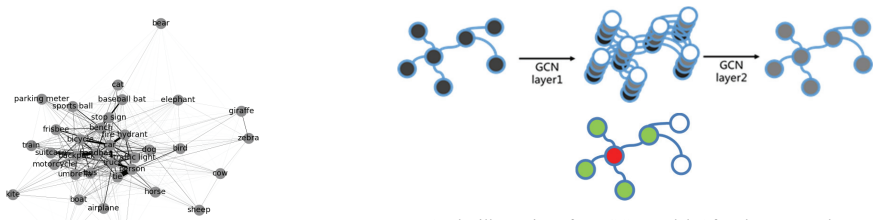
The load-bearing mechanism is a two-layer graph convolutional network acting on a category knowledge graph. Each of the 91 nodes (80 COCO classes plus background, according to the paper) holds one input feature: the maximum confidence that the base detector assigned to that category anywhere in the image. A graph convolution layer updates node features by combining the node's own feature, kept through an identity self-loop, with the features of neighboring categories, normalized by the degree of the graph and scaled by a trainable adaptive parameter alpha; a second trainable bias term shifts the output. The final layer outputs a per-category multiplicative weight vector, applied element-wise to every box's confidence row. The knowledge graph itself is built from COCO training-set statistics, with edge weights equal to the conditional probability of one category appearing given another, and the graph convolution is iterated with channel dimensions 1 to 4 to 1. This object--the max-pooled confidence vector plus adaptive graph convolution over a co-occurrence graph--is what carries the claimed transfer of context knowledge into detection.
What would settle it
Train the GCN on COCO training-set images, or on the non-minival portion of the validation set, and evaluate on COCO 2014 minival. If the 1-5 pp mAP gains do not reproduce, or become negative, the reported improvement came from fitting the evaluation set rather than from category-relationship knowledge.
Extended reading notes
Core claim
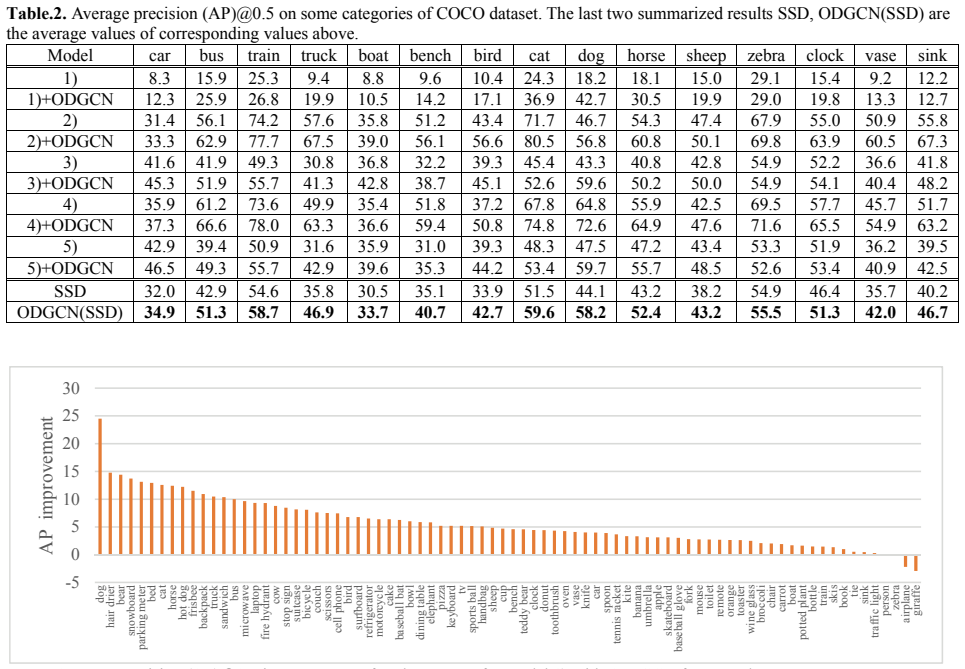
The central discovery is that high-level category co-occurrence, encoded as a knowledge graph, is sufficient signal to adjust a detector's raw confidence scores and improve benchmark accuracy. Concretely, the paper shows that if you take any well-trained detector's B x C confidence matrix, compute the max confidence of each category over all boxes, push that C-dimensional vector through a two-layer GCN whose adjacency matrix is built from conditional probabilities of category pairs in COCO, and element-wise multiply the output weights back into the original matrix, then mAP on COCO 2014 minival rises by about 1-5 percentage points across five SSD and three Faster R-CNN models. The adjustments are learned by cross-entropy loss against ground-truth labels, and the regularization term keeps the weight vector from drifting far from all-ones. The authors interpret the improved per-category AP, especially for strongly context-dependent classes such as car, bus, and cat, as evidence that the knowledge graph supplies information the base CNN lacks.
Load-bearing premise
The result only shows generalization if the GCN post-processor was trained on images that were not also used to compute the reported mAP; the paper does not state the training split for the GCN.
Editorial extensions
If this is right
- Any frozen pretrained detector can be plugged into OD-GCN, so accuracy gains could be obtained for models that cannot be easily retrained.
- Because only the two-layer GCN is trained, the computational overhead over the base detector is under 2%, making the post-processor practical in latency-sensitive settings.
- The multiplicative adjustment is global per image: a single weight per category is applied to all boxes of that category, so the improvement mechanism is re-ranking, not re-localization.
- Improvements are not uniform across categories; context-sensitive classes such as car, bus, cat, and dog see large AP gains, suggesting the method is most useful where co-occurrence is informative.
Reading between the lines
- Inference: because the paper describes computing GCN training labels from ground-truth boxes and evaluates on the same minival set, the reported gains should be re-checked under a clean train/eval split before being interpreted as a general detection improvement.
- Inference: the max-pooling over boxes discards spatial layout and box count, so the mechanism can only rebalance category priors per image; a model that also encoded pairwise spatial relations would likely capture more of the context signal.
- Inference: the same recipe could be tested on other detection benchmarks and on multi-label classification, where category co-occurrence graphs are already used, to see whether the 1-5 pp gain transfers beyond COCO.
- Inference: the adaptive alpha parameter could be made category-dependent rather than global, since some categories are far more context-sensitive than others.
Signed reviews
Editorial analysis
A structured set of objections, weighed in public.
Referee Report
Summary. The paper proposes OD-GCN, a post-processing module for object detection. It builds a knowledge graph from COCO category co-occurrence conditional probabilities, reduces a base detector's B×C confidence matrix to a C-dimensional vector by taking the maximum confidence per category across boxes, and feeds this vector through a two-layer GCN (1→4→1 channels) whose output is multiplied element-wise onto the raw confidence matrix. The GCN is trained with cross-entropy on labels derived from IoU with ground-truth boxes, plus a regularization term that keeps the output near one. Experiments on eight TensorFlow detection models report mAP gains of 1–5pp on COCO minival, along with qualitative examples. The central claim is that this GCN post-processor consistently raises detection accuracy across SSD and Faster R-CNN variants.
Significance. If the reported gains reflect genuine generalization, OD-GCN would be a simple, model-agnostic, and computationally cheap method to boost any pre-trained detector, and the use of max-pooled per-category confidence as a graph feature is a plausible new idea. The paper also claims an adaptive parameter for graph convolution, which could be of interest. These are potentially useful contributions. However, the experimental protocol as presented does not establish held-out evaluation: the GCN training set is not described, so the 1–5pp improvements may be in-sample fitting on the same minival images used for the reported mAP. The significance is therefore contingent on a corrected and fully specified evaluation.
major comments (3)
- [§4 and §3.3.2] The GCN training split is never stated. The paper reports all mAP results on COCO 2014 Minival (8,060 images) and defines training labels as being calculated by maximal IoU with ground-truth boxes 'in the dataset.' If the GCN is trained on the same minival images that are used to compute the reported mAP, the improvements are in-sample and do not demonstrate generalization. The authors must specify exactly which images are used to train the GCN and must provide results where the GCN is trained on COCO train2014 (or another disjoint split) and evaluated on minival. This is load-bearing for the central claim of a consistent 1–5pp boost.
- [§4, Table 1] The magnitude of the reported gains is suspicious relative to the capacity of the GCN (two layers, 1→4→1 channels, roughly 700 parameters). For example, model 1 improves from 6.15 to 9.28 mAP and model 2 from 29.9 to 33.9 mAP. No negative controls are provided, such as training the GCN with shuffled knowledge graph edges or with permuted labels, which would help distinguish genuine category-relationship learning from memorization of the evaluation set. The absence of such controls, together with the unspecified split, leaves the improvement unexplained.
- [§3.4] The training procedure is insufficiently specified for reproducibility. The paper gives the learning rate and decay schedule but does not state the number of training steps, batch size, or the exact data split used for the GCN. Since the GCN is the only trainable part of the framework, these details are necessary for independent verification of the results.
minor comments (6)
- [§3.2, Eq. (1)] The graph convolution equation is not rendered in the manuscript; the formula is missing. Please provide the complete equation with all symbols defined, including the role of the adaptive parameter α.
- [§3.3.2, Eqs. (2) and (3)] The notation around the max operation and the element-wise product is difficult to follow because symbols are garbled. Please rewrite these equations with clear definitions of each matrix and vector.
- [§4] The sentence 'we will present our experiments on several different SSD and Faster R-CNN models trained by Google on MSCOCO 2014 Minival dataset' is misleading; the pre-trained base models are not trained on minival. Please clarify that the base models are pre-trained on COCO and the evaluation is on minival.
- [§4] The paper removes boxes with max confidence lower than 0.1 instead of the standard threshold, which changes the evaluation protocol. Please report results with the standard threshold as well, and justify the choice with an ablation or a clear rationale.
- [§4, Table 1 and Table 2] The model names are enumerated in the table caption but not in the table body; please include the model names directly in the tables for readability.
- [§3.4] The regularization term in Eq. (5) is described as restricting the output to be near one, but the paper does not discuss how sensitive the results are to the value of β; a short sensitivity analysis would improve confidence in the method.
Circularity Check
No circularity found: the GCN post-processor is a trained model evaluated on an external benchmark; the unspecified training split is a reproducibility gap, not a demonstrated circular reduction.
full rationale
The paper's derivation chain is not circular. The GCN (Eq. 1) is a standard graph convolution with trainable weights, and its input (Eq. 2) is a max-pooled confidence vector derived from the base detector's raw output; the final confidence matrix (Eq. 3) is an element-wise product by the GCN's learned adjustment. The loss (Eq. 4) is cross-entropy against ground-truth labels computed by IoU, with a regularization term (Eq. 5) keeping the adjustment near one. These equations do not define the output as a function of the reported mAP or of the training labels; the GCN is a genuine learned post-processor whose improvement is an empirical claim. The knowledge graph is built from COCO training-set co-occurrence statistics following ML-GCN [21], and the paper does not claim the graph itself predicts mAP. The authors' citations are to external methods, not to their own prior work. The only serious concern is that Section 3.3.2 defines training labels from ground-truth boxes in 'the dataset' while Section 4 reports all mAP results on COCO minival and never states a disjoint GCN training split; if the GCN were trained on minival, the reported gains would be in-sample. However, the paper contains no sentence or equation forcing the training set to equal the evaluation set, so this is a missing experimental detail and a verification risk, not a circularity that can be exhibited by quotation and reduction under the stated rules. Therefore the honest finding is no significant circularity, score 0.
Assumptions & free parameters
free parameters (4)
- alpha =
usually 0.1-0.5 after training
- beta =
1.0
- learning rate and decay =
0.01, 95% decay per 100 steps
- low-confidence threshold =
0.1
assumptions (3)
- domain assumption COCO conditional probability graph captures useful category relationships for detection refinement.
- ad hoc to paper Max over boxes is a sufficient summary of image category presence.
- domain assumption Multiplicative confidence adjustment preserves meaningful probability ordering.
Cite this review
Pith. "Pith review of OD-GCN: Object Detection Boosted by Knowledge GCN." pith.science (2026). https://pith.science/paper/5TL2QGTR
@misc{pith2026190804385,
  author       = {Pith},
  title        = {Pith review of: OD-GCN: Object Detection Boosted by Knowledge GCN},
  year         = {2026},
  howpublished = {\url{https://pith.science/paper/5TL2QGTR}},
  note         = {Machine review of arXiv:1908.04385}
}
read the original abstract
Classical CNN based object detection methods only extract the objects' image features, but do not consider the high-level relationship among objects in context. In this article, the graph convolutional networks (GCN) is integrated into the object detection framework to exploit the benefit of category relationship among objects, which is able to provide extra confidence for any pre-trained object detection model in our framework. In experiments, we test several popular base detection models on COCO dataset. The results show promising improvement on mAP by 1-5pp. In addition, visualized analysis reveals the benchmark improvement is quite reasonable in human's opinion.
Figures


Figures from the paper (3 more)

Reference graph
Works this paper leans on
-
[1]
INTRODUCTION Humans have a talent for object detection for many reasons. For one reason, humans can recognize an object not only by knowledge of the object itself, but also by its surrounding objects. For the example shown in Fig.1, there is a detection result of desert with 0.99 confidence, while there is another possible result with 0.34 for fish and 0....
-
[2]
RELATED WORK Object detection is an essential task in computer vision field. It is backbone for many advanced applications, such as facial detection, autonomous driving, drone photography. With help of well-annotated datasets like ImageNet [9], PASCAL VOC [9], MSCOCO [4] and the famous CNN methods like SSD, YOLO, Faster-RCNN [1-3], object detection is abl...
-
[3]
there is category A in the image
APPROACH Our key idea is utilizing information of objects’ relationship for object detection task. In following parts, we will firstly introduce the details of knowledge graph and GCN structure. Then we will explain the whole OD-GCN framework and how it works. 3.1. Knowledge Graph for OD-GCN The category relationship knowledge graph is built following the...
work page 2014
-
[4]
Microsoft COCO is a well-known benchmark dataset for instance segmentation and object detection
EXPERIMENT In this part, we will present our experiments on several different SSD and Faster R-CNN models trained by Google on MSCOCO 2014 Minival dataset. Microsoft COCO is a well-known benchmark dataset for instance segmentation and object detection. COCO 2014 dataset contains 82,081 images as the training set, and 40,504 images as the validation set. T...
work page 2014
-
[5]
ssd_mobilenet_v1_0.75_depth, 2) ssd_mobilenet_v1,
-
[6]
ssd_mobilenet_v1_fpn, 4) ssd_mobilenet_v2,
-
[7]
ssd_resnet50_v1_fpn, 6) faster_rcnn_resnet50,
-
[8]
faster_rcnn_resnet101, 8) faster_rcnn_inception_v2. The last four summarized results SSD, ODGCN(SSD), Faster RCNN, ODGCN(Faster RCNN) are the average values of corresponding values above. Model mAP mAP @0.5 mAP @0.75 SSD 1) 6.15 12.4 4.53 +ODGCN 9.28 17.5 7.31 2) 29.9 48.5 27.2 +ODGCN 33.9 52.3 32.1 3) 23.2 36.9 22.0 +ODGCN 26.3 40.6 25.5 4) 29.3 48.0 26....
Show all 39 references
-
[9]
In this paper, we propose a novel framework named OD-GCN to solve the problem
CONCLUSION Lack of utilization of surrounding information is a crucial issue for classical object detection frameworks. In this paper, we propose a novel framework named OD-GCN to solve the problem. OD-GCN provides a new way for object detection with GCN. For the network struc...
-
[10]
1 36.9 42.7 30.5 19.9 29.0 19.8 13.3 12.7
8.3 15.9 25.3 9.4 8.8 9.6 10.4 2 4.3 18.2 18.1 15.0 29.1 15.4 9.2 12.2 1)+ODGCN 12.3 25.9 26.8 19.9 10.5 14.2 17. 1 36.9 42.7 30.5 19.9 29.0 19.8 13.3 12.7
-
[11]
6 80.5 56.8 60.8 50.1 69.8 63.9 60.5 67.3
31.4 56.1 74.2 57.6 35.8 51.2 43.4 7 1.7 46.7 54.3 47.4 67.9 55.0 50.9 55.8 2)+ODGCN 33.3 62.9 77.7 67.5 39.0 56.1 56. 6 80.5 56.8 60.8 50.1 69.8 63.9 60.5 67.3
-
[12]
1 52.6 59.6 50.2 50.0 54.9 54.1 40.4 48.2
41.6 41.9 49.3 30.8 36.8 32.2 39.3 4 5.4 43.3 40.8 42.8 54.9 52.2 36.6 41.8 3)+ODGCN 45.3 51.9 55.7 41.3 42.8 38.7 45. 1 52.6 59.6 50.2 50.0 54.9 54.1 40.4 48.2
-
[13]
8 74.8 72.6 64.9 47.6 71.6 65.5 54.9 63.2
35.9 61.2 73.6 49.9 35.4 51.8 37.2 6 7.8 64.8 55.9 42.5 69.5 57.7 45.7 51.7 4)+ODGCN 37.3 66.6 78.0 63.3 36.6 59.4 50. 8 74.8 72.6 64.9 47.6 71.6 65.5 54.9 63.2
-
[14]
2 53.4 59.7 55.7 48.5 52.6 53.4 40.9 42.5 SSD 32.0 42.9 54.6 35.8 30.5 35.1 33.9 5 1.5 44.1 43.2 38.2 54.9 46.4 35.7 40.2 ODGCN(SSD) 34.9 51.3 58.7 46.9 33.7 40.7 42.7 59
42.9 39.4 50.9 31.6 35.9 31.0 39.3 4 8.3 47.5 47.2 43.4 53.3 51.9 36.2 39.5 5)+ODGCN 46.5 49.3 55.7 42.9 39.6 35.3 44. 2 53.4 59.7 55.7 48.5 52.6 53.4 40.9 42.5 SSD 32.0 42.9 54.6 35.8 30.5 35.1 33.9 5 1.5 44.1 43.2 38.2 54.9 46.4 35.7 40.2 ODGCN(SSD) 34.9 51.3 58.7 46.9 33.7 ...
-
[15]
Faster R-CNN: Towards Real-Time Object Detection with Region Proposal Networks,
S. Ren, K. He, R. Girshick and J. Sun, "Faster R-CNN: Towards Real-Time Object Detection with Region Proposal Networks," in IEEE Transactions on Pattern Analysis and Machine Intelligence , vol. 39, no. 6, pp. 1137-1149, June 2017
2017
-
[16]
SSD: Single Shot MultiBox Detector,
W. Liu, D. Anguelov, D. Erhan, C. Szegedy, S. Reed, C. Fu, and A. C. Berg, "SSD: Single Shot MultiBox Detector," in ECCV, pp. 21–37, 2016
2016
-
[17]
You Only Look Once: Unified, Real-Time Object Detection,
J. Redmon, S. Divvala, R. Girshick and A. Farhadi, "You Only Look Once: Unified, Real-Time Object Detection," in CVPR, pp. 779-788, 2016
2016
-
[18]
Microsoft COCO: Common Objects in Context,
T. Lin, M. Maire, S. Belongie, J. Hays, P. Perona, D. Ramanan, P. Dollár, and C. L. Zitnick, "Microsoft COCO: Common Objects in Context," in ECCV, pp. 740–755, 2014
2014
-
[19]
Focal Loss for Dense Object Detection,
T. Lin, P. Goyal, R. Girshick, K. He and P. Dollár, "Focal Loss for Dense Object Detection," in CVPR, pp. 2999- 3007, 2017
2017
-
[20]
Feature Pyramid Networks for Object Detection,
T. Lin, P. Dollár, R. Girshick, K. He, B. Hariharan and S. Belongie, "Feature Pyramid Networks for Object Detection," in CVPR, pp. 936-944, 2017
2017
-
[21]
Seeing Small Faces from Robust Anchor's Perspective,
C. Zhu, R. Tao, K. Luu and M. Savvides, "Seeing Small Faces from Robust Anchor's Perspective," in CVPR, pp. 5127-5136, 2018
2018
-
[22]
Feature selective anchor-free module for single-shot object detection,
C. Zhu, Y. He, and M. Savvides, "Feature selective anchor-free module for single-shot object detection," arXiv preprint arXiv:1903.00621, 2019
1903 arXiv
-
[23]
ImageNet: A large-scale hierarchical image database,
J. Deng, W. Dong, R. Socher, L. Li, K. Li and F. Li, "ImageNet: A large-scale hierarchical image database," in CVPR, pp. 248-255, 2009
2009
-
[24]
The pascal visual object classes (VOC) challenge,
M. Everingh am , L. V. Goo l, C. K. Wil liam s, J. Win n, and A. Zisserman, "The pascal visual object classes (VOC) challenge," in IJCV, vol. 88, num. 2, pp. 303–338, 2010
2010
-
[25]
Zero-Shot Learning Through Cross-Modal Transfer,
R. Socher, M. Ganjoo, C. D. Manning, and A. Y. Ng, "Zero-Shot Learning Through Cross-Modal Transfer," in ICLR, 2013
2013
-
[26]
Large Scale Image Annotation: Learning to Rank with Joint Word- Image Embeddings,
J. Weston, S. Bengio, and N. Usunier, "Large Scale Image Annotation: Learning to Rank with Joint Word- Image Embeddings," In ECML, 2010
2010
-
[27]
Zero-Shot Learning via Joint Latent Similarity Embedding,
Z. Zhang and V. Saligrama, "Zero-Shot Learning via Joint Latent Similarity Embedding," in CVPR, pp. 6034- 6042, 2016
2016
-
[28]
Zero-Shot Recognition via Semantic Embeddings and Knowledge Graphs,
X. Wang, Y. Ye and A. Gupta, "Zero-Shot Recognition via Semantic Embeddings and Knowledge Graphs," in CVPR , pp. 6857-6866, 2018
2018
-
[29]
Multi-label image classification with a probabilistic label enhancement model,
X. Li, F. Zhao, and Y. Guo, "Multi-label image classification with a probabilistic label enhancement model," in UAI, pp. 1–10, 2014
2014
-
[30]
Conditional graphical lasso for multi-label image classification,
Q. Li, M. Qiao, W. Bian, and D. Tao, "Conditional graphical lasso for multi-label image classification," in CVPR, pp. 2977–2986, 2016
2016
-
[31]
Multi- label zero-shot learning with structured knowledge graphs,
H. Lee, W. Fang, C. Yeh, and Y. C. F. Wang, "Multi- label zero-shot learning with structured knowledge graphs," in CVPR, pp. 1576–1585, 2018
2018
-
[32]
Devise: A deep visual-semantic embedding model,
A. Frome, G. Corrado, J. Shlens, S. Bengio, J. Dean, and T. Mikolov, "Devise: A deep visual-semantic embedding model," in NIPS, 2013
2013
-
[33]
Zero-shot learning by convex combination of semantic embeddings,
M. Norouzi, T. Mikolov, S. Bengio, Y. Singer, J. Shlens, A. Frome, G. S. Corrado, and J. Dean, "Zero-shot learning by convex combination of semantic embeddings," in ICLR, 2014
2014
-
[34]
Synthesized Classifiers for Zero-Shot Learning,
S. Changpinyo, W. Chao, B. Gong, and F. Sha, "Synthesized Classifiers for Zero-Shot Learning," in CVPR, 2016
2016
-
[35]
Multi-Label Image Recognition with Graph Convolutional Networks,
Z. Chen, X. Wei, P. Wang, Y. Guo, "Multi-Label Image Recognition with Graph Convolutional Networks," in CVPR, 2019
2019
-
[36]
Knowledge Graph-Based Image Classification Refinement,
D. Zhang, M. Cui, Y. Yang, P. Yang, C. Xie , D. Liu, B. Yu, Z. Chen, "Knowledge Graph-Based Image Classification Refinement," in IEEE Access, vol. 7, pp. 57678-57690, 2019
2019
-
[37]
The Graph Neural Network Model,
F. Scarselli, M. Gori, A. C. Tsoi, M. Hagenbuchner and G. Monfardini, "The Graph Neural Network Model," in IEEE Transactions on Neural Networks , vol. 20, no. 1, pp. 61-80, Jan. 2009
2009
-
[38]
Geometric Deep Learning: Going beyond Euclidean data,
M. M. Bronstein, J. Bruna, Y. LeCun, A. Szlam and P. Vandergheynst, "Geometric Deep Learning: Going beyond Euclidean data," in IEEE Signal Processing Magazine, vol. 34, no. 4, pp. 18-42, July 2017
2017
-
[39]
Huang, V
J. Huang, V. Rathod, C. Sun, M. Zhu, A. Korattikara, A. Fathi, I. Fischer, Z. Wojna, Y. Song, S. Guadarrama, K. Murphy, (2011) [Online]. Available: https://github.com/tensorflow/models/tree/master/resear ch/object_detection, Accessed on: Feb. 12, 2014
2011
Reviewed August 14, 2026 · model on record in the stance chip above.
Discussion (0). Continue with ORCID to comment.