REVIEW 3 major objections 7 minor 21 references
Towards Real-World Applications with an Autonomous Powered Wheelchair
T0 review · 3 major / 7 minor · reviewed 2026-07-08 · glm-5.2
Pith's one-line read Self-Balancing Wheelchair Drives Itself to You
desk verdict Honest proof-of-concept for autonomous wheelchair integration; real engineering work but no quantitative evaluation and the planar approximation is already showing cracks. read the letter →
The pith
A machine-rendered reading of the paper's core claim, the machinery that carries it, and where it could break.
The reading
What carries the argument
Genny Zero self-balancing wheelchair; software-control mode converting velocity commands to pitch and steering; ROS 2 Nav2 navigation stack; AMCL localization with differential-drive motion model in the base_footprint frame; LiDAR-based virtual 2D scan; RGB-D body tracking for gesture recognition (hailing, follow-me, stop); Regulated Pure Pursuit controller
What would settle it
If pitch coupling between navigation commands and the balancing controller cannot be neglected at speeds above 1 m/s or when a user is seated on the platform, the velocity-to-pitch control interface would be insufficient for any operationally useful autonomous behavior, and the entire integration approach would need to be replaced with a controller that jointly models navigation and balance dynamics.
Extended reading notes
Core claim
The central finding is that the self-balancing wheelchair's internal pitch-based control can be driven by an outer PID velocity loop, allowing standard planar navigation software to command the platform without directly modeling or accessing the balancing dynamics. This abstraction is sufficient for low-speed, indoor, proof-of-concept demonstrations of people-following and hailing, but it breaks down when command jitter from the navigation layer introduces stop-and-go behavior that couples with the platform's self-balancing dynamics, producing oscillations that can destabilize perception and tracking.
Load-bearing premise
The navigation pipeline treats the wheelchair as a planar differential-drive robot and ignores the pitch dynamics of the self-balancing platform entirely. This quasi-static approximation is load-bearing because all demonstrated behaviors depend on it, and the paper itself shows that it causes oscillations when the planner sends intermittent stop-and-go commands that couple with the balancing controller.
Editorial extensions
If this is right
- If the velocity-to-pitch interface proves robust at higher speeds and with a seated user, autonomous assistive features (hailing, people-following, obstacle-aware navigation) could be deployed on existing self-balancing wheelchairs without redesigning the low-level balancing controller.
- The stop-and-go oscillation problem suggests that navigation planners for self-balancing platforms must produce smooth, continuous velocity profiles rather than the discrete replan-and-stop patterns typical of planar mobile-robot stacks.
- Shared-control driver-assistance functions (forward obstacle awareness, speed modulation, corridor centering) could be built on the same software-control interface, potentially offering a lower-risk path to real-world deployment than full autonomy.
- Extending perception to 360-degree coverage while preserving the wheelchair's form factor and usability remains an unsolved engineering challenge specific to assistive platforms.
Signed reviews
Editorial analysis
A structured set of objections, weighed in public.
Referee Report
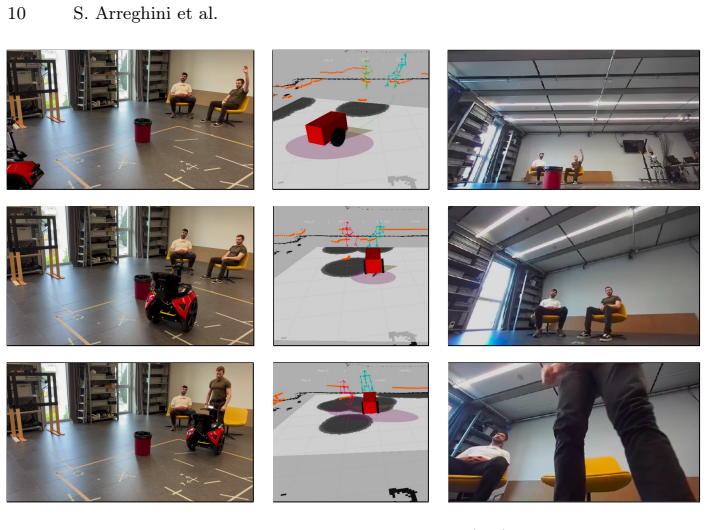
Summary. This paper presents a proof-of-concept integration of autonomous perception (LiDAR + RGB-D), gesture-based interaction, and navigation on the Genny Zero, a commercially available self-balancing powered wheelchair. The system is built on ROS 2 Nav2 with a custom driver that converts velocity commands into pitch and steering inputs for the self-balancing platform. Two assistive behaviors are demonstrated indoors: people-following (including constrained door-crossing and corridor navigation) and remote hailing. The paper is explicitly framed as a preliminary study and is transparent about its limitations: the wheelchair was unoccupied, motor torque was limited to 1 Nm, experiments were indoor-only, and no quantitative benchmarks are provided. The core technical contribution is the software-control interface and the integration pipeline rather than a novel algorithm or theoretical result.
Significance. The paper bridges a commercial self-balancing mobility platform with standard robotic navigation and perception modules, which is a practical engineering contribution of interest to the assistive robotics community. The inclusion of a video demonstrating the experiments and the honest discussion of integration challenges (especially the pitch-coupling issue) are commendable and add value. The work does not claim theoretical novelty; its significance lies in documenting the feasibility and limitations of the approach on a real platform. The gesture recognition module is simple but functional and is appropriately described as a first step.
major comments (3)
- Section 4, paragraph on navigation limitations: The paper acknowledges that the quasi-static planar approximation causes stop-and-go oscillations that interact with the self-balancing controller. This is the central load-bearing concern: the feasibility claim for the software-control interface rests on this approximation, yet the paper's own evidence shows instability symptoms even under the most conservative operating conditions (no payload, 1 Nm torque limit, 0.65 m/s). The paper should more explicitly characterize the severity and frequency of these oscillations—e.g., in how many of the conducted experiments did they occur, and did they cause any experiment to be aborted? This information is needed to assess whether the 'sufficient for proof-of-concept' claim is supported by the evidence.
- Section 3: The paper states that experiments are 'intended as preliminary demonstrations rather than as a quantitative benchmark,' but no quantitative results of any kind are provided—no success rates, no trajectory tracking errors, no timing data, no gesture recognition accuracy. Even for a proof-of-concept paper, minimal quantitative characterization (e.g., number of trials, success/failure counts, following-distance error) would substantially strengthen the feasibility claim and distinguish the demonstrated behaviors from single cherry-picked runs.
- Section 2.3, gesture recognition: The gesture recognition module is described as based on 'simple hands position rules,' but the specific thresholds, hold durations, and failure modes are not specified. Given that gesture recognition is the trigger for all demonstrated behaviors, at least a brief description of the detection logic and its robustness during the experiments would strengthen the system description.
minor comments (7)
- Section 2.1: The maximum velocity is stated as 20 km/h (approximately 5.55 m/s), hardware-limited to 10 km/h, and software-limited to 1.0 m/s. The Nav2 desired linear velocity is then stated as 0.65 m/s in Section 2.3. Clarify which velocity was actually used in experiments.
- Section 2.2: The sensor mount inclination (20 degrees) and the resulting ground-plane intersection distances are described, but a figure showing the actual fields of view overlaid on the platform (as partially done in Fig. 2) with the ground intersection points marked would improve clarity.
- Section 2.3: The command timeout of 0.25 s is mentioned as a safety mechanism. It would help to clarify whether this timeout was triggered during the experiments and whether it contributed to the stop-and-go oscillation issue.
- References [10, 16, 20] are citations to commercial product websites (DAAV, Omeo, Scewo) accessed in 2026. These may not be stable archival references; consider adding archived snapshots or finding published descriptions of these platforms.
- Section 3.1: The following distance of 1.25 m is mentioned in the text but the basis for this choice is not discussed. A brief justification would be useful.
- Fig. 5: The trajectory plot shows a '2 m' scale bar but the axes are unlabeled. Adding axis labels or a grid would improve interpretability. Also clarify whether the scale bar is 2 m (is it a scale bar or a dimension?).
- The abstract states 'A video demonstrating the experimental setup and results is available.' It would be appropriate to state how many trials were conducted and whether the video shows representative or cherry-picked runs.
Simulated Author's Rebuttal
We thank the referee for the careful and constructive review. The referee correctly identifies the paper as a proof-of-concept engineering contribution, and all three major comments request additional quantitative or technical detail that we agree would strengthen the manuscript. We address each comment below.
read point-by-point responses
-
Referee: Section 4: Characterize severity and frequency of stop-and-go oscillations; state how many experiments were affected and whether any were aborted.
Authors: The referee is correct that the oscillation issue is load-bearing for the feasibility claim, and we agree that the current description is insufficiently quantitative. We will revise Section 4 to include the following information. Across the experiments conducted (people-following in open space, people-following through doorway and corridor, and hailing), the stop-and-go oscillations occurred intermittently during the people-following experiments, particularly during the constrained doorway-crossing scenario where frequent replanning was triggered by jitter in the tracked user's position estimate. No experiment was aborted as a result of these oscillations; all demonstrated runs completed successfully. The oscillations were most pronounced during rapid direction changes and goal updates, and did not occur during the hailing experiment, where the navigation goal was static. We will add this characterization to the revised manuscript and note that the oscillations degraded motion smoothness but did not compromise safety or task completion under the conservative operating conditions used. revision: yes
-
Referee: Section 3: No quantitative results at all; provide minimal metrics such as trial counts, success/failure rates, following-distance error, timing data, or gesture recognition accuracy.
Authors: We agree that even a proof-of-concept paper benefits from minimal quantitative characterization, and we will add this to the revised manuscript. Specifically, we will report: (1) the number of trials conducted for each scenario (people-following in open space, people-following in constrained indoor navigation, and hailing), with success/failure counts; (2) following-distance error statistics from the people-following experiments, computed as the deviation between the achieved wheelchair-to-user distance and the configured 1.25 m setpoint; and (3) the trajectory data already shown in Figure 5 will be accompanied by quantitative tracking error metrics. We note that the current experimental setup was not designed as a systematic benchmark, so the quantitative data we can add is limited in scope. However, we agree it is sufficient and necessary to support the feasibility claim and to distinguish the results from cherry-picked runs. revision: yes
-
Referee: Section 2.3: Specify gesture recognition thresholds, hold durations, and failure modes; describe robustness during experiments.
Authors: We agree this information should be included and will add it to Section 2.3. Specifically, we will describe: (1) the detection logic for each of the three gestures (hailing: one hand above a height threshold relative to the head; follow me: one hand within a distance threshold of the corresponding shoulder; stop: both hands within the shoulder distance threshold); (2) the hold duration requirement (the gesture must be maintained for a configurable duration, which we will specify, before the behavior is triggered, to reduce false positives from transient poses); and (3) observed failure modes during the experiments, including cases where partial body occlusion or the user turning away from the camera caused tracking loss and gesture detection failure. We will also briefly comment on the robustness observed during the experiments, noting that gesture recognition was generally reliable when the user faced the camera and remained within the effective tracking range, but was susceptible to occlusion and pose ambiguity at close range or when the user was in motion. revision: yes
Circularity Check
No circularity: this is a systems-integration paper with no theoretical derivation chain to be circular.
full rationale
The paper presents a proof-of-concept integration of off-the-shelf components (Nav2, AMCL, Regulated Pure Pursuit, ZED SDK body tracking) on a commercial self-balancing wheelchair. It makes no first-principles theoretical claims, derives no equations whose outputs are defined by their inputs, and presents no fitted parameters as predictions. The self-citations [3,4,5,6] refer to prior HRI perception work by the authors but appear only in the future-work discussion (Section 4) as directions for richer capabilities—not as load-bearing premises for the integration claims demonstrated in Section 3. The quasi-static planar approximation (Section 2.3) is a modeling assumption whose limitations the paper openly acknowledges, not a circular reduction. The feasibility claim rests on empirical demonstrations (video, trajectory plots), not on a derivation that assumes its own conclusion. No circularity is present.
Assumptions & free parameters
free parameters (8)
- Following distance (people-following) =
1.25 m
- Hailing approach distance =
1.0 m
- Desired linear velocity (Nav2) =
0.65 m/s
- Velocity smoother limits =
0.75 m/s, 0.95 rad/s
- Acceleration/deceleration limits =
1.20 m/s^2, -0.70 m/s^2
- Inflation radius (costmap) =
0.7 m
- Command timeout =
0.25 s
- Sensor mount inclination =
20 degrees
assumptions (4)
- domain assumption The Genny Zero can be approximated as a planar differential-drive robot for low-speed navigation.
- domain assumption ZED 2i body tracking provides sufficiently accurate 3D joint positions for gesture recognition and people-following at the demonstrated ranges.
- domain assumption A virtual 2D scan extracted from the 3D LiDAR point cloud is sufficient for navigation and obstacle avoidance in the demonstrated environments.
- domain assumption Pre-built maps without people are reusable for localization during autonomous operation with people present as temporary obstacles.
Cite this review
Pith. "Pith review of Towards Real-World Applications with an Autonomous Powered Wheelchair." pith.science (2026). https://pith.science/paper/5V4OO5S2
@misc{pith2026260706383,
  author       = {Pith},
  title        = {Pith review of: Towards Real-World Applications with an Autonomous Powered Wheelchair},
  year         = {2026},
  howpublished = {\url{https://pith.science/paper/5V4OO5S2}},
  note         = {Machine review of arXiv:2607.06383}
}
read the original abstract
Wheelchair users call for assistive mobility systems that provide active support, adapt to dynamic environments, and are intuitive and user-friendly. However, powered wheelchairs typically still provide limited autonomy and lack effective integration with advanced perception and navigation capabilities, particularly in complex real-world environments. This paper presents a preliminary study toward autonomous powered wheelchairs for real-world assistive mobility. We introduce a proof-of-concept prototype that integrates autonomous perception, gesture-based interaction, and navigation on a commercially available self-balancing powered wheelchair. The proposed system builds upon Genny Zero, a commercial self-balancing wheelchair that enables hands-free and intuitive operation through body-weight shifting. To extend its capabilities toward autonomous operation, we integrate an RGB-D camera for human-aware perception and interaction, together with a LiDAR sensor for localization and navigation. We demonstrate the integrated system in two assistive applications: (i) hailing, allowing users to call the wheelchair from a distance; and (ii) people-following, where the wheelchair follows a person using leader-follower strategies, including a constrained indoor navigation example. The results highlight the potential of combining autonomous robotics with assistive mobility platforms, while also showing the feasibility of the proposed integration and identifying the main technical challenges that must be addressed before moving toward user-ready, accessible, and intelligent mobility solutions. A video demonstrating the experimental setup and results is available at: https://youtu.be/LVAix_Qx7bM.
Figures


Figures from the paper (3 more)


Reference graph
Works this paper leans on
-
[1]
Robotics and Au- tonomous Systems171, 104568 (2024)
Abbate, G., Giusti, A., Schmuck, V., Celiktutan, O., Paolillo, A.: Self-supervised prediction of the intention to interact with a service robot. Robotics and Au- tonomous Systems171, 104568 (2024)
work page 2024
-
[2]
Autonomous Robots47(8), 1255–1273 (2023)
Antonucci, A., Bevilacqua, P., Leonardi, S., Paolopoli, L., Fontanelli, D.: Humans as path-finders for mobile robots using teach-by-showing navigation. Autonomous Robots47(8), 1255–1273 (2023)
work page 2023
-
[3]
In: ACM/IEEE International Conference on Human-Robot Interaction
Arreghini, S., Abbate, G., Giusti, A., Paolillo, A.: A long-range mutual gaze detec- tor for hri. In: ACM/IEEE International Conference on Human-Robot Interaction. pp. 870–874 (2024)
work page 2024
-
[4]
In: IEEE International Conference on Robotics and Automation
Arreghini, S., Abbate, G., Giusti, A., Paolillo, A.: Predicting the intention to inter- act with a service robot: the role of gaze cues. In: IEEE International Conference on Robotics and Automation. pp. 993–999 (2024) 14 S. Arreghini et al
work page 2024
-
[5]
In: IEEE/RSJ International Conference on Intelligent Robots and Systems
Arreghini, S., Abbate, G., Giusti, A., Paolillo, A.: A service robot in the wild: Analysis of users intentions, robot behaviors, and their impact on the interaction. In: IEEE/RSJ International Conference on Intelligent Robots and Systems. pp. 2536–2541 (2024)
work page 2024
-
[6]
In: IEEE International Conference on Advanced Robotics and its Social Impacts
Arreghini, S., Carlotti, N., Nava, M., Paolillo, A., Giusti, A.: Sixth-sense: Self- supervised learning of spatial awareness of humans from a planar lidar. In: IEEE International Conference on Advanced Robotics and its Social Impacts. pp. — (2026)
work page 2026
-
[7]
International Journal of Social Robotics8(3), 393–408 (2016)
Bonaccorsi, M., Fiorini, L., Cavallo, F., Saffiotti, A., Dario, P.: A cloud robotics so- lution to improve social assistive robots for active and healthy aging. International Journal of Social Robotics8(3), 393–408 (2016)
work page 2016
-
[8]
European Journal of Operational Research277(2), 396–411 (2019)
Boysen, N., De Koster, R., Weidinger, F.: Warehousing in the e-commerce era: A survey. European Journal of Operational Research277(2), 396–411 (2019)
work page 2019
Show all 21 references
-
[9]
In: IEEE International Conference on Mechatronics
Brentari, M., Zambotti, A., Zaccarian, L., Bosetti, P., Biral, F.: Position and speed control of a low-cost two-wheeled, self-balancing inverted pendulum vehicle. In: IEEE International Conference on Mechatronics. pp. 347–352 (2015)
2015
-
[10]
DAAV SA: Autonomous mobility solutions.https://www.daav.ch/, accessed: 2026-04
2026
-
[11]
Urban Planning2(2), 13–25 (2017)
Jittrapirom, P., Caiati, V., Feneri, A.M., Ebrahimigharehbaghi, S., Alonso- González, M.J., Narayan, J.: Mobility as a service: A critical review of definitions, assessments of schemes, and key challenges. Urban Planning2(2), 13–25 (2017)
2017
-
[12]
IEEE Access12, 164248–164261 (2024)
Leong, P.Y., Ahmad, N.S.: Lidar-based obstacle avoidance with autonomous vehi- cles: A comprehensive review. IEEE Access12, 164248–164261 (2024)
2024
-
[13]
IEEE Robotics and Automation Letters (2025)
Liao, Y., Xu, X., Bai, R., Yang, Y., Cao, M., Yuan, S., Xie, L.: Following is all you need: Robot crowd navigation using people as planners. IEEE Robotics and Automation Letters (2025)
2025
-
[14]
Autonomous Robots47(6), 685–694 (2023)
Macenski, S., Singh, S., Martín, F., Ginés, J.: Regulated pure pursuit for robot path tracking. Autonomous Robots47(6), 685–694 (2023)
2023
-
[15]
ACM Transactions on Human-Robot Interaction12(3), 1–39 (2023)
Mavrogiannis, C., Baldini, F., Wang, A., Zhao, D., Trautman, P., Steinfeld, A., Oh, J.: Core challenges of social robot navigation: A survey. ACM Transactions on Human-Robot Interaction12(3), 1–39 (2023)
2023
-
[16]
Omeo Technology: About us.https://omeotechnology.com/about-us/, accessed: 2026-04
2026
-
[17]
World Health Organi- zation (2022)
Organization, W.H.: Global report on assistive technology. World Health Organi- zation (2022)
2022
-
[18]
arXiv preprint arXiv:2511.05158 (2025)
Salimpour, S., Catalano, I., Westerlund, T., Falahi, M., Queralta, J.P.: Follow- me in micro-mobility with end-to-end imitation learning. arXiv preprint arXiv:2511.05158 (2025)
2025
-
[19]
International Journal of Social Robotics 14(2), 441–462 (2022)
Salvini, P., Paez-Granados, D., Billard, A.: Safety concerns emerging from robots navigating in crowded pedestrian areas. International Journal of Social Robotics 14(2), 441–462 (2022)
2022
-
[20]
Scewo AG: About scewo.https://www.scewo.com/en/about/, accessed: 2026-04
2026
-
[21]
Communications of the ACM56(1), 116–124 (2013)
Shotton, J., Sharp, T., Kipman, A., Fitzgibbon, A., Finocchio, M., Blake, A., Cook, M., Moore, R.: Real-time human pose recognition in parts from single depth images. Communications of the ACM56(1), 116–124 (2013)
2013
Reviewed July 8, 2026 · model on record in the stance chip above.
Discussion (0). Continue with ORCID to comment.