A big step forward with SHARP: spatially resolved stellar population properties in passive galaxies at z > 1.5
Pith reviewed 2026-07-01 04:34 UTC · model grok-4.3
The pith
SHARP at the ELT can map stellar population gradients out to 2Re in most massive quiescent galaxies at z < 2.5 with 20-hour exposures.
A machine-rendered reading of the paper's core claim, the machinery that carries it, and where it could break.
Core claim
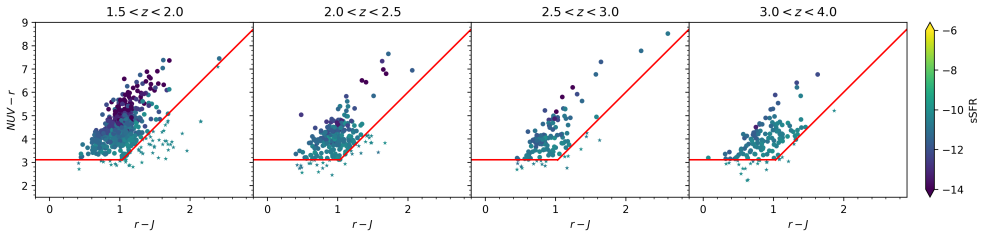
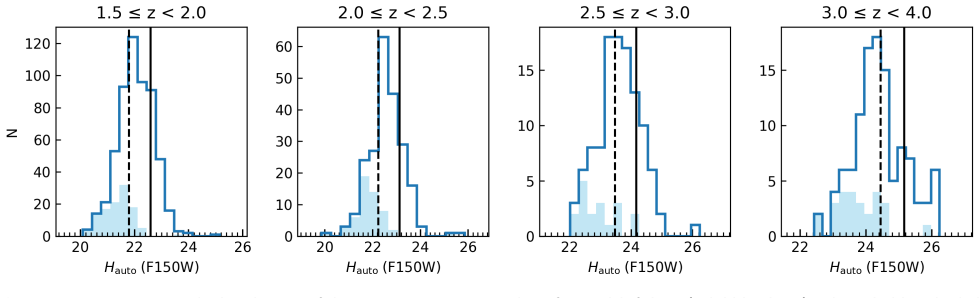
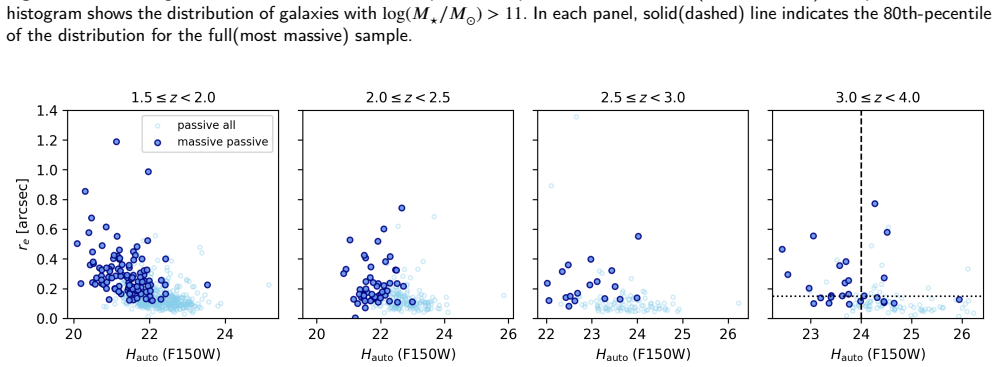
Using the COSMOS-Web catalogue to define a realistic population of massive quiescent galaxies at 1.5 < z < 3 and modeling representative compact and extended systems, simulations with the SHARP ETC show that exposure times of about 20 hours suffice to reach S/N = 10-15 per resolution element out to 2Re for the majority at z < 2.5, while 30 hours reach at least Re at z = 3. The 30 mas resolution enabled by MORFEO MCAO resolves the inner < 1 kpc at all redshifts, allowing direct tests of quenching mechanisms tied to central mass build-up, bulge growth, and structural transformation.
What carries the argument
Simulations with the official SHARP exposure time calculator applied to compact and extended galaxy models drawn from the COSMOS-Web catalogue.
If this is right
- Stellar population gradients become measurable out to 2Re for most massive quiescent galaxies at z < 2.5 in integrations of about 20 hours.
- At z = 3 the same measurements reach at least Re with about 30 hours of integration.
- The inner < 1 kpc region is resolved at all redshifts considered, enabling tests of quenching linked to central mass build-up.
- Statistically meaningful, spatially resolved stellar population constraints become available during the epoch when stellar cores of these galaxies were assembled.
Where Pith is reading between the lines
- Such maps could be combined with lower-redshift samples to trace how radial age and metallicity patterns evolve over cosmic time.
- The ability to resolve central regions might distinguish between quenching scenarios that predict different inner stellar population signatures.
- The exposure time estimates provide a benchmark that could guide observing strategies for similar IFU instruments on other large telescopes.
Load-bearing premise
The COSMOS-Web catalogue supplies a representative sample of massive quiescent galaxies at 1.5 < z < 3 and the chosen compact and extended structural models accurately capture the properties that determine required exposure times.
What would settle it
On-sky SHARP observations that require substantially more than 30 hours to reach S/N = 10-15 at z = 3 or fail to resolve structures inside 1 kpc as predicted by the models.
Figures
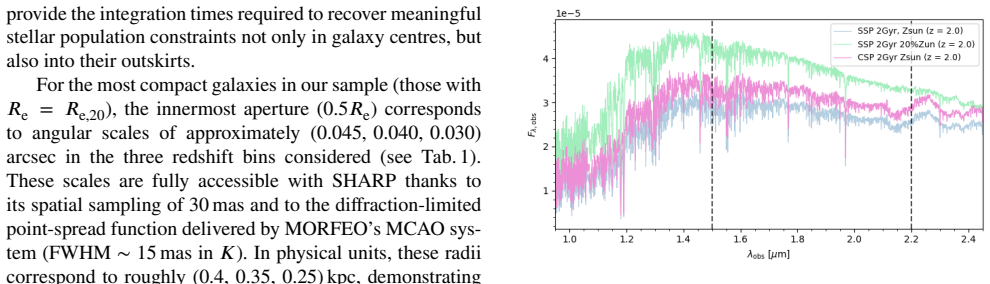
read the original abstract
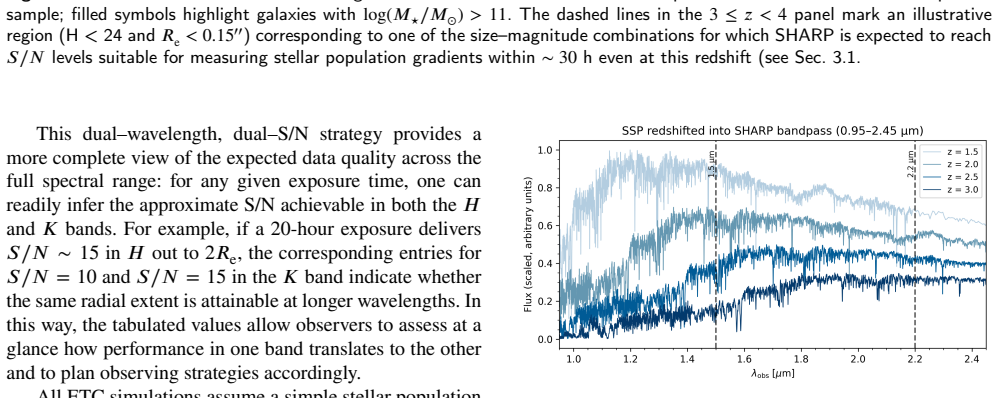
Understanding when and how massive quiescent galaxies (log(M*/Msun) > 10.5) assembled their stellar mass and quenched remains a central challenge in galaxy evolution. Spatially resolved stellar population measurements at z > 1.5 offer a uniquely powerful avenue to address this problem, as they can provide information on the radial variations in stellar age, metallicity, and enrichment histories in passive galaxies as they first emerge. In this work, we present a feasibility study quantifying the transformative capabilities of the proposed IFU SHARP/VESPER at the ELT for performing such radial mapping of stellar population gradients in passive galaxies at 1.5 < z < 3. Using the COSMOS-Web catalogue, we define a realistic population of massive quiescent systems at 1.5 < z < 3 and model representative compact and extended galaxies across this redshift range. Through detailed simulations with the official SHARP ETC, we derive the exposure times required to reach S/N = 10-15 per resolution element at key rest-frame optical wavelengths. Our results show that SHARP will routinely measure stellar population gradients out to 2Re for the majority of the population at z < 2.5 with integrations of about 20h, and that will reach at least Re in about 30h at z = 3. Thanks to MORFEO's MCAO and to its spatial resolution of 30mas SHARP/VESPER will also resolve the inner < 1kpc at all redshifts considered, enabling for the first time, direct tests of quenching mechanisms linked to central mass build-up, bulge growth, and structural transformation. These findings demonstrate that SHARP/VESPER will open an entirely new observational window on the early evolution of massive quiescent galaxies, providing, for the first time, statistically meaningful, spatially resolved stellar population constraints during the epoch when their stellar cores were assembled.
Editorial analysis
A structured set of objections, weighed in public.
Referee Report
Summary. The manuscript is a feasibility study for the proposed SHARP/VESPER IFU on the ELT, using the COSMOS-Web catalogue to select massive quiescent galaxies at 1.5 < z < 3, modeling representative compact and extended systems, and running the official SHARP ETC to compute exposure times for S/N = 10-15 per resolution element at rest-frame optical wavelengths. It concludes that ~20 h integrations enable stellar population gradient measurements out to 2Re for the majority of the population at z < 2.5, while ~30 h reach at least Re at z = 3, with the MCAO resolution also resolving the inner <1 kpc at all redshifts.
Significance. If the exposure-time projections hold, the result would be significant because it quantifies how SHARP/VESPER can deliver the first statistically meaningful, spatially resolved stellar population constraints on massive quiescent galaxies during the epoch of core assembly, directly testing quenching mechanisms tied to central mass build-up and structural transformation. The use of an external catalog for sample definition and the official ETC for forward modeling are strengths that make the projections more reproducible.
major comments (1)
- [Abstract (sample definition and modeling paragraph)] Abstract (sample definition and modeling paragraph): the headline exposure times (20 h to 2Re at z < 2.5; 30 h to Re at z = 3) are obtained by feeding COSMOS-Web-derived compact/extended structural models into the SHARP ETC and requiring S/N = 10-15 per resolution element. No sensitivity analysis to plausible variations in Re, Sersic index, or surface-brightness profile is presented; any systematic offset toward lower surface brightness would increase the quoted times, making this assumption load-bearing for the central claim.
minor comments (1)
- Clarify in the methods section the precise quantitative criteria used to define the 'representative compact and extended' models (e.g., ranges in Re, n, and magnitude) so that readers can assess how the chosen parameters map onto the COSMOS-Web parent sample.
Simulated Author's Rebuttal
We thank the referee for their careful reading and constructive comments on our manuscript. We address the major comment below.
read point-by-point responses
-
Referee: [Abstract (sample definition and modeling paragraph)] Abstract (sample definition and modeling paragraph): the headline exposure times (20 h to 2Re at z < 2.5; 30 h to Re at z = 3) are obtained by feeding COSMOS-Web-derived compact/extended structural models into the SHARP ETC and requiring S/N = 10-15 per resolution element. No sensitivity analysis to plausible variations in Re, Sersic index, or surface-brightness profile is presented; any systematic offset toward lower surface brightness would increase the quoted times, making this assumption load-bearing for the central claim.
Authors: We agree that this is a valid point and that the headline exposure times rest on the adopted structural parameters. Our analysis employs representative compact and extended models drawn directly from the COSMOS-Web catalogue to reflect the observed population, but we did not explore variations in Re, Sersic index or surface-brightness profile. In the revised manuscript we will add a dedicated sensitivity analysis (new subsection or appendix) that perturbs these parameters across the observed ranges at 1.5 < z < 3 and quantifies the resulting changes in required integration time. This will demonstrate the robustness of the quoted 20 h and 30 h figures. revision: yes
Circularity Check
No circularity: forward projections from external catalog and instrument ETC
full rationale
The paper's central claims are exposure-time estimates obtained by selecting galaxies from the independent COSMOS-Web catalog, adopting representative structural models, and feeding them into the official SHARP ETC to compute required integrations for target S/N. No equations, parameters, or results are defined in terms of the output quantities themselves, no self-citations underpin the load-bearing steps, and no fitted inputs are relabeled as predictions. The derivation chain is therefore self-contained against external benchmarks.
Axiom & Free-Parameter Ledger
axioms (2)
- domain assumption COSMOS-Web catalogue provides a representative sample of massive quiescent galaxies at 1.5<z<3
- domain assumption Compact and extended structural models accurately represent the population properties that set exposure times
Reference graph
Works this paper leans on
-
[1]
Cheng, C. M. and et al. , title = ". MNRAS , keywords =. doi:10.1093/mnras/stae1739 , archivePrefix =. 2407.10974 , primaryClass =
-
[2]
On the Restricted Isometry Property of Centered Self Khatri-Rao Products
Stellar Population Diagnostics of Elliptical Galaxy Formation. ARA & A , keywords =. doi:10.1146/annurev.astro.44.051905.092450 , archivePrefix =. astro-ph/0603479 , primaryClass =
work page internal anchor Pith review Pith/arXiv arXiv doi:10.1146/annurev.astro.44.051905.092450
-
[3]
Environment and self-regulation in galaxy formation. MNRAS , keywords =. doi:10.1111/j.1365-2966.2010.16427.x , archivePrefix =. 0912.0259 , primaryClass =
-
[4]
Insights into formation scenarios of massive early-type galaxies from spatially resolved stellar population analysis in CALIFA. MNRAS , keywords =. doi:10.1093/mnras/stz3205 , archivePrefix =. 1906.02209 , primaryClass =
-
[5]
The VLT LEGA-C Spectroscopic Survey: The Physics of Galaxies at a Lookback Time of 7 Gyr
The VLT LEGA-C Spectroscopic Survey: The Physics of Galaxies at a Lookback Time of 7 Gyr. APJS , keywords =. doi:10.3847/0067-0049/223/2/29 , archivePrefix =. 1603.05479 , primaryClass =
work page internal anchor Pith review Pith/arXiv arXiv doi:10.3847/0067-0049/223/2/29
-
[6]
Inverse stellar population age gradients of post-starburst galaxies at z = 0.8 with LEGA-C. MNRAS , keywords =. doi:10.1093/mnras/staa1937 , archivePrefix =. 2007.00663 , primaryClass =
-
[7]
The VIMOS Public Extragalactic Redshift Survey (VIPERS). The distinct build-up of dense and normal massive passive galaxies. AAP , keywords =. doi:10.1051/0004-6361/201630112 , archivePrefix =. 1611.07047 , primaryClass =
work page internal anchor Pith review Pith/arXiv arXiv doi:10.1051/0004-6361/201630112
-
[8]
3D-HST+CANDELS: The Evolution of the Galaxy Size-Mass Distribution since $z=3$
3D-HST+CANDELS: The Evolution of the Galaxy Size-Mass Distribution since z = 3. APJ , keywords =. doi:10.1088/0004-637X/788/1/28 , archivePrefix =. 1404.2844 , primaryClass =
work page internal anchor Pith review Pith/arXiv arXiv doi:10.1088/0004-637x/788/1/28
-
[9]
The Kormendy relation of massive elliptical galaxies at z -0.5ex 1.5: evidence for size evolution. MNRAS , keywords =. doi:10.1111/j.1365-2966.2006.11171.x , archivePrefix =. astro-ph/0610241 , primaryClass =
-
[10]
Passively Evolving Early-type Galaxies at 1.4<z<2.5 in the Hubble Ultra Deep Field
Passively Evolving Early-Type Galaxies at 1.4 < -0.5ex z < -0.5ex 2.5 in the Hubble Ultra Deep Field. ApJ , keywords =. doi:10.1086/430104 , archivePrefix =. astro-ph/0503102 , primaryClass =
work page internal anchor Pith review Pith/arXiv arXiv doi:10.1086/430104
-
[11]
SPIDER - VII. Revealing the stellar population content of massive early-type galaxies out to 8R _ e. MNRAS , keywords =. doi:10.1111/j.1365-2966.2012.21848.x , archivePrefix =. 1208.0587 , primaryClass =
-
[12]
Early-type galaxies at large galactocentric radii - II. Metallicity gradients and the [Z/H]-mass, [ /Fe]-mass relations. MNRAS , keywords =. doi:10.1111/j.1365-2966.2010.17080.x , archivePrefix =. 1006.1698 , primaryClass =
-
[13]
SDSS-IV MaNGA: stellar population gradients as a function of galaxy environment
SDSS-IV MaNGA: stellar population gradients as a function of galaxy environment. MNRAS , keywords =. doi:10.1093/mnras/stw2719 , archivePrefix =. 1612.01545 , primaryClass =
work page internal anchor Pith review Pith/arXiv arXiv doi:10.1093/mnras/stw2719
-
[14]
The CALIFA survey across the Hubble sequence. Spatially resolved stellar population properties in galaxies. AAP , keywords =. doi:10.1051/0004-6361/201525938 , archivePrefix =. 1506.04157 , primaryClass =
work page internal anchor Pith review Pith/arXiv arXiv doi:10.1051/0004-6361/201525938
-
[15]
GRAPE-SPH chemodynamical simulation of elliptical galaxies - I. Evolution of metallicity gradients. MNRAS , keywords =. doi:10.1111/j.1365-2966.2004.07258.x , archivePrefix =. astro-ph/0310160 , primaryClass =
-
[16]
On the survival of metallicity gradients to major dry-mergers
On the survival of metallicity gradients to major dry-mergers. AAP , keywords =. doi:10.1051/0004-6361/200911715 , archivePrefix =. 0903.2846 , primaryClass =
work page internal anchor Pith review Pith/arXiv arXiv doi:10.1051/0004-6361/200911715
-
[17]
The stellar accretion origin of stellar population gradients in massive galaxies at large radii
The stellar accretion origin of stellar population gradients in massive galaxies at large radii. MNRAS , keywords =. doi:10.1093/mnras/stv274 , archivePrefix =. 1410.2244 , primaryClass =
work page internal anchor Pith review Pith/arXiv arXiv doi:10.1093/mnras/stv274
-
[18]
Rest-frame Near-infrared Sizes of Galaxies at Cosmic Noon: Objects in JWST's Mirror Are Smaller than They Appeared. ApJL , keywords =. doi:10.3847/2041-8213/ac8e06 , archivePrefix =. 2207.10655 , primaryClass =
-
[19]
Medium Bands, Mega Science: A JWST/NIRCam Medium-band Imaging Survey of A2744. APJ , keywords =. doi:10.3847/1538-4357/ad75fe , archivePrefix =. 2404.13132 , primaryClass =
-
[20]
A surprising abundance of massive quiescent galaxies at 3 < z < 5 in the first data from JWST CEERS. MNRAS , keywords =. doi:10.1093/mnras/stad369 , archivePrefix =. 2208.00986 , primaryClass =
-
[21]
A massive quiescent galaxy at redshift 4.658. Nature , keywords =. doi:10.1038/s41586-023-06158-6 , archivePrefix =. 2301.11413 , primaryClass =
-
[22]
Half-mass Radii for 7000 Galaxies at 1.0 z 2.5: Most of the Evolution in the Mass-Size Relation Is Due to Color Gradients. APJ , keywords =. doi:10.3847/1538-4357/ab1bda , archivePrefix =. 1904.10992 , primaryClass =
work page internal anchor Pith review Pith/arXiv arXiv doi:10.3847/1538-4357/ab1bda 1904
-
[23]
Spatially resolved colours and stellar population properties in early-type galaxies at z 1.5. MNRAS , keywords =. doi:10.1111/j.1365-2966.2012.21670.x , archivePrefix =. 1207.2295 , primaryClass =
-
[24]
Remarkably Compact Quiescent Candidates at 3 < z < 5 in JWST-CEERS. ApJL , keywords =. doi:10.3847/2041-8213/ad2b6d , archivePrefix =. 2311.05394 , primaryClass =
-
[25]
REQUIEM-2D: A Diversity of Formation Pathways in a Sample of Spatially Resolved Massive Quiescent Galaxies at z 2. APJ , keywords =. doi:10.3847/1538-4357/aca677 , archivePrefix =. 2203.04979 , primaryClass =
-
[26]
Stellar population gradients at cosmic noon as a constraint to the evolution of passive galaxies. AAP , keywords =. doi:10.1051/0004-6361/202142523 , archivePrefix =. 2202.04086 , primaryClass =
-
[27]
Resolved Multi-element Stellar Chemical Abundances in the Brightest Quiescent Galaxy at z 2. ApJL , keywords =. doi:10.3847/2041-8213/aba11c , archivePrefix =. 2007.00205 , primaryClass =
-
[28]
Building up JWST-SUSPENSE: inside-out quenching at cosmic noon from age, Fe-, and Mg-abundance gradients. arXiv e-prints , keywords =. doi:10.48550/arXiv.2509.12316 , archivePrefix =. 2509.12316 , primaryClass =
work page internal anchor Pith review Pith/arXiv arXiv doi:10.48550/arxiv.2509.12316
-
[29]
High-redshift elliptical galaxies: are they (all) really compact?. MNRAS , keywords =. doi:10.1111/j.1365-2966.2009.15728.x , archivePrefix =. 0909.3088 , primaryClass =
-
[30]
The number density of superdense early-type galaxies at 1 < z < 2 and the local cluster galaxies. MNRAS , keywords =. doi:10.1111/j.1745-3933.2010.00920.x , archivePrefix =. 1004.3403 , primaryClass =
-
[31]
COSMOS-Web: The emergence of the Hubble Sequence. arXiv e-prints , keywords =. doi:10.48550/arXiv.2502.03532 , archivePrefix =. 2502.03532 , primaryClass =
-
[32]
COSMOS2025: The COSMOS-Web galaxy catalog of photometry, morphology, redshifts, and physical parameters from JWST, HST, and ground-based imaging. arXiv e-prints , keywords =. doi:10.48550/arXiv.2506.03243 , archivePrefix =. 2506.03243 , primaryClass =
-
[33]
Mass assembly in quiescent and star-forming galaxies since z=4 from UltraVISTA
Mass assembly in quiescent and star-forming galaxies since z = 4 from UltraVISTA. AAP , keywords =. doi:10.1051/0004-6361/201321100 , archivePrefix =. 1301.3157 , primaryClass =
work page internal anchor Pith review Pith/arXiv arXiv doi:10.1051/0004-6361/201321100
-
[34]
The Rapid Buildup of Massive Early-type Galaxies: Supersolar Metallicity, High Velocity Dispersion, and Young Age for an Early-type Galaxy at z = 3.35. APJ , keywords =. doi:10.3847/1538-4357/abc7c4 , archivePrefix =. 2011.04657 , primaryClass =
-
[35]
Sizes, colour gradients and resolved stellar mass distributions for the massive cluster galaxies in XMMUJ2235-2557 at z = 1.39. MNRAS , keywords =. doi:10.1093/mnras/stw502 , archivePrefix =. 1603.00468 , primaryClass =
work page internal anchor Pith review Pith/arXiv arXiv doi:10.1093/mnras/stw502
-
[36]
Colour gradients in cluster ellipticals at z~1.4: the hidden content of the galaxy central regions
Colour gradients in cluster ellipticals at z 1.4: the hidden content of the galaxy central regions. MNRAS , keywords =. doi:10.1093/mnras/stx003 , archivePrefix =. 1701.02736 , primaryClass =
work page internal anchor Pith review Pith/arXiv arXiv doi:10.1093/mnras/stx003
-
[37]
COSMOS2020: A Panchromatic View of the Universe to z 10 from Two Complementary Catalogs. ApJS , keywords =. doi:10.3847/1538-4365/ac3078 , archivePrefix =. 2110.13923 , primaryClass =
-
[38]
The ages and metallicities of galaxies in the local universe. MNRAS , keywords =. doi:10.1111/j.1365-2966.2005.09321.x , archivePrefix =. astro-ph/0506539 , primaryClass =
-
[39]
Predicting Quiescence: The Dependence of Specific Star Formation Rate on Galaxy Size and Central Density at 0.5 < z < 2.5. APJ , keywords =. doi:10.3847/1538-4357/aa6258 , archivePrefix =. 1607.03107 , primaryClass =
work page internal anchor Pith review Pith/arXiv arXiv doi:10.3847/1538-4357/aa6258
-
[40]
Cluster and field elliptical galaxies at z 1.3. The marginal role of the environment and the relevance of the galaxy central regions. AAP , keywords =. doi:10.1051/0004-6361/201628866 , archivePrefix =. 1609.06726 , primaryClass =
work page internal anchor Pith review Pith/arXiv arXiv doi:10.1051/0004-6361/201628866
-
[41]
DAWN JWST Archive: Morphology from profile fitting of over 340 000 galaxies in major JWST fields: Morphology evolution with redshift and galaxy type. AAP , keywords =. doi:10.1051/0004-6361/202555504 , archivePrefix =. 2505.21622 , primaryClass =
-
[42]
A census of metals and baryons in stars in the local Universe. MNRAS , keywords =. doi:10.1111/j.1365-2966.2007.12632.x , archivePrefix =. 0708.0533 , primaryClass =
-
[43]
Evolution of Density Profiles in High-z Galaxies: Compaction and Quenching Inside-Out
Evolution of density profiles in high-z galaxies: compaction and quenching inside-out. MNRAS , keywords =. doi:10.1093/mnras/stw303 , archivePrefix =. 1509.00017 , primaryClass =
work page internal anchor Pith review Pith/arXiv arXiv doi:10.1093/mnras/stw303
-
[44]
Wet Disc Contraction to Galactic Blue Nuggets and Quenching to Red Nuggets
Wet disc contraction to galactic blue nuggets and quenching to red nuggets. MNRAS , keywords =. doi:10.1093/mnras/stt2331 , archivePrefix =. 1310.1074 , primaryClass =
work page internal anchor Pith review Pith/arXiv arXiv doi:10.1093/mnras/stt2331
-
[45]
Compaction and Quenching of High-z Galaxies in Cosmological Simulations: Blue and Red Nuggets
Compaction and quenching of high-z galaxies in cosmological simulations: blue and red nuggets. MNRAS , keywords =. doi:10.1093/mnras/stv740 , archivePrefix =. 1412.4783 , primaryClass =
work page internal anchor Pith review Pith/arXiv arXiv doi:10.1093/mnras/stv740
discussion (0)
Sign in with ORCID, Apple, or X to comment. Anyone can read and Pith papers without signing in.