REVIEW 3 major objections 4 minor 8 references
Exclusion statistics and lattice random walks
T0 review · 3 major / 4 minor · reviewed 2026-08-14 · deepseek-v4-flash
Pith's one-line read Closed random walks on planar lattices, weighted by algebraic area, are exactly the grand partition functions of particles with integer exclusion statistics g—g=2 for the square lattice, g=3 for a triangular chiral walk.
desk verdict The g=3 triangular model and general-g cluster coefficients are real additions, but the unproved coefficient formula and a shift error in (29) need fixing before the new counts are trusted. read the letter →
The pith
A machine-rendered reading of the paper's core claim, the machinery that carries it, and where it could break.
The reading
What carries the argument
The central object is the secular determinant $\det(1-zH_g)$ of a cyclic matrix $H_g$ whose only nonzero entries are one diagonal above and one diagonal $g-1$ steps below the main diagonal (28). This determinant reproduces, up to spurious 'umklapp' wrap-around terms, the exclusion-$g$ grand partition function with spectral function $s_g(k)=g(k)f(k)f(k+1)\cdots f(k+g-2)$ and fugacity $z_g=-z^g$. The combinatorial work is done by the cluster coefficients $c(l_1,\dots,l_j)$ of formula (25), which are built from $g$-compositions: ordered sums of $n$ in which at most $g-2$ consecutive entries may be zero. For the square lattice, the Hofstadter spectral function $\tilde b_{p/q}(k)=4\sin^2(\pi k p/q)$ turns these coefficients into the known algebraic-area generating function.
What would settle it
Enumerate all closed chiral walks of length 6 on the triangular lattice and compare the area distribution with $C_6(0)=36$, $C_6(\pm2)=21$, $C_6(\pm4)=6$; a mismatch would disprove the $g=3$ mapping. Alternatively, compute the $g=3$ cluster coefficients $b(3)$ and $b(4)$ from the defining cluster expansion (17)--(18) and check them against (22)--(23).
Extended reading notes
Core claim
The paper's central claim is that the algebraic-area generating function of closed lattice walks is not merely analogous to, but identical with, the grand partition function of an exclusion-$g$ gas in a fixed single-particle spectrum. For the square lattice, the Hofstadter Hamiltonian produces the $g=2$ case, with the Kreft coefficients playing the role of cluster coefficients. For $g=3$, the paper constructs the chiral Hamiltonian $H_t=U+V+Q^{1+a}U^{-1}V^{-1}$ on a triangular lattice and extracts explicit walk counts such as $C_3(\pm1)=3$ and $C_6(0)=36$. A single determinant can be read in two ways, as a fermionic system with a nontrivial spectrum or as an exclusion-$g$ system with a simple spectrum, which the authors call a 'superfermionization' duality. The paper also supplies formula (25) for the microscopic cluster coefficients of arbitrary integer exclusion statistics, previously known only in the thermodynamic limit.
Load-bearing premise
The load-bearing premise is that the formula for the microscopic cluster coefficients of general exclusion statistics is correct; it is stated without derivation, and all triangular and higher-lattice walk counts depend on it.
Editorial extensions
If this is right
- Square-lattice closed-walk area enumeration is the $g=2$ exclusion grand partition function, so every known Kreft-coefficient identity is a many-body statement for exclusion-$2$ particles.
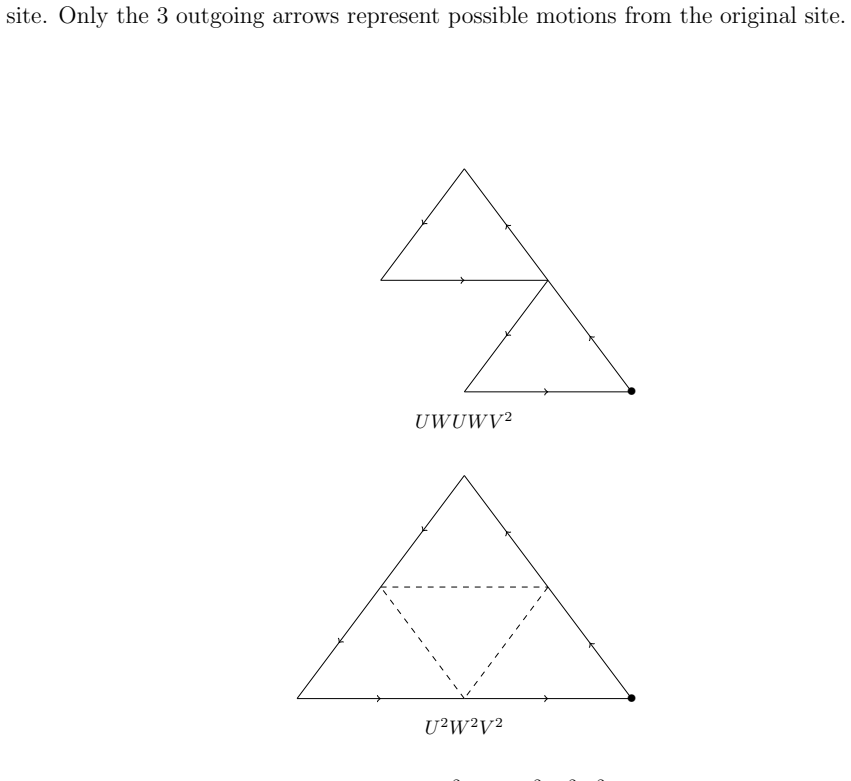
- The triangular chiral walk gives a concrete $g=3$ model, with explicit counts $C_3(\pm1)=3$, $C_6(0)=36$, $C_6(\pm2)=21$, and $C_6(\pm4)=6$ for symmetric cells.
- Formula (25) provides the first exact microscopic cluster coefficients for arbitrary integer $g$, extending results that were previously available only in the thermodynamic limit.
- The 'superfermionization' duality maps any such exclusion-$g$ determinant to a fermionic system with a generally nontrivial spectrum, giving a new handle on both sides.
- Higher-$g$ walk models can be constructed, as illustrated by a $g=4$ Hamiltonian whose $g=2$ description hides an even-particle-number constraint.
Reading between the lines
- Beyond the paper, the determinant duality suggests that planar walk models form a web of equivalences in which one lattice can realize several exclusion parameters depending on how its walks are grouped; this could organize the search for walks realizing fractional $g$.
- Beyond the paper, a direct enumeration of closed triangular chiral walks of length 9 or 12 would provide a cheap independent check of the $g=3$ cluster coefficients (22)--(23), which the paper leaves unverified.
- Beyond the paper, if formula (25) is correct, the same machinery should yield enumerative predictions for the $g=4$ example of Section 6.3, for example length-8 closed-walk counts, offering a sharp test of the higher-$g$ construction.
Signed reviews
Editorial analysis
A structured set of objections, weighed in public.
Referee Report
Summary. The paper claims a connection between exclusion statistics with integer exclusion parameter g and the algebraic-area enumeration of closed random walks on planar lattices. For the square lattice, closed walks are mapped to the Hofstadter Hamiltonian and the Kreft coefficients are reinterpreted as cluster coefficients of exclusion-2 particles; this part re-expresses the authors' earlier results in [1]. The new quantitative content is the explicit g=3 construction: a chiral random walk on the triangular lattice whose Hamiltonian is given in Eq. (32), with spectral function s3(k) in Eq. (34), leading to counts C3(±1)=3 and C6(0)=36, C6(±2)=21, C6(±4)=6. The paper also presents a general formula, Eq. (25), for microscopic cluster coefficients of exclusion statistics of arbitrary integer g, and discusses a matrix generalization (Hg in Eq. (28)) together with higher-g lattice examples.
Significance. If correct, the g=3 triangular-lattice counts are new exact enumerative results, and the general cluster-coefficient formula (25) would fill a recognized gap in the exact microscopic theory of exclusion statistics beyond the thermodynamic limit. The g=2 correspondence is well supported because it reorganizes formulas independently derived in [1], and the g=3 Hamiltonian construction is explicit and internally coherent. The paper also gives a useful 'superfermionization' perspective by writing the same determinant as both a fermionic and an exclusion-g grand partition function. However, the new g=3 predictions and the general-g formula rest on unproved assertions, and one displayed determinant expansion appears to contain a concrete inconsistency for g≠2, so the central new claim is not yet established as written.
major comments (3)
- [Section 4.1 and Section 4.2, Eqs. (23) and (25)] The microscopic cluster coefficients c(l1,...,lj) for g=3 and for general g are asserted without derivation ('one finds' in Section 4.1; 'can be generalized' in Section 4.2). These coefficients are load-bearing: Eq. (23) is used to obtain b(1), b(2) and the thermodynamic check (24), and the same coefficients feed directly into the triangular-lattice counts of Section 6.2 via the relation after Eq. (24). The agreement with the known thermodynamic-limit coefficient q(-1)^{n-1}(3n choose n)/(3n) is a necessary consistency check but not a proof, because many distinct coefficient assignments can sum to the same total. The manuscript should supply a derivation, for instance by induction from the determinant of the exclusion grand partition function, or at minimum an independent verification of the coefficients up to the order used in the walk counts.
- [Section 5.2, Eq. (29)] The determinant identity for the general-g matrix Hg is stated without proof, and as printed it cannot be correct for general g. The displayed z^{3g} term reads s_g(k1+4)s_g(k2+2)s_g(k3), which are the shifts appropriate to g=2; for general g the n=3 term in the exclusion-g grand partition function should be s_g(k1+2g)s_g(k2+g)s_g(k3), reducing to the displayed expression only when g=2. Since this identity is the mechanism by which Hg is claimed to reproduce exclusion-g statistics, it must be corrected and proved, for example by carrying out the trace/Taylor expansion sketched after Eq. (31), with the umklapp order n_c in Eq. (30) checked explicitly.
- [Section 6.2, relation after Eq. (24)] The bridge from cluster coefficients to walk counts, namely sum_A C_n(A)Q^A = (-1)^{n/3-1} n b(n/3)/q, is asserted without derivation and is then used to produce the advertised values C3(±1)=3 and C6(0)=36, C6(±2)=21, C6(±4)=6. This relation should be derived from the cluster expansion connecting b(n) to the partition function Z(n), and the conditions under which umklapp contributions are negligible for the triangular lattice (for instance the vanishing of s3(q-1) and s3(q)) should be stated explicitly. As it stands, the central enumerative predictions depend on an unproved relation in addition to the unproved coefficient formula.
minor comments (4)
- [Abstract and Section 1] The abstract says 'arbitrary integer exclusion parameter g', but the body constructs explicit walk models only for g=2 and g=3, with a sketch for g=4; the scope should be stated more precisely, e.g. as a general matrix construction with explicit walk realizations for low g.
- [Section 4.2, paragraph after Eq. (25)] The statement that there are g^{n-1} g-compositions is used without proof; a short bijective argument or reference would clarify the counting and would also help the reader verify the range 1 ≤ j ≤ (g-1)(n-1)+1.
- [Section 5.2, Eq. (30)] The formula n_c = g ceil(q/(g-1)) - q for the first umklapp order is stated without derivation; given that the preceding identity (29) already contains a shift error, this formula should be rederived and checked for small q and g.
- [Section 6.2, Figure 3 and surrounding text] The text says the closed walk U^2 W^2 V^2 encloses three up-vertex and one down-vertex triangular cells 'all in the counterclockwise sense'; it would help to spell out how the algebraic area of a down-vertex cell is oriented in this convention, since the figure alone does not make the sign convention unambiguous.
Circularity Check
No circularity: the g=3 walk counts are derived from an explicitly constructed triangular-lattice Hamiltonian and explicit low-order cluster coefficients; the g=2 mapping is presented as a reinterpretation of independently derived formulas from [1].
full rationale
The paper's derivation chain is self-contained and does not reduce to its own inputs. For g=2, the paper explicitly attributes equations (13) and (20) to the prior work [1] by one of the authors and then adds the exclusion-statistics dictionary. This is a reinterpretation of an independently derived combinatorial/Hofstadter result, not a case where a prediction is defined in terms of itself or where a fitted parameter is renamed as a prediction. For g=3, the triangular-lattice model is constructed from the Hamiltonian H_t in equation (32), and the determinant identity connecting det(1-zH3) to the exclusion-3 grand partition function with spectral function s3(k) is derived in Section 6.2. The displayed counts C3 and C6 follow from the explicitly listed b(1) and b(2) in equation (22), which are direct consequences of the g=3 partition-function definition and do not depend on the unproved general coefficient formula (25). No parameter is tuned to the walk counts; the total counts agree with independent combinatorial counting. The general microscopic cluster-coefficient formula (23)/(25) is asserted without derivation ('one finds', 'can be generalized'), and equation (29) contains a typo in its three-particle shifts for general g. These are correctness risks, not circularity, because the central g=3 enumerative results presented in the paper use only the explicit low-order coefficients. There is no self-definitional step, no fitted input called a prediction, and no load-bearing self-citation chain. The self-citation to [1] is real prior mathematical content, not an unverified appeal. Therefore the circularity score is 0.
Assumptions & free parameters
free parameters (1)
- a =
arbitrary real (not fitted)
assumptions (3)
- domain assumption The algebraic area enumeration generating function for lattice walks is obtained from Tr H^n after discarding umklapp terms (Eq. 8), as established in [1].
- ad hoc to paper The determinant of 1 - z Hg expands as the exclusion-g grand partition function with umklapp terms starting at order z^{n_c} (Eq. 29).
- ad hoc to paper The general cluster coefficient formula (25), with g=3 special case (23), gives the coefficients c(l1,...,lj) for g-compositions.
Cite this review
Pith. "Pith review of Exclusion statistics and lattice random walks." pith.science (2026). https://pith.science/paper/5VYH46AV
@misc{pith2026190800990,
  author       = {Pith},
  title        = {Pith review of: Exclusion statistics and lattice random walks},
  year         = {2026},
  howpublished = {\url{https://pith.science/paper/5VYH46AV}},
  note         = {Machine review of arXiv:1908.00990}
}
abstract
We establish a connection between exclusion statistics with arbitrary integer exclusion parameter $g$ and a class of random walks on planar lattices. This connection maps the generating function for the number of closed walks of given length enclosing a given algebraic area on the lattice to the grand partition function of particles obeying exclusion statistics $g$ in a particular single-particle spectrum, determined by the properties of the random walk. Square lattice random walks, described in terms of the Hofstadter Hamiltonian, correspond to $g=2$. In the $g=3$ case we explicitly construct a corresponding chiral random walk model on a triangular lattice, and we point to potential random walk models for higher $g$. In this context, we also derive the form of the microscopic cluster coefficients for arbitrary exclusion statistics.
Figures


Reference graph
Works this paper leans on
-
[1]
The algebraic area of closed lattice random walks
S. Ouvry and S. Wu, “The algebraic area of closed lattice random walks”, Journal of Physics A: Mathematical and Theoretical, Volume 52, Number 25 (2019)
work page 2019
-
[2]
Energy levels and wave functions of Bloch electrons in rational and irrational magnetic fields
D.R. Hofstadter, “Energy levels and wave functions of Bloch electrons in rational and irrational magnetic fields”, Phys. Rev. B 14 (1976) 2239
work page 1976
-
[3]
Explicit Computation of the Discriminant for the Harper Equation with Rational Flux
C. Kreft, “Explicit Computation of the Discriminant for the Harper Equation with Rational Flux”, SFB 288 Preprint No. 89 (1993)
work page 1993
-
[4]
Fractional statistics in arbitrary dimensions: A generalization of the Pauli principle
F.D.M. Haldane, “Fractional statistics in arbitrary dimensions: A generalization of the Pauli principle”, Phys. Rev. Lett. 67 (1991) 937940; see also Y.S. Wu, “Statistical distribution for generalized ideal gas of fractional-statistics particles”, Phys. Rev. Lett. 73 (1994) 922925
work page 1991
-
[5]
Nonrelativistic Bosonization and Fractional Statistics,
A.P. Polychronakos, “Nonrelativistic Bosonization and Fractional Statistics,” Nucl. Phys. B 324 (1989) 597
work page 1989
-
[6]
Equation of State of an Anyon gas in a Strong Magnetic Field
A. Dasni` eres de Veigy and S. Ouvry, “Equation of State of an Anyon gas in a Strong Magnetic Field”, Phys. Rev. Lett. 72 (1994) 600; “One-dimensional Statistical Me- chanics for Identical Particles: the Calogero and Anyon Cases”, Mod. Phys. Lett. A 10 (1995) 1; Mod. Phys. Lett. B 9 (1995) 271
work page 1994
-
[7]
Probabilities and path-integral realization of exclusion statis- tics,
A.P. Polychronakos, “Probabilities and path-integral realization of exclusion statis- tics,” Phys. Lett. B 365 (1996) 202
work page 1996
-
[8]
Generalized statistics in one dimension,
For relevant reviews of the anyon model, exclusion statistics and related topics see A.P. Polychronakos, “Generalized statistics in one dimension,” Les Houches LXIX Sum- mer School “Topological aspects of low dimensional systems (1998) 415472, arXiv:hep- th/9902157; S. Ouvry, “Anyons and lowest Landau level Anyons,” S´ eminaire Poincar´ e “Le Spin!”(2007)...
Reviewed August 14, 2026 · model on record in the stance chip above.
Discussion (0). Continue with ORCID to comment.