The M_(rm BH)-R_(rm b) relation and the high-mass end of the M_(rm BH)-σ relation
Pith reviewed 2026-06-27 08:47 UTC · model grok-4.3
The pith
Core-Sérsic galaxies with large depleted cores follow a tighter M_BH-R_b relation than M_BH-σ, showing an upturn at the highest masses.
A machine-rendered reading of the paper's core claim, the machinery that carries it, and where it could break.
Core claim
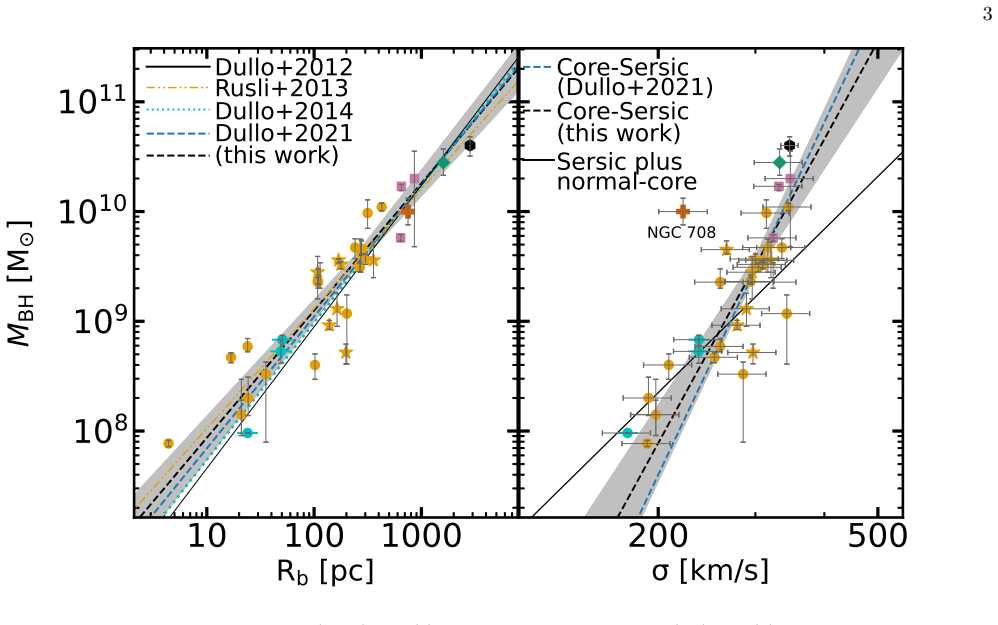
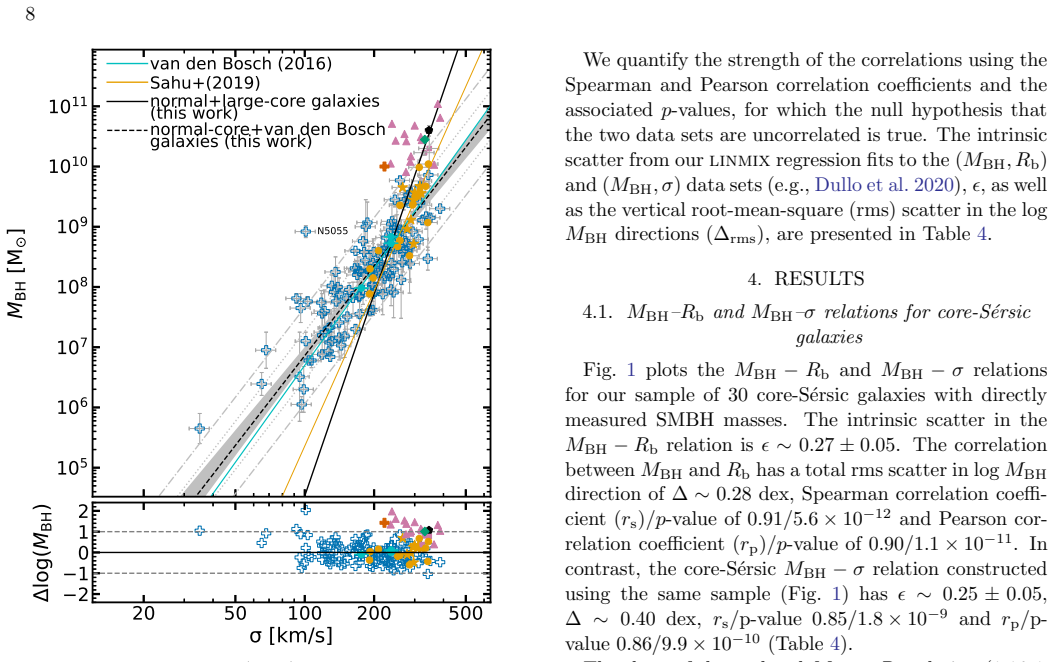
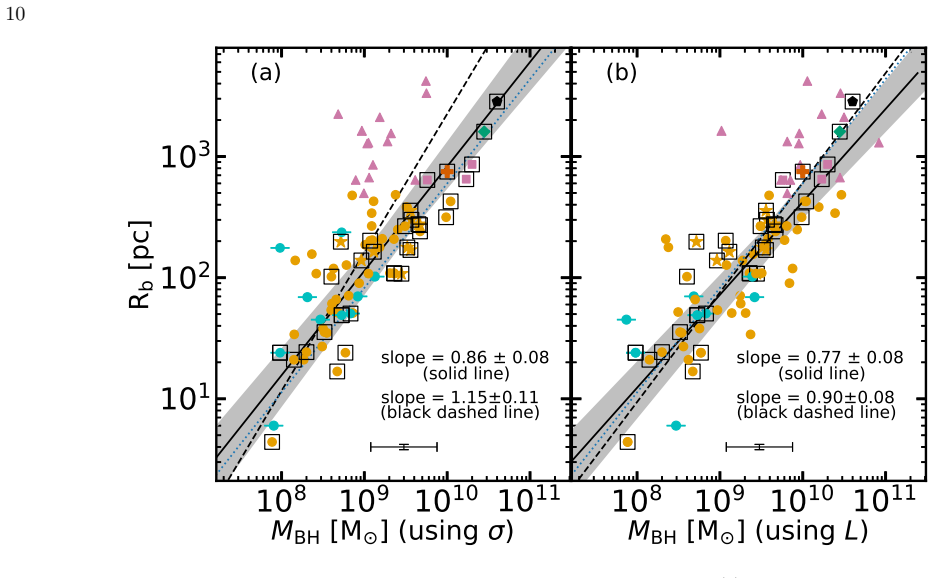
Core-Sérsic galaxies define an updated M_BH-R_b relation of the form M_BH ∝ R_b^{1.16 ± 0.10} with rms scatter Δ_rms ≃ 0.28 dex in log M_BH. Sérsic and normal-core galaxies follow a common log-linear M_BH-σ relation with slope 4.95 ± 0.29 and scatter Δ_rms ≃ 0.46 dex. Large-core galaxies drive a significant high-mass upturn, hosting ultramassive black holes whose masses scale more strongly with R_b than with σ and lie ∼(1-4)× the intrinsic scatter (0.39 dex) above the relation defined by the lower-mass sample. The M_BH-R_b relation shows ∼30-47% less scatter in log M_BH than the corresponding M_BH-σ relation for the same sample. The upturn is interpreted as a consequence of successive major
What carries the argument
The radius of the partially depleted core R_b in core-Sérsic galaxies, measured from high-resolution HST imaging, which serves as the tighter correlate with M_BH at the high-mass end compared to stellar velocity dispersion σ.
If this is right
- Large-core galaxies typically host ultramassive black holes lying ∼(1-4)× above the intrinsic scatter of the M_BH-σ relation defined by Sérsic and normal-core galaxies.
- Black hole masses in these galaxies scale more strongly with R_b than with σ.
- The M_BH-R_b relation exhibits 30-47% less scatter in log M_BH than the M_BH-σ relation for the same sample.
- The high-mass upturn in the M_BH-σ diagram arises from successive major dry mergers.
- This merger scenario explains the flattening of the σ-L_V relation at M_V < -23.5 mag.
Where Pith is reading between the lines
- R_b may serve as a more reliable predictor of black hole mass than σ in the most massive ellipticals if it is less sensitive to recent dynamical heating.
- The reported slope of 1.16 could be tested by obtaining dynamical M_BH measurements for more large-core galaxies across a wider range of R_b.
- Offsets from the M_BH-σ relation in individual galaxies might be used to estimate the number of major dry mergers they experienced.
- This framework connects directly to predictions from cosmological simulations of hierarchical galaxy assembly and black hole growth.
Load-bearing premise
The 30 core-Sérsic galaxies are correctly classified and their R_b values measured from HST imaging are free of significant systematic bias relative to the dynamical M_BH measurements.
What would settle it
A dynamical M_BH measurement for an additional large-core galaxy that places it on the extrapolation of the lower-mass M_BH-σ relation rather than above it by 1-4 times the scatter, or that deviates from the reported M_BH ∝ R_b^{1.16} power law, would falsify the claimed upturn and tighter relation.
Figures
read the original abstract
Using a sample of 151 galaxies with dynamically measured black hole (BH) masses ($M_{\rm BH}$), we investigate the scaling relations between $M_{\rm BH}$ and the stellar velocity dispersion, $\sigma$, and, for a subsample of 30 core-S\'ersic galaxies, between $M_{\rm BH}$ and the size of the partially depleted core, $R_{\rm b}$. Core-S\'ersic galaxies, identified using high-resolution $Hubble ~ Space ~ Telescope$ imaging and spanning both the normal-core $(R_{\rm b}<0.5$ kpc) and large-core ($R_{\rm b}>0.5$ kpc) regimes, define an updated $M_{\rm BH}$$-$$R_{\rm b}$ relation of the form $M_{\rm BH} \propto R_{\rm b}^{1.16 \pm 0.10}$, with an rms scatter of $\Delta_{\rm rms} \simeq 0.28$ dex in $\log M_{\rm BH}$. We find that S\'ersic and normal-core galaxies together follow a common log-linear $M_{\rm BH}$-$\sigma$ relation with a slope of $4.95 \pm 0.29$ and a scatter $\Delta_{\rm rms} \simeq 0.46$ dex. Deviations from this relation arise at the highest BH masses, where large-core galaxies, including six with direct $M_{\rm BH}$ measurements, drive a significant upturn. We find that these galaxies typically host ultramassive black holes whose masses scale more strongly with $R_{\rm b}$ than $\sigma$, and lie $\sim (1-4$) $~\times$ the intrinsic scatter (0.39 dex) above the relation defined by S\'ersic and normal-core galaxies. The $M_{\rm BH}$$-$$R_{\rm b}$ relation shows $\sim 30$-$47\%$ less scatter in $\log M_{\rm BH}$ than the corresponding $M_{\rm BH}$$-$$\sigma$ relation for the same sample. We interpret the high-mass upturn in the $M_{\rm BH}$$-$$\sigma$ diagram as a consequence of successive major, dry mergers, a scenario that naturally explains the observed flattening of the $\sigma-L_V$ relation at $M_V < -23.5$ mag.
Editorial analysis
A structured set of objections, weighed in public.
Referee Report
Summary. Using a sample of 151 galaxies with dynamical M_BH measurements, the paper derives an M_BH-R_b relation for 30 core-Sérsic galaxies (identified via HST imaging) of the form M_BH ∝ R_b^{1.16±0.10} with rms scatter 0.28 dex. Sérsic and normal-core galaxies follow a common M_BH-σ relation with slope 4.95±0.29 and scatter 0.46 dex, while large-core galaxies (R_b > 0.5 kpc) drive a high-mass upturn, lying ∼(1-4)× the 0.39 dex intrinsic scatter above the relation. The M_BH-R_b relation shows 30-47% less scatter in log M_BH than M_BH-σ for the same sample, interpreted as a consequence of successive major dry mergers.
Significance. If the core-Sérsic classifications and R_b measurements prove robust, the work provides a tighter empirical predictor for ultramassive black holes and observational support for dry-merger growth at the high-mass end of the M_BH-σ relation. The reported scatter reduction is a concrete, falsifiable result that could be tested with future dynamical measurements and refined core modeling.
major comments (2)
- [Abstract] Abstract: the reported M_BH-R_b slope, the 30-47% scatter reduction, and the (1-4)× upturn claim all rest on the 30-galaxy core-Sérsic subsample, yet the abstract supplies no information on individual M_BH error bars, sample completeness, or outlier rejection criteria; these choices directly affect the fitted parameters and the identification of the high-mass deviation.
- [Abstract] Abstract (core-Sérsic subsample description): the normal-core vs. large-core division at R_b = 0.5 kpc is used both to define the common M_BH-σ relation and to attribute the upturn to dry mergers; the manuscript must demonstrate that R_b values are free of systematic bias from PSF modeling, core-Sérsic functional form, or resolution limits at the high-mass end, as any offset would alter the slope comparison and the upturn attribution.
minor comments (1)
- [Abstract] Abstract: the text alternates between Δ_rms ≃ 0.28 dex and an intrinsic scatter of 0.39 dex without explicit definition; clarify whether these are the same quantity or how the intrinsic value is derived from the total rms.
Simulated Author's Rebuttal
We thank the referee for their constructive comments, which have helped improve the clarity of the manuscript. We have revised the abstract to incorporate more details on the sample and fitting procedures, and expanded the discussion on the robustness of R_b measurements. These changes address the concerns while maintaining the abstract's conciseness.
read point-by-point responses
-
Referee: [Abstract] Abstract: the reported M_BH-R_b slope, the 30-47% scatter reduction, and the (1-4)× upturn claim all rest on the 30-galaxy core-Sérsic subsample, yet the abstract supplies no information on individual M_BH error bars, sample completeness, or outlier rejection criteria; these choices directly affect the fitted parameters and the identification of the high-mass deviation.
Authors: We agree that additional context in the abstract strengthens the presentation. The revised abstract now notes that the 30 core-Sérsic galaxies are drawn from the parent sample of 151 galaxies with dynamical M_BH measurements compiled from the literature, with typical M_BH uncertainties of 0.1-0.3 dex. The core-Sérsic subsample is defined by the availability of suitable HST imaging for classification, representing the complete set meeting this criterion in the compilation. No individual galaxies were rejected as outliers; the reported fits use the full subsample and follow the maximum-likelihood procedure detailed in Section 3, which accounts for measurement errors and intrinsic scatter. These additions directly address the impact on the slope, scatter reduction, and upturn identification. revision: yes
-
Referee: [Abstract] Abstract (core-Sérsic subsample description): the normal-core vs. large-core division at R_b = 0.5 kpc is used both to define the common M_BH-σ relation and to attribute the upturn to dry mergers; the manuscript must demonstrate that R_b values are free of systematic bias from PSF modeling, core-Sérsic functional form, or resolution limits at the high-mass end, as any offset would alter the slope comparison and the upturn attribution.
Authors: We acknowledge the need to explicitly demonstrate robustness. Section 2 of the manuscript details the core-Sérsic modeling on HST images, including PSF convolution/deconvolution using standard tools (e.g., TinyTim PSFs) and the adopted functional form. We have added a dedicated paragraph in Section 4.2 presenting sensitivity tests: varying the PSF model and core-Sérsic parameters shifts R_b by at most ~15-20% for the large-core systems, insufficient to change their classification relative to the 0.5 kpc threshold or the identification of the high-mass upturn. All large-core galaxies have R_b > 0.5 kpc, well resolved above the HST diffraction limit (~0.05 arcsec, corresponding to physical scales <<0.5 kpc at the relevant distances). These tests confirm that the division and the dry-merger interpretation are not driven by the cited systematics. revision: yes
Circularity Check
Direct empirical fits to dynamical M_BH, photometric R_b and σ data show no circularity
full rationale
The paper reports least-squares fits of power-law relations directly to measured quantities: M_BH ∝ R_b^{1.16±0.10} (rms 0.28 dex) for the 30 core-Sérsic galaxies and M_BH-σ slope 4.95±0.29 (rms 0.46 dex) for Sérsic+normal-core galaxies, plus a direct scatter comparison (30-47% reduction) and an observed upturn at high mass. These quantities are computed from the input sample of 151 dynamical M_BH values and HST-derived R_b, σ measurements; no equation reduces any reported slope, scatter, or upturn to a prior fit or self-citation by construction. Core-Sérsic classification and the normal-core vs. large-core split (R_b=0.5 kpc) are performed on independent imaging data and serve only to partition the sample for the fits. The derivation chain is therefore self-contained against external dynamical benchmarks.
Axiom & Free-Parameter Ledger
free parameters (2)
- slope of M_BH-R_b relation
- slope of M_BH-σ relation
axioms (2)
- domain assumption Dynamically measured M_BH values are unbiased and have correctly estimated uncertainties.
- domain assumption Core-Sérsic classification and R_b measurements from HST imaging are reliable and free of selection bias.
Reference graph
Works this paper leans on
-
[1]
1974, IEEE Transactions on Automatic Control, 19, 716, 10.1109/TAC.1974.1100705
Akaike , H. 1974, IEEE Transactions on Automatic Control, 19, 716, 10.1109/TAC.1974.1100705
-
[2]
Akritas , M. G., & Bershady , M. A. 1996, , 470, 706, 10.1086/177901
-
[3]
Astropy Collaboration , Robitaille , T. P., Tollerud , E. J., et al. 2013, , 558, A33, 10.1051/0004-6361/201322068
-
[4]
, archivePrefix = "arXiv", eprint =
Astropy Collaboration , Price-Whelan , A. M., Sip o cz , B. M., et al. 2018, , 156, 123, 10.3847/1538-3881/aabc4f
-
[5]
Begelman , M. C., Blandford , R. D., & Rees , M. J. 1980, , 287, 307, 10.1038/287307a0
-
[6]
Bernardi , M., Hyde , J. B., Sheth , R. K., Miller , C. J., & Nichol , R. C. 2007, , 133, 1741, 10.1086/511783
-
[7]
Bernardi , M., Roche , N., Shankar , F., & Sheth , R. K. 2011, , 412, 684, 10.1111/j.1365-2966.2010.17984.x
-
[8]
Bezanson , R., van Dokkum , P. G., Tal , T., et al. 2009, , 697, 1290, 10.1088/0004-637X/697/2/1290
-
[9]
Boylan-Kolchin , M., Ma , C.-P., & Quataert , E. 2006, , 369, 1081, 10.1111/j.1365-2966.2006.10379.x
-
[10]
M., Franx , M., Illingworth , G
Carollo , C. M., Franx , M., Illingworth , G. D., & Forbes , D. A. 1997, , 481, 710, 10.1086/304060
-
[11]
2007, , 658, 65, 10.1086/510773
Ciotti , L., Lanzoni , B., & Volonteri , M. 2007, , 658, 65, 10.1086/510773
-
[12]
de Nicola , S., Thomas , J., Saglia , R. P., et al. 2024, , 530, 1035, 10.1093/mnras/stae806
-
[13]
Dullo , B. T. 2019, , 886, 80, 10.3847/1538-4357/ab4d4f
-
[14]
Dullo , B. T., Bouquin , A. Y. K., Gil de Paz , A., Knapen , J. H., & Gorgas , J. 2020, , 898, 83, 10.3847/1538-4357/ab9dff
-
[15]
T., Gil de Paz , A., & Knapen , J
Dullo , B. T., Gil de Paz , A., & Knapen , J. H. 2021, , 908, 134, 10.3847/1538-4357/abceae
-
[16]
Dullo , B. T., & Graham , A. W. 2012, , 755, 163, 10.1088/0004-637X/755/2/163
-
[17]
2014, , 444, 2700, 10.1093/mnras/stu1590
---. 2014, , 444, 2700, 10.1093/mnras/stu1590
-
[18]
2015, , 798, 55, 10.1088/0004-637X/798/1/55
---. 2015, , 798, 55, 10.1088/0004-637X/798/1/55
-
[19]
Dullo , B. T., Graham , A. W., & Knapen , J. H. 2017, , 471, 2321, 10.1093/mnras/stx1635
-
[20]
Dullo , B. T., Knapen , J. H., Beswick , R. J., et al. 2023 a , , 675, A105, 10.1051/0004-6361/202345913
-
[21]
2023 b , , 522, 3412, 10.1093/mnras/stad1122
---. 2023 b , , 522, 3412, 10.1093/mnras/stad1122
-
[22]
Dullo , B. T., Knapen , J. H., Baldi , R. D., et al. 2024, , 532, 4729, 10.1093/mnras/stae1732
-
[23]
Ebisuzaki , T., Makino , J., & Okumura , S. K. 1991, , 354, 212, 10.1038/354212a0
-
[24]
Faber , S. M., & Jackson , R. E. 1976, , 204, 668, 10.1086/154215
-
[25]
Feigelson , E. D., & Babu , G. J. 1992, , 397, 55, 10.1086/171766
-
[26]
2005, , 116, 523, 10.1007/s11214-005-3947-6
Ferrarese , L., & Ford , H. 2005, , 116, 523, 10.1007/s11214-005-3947-6
-
[27]
A Fundamental Relation Between Supermassive Black Holes and Their Host Galaxies
Ferrarese , L., & Merritt , D. 2000, , 539, L9, 10.1086/312838
work page internal anchor Pith review doi:10.1086/312838 2000
-
[28]
2017, , 469, 2184, 10.1093/mnras/stx875
Frigo , M., & Balcells , M. 2017, , 469, 2184, 10.1093/mnras/stx875
-
[29]
2000, , 539, L13, 10.1086/312840
Gebhardt , K., Bender , R., Bower , G., et al. 2000, , 539, L13, 10.1086/312840
-
[30]
The Astronomical Journal , author =
Ginsburg , A., Sip o cz , B. M., Brasseur , C. E., et al. 2019, , 157, 98, 10.3847/1538-3881/aafc33
-
[31]
Graham , A. W., & Scott , N. 2013, , 764, 151, 10.1088/0004-637X/764/2/151
-
[32]
Green , D. A. 2011, Bulletin of the Astronomical Society of India, 39, 289. 1108.5083
Pith/arXiv arXiv 2011
-
[33]
2012, , 744, 74, 10.1088/0004-637X/744/1/74
Gualandris , A., & Merritt , D. 2012, , 744, 74, 10.1088/0004-637X/744/1/74
-
[34]
2014, , 781, 112, 10.1088/0004-637X/781/2/112
G \"u ltekin , K., Gebhardt , K., Kormendy , J., et al. 2014, , 781, 112, 10.1088/0004-637X/781/2/112
-
[35]
G \"u ltekin , K., Richstone , D. O., Gebhardt , K., et al. 2011, , 741, 38, 10.1088/0004-637X/741/1/38
-
[36]
2004, , 604, L89, 10.1086/383567
H \"a ring , N., & Rix , H.-W. 2004, , 604, L89, 10.1086/383567
-
[37]
V., de Zeeuw , T., Mould , J., & Picard , A
Held , E. V., de Zeeuw , T., Mould , J., & Picard , A. 1992, , 103, 851, 10.1086/116106
-
[38]
Hlavacek-Larrondo , J., Fabian , A. C., Edge , A. C., & Hogan , M. T. 2012, , 424, 224, 10.1111/j.1365-2966.2012.21187.x
-
[39]
Hunter, J. D. 2007, Computing in Science & Engineering, 9, 90, 10.1109/MCSE.2007.55
-
[40]
Kelly , B. C. 2007, , 665, 1489, 10.1086/519947
-
[41]
M., Holley-Bockelmann , K., Berczik , P., & Just , A
Khan , F. M., Holley-Bockelmann , K., Berczik , P., & Just , A. 2013, , 773, 100, 10.1088/0004-637X/773/2/100
-
[42]
2001, , 561, 517, 10.1086/323382
Khochfar , S., & Burkert , A. 2001, , 561, 517, 10.1086/323382
-
[43]
2016, in Positioning and Power in Academic Publishing: Players, Agents and Agendas, ed
Kluyver, T., Ragan-Kelley, B., P \'e rez, F., et al. 2016, in Positioning and Power in Academic Publishing: Players, Agents and Agendas, ed. F. Loizides & B. Schmidt, Amsterdam: IOS Press, 87 -- 90
2016
-
[44]
2013, , 769, L5, 10.1088/2041-8205/769/1/L5
Kormendy , J., & Bender , R. 2013, , 769, L5, 10.1088/2041-8205/769/1/L5
-
[45]
title Inward Bound---The Search For Supermassive Black Holes In Galactic Nuclei
Kormendy , J., & Richstone , D. 1995, , 33, 581, 10.1146/annurev.aa.33.090195.003053
-
[46]
Krajnovi \'c , D., Cappellari , M., & McDermid , R. M. 2018, , 473, 5237, 10.1093/mnras/stx2704
-
[47]
Laine , S., van der Marel , R. P., Lauer , T. R., et al. 2003, , 125, 478, 10.1086/345823
-
[48]
Lauer , T. R., Postman , M., Strauss , M. A., Graves , G. J., & Chisari , N. E. 2014, , 797, 82, 10.1088/0004-637X/797/2/82
-
[49]
Lauer , T. R., Faber , S. M., Richstone , D., et al. 2007, , 662, 808, 10.1086/518223
-
[50]
1998, , 115, 2285, 10.1086/300353
Magorrian , J., Tremaine , S., Richstone , D., et al. 1998, , 115, 2285, 10.1086/300353
-
[51]
Malumuth , E. M., & Kirshner , R. P. 1981, , 251, 508, 10.1086/159490
-
[52]
Marconi , A., & Hunt , L. K. 2003, , 589, L21, 10.1086/375804
-
[53]
Matkovi \'c , A., & Guzm \'a n , R. 2005, , 362, 289, 10.1111/j.1365-2966.2005.09298.x
-
[54]
Revisiting the Scaling Relations of Black Hole Masses and Host Galaxy Properties
McConnell , N. J., & Ma , C.-P. 2013, , 764, 184, 10.1088/0004-637X/764/2/184
work page internal anchor Pith review doi:10.1088/0004-637x/764/2/184 2013
-
[55]
J., Ma , C.-P., Gebhardt , K., et al
McConnell , N. J., Ma , C.-P., Gebhardt , K., et al. 2011, , 480, 215, 10.1038/nature10636
-
[56]
McConnell , N. J., Ma , C.-P., Murphy , J. D., et al. 2012, , 756, 179, 10.1088/0004-637X/756/2/179
-
[57]
McLure , R. J., & Dunlop , J. S. 2002, , 331, 795, 10.1046/j.1365-8711.2002.05236.x
-
[58]
2019, , 887, 195, 10.3847/1538-4357/ab5856
Mehrgan , K., Thomas , J., Saglia , R., et al. 2019, , 887, 195, 10.3847/1538-4357/ab5856
-
[59]
2006, , 648, 976, 10.1086/506139
Merritt , D. 2006, , 648, 976, 10.1086/506139
-
[60]
Mezcua , M., Hlavacek-Larrondo , J., Lucey , J. R., et al. 2018, , 474, 1342, 10.1093/mnras/stx2812
-
[61]
2001, , 563, 34, 10.1086/323830
Milosavljevi \'c , M., & Merritt , D. 2001, , 563, 34, 10.1086/323830
-
[62]
2020, , 497, 739, 10.1093/mnras/staa1896
Nasim , I., Gualandris , A., Read , J., et al. 2020, , 497, 739, 10.1093/mnras/staa1896
-
[63]
S., Georganopoulos , M., Guiriec , S., et al
Nemmen , R. S., Georganopoulos , M., Guiriec , S., et al. 2012, Science, 338, 1445, 10.1126/science.1227416
-
[64]
2023, , 950, 15, 10.3847/1538-4357/accffa
Neureiter , B., Thomas , J., Rantala , A., et al. 2023, , 950, 15, 10.3847/1538-4357/accffa
-
[65]
Nipoti , C., Londrillo , P., & Ciotti , L. 2003, , 342, 501, 10.1046/j.1365-8711.2003.06554.x
-
[66]
Novak , G. S., Faber , S. M., & Dekel , A. 2006, , 637, 96, 10.1086/498333
-
[67]
Oegerle , W. R., & Hoessel , J. G. 1991, , 375, 15, 10.1086/170165
-
[68]
Onishi , K., Iguchi , S., Davis , T. A., et al. 2017, , 468, 4663, 10.1093/mnras/stx631
-
[69]
2023, ChatGPT (GPT-4) , Accessed: 2023-03-15
OpenAI . 2023, ChatGPT (GPT-4) , Accessed: 2023-03-15
2023
-
[70]
2025, ChatGPT (GPT-5) , Accessed: 2025-03-15
---. 2025, ChatGPT (GPT-5) , Accessed: 2025-03-15
2025
-
[71]
2003, , 412, 45, 10.1051/0004-6361:20031411
Paturel , G., Petit , C., Prugniel , P., et al. 2003, , 412, 45, 10.1051/0004-6361:20031411
-
[72]
Pilawa , J., Liepold , E. R., Ma , C.-P., Walsh , J. L., & Greene , J. E. 2025, , 989, 98, 10.3847/1538-4357/adee1e
-
[73]
H., Naab , T., Thomas , J., & Frigo , M
Rantala , A., Johansson , P. H., Naab , T., Thomas , J., & Frigo , M. 2018, , 864, 113, 10.3847/1538-4357/aada47
-
[74]
Rusli , S. P., Erwin , P., Saglia , R. P., et al. 2013 a , , 146, 160, 10.1088/0004-6256/146/6/160
-
[75]
Rusli , S. P., Thomas , J., Saglia , R. P., et al. 2013 b , , 146, 45, 10.1088/0004-6256/146/3/45
-
[76]
Sahu , N., Graham , A. W., & Davis , B. L. 2019, , 887, 10, 10.3847/1538-4357/ab50b7
-
[77]
Sasseville , G., Hlavacek-Larrondo , J., Berek , S. C., et al. 2025, , 978, 48, 10.3847/1538-4357/ad93d4
-
[78]
Savorgnan , G. A. D., & Graham , A. W. 2015, , 446, 2330, 10.1093/mnras/stu2259
-
[79]
Schwarz, G. 1978, The Annals of Statistics, 6, 461 , 10.1214/aos/1176344136
-
[80]
S\'ersic , J. L. 1963, Boletin de la Asociacion Argentina de Astronomia La Plata Argentina, 6, 41
1963
discussion (0)
Sign in with ORCID, Apple, or X to comment. Anyone can read and Pith papers without signing in.