REVIEW 3 major objections 6 minor 1 cited by
Disentangling critical quantum spin chains with Clifford circuits
T0 review · 3 major / 6 minor · reviewed 2026-08-12 · deepseek-v4-flash
Pith's one-line read For the critical Ising chain, the disentangling Clifford circuits found by CAMPS are exactly the Kramers–Wannier self-duality; for the critical XXZ chain they realize the duality to the quantum Ashkin–Teller model.
desk verdict CAMPS recovers the Kramers-Wannier duality for critical Ising with a clean quantitative match; the XXZ-to-Ashkin-Teller identification is plausible but not yet proven. read the letter →
The pith
A machine-rendered reading of the paper's core claim, the machinery that carries it, and where it could break.
The reading
What carries the argument
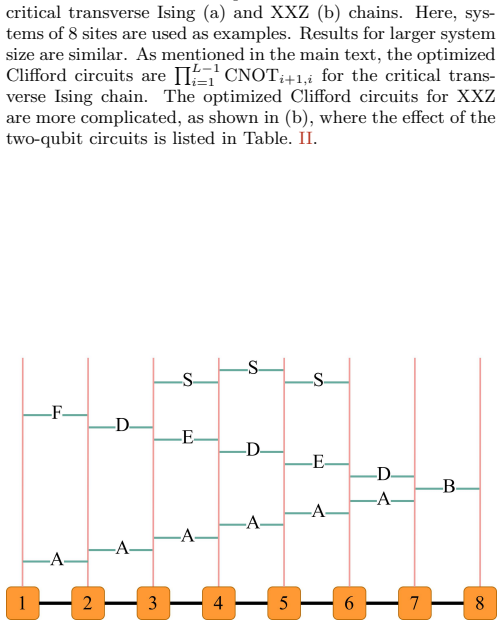
The machinery is the CAMPS ansatz: a matrix product state dressed by two-site Clifford circuits, optimized inside the density-matrix renormalization group by searching, after each local solve, for the two-qubit Clifford gate that minimizes the entanglement entropy before singular-value truncation. Because Clifford gates map Pauli strings to Pauli strings, the conjugated Hamiltonian remains a sum of local Pauli terms and can be updated cheaply. The specific load-bearing object is the optimized circuit itself: a single layer of CNOT gates $\prod_{i=1}^{L-1} \mathrm{CNOT}_{i+1,i}$ for the Ising chain, which is the Kramers–Wannier duality operator; and a longer layered circuit, written as a matrix product operator of finite bond dimension, for the XXZ chain, which realizes the two-step duality to the Ashkin–Teller model. For the XX case, the circuit also contains pyramid layers of swap gates that spatially separate the two dual Ising chains.
What would settle it
Run CAMPS on the critical Ising chain at $g=1$ for lengths well beyond 400 and check whether the optimized circuit is exactly $\prod_{i=1}^{L-1} \mathrm{CNOT}_{i+1,i}$ and whether the conjugated Hamiltonian's boundary terms match Eq. (5); if the circuit deviates in a way that does not vanish with $L$, the claim that the greedy search finds the exact self-duality is falsified. A second check: measure the CAMPS-induced entropy reduction $\Delta S$ as a function of $L$ and compare the extrapolated $\gamma$ with the predicted boundary-entropy change between free and fixed Ising BCFTs—the paper's fit gives $\gamma\approx 0.3466$, so a clearly different infinite-size limit would rule out the boundary-condition-change explanation.
Extended reading notes
Core claim
The paper's discovery is that the optimized disentanglers coincide with duality transformations. For the critical Ising chain at g=1, the variational search returns the circuit $\prod_{i=1}^{L-1} \mathrm{CNOT}_{i+1,i}$, which is the lattice realization of the Kramers–Wannier self-duality; after a local rotation the conjugated Hamiltonian is the same Ising Hamiltonian with boundary terms that break $\mathbb{Z}_2$ at one end and remove the transverse field at the other, Eq. (5). The entanglement spectrum changes from the free-boundary towers $I$ and $\epsilon$ to a single $\sigma$ tower, showing that CAMPS has mapped a free boundary conformal field theory to a fixed (mixed) boundary one; the central charge stays $c=1/2$ and only the boundary entropy is removed. For the XXZ chain, CAMPS produces a circuit whose conjugated Hamiltonian is the quantum Ashkin–Teller Hamiltonian up to boundary terms, and for the XX point $g=0$ the dual model is two decoupled critical Ising chains that swap gates move to opposite halves of the lattice. Thus the method is a variational realization of the $\mathbb{Z}_2$-orbifold duality between the $c=1$ compactified boson and the Ashkin–Teller model, and more generally a numerical route from a critical chain to its dual conformal field theory.
Load-bearing premise
The paper assumes that the greedy finite-size variational search over Clifford circuits finds the exact duality transformation of the thermodynamic model, a claim checked only for chains up to length 400 and by the pattern of circuits at length 8 rather than proven.
Editorial extensions
If this is right
- For the critical Ising chain, the entanglement entropy after CAMPS still has the same logarithmic slope, giving central charge $c\approx 0.5$, so the Clifford circuits remove only the boundary contribution and not the bulk critical scaling.
- For the XX chain, the dual Hamiltonian is two decoupled critical Ising chains spatially separated by swap gates, so the effective central charge drops from $c=1$ to $c=1/2$.
- For XXZ chains with $g=0.5$ and $g=1$, CAMPS gives a constant entropy reduction that extrapolates to about $\ln 2 \approx 0.69$ in the thermodynamic limit while the logarithmic slope is unchanged.
- At fixed bond dimension, CAMPS yields substantially lower ground-state energy errors than plain MPS for all models tested (Ising, XX, XXZ, Heisenberg).
- Because the optimized circuits are expressed as matrix product operators of finite bond dimension (bond dimension 4 for Ising), the dual Hamiltonian remains a local Pauli Hamiltonian, enabling the method to be used as a numerical search for dualities in other critical models.
Reading between the lines
- If CAMPS is run on a chain with a non-invertible duality, such as the three-state Potts model, the optimized circuit should implement that duality defect; the bond dimension of the circuit's matrix-product-operator representation would then measure how far the duality is from being Clifford-simple.
- The extrapolated reductions $\gamma\approx\ln 2$ for the $g=0.5$ and Heisenberg chains hint that the removable boundary entropy equals the logarithm of a quantum dimension of the duality defect, tying non-stabilizerness entanglement entropy to categorical symmetry data in a way the paper leaves implicit.
- For a compactified boson at irrational radius, the absence of a slope reduction predicts that the non-stabilizerness entanglement entropy has the same $c/6\,\ln L$ prefactor as the entanglement entropy, so Clifford operations would remove only boundary entropy from such a critical chain.
- Applying the same variational search in two dimensions would test whether Clifford circuits can find entanglement-reducing dualities beyond one-dimensional chains; the paper identifies this as a natural but unimplemented next step.
Editorial analysis
A structured set of objections, weighed in public.
Referee Report
Summary. The paper studies the CAMPS method on critical spin chains and reports that the optimized Clifford disentanglers correspond to duality transformations. For the critical Ising chain, the optimized circuit is identified as the Kramers-Wannier self-duality implemented by a chain of CNOT gates, mapping free to fixed boundary conditions and reducing the entanglement entropy by a constant that matches ln(sqrt(2)). For the XXZ chain, the authors claim that CAMPS finds a duality mapping to the quantum Ashkin-Teller chain, with the XX point mapping to two decoupled critical Ising chains. The evidence includes explicit L=8 circuits, conjugated Hamiltonians, finite-size scaling of the entanglement entropy, universal entanglement spectra, and energy-convergence comparisons.
Significance. If the results hold, the paper provides a concrete example of a variational method that discovers exact dualities in critical spin chains and explains the disentangling power of CAMPS through boundary-entropy changes. The Ising case is well supported by an explicit closed-form circuit and by the numerical reduction gamma ≈ 0.3466 = ln(sqrt(2)), which matches the known boundary-entropy difference. The XXZ-to-Ashkin-Teller claim is potentially substantial, connecting the numerical circuits to a known orbifold duality, but the current evidence for exactness at arbitrary system size is incomplete. The paper is clearly written and reports explicit circuits and conjugated Hamiltonians, which are valuable assets for verification.
major comments (3)
- [Sec. III.B, Eq. (7), and Appendix C] The claim that CAMPS finds the exact duality mapping from the XXZ chain to the Ashkin-Teller chain is central to the paper, but it rests on the L=8 circuit in Fig. 7(b) and the statement that circuits for larger systems are 'similar.' No closed-form expression or recursive construction is given for the circuit at general L, and Eq. (7) is asserted as the conjugated Hamiltonian without showing the conjugation calculation. Because the greedy variational optimization could in principle settle on a finite-size approximation for L>8, the exactness claim is not fully established. The authors should provide a closed-form or recursively defined circuit for general L and demonstrate the conjugation to Eq. (7), or alternatively report the optimized circuits for several larger L values and quantify how closely they match the L=8 pattern.
- [Sec. III.B and Appendix B] The entropy reductions reported in Table I for the XXZ chain at g=0.5 (gamma ≈ 0.6931) and the Heisenberg chain (gamma ≈ 0.6906) are close to ln 2, but the paper does not provide a theoretical interpretation of these values. For the Ising chain, the reduction is explained via the Affleck-Ludwig boundary-entropy difference; an analogous explanation for the XXZ/Ashkin-Teller case would both test the claimed duality and make the numerical results more informative. If the boundary-entropy change is not currently calculable, the authors should state this explicitly.
- [Sec. III.B, Fig. 4] The observation that the slopes of S versus ln L are unchanged while the offsets decrease is attributed to the optimized circuit being an MPO of finite bond dimension. This consistency is necessary but not sufficient: any constant-depth (or constant-MPO-bond) Clifford circuit would produce the same qualitative behavior. To distinguish the claimed exact Ashkin-Teller duality from a finite-size approximate disentangler, the authors should compare the conjugated Hamiltonian directly with the exact Ashkin-Teller Hamiltonian, for example by evaluating the norm of their difference as a function of L.
minor comments (6)
- [Eq. (7)] The summation limits in Eq. (7) are asymmetric (j=2 to L-3 for the X_j X_{j+2} term and j=2 to L-1 for the Y_j term); please state explicitly whether this is intentional and how the limits are defined for odd and even L.
- [Appendix B, Table I] The fitted values 0.6931(14) and 0.6906(30) are very close to ln 2; the paper should at least comment on this coincidence, as it may signal a simple boundary-entropy interpretation.
- [Sec. III.A and Appendix C] The notation Q_{i=1}^{L-1} CNOT_{i+1,i} does not specify the order in which the gates are multiplied; the action on a quantum state is ambiguous without a clear convention for the product order.
- [Fig. 3(b) and 3(d)] The caption states that the lowest entanglement eigenvalue is normalized to 0 for MPS and to 1/16 for CAMPS, but it is unclear whether the spectra are shifted to a common reference; please clarify the normalization and report unshifted values in the text or caption.
- [Sec. III.A, MPO bond dimension] The statement that the CNOT-chain circuit 'can be represented as an MPO with bond dimension 4, which can explain why the central charge is not altered' is too terse; a finite MPO bond dimension alone does not preclude a change of central charge, so the argument should be clarified.
- [General] No code or data availability statement is given; for a numerical work whose central output is an optimized circuit pattern, releasing the circuit data and the CAMPS implementation would substantially aid independent verification.
Circularity Check
No circularity: the CAMPS outputs are checked against external analytical benchmarks rather than being built into the derivation.
full rationale
The paper's central claims are that CAMPS discovers the Kramers-Wannier self-duality in the critical Ising chain and maps the XXZ chain to the Ashkin-Teller chain. Both identifications are made after variational optimization, by inspecting the returned Clifford circuit and the conjugated Hamiltonian, and are then compared to independent, pre-existing results: Eq. (4) defines KW, Eq. (5) is the explicit conjugated Ising Hamiltonian, and the boundary-entropy reduction gamma = (1/2)ln2 approximately 0.3466 matches the known free-versus-fixed boundary CFT value from Refs. [24,25,41]. For XXZ, Eq. (7) is explicitly compared to the known Ashkin-Teller Hamiltonian and to the known two-step KW construction of Refs. [49,50]; the XX case is benchmarked against the c=1 free boson to two-Ising-copies duality. The fitted quantities (c approximately 0.50, gamma values in Table I) are output statistics that are subsequently matched to predicted CFT numbers, not parameters tuned to force those numbers. The paper does cite its own prior CAMPS and NsEE work (Refs. [16,23]) to supply the numerical method, but the method is not the target result and the paper's conclusions do not reduce to those citations. The main weaknesses—identifying the exact duality from the L=8 circuit pattern and 'similar' larger-size circuits, and the absence of code and data—are reproducibility and correctness risks, not circularity.
Assumptions & free parameters
free parameters (5)
- Fitted central charge c (critical Ising, MPS and CAMPS) =
~0.50
- Fitted central charge c (XX chain after CAMPS) =
~0.50
- Fitted entropy reduction gamma (critical Ising) =
0.3466(1)
- Fitted entropy reduction gamma (XXZ g=0.5) =
0.6931(14)
- Fitted entropy reduction gamma (Heisenberg) =
0.6906(30)
assumptions (5)
- domain assumption Entanglement entropy of a critical chain with open boundaries scales as S = c/6 ln L + b.
- domain assumption The low-lying entanglement spectrum of the reduced density matrix is governed by the operator content of the boundary CFT.
- standard math The Kramers-Wannier duality acts as in Eq. (4) and maps the critical Ising chain with free boundary conditions to one with fixed boundary conditions.
- domain assumption The conjugated Hamiltonian Eq. (7) corresponds to the quantum Ashkin-Teller chain, up to boundary terms.
- ad hoc to paper The greedy Clifford-circuit optimization in CAMPS converges to the globally optimal (or at least the exact duality) disentangler.
Cite this review
Pith. "Pith review of Disentangling critical quantum spin chains with Clifford circuits." pith.science (2026). https://pith.science/paper/5YKR64HC
@misc{pith2026241112683,
  author       = {Pith},
  title        = {Pith review of: Disentangling critical quantum spin chains with Clifford circuits},
  year         = {2026},
  howpublished = {\url{https://pith.science/paper/5YKR64HC}},
  note         = {Machine review of arXiv:2411.12683}
}
read the original abstract
Clifford circuits can be utilized to disentangle quantum states with polynomial cost, thanks to the Gottesman-Knill theorem. Based on this idea, the Clifford circuits augmented matrix product states (CAMPS) method, which is a seamless integration of Clifford circuits within the density-matrix renormalization group algorithm, was proposed recently and was shown to be able to reduce entanglement in various quantum systems. In this work, we further explore the power of the CAMPS method in critical spin chains described by conformal field theories (CFTs) in the scaling limit. We find that the optimized disentanglers correspond to {\it duality} transformations, which significantly reduce the entanglement entropy in the ground state. For the critical quantum Ising spin chain governed by the Ising CFT with self-duality, the Clifford circuits found by CAMPS coincide with the duality transformation, i.e., the Kramers-Wannier self-duality in the critical Ising chain. It reduces the entanglement entropy by mapping the free conformal boundary condition to the fixed one. In the more general case of the XXZ chain, the CAMPS gives rise to a duality transformation mapping the model to the quantum Ashkin-Teller spin chain. Our results highlight the potential of the framework as a versatile tool for uncovering hidden dualities and simplifying the entanglement structure of critical quantum systems.
Figures


Figures from the paper (4 more)


Forward citations
Cited by 1 Pith paper
-
Clifford circuits Augmented Matrix Product States for fermion systems
Fermionic CAMPS, built by combining Clifford circuits with MPS via the Jordan-Wigner transformation, improves ground-state energy accuracy over plain MPS in benchmarks on the t-V and Hubbard models.
Reference graph
Works this paper leans on
-
[1]
Quantum com- putation and quantum information: 10th anniversary edition,
Michael A. Nielsen and Isaac L. Chuang, “Quantum com- putation and quantum information: 10th anniversary edition,” (2010)
work page 2010
-
[2]
Stabilizer codes and quantum error correction,
Daniel Gottesman, “Stabilizer codes and quantum error correction,” (1997), arXiv:quant-ph/9705052 [quant-ph]
arXiv 1997
-
[3]
Improved sim- ulation of stabilizer circuits,
Scott Aaronson and Daniel Gottesman, “Improved sim- ulation of stabilizer circuits,” Phys. Rev. A 70, 052328 (2004)
2004
-
[4]
Fast simulation of stabilizer circuits using a graph-state representation,
Simon Anders and Hans J. Briegel, “Fast simulation of stabilizer circuits using a graph-state representation,” Phys. Rev. A 73, 022334 (2006)
work page 2006
-
[5]
Quantum entanglement growth un- der random unitary dynamics,
Adam Nahum, Jonathan Ruhman, Sagar Vijay, and Jeongwan Haah, “Quantum entanglement growth un- der random unitary dynamics,” Phys. Rev. X 7, 031016 (2017)
work page 2017
-
[6]
Density matrix formulation for quan- tum renormalization groups,
Steven R. White, “Density matrix formulation for quan- tum renormalization groups,” Phys. Rev. Lett. 69, 2863– 2866 (1992)
work page 1992
-
[7]
Entanglement renormaliza- tion in two spatial dimensions,
G. Evenbly and G. Vidal, “Entanglement renormaliza- tion in two spatial dimensions,” Phys. Rev. Lett. 102, 180406 (2009)
work page 2009
-
[8]
Philippe Corboz, Rom´ an Or´ us, Bela Bauer, and Guifr´ e Vidal, “Simulation of strongly correlated fermions in two spatial dimensions with fermionic projected entangled- pair states,” Phys. Rev. B 81, 165104 (2010)
work page 2010
Show all 52 references
-
[9]
The density-matrix renormalization group in the age of matrix product states,
Ulrich Schollw¨ ock, “The density-matrix renormalization group in the age of matrix product states,” Annals of Physics 326, 96–192 (2011), january 2011 Special Issue
2011
-
[10]
A practical introduction to tensor net- works: Matrix product states and projected entangled pair states,
Rom´ an Or´ us, “A practical introduction to tensor net- works: Matrix product states and projected entangled pair states,” Annals of Physics 349, 117–158 (2014)
2014
-
[11]
Matrix product states and pro- jected entangled pair states: Concepts, symmetries, the- orems,
J. Ignacio Cirac, David P´ erez-Garc ´ ıa, Norbert Schuch, and Frank Verstraete, “Matrix product states and pro- jected entangled pair states: Concepts, symmetries, the- orems,” Rev. Mod. Phys. 93, 045003 (2021)
2021
-
[12]
Tao Xiang, Density Matrix and Tensor Network Renormalization (Cambridge University Press, 2023)
2023
-
[13]
Hierarchical clifford transformations to reduce entanglement in quantum chemistry wave functions,
Ryan V. Mishmash, Tanvi P. Gujarati, Mario Motta, Huanchen Zhai, Garnet Kin-Lic Chan, and Antonio Mez- zacapo, “Hierarchical clifford transformations to reduce entanglement in quantum chemistry wave functions,” Journal of Chemical Theory and Computation 19, 3194– 3208 (2023), ...
2023
-
[14]
Stabilizer tensor networks: universal quantum simulator on a basis of stabilizer states,
Sergi Masot-Llima and Artur Garcia-Saez, “Stabilizer tensor networks: universal quantum simulator on a basis of stabilizer states,” (2024), arXiv:2403.08724 [quant- ph]
2024 arXiv
-
[15]
Quantum state designs with clifford enhanced matrix product states,
Guglielmo Lami, Tobias Haug, and Jacopo De Nardis, “Quantum state designs with clifford enhanced matrix product states,” (2024), arXiv:2404.18751 [quant-ph]
2024 arXiv
-
[16]
Aug- menting density matrix renormalization group with clif- ford circuits,
Xiangjian Qian, Jiale Huang, and Mingpu Qin, “Aug- menting density matrix renormalization group with clif- ford circuits,” Phys. Rev. Lett. 133, 190402 (2024)
2024
-
[17]
The other one spontaneously breaks the global symmetry, hence the up and down fixed boundary con- ditions both contribute to the partition function
More precisely, the conjugated Ising model has one fixed boundary. The other one spontaneously breaks the global symmetry, hence the up and down fixed boundary con- ditions both contribute to the partition function. In the variational simulation of a quantum chain, a fixed bou...
-
[18]
Clif- ford Circuits Augmented Time-Dependent Variational Principle,
Xiangjian Qian, Jiale Huang, and Mingpu Qin, “Clif- ford Circuits Augmented Time-Dependent Variational Principle,” arXiv e-prints , arXiv:2407.03202 (2024), arXiv:2407.03202 [cond-mat.str-el]
2024 arXiv
-
[19]
Clifford Dressed Time-Dependent Variational Principle,
Antonio Francesco Mello, Alessandro Santini, Guglielmo Lami, Jacopo De Nardis, and Mario Collura, “Clifford Dressed Time-Dependent Variational Principle,” arXiv e-prints , arXiv:2407.01692 (2024), arXiv:2407.01692 [quant-ph]
2024 arXiv
-
[20]
Aug- menting Finite Temperature Tensor Network with Clif- ford Circuits,
Xiangjian Qian, Jiale Huang, and Mingpu Qin, “Aug- menting Finite Temperature Tensor Network with Clif- ford Circuits,” arXiv e-prints , arXiv:2410.15709 (2024), arXiv:2410.15709 [quant-ph]
2024 arXiv
-
[21]
Time-dependent variational principle for quantum lat- tices,
Jutho Haegeman, J. Ignacio Cirac, Tobias J. Osborne, Iztok Piˇ zorn, Henri Verschelde, and Frank Verstraete, “Time-dependent variational principle for quantum lat- tices,” Phys. Rev. Lett. 107, 070601 (2011)
2011
-
[22]
Unifying time evolution and optimization with matrix product states,
Jutho Haegeman, Christian Lubich, Ivan Oseledets, Bart Vandereycken, and Frank Verstraete, “Unifying time evolution and optimization with matrix product states,” Phys. Rev. B 94, 165116 (2016)
2016
-
[23]
Non- stabilizerness Entanglement Entropy: a measure of hardness in the classical simulation of quantum many- body systems,
Jiale Huang, Xiangjian Qian, and Mingpu Qin, “Non- stabilizerness Entanglement Entropy: a measure of hardness in the classical simulation of quantum many- body systems,” arXiv e-prints , arXiv:2409.16895 (2024), arXiv:2409.16895 [quant-ph]
2024 arXiv
-
[24]
Entanglement Hamilto- nians in two-dimensional conformal field theory,
John L. Cardy and Erik Tonni, “Entanglement Hamilto- nians in two-dimensional conformal field theory,” Journal of Statistical Mechanics: Theory and Experiment 2016, 123103 (2016)
2016
-
[25]
Boundary effects in the criti- cal scaling of entanglement entropy in 1d systems,
Nicolas Laflorencie, Erik S. Sørensen, Ming-Shyang Chang, and Ian Affleck, “Boundary effects in the criti- cal scaling of entanglement entropy in 1d systems,” Phys. Rev. Lett. 96, 100603 (2006)
2006
-
[26]
How to efficiently select an arbitrary Clifford group element,
Robert Koenig and John A. Smolin, “How to efficiently select an arbitrary Clifford group element,” Journal of Mathematical Physics 55, 122202 (2014)
2014
-
[27]
Measurement-driven entanglement transition in hybrid quantum circuits,
Yaodong Li, Xiao Chen, and Matthew P. A. Fisher, “Measurement-driven entanglement transition in hybrid quantum circuits,” Phys. Rev. B 100, 134306 (2019)
2019
-
[28]
Process verification of two- qubit quantum gates by randomized benchmarking,
A. D. C´ orcoles, Jay M. Gambetta, Jerry M. Chow, John A. Smolin, Matthew Ware, Joel Strand, B. L. T. Plourde, and M. Steffen, “Process verification of two- qubit quantum gates by randomized benchmarking,” Phys. Rev. A 87, 030301 (2013)
2013
-
[29]
Disentangling unitary dynamics with classically simulable quantum circuits,
Gerald E. Fux, Benjamin B´ eri, Rosario Fazio, and Emanuele Tirrito, “Disentangling unitary dynamics with classically simulable quantum circuits,” arXiv e-prints , arXiv:2410.09001 (2024), arXiv:2410.09001 [quant-ph]
2024
-
[30]
Augmenting density matrix renormalization group with disentanglers,
Xiangjian Qian and Mingpu Qin, “Augmenting density matrix renormalization group with disentanglers,” Chi- nese Physics Letters 40, 057102 (2023)
2023
-
[31]
Stabilizer r´ enyi entropy,
Lorenzo Leone, Salvatore F. E. Oliviero, and Alioscia Hamma, “Stabilizer r´ enyi entropy,” Phys. Rev. Lett.128, 050402 (2022)
2022
-
[32]
Topological aspects of the critical three-state potts model,
Robijn Vanhove, Laurens Lootens, Hong-Hao Tu, and Frank Verstraete, “Topological aspects of the critical three-state potts model,” Journal of Physics A: Math- ematical and Theoretical 55, 235002 (2022)
2022
-
[33]
Topological defects on the lattice: Dualities and de- generacies,
David Aasen, Paul Fendley, and Roger S. K. Mong, “Topological defects on the lattice: Dualities and de- generacies,” (2020), arXiv:2008.08598 [cond-mat.stat- mech]. 9
2020 arXiv
-
[34]
Topological disorder parameter: A many-body invariant to characterize gapped quantum phases,
Bin-Bin Chen, Hong-Hao Tu, Zi Yang Meng, and Meng Cheng, “Topological disorder parameter: A many-body invariant to characterize gapped quantum phases,” Phys. Rev. B 106, 094415 (2022), arXiv:2203.08847
2022 arXiv
-
[35]
Non-invertible symmetries and LSM-type constraints on a tensor product Hilbert space,
Nathan Seiberg, Sahand Seifnashri, and Shu-Heng Shao, “Non-invertible symmetries and LSM-type constraints on a tensor product Hilbert space,” SciPost Phys. 16, 154 (2024)
2024
-
[36]
In- trinsically/purely gapless-spt from non-invertible dual- ity transformations,
Linhao Li, Masaki Oshikawa, and Yunqin Zheng, “In- trinsically/purely gapless-spt from non-invertible dual- ity transformations,” arXiv preprint arXiv:2307.04788 (2023)
2023 arXiv
-
[37]
Non- invertible duality transformation between spt and ssb phases,
Linhao Li, Masaki Oshikawa, and Yunqin Zheng, “Non- invertible duality transformation between spt and ssb phases,” arXiv preprint arXiv:2301.07899 (2023)
2023 arXiv
-
[38]
Generalized kramers-wanier duality from bilinear phase map,
Han Yan and Linhao Li, “Generalized kramers-wanier duality from bilinear phase map,” arXiv preprint arXiv:2403.16017 (2024)
2024 arXiv
-
[39]
Entanglement and the density matrix renor- malisation group in the generalised landau paradigm,
Laurens Lootens, Clement Delcamp, and Frank Ver- straete, “Entanglement and the density matrix renor- malisation group in the generalised landau paradigm,” (2024), arXiv:2408.06334 [quant-ph]
2024
-
[40]
Kramers-wannier self-duality and non-invertible translation symmetry in quantum chains: a wave-function perspective,
Hua-Chen Zhang and Germ´ an Sierra, “Kramers-wannier self-duality and non-invertible translation symmetry in quantum chains: a wave-function perspective,” (2024), arXiv:2410.06727 [cond-mat.stat-mech]
2024 arXiv
-
[41]
Universal non- integer “ground-state degeneracy
Ian Affleck and Andreas W. W. Ludwig, “Universal non- integer “ground-state degeneracy” in critical quantum systems,” Phys. Rev. Lett. 67, 161–164 (1991)
1991
-
[42]
Operator content of real-space en- tanglement spectra at conformal critical points,
Andreas M. L¨ auchli, “Operator content of real-space en- tanglement spectra at conformal critical points,” (2013), arXiv:1303.0741
2013 arXiv
-
[43]
Emergent conformal boundaries from finite-entanglement scaling in matrix product states,
Rui-Zhen Huang, Long Zhang, Andreas M. L¨ auchli, Jutho Haegeman, Frank Verstraete, and Laurens Vanderstraeten, “Emergent conformal boundaries from finite-entanglement scaling in matrix product states,” Phys. Rev. Lett. 132, 086503 (2024)
2024
-
[44]
Self- congruent point in critical matrix product states: An effective field theory for finite-entanglement scaling,
Jan T. Schneider, Atsushi Ueda, Yifan Liu, Andreas M. L¨ auchli, Masaki Oshikawa, and Luca Tagliacozzo, “Self- congruent point in critical matrix product states: An effective field theory for finite-entanglement scaling,” (2024), arXiv:2411.03954 [cond-mat.stat-mech]
2024 arXiv
-
[45]
Effect of boundary conditions on the op- erator content of two-dimensional conformally invariant theories,
John L. Cardy, “Effect of boundary conditions on the op- erator content of two-dimensional conformally invariant theories,” Nuclear Physics B 275, 200–218 (1986)
1986
-
[46]
Boundary conditions, fusion rules and the verlinde formula,
John L. Cardy, “Boundary conditions, fusion rules and the verlinde formula,” Nuclear Physics B 324, 581–596 (1989)
1989
-
[47]
Conformal invariance and surface critical behavior,
John L. Cardy, “Conformal invariance and surface critical behavior,” Nuclear Physics B 240, 514–532 (1984)
1984
-
[48]
Thierry Giamarchi, Quantum Physics in One Dimension (Oxford University Press, Oxford, 2003)
2003
-
[49]
Hamiltonian studies of the d = 2 ashkin-teller model,
Mahito Kohmoto, Marcel den Nijs, and Leo P. Kadanoff, “Hamiltonian studies of the d = 2 ashkin-teller model,” Phys. Rev. B 24, 5229–5241 (1981)
1981
-
[50]
Hidden z2×z2 symme- try breaking and the haldane phase in the s=1/2 quan- tum spin chain with bond alternation,
Mahito Kohmoto and Hal Tasaki, “Hidden z2×z2 symme- try breaking and the haldane phase in the s=1/2 quan- tum spin chain with bond alternation,” Phys. Rev. B 46, 3486–3495 (1992)
1992
-
[51]
Curiosities at c = 1,
P. Ginsparg, “Curiosities at c = 1,” Nucl. Phys. B 295, 153–170 (1988)
1988
-
[52]
Stabi- lizer disentangling of conformal field theories,
Martina Frau, Poetri Sonya Tarabunga, Mario Col- lura, Emanuele Tirrito, and Marcello Dalmonte, “Stabi- lizer disentangling of conformal field theories,” (2024), arXiv:2411.11720 [quant-ph]
2024
Reviewed August 12, 2026 · model on record in the stance chip above.
Discussion (0). Continue with ORCID to comment.