REVIEW 1 major objections 8 minor 108 references
Lyα radiation forces need a three-tier convergence test, not one
Reviewed by Pith at T0; open to challenge. T0 means a machine referee read the full paper against a public rubric. the ladder, T0–T4 →
T0 review · glm-5.2
2026-07-10 02:08 UTC pith:5ZOVS7OE
load-bearing objection A practical three-tier convergence framework for Lyα MCRT force estimators, with new analytic benchmarks and a clear demonstration that core-skipping biases internal forces. the 1 major comments →
Force convergence in Monte Carlo Lyman-alpha radiative transfer
The pith
A machine-rendered reading of the paper's core claim, the machinery that carries it, and where it could break.
Core claim
The convergence of internal Lyα Monte Carlo radiation-force calculations cannot be captured by a single criterion. It requires a three-tier hierarchy—mean correctness, finite-sampling precision, and variance stability—and these tiers fail independently across different estimators and acceleration schemes. Core-skipping algorithms, while computationally efficient, introduce systematic downward bias in the internal momentum budget because they skip scatterings that contribute real momentum deposition inside the gas.
What carries the argument
The framework treats each completed photon packet's contribution to the force estimator as a single Monte Carlo sample drawn from an unknown distribution P(Y). The raw moments S_k = Σ Y_p^k of these per-packet contributions generate all convergence diagnostics: the first moment gives the signal, the second gives the sampling noise (via fractional error FE = sqrt(Var(S_1))/E[S_1] = CV/sqrt(N_ph)), and the fourth moment governs the stability of the variance estimate itself (via the coefficient of variation of variance, CVoV ≈ sqrt(β_2 - 1)/sqrt(N), where β_2 is the kurtosis). A scaling argument based on the telescoping property of correlated momentum kicks—where the incoming direction of one散射
Load-bearing premise
The scaling argument that predicts optical-depth-independent convergence metrics rests on a heuristic picture of telescoping momentum kicks: the incoming direction of one scattering event is the outgoing direction of the previous one, so intermediate terms partially cancel and the final variance is set by the escape scale rather than the raw number of scatterings. This telescoping picture is stated as an ansatz, not derived from first principles, and the detailed covariance分解
What would settle it
If, in a wider range of optical depths or geometries, the coefficient of variation CV = σ_Y/⟨Y⟩ develops a clear dependence on τ₀ (contradicting Eq. 30), or if the three estimators' fractional errors diverge by orders of magnitude rather than clustering in the same range, the scaling argument based on telescoping covariance would be revealed as an artifact of the limited parameter space tested rather than a fundamental property of the estimator.
If this is right
- Any future Lyα MCRT calculation claiming converged internal forces should report all three tiers: bias against a benchmark, fractional error at the run's photon count, and CVoV to confirm the error bar is trustworthy.
- Core-skipping schemes used in production galaxy-formation simulations may be systematically underestimating Lyα radiation pressure feedback in optically thick gas, with consequences for predictions of early star formation, black hole growth, and galactic winds.
- The moment-based hierarchy is estimator-agnostic and could be applied to any Monte Carlo radiative transfer quantity where internal field properties—not just emergent spectra—matter, such as non-LTE level populations or ionization rates.
- The finding that path-based and event-based estimators have comparable fractional error, despite very different raw variances, suggests that covariance structure—not raw event count—is the primary controller of estimator efficiency, pointing toward covariance-aware importance sampling as an optimisation strategy.
- The new closed-form radial acceleration profiles for both point-source and uniform-source geometries provide the first spatially resolved benchmarks for validating Lyα force calculations beyond the integrated force multiplier.
Where Pith is reading between the lines
- If the telescoping-covariance scaling (σ²_Y ~ (aτ₀)^{2/3}, yielding optical-depth-independent CV) holds across a wider τ₀ range than tested, one could predict the photon budget for any Lyα force calculation from a single pilot run, regardless of cloud opacity. If it breaks down at extreme optical depths, the convergence cost could grow steeply in ways the current τ₀ ≤ 10⁸ tests would not reveal.
- The observation that path-based estimators reinforce variance through coherent over-contribution of long-lived photons suggests a natural target for variance reduction: splitting or Russian-roulette strategies that break the coherent path-length correlation without altering the physical mean.
- If the uniform-source geometric-core undersampling problem is fundamentally a volume-weighted launching issue, then adaptive source-function decomposition—launching photons from coarse spatial strata with compensating weights—might repair the central-region noise without the weight-dispersion penalty that defeated simple volume boosting.
Editorial analysis
A structured set of objections, weighed in public.
Referee Report
Summary. This paper develops a three-tier convergence hierarchy (zeroth-order mean correctness, first-order finite-sampling precision, second-order variance stability) for internal Lyman-alpha (Lyα) Monte Carlo radiative transfer (MCRT) force calculations. The authors derive new diffusion-limit analytic benchmarks for radial acceleration profiles in static spherical clouds for both central point-source and uniform-source emission (Eqs. 6–17), validate them against MCRT simulations (Fig. 2), and then apply the convergence hierarchy to three force estimators: direct event-based scattering, gradient-of-energy-density, and divergence-of-radiation-pressure. The key practical findings are: (1) core-skipping algorithms systematically bias internal momentum deposition downward (Figs. 3–5), (2) path-based estimators carry additional reconstruction bias for point-source geometries that worsens at coarse spatial resolution (Fig. 6), (3) all three estimators have comparable fractional error despite different raw variance structures, which the authors attribute to intra-history covariance effects, and (4) the three estimators are not interchangeable and must be evaluated separately for bias, variance, and cost. The paper is well-structured, the analytic benchmarks are a useful contribution, and the convergence framework is practically relevant for the Lyα MCRT community.
Significance. The paper makes a solid contribution to the methodology of Lyα radiative transfer. The new closed-form diffusion-limit radial acceleration profiles (Eqs. 6, 12) and cumulative force-multiplier expressions (Eqs. 7, 13) are a genuine addition to the analytic literature and are validated against independent MCRT simulations. The three-tier convergence hierarchy is standard statistical practice (bias, variance, variance-of-variance) but its systematic application to internal Lyα force estimators—including the distinction between physical accuracy and statistical precision—is practically useful and not previously codified in this form. The empirical demonstration that core-skipping biases internal forces (not just spectra) is important for the community. The scaling argument in §2.4 is honestly flagged as heuristic and deferred to a companion paper, which is appropriate. The framework is falsifiable: the CV~constant prediction (Eq. 30) and the bias trends with τ₀ are testable against future simulations at higher optical depth or in different geometries.
major comments (1)
- §2.4, Eqs. (29)–(30): The ansatz σ²_Y ~ (aτ₀)^{2/3} is the critical step producing the optical-depth-independent CV prediction (Eq. 30). It rests on the 'telescoping' argument (Eq. 26) that intra-history covariance suppresses raw kick variance down to the escape scale, but this is asserted heuristically, not derived. The empirical test spans τ₀ = 10⁵–10⁸ (three decades), and the prediction CV ~ constant is a weak claim: many functional forms (e.g., CV ~ τ₀^α with |α| ≲ 0.1) would be indistinguishable from constant over this range. This concern is load-bearing for the interpretation that all three estimators share comparable FE for fundamental reasons (§4.2.1) rather than as a coincidence of the tested range. The authors should either (a) add a quantitative test of the CV~constant prediction (e.g., a power-law fit to CV vs. τ₀ with the exponent and its uncertainty reported) or (b) more谨慎地
minor comments (8)
- §2.4, Eq. (22): The independent-kick expectation CV ~ a^{-1/3} τ₀^{1/6} is presented as a contrast to the final ansatz, but the reader would benefit from a one-sentence explanation of why the τ₀^{1/6} scaling arises from N_scat ~ τ₀ and σ_Y ~ τ₀^{1/2}.
- Fig. 3: The violin distributions are informative but the color coding for no-core-skipping vs. dynamical core-skipping is not clearly distinguished in the caption. A brief note on how to read the violin widths would help the reader.
- Fig. 5, bottom row: The path-based estimator bias is defined relative to the matching x_crit scattering estimator, which is a different baseline than the top row. This is stated in the text but could be made more prominent in the figure caption to avoid confusion.
- §4.1.5, Fig. 7: The relative error curves deviate from N^{-1/2} at the largest group sizes due to small group counts. The caption notes this, but adding a shaded region or vertical line indicating where the number of independent groups drops below ~10 would clarify the reliable range.
- Appendix B: The volume-boosted tests are a useful supplement. The conclusion that volume boosting is not effective is clear, but a brief note on whether alternative importance-sampling strategies (e.g., source-position biasing with optimized weights) might work would be a helpful pointer for readers facing this issue.
- §4.2.3, Fig. 10: The runtime scaling exponents (τ₀^{0.961} and τ₀^{0.959}) are quoted to three significant figures. Given the likely scatter in timing measurements, reporting two significant figures would be more appropriate.
- The paper uses 'force multiplier' notation M_F inconsistently: sometimes as M_F (Eq. 4), sometimes as M^scat_F, M^{∇u}_F, M^{∇·P}_F (Fig. 5). A brief notation summary would improve readability.
- References: Several arXiv preprints are cited (e.g., Byrohl & Nelson 2025, Li & Zheng 2026, Menon & Smith 2026, Nebrin et al. 2026). If any have been published since submission, the references should be updated.
Circularity Check
No significant circularity; the framework is self-contained against external benchmarks and the heuristic scaling argument is honestly flagged as non-load-bearing.
full rationale
The paper's central practical claims—the three-tier convergence hierarchy, the core-skipping bias, and the estimator non-interchangeability—are established empirically and through standard statistical definitions, not through circular derivation. The analytic benchmarks (Eqs. 6–17) derive from Lao & Smith (2020), which shares author A. Smith with this paper, but those are parameter-free diffusion-limit solutions validated against independent MCRT simulations in Fig. 2, satisfying the non-circularity criterion. The bias truth values use the no-core-skipping scattering estimator as reference (zero by construction in Fig. 5), but this is explicitly stated as a relative comparison, not a physical truth claim. The §2.4 scaling argument (σ²_Y ~ (aτ₀)^{2/3}, Eq. 29) is the only potentially weak link: it produces the optical-depth-independent CV prediction (Eq. 30) via a heuristic 'telescoping' argument (Eq. 26) that is asserted, not derived. However, the authors explicitly label this as 'only intended as a scaling argument, not a closed-form statistical theory' and defer detailed covariance analysis to a companion paper. Crucially, this ansatz supports the interpretation of why estimators share comparable FE, but it is not load-bearing for the central framework or the bias result, which stand on empirical evidence (Figs. 3–5, 8–11) independent of the scaling argument. No prediction or first-principles result reduces to its inputs by construction. The one minor self-citation (Lao & Smith 2020) is not load-bearing because it is independently validated here. Score 1 reflects this minor self-citation with no circularity in the central claims.
Axiom & Free-Parameter Ledger
free parameters (2)
- Core-skipping threshold x_crit =
0, 1, 2, 3, dynamical
- Group size N for convergence diagnostics =
varied from ~10^2 to ~10^5
axioms (4)
- domain assumption Diffusion approximation valid when aτ₀ ≫ 10³ (Nebrin et al. 2025)
- domain assumption Photon packets are independent Monte Carlo samples (Cov(Y_p, Y_q) ≈ Var(Y_p)δ_pq)
- ad hoc to paper Intra-history covariance suppresses raw kick variance via telescoping (σ²_Y ~ R·σ²_kick with R < 1)
- domain assumption Fick's Law closure: F ≈ -c∇u/(3k) for diffusive radiation
read the original abstract
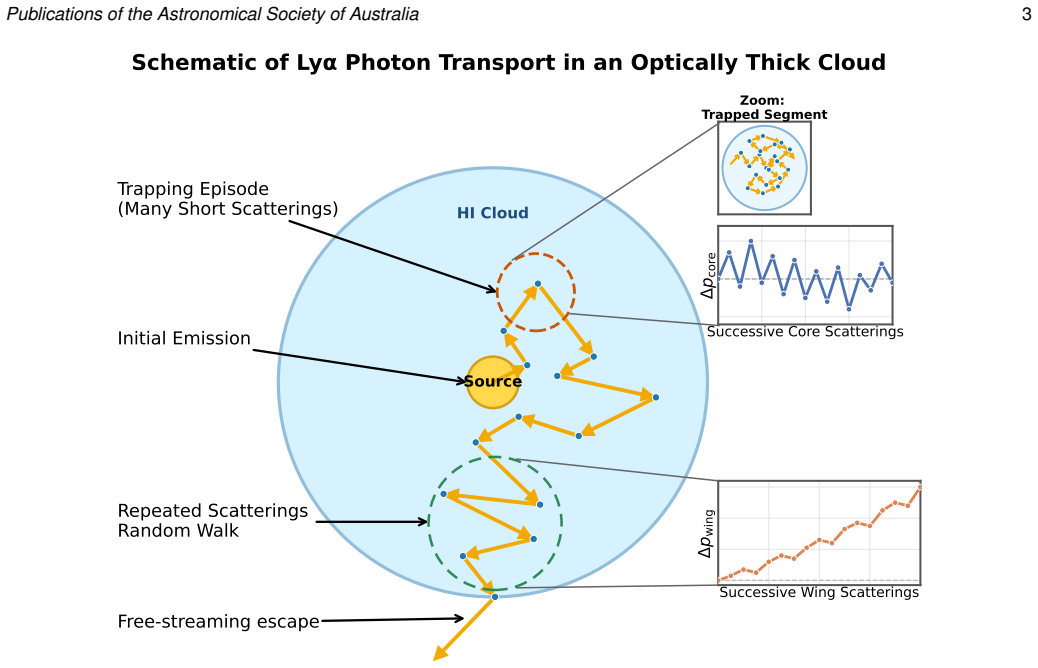
Monte Carlo radiative transfer (MCRT) is widely used to model Lyman-alpha (Lya) resonant-line transport, but convergence is difficult to assess in optically thick media where photons undergo many scatterings before escape. This is especially important for internal quantities such as radiative acceleration and the force multiplier, which depend on momentum deposition throughout the gas rather than only on emergent spectra. We study the convergence of Lya MCRT momentum-transfer estimators in static spherical clouds. We first establish diffusion-limit benchmarks for radial acceleration profiles and integrated force multipliers, then develop a moment-based framework for diagnosing convergence from the photon-packet contribution distribution. This framework separates three distinct questions: whether the estimator converges to the correct mean, how large its finite-sampling uncertainty is, and whether the estimated uncertainty is itself stable. We apply this hierarchy to the direct event-based scattering estimator, a gradient-of-energy-density estimator, and a divergence-of-radiation-pressure estimator. Zeroth-order convergence is assessed with profile comparisons, integrated force-multiplier bias, and finite-group relative error. First-order convergence is quantified with fractional error, the photon number required to reach a target precision, and the corresponding runtime requirement. Second-order convergence is tested with the coefficient of variation of variance, which measures the reliability of the variance estimate used in the first-order diagnostics. Core-skipping prescriptions, source geometry, estimator construction, and spatial resolution enter this hierarchy in different ways. Our results provide a practical convergence framework for internal Lya MCRT force calculations and show why statistical precision, computational cost, and physical accuracy must be evaluated separately.
Figures


Reference graph
Works this paper leans on
-
[1]
Planck 2018 results. VI. Cosmological parameters. , keywords =. doi:10.1051/0004-6361/201833910 , archivePrefix =. 1807.06209 , primaryClass =
work page internal anchor Pith review Pith/arXiv arXiv doi:10.1051/0004-6361/201833910 2018
-
[2]
, year = 1967, month = mar, volume =
Are Young Galaxies Visible?. , year = "1967", month = "Mar", volume =. doi:10.1086/149079 , adsurl =
-
[3]
Lyman Alpha Emitting Galaxies as a Probe of Reionization
Ly Emitting Galaxies as a Probe of Reionisation. , keywords =. 2014. doi:10.1017/pasa.2014.33 , archivePrefix =. 1406.7292 , primaryClass =
work page internal anchor Pith review Pith/arXiv arXiv doi:10.1017/pasa.2014.33 2014
-
[4]
The scattering of resonance-line radiation in the limit of large optical depth. , year = "1973", month = "Jan", volume =. doi:10.1093/mnras/162.1.43 , adsurl =
-
[5]
The Transfer of Resonance-Line Radiation in Static Astrophysical Media. , keywords =. 1990. doi:10.1086/168375 , adsurl =
-
[6]
Scattered Lyman-alpha Radiation Around Sources Before Cosmological Reionization
Scattered Ly Radiation around Sources before Cosmological Reionization. , keywords =. 1999. doi:10.1086/307844 , archivePrefix =. astro-ph/9902180 , primaryClass =
work page internal anchor Pith review Pith/arXiv arXiv doi:10.1086/307844 1999
-
[7]
Ly Radiation from Collapsing Protogalaxies. I. Characteristics of the Emergent Spectrum. , keywords =. 2006. doi:10.1086/506243 , archivePrefix =. astro-ph/0510407 , primaryClass =
work page internal anchor Pith review Pith/arXiv arXiv doi:10.1086/506243 2006
-
[8]
Auer, Lawrence H. , doi =. ApJ , month =
-
[9]
Ahn, Sang-Hyeon and Lee, Hee-Won and Lee, Hyung Mok , doi =. ApJ , keywords =
-
[10]
Zheng, Zheng and Miralda-Escud\'. ApJ , keywords =. doi:10.1086/342400 , issn =
-
[11]
Osterbrock, Donald E. , doi =. ApJ , month =
-
[12]
, year = 1972, month = jun, volume =
The Escape of Resonance-Line Radiation from Extremely Opaque Media. , year = 1972, month = jun, volume =. doi:10.1086/151503 , adsurl =
-
[13]
Adams, Thomas F. , doi =. ApJ , month =
-
[14]
Lyman radiative transfer in a multiphase medium. , keywords =. 2006. doi:10.1111/j.1365-2966.2005.09870.x , archivePrefix =. astro-ph/0507586 , primaryClass =
- [15]
-
[16]
Hummer, D. G. , doi =. MNRAS , pages =
-
[17]
Rybicki, George B. and Dell'Antonio, Ian P. , doi =. ApJ , keywords =
- [18]
-
[19]
On the transfer of resonant-line radiation in mesh simulations
On the Transfer of Resonant-Line Radiation in Mesh Simulations. , keywords =. doi:10.1086/505682 , archivePrefix =. astro-ph/0601562 , primaryClass =
work page internal anchor Pith review Pith/arXiv arXiv doi:10.1086/505682
-
[20]
The scattering of Ly radiation in the intergalactic medium: numerical methods and solutions. , keywords =. doi:10.1111/j.1365-2966.2012.21917.x , archivePrefix =. 1206.6759 , primaryClass =
-
[21]
Verhamme, A. and Dubois, Y. and Blaizot, J. and Garel, T. and Bacon, R. and Devriendt, J. and Guiderdoni, B. and Slyz, A. , doi =. A&A , keywords =
-
[22]
and Sommer-Larsen, Jesper , doi =
Laursen, Peter and Razoumov, Alexei O. and Sommer-Larsen, Jesper , doi =. ApJ , keywords =
-
[23]
Discrete diffusion Lyman-alpha radiative transfer
Discrete diffusion Lyman radiative transfer. , keywords =. 2018. doi:10.1093/mnras/sty1509 , archivePrefix =. 1709.10187 , primaryClass =
work page internal anchor Pith review Pith/arXiv arXiv doi:10.1093/mnras/sty1509 2018
-
[24]
The Lyman-alpha signature of the first galaxies
The Lyman signature of the first galaxies. , keywords =. 2015. doi:10.1093/mnras/stv565 , archivePrefix =. 1409.4480 , primaryClass =
work page internal anchor Pith review Pith/arXiv arXiv doi:10.1093/mnras/stv565 2015
-
[25]
Radiative processes in astrophysics. 1979
work page 1979
-
[26]
Uniform asymptotic expansions in transport theory with small mean free paths, and the diffusion approximation. Journal of Mathematical Physics , year = "1975", month = "Apr", volume =. doi:10.1063/1.522618 , adsurl =
-
[27]
Bipolar reflection nebulae : Monte Carlo simulations. , keywords =. doi:10.1086/161780 , adsurl =
-
[28]
Chasing Lyman alpha-emitting galaxies at z = 8.8
Lyman -emitting galaxies in the epoch of reionization. , keywords =. doi:10.1051/0004-6361/201833645 , archivePrefix =. 1806.07392 , primaryClass =
work page internal anchor Pith review Pith/arXiv arXiv doi:10.1051/0004-6361/201833645
-
[29]
The physics of Lyman-alpha escape from high-redshift galaxies
The physics of Lyman escape from high-redshift galaxies. , keywords =. doi:10.1093/mnras/sty3483 , archivePrefix =. 1810.08185 , primaryClass =
work page internal anchor Pith review Pith/arXiv arXiv doi:10.1093/mnras/sty3483
-
[30]
Ly{\alpha} emission from galaxies in the Epoch of Reionization
Ly emission from galaxies in the Epoch of Reionization. , keywords =. doi:10.1093/mnras/stz980 , archivePrefix =. 1903.06185 , primaryClass =
work page internal anchor Pith review Pith/arXiv arXiv doi:10.1093/mnras/stz980 1903
-
[31]
RASCAS: RAdiation SCattering in Astrophysical Simulations
RASCAS: RAdiation SCattering in Astrophysical Simulations. , keywords =. doi:10.1051/0004-6361/201834961 , archivePrefix =. 2001.11252 , primaryClass =
work page internal anchor Pith review Pith/arXiv arXiv doi:10.1051/0004-6361/201834961 2001
-
[32]
ART ^ 2 : A 3D Parallel Multi-wavelength Radiative Transfer Code for Continuum and Atomic and Molecular Lines. , keywords =. doi:10.1093/mnras/staa733 , archivePrefix =. 2001.11146 , primaryClass =
work page internal anchor Pith review Pith/arXiv arXiv doi:10.1093/mnras/staa733 2001
-
[33]
On the effect of Lyman alpha trapping during the initial collapse of massive black hole seeds
On the effect of Lyman trapping during the initial collapse of massive black hole seeds. , keywords =. doi:10.1093/mnras/stx2074 , archivePrefix =. 1706.01467 , primaryClass =
work page internal anchor Pith review Pith/arXiv arXiv doi:10.1093/mnras/stx2074
-
[34]
Lyman-alpha radiation hydrodynamics of galactic winds before cosmic reionization
Lyman radiation hydrodynamics of galactic winds before cosmic reionization. , keywords =. doi:10.1093/mnras/stw2591 , archivePrefix =. 1607.07166 , primaryClass =
work page internal anchor Pith review Pith/arXiv arXiv doi:10.1093/mnras/stw2591
-
[35]
Ly-alpha Radiative Transfer: Monte-Carlo Simulation of the Wouthuysen-Field Effect
Ly Radiative Transfer: Monte Carlo Simulation of the Wouthuysen-Field Effect. , keywords =. doi:10.3847/1538-4365/aba2d6 , archivePrefix =. 2005.00238 , primaryClass =
work page internal anchor Pith review Pith/arXiv arXiv doi:10.3847/1538-4365/aba2d6 2005
-
[36]
Lyman-alpha radiation pressure: an analytical exploration
Lyman-alpha radiation pressure: an analytical exploration. , keywords =. doi:10.1093/mnras/stab876 , archivePrefix =. 2103.14655 , primaryClass =
work page internal anchor Pith review Pith/arXiv arXiv doi:10.1093/mnras/stab876
-
[37]
The impact of gas bulk rotation on the lyman-alpha line
The Impact of Gas Bulk Rotation on the Ly Line. , keywords =. doi:10.1088/0004-637X/795/2/120 , archivePrefix =. 1408.2561 , primaryClass =
work page internal anchor Pith review Pith/arXiv arXiv doi:10.1088/0004-637x/795/2/120
-
[38]
Lyman-$\alpha$ photons through rotating outflows
Lyman photons through rotating outflows. , keywords =. doi:10.1093/mnras/sty3009 , archivePrefix =. 1811.01266 , primaryClass =
work page internal anchor Pith review Pith/arXiv arXiv doi:10.1093/mnras/sty3009
-
[39]
Line transfer through clumpy, large-scale outflows: Ly absorption and haloes around star-forming galaxies. , keywords =. doi:10.1111/j.1365-2966.2012.21131.x , archivePrefix =. 1203.3803 , primaryClass =
-
[40]
Radiation Hydrodynamics
-
[41]
Resonant-line radiative transfer within power-law density profiles
Resonant-line radiative transfer within power-law density profiles. , keywords =. doi:10.1093/mnras/staa2198 , archivePrefix =. 2005.09692 , primaryClass =
work page internal anchor Pith review Pith/arXiv arXiv doi:10.1093/mnras/staa2198 2005
-
[42]
The Radiative Equilibrium of an Expanding Planetary Nebula. I. Radiation Pressure in Lyman-. , year = 1945, month = nov, volume =. doi:10.1086/144771 , adsurl =
-
[43]
Fermi Acceleration of Lyman-Alpha Photons by Shocks. , keywords =. doi:10.1086/185241 , adsurl =
-
[44]
Blue Wings and Bumps via Fermi-like Acceleration of Lyman-alpha photons across Shocks
Blue wings and bumps via Fermi-like acceleration of Ly photons across shocks. , keywords =. doi:10.1093/mnras/stv2340 , archivePrefix =. 1509.07364 , primaryClass =
work page internal anchor Pith review Pith/arXiv arXiv doi:10.1093/mnras/stv2340
-
[45]
Astrophysics , year = 1981, month = jan, volume =
Thermalization Length of Resonance Radiation in the Case of Partial Frequency Redistribution. Astrophysics , year = 1981, month = jan, volume =. doi:10.1007/BF01014298 , adsurl =
-
[46]
Improved Fokker-Planck Equation for Resonance Line Scattering
Improved Fokker-Planck Equation for Resonance-Line Scattering. , keywords =. doi:10.1086/505327 , archivePrefix =. astro-ph/0603047 , primaryClass =
work page internal anchor Pith review Pith/arXiv arXiv doi:10.1086/505327
-
[47]
, year = 1959, month = may, volume =
The Time Relaxation of a Resonance-Line Profile. , year = 1959, month = may, volume =. doi:10.1086/146654 , adsurl =
-
[48]
, year = 1973, month = sep, volume =
On the Existence of Classical Microturbulence. , year = 1973, month = sep, volume =. doi:10.1086/152344 , adsurl =
-
[49]
Radiation Hydrodynamics of Turbulent H II Regions in Molecular Clouds: A Physical Origin of LyC Leakage and the Associated Ly Spectra. , keywords =. doi:10.3847/1538-4357/abc2d9 , archivePrefix =. 1905.02480 , primaryClass =
work page internal anchor Pith review Pith/arXiv arXiv doi:10.3847/1538-4357/abc2d9 1905
-
[50]
Understanding the escape of LyC and Ly$\alpha$ photons from turbulent clouds
Understanding the escape of LyC and Ly photons from turbulent clouds. , keywords =. doi:10.1093/mnras/stz989 , archivePrefix =. 1901.05990 , primaryClass =
work page internal anchor Pith review Pith/arXiv arXiv doi:10.1093/mnras/stz989 1901
-
[51]
A systematic study of the escape of LyC and Ly photons from star-forming, magnetized turbulent clouds. arXiv e-prints , keywords =
-
[52]
3D Ly radiation transfer. I. Understanding Ly line profile morphologies. , keywords =. doi:10.1051/0004-6361:20065554 , archivePrefix =. astro-ph/0608075 , primaryClass =
work page internal anchor Pith review Pith/arXiv arXiv doi:10.1051/0004-6361:20065554
-
[53]
Lyman-alpha radiative transfer during the epoch of reionization: contribution to 21-cm signal fluctuations. , keywords =. doi:10.1051/0004-6361:20077965 , archivePrefix =. 0707.2483 , primaryClass =
work page internal anchor Pith review Pith/arXiv arXiv doi:10.1051/0004-6361:20077965
-
[54]
ART ^ 2 : coupling Ly line and multi-wavelength continuum radiative transfer. , keywords =. doi:10.1111/j.1365-2966.2012.21228.x , archivePrefix =. 1109.4891 , primaryClass =
-
[55]
A systematic study of Lyman-Alpha transfer through outflowing shells: Model parameter estimation
A Systematic Study of Lyman- Transfer through Outflowing Shells: Model Parameter Estimation. , keywords =. doi:10.1088/0004-637X/812/2/123 , archivePrefix =. 1506.03836 , primaryClass =
work page internal anchor Pith review Pith/arXiv arXiv doi:10.1088/0004-637x/812/2/123
-
[56]
Ly$\alpha$ Spectra from Multiphase Outflows, and their Connection to Shell Models
Lyman- Spectra from Multiphase Outflows, and their Connection to Shell Models. , keywords =. doi:10.3847/0004-637X/826/1/14 , archivePrefix =. 1604.06805 , primaryClass =
work page internal anchor Pith review Pith/arXiv arXiv doi:10.3847/0004-637x/826/1/14
-
[57]
On the (non-)enhancement of the Lyman \alpha\ equivalent width by a multiphase interstellar medium
On the (Non-)Enhancement of the Ly Equivalent Width by a Multiphase Interstellar Medium. , keywords =. doi:10.1088/0004-637X/766/2/124 , archivePrefix =. 1211.2833 , primaryClass =
work page internal anchor Pith review Pith/arXiv arXiv doi:10.1088/0004-637x/766/2/124
-
[58]
Ly Radiative Transfer: Modeling Spectrum and Surface Brightness Profiles of Ly -emitting Galaxies at Z = 3-6. , keywords =. doi:10.3847/1538-4357/abac02 , archivePrefix =. 2007.08172 , primaryClass =
work page internal anchor Pith review Pith/arXiv arXiv doi:10.3847/1538-4357/abac02 2007
-
[59]
Beamed Lyman Alpha Emission through Outflow-Driven Cavities
Beamed Ly emission through outflow-driven cavities. , keywords =. doi:10.1051/0004-6361/201322949 , archivePrefix =. 1401.4860 , primaryClass =
work page internal anchor Pith review Pith/arXiv arXiv doi:10.1051/0004-6361/201322949
-
[60]
Anisotropic Lyman-alpha Emission
Anisotropic Lyman-alpha Emission. , keywords =. doi:10.1088/0004-637X/794/2/116 , archivePrefix =. 1308.1405 , primaryClass =
work page internal anchor Pith review Pith/arXiv arXiv doi:10.1088/0004-637x/794/2/116
-
[61]
Smith, A and Kannan, R and Garaldi, E and Vogelsberger, M and Pakmor, R and Springel, V and Hernquist, L , year=. The<scp>thesan</scp>project: Lyman-α emission and transmission during the Epoch of Reionization , volume=. Monthly Notices of the Royal Astronomical Society , publisher=. doi:10.1093/mnras/stac713 , number=
-
[62]
The physics of Lyman-alpha escape from disc-like galaxies
The physics of Lyman- escape from disc-like galaxies. , keywords =. doi:10.1093/mnras/stac2641 , archivePrefix =. 2111.13721 , primaryClass =
work page internal anchor Pith review Pith/arXiv arXiv doi:10.1093/mnras/stac2641
-
[63]
Lyman- feedback prevails at Cosmic Dawn: implications for the first galaxies, stars, and star clusters. , keywords =. doi:10.1093/mnras/staf038 , archivePrefix =. 2409.19288 , primaryClass =
work page internal anchor Pith review Pith/arXiv arXiv doi:10.1093/mnras/staf038
-
[64]
Lyman-alpha Pressure Strongly Enhances Pre-Supernova Feedback at Cosmic Dawn: The First Multi-Dimensional Lyman-alpha Radiation Hydrodynamics Simulations. arXiv e-prints , keywords =. doi:10.48550/arXiv.2606.02711 , archivePrefix =. 2606.02711 , primaryClass =
work page internal anchor Pith review Pith/arXiv arXiv doi:10.48550/arxiv.2606.02711
-
[65]
Lyman-alpha Radiation Pressure in Dense Star Clusters: Implications for Star Formation and Winds at Cosmic Dawn. arXiv e-prints , keywords =. doi:10.48550/arXiv.2605.13982 , archivePrefix =. 2605.13982 , primaryClass =
work page internal anchor Pith review Pith/arXiv arXiv doi:10.48550/arxiv.2605.13982
-
[66]
A Novel Solution for Resonant Scattering Using Self-Consistent Boundary Conditions
A Novel Solution for Resonant Scattering Using Self-consistent Boundary Conditions. , keywords =. doi:10.3847/1538-4357/ac7724 , archivePrefix =. 2205.05082 , primaryClass =
work page internal anchor Pith review Pith/arXiv arXiv doi:10.3847/1538-4357/ac7724
-
[67]
Intergalactic Lyman-$\alpha$ haloes before reionization are detectable with JWST
Intergalactic Lyman- haloes before reionization are detectable with JWST. , keywords =. doi:10.1088/1475-7516/2024/10/059 , archivePrefix =. 2404.18998 , primaryClass =
work page internal anchor Pith review Pith/arXiv arXiv doi:10.1088/1475-7516/2024/10/059 2024
-
[68]
Impact of Lyman alpha pressure on metal-poor dwarf galaxies
Impact of Lyman alpha pressure on metal-poor dwarf galaxies. , keywords =. doi:10.1093/mnras/sty126 , archivePrefix =. 1801.04952 , primaryClass =
work page internal anchor Pith review Pith/arXiv arXiv doi:10.1093/mnras/sty126
-
[69]
On Wasserstein Two Sample Testing and Related Families of Nonparametric Tests
On Wasserstein Two Sample Testing and Related Families of Nonparametric Tests. arXiv e-prints , keywords =. doi:10.48550/arXiv.1509.02237 , archivePrefix =. 1509.02237 , primaryClass =
work page internal anchor Pith review Pith/arXiv arXiv doi:10.48550/arxiv.1509.02237
-
[70]
Lyman-alpha resonant-line radiative transfer in expanding media
Lyman- resonant-line radiative transfer in expanding media. , keywords =. doi:10.1093/mnras/staf961 , archivePrefix =. 2501.01928 , primaryClass =
work page internal anchor Pith review Pith/arXiv arXiv doi:10.1093/mnras/staf961
-
[71]
Arepo-MCRT: Monte Carlo Radiation Hydrodynamics on a Moving Mesh
AREPO-MCRT: Monte Carlo Radiation Hydrodynamics on a Moving Mesh. , keywords =. doi:10.3847/1538-4357/abc47e , archivePrefix =. 2008.01750 , primaryClass =
work page internal anchor Pith review Pith/arXiv arXiv doi:10.3847/1538-4357/abc47e 2008
-
[72]
The Failure of Monte Carlo Radiative Transfer at Medium to High Optical Depths
The Failure of Monte Carlo Radiative Transfer at Medium to High Optical Depths. , keywords =. doi:10.3847/1538-4357/aac824 , archivePrefix =. 1805.09502 , primaryClass =
work page internal anchor Pith review Pith/arXiv arXiv doi:10.3847/1538-4357/aac824
-
[73]
Energy transfer by the scattering of resonant photons. , keywords =. doi:10.1111/j.1365-2966.2006.10632.x , archivePrefix =. astro-ph/0603855 , primaryClass =
-
[74]
Ly -driven outflows around star-forming galaxies. , keywords =. doi:10.1111/j.1365-2966.2008.13920.x , archivePrefix =. 0807.2645 , primaryClass =
-
[75]
Suppression of globular cluster formation in metal-poor gas clouds by Lyman-alpha radiation feedback
Suppression of globular cluster formation in metal-poor gas clouds by Lyman radiation feedback. , keywords =. doi:10.1093/mnrasl/sly018 , archivePrefix =. 1801.10473 , primaryClass =
work page internal anchor Pith review Pith/arXiv arXiv doi:10.1093/mnrasl/sly018
-
[76]
Bulletin of the Astronomical Institutes of Czechoslovakia , keywords =
Derivatives of the Voigt Functions. Bulletin of the Astronomical Institutes of Czechoslovakia , keywords =
-
[77]
Journal of Applied Mechanics , year = 1991, month = jan, volume =
The Fokker-Planck Equation: Methods of Solution and Application, 2nd ed. Journal of Applied Mechanics , year = 1991, month = jan, volume =. doi:10.1115/1.2897281 , adsurl =
- [78]
-
[79]
Monte Carlo transition probabilities
Monte Carlo transition probabilities. , keywords =. doi:10.1051/0004-6361:20011756 , archivePrefix =. astro-ph/0107377 , primaryClass =
work page internal anchor Pith review Pith/arXiv arXiv doi:10.1051/0004-6361:20011756
-
[80]
and Hayashi, Eric and Power, Chris and Jenkins, Adrian and Frenk, Carlos S
A three-dimensional Monte Carlo photoionization code for modelling diffuse ionized gas. , keywords =. doi:10.1111/j.1365-2966.2004.07458.x , archivePrefix =. astro-ph/0311584 , primaryClass =
discussion (0)
Sign in with ORCID, Apple, or X to comment. Anyone can read and Pith papers without signing in.