REVIEW 3 major objections 4 minor 189 references
This paper argues that the scattered field of post-training methods for time series foundation models is unified by where each method intervenes in the prediction pipeline, yielding five families.
Reviewed by Pith at T0; open to challenge. T0 means a machine referee read the full paper against a public rubric. the ladder, T0–T4 →
A survey that groups time series foundation model post-training methods into five families based on where they intervene in the prediction pipeline.
T0 review reviewed 2026-08-01 challenge →
load-bearing objection A broad, honest survey whose locus-of-intervention taxonomy is a genuinely useful organizing device for TSFM post-training, though the category boundaries are intuitive rather than principled and the paper slightly overclaims their exactness. the 3 major comments →
Post-Training in Time Series Foundation Models: A Unifying Framework
The pith
A machine-rendered reading of the paper's core claim, the machinery that carries it, and where it could break.
The reading
Core claim
The central claim is that the entire emerging TSFM post-training landscape can be organized by locus of intervention. After observing that pretraining alone often fails to bridge domain shift, task heterogeneity, limited supervision, and compute constraints, the paper defines post-training broadly as any procedure applied after pretraining to improve a model on a target domain, written as A(fθ0, x, R). It then partitions this space into five categories: modifying parameters, augmenting input context, composing multiple models, processing outputs and controlling uncertainty, and compressing or specializing for deployment. Within each category, representative methods are grouped into subcatego
What carries the argument
The key object is the locus-of-intervention axis: the place in the inference pipeline where a post-training mechanism acts. Concretely, post-training is formalized as a mechanism A applied to a pretrained model fθ0, an input series x, and optional resources R, and the taxonomy reads off which component of the pipeline A touches—parameters, input context, model pool, output, or computational structure. This axis does the work: it makes task-transferable methods comparable and yields five families with named subcategories, such as retrieval versus memory versus context transformation under context augmentation.
Load-bearing premise
The taxonomy holds together only if every post-training method really does have one clearly primary place where it intervenes, but the paper's rule for picking that place is intuitive rather than formal.
What would settle it
Take a representative sample of recently published TSFM post-training methods and ask two annotators to assign each to exactly one of the five loci; if a sizable fraction cannot be assigned or the annotators disagree systematically, the partition fails as a unifier. A concrete first probe is a framework that simultaneously nudges the input, corrects the output, and recalibrates uncertainty—does it have a unique primary locus under the paper's rule?
If this is right
- Post-training is not synonymous with finetuning; retrieval, context engineering, routing, calibration, and compression are all first-class post-training mechanisms.
- Methods transfer across tasks and backbones, so choosing where to intervene is often more informative than asking which task a method was built for.
- The five families have asymmetric maturity: parameter adaptation is the most developed, model composition is described as early-stage, and compression and specialization are almost entirely focused on forecasting.
- Each locus comes with a concrete research agenda: controlled adaptation, reliable context construction, uncertainty-aware composition, calibrated output processing, and deployment-aware specialization.
- The taxonomy provides a shared vocabulary and a checklist of open problems, including the need to standardize reporting of post-training cost, routing cost, activated parameters, latency, and memory.
Where Pith is reading between the lines
- Beyond the paper: the five loci could serve as a deployment-failure checklist—when a forecast is off, test whether the gap is in parameters, context, model choice, output calibration, or compute cost.
- Beyond the paper: a simple empirical check of the taxonomy would be to have independent annotators assign a random sample of post-training papers to families; low agreement would signal that the boundary definitions need sharpening.
- Beyond the paper: the 'primary subcategory' rule implies a prediction about hybrid methods, such as those doing both input transformation and output correction: one locus is expected to dominate, but the paper gives no decision procedure for choosing it.
- Beyond the paper: if adopted as a community convention, the taxonomy could become a metadata standard for reporting TSFM post-training experiments, enabling quantitative mapping of research activity per locus.
Editorial analysis
A structured set of objections, weighed in public.
Referee Report
Summary. The paper proposes a unifying taxonomy for the emerging area of post-training in time series foundation models (TSFMs). It argues that the most informative way to organize post-training methods is by their 'locus of intervention' in the prediction pipeline, yielding five families: parameter adaptation, context augmentation, model composition, output processing and uncertainty control, and compression and specialization. The bulk of the paper surveys representative methods in each family, provides timelines and subcategorizations, discusses per-family limitations, and concludes with cross-cutting future directions. The central claim is that this locus-of-intervention perspective gives a structured design-space map that goes beyond existing surveys focused on pretraining or on finetuning alone.
Significance. If the proposed taxonomy is sound, it would be a genuinely useful organizing device for a rapidly growing literature. The paper's strengths are its breadth of recent coverage, its explicit per-family limitations, and its concrete research agenda. It also makes appropriate distinctions between finetuning and other post-training mechanisms. The value of the contribution, however, rests on the taxonomy being both principled and reproducible. The paper does not provide a classification protocol, and at least one method (δ-Adapter) is described as spanning multiple loci while being assigned to only one category. These issues do not destroy the survey's descriptive value, but they do weaken the central 'unifying framework' claim and need to be addressed before the taxonomic contribution can be fully credited.
major comments (3)
- [Section 3 and Fig. 2] The central claim is that 'what principally distinguishes' post-training methods is where they intervene, and the taxonomy requires that each method be assigned to one primary subcategory 'to avoid duplication' (Fig. 2 caption). No rule is given for choosing the primary locus. The paper itself provides a concrete counterexample: §7.1 describes δ-Adapter as a framework that 'combines input nudging, output residual correction, and uncertainty calibration,' and §5.3 explicitly treats its input-nudging component as a context-transformation method. Yet Fig. 2 places δ-Adapter only under Forecast Refinement. The same method therefore intervenes at the input, output, and calibration loci, and its single-category assignment rests on an unstated judgment. Similar multi-locus overlaps are plausible for model composition vs. parameter adaptation and for compression vs. parameter adaptation. Without
- [Section 1 and Fig. 2] The paper claims a 'comprehensive overview' of TSFM post-training methods, but no methodology is provided for how methods were collected, screened, or classified. There is no search protocol, inclusion/exclusion criterion, or inter-annotator agreement measure, and the set of methods in Fig. 2 is not enumerated in a machine-readable or independently checkable way. As a result, the exhaustiveness of the five families and the coverage claim cannot be verified from the manuscript. This matters because the paper's contribution is the taxonomy itself, not a new empirical result. I suggest adding a short methodology subsection describing the literature search, the time window, the inclusion criteria, and the classification/tie-break rule, or, failing that, softening 'comprehensive' to 'representative.'
- [Section 3, Section 5, and Fig. 2] There is an internal inconsistency in the context-augmentation subcategories. Section 3 states: 'We further categorize the methods into retrieval augmentation, memory augmentation, and in-context augmentation.' However, Section 5 and Fig. 2 present the subcategories as retrieval augmentation, memory augmentation, and context transformation. The term 'in-context augmentation' is never defined, and no method is placed in it. This is not merely a wording issue: it affects the internal structure of one of the five central families and should be reconciled before the taxonomy can be considered stable.
minor comments (4)
- [Section 8.1] The first paragraph of Section 8 says 'We identify two subcategories ... knowledge distillation, pruning, and specialization,' but three items are listed. Please correct the count or the list.
- [Section 8.1] The text refers to '(Hu et al., 2022, LoRa)'; the standard capitalization is 'LoRA' (Low-Rank Adaptation).
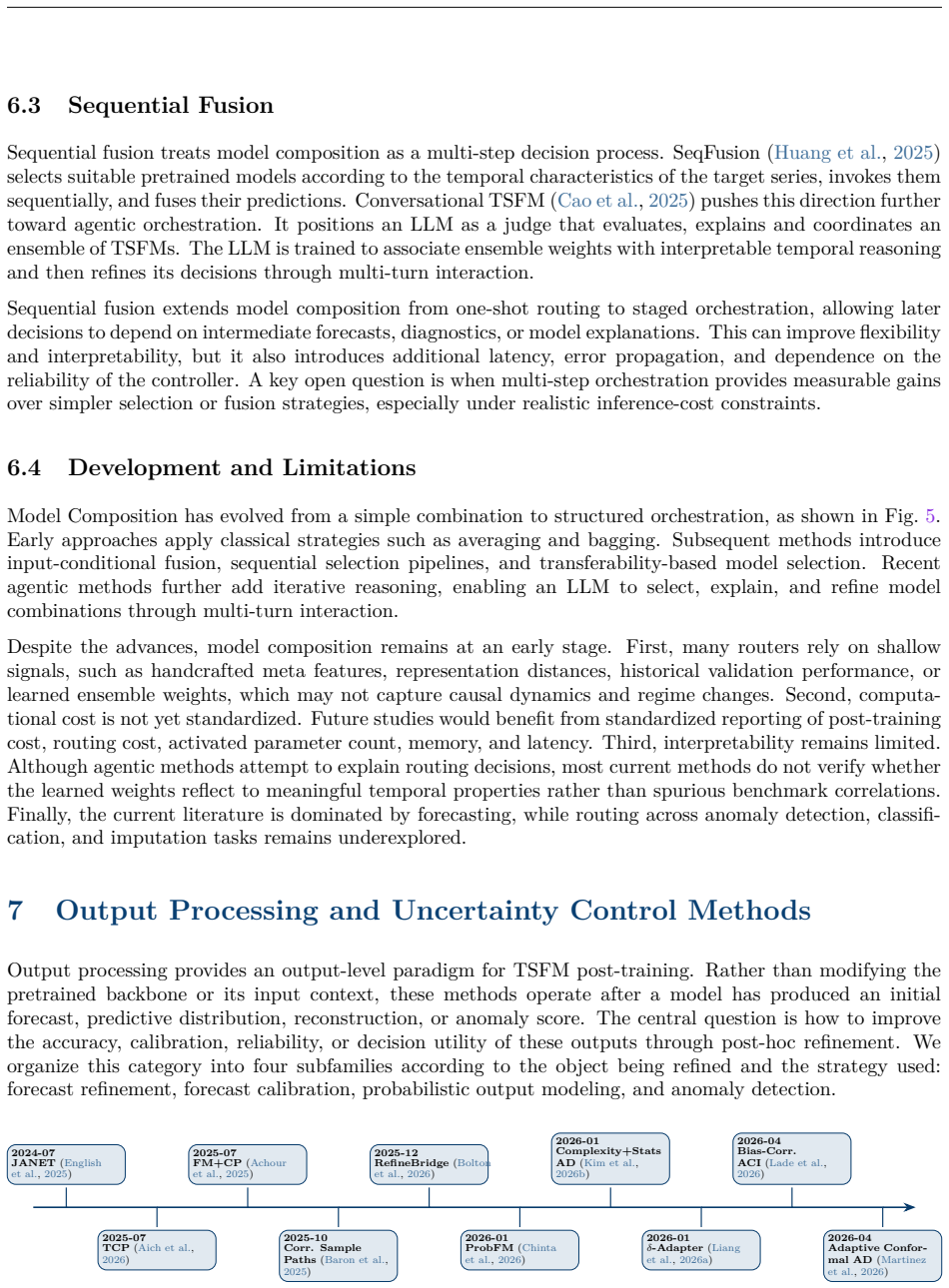
- [Figure 1] Figure 1 is dense and the small captions within the diagram are hard to read. Consider enlarging the label text or splitting the figure for clarity.
- [References] Several references are to preprints with 2026 dates; it would help readers to indicate in the text which methods are peer-reviewed and which are preprints, given the paper's stated coverage of both.
Circularity Check
No circularity: taxonomy is a stipulated schema; self-citations are contextual, not load-bearing.
full rationale
The paper is a survey/taxonomy, not a derivation with fitted parameters or empirical predictions. Section 3 defines post-training as any procedure that improves a TSFM by modifying one of five pipeline components, and the five categories are exactly those components; this is a stipulated classification scheme rather than a derived result, so the taxonomy does not reduce to its own inputs in a circular way. The manuscript's self-citations (e.g., Oreshkin et al. 2021/2026, Xie et al. 2026a,b, Baron et al. 2025, and works co-authored by Liu) appear as background, examples, or surveyed methods and are not load-bearing for the taxonomic criterion. The δ-Adapter case, placed under Output Processing while its input-nudging component is also discussed under Context Transformation, is a boundary/consistency issue in the classification, not a circular reduction; similarly, overlaps between model composition and parameter adaptation concern mutual exclusivity of the taxonomy, not circularity. Reported performance numbers are quoted from external works and are not predictions generated by this paper. No circular step can be exhibited by quoting the paper's own equations or definitions.
Axiom & Free-Parameter Ledger
axioms (2)
- domain assumption The surveyed methods exist and are accurately represented by the cited references and the paper's one-paragraph summaries.
- ad hoc to paper TSFM post-training methods can be assigned to exactly one primary locus of intervention among the five families.
Cite this review
Pith. "Pith review of Post-Training in Time Series Foundation Models: A Unifying Framework." pith.science (2026). https://pith.science/paper/63PUV7Y4
@misc{pith2026260720002,
  author       = {Pith},
  title        = {Pith review of: Post-Training in Time Series Foundation Models: A Unifying Framework},
  year         = {2026},
  howpublished = {\url{https://pith.science/paper/63PUV7Y4}},
  note         = {Machine review of arXiv:2607.20002}
}
read the original abstract
Time series foundation models (TSFMs) have emerged as general-purpose models for time series analysis, but pretraining alone is often insufficient for reliable downstream deployment. Bridging this gap requires further intervention to handle domain shift, task heterogeneity, limited supervision, and computational constraints, which motivates post-training as a broad class of methods to adapt, augment, compose, calibrate, or specialize pretrained TSFMs for downstream tasks. In this work, we analyze TSFM post-training methods based on their locus of intervention in the prediction pipeline, yielding five categories: parameter adaptation, context augmentation, model composition, output processing and uncertainty control, and compression and specialization. Within each category, we study main representative methods and discuss their current limitations. We further identify future directions toward controlled adaptation, reliable context construction, uncertainty-aware model composition, calibrated output processing, and deployment-aware specialization. Overall, by providing a unifying framework for the emerging TSFM post-training landscape, this work aims to support future research to navigate the design space between a pretrained TSFM and its reliable downstream deployment.
Figures



Reference graph
Works this paper leans on
-
[1]
arXiv preprint arXiv:2512.07624 , year =
Time Series Foundation Models for Process Model Forecasting , author =. arXiv preprint arXiv:2512.07624 , year =
-
[2]
Gupta, Divij and Bhatti, Anubhav and Parmar, Surajsinh , journal =. Beyond. 2024 , doi =
2024
-
[3]
2025 , eprint=
TS-Reasoner: Aligning Time Series Foundation Models with LLM Reasoning , author=. 2025 , eprint=
2025
-
[4]
2024 , eprint=
ChatTime: A Unified Multimodal Time Series Foundation Model Bridging Numerical and Textual Data , author=. 2024 , eprint=
2024
-
[5]
Xie, Zhe and Li, Zeyan and He, Xiao and Xu, Longlong and Wen, Xidao and Zhang, Tieying and Chen, Jianjun and Shi, Rui and Pei, Dan , year=. ChatTS: Aligning Time Series with LLMs via Synthetic Data for Enhanced Understanding and Reasoning , volume=. Proceedings of the VLDB Endowment , publisher=. doi:10.14778/3742728.3742735 , number=
-
[6]
Forty-second International Conference on Machine Learning , year=
Context is Key: A Benchmark for Forecasting with Essential Textual Information , author=. Forty-second International Conference on Machine Learning , year=
-
[7]
2025 , eprint=
Time-MMD: Multi-Domain Multimodal Dataset for Time Series Analysis , author=. 2025 , eprint=
2025
-
[8]
2025 , eprint=
ChronoSteer: Bridging Large Language Model and Time Series Foundation Model via Synthetic Data , author=. 2025 , eprint=
2025
-
[9]
Time Series Foundation Models Improve
Shifeng Xie and Ziwei Li and Themis Palpanas and Peilin Zhao and Chenghao Liu , booktitle=. Time Series Foundation Models Improve. 2026 , url=
2026
-
[10]
The Fourteenth International Conference on Learning Representations , year =
Zero-shot Forecasting by Simulation Alone , author =. The Fourteenth International Conference on Learning Representations , year =
-
[11]
arXiv preprint arXiv:2310.03589 , year=
TimeGPT-1 , author=. arXiv preprint arXiv:2310.03589 , year=
-
[12]
Proceedings of the AAAI Conference on Artificial Intelligence , pages=
Meta-learning framework with applications to zero-shot time-series forecasting , author=. Proceedings of the AAAI Conference on Artificial Intelligence , pages=
-
[13]
2022 , note =
Hierarchical forecasting with a top-down alignment of independent-level forecasts , journal =. 2022 , note =
2022
-
[14]
Oreshkin and Dmitri Carpov and Nicolas Chapados and Yoshua Bengio , title =
Boris N. Oreshkin and Dmitri Carpov and Nicolas Chapados and Yoshua Bengio , title =. 8th International Conference on Learning Representations,. 2020 , url =
2020
-
[15]
A hybrid method of exponential smoothing and recurrent neural networks for time series forecasting , journal =
Smyl, Slawek , year =. A hybrid method of exponential smoothing and recurrent neural networks for time series forecasting , journal =
-
[16]
Scaling Learning Algorithms Towards
Bengio, Yoshua and LeCun, Yann , booktitle =. Scaling Learning Algorithms Towards
-
[17]
and Osindero, Simon and Teh, Yee Whye , journal =
Hinton, Geoffrey E. and Osindero, Simon and Teh, Yee Whye , journal =. A Fast Learning Algorithm for Deep Belief Nets , volume =
-
[18]
2016 , publisher=
Deep learning , author=. 2016 , publisher=
2016
-
[19]
The Fourteenth International Conference on Learning Representations , year=
Test-Time Efficient Pretrained Model Portfolios for Time Series Forecasting , author=. The Fourteenth International Conference on Learning Representations , year=
-
[20]
2025 , eprint=
One-Embedding-Fits-All: Efficient Zero-Shot Time Series Forecasting by a Model Zoo , author=. 2025 , eprint=
2025
-
[21]
2025 , eprint=
Estimating Time Series Foundation Model Transferability via In-Context Learning , author=. 2025 , eprint=
2025
-
[22]
Forty-second International Conference on Machine Learning , year=
Breaking Silos: Adaptive Model Fusion Unlocks Better Time Series Forecasting , author=. Forty-second International Conference on Machine Learning , year=
-
[23]
Transactions on Machine Learning Research , issn=
Synapse: Adaptive Arbitration of Complementary Expertise in Time Series Foundational Models , author=. Transactions on Machine Learning Research , issn=. 2026 , url=
2026
-
[24]
2025 , eprint=
Enhancing Transformer-Based Foundation Models for Time Series Forecasting via Bagging, Boosting and Statistical Ensembles , author=. 2025 , eprint=
2025
-
[25]
2025 , eprint=
SeqFusion: Sequential Fusion of Pre-Trained Models for Zero-Shot Time-Series Forecasting , author=. 2025 , eprint=
2025
-
[26]
2025 , eprint=
Conversational Time Series Foundation Models: Towards Explainable and Effective Forecasting , author=. 2025 , eprint=
2025
-
[27]
Zhang and Kashif Rasul and Anderson Schneider and Lintao Ma and Yuriy Nevmyvaka and Dongjin Song , booktitle=
Kanghui Ning and Zijie Pan and Yu Liu and Yushan Jiang and James Y. Zhang and Kashif Rasul and Anderson Schneider and Lintao Ma and Yuriy Nevmyvaka and Dongjin Song , booktitle=. 2026 , url=
2026
-
[28]
TimeRAF: Retrieval-Augmented Foundation Model for Zero-Shot Time Series Forecasting , year=
Zhang, Huanyu and Xu, Chang and Zhang, Yi-Fan and Zhang, Zhang and Wang, Liang and Bian, Jiang , journal=. TimeRAF: Retrieval-Augmented Foundation Model for Zero-Shot Time Series Forecasting , year=
-
[29]
Forty-second International Conference on Machine Learning , year=
Retrieval Augmented Time Series Forecasting , author=. Forty-second International Conference on Machine Learning , year=
-
[30]
2026 , eprint=
Cross-RAG: Zero-Shot Retrieval-Augmented Time Series Forecasting via Cross-Attention , author=. 2026 , eprint=
2026
-
[31]
2025 , eprint=
RATFM: Retrieval-augmented Time Series Foundation Model for Anomaly Detection , author=. 2025 , eprint=
2025
-
[32]
2026 , eprint=
Retrieval-Augmented Generation with Covariate Time Series , author=. 2026 , eprint=
2026
-
[33]
2026 , eprint=
MEMTS: Internalizing Domain Knowledge via Parameterized Memory for Retrieval-Free Domain Adaptation of Time Series Foundation Models , author=. 2026 , eprint=
2026
-
[34]
2026 , eprint=
TS-Memory: Plug-and-Play Memory for Time Series Foundation Models , author=. 2026 , eprint=
2026
-
[35]
2026 , eprint=
MOMEMTO: Patch-based Memory Gate Model in Time Series Foundation Model , author=. 2026 , eprint=
2026
-
[36]
The Fourteenth International Conference on Learning Representations , year=
Adapt Data to Model: Adaptive Transformation Optimization for Domain-shared Time Series Foundation Models , author=. The Fourteenth International Conference on Learning Representations , year=
-
[37]
The Fourteenth International Conference on Learning Representations , year=
The Forecast After the Forecast: A Post-Processing Shift in Time Series , author=. The Fourteenth International Conference on Learning Representations , year=
-
[38]
RefineBridge: Generative Bridge Models Improve Financial Forecasting by Foundation Models , year=
Bolton, Anthony and Zhou, Wuyang and Chen, Zehua and Iacovides, Giorgos and Mandic, Danilo , booktitle=. RefineBridge: Generative Bridge Models Improve Financial Forecasting by Foundation Models , year=
-
[39]
2025 , eprint=
Foundation models for time series forecasting: Application in conformal prediction , author=. 2025 , eprint=
2025
-
[40]
2026 , eprint=
Temporal Conformal Prediction (TCP): A Distribution-Free Statistical and Machine Learning Framework for Adaptive Risk Forecasting , author=. 2026 , eprint=
2026
-
[41]
2026 , eprint=
Bias-Corrected Adaptive Conformal Inference for Multi-Horizon Time Series Forecasting , author=. 2026 , eprint=
2026
-
[42]
English, Eshant and Wong-Toi, Eliot and Fontana, Matteo and Mandt, Stephan and Smyth, Padhraic and Lippert, Christoph , title=. Machine Learning , year=. doi:10.1007/s10994-025-06812-2 , url=
-
[43]
2026 , eprint=
ProbFM: Probabilistic Time Series Foundation Model with Uncertainty Decomposition , author=. 2026 , eprint=
2026
-
[44]
Recent Advances in Time Series Foundation Models Have We Reached the 'BERT Moment'? , year=
Efficiently Generating Correlated Sample Paths from Multi-step Time Series Foundation Models , author=. Recent Advances in Time Series Foundation Models Have We Reached the 'BERT Moment'? , year=
-
[45]
The Fourteenth International Conference on Learning Representations , year=
Adaptive Conformal Anomaly Detection with Time Series Foundation Models for Signal Monitoring , author=. The Fourteenth International Conference on Learning Representations , year=
-
[46]
The Fourteenth International Conference on Learning Representations , year=
Complexity- and Statistics-Guided Anomaly Detection in Time Series Foundation Models , author=. The Fourteenth International Conference on Learning Representations , year=
-
[47]
The Thirty-ninth Annual Conference on Neural Information Processing Systems , year=
Multi-Scale Finetuning for Encoder-based Time Series Foundation Models , author=. The Thirty-ninth Annual Conference on Neural Information Processing Systems , year=
-
[48]
2025 , eprint=
VisionTS++: Cross-Modal Time Series Foundation Model with Continual Pre-trained Vision Backbones , author=. 2025 , eprint=
2025
-
[49]
Financial Fine-Tuning a Large Time Series Model , year=
Fu, Xinghong and Hirano, Masanori and Imajo, Kentaro , booktitle=. Financial Fine-Tuning a Large Time Series Model , year=
-
[50]
2025 , eprint=
Foundation Time-Series AI Model for Realized Volatility Forecasting , author=. 2025 , eprint=
2025
-
[51]
2025 , eprint=
Time-Series Foundation AI Model for Value-at-Risk Forecasting , author=. 2025 , eprint=
2025
-
[52]
2025 , eprint=
Fine-Tuning Foundation Models with Federated Learning for Privacy Preserving Medical Time Series Forecasting , author=. 2025 , eprint=
2025
-
[53]
Chen, Shengchao and Long, Guodong and Jiang, Jing and Zhang, Chengqi , title =. 2025 , isbn =. doi:10.1609/aaai.v39i15.33739 , booktitle =
-
[54]
2026 , eprint=
Bi-level Heterogeneous Learning for Time Series Foundation Models: A Federated Learning Approach , author=. 2026 , eprint=
2026
-
[55]
Proceedings of The 28th International Conference on Artificial Intelligence and Statistics , pages =
ChronosX: Adapting Pretrained Time Series Models with Exogenous Variables , author =. Proceedings of The 28th International Conference on Artificial Intelligence and Statistics , pages =. 2025 , editor =
2025
-
[56]
Lu Han and Yu Liu and Lan Li and Qiwen Deng and Jian Jiang and Yinbo sun and Zhe Yu and Binfeng Wang and Xingyu Lu and Lintao Ma and Han-Jia Ye and De-Chuan Zhan , booktitle=. Uni. 2026 , url=
2026
-
[57]
Dange, Afrin and Sarawagi, Sunita , title =. 2025 , isbn =. doi:10.1145/3746252.3761272 , booktitle =
arXiv 2025
-
[58]
2025 , eprint=
CoRA: Covariate-Aware Adaptation of Time Series Foundation Models , author=. 2025 , eprint=
2025
-
[59]
Yuwei Fan and Tao Song and Chenlong Feng and Chao Liu and Dongxiang Jiang , keywords =. Wind power prediction using foundation large time series models enhanced by time series prompt in exogenous and tuning forms , journal =. 2025 , issn =. doi:https://doi.org/10.1016/j.apenergy.2025.126535 , url =
arXiv 2025
-
[60]
Hanyin Cheng and Xingjian Wu and Yang Shu and Zhongwen Rao and Lujia Pan and Bin Yang and Chenjuan Guo , booktitle=. Co. 2026 , url=
2026
-
[61]
Abdelhakim Benechehab and Vasilii Feofanov and Giuseppe Paolo and Albert Thomas and Maurizio Filippone and Bal. Ada. Forty-second International Conference on Machine Learning , year=
-
[62]
2026 , eprint=
DualWeaver: Synergistic Feature Weaving Surrogates for Multivariate Forecasting with Univariate Time Series Foundation Models , author=. 2026 , eprint=
2026
-
[63]
2024 , eprint=
Generalized Prompt Tuning: Adapting Frozen Univariate Time Series Foundation Models for Multivariate Healthcare Time Series , author=. 2024 , eprint=
2024
-
[64]
doi:10.1016/j.neucom.2025.132098 , journal=
Li, Yuze and Zhu, Wei , year=. doi:10.1016/j.neucom.2025.132098 , journal=
arXiv 2025
-
[65]
2025 , eprint=
STAR: Boosting Time Series Foundation Models for Anomaly Detection through State-aware Adapter , author=. 2025 , eprint=
2025
-
[66]
The Fourteenth International Conference on Learning Representations , year=
Repurposing Foundation Model for Generalizable Medical Time Series Classification , author=. The Fourteenth International Conference on Learning Representations , year=
-
[67]
Second Workshop on Test-Time Adaptation: Putting Updates to the Test! at ICML 2025 , year=
Lightweight Online Adaption for Time Series Foundation Model Forecasts , author=. Second Workshop on Test-Time Adaptation: Putting Updates to the Test! at ICML 2025 , year=
2025
-
[68]
Kim, HyunGi and Kim, Siwon and Mok, Jisoo and Yoon, Sungroh , title =. 2025 , isbn =. doi:10.1609/aaai.v39i17.33965 , booktitle =
-
[69]
Proceedings of the AAAI Conference on Artificial Intelligence , year =
Kim, HyunGi and Mok, Jisoo and Lee, Hyungyu and Shin, Juhyeon and Yoon, Sungroh , title =. Proceedings of the AAAI Conference on Artificial Intelligence , year =. doi:10.1609/aaai.v40i17.38524 , url =
-
[70]
AdaNODEs: Test Time Adaptation for Time Series Forecasting Using Neural Odes , year=
Dang, Ting and Chatterjee, Soumyajit and Jia, Hong and Wu, Yu and Salim, Flora and Kawsar, Fahim , booktitle=. AdaNODEs: Test Time Adaptation for Time Series Forecasting Using Neural Odes , year=
-
[71]
Second Workshop on Test-Time Adaptation: Putting Updates to the Test! at ICML 2025 , year=
Shift-Aware Test Time Adaptation and Benchmarking for Time-Series Forecasting , author=. Second Workshop on Test-Time Adaptation: Putting Updates to the Test! at ICML 2025 , year=
2025
-
[72]
2026 , eprint=
RG-TTA: Regime-Guided Meta-Control for Test-Time Adaptation in Streaming Time Series , author=. 2026 , eprint=
2026
-
[73]
NeurIPS Workshop on Time Series in the Age of Large Models , year=
Fine-Tuning a Time Series Foundation Model with Wasserstein Loss , author=. NeurIPS Workshop on Time Series in the Age of Large Models , year=
-
[74]
Beichter, Maximilian and Friederich, Nils and Pinter, Janik and Werling, Dorina and Phipps, Kaleb and Beichter, Sebastian and Neumann, Oliver and Mikut, Ralf and Hagenmeyer, Veit and Heidrich, Benedikt , year=. Decision-focused fine-tuning of time series foundation models for dispatchable feeder optimization , volume=. doi:10.1016/j.egyai.2025.100533 , journal=
arXiv 2025
-
[75]
2026 , eprint=
Adapting Time Series Foundation Models through Data Mixtures , author=. 2026 , eprint=
2026
-
[76]
2025 , eprint=
Forecast2Anomaly (F2A): Adapting Multivariate Time Series Foundation Models for Anomaly Prediction , author=. 2025 , eprint=
2025
-
[77]
2024 , url=
Uncertainty-aware Fine-tuning on Time Series Foundation Model for Anomaly Detection , author=. 2024 , url=
2024
-
[78]
2015 , eprint=
Distilling the Knowledge in a Neural Network , author=. 2015 , eprint=
2015
-
[79]
2026 , eprint=
Distilling Time Series Foundation Models for Efficient Forecasting , author=. 2026 , eprint=
2026
-
[80]
Efficient Multivariate Time Series Forecasting via Calibrated Language Models with Privileged Knowledge Distillation , year=
Liu, Chenxi and Miao, Hao and Xu, Qianxiong and Zhou, Shaowen and Long, Cheng and Zhao, Yan and Li, Ziyue and Zhao, Rui , booktitle=. Efficient Multivariate Time Series Forecasting via Calibrated Language Models with Privileged Knowledge Distillation , year=
This paper was first reviewed by deepseek-v4-flash on August 1, 2026.
discussion (0)
Sign in with ORCID, Apple, or X to comment. Anyone can read and Pith papers without signing in.