REVIEW 4 major objections 5 minor 99 references
Model Comparisons of Transverse Energy and Charged-Particle Multiplicity in A+A Collisions at Midrapidity from $\sqrt{s_{NN}}$ $=$ 7.7 to 200~GeV
T0 review · 4 major / 5 minor · reviewed 2026-08-07 · deepseek-v4-flash
Pith's one-line read A systematic comparison of four event generators against PHENIX measurements of transverse energy and charged-particle multiplicity finds that none reproduces the data at low beam energies or in peripheral collisions, pointing to gaps in…
desk verdict Useful broad benchmark, but the headline low-energy/peripheral claim rests on a centrality calibration that is not validated in exactly the regimes where it matters. read the letter →
The pith
A machine-rendered reading of the paper's core claim, the machinery that carries it, and where it could break.
The reading
What carries the argument
The main engine of the comparison is the Rivet framework, a standard tool for comparing Monte Carlo event generators with experimental data, combined with a BBC-based centrality calibration. For each collision system and energy, and for each model, the authors record the charged-particle multiplicity in the BBC acceptance region ($3.1<|\eta|<3.9$) and set percentile thresholds in the simulated inelastic cross section so that centrality bins match PHENIX's experimental definition. This calibration decides which model events land in each centrality class, so all subsequent ratio comparisons of $dE_T/d\eta$ and $dN/d\eta$ rest on it. A second piece is the linear fit of $dE_T/d\eta$ versus $dN/d\eta$ across systems, whose slope gives a compact test of the energy per charged particle produced by each model.
What would settle it
Replace the BBC-percentile centrality selection with a Glauber $N_{\rm part}$-based selection and recompute 0–5% central Au+Au at $\sqrt{s_{NN}}=7.7$ GeV with the same four models; if model-to-data ratios shift by more than the experimental uncertainties, the centrality calibration is partly responsible for the reported deviations, whereas if they stay put, the missing baryon-stopping physics is real.
Extended reading notes
Core claim
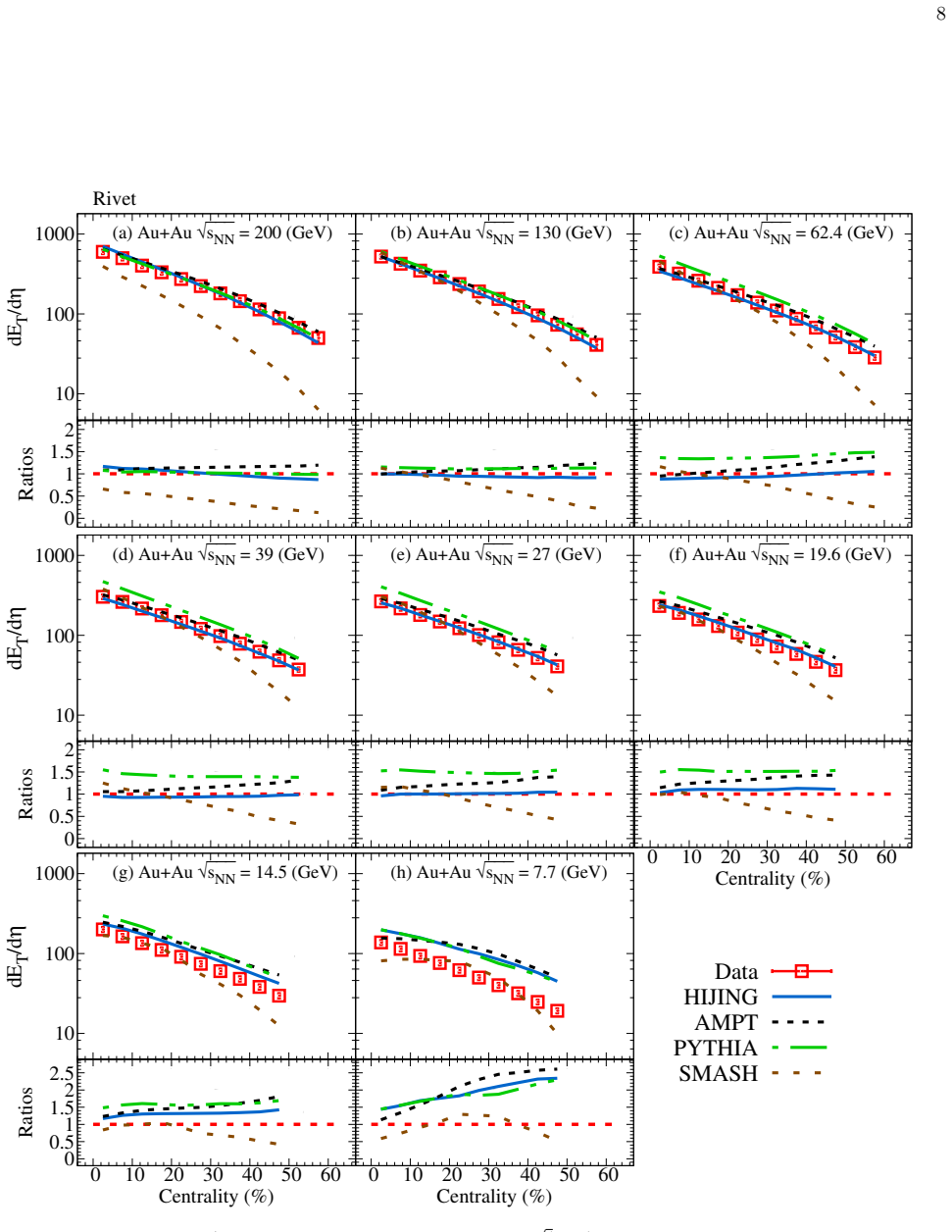
On the paper's own terms, the discovery is that the measured PHENIX values of $dE_T/d\eta$ and $dN/d\eta$ at midrapidity provide a discriminating test that current event generators fail. Although each of the four models follows the gross energy and multiplicity trends, model-to-data ratios deviate substantially in peripheral collisions and at $\sqrt{s_{NN}}\lesssim20$ GeV. The deviations form a pattern that the authors attribute to incomplete descriptions of baryon stopping and energy deposition. At the same time, the linear correlation between $dE_T/d\eta$ and $dN/d\eta$ holds across systems from d+Au to U+U in both data and models, with slopes agreeing within about 5% except for AMPT, suggesting a common participant-scaling mechanism.
Load-bearing premise
The load-bearing premise is that cutting a model's simulated BBC multiplicity distribution at the same percentiles PHENIX uses actually selects the same collision geometries, so the centrality comparison is fair, and that any bias in this mapping would shift all centrality-dependent results.
Editorial extensions
If this is right
- If the paper is right, none of the four tested generators can be used for quantitative predictions of these bulk observables at $\sqrt{s_{NN}}\lesssim20$ GeV or in peripheral collisions without adding improved baryon-stopping and energy-deposition physics.
- The calibrated Rivet analyses are reusable: future versions of these generators can be checked against the same PHENIX data set without reimplementing the centrality selection.
- The observed linear scaling across systems supports a common mechanism tied to the number of participant nucleons, so the slope of the $dE_T/d\eta$–$dN/d\eta$ correlation becomes a model target in its own right.
- The model-to-data ratio patterns give specific tuning targets, especially the centrality dependence at 7.7 GeV, which would require more stopping than current string fragmentation and transport schemes produce.
Reading between the lines
- The centrality calibration itself is model-dependent: if a model's simulated BBC multiplicity distribution does not match the real one, the same percentile cuts map to different impact-parameter ranges, so some of the reported deviation could be centrality bias rather than physics.
- A cheap cross-check would be to recompute the ratios using a Glauber $N_{\rm part}$-based centrality selection; large shifts would implicate the calibration, while stable ratios would strengthen the baryon-stopping interpretation.
- AMPT's roughly 25% lower slope implies less transverse energy per charged particle at fixed multiplicity; comparing identified-particle spectra, especially protons versus pions, would show whether the deficit originates in the partonic phase or the hadronic afterburner.
- The same correlation measured at LHC energies would test the participant-scaling interpretation, since a different slope per participant at higher $\sqrt{s_{NN}}$ would require a revised explanation.
Editorial analysis
A structured set of objections, weighed in public.
Referee Report
Summary. The paper presents a systematic comparison of PHENIX measurements of transverse energy production dE_T/deta and charged-particle multiplicity dN/deta at midrapidity with simulations from PYTHIA-8 Angantyr, AMPT, HIJING, and SMASH. The comparison covers d+Au, 3He+Au, Cu+Cu, Cu+Au, Au+Au, and U+U collisions at sqrt(s_NN) ~ 200 GeV, with Au+Au spanning sqrt(s_NN) = 7.7 to 200 GeV. Centrality is defined via percentile cuts on the simulated BBC multiplicity in 3.1 < |eta| < 3.9, calibrated separately for each model, system, and energy. The paper reports that the models capture general trends but show significant deviations at low beam energies and in peripheral collisions, and that dE_T/deta and dN/deta are linearly correlated across systems, with fit slopes for data, PYTHIA, HIJING, and SMASH agreeing within 5% while AMPT's slope is about 25% lower.
Significance. The paper's main strength is its breadth: it generates large-statistics samples for six collision systems and eight beam energies and compares them to published PHENIX data within the standardized Rivet framework, without tuning the models to the observables being compared. This makes the comparison a valid, falsifiable benchmark: if the centrality calibration is trustworthy, the result that none of the four event generators quantitatively reproduces the energy and centrality dependence of these bulk observables at low energies and in peripheral collisions is an important constraint on models. The observed linear scaling between dE_T/deta and dN/deta across systems, with a notable exception for AMPT, is also a compact model test. However, the central conclusions currently rest on visual ratio comparisons without quantitative goodness-of-fit measures or model uncertainty bands, and the centrality calibration in the low-occupancy regimes where the claimed deviations live is not validated.
major comments (4)
- [Section II.B] The centrality calibration is load-bearing for the main claim, but it is not validated in the regimes where the claimed deviations are largest. The paper defines centrality via percentile cuts on the simulated BBC multiplicity in 3.1 < |eta| < 3.9, yet it does not show the simulated BBC multiplicity distributions, does not report occupancy values for each energy and centrality, and does not compare the simulated BBC response with PHENIX BBC distributions. At sqrt(s_NN) = 7.7 and 14.5 GeV the available rapidity range is only about 2.1 and 2.7, respectively, so the simulated charged-particle yield reaching the BBC region is expected to be sparse; in such low-occupancy situations, percentile cuts from Eq. (2) can select rare upward fluctuations rather than a meaningful geometric centrality class. Because the abstract's conclusion about low-energy and peripheral discrepancies is derived from ratios built on this calibration, the authors should provide a quantitative validation of the centrality mapping, for example by comparing the simulated BBC multiplicity spectra to the experimental ones and by cross-checking the centrality determination against an alternative estimator such as impact-parameter or participant-number percentiles for the lowest energies and most peripheral bins.
- [Section III and Appendix A] The paper states that 'significant deviations persist' and that the 'largest discrepancies' appear at low energies and in peripheral collisions, but no quantitative measure of agreement is provided. The ratio plots in Appendix A and Fig. 2 show ratios deviating to roughly 0.4 and 2.5 in some cases, but without a goodness-of-fit metric such as chi-square per degree of freedom, mean and RMS of the ratios, or a simple test of whether the deviations exceed the data uncertainties, the word 'significant' is not supported. The authors should add a quantitative summary of the model-data agreement across all centrality and energy bins, including the data point uncertainties in the ratio plots and, if feasible, an estimate of the model statistical uncertainty.
- [Section III, Fig. 3(f)] The claim that the slopes of dE_T/deta versus dN/deta for data, PYTHIA, HIJING, and SMASH 'agree within 5%' while AMPT is 'lower than the data by about 25%' is made without reporting the fitted slope uncertainties. With only a handful of systems per fit, the statistical uncertainty on each slope is likely to be much larger than 5%, and the stated agreement is therefore not established. The authors should report the fitted slopes with uncertainties and, if appropriate, the correlation matrix, so that the 'within 5%' and '25% lower' statements can be tested for statistical significance.
- [Section IV and Abstract] The conclusion attributes the observed discrepancies to 'baryon stopping and energy deposition mechanisms,' but the presented observables are midrapidity dN/deta and dE_T/deta, which are not directly sensitive to baryon stopping in the fragmentation region. The paper does not analyze any baryon-number-related observable, such as net-proton yields or baryon transport ratios, that would support this attribution. This interpretation should either be removed or softened, or the paper should include an additional observable that actually constrains baryon stopping, before the abstract's conclusion can be accepted.
minor comments (5)
- [Fig. 6 caption] The caption reads 'U+U at 193, Cu+Au at 62.4 and 200 GeV, Cu+Au, 3He+Au and d+Au at 200 GeV,' but the panels show U+U, Cu+Cu at 200 and 62.4 GeV, Cu+Au at 200 GeV, 3He+Au, and d+Au; the caption should be corrected to 'Cu+Cu at 62.4 and 200 GeV, Cu+Au at 200 GeV.'
- [Figs. 6 and 7 captions] The word 'central' in 'central dependence' should be replaced with 'centrality dependence'.
- [Section II.A] For PYTHIA-8 Angantyr the version number is not specified, while AMPT v2.26t9b, HIJING v1.411, and SMASH 3.1 are given; please state the PYTHIA-8 version and any relevant parameter settings to ensure reproducibility.
- [Section II.B] The paper does not state whether the implemented Rivet analyses will be made publicly available, for example in the Rivet repository or a public code archive; making the analysis routines available would substantially increase the reproducibility and impact of the comparison.
- [Section III, Fig. 2] The text refers to dE_T/deta as panels (a)-(f) and dN/deta as panels (g)-(l), but the panel layout in Fig. 2 as presented has three rows and four columns; please ensure the textual panel references match the actual figure layout.
Circularity Check
No circularity identified: the paper compares independent, fixed-default event-generator outputs against external PHENIX data, and centrality is defined by forward BBC multiplicity, a separate observable from the midrapidity quantities being compared.
full rationale
The paper's derivation chain is a data-model comparison with no fitted parameters. The four event generators (PYTHIA-8 Angantyr, AMPT, HIJING, SMASH) are run with their published default settings ('approximately 5.0 million events generated for each case'), and their midrapidity dN/dη and dET/dη outputs are compared directly to PHENIX published data [11,48,49], which are external benchmarks. Centrality is defined in Section II.B via Eq. (2) as a percentile of each model's own simulated BBC multiplicity in 3.1<|η|<3.9, following the standard Rivet method (Ref. [94]); the forward BBC multiplicity is distinct from the midrapidity observables that are the objects of comparison, so no quantity being 'predicted' enters the definition of the input. The slope fits in Fig. 3 are descriptive statistics of a correlation between two compared observables and are not fed back into any model or used to derive the paper's conclusions. The headline claim—that models deviate most strongly at low beam energies and in peripheral collisions—is an empirical reading of the model-to-data ratios in Appendix A, not a by-construction result. Author self-citations (Refs. [37,69,71,72]) appear only as background literature and are not load-bearing for any step. The paper even includes an honest limitation statement ('The ability of these models to describe the data with comparable fidelity may indicate either that these models have been tuned extensively or that more detailed tests are required to distinguish models'). The skeptic's concern about BBC centrality calibration at low occupancy is a possible systematic-validity issue, not circularity: a biased centrality mapping would shift the comparisons, but it would not make any model output equivalent to an input by construction. Under hard rule 3, because the paper is self-contained against external benchmarks with independent generators, the honest finding is a circularity score of 0.
Assumptions & free parameters
assumptions (3)
- domain assumption The published PHENIX dN/deta and dET/deta measurements are accurate representations of the collisions.
- domain assumption Selecting centrality by percentile cuts on simulated BBC multiplicity (3.1<|eta|<3.9) reproduces the experimental centrality selection.
- domain assumption Default parameter settings of PYTHIA-8, AMPT, HIJING, and SMASH are appropriate for the systems and energies studied.
Cite this review
Pith. "Pith review of Model Comparisons of Transverse Energy and Charged-Particle Multiplicity in A+A Collisions at Midrapidity from $\sqrt{s_{NN}}$ $=$ 7.7 to 200~GeV." pith.science (2026). https://pith.science/paper/65GS4VLS
@misc{pith2026250607941,
  author       = {Pith},
  title        = {Pith review of: Model Comparisons of Transverse Energy and Charged-Particle Multiplicity in A+A Collisions at Midrapidity from $\sqrts_NN$ $=$ 7.7 to 200~GeV},
  year         = {2026},
  howpublished = {\url{https://pith.science/paper/65GS4VLS}},
  note         = {Machine review of arXiv:2506.07941}
}
abstract
We present a comprehensive comparison of PHENIX measurements of transverse energy production ($dE_T/d\eta$) and charged-particle multiplicity ($dN/d\eta$) at midrapidity to simulations from PYTHIA-8, AMPT, HIJING, and SMASH. These comparisons span both small systems (d+Au, $^3$He+Au) and large systems (Cu+Cu, Cu+Au, Au+Au, and U+U) at $\sqrt{s_{NN}}$ $\sim$ 200~GeV and Au+Au over a range of beam energies $\sqrt{s_{NN}} = 7.7$--200~GeV. Using the Rivet framework, we assess the performance of these models. While general trends are captured, significant deviations persist, particularly in low-energy and peripheral collisions, underscoring the need for improved modeling of baryon stopping and energy deposition mechanisms.
Figures


Figures from the paper (4 more)



Reference graph
Works this paper leans on
-
[1]
In pp col- lisions, multi-parton interactions (MPI) are generated, assuming that each partonic interaction is mainly inde- pendent
PYTHIA-8 Angantyr PYTHIA [50] is an event generator for studying proton-proton and proton-lepton collisions. In pp col- lisions, multi-parton interactions (MPI) are generated, assuming that each partonic interaction is mainly inde- pendent. The introduction of the Angantyr model [50] extends PYTHIA-8’s capabilities to heavy-ion collisions, allowing for th...
-
[2]
It employs Glauber geometry to simulate heavy-ion collisions via binary nucleon-nucleon interactions
HIJING HIJING [52, 53] is a Monte Carlo event generator designed to simulate parton and particle production in high-energy heavy ion collisions. It employs Glauber geometry to simulate heavy-ion collisions via binary nucleon-nucleon interactions. It is used for studying jet and mini-jet production alongside associated parti- cle production in high-energy ...
-
[3]
Here, z represents the light-cone momentum fraction of the produced hadron with transverse mass m⊥ around that of the fragmenting string
AMPT AMPT [51, 59–72] encompasses several key compo- nents: (i) an initial partonic state provided by HI- JING [52, 53], with parameters specified in the Lund string fragmentation function [73] denoted by f (z) ∝ z−1(1 − z)a exp(−b m2 ⊥/z), where a = 0.55 and b = 0.15 GeV−2, as detailed in Ref [74]. Here, z represents the light-cone momentum fraction of t...
-
[4]
SMASH Transport Model SMASH (Simulating Many Accelerated Strongly- interacting Hadrons) [54] 3.1 [77] is a microscopic hadronic transport approach developed to simulate the non-equilibrium dynamics of hadronic matter in heavy- ion collisions, especially at low to intermediate energies where hadronic interactions dominate [54]. The model solves the relativ...
-
[5]
U. W. Heinz and M. Jacob, (2000), arXiv:nucl- th/0002042
arXiv 2000
- [6]
-
[7]
Heinz and R
U. Heinz and R. Snellings, Ann. Rev. Nucl. Part. Sci. 63, 123 (2013)
2013
-
[8]
E. V. Shuryak, Sov. J. Nucl. Phys. 28, 408 (1978)
1978
Show all 99 references
-
[9]
E. V. Shuryak, Phys. Rept. 61, 71 (1980)
1980
-
[10]
Muller, J
B. Muller, J. Schukraft, and B. Wyslouch, Ann. Rev. Nucl. Part. Sci. 62, 361 (2012), arXiv:1202.3233 [hep-ex]
2012 arXiv
- [11]
-
[12]
Adcox et al
K. Adcox et al. (PHENIX), Nucl. Phys. A 757, 184 (2005), arXiv:nucl-ex/0410003
2005 arXiv
-
[13]
Arsene et al.(BRAHMS), Nucl
I. Arsene et al.(BRAHMS), Nucl. Phys. A 757, 1 (2005), arXiv:nucl-ex/0410020
2005 arXiv
-
[14]
B. B. Back et al. (PHOBOS), Nucl. Phys. A 757, 28 (2005), arXiv:nucl-ex/0410022
2005 arXiv
-
[15]
Adare et al
A. Adare et al. (PHENIX), Phys. Rev. C 93, 024901 (2016), arXiv:1509.06727 [nucl-ex]
2016 arXiv
-
[16]
S. S. Adler et al. (PHENIX), Phys. Rev. C 71, 034908 (2005), [Erratum: Phys.Rev.C 71, 049901 (2005)], arXiv:nucl-ex/0409015
2005 arXiv
-
[17]
Cleymans, R
J. Cleymans, R. Sahoo, D. P. Mahapatra, D. K. Srivas- tava, and S. Wheaton, Phys. Lett. B 660, 172 (2008), arXiv:0708.0914 [hep-ph]
2008 arXiv
- [18]
-
[19]
Kharzeev, E
D. Kharzeev, E. Levin, and M. Nardi, Phys. Rev. C 71, 054903 (2005), arXiv:hep-ph/0111315
2005 arXiv
-
[20]
Mendenhall and Z.-W
T. Mendenhall and Z.-W. Lin, Phys. Rev. C 103, 024907 (2021), arXiv:2012.13825 [nucl-th]
2021 arXiv
-
[21]
Auvinen, K
J. Auvinen, K. J. Eskola, P. Huovinen, H. Niemi, R. Paatelainen, and P. Petreczky, Phys. Rev. C 102, 044911 (2020), arXiv:2006.12499 [nucl-th]
2020 arXiv
-
[22]
I. A. Karpenko, P. Huovinen, H. Petersen, and M. Ble- icher, Phys. Rev. C 91, 064901 (2015)
2015
-
[23]
S. A. Jahan, H. Roch, and C. Shen, Phys. Rev. C 110, 054905 (2024), arXiv:2408.00537 [nucl-th]
2024
-
[24]
Adare et al.(PHENIX), Phys
A. Adare et al.(PHENIX), Phys. Rev. Lett. 111, 212301 (2013), arXiv:1303.1794 [nucl-ex]
2013
-
[25]
N. J. Abdulameer et al. (PHENIX), Phys. Rev. C 107, 024907 (2023), arXiv:2203.09894 [nucl-ex]
2023
-
[26]
M. I. Abdulhamid et al. (STAR), Phys. Rev. Lett. 130, 242301 (2023), arXiv:2210.11352 [nucl-ex]
2023
-
[27]
M. I. Abdulhamid et al. (STAR), Phys. Rev. C 110, 064902 (2024), arXiv:2312.07464 [nucl-ex]
2024
-
[28]
Aad et al
G. Aad et al. (ATLAS), Phys. Rev. Lett. 116, 172301 (2016), arXiv:1509.04776 [hep-ex]
2016 arXiv
-
[29]
Chatrchyan et al
S. Chatrchyan et al. (CMS), Phys. Lett. B718, 795 (2013), arXiv:1210.5482 [nucl-ex]
2013 arXiv
-
[30]
Abelev et al
B. Abelev et al. (ALICE), Phys. Lett. B 719, 29 (2013), arXiv:1212.2001 [nucl-ex]
2013 arXiv
-
[31]
Khachatryan et al
V. Khachatryan et al. (CMS), Phys. Lett. B 765, 193 (2017), arXiv:1606.06198 [nucl-ex]
2017 arXiv
-
[32]
Schenke, Rept
B. Schenke, Rept. Prog. Phys. 84, 082301 (2021), arXiv:2102.11189 [nucl-th]
2021 arXiv
-
[33]
Y. Aoki, G. Endrodi, Z. Fodor, S. D. Katz, and K. K. Szabo, Nature 443, 675 (2006), arXiv:hep-lat/0611014
2006 arXiv
-
[34]
Borsanyi, Z
S. Borsanyi, Z. Fodor, J. N. Guenther, R. Kara, S. D. Katz, P. Parotto, A. Pasztor, C. Ratti, and K. K. Szabo, Phys. Rev. Lett. 125, 052001 (2020), arXiv:2002.02821 [hep-lat]
2020 arXiv
-
[35]
Bazavov et al., Phys
A. Bazavov et al., Phys. Rev. D 85, 054503 (2012), arXiv:1111.1710 [hep-lat]
2012 arXiv
-
[36]
Bazavov et al
A. Bazavov et al. (HotQCD), Phys. Lett. B 795, 15 (2019), arXiv:1812.08235 [hep-lat]
2019 arXiv
-
[37]
J. N. Guenther, Eur. Phys. J. A 57, 136 (2021), arXiv:2010.15503 [hep-lat]
2021 arXiv
- [38]
- [39]
-
[40]
Csikor, G
F. Csikor, G. I. Egri, Z. Fodor, S. D. Katz, K. K. Szabo, and A. I. Toth, Nucl. Phys. B Proc. Suppl. 119, 547 (2003), arXiv:hep-lat/0209114
2003 arXiv
-
[41]
Magdy, P
N. Magdy, P. Parfenov, A. Taranenko, I. Karpenko, and R. A. Lacey, Phys. Rev. C 105, 044901 (2022), arXiv:2111.07406 [nucl-th]
2022 arXiv
-
[42]
Adamczyk et al
L. Adamczyk et al. (STAR), Phys. Rev. C 86, 054908 (2012)
2012
-
[43]
Becattini, J
F. Becattini, J. Manninen, and M. Gazdzicki, Phys. Rev. C 73, 044905 (2006), arXiv:hep-ph/0511092
2006 arXiv
-
[44]
Werner, J
K. Werner, J. Jahan, I. Karpenko, T. Pierog, M. Stefa- niak, and D. Vintache, (2024), arXiv:2401.11275 [hep- ph]
2024 arXiv
-
[45]
Cimerman, I
J. Cimerman, I. Karpenko, B. Tomasik, and P. Huovi- nen, Phys. Rev. C 107, 044902 (2023), arXiv:2301.11894 [nucl-th]
2023 arXiv
-
[46]
Aboona et al
B. Aboona et al. (STAR), Phys. Lett. B 839, 137755 (2023), arXiv:2211.11637 [nucl-ex]
2023
-
[47]
Abdallah et al.(STAR), Phys
M. Abdallah et al.(STAR), Phys. Rev. Lett.129, 252301 (2022), arXiv:2201.10365 [nucl-ex]
2022
-
[48]
S. Rao, M. Sievert, and J. Noronha-Hostler, Phys. Rev. C 103, 034910 (2021), arXiv:1910.03677 [nucl-th]
2021 arXiv
-
[49]
Adamczyk et al
L. Adamczyk et al. (STAR), Phys. Rev. Lett. 121, 032301 (2018), arXiv:1707.01988 [nucl-ex]
2018 arXiv
-
[50]
Buckley, J
A. Buckley, J. Butterworth, D. Grellscheid, H. Hoeth, L. Lonnblad, J. Monk, H. Schulz, and F. Siegert, Com- put. Phys. Commun. 184, 2803 (2013), arXiv:1003.0694 [hep-ph]
2013 arXiv
-
[51]
Bierlich et al
C. Bierlich et al. , SciPost Phys. 8, 026 (2020), arXiv:1912.05451 [hep-ph]
2020 arXiv
-
[52]
Adcox et al
K. Adcox et al. (PHENIX), Phys. Rev. Lett. 87, 052301 (2001), arXiv:nucl-ex/0104015
2001 arXiv
-
[53]
S. S. Adler et al. (PHENIX), Phys. Rev. C 89, 044905 (2014), arXiv:1312.6676 [nucl-ex]
2014 arXiv
-
[54]
Bierlich, G
C. Bierlich, G. Gustafson, L. L¨ onnblad, and H. Shah, JHEP 10, 134 (2018), arXiv:1806.10820 [hep-ph]
2018 arXiv
-
[55]
Z.-W. Lin, C. M. Ko, B.-A. Li, B. Zhang, and S. Pal, Phys. Rev. C72, 064901 (2005), arXiv:nucl-th/0411110 [nucl-th]
2005 arXiv
-
[56]
Wang and M
X.-N. Wang and M. Gyulassy, Phys. Rev. D44, 3501 (1991)
1991
-
[57]
Gyulassy and X.-N
M. Gyulassy and X.-N. Wang, Comput. Phys. Commun. 83, 307 (1994), arXiv:nucl-th/9502021 [nucl-th]
1994 arXiv
-
[58]
Weil et al.(SMASH), Phys
J. Weil et al.(SMASH), Phys. Rev. C 94, 054905 (2016), arXiv:1606.06642 [nucl-th]
2016 arXiv
-
[59]
R. J. Glauber, Phys. Rev. 100, 242 (1955)
1955
-
[60]
Rybczynski, G
M. Rybczynski, G. Stefanek, W. Broniowski, and P. Bozek, Comput. Phys. Commun. 185, 1759 (2014), 12 arXiv:1310.5475 [nucl-th]
2014 arXiv
-
[61]
Sjostrand and M
T. Sjostrand and M. Bengtsson, Comput. Phys. Com- mun. 43, 367 (1987)
1987
-
[62]
Andersson, G
B. Andersson, G. Gustafson, G. Ingelman, and T. Sjos- trand, Phys. Rept. 97, 31 (1983)
1983
-
[63]
Ma and Z.-W
G.-L. Ma and Z.-W. Lin, Phys. Rev. C93, 054911 (2016), arXiv:1601.08160 [nucl-th]
2016 arXiv
- [64]
- [65]
-
[66]
Bzdak and G.-L
A. Bzdak and G.-L. Ma, Phys. Rev. Lett. 113, 252301 (2014), arXiv:1406.2804 [hep-ph]
2014 arXiv
-
[67]
M.-W. Nie, P. Huo, J. Jia, and G.-L. Ma, Phys. Rev. C98, 034903 (2018), arXiv:1802.00374 [hep-ph]
2018 arXiv
-
[68]
M. R. Haque, M. Nasim, and B. Mohanty, J. Phys. G 46, 085104 (2019)
2019
-
[69]
J. Zhao, Y. Feng, H. Li, and F. Wang, Phys. Rev. C 101, 034912 (2020), arXiv:1912.00299 [nucl-th]
2020 arXiv
-
[70]
P. P. Bhaduri and S. Chattopadhyay, Phys. Rev. C 81, 034906 (2010), arXiv:1002.4100 [hep-ph]
2010 arXiv
-
[71]
Nasim, L
M. Nasim, L. Kumar, P. K. Netrakanti, and B. Mohanty, Phys. Rev. C 82, 054908 (2010), arXiv:1010.5196 [nucl- ex]
2010 arXiv
- [72]
-
[73]
Magdy, O
N. Magdy, O. Evdokimov, and R. A. Lacey, J. Phys. G 48, 025101 (2020), arXiv:2002.04583 [nucl-ex]
2020 arXiv
-
[74]
Y. Guo, S. Shi, S. Feng, and J. Liao, Phys. Lett. B 798, 134929 (2019), arXiv:1905.12613 [nucl-th]
2019 arXiv
-
[75]
Magdy, X
N. Magdy, X. Sun, Z. Ye, O. Evdokimov, and R. Lacey, Universe 6, 146 (2020), arXiv:2009.02734 [nucl-ex]
2020 arXiv
- [76]
-
[77]
Ferreres-Sol´ e and T
S. Ferreres-Sol´ e and T. Sj¨ ostrand, Eur. Phys. J. C 78, 983 (2018), arXiv:1808.04619 [hep-ph]
2018 arXiv
- [78]
-
[79]
Zhang, Comput
B. Zhang, Comput. Phys. Commun. 109, 193 (1998), arXiv:nucl-th/9709009 [nucl-th]
1998 arXiv
-
[80]
Li and C
B.-A. Li and C. M. Ko, Phys. Rev. C52, 2037 (1995), arXiv:nucl-th/9505016 [nucl-th]
1995 arXiv
-
[81]
smash-transport/smash: Smash-3.1,
A. Wergieluk, J. Weil, J. Tindall, V. Steinberg, J. Stau- denmaier, A. Sorensen, A. Sciarra, A. Sch¨ afer, R. Sat- tler, S. Ryu, J. Rothermel, J.-B. Rose, H. Roch, L. Prinz, H. Petersen, Z. Paulinyova, L.-G. Pang, D. Oliinychenko, J. Mohs, D. Mitrovic, M. Mayer, F. Li, N. K¨ u...
2024
-
[82]
S. A. Bass et al., Prog. Part. Nucl. Phys. 41, 255 (1998), arXiv:nucl-th/9803035
1998 arXiv
-
[83]
Sj¨ ostrand, S
T. Sj¨ ostrand, S. Ask, J. R. Christiansen, R. Corke, N. De- sai, P. Ilten, S. Mrenna, S. Prestel, C. O. Rasmussen, and P. Z. Skands, Comput. Phys. Commun. 191, 159 (2015), arXiv:1410.3012 [hep-ph]
2015 arXiv
- [84]
-
[85]
Hoeche, F
S. Hoeche, F. Krauss, M. Schonherr, and F. Siegert, JHEP 04, 027 (2013), arXiv:1207.5030 [hep-ph]
2013 arXiv
-
[86]
B ´ ır´ o, G
G. B ´ ır´ o, G. G. Barnaf¨ oldi, G. Papp, M. Gyu- lassy, P. L´ evai, X.-N. Wang, and B.-W. Zhang, PoS HardProbes2018, 045 (2019), arXiv:1901.04220 [physics.comp-ph]
2019 arXiv
-
[87]
Krauss, J
F. Krauss, J. M. Lindert, R. Linten, and M. Sch¨ onherr, Eur. Phys. J. C 79, 143 (2019), arXiv:1809.10650 [hep- ph]
2019 arXiv
-
[88]
H¨ oche, S
S. H¨ oche, S. Kuttimalai, and Y. Li, Phys. Rev. D 98, 114013 (2018), arXiv:1809.04192 [hep-ph]
2018 arXiv
-
[89]
Hoeche, F
S. Hoeche, F. Krauss, M. Schonherr, and F. Siegert, JHEP 09, 049 (2012), arXiv:1111.1220 [hep-ph]
2012 arXiv
- [90]
-
[91]
Neill, A
D. Neill, A. Papaefstathiou, W. J. Waalewijn, and L. Zoppi, JHEP 01, 067 (2019), arXiv:1810.12915 [hep- ph]
2019 arXiv
-
[92]
Reyer, M
M. Reyer, M. Sch¨ onherr, and S. Schumann, Eur. Phys. J. C 79, 321 (2019), arXiv:1902.01763 [hep-ph]
2019 arXiv
- [93]
-
[94]
Les Houches 2017: Physics at TeV Colliders Standard Model Working Group Report (2018) arXiv:1803.07977 [hep-ph]
2018 arXiv
-
[95]
de Florian et al
D. de Florian et al. (LHC Higgs Cross Section Work- ing Group), 2/2017 (2016), 10.23731/CYRM-2017-002, arXiv:1610.07922 [hep-ph]
2016 arXiv
-
[96]
Dobbs and J
M. Dobbs and J. B. Hansen, Comput. Phys. Commun. 134, 41 (2001)
2001
-
[97]
Buckley, P
A. Buckley, P. Ilten, D. Konstantinov, L. L¨ onnblad, J. Monk, W. Pokorski, T. Przedzinski, and A. Ver- bytskyi, Comput. Phys. Commun. 260, 107310 (2021), arXiv:1912.08005 [hep-ph]
2021 arXiv
-
[98]
Bierlich et al., Eur
C. Bierlich et al., Eur. Phys. J. C 80, 485 (2020), arXiv:2001.10737 [hep-ph]
2020 arXiv
-
[99]
J. Mohs, S. Ryu, and H. Elfner (SMASH), J. Phys. G 47, 065101 (2020), arXiv:1909.05586 [nucl-th]
2020 arXiv
Reviewed August 7, 2026 · model on record in the stance chip above.
Discussion (0). Sign in to comment.