REVIEW 5 major objections 4 minor 55 references
The paper claims that a one-parameter Gaussian graphon, fitted only to a real network's mean interaction strength, reproduces that network's asymptotic opinion distribution to Fourier distances of order 10^-3.
Reviewed by Pith at T0; open to challenge. T0 means a machine referee read the full paper against a public rubric. the ladder, T0–T4 →
T0 review · deepseek-v4-flash
2026-08-02 08:55 UTC pith:66OMNT2K
load-bearing objection Useful model and stationary-state analysis, but the convergence theorem is unproven for the actual constrained dynamics and the main empirical claim is calibration, not prediction. the 5 major comments →
From graphons to real-world networks: kinetic opinion dynamics under selective media influence
The pith
A machine-rendered reading of the paper's core claim, the machinery that carries it, and where it could break.
Core claim
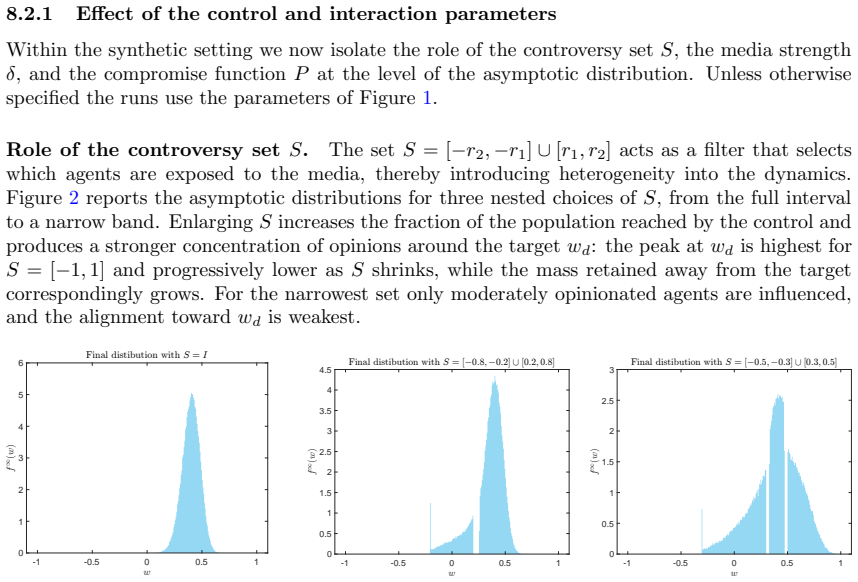
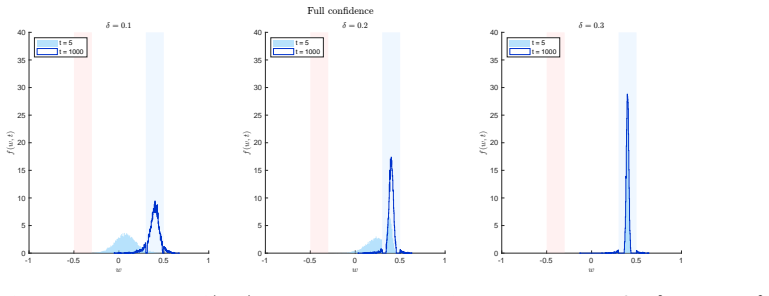
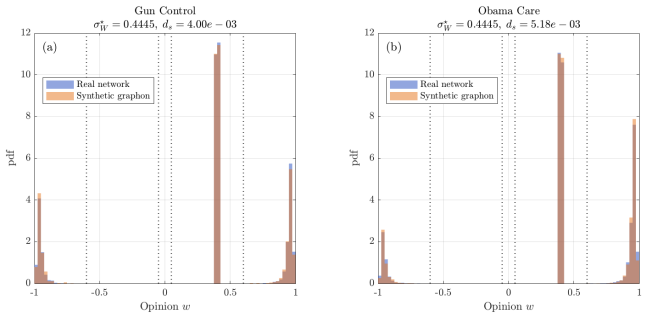
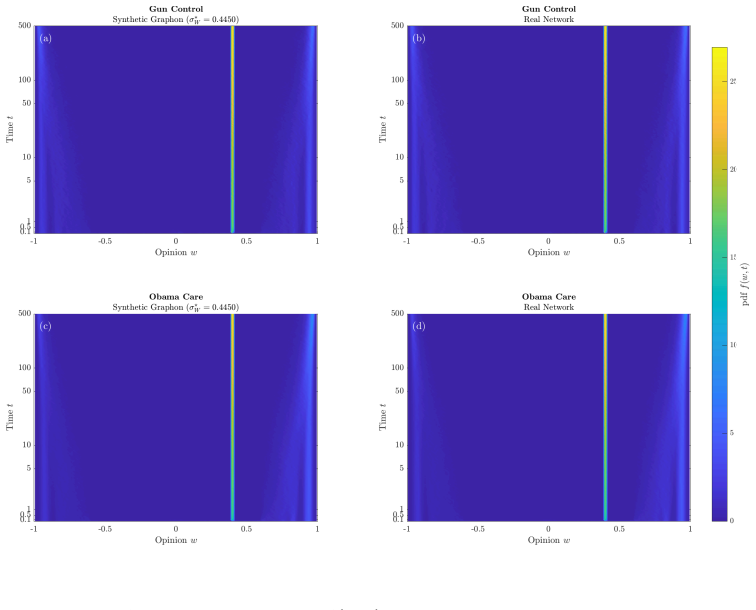
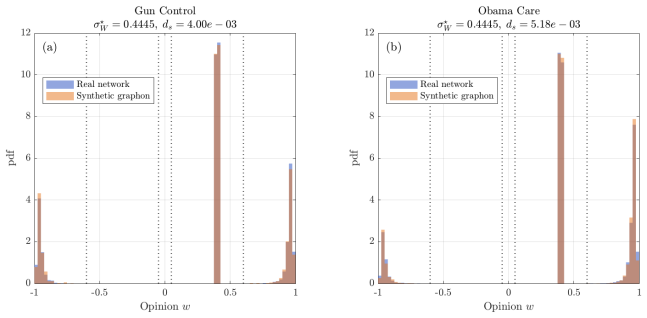
Central claim: for this opinion model the network structure matters only through its mean interaction intensity. In the Fokker-Planck limit the graphon enters the stationary state only through the weighted mass and mean; the media shifts the Beta parameters inside the controversy set, giving a piecewise Beta distribution continuous at its boundary. The theorem states exponential Fourier-metric convergence to the stationary state at a rate that is strictly negative regardless of the graphon. Numerically, one fitted Gaussian graphon reproduces the asymptotic opinion marginal of two real Twitter networks to Fourier distances 4.00e-3 and 5.18e-3.
What carries the argument
The graphon W(x,y) as the Boltzmann interaction kernel; in the Fokker-Planck limit only the weighted mass rho_W(x) and mean m_W(x) survive. The media control is the closed-form projection (Lemma 3.1) of the unconstrained linear update onto the controversy set S. Convergence is measured in the Fourier metric D_s, which controls the opinion law at every graph position.
Load-bearing premise
The exponential-convergence theorem assumes the media update can be treated as the unconstrained linear map w''=(lambda_tilde w + delta^2 w_d)/(lambda_tilde + delta^2); if that substitution fails, or if the stationary state does not in fact solve the noiseless Boltzmann equation as asserted, the exponential convergence conclusion does not follow.
What would settle it
Rewire the gun-control network edges uniformly at random while preserving each node's degree (configuration model); run the model on the rewired matrix and on the fitted Gaussian graphon. If the asymptotic opinion marginals differ by more than the reported 10^-3 Fourier distance, the claim that only the mean interaction strength matters would be falsified.
If this is right
- If the surrogate claim is right, one can simulate opinion dynamics on real networks without storing the adjacency matrix: a one-parameter graphon uses O(N) storage and allows arbitrarily many particles for smoother densities.
- The near-identical calibrated bandwidths for the two networks suggest that in this model the asymptotic opinion distribution is determined by a single scalar, the mean interaction strength, rather than by community structure or degree distribution.
- The model implies that to achieve consensus at the media target, either the compromise interactions must be global or the media must reach the whole opinion interval; if both are localised, extreme agents are shielded and polarisation persists.
- The convergence theorem guarantees that every solution on a graphon relaxes to the piecewise-Beta stationary state exponentially fast in the Fourier metric, uniformly in the graph position, provided the media update is replaced by its unconstrained linearisation.
- The piecewise-Beta characterisation gives an explicit formula for the stationary opinion distribution under selective media influence, which could be used to estimate media strength or target opinion from observed opinion surveys.
Where Pith is reading between the lines
- The claim that only the mean interaction intensity matters suggests a stronger, testable version: any graphon family (e.g., a stochastic block model) whose mean interaction strength matches rho_W should produce the same asymptotic marginal; comparing such surrogates would delineate exactly what structure, if any, is washed out.
- Since the match is only for the opinion marginal, the surrogate should fail for position-resolved observables such as the correlation between opinion and degree; measuring how the Fourier distance degrades when the population is split by connectivity would give a quantitative boundary of the surrogate's validity.
- A natural extension the authors do not pursue is to let the media act on two competing targets on overlapping controversy sets; the piecewise-Beta framework would then yield a stationary state with two shifted Beta branches, providing a ready-made model for polarisation by adversarial media.
- Because the convergence proof uses the unconstrained linearised media update, a direct Monte Carlo comparison of the clamped and unclamped evolutions would show whether the exponential rate holds for the actual model or only for its proxy.
Editorial analysis
A structured set of objections, weighed in public.
Referee Report
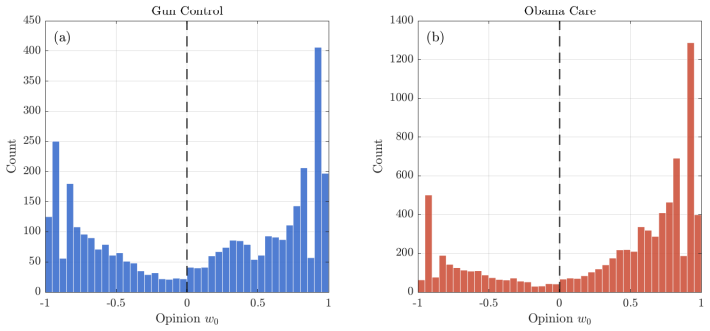
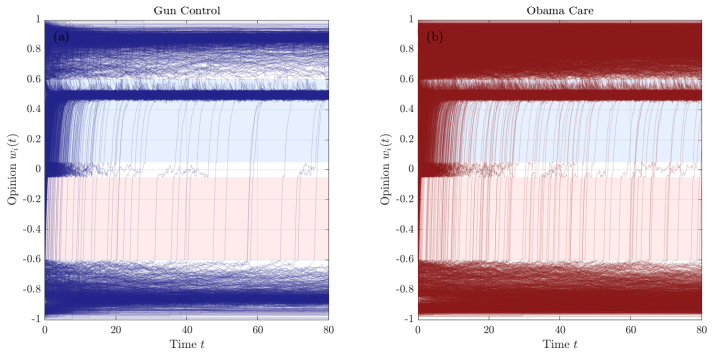
Summary. The paper proposes a kinetic model of opinion formation on graphon-modulated networks in which a media influence acts selectively on a subset S of opinions (Hallin's spheres) through a model predictive control solved in closed form. The authors derive a Boltzmann-type equation, analyse moment evolution, pass to a Fokker-Planck equation in a quasi-invariant limit, characterise its stationary states as piecewise Beta-type distributions, and claim exponential convergence to equilibrium in a Fourier-based metric. Numerical experiments are run on Gaussian graphons and on two real Twitter networks (gun control, Obamacare), with initial opinions taken from Barberá ideal points. A one-parameter Gaussian graphon is fitted to each real network and the asymptotic opinion distributions are compared via the same Fourier metric.
Significance. If the convergence theorem were correct, it would be a useful extension of Fourier-metric contraction arguments to graphon-mediated kinetic opinion dynamics with a non-trivial constrained control. The closed-form solution of the MPC problem in Lemma 3.1 and the piecewise Beta stationary characterization in Section 6 are interesting and potentially reusable. The numerical setup is thoughtful: using Barberá ideal points to initialise opinions and comparing real adjacency matrices with a calibrated Gaussian graphon is a sensible test bed. However, the advertised analytical result (exponential convergence to the Section 6 stationary state) is not established, and the central empirical claim is based on an in-sample fit. The modelling and numerical parts have merit, but the headline claims need substantial reworking.
major comments (5)
- [Section 7, Eqs. (40)–(41)] The Fourier estimate of the media operator is not an estimate of the model's media operator. Lemma 3.1 defines the constrained update w''_* = sgn(w''_free) Proj_{[r1,r2]}(|w''_free|), but Eqs. (40)–(41) use the unconstrained affine update w''=(λ̃ w+δ² w_d)/(λ̃+δ²), leading to the factorisation cQ1(f)(ξ)=cM(...)∠f_S(...). The projection is nonlinear and does not factorise in Fourier space; the factor (λ̃/(λ̃+δ²))^s in κ_W(t) is the contraction rate of the linear map only. Moreover, the loss term in Eq. (32) is −f̂, although the media acts only on S; the effective loss should be confined to the support of χ_S. Thus Theorem 7.2 is not proved for the constrained model defined in Section 3.
- [Section 7, Corollary 7.3 and Assumption 7.1(iii)] Corollary 7.3 asserts that f∞ solves the same equation on the same W because ∂_t f∞=0 and the local masses agree. But f∞ is the stationary state of the Fokker–Planck equation (15), which contains diffusion, while Assumption 7.1(iii) sets η=0, so the relevant Boltzmann equation is noiseless. The absolutely continuous piecewise Beta density (24) is not, in general, a stationary solution of the noiseless first-order Boltzmann equation, whose equilibria are typically supported on invariant atoms. This identification is asserted, not proved, and is implausible. Even if Theorem 7.2 were valid, it would only establish convergence to some common asymptotic state, not to the particular f∞ characterised in Section 6.
- [Section 4, Lemma 4.1, Eq. (12)] The mean-evolution calculation uses the unconstrained media update: w''−w = δ²/(λ̃+δ²)(w_d−w). For agents whose unconstrained image falls outside S, Lemma 3.1 clamps w''_* to the boundary r1 or r2, so this equality fails. Consequently the condition w_d = m_S/M_S is not sufficient for total mean conservation under the constrained control, and Assumption 7.1(ii), on which Theorem 7.2 relies, is not guaranteed. The lemma needs either a constraint-aware computation or an explicit assumption that the projection is inactive on the support of f.
- [Section 7, Eq. (37)] The estimate for the binary interaction term is also not justified as written. The first term on the right of Eq. (37) has coefficient |∠f_1((1−γ)ξ,x0,t)|, which is at most ρ(x0,t), not ρ_W(x0,t). The text's assertion that ρ(x,t)≤1 is false: f(w,x,t) is a density in (w,x), so the x-marginal ρ(x,t) can exceed 1. The later step replacing the coefficient by ρ_W(t)=inf_x ρ_W(x,t) in (44)–(45) is therefore unsupported. This affects the binary part of the convergence theorem independently of the media-projection issue.
- [Section 8.4] The central empirical claim is an in-sample calibration. The bandwidth σ_W is selected by minimising the Fourier distance d_s between the synthetic and real asymptotic distributions, and the minimised distances (4.00e−3 and 5.18e−3) are then reported as evidence of descriptive power. This is circular: the minimised distance is not an independent measure of fit. The 'common' σ*_W=0.4445 is the coincidence of two separately fitted minimisers on a logarithmic grid, and no validation is provided on held-out networks, other issues, or out-of-sample time windows. The conclusion that macroscopic dynamics depends on the interaction structure only through its mean intensity is stronger than this experiment supports.
minor comments (4)
- [Notation in Section 7] The parameter λ in Eqs. (34) and (40)–(41) appears to be the control penalty λ̃ of Lemma 3.1, but Section 5 uses λ for the noise-variance ratio σ²/γ. This notational collision is confusing and should be fixed throughout.
- [Typos] There are several typographical errors: 'model predicative control' in the Introduction, 'correspondance' in the author footnote, and 'Fullcon-dence' in the axis label of Figure 5.
- [Algorithm 1] Lines 9–13 apply the media update to w_free^i, the opinion after the binary interaction, rather than to the pre-interaction w_i. This sequential-update convention should be stated explicitly in the text, since the analytical equations in Sections 2–5 treat the two mechanisms as separate weak-form operators.
- [Section 8.3] The rescaling of Barberá ideal points to [−1,1] is described as linear, but the specific affine map or normalization is not given. This makes the real-data initial conditions less reproducible.
Circularity Check
Empirical graphon-reproduction claim is a fitted-parameter report: σ_W is selected by minimizing the very Fourier distance later quoted as evidence of descriptive power.
specific steps
-
fitted input called prediction
[Section 8.4 (Graphon surrogate), Figure 10 caption, and Conclusions]
"To recover the real dynamics we sweep σ_W and select, for each dataset, the value σ⋆_W that minimises the Fourier distance d_s between the asymptotic empirical distribution of the synthetic graphon and that of the real network. ... terminal Fourier distance d_s = 4.00×10^−3 for gun control and d_s = 5.18×10^−3 for Obamacare, both at the recovered bandwidth σ⋆_W = 0.4445."
The single graphon parameter σ_W is calibrated by minimizing the same Fourier distance d_s that is then reported as the measure of descriptive power ('recovered up to Fourier distances...'). The quoted d_s values are therefore training errors of a one-parameter fit on the very asymptotic distributions used to choose the bandwidth, not out-of-sample predictions. For any one-parameter family, the minimized distance is small by construction at its minimizer; the near-agreement of the two minimizers is a property of the fitting procedure, not independent confirmation that the graphon 'recovers' the real dynamics.
full rationale
The analytic parts of the paper are not circular: the Boltzmann, Fokker–Planck, and stationary-state derivations are self-contained given their stated assumptions, and the exponential convergence argument, while containing a serious correctness gap (Section 7 estimates the media operator using the unconstrained linear update w''=(λ̃w+δ²w_d)/(λ̃+δ²) from eqs. (40)–(41), rather than the constrained projection of Lemma 3.1, and Corollary 7.3 asserts without proof that the Fokker–Planck stationary state f∞ solves the noiseless Boltzmann equation (32)), is not a definitional reduction to its inputs. Those are proof/assumption failures, not instances of circularity under the criteria here. The paper's own limitation statement concedes the data comparison is restricted to the asymptotic state from a single temporal snapshot, which further weakens the empirical claim but does not itself constitute circularity. The load-bearing circularity is the central empirical claim: a one-parameter Gaussian graphon is 'recovered' by sweeping σ_W to minimize the Fourier distance to the real asymptotic distributions, and the minimized distances (4.00e-3, 5.18e-3) are then presented as evidence of descriptive power. This is a fitted input presented as a reproduction/prediction, warranting the score 6.
Axiom & Free-Parameter Ledger
free parameters (3)
- Gaussian graphon bandwidth σ_W =
0.4445 (grid search, both datasets)
- Diffusion exponent α =
2 in numerics; 1/2 in explicit steady-state formulas
- Controversy set boundaries r1, r2 =
r1 = 0.05, r2 = 0.6 in real-network runs; varied in synthetic scans
axioms (6)
- domain assumption Graphon W is a symmetric Lebesgue-measurable kernel representing interaction probabilities; real networks are approximated by a binary adjacency matrix.
- domain assumption Noise truncation in Appendix A.1 guarantees opinions stay in [-1,1].
- domain assumption Quasi-invariant scaling with σ²/γ fixed and formal Taylor expansion yields the Fokker–Planck equation.
- ad hoc to paper In Section 7, Assumption 7.1(iii) sets η = 0, and the FP stationary state f∞ is assumed stationary for the resulting noiseless Boltzmann equation.
- ad hoc to paper The media control in the Fourier estimate of Q+1 is treated as the unconstrained linear update, with the projection in Lemma 3.1 dropped.
- domain assumption Barberá ideal points, linearly rescaled, measure issue-specific initial opinions.
read the original abstract
We propose a kinetic model of opinion dynamics under selective media influence on both graphon-based and real-world networks. The media action, inspired by Hallin's theory of spheres, is incorporated through a model predictive control strategy designed to steer agents' opinions toward a desired target opinion. For the resulting Boltzmann-type description, we analyse the evolution of the moments and, in the quasi-invariant interaction limit, derive a Fokker--Planck-type equation together with a characterisation of its stationary states. We also prove exponential convergence to equilibrium in the Fourier metric. Numerical experiments are performed on networks generated by a Gaussian graphon and on real-world, single-issue Twitter networks, allowing us to investigate the role of control and interaction parameters, as well as the impact of the subset of agents subject to media influence. Using real-world social networks data to initialise opinions and infer the interaction structure, we then compare the dynamics obtained on the original networks with those produced by Gaussian graphons fitted to their adjacency matrices, thereby assessing the descriptive power of the graphon approach for real-world opinion dynamics.
Figures










Reference graph
Works this paper leans on
-
[1]
Albi et al
G. Albi et al. ‘A data-driven kinetic model for opinion dynamics with social network con- tacts’.Eur. J. Appl. Math.36.2 (2025), pp. 264–290
2025
-
[2]
Albi et al
G. Albi et al. ‘Boltzmann games in heterogeneous consensus dynamics’.J. Stat. Phys.175.1 (2019), pp. 97–125
2019
-
[3]
Albi et al
G. Albi et al. ‘Boltzmann-type control of opinion consensus through leaders’.Phil. Trans. R. Soc. A372.2028 (2014)
2028
-
[4]
Albi et al
G. Albi et al. ‘On the optimal control of opinion dynamics on evolving networks’.System Modeling and Optimization. Ed. by L. Bociu et al. Vol. 494. IFIP Advances in Information and Communication Technology. Springer, 2016, pp. 1–12
2016
-
[5]
Albi et al
G. Albi et al. ‘Opinion dynamics over complex networks: kinetic modelling and numerical methods’.Kinet. Relat. Mod.10.1 (2017), pp. 1–32
2017
-
[6]
Aletti and G
G. Aletti and G. Naldi. ‘Opinion dynamics on graphon: The piecewise constant case’.Applied Math. Letters133 (2022), p. 108227
2022
-
[7]
Aylaj et al
B. Aylaj et al. ‘A unified multiscale vision of behavioral crowds’.Math. Models Methods Appl. Sci.30.1 (2020), pp. 1–22
2020
-
[8]
Barber´ a
P. Barber´ a. ‘Birds of the Same Feather Tweet Together: Bayesian Ideal Point Estimation Using Twitter Data’.Political Analysis23.1 (2015), pp. 76–91
2015
-
[9]
Bayraktar et al
E. Bayraktar et al. ‘Graphon mean field systems’.Ann. Appl. Probab.33.5 (2023), pp. 3587– 3619
2023
-
[10]
Bellomo et al
N. Bellomo et al. ‘From a systems theory of sociology to modeling the onset and evolution of criminality’.Netw. Heterog. Media10.3 (2015), pp. 421–441
2015
-
[11]
Bellomo et al
N. Bellomo et al. ‘What is life? A perspective of the mathematical kinetic theory of active particles’.Math. Models Methods Appl. Sci.31.9 (2021), pp. 1821–1866
2021
-
[12]
Bonnet et al
B. Bonnet et al. ‘Consensus formation in first-order graphon models with time-varying to- pologies’.Math. Models Methods Appl. Sci.32.11 (2022), pp. 2121–2188
2022
-
[13]
Borgs et al
C. Borgs et al. ‘AnL p theory of sparse graph convergence I: Limits, sparse random graph models, and power law distributions’.Trans. Am. Math. Soc.372.5 (2019), pp. 3019–3062
2019
-
[14]
Boscheri et al
W. Boscheri et al. ‘Modeling and simulating the spatial spread of an epidemic through multiscale kinetic transport equations’.Math. Models Methods Appl. Sci.31.6 (2021), pp. 1059– 1097
2021
-
[15]
Boudin and F
L. Boudin and F. Salvarani. ‘Opinion dynamics: kinetic modelling with mass media, applic- ation to the Scottish independence referendum’.Physica A444 (2016), pp. 448–457
2016
-
[16]
M. Burger. ‘Network structured kinetic models of social interactions’.Vietnam J. Math. (2021)
2021
-
[17]
Burger et al
M. Burger et al. ‘Sorting phenomena in a mathematical model for two mutually attract- ing/repelling species’.SIAM J. Math. Anal.50.3 (2018), pp. 3210–3250
2018
-
[18]
Caron et al
F. Caron et al. ‘On sparsity, power-law, and clustering properties of graphex processes’.Adv. Appl. Probab.55.4 (2023), pp. 1211–1253
2023
-
[19]
J. A. Carrillo, G. Toscani et al. ‘Contractive probability metrics and asymptotic behavior of dissipative kinetic equations’.Riv. Mat. Univ. Parma6.7 (2007), pp. 75–198
2007
-
[20]
Chazelle et al
B. Chazelle et al. ‘Well-posedness of the limiting equation of a noisy consensus model in opinion dynamics’.J. Differ. Equations263.1 (2017), pp. 365–397
2017
-
[21]
Coculescu et al
D. Coculescu et al. ‘Opinion dynamics in communities with major influencers and implicit social influence via mean-field approximation’.Math. Financ. Econ.18.2 (2024), pp. 333– 377. 30
2024
-
[22]
F. Coppini. ‘A Note on Fokker-Planck Equations and Graphons’.J. Stat. Phys.187.2 (2022), p. 15
2022
-
[23]
Cristiani and A
E. Cristiani and A. Tosin. ‘Reducing complexity of multiagent systems with symmetry break- ing: an application to opinion dynamics with polls’.Multiscale Model. Simul.16.1 (2018), pp. 528–549
2018
-
[24]
Degond et al
P. Degond et al. ‘Continuum dynamics of the intention field under weakly cohesive social interaction’.Math. Models Methods Appl. Sci.27.1 (2017), pp. 159–182
2017
-
[25]
D¨ uring and M
B. D¨ uring and M. Wolfram. ‘Opinion dynamics: inhomogeneous Boltzmann-type equations modelling opinion leadership and political segregation’.Proc. R. Soc. A.471 (2015), p. 20150345
2015
-
[26]
D¨ uring and O
B. D¨ uring and O. Wright. ‘On a kinetic opinion formation model for pre-election polling’. Phil. Trans. R. Soc. A.380.2224 (2022), p. 20210154
2022
-
[27]
D¨ uring and O
B. D¨ uring and O. Wright. ‘PDE-constrained optimal control of a leader–follower opinion formation model’.Boll. Unione Mat. Ital.(2025), pp. 1–25
2025
-
[28]
D¨ uring and O
B. D¨ uring and O. Wright. ‘Voter demographics and socio-economic factors in kinetic models for opinion formation’.EMS Ser. Congr. Rep.23 (2026). Ed. by G. Albi et al., pp. 277–297
2026
-
[29]
D¨ uring et al
B. D¨ uring et al. ‘Boltzmann and Fokker-Planck equations modelling opinion formation in the presence of strong leaders’.Proc. R. Soc. A.465 (2009), pp. 3687–3708
2009
-
[30]
D¨ uring et al
B. D¨ uring et al. ‘Breaking Consensus in Kinetic Opinion Formation Models on Graphons’. Kinet. Relat. Mod.15.5 (2022), pp. 815–843
2022
-
[31]
Furioli et al
G. Furioli et al. ‘Fokker-Planck equations in the modeling of socio-economic phenomena’. Math. Models Methods Appl. Sci.27.1 (2017), pp. 115–158
2017
-
[32]
Gabetta et al
G. Gabetta et al. ‘Metrics for probability distributions and the trend to equilibrium for solutions of the Boltzmann equation’.J. Stat. Phys.81.5 (1995), pp. 901–934
1995
-
[33]
Garimella et al
K. Garimella et al. ‘Political discourse on social media: Echo chambers, gatekeepers, and the price of bipartisanship’.Proceedings of the 2018 world wide web conference. 2018, pp. 913– 922
2018
-
[34]
Garimella et al
K. Garimella et al. ‘Quantifying Controversy on Social Media’.ACM Trans. Soc. Comput. 1.1 (2018). Dataset:https://rutgers.box.com/s/9lavww3g0uyajkcvxwu66sxtauncq589, pp. 1–27
2018
-
[35]
Garnier et al
J. Garnier et al. ‘Consensus convergence with stochastic effects’.Vietnam J. Math.45 (2017), pp. 51–75
2017
-
[36]
D. J. Glasscock. ‘What is a graphon?’Notices Amer. Math. Soc.66.5 (2019), pp. 733–738
2019
-
[37]
B. D. Goddard et al. ‘Noisy bounded confidence models for opinion dynamics: the effect of boundary conditions on phase transitions’.IMA J. Appl. Math.87.1 (2021), pp. 80–110
2021
-
[38]
D. C. Hallin.The Uncensored War: The Media and Vietnam. Oxford University Press, 1986
1986
-
[39]
Hegselmann and U
R. Hegselmann and U. Krause. ‘Opinion Dynamics and Bounded Confidence Models, Ana- lysis, and Simulation’.J. Artif. Soc. Soc. Simul.5.3 (2002)
2002
-
[40]
Helfmann et al
L. Helfmann et al. ‘Modelling opinion dynamics under the impact of influencer and media strategies’.Scientific Reports13.1 (2023), p. 19375
2023
-
[41]
Jabin and S
P.-E. Jabin and S. Motsch. ‘Clustering and asymptotic behavior in opinion formation’.J. Differ. Equations257.11 (2014), pp. 4165–4187
2014
-
[42]
Lov´ asz.Large networks and graph limits
L. Lov´ asz.Large networks and graph limits. Vol. 60. American Mathematical Society, 2012
2012
-
[43]
Loy et al
N. Loy et al. ‘Opinion polarization in social networks’.Phil. Trans. R. Soc. A380.2224 (2022)
2022
-
[44]
Motsch and E
S. Motsch and E. Tadmor. ‘Heterophilious dynamics enhances consensus’.SIAM Rev.56.4 (2014), pp. 577–621. 31
2014
-
[45]
Nugent et al
A. Nugent et al. ‘Opinion dynamics with continuous age structure’.Eur. J. Appl. Math. (2025), pp. 1–36
2025
-
[46]
Nurisso et al
M. Nurisso et al. ‘Network-based kinetic models: Emergence of a statistical description of the graph topology’.Eur. J. Appl. Math.(2024), pp. 1–22
2024
-
[47]
Pareschi and G
L. Pareschi and G. Toscani.Interacting Multiagent Systems: Kinetic equations and Monte Carlo methods. Oxford University Press, 2013
2013
-
[48]
Pareschi et al
L. Pareschi et al. ‘Hydrodynamic models of preference formation in multi-agent societies’. J. Nonlinear Sci.29.6 (2019), pp. 2761–2796
2019
-
[49]
Pedraza et al
L. Pedraza et al. ‘Measure-valued opinion dynamics’.Math. Models Methods Appl. Sci.30.2 (2020), pp. 225–260
2020
-
[50]
P´ erez-Llanos et al
M. P´ erez-Llanos et al. ‘Opinion formation models with heterogeneous persuasion and zealotry’. SIAM J. Math. Anal.50.5 (2018), pp. 4812–4837
2018
-
[51]
G. Taricco and A. Tosin. ‘Homogeneous Boltzmann-type equations on dense graphs’.arXiv 2606.17638 (2026)
Pith/arXiv arXiv 2026
-
[52]
G. Toscani. ‘Kinetic models of opinion formation’.Comm. Math. Sci.4.3 (2006), pp. 481– 496
2006
-
[53]
Toscani et al
G. Toscani et al. ‘Opinion modeling on social media and marketing aspects’.Phys. Rev. E 98.2 (2018), p. 022315
2018
-
[54]
Van Der Hofstad.Random Graphs and Complex Networks
R. Van Der Hofstad.Random Graphs and Complex Networks. Vol. 43. Cambridge University Press, 2016
2016
-
[55]
Wang et al
C. Wang et al. ‘Noisy Hegselmann-Krause systems: Phase transition and the 2R-conjecture’. J. Stat. Phys.166.5 (2017), pp. 1209–1225. 32
2017
discussion (0)
Sign in with ORCID, Apple, or X to comment. Anyone can read and Pith papers without signing in.