REVIEW 3 major objections 4 minor 21 references
Smooth Quadratic Prediction Markets
T0 review · 3 major / 4 minor · reviewed 2026-08-16 · deepseek-v4-flash
Pith's one-line read A prediction market that swaps the DCFMM's Bregman fee for a quadratic fee keeps the core guarantees, lowers the worst-case loss, and makes traders run steepest descent toward their shared belief.
desk verdict A clean, honest mechanism-design paper that adds a simpler fee schedule to prediction markets and ties trader updates to steepest descent, but the claimed 1/t price-convergence rate does not follow from the cited theorems. read the letter →
The pith
A machine-rendered reading of the paper's core claim, the machinery that carries it, and where it could break.
The reading
What carries the argument
The load-bearing object is the payment rule $Pay_L(q_t, r_t) = \langle\nabla C(q_t), r_t\rangle + \frac{L}{2}\|r_t\|^2$, a 'Price-Plus-Fee' market with a quadratic fee. The linear term sets the instantaneous price; the quadratic fee replaces the Bregman divergence that the DCFMM charges implicitly through the cost difference $C(q_t+r_t)-C(q_t)$. Because $L$-smoothness bounds the Bregman divergence by the quadratic fee, the market maker collects at least as much revenue as the DCFMM on every trade. And because each trader's objective is, up to constants, $\langle\nabla C(q_t), r_t\rangle + \frac{L}{2}\|r_t\|^2 - \langle\mu, r_t\rangle$, minimizing it over the next market state is exactly the definition of general steepest descent on $C(q)-\langle\mu, q\rangle$; standard smoothness-based convergence theorems then give the $1/t$ rate.
What would settle it
Simulate the market: choose a smooth cost function such as softmax with $L=1$, fix a belief $\mu$ in the interior of the simplex, and run a long sequence of traders each solving their one-step expected-profit maximization; Theorem 6 predicts $\|\nabla C(q_t)-\mu\|$ decays as $O(1/t)$, so a price that stalls, cycles, or converges at a slower rate would contradict the incremental incentive-compatibility claim.
Extended reading notes
Core claim
The central claim is that the payment rule $Pay_L(q_t, r_t) = \langle\nabla C(q_t), r_t\rangle + \frac{L}{2}\|r_t\|^2$, defined for any smooth convex cost function $C$ whose gradient maps to the probability simplex, defines a prediction market that satisfies the standard axioms of instantaneous price, information incorporation, no arbitrage, and expressiveness, and has, for every fixed trade history, a worst-case monetary loss no larger than the DCFMM's. It does not satisfy the standard one-shot incentive compatibility axiom; instead, when traders appear sequentially with a common belief $\mu$ and each maximizes expected payout minus payment, the market price $\nabla C(q_t)$ converges to $\mu$ at rate $1/t$. The mechanism is that each trader's best response is exactly one step of general steepest descent on $C(q) - \langle\mu, q\rangle$. The paper also derives a closed-form update for buy-only markets and gives an adaptive-liquidity extension.
Load-bearing premise
The convergence guarantee requires an infinite sequence of traders who all share exactly the same belief and each maximizes only their immediate one-step profit, so the paper does not cover changing beliefs, traders who plan ahead, or beliefs on the boundary of the probability simplex.
Editorial extensions
If this is right
- For any fixed trade history, the market maker's collected revenue is at least that of the DCFMM, so the worst-case loss is no larger; with any nonzero trade it is strictly smaller because the quadratic fee dominates the Bregman fee pointwise.
- A market run by a sequence of traders with identical belief $\mu$ reaches $\mu$ in price: with an $\ell^2$ fee the price error decays as $O(1/t)$, and with an $\ell^p$ fee the traders implement general steepest descent with the same convergence guarantee.
- The buy-only constraint does not break convergence: the optimal trade has the closed form $\frac{1}{L}((\nabla C(q_t)-\mu)_+ - (\nabla C(q_t)-\mu))$, which is a coordinate gradient-descent step, so prices still approach the shared belief.
- The payment rule can be extended to adaptive liquidity by letting the smoothness parameter shrink as trade volume grows; the volume-parameterized extension preserves no arbitrage, while the remaining axioms are left to future work.
Reading between the lines
- A natural extension not explored in the paper: the price/fee split suggests a generic recipe, whereby any learning algorithm with gradient-descent-like updates could seed a market whose fee encodes the algorithm's one-step cost; the Smooth Quadratic Market is one instantiation.
- If trader beliefs drift slowly over time, the same descent dynamics should track a moving consensus; a stochastic-gradient treatment with randomly selected traders, which the authors mention as future work, would likely turn this into a quantitative tracking bound.
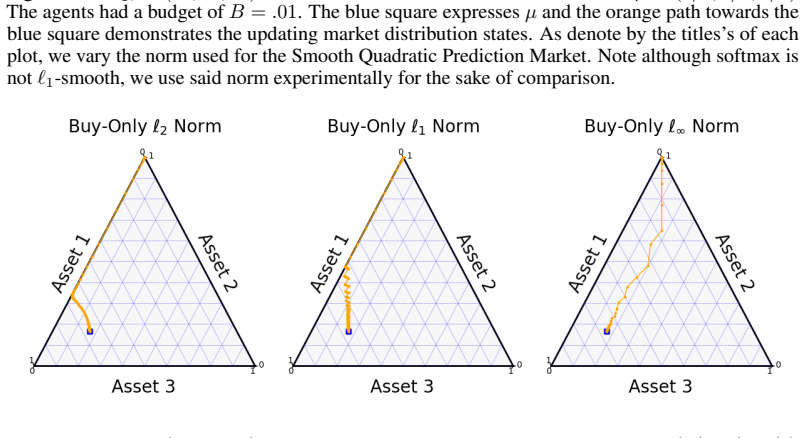
- By choosing the fee's norm or scaling, a designer can shape the path prices take to the consensus without changing the worst-case loss or no-arbitrage guarantees; the paper's simulations with different $\ell^p$ fees illustrate this freedom.
Signed reviews
Editorial analysis
A structured set of objections, weighed in public.
Referee Report
Summary. The paper proposes a new automated market maker for Arrow-Debreu securities, the Smooth Quadratic Prediction Market, whose payment rule is Pay_L(q_t, r_t) = ⟨∇C(q_t), r_t⟩ + (L/2)‖r_t‖² for a CIIP cost function C. The authors show that this mechanism satisfies the DCFMM axioms of instantaneous pricing, information incorporation, no arbitrage, and expressiveness, and that its worst-case loss is no worse than that of the DCFMM. They then characterize traders' expected-profit-maximizing behavior: for the ℓ₂-based market this is exactly gradient descent on F(q)=C(q)-⟨μ,q⟩, and for ℓ_p-based markets it is general steepest descent; they claim this implies that prices converge to a common trader belief μ at rate 1/t. The paper also analyzes budget-bounded traders, a buy-only market, and an adaptive-liquidity extension.
Significance. The construction is elegant and, if the convergence claims are properly established, would be a useful contribution to prediction-market mechanism design: it cleanly separates the instantaneous price term from a quadratic fee, preserves the main DCFMM axioms, and gives a concrete optimization-theoretic interpretation of trader behavior. The elementary axiom proofs (Lemmas 4–7) and the worst-case-loss comparison (Theorem 4) are direct and convincing, and the paper is honest about the exploratory status of the adaptive-liquidity section. However, the central incremental-incentive-compatibility claim currently rests on convergence arguments that are not fully justified: the stated 1/t price rate does not follow from the cited function-value bounds, the minimizer-existence assumption is not guaranteed for boundary beliefs, and the buy-only market claim is asserted without a proof of convergence. These issues are fixable but substantive, so the paper needs a major revision rather than minor polishing.
major comments (3)
- [§3.2–3.3, Theorems 6 and 8] The claimed rate lim_{t→∞} ∇C(q_t)=μ at rate 1/t is not established by the proofs. The proofs identify the trader update with gradient/steepest descent on F(q)=C(q)-⟨μ,q⟩ and invoke Theorem 5 or Theorem 7, which give F(q_t)-inf F = O(1/t). Lemma 8 then converts this only into ‖∇F(q_t)‖_* = O(1/√t). Since ∇F(q_t) = ∇C(q_t)-μ, the price error is O(1/√t), not O(1/t), unless an additional strong-convexity or duality argument is supplied. Please either correct the rate to O(1/√t) or add assumptions that genuinely yield the 1/t rate.
- [§3.2–3.3, Theorems 6 and 8] Both theorems assume the existence of a minimizer q* of F(q)=C(q)-⟨μ,q⟩ with ∇C(q*)=μ, but the CIIP condition only gives closure({∇C(q) | q∈R^d}) = Δ_d. For natural choices such as softmax, ∇C(q) lies in the relative interior of Δ_d, so no q* exists for boundary beliefs μ. Since the theorem statements allow arbitrary μ∈Δ_d, the boundary case is not covered by the cited convergence results. Please restrict the statements to beliefs for which a minimizer exists, or handle boundary beliefs by an explicit approximation or limiting argument.
- [§4, Buy-Only Market] The buy-only subsection asserts that the KKT-derived update qt+1 = qt + (1/L)((∇C(qt)-μ)_+ - (∇C(qt)-μ)) implies incremental incentive compatibility, but no theorem or proof is provided. The KKT conditions characterize only the one-step optimal bundle; they do not by themselves imply lim_{t→∞} ∇C(qt)=μ. This is a load-bearing claim in the paper's motivation, so it needs a precise statement and a proof, including treatment of coordinates where the constraint is active and of boundary beliefs.
minor comments (4)
- [Abstract and Section 1] There is a typo in the abstract: 'the incentivizes agents' should read 'that incentivizes agents'. Similar proofreading issues appear elsewhere, e.g., 'a a curvature fee' in Section 2.4 and 'instsantaneous' in Definition 2.
- [Theorem 6 proof] The proof uses the same symbol C for both the market cost function and the auxiliary function F(q)=C(q)-⟨μ,q⟩; this makes the argument harder to follow and invites the incorrect impression that the market cost itself is being minimized. Please introduce a separate notation such as F(q).
- [§4, Buy-Only Market] The text says the result holds 'not just experimentally but analytically', but the convergence claim is not actually proved in the main text or Appendix F. Please either supply the proof or soften the claim to 'we conjecture' / 'we leave the proof to future work'.
- [Figures 1–3] The captions state that softmax is not ℓ₁-smooth but is nevertheless used with ℓ₁ norms 'for the sake of comparison'; this is fine, but the captions should also state how convergence is measured (e.g., which quantity is plotted on the axes and over how many iterations).
Circularity Check
No circularity found: the steepest-descent equivalence is the designed mechanism, and the convergence claims rest on external optimization theorems rather than on fitted inputs or self-citations.
full rationale
The paper's central claim is that paying Pay_L(q_t,r_t)=<∇C(q_t),r_t>+L/2||r_t||^2 makes an expected-payout-maximizing trader choose a bundle that is exactly a steepest-descent step on F(q)=C(q)-<μ,q>. This is not circular: the trader's optimization problem is solved directly from the payment definition, yielding q_{t+1}=argmin <∇C(q_t)-μ,q_{t+1}-q_t>+L/2||q_{t+1}-q_t||^2, and the resulting iterate sequence is then analyzed using external, independently cited convergence results (Garrigos-Gower, Sidford, Kelner et al.). The quadratic fee is an explicit design ansatz, but an ansatz is not circularity; it is the mechanism being proposed and tested. No parameter is fitted to data and then renamed a prediction, and no load-bearing step is justified solely by a self-citation. The worst-case loss comparison with the DCFMM follows from L-smoothness via D_C(q_{t+1},q_t) ≤ L/2||r_t||^2, an inequality from the definition of smoothness, not an assumption of the conclusion. The authors' own prior work appears only as contextual references and is not used to force the market design or to import a uniqueness theorem. The claimed 1/t price-convergence rate and the existence of a minimizer for boundary beliefs may be mathematically under-supported, but an unsupported or incorrect derivation is a correctness gap, not circular reasoning.
Assumptions & free parameters
free parameters (1)
- Smoothness constant L of the cost function C
assumptions (4)
- domain assumption C is CIIP and L-smooth w.r.t. the chosen norm, and L is known to the market maker.
- ad hoc to paper Traders arrive in a sequence with a common belief μ and maximize one-step expected return.
- standard math The external convergence theorems for gradient and steepest descent (Garrigos-Gower, Kelner et al., Sidford, Wright-Recht) are correct and apply.
- ad hoc to paper For the buy-only market, the KKT stationary condition of the one-step update implies convergence of the price sequence to μ.
Cite this review
Pith. "Pith review of Smooth Quadratic Prediction Markets." pith.science (2026). https://pith.science/paper/67KM2EJP
@misc{pith2026250502959,
  author       = {Pith},
  title        = {Pith review of: Smooth Quadratic Prediction Markets},
  year         = {2026},
  howpublished = {\url{https://pith.science/paper/67KM2EJP}},
  note         = {Machine review of arXiv:2505.02959}
}
read the original abstract
When agents trade in a Duality-based Cost Function prediction market, they collectively implement the learning algorithm Follow-The-Regularized-Leader. We ask whether other learning algorithms could be used to inspire the design of prediction markets. By decomposing and modifying the Duality-based Cost Function Market Maker's (DCFMM) pricing mechanism, we propose a new prediction market, called the Smooth Quadratic Prediction Market, the incentivizes agents to collectively implement general steepest gradient descent. Relative to the DCFMM, the Smooth Quadratic Prediction Market has a better worst-case monetary loss for AD securities while preserving axiom guarantees such as the existence of instantaneous price, information incorporation, expressiveness, no arbitrage, and a form of incentive compatibility. To motivate the application of the Smooth Quadratic Prediction Market, we independently examine agents' trading behavior under two realistic constraints: bounded budgets and buy-only securities. Finally, we provide an introductory analysis of an approach to facilitate adaptive liquidity using the Smooth Quadratic Prediction Market. Our results suggest future designs where the price update rule is separate from the fee structure, yet guarantees are preserved.
Figures


Reference graph
Works this paper leans on
-
[1]
Efficient market making via convex optimization, and a connection to online learning
Jacob Abernethy, Yiling Chen, and Jennifer Wortman Vaughan. Efficient market making via convex optimization, and a connection to online learning. ACM Transactions on Economics and Computation (TEAC), 1 0 (2): 0 1--39, 2013
2013
-
[2]
A general volume-parameterized market making framework
Jacob D Abernethy, Rafael M Frongillo, Xiaolong Li, and Jennifer Wortman Vaughan. A general volume-parameterized market making framework. In Proceedings of the fifteenth ACM conference on economics and computation, pages 413--430, 2014
work page 2014
-
[3]
Convergence rate of gradient descent algorithm on β-smooth ..., Jan 2025
Andersen Ang. Convergence rate of gradient descent algorithm on β-smooth ..., Jan 2025. URL https://angms.science/doc/CVX/CVX_GD_Convergence.pdf
work page 2025
-
[4]
The role of securities in the optimal allocation of risk-bearing
Kenneth J Arrow. The role of securities in the optimal allocation of risk-bearing. The review of economic studies, 31 0 (2): 0 91--96, 1964
work page 1964
-
[5]
Yun Kuen Cheung and Georgios Piliouras. Online optimization in games via control theory: Connecting regret, passivity and poincar \'e recurrence. In International Conference on Machine Learning, pages 1855--1865. PMLR, 2021
work page 2021
-
[6]
Budget constraints in prediction markets
Nikhil Devanur, Miroslav Dud k, Zhiyi Huang, and David M Pennock. Budget constraints in prediction markets. 2015
work page 2015
-
[7]
Multi-outcome and multidimensional market scoring rules (manuscript)
Lance Fortnow and Rahul Sami. Multi-outcome and multidimensional market scoring rules (manuscript). 2012
work page 2012
-
[8]
An Axiomatic Study of Scoring Rule Markets
Rafael Frongillo and Bo Waggoner. An axiomatic study of scoring rule markets. arXiv preprint arXiv:1709.10065, 2017
work page Pith review arXiv 2017
Show all 21 references
-
[9]
An axiomatic characterization of cfmms and equivalence to prediction markets
Rafael Frongillo, Maneesha Papireddygari, and Bo Waggoner. An axiomatic characterization of cfmms and equivalence to prediction markets. arXiv preprint arXiv:2302.00196, 2023
2023 arXiv
-
[10]
Handbook of convergence theorems for (stochastic) gradient methods
Guillaume Garrigos and Robert M Gower. Handbook of convergence theorems for (stochastic) gradient methods. arXiv preprint arXiv:2301.11235, 2023
2023 arXiv
-
[11]
Combinatorial information market design
Robin Hanson. Combinatorial information market design. Information Systems Frontiers, 5: 0 107--119, 2003
2003
-
[12]
Fundamentals of convex analysis
Jean-Baptiste Hiriart-Urruty and Claude Lemar \'e chal. Fundamentals of convex analysis. Springer Science & Business Media, 2004
2004
-
[13]
On the duality of strong convexity and strong smoothness: Learning applications and matrix regularization
Sham Kakade, Shai Shalev-Shwartz, Ambuj Tewari, et al. On the duality of strong convexity and strong smoothness: Learning applications and matrix regularization. Unpublished Manuscript, http://ttic. uchicago. edu/shai/papers/KakadeShalevTewari09. pdf, 2 0 (1): 0 35, 2009
2009
-
[14]
An almost-linear-time algorithm for approximate max flow in undirected graphs, and its multicommodity generalizations
Jonathan A Kelner, Yin Tat Lee, Lorenzo Orecchia, and Aaron Sidford. An almost-linear-time algorithm for approximate max flow in undirected graphs, and its multicommodity generalizations. In Proceedings of the twenty-fifth annual ACM-SIAM symposium on Discrete algorithms, page...
2014
-
[15]
A continuous-time approach to online optimization
Joon Kwon and Panayotis Mertikopoulos. A continuous-time approach to online optimization. Journal of Dynamics and Games, 4 0 (2): 0 125--148, 2017
2017
-
[16]
An axiomatic characterization of adaptive-liquidity market makers
Xiaolong Li and Jennifer Wortman Vaughan. An axiomatic characterization of adaptive-liquidity market makers. In Proceedings of the fourteenth ACM Conference on Electronic Commerce, pages 657--674, 2013
2013
-
[17]
From softmax to sparsemax: A sparse model of attention and multi-label classification
Andre Martins and Ramon Astudillo. From softmax to sparsemax: A sparse model of attention and multi-label classification. In International conference on machine learning, pages 1614--1623. PMLR, 2016
2016
-
[18]
Cycles in adversarial regularized learning
Panayotis Mertikopoulos, Christos Papadimitriou, and Georgios Piliouras. Cycles in adversarial regularized learning. In Proceedings of the twenty-ninth annual ACM-SIAM symposium on discrete algorithms, pages 2703--2717. SIAM, 2018
2018
-
[19]
A regularized framework for sparse and structured neural attention
Vlad Niculae and Mathieu Blondel. A regularized framework for sparse and structured neural attention. Advances in neural information processing systems, 30, 2017
2017
-
[20]
Optimization algorithms
Aaron Sidford. Optimization algorithms. 2024. URL https://drive.google.com/file/d/1-AWpkVplGyfQVRggGzuSR-iZiWPFCJQp/view
2024
-
[21]
Wright and Benjamin Recht
Stephen J. Wright and Benjamin Recht. Optimization for Data Analysis. Cambridge University Press, 2022
2022
Reviewed August 16, 2026 · model on record in the stance chip above.
Discussion (0). Continue with ORCID to comment.