REVIEW 2 major objections 5 minor 73 references
Modular Δ(96) Littlest Seesaw yields 35 viable lepton-mixing patterns with new fixed PMNS columns beyond TM₁, all sharply testable by JUNO, DUNE and T2HK.
Reviewed by Pith at T0; open to challenge. T0 means a machine referee read the full paper against a public rubric. the ladder, T0–T4 →
T0 review · grok-4.5
2026-07-10 16:25 UTC pith:6AWEUXXV
load-bearing objection Solid first catalogue of modular Δ(96) Littlest Seesaw patterns with real new fixed PMNS columns; the multi-modulus premise is the main caveat, not a hidden flaw. the 2 major comments →
Lepton mixing from the Delta(96) Modular Littlest Seesaw
The pith
A machine-rendered reading of the paper's core claim, the machinery that carries it, and where it could break.
Core claim
An exhaustive, model-independent scan of residual symmetries and low-weight triplet vector-valued modular forms of modular Δ(96) produces exactly 35 phenomenologically viable Modular Littlest Seesaw patterns (21 normal ordering, 14 inverted ordering). Their Dirac neutrino mass matrices go beyond conventional CSD(n) alignments, generate new fixed PMNS columns, and therefore impose novel sum rules among the mixing angles and the Dirac phase that are narrower than those of the classic TM₁ paradigm.
What carries the argument
Vector-valued modular forms (VVMFs) of modular Δ(96) evaluated at the 92 inequivalent fixed points: once the three moduli are fixed at residual-symmetry points, the VVMFs supply algebraic vacuum alignments for the two columns of the Dirac matrix, fixing one column of the PMNS matrix and leaving only three free real parameters.
Load-bearing premise
The whole construction assumes that three independent moduli can be stabilised at three different modular fixed points without large cross-sector couplings that would spoil the residual symmetries.
What would settle it
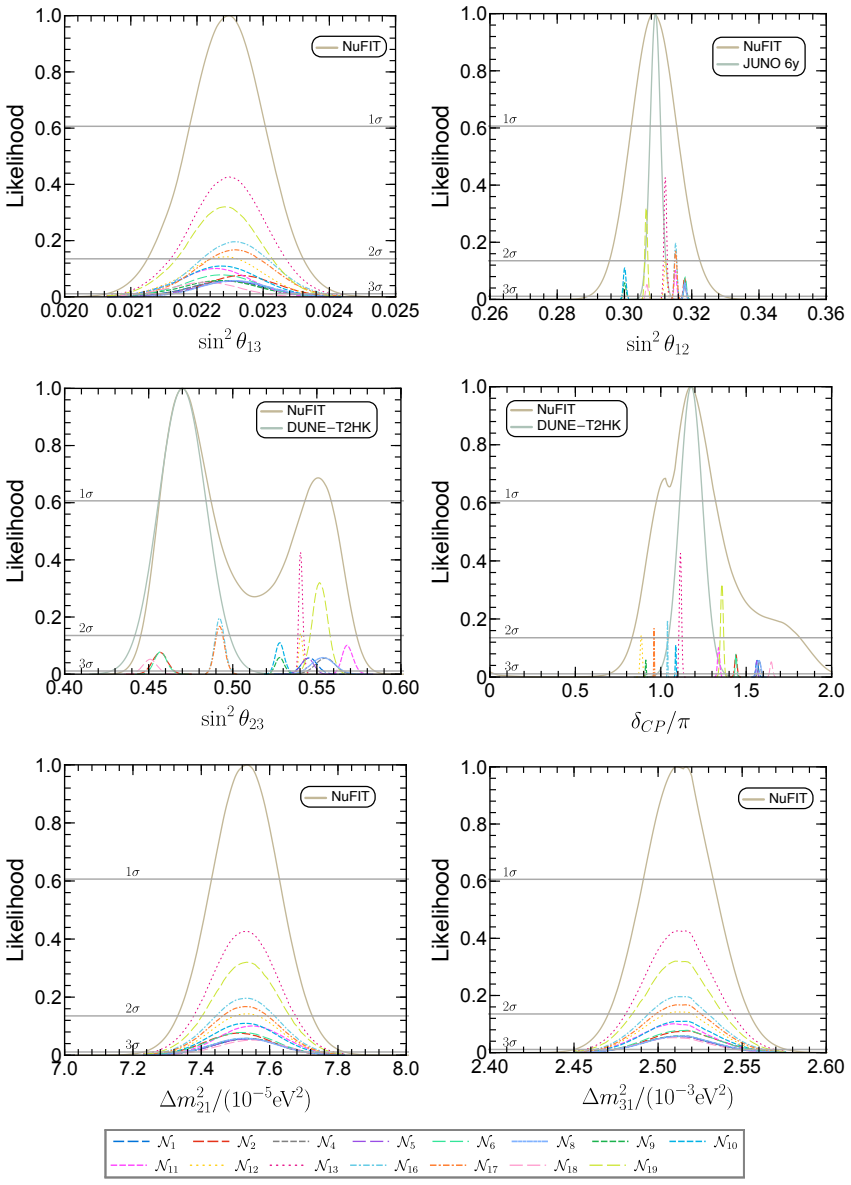
A high-precision measurement of sin² heta₁₂ by JUNO that falls outside the narrow intervals predicted by every remaining viable pattern (especially the eight TM₁ patterns), or a combined DUNE/T2HK determination of sin² heta₂₃ and δ_CP that lies outside all 35 predicted bands.
Editorial analysis
A structured set of objections, weighed in public.
Referee Report
Summary. The paper presents the first comprehensive, model-independent study of Modular Littlest Seesaw models based on the finite modular group Δ(96). It constructs the vector-valued modular forms (VVMFs) for all irreducible representations of modular Δ(96), classifies the 92 inequivalent symmetry-preserving fixed points via double cosets, and derives the alignments of the lowest- and next-to-lowest-weight triplet VVMFs at those points. An exhaustive scan over residual symmetries in the charged-lepton, atmospheric, and solar sectors (with three independent moduli τℓ, τatm, τsol stabilized at fixed points) identifies 35 phenomenologically viable inequivalent breaking patterns (21 NO, 14 IO). The resulting Dirac neutrino mass matrices go beyond conventional CSD(n), producing new fixed PMNS columns and sum rules beyond TM1. With only three continuous parameters (ma, r, η), the models yield narrow, experimentally testable ranges for neutrino masses, mixing angles, and CP phases.
Significance. If the multi-modulus fixed-point assumption can be realized in a UV completion, this work substantially enlarges the Modular Littlest Seesaw landscape beyond S4/A5 constructions. The algebraic rigidity of fixed-point VVMF alignments (Eqs. 3.11–3.14, 4.7–4.16) produces a finite set of exact directions and new fixed PMNS columns (Table 6, Appendix C) that are independent of the fitted parameters. The exhaustive scan over 89662 patterns, the NuFIT-based χ² analysis, the explicit sum rules (Appendix D), and the confrontation with JUNO/DUNE/T2HK sensitivities constitute a concrete, falsifiable catalogue. The group-theory and VVMF appendices (A–B) are a reusable resource for future modular Δ(96) model building.
major comments (2)
- The entire catalogue of 35 patterns rests on the multi-modulus premise that three independent moduli can be stabilized at distinct fixed points preserving different residual symmetries (§4, Eq. (4.2); Table 2). A single common modulus would force the residual symmetries to be conjugate under the same modular transformation, collapsing most of the new fixed columns in Table 6 and Appendix C. The paper itself flags this as an open UV question (Conclusion; refs. [42,43,45,54]). The claim that the 35 patterns are “phenomenologically viable Modular Littlest Seesaw models” should be qualified more carefully as a classification under the multi-modulus assumption, with a clearer statement of the conditions under which the residual symmetries survive.
- The restriction to lowest- and next-to-lowest-weight triplet VVMFs is presented as a minimality choice (§3, Table 1). While reasonable for predictivity, the paper does not quantify how many additional viable patterns would appear if higher-weight triplets (or the sextet) were admitted. A short discussion of the completeness of the weight cut, or an argument that higher weights generically reintroduce continuous freedom or lose residual-symmetry protection, would strengthen the claim that the 35-pattern list is exhaustive within the modular framework.
minor comments (5)
- Table 6 and Appendix C: the analytical fixed-column expressions are dense; a short numerical cross-check (e.g., that the listed vectors are unit-normalized and orthogonal to the two Yukawa directions) would help the reader verify the algebra.
- Figures 2–3: the symbol coding for the 21 NO / 14 IO patterns is hard to parse without a legend that maps each marker to the case labels N1–N21 / I1–I14 of Table 6.
- Eq. (4.16) and Appendix D: the sum-rule formulae for the non-TM1 patterns are lengthy; stating the numerical values of the fixed-column components used in each derivation would improve reproducibility.
- A few minor typos appear (e.g., “dirreducible” for “d-irreducible” in §2; occasional missing spaces around “τ”). A light copy-edit pass would clean these.
- The relation of the Δ(96) modular construction to the earlier tri-direct CP Δ(96) analysis of Ref. [27] is noted in §5.1; a short table comparing the vacuum alignments that are shared versus those that are modular-specific would clarify the complementarity claimed in the text.
Circularity Check
No significant circularity: fixed PMNS columns and sum rules are algebraic consequences of modular covariance at fixed points; continuous parameters are fitted in the standard phenomenological way.
specific steps
-
fitted input called prediction
[Sec. 5.1, Tables 7–9; abstract claim of ‘narrow ranges’]
"The viable models are highly predictive, giving narrow ranges for neutrino masses, mixing parameters and CP phases… For any given set of input parameters, the model predicts the neutrino masses, mixing parameters, and the corresponding χ² value… the three leptonic mixing angles, the two CP-violating phases, the neutrino masses, and the effective Majorana mass… are all confined to narrow regions."
ma, r, η are fitted by minimizing χ² against the same six oscillation observables whose best-fit values and 3σ ranges are then reported as model ‘predictions.’ The narrowness of those ranges is partly forced by the requirement that all fitted observables already lie inside the experimental 3σ intervals. This is only a mild, standard phenomenological presentation, not a definitional loop: the fixed PMNS columns and sum rules (Eq. 4.16, App. C–D) remain independent algebraic content that genuinely constrain the fit.
full rationale
The derivation chain is self-contained and non-circular under the stated criteria. VVMFs for all irreps of modular Δ(96) are constructed from MLDEs and tensor products (Sec. 3, App. B); inequivalent fixed points and residual stabilizers are classified by double cosets (Eqs. 3.11–3.15, Table 2); vacuum alignments of lowest- and next-to-lowest-weight triplets are eigenvectors of residual generators (Table 3). The null vector ˆv_fix = vatm × vsol / |…| (Eq. 4.7) and the fixed PMNS column Pℓ U†ℓ ˆv_fix (Eqs. 4.13–4.16) are therefore fixed algebraically by modular covariance once the residual symmetries and VVMF weights are chosen—independent of the continuous parameters ma, r, η. Those three parameters are then scanned against NuFIT 6.1 via a global χ² (Sec. 5.1); the resulting best-fit values and 3σ ranges for mixing angles, phases, masses and mee are the model’s allowed region under that fit, which is ordinary model-building practice rather than a definitional reduction. Self-citations to the multi-modulus Modular Littlest Seesaw setup ([42,43] and related works) supply the framework assumption, not a uniqueness theorem that forbids alternatives or forces the 35-pattern catalogue. The multi-modulus premise is a genuine UV assumption (as the paper itself notes in the Conclusion), but that is a correctness/realizability concern, not circularity. No step reduces a claimed first-principles result to its own input by construction.
Axiom & Free-Parameter Ledger
free parameters (3)
- ma (overall light-neutrino mass scale) =
O(few–12) meV depending on pattern (Table 7)
- r (solar/atmospheric Yukawa–mass ratio) =
O(0.15–4.5) depending on pattern (Table 7)
- η (relative CP phase) =
O(0.1–1.9)π depending on pattern (Table 7)
axioms (6)
- domain assumption Yukawa couplings are vector-valued modular forms transforming under a finite modular group Gf ≅ Γ/ker(ρ) with the automorphy factor (cτ+d)^k.
- domain assumption Light neutrino masses arise from the type-I seesaw with exactly two right-handed neutrinos (rank-2 Mν, one massless neutrino).
- ad hoc to paper Three independent moduli τℓ, τatm, τsol can be stabilized at distinct modular fixed points preserving different residual symmetries.
- ad hoc to paper Only lowest- and next-to-lowest-weight triplet VVMFs are used for Yatm and Ysol.
- domain assumption Kähler potential is the minimal modular-invariant form, yielding canonical kinetic terms after τ acquires a VEV.
- domain assumption NuFIT 6.1 3σ intervals define phenomenological viability.
read the original abstract
We perform the first comprehensive and model independent study of Modular Littlest Seesaw models based on the finite modular group $\Delta(96)$. We construct the vector-valued modular forms (VVMFs) for all irreducible representations of modular $\Delta(96)$, classify the inequivalent symmetry-preserving fixed points, and derive the corresponding alignments of the low-weight and next-to-lowest-weight triplet VVMFs. These results allow an exhaustive scan over the residual symmetries in the charged lepton, atmospheric neutrino, and solar neutrino sectors. We identify 35 phenomenologically viable and inequivalent breaking patterns, including 21 with normal ordering and 14 with inverted ordering. The resulting Dirac neutrino mass matrices go beyond the conventional CSD$(n)$ structure, yielding new fixed PMNS columns and novel correlations among the lepton mixing parameters beyond the TM$_1$ paradigm. The viable models are highly predictive, giving narrow ranges for neutrino masses, mixing parameters and CP phases, and can be stringently tested by upcoming experiments such as JUNO, DUNE and T2HK.
Figures



Reference graph
Works this paper leans on
-
[1]
Nobel Lecture: The Sudbury Neutrino Observatory: Observation of flavor change for solar neutrinos,
A. B. McDonald, “Nobel Lecture: The Sudbury Neutrino Observatory: Observation of flavor change for solar neutrinos,”Rev. Mod. Phys.88no. 3, (2016) 030502
work page 2016
-
[2]
Nobel Lecture: Discovery of atmospheric neutrino oscillations,
T. Kajita, “Nobel Lecture: Discovery of atmospheric neutrino oscillations,”Rev. Mod. Phys.88no. 3, (2016) 030501. [3]Particle Data GroupCollaboration, F. Takahashiet al., “Review of Particle Physics,” Int. J. Mod. Phys. A41(2026) 2630011
work page 2016
-
[3]
µ→eγat a Rate of One Out of 10 9 Muon Decays?,
P. Minkowski, “µ→eγat a Rate of One Out of 10 9 Muon Decays?,”Phys. Lett. B67 (1977) 421–428
work page 1977
-
[4]
S. F. King, “Large mixing angle MSW and atmospheric neutrinos from single right-handed neutrino dominance and U(1) family symmetry,”Nucl. Phys. B576(2000) 85–105, arXiv:hep-ph/9912492
work page internal anchor Pith review Pith/arXiv arXiv 2000
-
[5]
Cosmological Sign of Neutrino CP Violation
P. H. Frampton, S. L. Glashow, and T. Yanagida, “Cosmological sign of neutrino CP violation,”Phys. Lett. B548(2002) 119–121,arXiv:hep-ph/0208157
work page internal anchor Pith review Pith/arXiv arXiv 2002
-
[6]
The minimal seesaw and leptogenesis models
Z.-z. Xing and Z.-h. Zhao, “The minimal seesaw and leptogenesis models,”Rept. Prog. Phys.84no. 6, (2021) 066201,arXiv:2008.12090 [hep-ph]. 48
work page internal anchor Pith review Pith/arXiv arXiv 2021
-
[7]
Atmospheric and Solar Neutrinos with a Heavy Singlet
S. F. King, “Atmospheric and solar neutrinos with a heavy singlet,”Phys. Lett. B439 (1998) 350–356,arXiv:hep-ph/9806440
work page internal anchor Pith review Pith/arXiv arXiv 1998
-
[8]
Atmospheric and Solar Neutrinos from Single Right-Handed Neutrino Dominance and U(1) Family Symmetry
S. F. King, “Atmospheric and solar neutrinos from single right-handed neutrino dominance and U(1) family symmetry,”Nucl. Phys. B562(1999) 57–77,arXiv:hep-ph/9904210
work page internal anchor Pith review Pith/arXiv arXiv 1999
-
[9]
S. F. King, “Constructing the large mixing angle MNS matrix in seesaw models with right-handed neutrino dominance,”JHEP09(2002) 011,arXiv:hep-ph/0204360
work page internal anchor Pith review Pith/arXiv arXiv 2002
-
[10]
Predicting neutrino parameters from SO(3) family symmetry and quark-lepton unification
S. F. King, “Predicting neutrino parameters from SO(3) family symmetry and quark-lepton unification,”JHEP08(2005) 105,arXiv:hep-ph/0506297
work page internal anchor Pith review Pith/arXiv arXiv 2005
-
[11]
Trimaximal mixing with predicted \theta_13 from a new type of constrained sequential dominance
S. Antusch, S. F. King, C. Luhn, and M. Spinrath, “Trimaximal mixing with predictedθ 13 from a new type of constrained sequential dominance,”Nucl. Phys. B856(2012) 328–341, arXiv:1108.4278 [hep-ph]
work page internal anchor Pith review Pith/arXiv arXiv 2012
-
[12]
Minimal predictive see-saw model with normal neutrino mass hierarchy
S. F. King, “Minimal predictive see-saw model with normal neutrino mass hierarchy,” JHEP07(2013) 137,arXiv:1304.6264 [hep-ph]
work page internal anchor Pith review Pith/arXiv arXiv 2013
-
[13]
S. F. King, “Littlest Seesaw,”JHEP02(2016) 085,arXiv:1512.07531 [hep-ph]
work page internal anchor Pith review Pith/arXiv arXiv 2016
-
[14]
Littlest Seesaw model from S4 x U(1)
S. F. King and C. Luhn, “Littlest Seesaw model from S 4×U(1),”JHEP09(2016) 023, arXiv:1607.05276 [hep-ph]
work page internal anchor Pith review Pith/arXiv arXiv 2016
-
[15]
Precision neutrino experiments vs the Littlest Seesaw
P. Ballett, S. F. King, S. Pascoli, N. W. Prouse, and T. Wang, “Precision neutrino experiments vs the Littlest Seesaw,”JHEP03(2017) 110,arXiv:1612.01999 [hep-ph]
work page internal anchor Pith review Pith/arXiv arXiv 2017
-
[16]
Fitting high-energy Littlest Seesaw parameters using low-energy neutrino data and leptogenesis
S. F. King, S. Molina Sedgwick, and S. J. Rowley, “Fitting high-energy Littlest Seesaw parameters using low-energy neutrino data and leptogenesis,”JHEP10(2018) 184, arXiv:1808.01005 [hep-ph]
work page internal anchor Pith review Pith/arXiv arXiv 2018
-
[17]
Minimal see-saw model predicting best fit lepton mixing angles
S. F. King, “Minimal see-saw model predicting best fit lepton mixing angles,”Phys. Lett. B724(2013) 92–98,arXiv:1305.4846 [hep-ph]
work page internal anchor Pith review Pith/arXiv arXiv 2013
-
[18]
A model of quark and lepton mixing
S. F. King, “A model of quark and lepton mixing,”JHEP01(2014) 119, arXiv:1311.3295 [hep-ph]
work page internal anchor Pith review Pith/arXiv arXiv 2014
-
[19]
Testing constrained sequential dominance models of neutrinos
F. Bj¨ orkeroth and S. F. King, “Testing constrained sequential dominance models of neutrinos,”J. Phys. G42no. 12, (2015) 125002,arXiv:1412.6996 [hep-ph]
work page internal anchor Pith review Pith/arXiv arXiv 2015
-
[20]
Tri-bimaximal Neutrino Mixing and Flavor-dependent Resonant Leptogenesis
Z.-z. Xing and S. Zhou, “Tri-bimaximal Neutrino Mixing and Flavor-dependent Resonant Leptogenesis,”Phys. Lett. B653(2007) 278–287,arXiv:hep-ph/0607302
work page internal anchor Pith review Pith/arXiv arXiv 2007
-
[21]
Mass Independent Textures and Symmetry
C. S. Lam, “Mass Independent Textures and Symmetry,”Phys. Rev. D74(2006) 113004, arXiv:hep-ph/0611017
work page internal anchor Pith review Pith/arXiv arXiv 2006
-
[22]
P.-T. Chen, G.-J. Ding, S. F. King, and C.-C. Li, “A New Littlest Seesaw Model,”J. Phys. G47no. 6, (2020) 065001,arXiv:1906.11414 [hep-ph]
work page internal anchor Pith review Pith/arXiv arXiv 2020
-
[23]
G.-J. Ding, S. F. King, and C.-C. Li, “Golden Littlest Seesaw,”Nucl. Phys. B925(2017) 470–499,arXiv:1705.05307 [hep-ph]
work page internal anchor Pith review Pith/arXiv arXiv 2017
-
[24]
Tri-Direct CP in the Littlest Seesaw Playground
G.-J. Ding, S. F. King, and C.-C. Li, “Tri-Direct CP in the Littlest Seesaw Playground,” JHEP12(2018) 003,arXiv:1807.07538 [hep-ph]. 49
work page internal anchor Pith review Pith/arXiv arXiv 2018
-
[25]
G.-J. Ding, S. F. King, and C.-C. Li, “Lepton mixing predictions fromS 4 in the tridirect CP approach to two right-handed neutrino models,”Phys. Rev. D99no. 7, (2019) 075035, arXiv:1811.12340 [hep-ph]
work page internal anchor Pith review Pith/arXiv arXiv 2019
-
[26]
Neutrino mixing parameters and masses from ∆(96)⋊H CP in the tri-direct CP approach,
L.-N. Yan, X.-Y. Gao, G.-D. Liu, and C.-C. Li, “Neutrino mixing parameters and masses from ∆(96)⋊H CP in the tri-direct CP approach,”JHEP10(2025) 206, arXiv:2507.02840 [hep-ph]
-
[27]
Are neutrino masses modular forms?
F. Feruglio,Are neutrino masses modular forms?, pp. 227–266. 2019.arXiv:1706.08749 [hep-ph]
work page internal anchor Pith review Pith/arXiv arXiv 2019
-
[28]
Modular flavor symmetric models
T. Kobayashi and M. Tanimoto, “Modular flavor symmetric models,”Int. J. Mod. Phys. A 39no. 09n10, (2024) 2441012,arXiv:2307.03384 [hep-ph]
work page internal anchor Pith review Pith/arXiv arXiv 2024
-
[29]
Neutrino Mass and Mixing with Modular Symmetry
G.-J. Ding and S. F. King, “Neutrino mass and mixing with modular symmetry,”Rept. Prog. Phys.87no. 8, (2024) 084201,arXiv:2311.09282 [hep-ph]
work page internal anchor Pith review Pith/arXiv arXiv 2024
-
[30]
Modular flavor symmetry and vector-valued modular forms
X.-G. Liu and G.-J. Ding, “Modular flavor symmetry and vector-valued modular forms,” JHEP03(2022) 123,arXiv:2112.14761 [hep-ph]
work page internal anchor Pith review Pith/arXiv arXiv 2022
-
[31]
Duality and the Role of Nonperturbative Effects on the World Sheet,
J. Lauer, J. Mas, and H. P. Nilles, “Duality and the Role of Nonperturbative Effects on the World Sheet,”Phys. Lett. B226(1989) 251–256
work page 1989
-
[32]
Modular Invariance in Supersymmetric Field Theories,
S. Ferrara, D. Lust, A. D. Shapere, and S. Theisen, “Modular Invariance in Supersymmetric Field Theories,”Phys. Lett. B225(1989) 363
work page 1989
-
[33]
Modular symmetry and non-Abelian discrete flavor symmetries in string compactification
T. Kobayashi, S. Nagamoto, S. Takada, S. Tamba, and T. H. Tatsuishi, “Modular symmetry and non-Abelian discrete flavor symmetries in string compactification,”Phys. Rev. D97no. 11, (2018) 116002,arXiv:1804.06644 [hep-th]
work page internal anchor Pith review Pith/arXiv arXiv 2018
-
[34]
Unification of Flavor, CP, and Modular Symmetries
A. Baur, H. P. Nilles, A. Trautner, and P. K. S. Vaudrevange, “Unification of Flavor, CP, and Modular Symmetries,”Phys. Lett. B795(2019) 7–14,arXiv:1901.03251 [hep-th]
work page internal anchor Pith review Pith/arXiv arXiv 2019
-
[35]
Lessons from eclectic flavor symmetries
H. P. Nilles, S. Ramos-Sanchez, and P. K. S. Vaudrevange, “Lessons from eclectic flavor symmetries,”Nucl. Phys. B957(2020) 115098,arXiv:2004.05200 [hep-ph]
work page internal anchor Pith review Pith/arXiv arXiv 2020
-
[36]
Supersymmetry Breaking From Duality Invariant Gaugino Condensation,
A. Font, L. E. Ibanez, D. Lust, and F. Quevedo, “Supersymmetry Breaking From Duality Invariant Gaugino Condensation,”Phys. Lett. B245(1990) 401–408
work page 1990
-
[37]
Spontaneous breaking of CP symmetry by orbifold moduli
B. S. Acharya, D. Bailin, A. Love, W. A. Sabra, and S. Thomas, “Spontaneous breaking of CP symmetry by orbifold moduli,”Phys. Lett. B357(1995) 387–396, arXiv:hep-th/9506143. [Erratum: Phys.Lett.B 407, 451–451 (1997)]
work page internal anchor Pith review Pith/arXiv arXiv 1995
-
[38]
Breaking CP and supersymmetry with orbifold moduli dynamics
T. Dent, “Breaking CP and supersymmetry with orbifold moduli dynamics,”Nucl. Phys. B 623(2002) 73–96,arXiv:hep-th/0110110. [Erratum: Nucl.Phys.B 629, 493–493 (2002)]
work page internal anchor Pith review Pith/arXiv arXiv 2002
-
[39]
Landscape of Modular Symmetric Flavor Models
K. Ishiguro, T. Kobayashi, and H. Otsuka, “Landscape of Modular Symmetric Flavor Models,”JHEP03(2021) 161,arXiv:2011.09154 [hep-ph]
work page internal anchor Pith review Pith/arXiv arXiv 2021
-
[40]
Modular Flavour Symmetries and Modulus Stabilisation
P. P. Novichkov, J. T. Penedo, and S. T. Petcov, “Modular flavour symmetries and modulus stabilisation,”JHEP03(2022) 149,arXiv:2201.02020 [hep-ph]. 50
work page internal anchor Pith review Pith/arXiv arXiv 2022
-
[41]
Modular S 4 and A4 symmetries and their fixed points: new predictive examples of lepton mixing,
G.-J. Ding, S. F. King, X.-G. Liu, and J.-N. Lu, “Modular S 4 and A4 symmetries and their fixed points: new predictive examples of lepton mixing,”JHEP12(2019) 030, arXiv:1910.03460 [hep-ph]
-
[42]
I. de Medeiros Varzielas, S. F. King, and M. Levy, “Littlest modular seesaw,”JHEP02 (2023) 143,arXiv:2211.00654 [hep-ph]
work page internal anchor Pith review Pith/arXiv arXiv 2023
-
[43]
G.-J. Ding, S. F. King, and C.-Y. Yao, “ModularS 4 ×SU(5) GUT,”Phys. Rev. D104 no. 5, (2021) 055034,arXiv:2103.16311 [hep-ph]
work page internal anchor Pith review Pith/arXiv arXiv 2021
-
[44]
A Modular $SU(5)$ Littlest Seesaw
I. de Medeiros Varzielas, S. F. King, and M. Levy, “A modular SU (5) littlest seesaw,” JHEP05(2024) 203,arXiv:2309.15901 [hep-ph]
work page internal anchor Pith review Pith/arXiv arXiv 2024
-
[45]
New modular fixed point models and their phenomenological implications for JUNO, T2HK and DUNE,
E.-H. Shang, J.-N. Lu, G.-J. Ding, and S. F. King, “New modular fixed point models and their phenomenological implications for JUNO, T2HK and DUNE,”arXiv:2601.09598 [hep-ph]
-
[46]
Trimaximal Neutrino Mixing from Modular A4 Invariance with Residual Symmetries
P. P. Novichkov, S. T. Petcov, and M. Tanimoto, “Trimaximal Neutrino Mixing from Modular A4 Invariance with Residual Symmetries,”Phys. Lett. B793(2019) 247–258, arXiv:1812.11289 [hep-ph]
work page internal anchor Pith review Pith/arXiv arXiv 2019
-
[47]
Modular $S_4$ Models of Lepton Masses and Mixing
P. P. Novichkov, J. T. Penedo, S. T. Petcov, and A. V. Titov, “Modular S 4 models of lepton masses and mixing,”JHEP04(2019) 005,arXiv:1811.04933 [hep-ph]
work page internal anchor Pith review Pith/arXiv arXiv 2019
-
[48]
Modular $A_5$ Symmetry for Flavour Model Building
P. P. Novichkov, J. T. Penedo, S. T. Petcov, and A. V. Titov, “Modular A 5 symmetry for flavour model building,”JHEP04(2019) 174,arXiv:1812.02158 [hep-ph]
work page internal anchor Pith review Pith/arXiv arXiv 2019
-
[49]
Two A5 modular symmetries for Golden Ratio 2 mixing
I. de Medeiros Varzielas and J. Louren¸ co, “Two A5 modular symmetries for Golden Ratio 2 mixing,”Nucl. Phys. B984(2022) 115974,arXiv:2206.14869 [hep-ph]
work page internal anchor Pith review Pith/arXiv arXiv 2022
-
[50]
Multiple modular symmetries as the origin of flavour
I. de Medeiros Varzielas, S. F. King, and Y.-L. Zhou, “Multiple modular symmetries as the origin of flavor,”Phys. Rev. D101no. 5, (2020) 055033,arXiv:1906.02208 [hep-ph]
work page internal anchor Pith review Pith/arXiv arXiv 2020
-
[51]
Trimaximal TM$_1$ mixing with two modular $S_4$ groups
S. F. King and Y.-L. Zhou, “Trimaximal TM 1 mixing with two modularS 4 groups,”Phys. Rev. D101no. 1, (2020) 015001,arXiv:1908.02770 [hep-ph]
work page internal anchor Pith review Pith/arXiv arXiv 2020
-
[52]
Symmetries and stabilisers in modular invariant flavour models
I. de Medeiros Varzielas, M. Levy, and Y.-L. Zhou, “Symmetries and stabilisers in modular invariant flavour models,”JHEP11(2020) 085,arXiv:2008.05329 [hep-ph]
work page internal anchor Pith review Pith/arXiv arXiv 2020
-
[53]
Modular flavour symmetry and orbifolds
F. J. de Anda and S. F. King, “Modular flavour symmetry and orbifolds,”JHEP06(2023) 122,arXiv:2304.05958 [hep-ph]
work page internal anchor Pith review Pith/arXiv arXiv 2023
-
[54]
Finite Modular Groups and Lepton Mixing
R. de Adelhart Toorop, F. Feruglio, and C. Hagedorn, “Finite Modular Groups and Lepton Mixing,”Nucl. Phys. B858(2012) 437–467,arXiv:1112.1340 [hep-ph]
work page internal anchor Pith review Pith/arXiv arXiv 2012
-
[55]
TFH Mixing Patterns, Large $\theta_{13}$ and $\Delta(96)$ Flavor Symmetry
G.-J. Ding, “TFH Mixing Patterns, Largeθ 13 and ∆(96) Flavor Symmetry,”Nucl. Phys. B 862(2012) 1–42,arXiv:1201.3279 [hep-ph]
work page internal anchor Pith review Pith/arXiv arXiv 2012
-
[56]
A Grand Delta(96) x SU(5) Flavour Model
S. F. King, C. Luhn, and A. J. Stuart, “A Grand Delta(96) x SU(5) Flavour Model,”Nucl. Phys. B867(2013) 203–235,arXiv:1207.5741 [hep-ph]
work page internal anchor Pith review Pith/arXiv arXiv 2013
-
[57]
Generalised CP and $\Delta (96)$ Family Symmetry
G.-J. Ding and S. F. King, “GeneralizedCPand ∆(96) family symmetry,”Phys. Rev. D 89no. 9, (2014) 093020,arXiv:1403.5846 [hep-ph]. 51
work page internal anchor Pith review Pith/arXiv arXiv 2014
-
[58]
Reconstructing Effective Lagrangians Embedding Residual Family Symmetries
J. Bernigaud, I. de Medeiros Varzielas, and J. Talbert, “Reconstructing Effective Lagrangians Embedding Residual Family Symmetries,”Eur. Phys. J. C81no. 1, (2021) 65,arXiv:2005.12293 [hep-ph]
work page internal anchor Pith review Pith/arXiv arXiv 2021
-
[59]
N. Gautam, R. Krishnan, and M. K. Das, “Effect of Sterile Neutrino on Low-Energy Processes in Minimal Extended Seesaw With ∆(96) Symmetry and TM1 Mixing,”Front. in Phys.0(2021) 417,arXiv:2011.05693 [hep-ph]
work page internal anchor Pith review Pith/arXiv arXiv 2021
-
[60]
Predicting Neutrino Mixing Angles Using Group Presentations
C. Alvarado, J. Bautista, and A. J. Stuart, “Predicting neutrino mixing angles using group presentations,”Int. J. Mod. Phys. A38no. 06n07, (2023) 2350039,arXiv:2211.07785 [hep-ph]
work page internal anchor Pith review Pith/arXiv arXiv 2023
-
[61]
Fermion mass relations in one-parameter modular models
S. Centelles Chuli´ a, X. Li, X.-G. Liu, O. Medina, and J. T. Penedo, “Fermion mass relations in one-parameter modular models,”arXiv:2606.25027 [hep-ph]. [63]JUNOCollaboration, A. Abuslemeet al., “Sub-percent precision measurement of neutrino oscillation parameters with JUNO,”Chin. Phys. C46no. 12, (2022) 123001, arXiv:2204.13249 [hep-ex]. [64]JUNOCollabo...
work page internal anchor Pith review Pith/arXiv arXiv 2022
-
[62]
Modular binary octahedral symmetry for flavor structure of Standard Model
G.-J. Ding, X.-G. Liu, J.-N. Lu, and M.-H. Weng, “Modular binary octahedral symmetry for flavor structure of Standard Model,”JHEP11(2023) 083,arXiv:2307.14926 [hep-ph]
work page internal anchor Pith review Pith/arXiv arXiv 2023
-
[63]
C. E. Marks,Classification of vector-valued modular forms of dimension less than six. University of California, Santa Cruz, 2009
work page 2009
-
[64]
X.-G. Liu and M. Ratz, “Modular Zeros,”Phys. Lett. B875(2026) 140372, arXiv:2512.21386 [hep-th]
-
[65]
C. Jarlskog, “Commutator of the Quark Mass Matrices in the Standard Electroweak Model and a Measure of Maximal CP Nonconservation,”Phys. Rev. Lett.55(1985) 1039
work page 1985
-
[66]
Majorana Neutrinos and CP Violation in the Leptonic Sector,
G. C. Branco, L. Lavoura, and M. N. Rebelo, “Majorana Neutrinos and CP Violation in the Leptonic Sector,”Phys. Lett. B180(1986) 264–268
work page 1986
-
[67]
Minimal Rephasing Invariant CP Violating Parameters With Dirac and Majorana Fermions,
J. F. Nieves and P. B. Pal, “Minimal Rephasing Invariant CP Violating Parameters With Dirac and Majorana Fermions,”Phys. Rev. D36(1987) 315
work page 1987
-
[68]
Rephasing-invariant CP violating parameters with Majorana neutrinos
J. F. Nieves and P. B. Pal, “Rephasing invariant CP violating parameters with Majorana neutrinos,”Phys. Rev. D64(2001) 076005,arXiv:hep-ph/0105305
work page internal anchor Pith review Pith/arXiv arXiv 2001
-
[69]
Rephasing Invariants of Quark and Lepton Mixing Matrices
E. E. Jenkins and A. V. Manohar, “Rephasing Invariants of Quark and Lepton Mixing Matrices,”Nucl. Phys. B792(2008) 187–205,arXiv:0706.4313 [hep-ph]. 52
work page internal anchor Pith review Pith/arXiv arXiv 2008
-
[70]
G. C. Branco, R. G. Felipe, and F. R. Joaquim, “Leptonic CP Violation,”Rev. Mod. Phys. 84(2012) 515–565,arXiv:1111.5332 [hep-ph]
work page internal anchor Pith review Pith/arXiv arXiv 2012
-
[71]
Generalised CP and $A_4$ Family Symmetry
G.-J. Ding, S. F. King, and A. J. Stuart, “Generalised CP andA 4 Family Symmetry,” JHEP12(2013) 006,arXiv:1307.4212 [hep-ph]
work page internal anchor Pith review Pith/arXiv arXiv 2013
-
[72]
Deviation from Bimaximal Mixing and Leptonic CP Phases in $S_4$ Family Symmetry and Generalized CP
C.-C. Li and G.-J. Ding, “Deviation from bimaximal mixing and leptonic CP phases in S 4 family symmetry and generalized CP,”JHEP08(2015) 017,arXiv:1408.0785 [hep-ph]
work page internal anchor Pith review Pith/arXiv arXiv 2015
-
[73]
NuFit-6.0: Updated global analysis of three-flavor neutrino oscillations
I. Esteban, M. C. Gonzalez-Garcia, M. Maltoni, I. Martinez-Soler, J. a. P. Pinheiro, and T. Schwetz, “NuFit-6.0: updated global analysis of three-flavor neutrino oscillations,” JHEP12(2024) 216,arXiv:2410.05380 [hep-ph]. [79]KamLAND-ZenCollaboration, S. Abeet al., “Search for Majorana Neutrinos with the Complete KamLAND-Zen Dataset,”arXiv:2406.11438 [hep-...
work page internal anchor Pith review Pith/arXiv arXiv 2024
discussion (0)
Sign in with ORCID, Apple, or X to comment. Anyone can read and Pith papers without signing in.