REVIEW 3 major objections 4 minor 1 references
A lightweight Temporal Convolutional Network can detect and mitigate DDoS attacks in simulated healthcare-IoT networks with reported accuracy above 99.9% by watching per-node message frequency, then run quantized on a Raspberry Pi 4.
Reviewed by Pith at T0; open to challenge. T0 means a machine referee read the full paper against a public rubric. the ladder, T0–T4 →
T0 review · deepseek-v4-flash
2026-08-04 01:14 UTC pith:6BN7DK64
load-bearing objection Useful datasets and an honest deployment study, but the headline accuracy is a measure of the labeling rule, not independent DDoS detection. the 3 major comments →
Deep Learning for Cyber Threat Detection and Mitigation in Healthcare-IoT
The pith
A machine-rendered reading of the paper's core claim, the machinery that carries it, and where it could break.
Core claim
On the paper's own terms, the discovery is that per-node transmission frequency is a sufficient signature for DDoS activity in healthcare IoT. Malicious nodes are simulated to transmit at shorter intervals than normal nodes; the TCN ingests features such as total messages per node, message frequency proportion, and a 5-second monitoring frequency, and labels each node as malicious or normal. The same recipe works across two protocol families: MQTT (Cooja) and UDP (ns-3, 5G-enabled), with reported accuracies of 99.98% and 99.99% respectively, outperforming BiLSTM and CNN baselines. Quantization to TensorFlow Lite shrinks the model for a Raspberry Pi 4 deployment with low latency and power con
What carries the argument
The central object is the Temporal Convolutional Network (TCN) — a convolutional architecture with dilated causal convolutions that processes time-ordered features in parallel rather than sequentially — trained on frequency features computed per node: total messages, per-node message counts, message frequency proportion, monitoring frequency, and running mean frequency. The detection signal is the monitoring frequency of each node; the mitigation mechanism is a dynamic threshold that blacklists nodes whose monitored behaviour matches the malicious pattern. In the multi-attack setting the companion is a Residual TCN (Res-TCN), which adds skip connections for stable training on combined physio
Load-bearing premise
The load-bearing premise is that the frequency rules are valid ground truth for DDoS: in the UDP dataset a node is labelled malicious when its 5-second monitoring frequency meets or exceeds the running mean frequency, and in the MQTT dataset when its message frequency proportion exceeds 5% (Sections 3.4.2, 3.4.4, and 4.8). If those rules do not independently correspond to real attack activity, the near-perfect accuracy largely reflects the model learning the labelling rule, s
What would settle it
A decisive check: apply the labelling rules directly as a detector, with no trained model — label a node malicious whenever its monitoring frequency is at least the running mean (UDP) or its frequency proportion exceeds 5% (MQTT) — and measure accuracy on the same train/test splits. If this rule-only baseline already reaches the reported 99.9+% figures, the TCN adds no detection power beyond the rule. A second check: evaluate the trained TCN on a dataset labelled by actual attack injection rather than by the frequency rule; if accuracy collapses, the model learned the rule, not the attack.
If this is right
- If the frequency-based claim is right, DDoS detection in H-IoT does not need heavyweight recurrent networks; a compact TCN that processes time-ordered features in parallel can do the job within wearable-device budgets.
- The same detection-and-blacklist loop could run at the edge, next to the medical data sink, rather than depending on cloud connectivity — relevant for clinics and remote monitoring where the network link is itself the target.
- Because the mechanism transfers across MQTT and UDP, a single TCN design may cover several IoT protocol stacks without architectural change.
- The multiclass Res-TCN result implies that one model can distinguish DDoS, selective forwarding, and man-in-the-middle behaviours in a single topology, which is closer to the mixed-threat reality of deployed networks.
- The released datasets give the community node-level, temporal, protocol-specific benchmarks that aggregated traffic datasets do not provide, enabling fairer comparison of detection models.
Where Pith is reading between the lines
- My inference: the reported accuracy is likely dominated by the labelling rule itself — in the UDP dataset a node is labelled malicious exactly when its 5-second monitoring frequency reaches the running mean, and the model is trained on those same frequency features, so the 99.99% figure may measure how well the network reproduces that rule rather than how well it detects attacks.
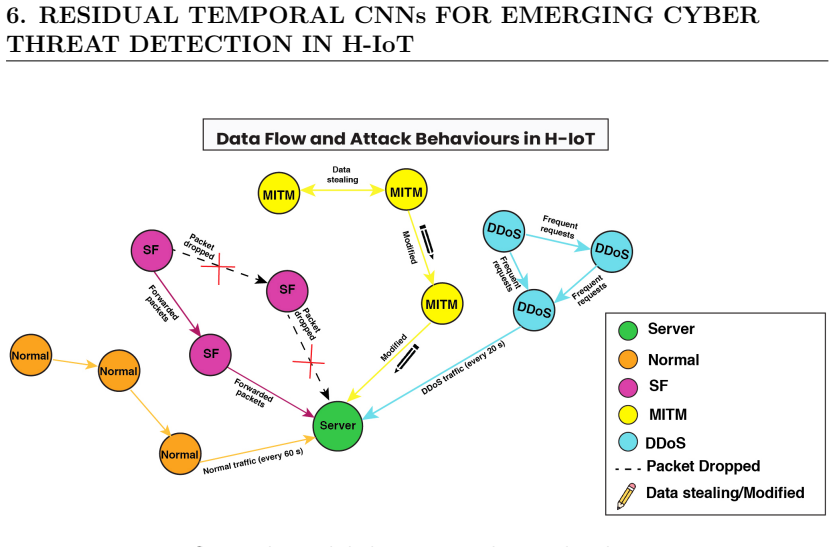
- My inference: because attack behaviour is simulated with fixed transmission intervals (e.g., 20 s versus 60 s), the frequency signature is cleanly separable by design; real DDoS traffic with variable, randomized, or slow-and-low rates would probably erode the margin, so the headline numbers are best read as upper bounds for the simulated regime.
- My inference: a natural test is to compare the TCN against a parameter-free baseline — classify a node as malicious whenever its monitored frequency equals or exceeds the running mean (or its frequency proportion exceeds 5% for MQTT), since that rule, not the learned model, generates the labels; if the baseline matches TCN accuracy, the contribution is engineering for efficient edge deployment rat
Editorial analysis
A structured set of objections, weighed in public.
Referee Report
Summary. The manuscript is a PhD thesis-style paper that develops synthetic healthcare-IoT (H-IoT) attack datasets and proposes lightweight deep learning models for cyber threat detection and mitigation. It introduces three datasets: UL-ECE-MQTT-DDoS-H-IoT2025 and UL-ECE-UDP-DDoS-H-IoT2025 for binary DDoS detection, and UL-ECE-MultiAttack-H-IoT2025 for multiclass detection of DDoS, selective forwarding, and man-in-the-middle attacks. The central detection claim is that a Temporal Convolutional Network (TCN) can detect DDoS attacks at node level with near-perfect accuracy on the authors' own MQTT and UDP datasets, and that a quantized TFLite version runs efficiently on a Raspberry Pi 4. A residual variant (Res-TCN) is proposed for multiclass detection. The paper also reports comparisons with BiLSTM, CNN, and decision-tree baselines, and describes edge deployment experiments with power and latency measurements.
Significance. If the detection claims were valid, the paper would offer a genuinely useful contribution: a lightweight TCN with ~99.9% accuracy for node-level DDoS detection in resource-constrained H-IoT settings, plus a reproducible dataset-generation pipeline and concrete edge-deployment measurements. The thesis is transparent about its simulation-based approach and includes publicly archived datasets and preprocessing scripts, which are strengths for reproducibility. The Raspberry Pi 4 power and latency data, and the TFLite quantization workflow, are valuable practical artifacts. However, the core detection claim is not independently supported by the visible evidence because the ground-truth labels are generated by frequency-based rules and the model input includes the very same frequency features. This circularity means the reported near-perfect accuracy primarily measures consistency with the labeling rule rather than an independent ability to detect DDoS activity. The external validation on CICIoT2023 and similar datasets is cited but the full results are not visible in the provided text, so the in-scope evidence for the headline claim rests on the self-labelled datasets.
major comments (3)
- [Section 3.4.4 / Section 4.5.3.13] The UDP dataset is labelled by the rule: if the 5-second monitoring frequency is greater than or equal to the running mean frequency, the record is malicious (Section 3.4.4). The TCN input includes monitoring frequency and mean frequency as features (Sections 4.5.3.9, 4.5.3.10, 4.5.3.13). Thus the label is a deterministic function of the input features. The reported 99.99% accuracy on this dataset is exactly what would be expected from learning that threshold, and does not establish independent DDoS detection. This is a load-bearing issue: the paper's central claim that TCN 'uses monitoring frequency to accurately identify malicious nodes' is not supported by an evaluation protocol that shares the labeling rule with the model's features. The authors should re-label using the known attack-node configuration from the ns-3 simulator (which nodes were actually programmed as attackers) rather
- [Sections 3.4.2 and 4.8] The MQTT dataset is labelled by flagging nodes that exceed a 5% message-frequency proportion as malicious, and the 'frequency' feature is included in the model input (Section 4.4.3.5). Table 3.2 shows that malicious nodes have frequency values above 10% while normal nodes are mostly below 6%, so the classes are nearly linearly separable by the threshold itself. The TCN's reported 99.98% accuracy is therefore consistent with learning this 5% rule rather than discovering attack behaviour. Section 4.8 explicitly acknowledges 'Threshold-Based Labelling in the MQTT Dataset', which confirms that the labels are derived from the same feature used for prediction. This circularity undermines the detection claim for the MQTT dataset as well.
- [Section 5.5.4 / Section 6.6.4] The external validation on public datasets (CICIoT2023, CICIIoT2025, CICIoMT2024, IoMT-TrafficData) is described in prose and summaries, but the detailed performance numbers are not visible in the provided manuscript text. Since the self-generated datasets are subject to the circularity described above, the external validation is the only potential source of independent evidence for the detection claim. The authors should present complete confusion matrices and per-class results for these public datasets in a form that can be checked by the reader, ideally with a description of how the TCN input features were constructed from those datasets and whether the features overlap with the label-generation process.
minor comments (4)
- [Table 3.6] The comparison in Table 3.6 mixes different models (RF, DT, CNN, TCN) and different datasets; the accuracy values are not directly comparable. It should be clearly stated that these are reported accuracies from the cited studies, not a controlled comparison under identical training settings.
- [Chapter 3] The equations in Sections 3.4.2 and 3.4.4 are labelled with Roman numerals (i), (ii), (iii) rather than numbered conventions used elsewhere. This makes cross-referencing difficult. Also, the terms 'total messages same node' and 'monitoring total messages same node' are not formally distinguished until later in Chapter 4; defining them earlier would improve readability.
- [Multiple sections] The thesis contains a small number of grammatical errors and inconsistent hyphenation (e.g., '5G-enabled H-IoT', 'healthcare-IoT'). These do not affect the technical content but should be polished in a final revision.
- [Section 3.6] The limitations section correctly notes that simulation-based data may not reflect real-world variability. However, it does not mention the more specific and consequential limitation that the labels are derived from the same frequency features used for detection. Adding this explicitly would make the evaluation protocol easier to assess.
Circularity Check
UDP and MQTT 'malicious' labels are defined by the same frequency features fed to the TCN, so the reported near-perfect accuracy largely re-learns the labelling rule.
specific steps
-
self definitional
[Section 3.4.4 (UDP labelling rule); features listed in Table 3.4 and Sections 4.5.3.9, 4.5.3.10, 4.5.3.13]
"If the 5-second monitoring frequency is greater than or equal to the running mean frequency, the labelling rule assigns a binary outcome label, malicious = 1 and normal = 0."
The label is defined as the condition monitoring_frequency >= running_mean_frequency. Both quantities are among the 13 selected features used to train the TCN (Table 3.4: 'Frequency', 'Mean Frequency', 'Monitoring Frequency'; Section 4.5.3.9-4.5.3.13). Therefore every record's label is a deterministic function of the model inputs. A TCN (or almost any classifier) can reproduce this inequality, so its reported 99.99% accuracy on the UDP dataset is a check of label-feature redundancy, not independent evidence that the model detects DDoS.
-
self definitional
[Section 3.4.2 (MQTT labelling); Section 4.4.3.5 (Message Frequency Proportion feature)]
"This feature plays a crucial role in identifying DDoS-affected nodes, as an abnormally high frequency value may indicate anomalous or malicious behaviour. A threshold-based mechanism is applied to flag nodes that exceed a frequency of 5%, as illustrated in the sample dataset provided in Table 3.2."
For MQTT, the 'malicious' label is a threshold on the 'Message Frequency Proportion (frequency)' feature, and the same frequency proportion is one of the four features supplied to the TCN (Section 4.4.3.5). Hence the 99.98% detection accuracy can be achieved by learning the 5% cutoff itself; it does not establish that the model identifies attack behaviour independent of the threshold that generated the labels.
full rationale
The central DDoS-detection claim is evaluated on two datasets whose ground-truth labels are generated from thresholds on transmission-frequency features. The UDP pipeline labels a record malicious exactly when the 5-second monitoring frequency is at least the running mean frequency; the MQTT pipeline labels nodes exceeding a 5% frequency proportion as malicious. These same quantities (frequency, mean frequency, monitoring frequency, total messages, etc.) are the TCN's input features. As a result, the near-perfect accuracies are the expected outcome of fitting a rule that is already encoded in the labels, and they cannot by themselves validate DDoS detection beyond that rule. The thesis references cross-dataset evaluations on CICIoT2023/CICIIoT2025 and CICIoMT2024 as external support, but those results are only listed/mentioned in the provided text, not presented with enough detail to repair the internal evaluation protocol. This is therefore a definitional/circular evaluation issue rather than a mere disagreement with external consensus; the reported detection accuracy on the primary datasets reduces, by construction, to the labelling rule. No separate self-citation chain is load-bearing here, so the score is 8 rather than 10.
Axiom & Free-Parameter Ledger
free parameters (3)
- MQTT message-frequency threshold =
5%
- UDP monitoring window =
5 seconds
- TCN hyperparameters =
dropout/learning rate selected by ablation (Tables 4.9-4.10)
axioms (4)
- domain assumption Cooja/ns-3 simulations with fixed transmission intervals (e.g., normal 60 s vs malicious 20 s) are a faithful proxy for real H-IoT traffic
- domain assumption DDoS attack behavior is sufficiently represented by higher message frequency
- ad hoc to paper UDP ground truth is defined by '5-s monitoring frequency >= running mean frequency'
- ad hoc to paper MQTT ground truth is defined by exceeding a 5% frequency proportion
read the original abstract
Cybersecurity is a fundamental requirement for protecting wearable devices used in healthcare Internet of Things (H-IoT) systems. Security failures in these resource-constrained systems directly compromise patient safety. Physiological data and network traffic are frequent targets of cyberattacks in H-IoT environments. To address these risks, deep learning-based cybersecurity mechanisms for H-IoT often involve complex architectures with large parameter counts. Existing datasets are also rarely assessed for quality, limiting their applicability. However, this research addresses these challenges by developing multiple realistic datasets and proposing lightweight deep learning models, namely the Temporal Convolutional Network (TCN) and Residual TCN (Res-TCN), for H-IoT. It includes two binary classification datasets for Distributed Denial of Service (DDoS) attacks and a multiclass dataset representing Selective Forwarding (SF), Man-in-the-Middle (MITM), and DDoS attacks. The datasets UL-ECE-MQTT-DDoS-H-IoT2025 and UL-ECE-UDP-DDoS-H-IoT2025 are generated in Cooja and ns-3 to capture transmission behaviours and protocol variations. The third dataset, UL-ECE-MultiAttack-H-IoT2025, integrates physiological and network features to represent multiple cyber threats in H-IoT. Building on this, the TCN model is designed to detect and mitigate DDoS attacks over the MQTT and UDP-based datasets. It incorporates a monitoring frequency-based detection mechanism and a dynamic threshold-based mitigation strategy. To enable edge deployment, the model is quantised and converted into TensorFlow Lite (TFLite) for real-time DDoS detection on Raspberry Pi 4, achieving low latency and power-efficient operation in H-IoT. This thesis establishes a deep learning-based cybersecurity defence mechanism encompassing realistic dataset generation, lightweight model design, and edge deployment for securing H-IoT systems.
Figures




Reference graph
Works this paper leans on
-
[1]
A perspective on explainable artificial intelligence methods: Shap and lime,
[519] A. M. Salih, Z. Raisi-Estabragh, I. B. Galazzo, et al. , “A perspective on explainable artificial intelligence methods: Shap and lime,” Advanced In- telligent Systems , vol. 7, no. 1, p. 2 400 304, 2025 (cit. on p. 260). 325
2025
discussion (0)
Sign in with ORCID, Apple, or X to comment. Anyone can read and Pith papers without signing in.