REVIEW 3 major objections 4 minor 58 references
A new open-source simulation framework self-consistently tracks charge buildup in dielectric materials and finds repulsive electrostatic forces forming inside the micro-cavities of lunar regolith, matching experiments.
Reviewed by Pith at T0; open to challenge. T0 means a machine referee read the full paper against a public rubric. the ladder, T0–T4 →
T0 review · deepseek-v4-flash
2026-08-02 22:13 UTC pith:6DLGFGSP
load-bearing objection Useful open-source Geant4 charging framework, but the headline repulsion claim rests on an unvalidated dielectric-interface approximation (Eq. 2) and an extrapolated photon benchmark. the 3 major comments →
g4chargeit: Geant4-based kinetic Monte Carlo simulations of charging in dielectric materials
The pith
A machine-rendered reading of the paper's core claim, the machinery that carries it, and where it could break.
Core claim
g4chargeit re-initializes the Geant4 simulation at each time step, loading a master list of all previously deposited charges and recomputing the electric field by superposing point-charge contributions with an adaptive octree and Barnes-Hut approximation, then feeds that field back into particle tracking. In hexagonally packed spheres the code reproduces the analytic hexagonally-packed-sphere model to within about 5% for solar-wind irradiation, and it finds net attraction between grains, as that model does. When the packing is made irregular or realistic (from X-ray microtomography), the same physics produces localized repulsive regions inside micro-cavities—regions of same-sign electric pre
What carries the argument
The load-bearing mechanism is the iterative self-consistency loop: after each kinetic Monte Carlo iteration, deposited charges are appended to a master charge list; a custom class builds a charge octree and a field octree, uses Barnes-Hut summation of the point-charge potential (with a bin-averaged effective dielectric constant) to compute the electric field, adaptively refines high-gradient cells, and hands the resulting field to the Dormand-Prince stepper for the next iteration's trajectories. Charge dissipation enters macroscopically via the continuity equation for surface charge density. This loop converts stochastic scattering events into a time-evolving, geometry-resolved electrostatic
Load-bearing premise
The load-bearing premise is that the electric field can be computed by treating each deposited charge as a point charge in a medium whose permittivity is a volume-averaged inverse dielectric constant per octree bin, without solving the actual dielectric boundary-value problem at grain/vacuum interfaces; if this approximation distorts the fields inside micro-cavities, the sign and magnitude of the reported repulsive electric pressures are not assured.
What would settle it
Compute the same irregular or realistic grain geometry with a fully boundary-resolving electrostatic solver (e.g., a finite-element or boundary-element Poisson solution that enforces continuity of the normal displacement field at the SiO2/vacuum interfaces), feeding it the same deposited-charge distribution. If the electric pressure in the reported micro-cavities changes sign or drops by an order of magnitude, then the bin-averaged permittivity approximation is responsible for the repulsion claim.
If this is right
- For regularly packed spheres, g4chargeit reproduces the analytic electric-field evolution to within about 5% under solar-wind irradiation, validating the coupling of stochastic transport with continuum charge dissipation.
- Irregular and realistic grain packings develop repulsive electrostatic forces within micro-cavities, providing a mechanistic route to grain lofting without invoking externally applied fields.
- The particle-resolved approach captures higher-order multipole interactions that analytic multipole models miss, making it suitable for short-range forces between irregular grains.
- Because geometry and material are user-defined inputs, the code can be applied to spacecraft charging, dielectric breakdown limits, electrodynamic dust shields, and other dielectric charging problems.
Where Pith is reading between the lines
- The repulsive-force result likely depends sensitively on the bin-averaged permittivity approximation; a boundary-resolving Poisson solve in the same geometry would tell whether the sign of the electric pressure in micro-cavities is robust or an artifact of smoothing the dielectric interface.
- The static-geometry assumption means the code predicts precursor fields only; a natural extension is to couple grain dynamics once the electric pressure exceeds gravity or adhesion, which would test the lofting mechanism directly.
- The simulated timescales reach seconds and fluences near 10^15 m^-2, far from the ~10^17 e-/m^2 fluences at which lofting is observed, so extrapolating these pressure patterns to longer times or adding solar-energetic-particle events could connect precursor fields to the lofting threshold.
Editorial analysis
A structured set of objections, weighed in public.
Referee Report
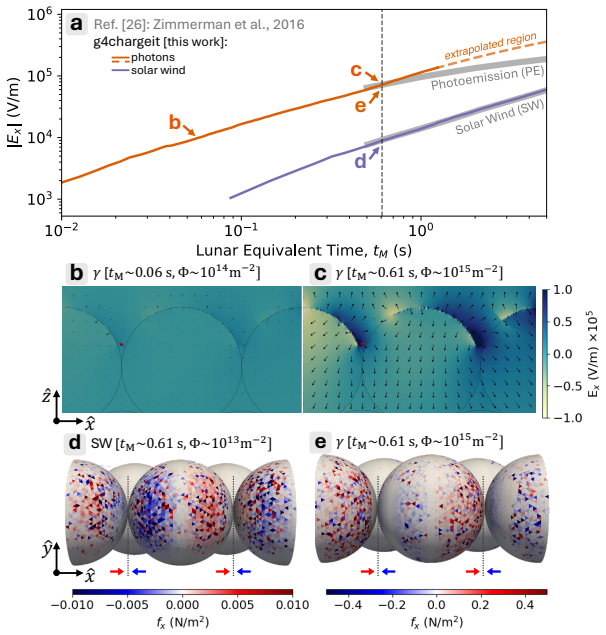
Summary. The paper presents g4chargeit, an open-source Geant4-based kinetic Monte Carlo framework for self-consistent, time-dependent simulation of electrostatic charging in dielectric materials. The method iteratively transports particles (photons, protons, electrons) using Geant4 physics lists, records deposited charges, computes the electric potential/field via adaptive octree and Barnes–Hut summation, and applies an ohmic dissipation law (Eq. B.1). The framework is benchmarked against the analytical model of Zimmerman et al. [26] for regularly packed spherical grains: the solar-wind case agrees to ~4.85%, while the photon case is extrapolated to saturation via a least-squares fit to Eq. B.1. The framework is then applied to irregularly packed and realistic X-ray-tomography-derived grain geometries, where the authors report charge accumulation in intergrain micro-cavities leading to repulsive electrostatic pressures (Eq. 3), which they interpret as consistent with the patched-charge model and experimental observations.
Significance. If the reported results are robust, g4chargeit would be a valuable open-source tool that connects validated Geant4 scattering physics to grain-scale charge evolution in arbitrary dielectric geometries. The solar-wind regular-sphere benchmark is a genuine quantitative check, and the explicit treatment of stochastic photoemission and secondary-electron trajectories is a step beyond simplified analytical models. However, the central new claim—repulsive forces in micro-cavities of realistic/irregular grain packings—rests on an approximate treatment of dielectric polarization that is not validated by the ε_r=1 benchmark, and the connection to experimental observations is qualitative and extrapolated. The potential of the tool is clear, but the current evidence does not yet fully support the abstract's claim of repulsive forces consistent with observations.
major comments (3)
- [§2.1.1, Eq. (2)] The field calculation replaces the dielectric boundary-value problem with a per-voxel volume-averaged inverse permittivity. This does not enforce the correct interface conditions for ∇·(ε∇φ)=−ρ_free at grain/vacuum boundaries; in particular, the normal component of E is discontinuous across a dielectric interface, and bound surface-polarization charges are omitted. Since the micro-cavity fields in Figs. 5–6 and the electric pressure of Eq. (3) are computed from this approximate field, the sign and magnitude of the reported repulsion are not assured. The only quantitative benchmark (§4.3.1) uses ε_r=1, i.e., no dielectric contrast, so this part of the electrostatics is untested. Please validate against an analytic dielectric-interface problem (e.g., a dielectric sphere in a uniform field or the two-sphere image-charge solution) or provide a quantitative estimate of the introduced error.
- [§4.3.1, Fig. 4a] The photon case is not directly simulated to saturation; the plateau value of 8.4×10^5 V/m at t_M=120 s is obtained by extrapolating a least-squares fit to Eq. B.1. The text nevertheless says the results are in 'excellent agreement' with Ref. [26]. Only the solar-wind case provides a direct quantitative benchmark (~4.85%). The photon comparison is an extrapolated model comparison, not a simulation result, and the factor-of-two difference from Ref. [26] is attributed to photoelectron energies without a converged simulation to confirm it. Please label the photon curve clearly as extrapolated and separate that from the validated SW benchmark.
- [§4.3.2–4.3.3, Figs. 5–6 and Eq. (3)] The central claim of 'repulsive electrostatic forces consistent with experimental observations' is supported only by qualitative sign patterns of electric pressure. The maximum computed pressure in the irregular case is ~0.1 N/m², corresponding to F_c~10^−13 N, which the authors state is three to four orders of magnitude below the experimental/patched-charge estimates cited (F_c~10^−10 N, fluences ~10^17 e−/m²). The simulations are static and run to only a few seconds of lunar-equivalent time. Thus the comparison is an extrapolation, not a quantitative validation. The claim in the abstract should be softened to 'qualitative agreement with the patched-charge model' unless the simulations are extended toward the relevant fluence regime or an explicit scaling argument is provided.
minor comments (4)
- [§3] The text states that 'the deposited charge has no mobility' but then applies macroscopic ohmic dissipation via Eq. B.1. This is at least a terminology inconsistency; please clarify whether the model treats charges as immobile except for the continuum leakage term, and how that is reconciled with the point-charge master list.
- [§2.1.1] The sentence 'both the microscopic and macroscopic electric potentials and fields remain continuous... [35]' cites a DSMC/PIC paper that does not address dielectric interface conditions. The cited reference does not support the physical claim; either provide a proper electrostatic reference or remove the assertion.
- [§4.2 / Table 1] The relationship between 'Incident particles per n' and 'Particles at n=0' is not self-explanatory, especially for the solar-wind cases (80,000 incident vs. 13,060 at n=0). Please define what 'Particles at n=0' represents and why it differs from the incident count.
- [Throughout] Several typographical errors should be corrected: 'isotopic' for 'isotropic' in §4.2 and Fig. 2 caption, 'Columbic' for 'Coulombic' in §2.2, and 'Vary' for 'Very' in the author list/caption of Fig. 3. Also, the numerical values of DeltaOneStep and the octree refinement threshold DeltaE_th are not reported; a reproducibility statement with these parameters would be helpful.
Circularity Check
No significant circularity: central simulation is self-contained, with only a minor non-load-bearing self-citation (Ref. [26]) and an explicitly labeled extrapolation.
full rationale
The derivation chain is not circular. Particle transport uses Geant4 with externally validated low-energy Livermore/EPDL97/EEDL cross-sections (Appendix A), and the field is accumulated from previously deposited charges via direct Coulomb summation with an octree/Barnes–Hut approximation (Eq. 1, §2.1). The central micro-cavity repulsion result (§4.3.2–4.3.3) emerges from stochastic particle trajectories in the irregular/realistic grain geometries and is compared qualitatively with external experiments [24,42]; no parameter is fitted to produce that repulsion. The analytical benchmark [26] shares co-author W. M. Farrell, but it is used as a comparison, not as a constraint, and there is no uniqueness theorem or ansatz imported from that work. Eq. B.1 is also taken from [26], but it is a standard ohmic-relaxation continuity equation and is negligible on the ~1.5 s timescales of the repulsion snapshots (dissipation time ~345 s for ε_r=3.9, σ=1e-13 Ω^-1 m^-1), so the self-citation is not load-bearing. The photon plateau in Fig. 4a is explicitly an extrapolation ('least-squares fit to Eq. B.1'), not presented as an independent prediction. The main technical caveat is Eq. 2's voxel-averaged inverse permittivity, which does not solve the dielectric boundary-value problem at grain/vacuum interfaces; this is a modeling approximation that could affect the magnitude/sign of the reported pressures, but it is not circular reasoning.
Axiom & Free-Parameter Ledger
free parameters (4)
- Electrical conductivity vartheta =
1e-13 Ohm^-1 m^-1 (~425 K)
- Photon-case saturation extrapolation =
|E_x| ~ 8.4e5 V/m at t_M = 120 s
- DeltaOneStep integration tolerance =
0.1 micrometer
- Octree refinement threshold DeltaE_th =
not specified (user-defined)
axioms (5)
- domain assumption Geant4 low-energy Livermore cross-sections (EPDL97, EEDL, EADL) are valid for SiO2 regolith at 1 eV–350 eV.
- domain assumption Deposited charges are immobile point charges; leakage is handled only by the macroscopic continuity equation B.1.
- ad hoc to paper The electrostatic field in a heterogeneous dielectric is given by point-charge superposition with locally volume-averaged inverse permittivity (Eqs. 1–2).
- domain assumption Static grain geometry during simulation.
- domain assumption The exponential charging-current law j exp(-sigma/Sigma) in Eq. B.1 from Ref [26] is appropriate for grain-scale charging.
read the original abstract
We present g4chargeit, a kinetic Monte Carlo framework built on Geant4 for self-consistent simulation of time-dependent electrostatic charging in dielectric materials. The model explicitly incorporates stochastic particle transport and scattering processes using validated Geant4 cross-sections, while self-consistently evolving the electric potential and field. As a representative application, we simulate the charging of regolith grains under average dayside conditions on the Moon. The surface of the Moon, in addition to other airless planetary bodies, are regularly exposed to solar ultraviolet photons and solar-wind plasma, creating a radiation environment in which electrostatic interactions among regolith grains become significant. Until now, simulations of regolith charging have often relied on analytical approximations that oversimplify grain geometry and interaction mechanisms. Our Geant4-based simulations reveal charge accumulation within intergrain micro-cavities, leading to repulsive electrostatic forces consistent with experimental observations. The framework establishes a multiscale approach that links microscopic scattering events to the continuity equation of surface charge density and to the formation of macroscopic surface charge patches in complex grain geometries. Although demonstrated here for planetary regolith, the method is general and applicable to a broad range of dielectric charging problems. The code is openly available at https://github.com/kgandhi63/g4chargeit.git.
Figures




Reference graph
Works this paper leans on
-
[1]
M. Casalegno, G. Raos, R. Po, Methodological assessment of kinetic monte carlo simula- tions of organic photovoltaic devices: The treatment of electrostatic interactions, The Jour- nal of Chemical Physics 132 (9) (2010) 094705.arXiv:https://pubs.aip.org/aip/ jcp/article-pdf/doi/10.1063/1.3337909/15876736/094705_1_online.pdf, doi:10.1063/1.3337909
work page doi:10.1063/1.3337909/15876736/094705_1_online.pdf 2010
-
[2]
L. Guldbrand, L. G. Nilsson, L. Nordenskiöld, A monte carlo simulation study of electrostatic forces between hexagonally packed dna double helices, The Jour- nal of Chemical Physics 85 (11) (1986) 6686–6698.arXiv:https://pubs. aip.org/aip/jcp/article-pdf/85/11/6686/18962003/6686_1_online.pdf, doi:10.1063/1.451450
-
[3]
T. Sun, V . Minhas, N. Korolev, A. Mirzoev, A. P. Lyubartsev, L. Nordenskiöld, Bottom-up coarse-grained modeling of dna, Frontiers in Molecular Biosciences V olume 8 - 2021 (2021).doi:10.3389/fmolb.2021.645527
arXiv 2021
-
[4]
T. Wang, K. Hess, G. J. Iafrate, Time-dependent ensemble monte carlo simulation for planar-doped gaas structures, Journal of Applied Physics 58 (2) (1985) 857–861. doi:10.1063/1.336155. 17
-
[5]
A. Akturk, N. Goldsman, G. Pennington, Self-consistent ensemble monte carlo simulations show terahertz oscillations in single-walled carbon nanotubes, Journal of Applied Physics 102 (7) (2007) 073720.doi:10.1063/1.2794690
-
[6]
X. Q. Yu, C. HongFei, Z. QiuGang, W. JianZhao, S. WeiHong, Z. Hong, Z. JiQing, Z. WeiYing, C. Zhe, S. SiPei, J. XiangHong, Leakage current of grounded dielectrics in electron radiation as a diagnostic method to evaluate the deep charging hazards in space, IEEE Transactions on Nuclear Science 63 (2) (2016) 1306–1313.doi:10.1109/TNS. 2016.2537839
arXiv 2016
-
[7]
J. Wang, R. Liu, R. Xiao, A. Ping, J. Liu, M. Zhang, Q. Li, Optimized design of slip ring assembly for aerospace to reduce deep dielectric charging, IEEE Transactions on Nuclear Science 69 (4) (2022) 915–924.doi:10.1109/TNS.2022.3157670
arXiv 2022
-
[8]
K. Fichthorn, W. Weinberg, Theoretical foundations of dynamical monte carlo simulations, The Journal of chemical physics 95 (2) (1991) 1090–1096.doi:10.1063/1.461138
doi:10.1063/1.461138 1991
-
[9]
J. Wu, Y . Zhi, X. Dang, P. Wang, B. Zhang, Weak conductive channel effect of glass fabric on deep charging of polyimide in geo, IEEE Transactions on Nuclear Science 72 (2) (2025) 164–174.doi:10.1109/TNS.2024.3519769
arXiv 2025
-
[10]
Ramachandran, A
T. Ramachandran, A. Ali, F. A. Deader, H. Shafeekali, L. Zheng, H. Butt, M. Rezeq, Dual influence of size and electric field on gold nanoparticles: Insights into 2d mono- layer assembly, Langmuir 41 (2) (2025) 1271–1280, pMID: 39772803.doi:10.1021/ acs.langmuir.4c03580
2025
-
[11]
C. M. Katzan, D. J. Brinker, R. Kress, The effects of lunar dust accumulation on the performance of photovoltaic arrays (1991)
1991
-
[12]
R. F. Willis, M. Anderegg, B. Feuerbacher, B. Fitton, Photoemission and Secondary Elec- tron Emission from Lunar Surface Material, Springer Netherlands, Dordrecht, 1973
1973
-
[13]
S. Hazra, V . Réville, B. Perri, A. Strugarek, A. S. Brun, E. Buchlin, Modeling solar wind variations over an 11 year cycle with alfvén wave dissipation: A parameter study, The Astrophysical Journal 910 (2) (2021) 90.doi:10.3847/1538-4357/abe12e
-
[14]
S. Popel, L. Zelenyi, A. Golub’, A. Dubinskii, Lunar dust and dusty plasmas: Re- cent developments, advances, and unsolved problems, Planetary and Space Science 156 (2018) 71–84, dust, Atmosphere, and Plasma Environment of the Moon and Small Bodies. doi:10.1016/j.pss.2018.02.010
-
[15]
Goodwin, Apollo 17: The NASA Mission Reports, vol
R. Goodwin, Apollo 17: The NASA Mission Reports, vol. 1 (2002)
2002
-
[16]
J. R. Gaier, The Effects of Lunar Dust on EV A Systems During the Apollo Missions, Tech. rep., National Aeronautics and Space Administration (2007)
2007
-
[17]
J. E. Colwell, S. Batiste, M. Horányi, S. Robertson, S. Sture, Lunar surface: Dust dy- namics and regolith mechanics, Reviews of Geophysics 45 (2) (2007).doi:10.1029/ 2005RG000184. 18
2007
-
[18]
Christoffersen, J
R. Christoffersen, J. F. Lindsay, S. K. Noble, M. A. Meador, J. J. Kosmo, J. A. Lawrence, L. Brostoff, A. Young, T. McCue, Lunar Dust Effects on Spacesuit Systems: Insights from the Apollo Spacesuits, Tech. rep., National Aeronautics and Space Administration (2008)
2008
-
[19]
A. Romero-Calvo, J. Hammerl, H. Schaub, Touchless potential sensing of differentially charged spacecraft using secondary electrons, Journal of Spacecraft and Rockets 59 (5) (2022) 1623–1633.doi:10.2514/1.A35355
-
[20]
A. Romero-Calvo, K. Champion, H. Schaub, Enabling ultraviolet lasers for touchless spacecraft potential sensing, IEEE Transactions on Plasma Science 51 (9) (2023) 2468– 2481.doi:10.1109/TPS.2023.3264914
arXiv 2023
-
[21]
T. M. Flanagan, J. Goree, Dust release from surfaces exposed to plasma, Physics of Plasmas 13 (12) (2006) 123504.doi:10.1063/1.2401155
-
[22]
T. E. Sheridan, A. Hayes, Charge fluctuations for particles on a surface exposed to plasma, Applied Physics Letters 98 (9) (2011) 091501.doi:10.1063/1.3560302
-
[23]
Z. Wang, D. Tian, Z. Ma, C. Zhao, Y . Liu, Y . Liu, Y . Ding, Z. Shen, An electrostatic lofting model based on adhesion separation characteristics for lunar dust, Planetary and Space Science 184 (2020) 104883.doi:10.1016/j.pss.2020.104883
arXiv 2020
-
[24]
X. Wang, J. Schwan, H.-W. Hsu, E. Grün, M. Horányi, Dust charging and transport on airless planetary bodies, Geophysical Research Letters 43 (12) (2016) 6103 – 6110.doi: 10.1002/2016GL069491
-
[25]
X. Wang, J. Schwan, N. Hood, H.-W. Hsu, E. Grün, M. Horányi, Experimental Methods of Dust Charging and Mobilization on Surfaces with Exposure to Ultraviolet Radiation or Plasmas, Journal of Visualized Experiments 134 (2018) 57072.doi:10.3791/57072
-
[26]
M. I. Zimmerman, W. M. Farrell, C. M. Hartzell, X. Wang, M. Horanyi, D. M. Hurley, K. Hibbitts, Grain-scale supercharging and breakdown on airless regoliths, Journal of Geo- physical Research: Planets 121 (10) (2016) 2150–2165.doi:https://doi.org/10. 1002/2016JE005049
2016
-
[27]
S. Agostinelli, J. Allison, K. Amako, J. Apostolakis, H. Araujo, P. Arce, M. Asai, D. Axen, S. Banerjee, G. Barrand, F. Behner, L. Bellagamba, J. Boudreau, et al., Geant4—a sim- ulation toolkit, Nuclear Instruments and Methods in Physics Research Section A: Ac- celerators, Spectrometers, Detectors and Associated Equipment 506 (3) (2003) 250–303. doi:10.10...
-
[28]
J. Allison, K. Amako, J. Apostolakis, H. Araujo, P. Arce Dubois, M. Asai, G. Barrand, R. Capra, S. Chauvie, R. Chytracek, G. Cirrone, G. Cooperman, et al., Geant4 develop- ments and applications, IEEE Transactions on Nuclear Science 53 (1) (2006) 270–278. doi:10.1109/TNS.2006.869826. 19
arXiv 2006
-
[29]
Allison, K
J. Allison, K. Amako, J. Apostolakis, P. Arce, M. Asai, T. Aso, E. Bagli, A. Bagulya, S. Banerjee, G. Barrand, B. Beck, A. Bogdanov, D. Brandt, et al., Recent developments in geant4, Nuclear Instruments and Methods in Physics Research Section A: Accelerators, Spectrometers, Detectors and Associated Equipment 835 (2016) 186–225.doi:10.1016/ j.nima.2016.06.125
2016
-
[30]
R. Chytracek, J. McCormick, W. Pokorski, G. Santin, Geometry description markup lan- guage for physics simulation and analysis applications, IEEE Transactions on Nuclear Sci- ence 53 (5) (2006) 2892 – 2896, cited by: 131.doi:10.1109/TNS.2006.881062
arXiv 2006
-
[31]
L. Dagum, R. Menon, Openmp: An industry-standard api for shared-memory program- ming, IEEE Comput. Sci. Eng. 5 (1) (1998) 46–55.doi:10.1109/99.660313
-
[32]
R. Brun, F. Rademakers, Root — an object oriented data analysis framework, Nuclear Instruments and Methods in Physics Research Section A: Accelerators, Spectrometers, Detectors and Associated Equipment 389 (1) (1997) 81–86, new Computing Techniques in Physics Research V .doi:https://doi.org/10.1016/S0168-9002(97)00048-X
-
[33]
D. Meagher, Geometric modeling using octree encoding, Computer Graphics and Image Processing 19 (2) (1982) 129–147.doi:https://doi.org/10.1016/0146-664X(82) 90104-6
-
[34]
Z. Gan, Z. Xu, Efficient implementation of the barnes-hut octree algorithm for monte carlo simulations of charged systems, Science China Mathematics 57 (7) (2014) 1331–1340
2014
-
[35]
R. S. Martin, J.-L. Cambier, Octree particle management for DSMC and PIC simulations, Journal of Computational Physics 327 (2016) 943–966.doi: 10.1016/j.jcp.2016.01.020
-
[36]
J. R. Dormand, P. J. Prince, A family of embedded runge–kutta formulae, Journal of Com- putational and Applied Mathematics 6 (1980) 19–26
1980
-
[37]
W. M. Farrell, D. M. Hurley, V . J. Esposito, J. L. McLain, M. I. Zimmerman, The statistical mechanics of solar wind hydroxylation at the Moon, within lunar magnetic anomalies, and at Phobos, Journal of Geophysical Research: Planets 122 (1) (2017) 269–289. doi:10.1002/2016JE005168
-
[38]
A. D. Vira, E. M. Mone, E. A. Ryan, P. T. Connolly, K. Smith, C. D. Roecker, K. E. Mesick, T. M. Orlando, Z. Jiang, P. N. First, Designing a boron nitride polyethylene composite for shielding neutrons, APL Materials 11 (10) (2023) 101104.arXiv:https://pubs.aip.org/aip/apm/article-pdf/doi/10.1063/5. 0163377/18147885/101104_1_5.0163377.pdf,doi:10.1063/5.0163377. 20
doi:10.1063/5 2023
-
[39]
C. B. Sullivan, A. A. Kaszynski, Pyvista: 3d plotting and mesh analysis through a streamlined interface for the visualization toolkit (vtk), Journal of Open Source Software 4 (37) (2019) 1450.doi:10.21105/joss.01450
-
[40]
Galli, Massimiliano, Tejedor, Enric, Wunsch, Stefan, A new pyroot: Mod- ern, interoperable and more pythonic, EPJ Web Conf. 245 (2020) 06004. doi:10.1051/epjconf/202024506004
arXiv 2020
-
[41]
W. M. Farrell, J. S. Halekas, M. Horányi, R. M. Killen, C. Grava, J. R. Szalay, M. Benna, P. E. Clark, M. R. Collier, A. Colaprete, J. Deca, R. C. Elphic, S. Fatemi, Y . Fu- taana, M. Holmström, D. M. Hurley, G. Y . Kramer, P. R. Mahaffy, M. N. Nishino, S. K. Noble, Y . Saito, A. R. Poppe, K. D. Retherford, X. Wang, S. Yokota, The Dust, Atmosphere, and Pl...
2023
-
[42]
N. Hood, A. Carroll, R. Mike, X. Wang, J. Schwan, H. Hsu, M. Horányi, Laboratory Investigation of Rate of Electrostatic Dust Lofting Over Time on Airless Planetary Bodies, Geophysical Research Letters 45 (24) (Dec. 2018).doi:10.1029/2018GL080527
-
[43]
G. R. Olhoeft, D. W. Strangway, Dielectric properties of the first 100 meters of the Moon, Earth and Planetary Science Letters 24 (3) (1975) 394–404.doi:10.1016/ 0012-821X(75)90146-6
1975
-
[44]
Z. Li, C. Michelet, S. Incerti, V . Ivanchenko, M. Novak, S. Guatelli, H. Seznec, Implemen- tation of the epics2017 database for photons in geant4, Physica Medica 95 (2022) 94–115. doi:https://doi.org/10.1016/j.ejmp.2022.01.008
-
[45]
A. Albqoor, E. Ababneh, S. Okoor, I. Zahran, Validation of electromagnetic physics models and electron range in geant4 brachytherapy application, Nuclear Engineering and Tech- nology 55 (1) (2023) 229–237.doi:https://doi.org/10.1016/j.net.2022.09.018
-
[46]
S. Li, A. R. Poppe, T. M. Orlando, B. M. Jones, O. J. Tucker, W. M. Farrell, A. R. Hendrix, Formation of lunar surface water associated with high-energy electrons in Earth’s magneto- tail, Nature Astronomy 7 (12) (2023) 1427–1435.doi:10.1038/s41550-023-02081-y
-
[47]
W. D. Carrier, Lunar soil grain size distribution, The Moon 6 (3–4) (1973) 250–263. doi:10.1007/BF00562206
-
[48]
J. Goguen, A. Sharits, A. Chiaramonti, T. Lafarge, E. Garboczi, Three-dimensional characterization of particle size, shape, and internal porosity for Apollo 11 and Apollo 14 lunar regolith and JSC-1A lunar regolith soil simulant, Icarus 420 (2024) 116166. 21 doi:https://doi.org/10.1016/j.icarus.2024.116166
arXiv 2024
-
[49]
J. S. Halekas, G. T. Delory, R. P. Lin, T. J. Stubbs, W. M. Farrell, Lunar surface charging during solar energetic particle events: Measurement and prediction, Jour- nal of Geophysical Research: Space Physics 114 (A5) (2009).arXiv:https: //agupubs.onlinelibrary.wiley.com/doi/pdf/10.1029/2009JA014113, doi:https://doi.org/10.1029/2009JA014113
-
[50]
M. Kelsey, R. Agnese, Y . Alam, I. A. Langroudy, E. Azadbakht, D. Brandt, R. Bunker, B. Cabrera, Y .-Y . Chang, H. Coombes, R. Cormier, M. Diamond, E. Edwards, E. Figueroa- Feliciano, J. Gao, P. Harrington, Z. Hong, M. Hui, N. Kurinsky, R. Lawrence, B. Loer, M. Masten, E. Michaud, E. Michielin, J. Miller, V . Novati, N. Oblath, J. Orrell, W. Perry, P. Red...
arXiv 2023
-
[51]
D. E. Cullen, J. H. Hubbell, L. Kissel, Epdl97: the evaluated photo data library ‘97 version, Tech. rep., Lawrence Livermore National Lab., CA (United States) (09 1997). doi:10.2172/295438
-
[52]
S. Perkins, D. Cullen, S. Seltzer, Tables and graphs of electron-interaction cross sections from 10 ev to 100 gev derived from the llnl evaluated electron data library (eedl), z=1 to 100, Unknown -1 (10 1991).doi:10.2172/5691165
-
[53]
S. T. Perkins, D. E. Cullen, M. H. Chen, J. Rathkopf, J. Scofield, J. H. Hubbell, Tables and graphs of atomic subshell and relaxation data derived from the llnl evaluated atomic data library (eadl), z=1–100, Tech. rep., Lawrence Livermore National Lab., CA (United States) (10 1991).doi:10.2172/10121422
-
[54]
J. H. SCOFIELD, 6 - radiative transitions, in: B. CRASEMANN (Ed.), Atomic Inner-Shell Processes, Academic Press, 1975, pp. 265–292.doi:https: //doi.org/10.1016/B978-0-12-196901-1.50012-1
-
[55]
J. F. Ziegler, J. P. Biersack, The Stopping and Range of Ions in Matter, Springer-Verlag US, 1985.doi:10.1007/978-1-4615-8103-1_3
-
[56]
Ziegler, The Stopping and Ranges of Ions in Matter, Pergamon, 2013
J. Ziegler, The Stopping and Ranges of Ions in Matter, Pergamon, 2013
2013
-
[57]
D. Drouin, P. Hovington, R. Gauvin, Casino: A new monte carlo code in c language for electron beam interactions—part ii: Tabulated values of the mott cross section, Scanning 19 (1) (1997) 20–28.doi:https://doi.org/10.1002/sca.4950190103. 22
-
[58]
R. J. L. Grard (Ed.), Photon and particle interactions with surfaces in space, V ol. 37 of Astrophysics and Space Science Library, 1973.doi:10.1007/978-94-010-2647-5. 23
discussion (0)
Sign in with ORCID, Apple, or X to comment. Anyone can read and Pith papers without signing in.