REVIEW 1 major objections 2 minor 1 cited by
Dynamic Neural Koopman Distillation turns iterative diffusion policies for robots into single forward-pass models that keep multimodal trajectory diversity.
Reviewed by Pith at T0; open to challenge. T0 means a machine referee read the full paper against a public rubric. the ladder, T0–T4 →
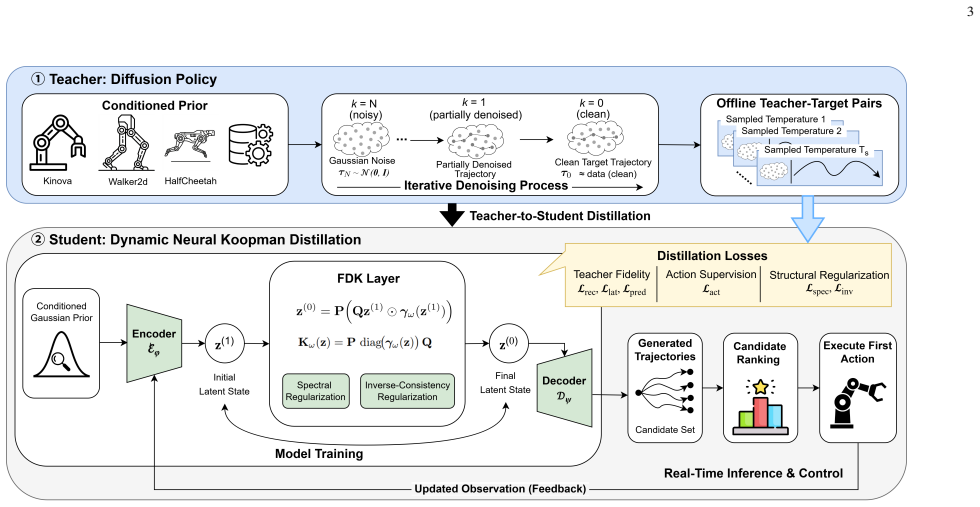
Dynamic Neural Koopman Distillation distills multistep diffusion policies for robot control into single-pass inference via factorized dynamic Koopman layers, achieving millisecond latency and outperforming one-step baselines on MuJoCo locomotion and hardware tasks.
T0 review reviewed 2026-06-30 challenge →
load-bearing objection The paper distills diffusion planners into a single-pass policy via a Factorized Dynamic Koopman layer and shows usable latency plus better locomotion results than other one-step methods, but the claim that this layer fully preserves multimodal expressivity rests on an assumption that still needs stronger verification. the 1 major comments →
Dynamic Neural Koopman Distillation for Real-Time Robot Control Using Diffusion Models
The pith
A machine-rendered reading of the paper's core claim, the machinery that carries it, and where it could break.
The reading
Core claim
Dynamic Neural Koopman Distillation distills multistep diffusion inference into a single forward pass while retaining the multimodal expressivity of the teacher model. It does so by introducing a Factorized Dynamic Koopman layer that models the denoising process through a factorized latent transition with state-dependent modal gains. On D4RL MuJoCo locomotion benchmarks the distilled models outperform existing one-step baselines, and on a physical Kinova manipulator they achieve millisecond inference latency with smooth closed-loop execution and maintained task success.
What carries the argument
Factorized Dynamic Koopman layer that models the denoising process through a factorized latent transition with state-dependent modal gains
Load-bearing premise
The Factorized Dynamic Koopman layer can model the full denoising process of the diffusion model through a factorized latent transition with state-dependent modal gains without substantial loss of expressivity or performance.
What would settle it
Deploy the distilled single-pass model on a D4RL MuJoCo locomotion task where the original diffusion teacher succeeds and measure whether task reward or trajectory diversity falls below the one-step baselines while latency stays low.
If this is right
- The distilled models significantly outperform existing one-step distillation approaches on the reported locomotion tasks.
- Inference latency drops to the millisecond regime compared with the teacher policy.
- Hardware experiments show smooth and fast closed-loop execution on a physical manipulator while preserving task success and accuracy.
Where Pith is reading between the lines
- The same layer structure could be tested on diffusion models for non-robot tasks that need fast multimodal sampling, such as motion planning in simulation.
- Koopman-style factorization might serve as a general tool for accelerating other iterative generative processes in control without retraining the full teacher.
- Experiments that vary the number of original diffusion steps or the state dimension would clarify how much the factorized gains preserve performance across different problem scales.
Editorial analysis
A structured set of objections, weighed in public.
Referee Report
Summary. The paper introduces Dynamic Neural Koopman Distillation to compress the iterative denoising of diffusion models into a single forward pass for real-time robotic control. It proposes a Factorized Dynamic Koopman layer that models the denoising trajectory via a factorized latent transition with state-dependent modal gains, claiming to retain the teacher's multimodal expressivity. Experiments on D4RL MuJoCo locomotion tasks and a Kinova manipulator show outperformance over one-step distillation baselines, with inference reduced to milliseconds and successful hardware closed-loop execution.
Significance. If the distillation preserves multimodality and performance without collapse, the work would enable diffusion-based trajectory generation in high-frequency control loops, addressing a key barrier for generative models in robotics. The combination of theoretical distillation with physical validation on locomotion and manipulation tasks would strengthen its relevance for practical deployment.
major comments (1)
- [Factorized Dynamic Koopman layer description (abstract and method)] The central claim that the Factorized Dynamic Koopman layer models the full multistep denoising process of the teacher diffusion model through a single factorized latent transition with state-dependent modal gains (without substantial loss of expressivity or multimodality) is load-bearing for both the 'retaining multimodal expressivity' and 'significantly outperforming' assertions. No explicit verification, such as a comparison of mode coverage or trajectory distribution divergence metrics between teacher and student, is provided to confirm this decomposition holds for the denoising score field.
minor comments (2)
- [Abstract] The abstract states results on 'standard D4RL MuJoCo locomotion benchmarks' but does not specify which tasks or report quantitative metrics (e.g., normalized scores, success rates) with error bars or statistical tests.
- [Hardware experiments (abstract)] Hardware experiments are mentioned but lack details on control frequency, latency measurements, or comparison to the teacher policy's real-time feasibility.
Simulated Author's Rebuttal
We thank the referee for the constructive feedback. The central concern regarding explicit verification of multimodality preservation in the Factorized Dynamic Koopman layer is well-taken, and we address it directly below.
read point-by-point responses
-
Referee: [Factorized Dynamic Koopman layer description (abstract and method)] The central claim that the Factorized Dynamic Koopman layer models the full multistep denoising process of the teacher diffusion model through a single factorized latent transition with state-dependent modal gains (without substantial loss of expressivity or multimodality) is load-bearing for both the 'retaining multimodal expressivity' and 'significantly outperforming' assertions. No explicit verification, such as a comparison of mode coverage or trajectory distribution divergence metrics between teacher and student, is provided to confirm this decomposition holds for the denoising score field.
Authors: We agree that direct quantitative verification of multimodality preservation would strengthen the claims. The current manuscript relies on downstream task performance (outperformance over one-step baselines on D4RL locomotion and hardware success) as indirect evidence, but does not report mode coverage statistics or distribution divergence metrics (e.g., Wasserstein distance or KL divergence on trajectory distributions) between the teacher diffusion model and the distilled student. In the revised version we will add such analyses, including mode coverage comparisons on the MuJoCo tasks and divergence metrics computed on sampled trajectories. revision: yes
Circularity Check
No significant circularity detected; derivation self-contained
full rationale
The abstract and available text introduce the Factorized Dynamic Koopman layer as a modeling ansatz for distilling diffusion denoising into a single pass, but present no equations, derivations, or self-citations that reduce any claimed prediction or result to its inputs by construction. No load-bearing self-citation chains, self-definitional loops, or fitted parameters renamed as predictions appear. The central claim rests on empirical outperformance on D4RL benchmarks and hardware tests rather than a closed mathematical reduction. This matches the expected case of an honest non-finding for a method paper whose key assumption (modal factorization preserving multimodality) is stated but not internally derived from prior self-work.
Axiom & Free-Parameter Ledger
Cite this review
Pith. "Pith review of Dynamic Neural Koopman Distillation for Real-Time Robot Control Using Diffusion Models." pith.science (2026). https://pith.science/paper/6E3L5U6P
@misc{pith2026260524924,
  author       = {Pith},
  title        = {Pith review of: Dynamic Neural Koopman Distillation for Real-Time Robot Control Using Diffusion Models},
  year         = {2026},
  howpublished = {\url{https://pith.science/paper/6E3L5U6P}},
  note         = {Machine review of arXiv:2605.24924}
}
read the original abstract
Diffusion models excel at generating diverse and multimodal trajectories for robotic planning, yet their iterative denoising process introduces latency that is incompatible with high-frequency closed-loop control. To address this problem, we propose Dynamic Neural Koopman Distillation, a framework that distills multistep diffusion inference into a single forward pass while retaining the multimodal expressivity of the teacher model. Specifically, we introduce a Factorized Dynamic Koopman layer that models the denoising process through a factorized latent transition with state-dependent modal gains. We evaluate the proposed method on standard D4RL MuJoCo locomotion benchmarks and a physical Kinova manipulator, comparing against one-step baselines. The results show that our method significantly outperforms existing one-step distillation approaches on the reported locomotion tasks, and reduces the inference latency to the millisecond regime compared with the teacher policy. Hardware experiments further demonstrate that our method enables smooth and fast closed-loop execution while maintaining task success and comparable accuracy. A project page is available at https://fdkoopman.github.io/.
Figures


Forward citations
Cited by 1 Pith paper
-
Koopman operator theory: fundamentals, control, and applications
Tutorial on Koopman operator theory, data-driven methods such as EDMD, and their use in controller design for nonlinear systems with provided simulations and code.
Reference graph
Works this paper leans on
-
[1]
A survey on deep generative models for robot learning from multimodal demonstrations,
J. Urain, A. Mandlekar, Y . Du, N. Muhammad, D. Xu, K. Fragkiadaki, G. Chalvatzaki, J. Peterset al., “A survey on deep generative models for robot learning from multimodal demonstrations,”IEEE Transactions on Robotics, vol. 42, pp. 60–79, 2025
2025
-
[2]
Diffusion models for intelligent transportation systems: A survey,
M. Peng, K. Chen, X. Guo, Q. Zhang, H. Zhong, M. Zhu, and H. Yang, “Diffusion models for intelligent transportation systems: A survey,” IEEE Transactions on Intelligent Transportation Systems, vol. 26, no. 12, pp. 21 526–21 543, 2025
2025
-
[3]
Model-based diffusion for trajectory optimization,
C. Pan, Z. Yi, G. Shi, and G. Qu, “Model-based diffusion for trajectory optimization,”Advances in Neural Information Processing Systems, vol. 37, pp. 57 914–57 943, 2024
2024
-
[4]
Diffusion policy: Visuomotor policy learning via action diffusion,
C. Chi, Z. Xu, S. Feng, E. Cousineau, Y . Du, B. Burchfiel, R. Tedrake, and S. Song, “Diffusion policy: Visuomotor policy learning via action diffusion,”The International Journal of Robotics Research, vol. 44, no. 10-11, pp. 1684–1704, 2025
2025
-
[5]
R. Yang, L. Zheng, R. Yao, and J. Ma, “DualShield: Safe model predictive diffusion via reachability analysis for interactive autonomous driving,”arXiv preprint arXiv:2601.15729, 2026
-
[6]
SICNav-Diffusion: Safe and interactive crowd navigation with diffusion trajectory predictions,
S. Samavi, A. Lem, F. Sato, S. Chen, Q. Gu, K. Yano, A. P. Schoel- lig, and F. Shkurti, “SICNav-Diffusion: Safe and interactive crowd navigation with diffusion trajectory predictions,”IEEE Robotics and Automation Letters, vol. 10, no. 9, pp. 8738–8745, 2025
2025
-
[7]
DARE: Diffu- sion policy for autonomous robot exploration,
Y . Cao, J. Lew, J. Liang, J. Cheng, and G. Sartoretti, “DARE: Diffu- sion policy for autonomous robot exploration,” inIEEE International Conference on Robotics and Automation, 2025, pp. 11 987–11 993
2025
-
[8]
Score-based generative modeling through stochastic differ- ential equations,
Y . Song, J. Sohl-Dickstein, D. P. Kingma, A. Kumar, S. Ermon, and B. Poole, “Score-based generative modeling through stochastic differ- ential equations,” inInternational Conference on Learning Representa- tions, 2021
2021
-
[9]
Denoising diffusion probabilistic models,
J. Ho, A. Jain, and P. Abbeel, “Denoising diffusion probabilistic models,” Advances in Neural Information Processing Systems, vol. 33, pp. 6840– 6851, 2020
2020
-
[10]
Learning agile and dynamic motor skills for legged robots,
J. Hwangbo, J. Lee, A. Dosovitskiy, D. Bellicoso, V . Tsounis, V . Koltun, and M. Hutter, “Learning agile and dynamic motor skills for legged robots,”Science Robotics, vol. 4, no. 26, p. eaau5872, 2019
2019
-
[11]
Consistency models,
Y . Song, P. Dhariwal, M. Chen, and I. Sutskever, “Consistency models,” inInternational Conference on Machine Learning, 2023, pp. 32 211– 32 252
2023
-
[12]
Improved techniques for training consistency models,
Y . Song and P. Dhariwal, “Improved techniques for training consistency models,” inInternational Conference on Learning Representations, 2024
2024
-
[13]
Progressive distillation for fast sampling of diffusion models,
T. Salimans and J. Ho, “Progressive distillation for fast sampling of diffusion models,” inInternational Conference on Learning Represen- tations, 2022
2022
-
[14]
One-step diffusion policy: Fast visuomotor policies via diffusion distillation,
Z. Wang, M. Li, A. Mandlekar, Z. Xu, J. Fan, Y . Narang, L. Fan, Y . Zhu, Y . Balaji, M. Zhou, M.-Y . Liu, and Y . Zeng, “One-step diffusion policy: Fast visuomotor policies via diffusion distillation,” inInternational Conference on Machine Learning, 2025
2025
-
[15]
Koopman operator dynamical models: Learning, analysis and control,
P. Bevanda, S. Sosnowski, and S. Hirche, “Koopman operator dynamical models: Learning, analysis and control,”Annual Reviews in Control, vol. 52, pp. 197–212, 2021
2021
-
[16]
Koopman operators in robot learning,
L. Shi, M. Haseli, G. Mamakoukas, D. Bruder, I. Abraham, T. Murphey, J. Cort´es, and K. Karydis, “Koopman operators in robot learning,”IEEE Transactions on Robotics, 2026
2026
-
[17]
Imitation learning with limited actions via diffusion planners and deep Koopman controllers,
J. Bi, K. Lim, K. Chen, Y . Huang, and H. Soh, “Imitation learning with limited actions via diffusion planners and deep Koopman controllers,” inIEEE International Conference on Robotics and Automation, 2025, pp. 4861–4868
2025
-
[18]
An overview of Koopman-based control: From error bounds to closed-loop guarantees,
R. Str ¨asser, K. Worthmann, I. Mezi ´c, J. Berberich, M. Schaller, and F. Allg ¨ower, “An overview of Koopman-based control: From error bounds to closed-loop guarantees,”Annual Reviews in Control, vol. 61, p. 101035, 2026
2026
-
[19]
One- Step Offline Distillation of Diffusion-based Models via Koopman Mod- eling,
N. Berman, I. Naiman, M. Eliasof, H. Zisling, and O. Azencot, “One- Step Offline Distillation of Diffusion-based Models via Koopman Mod- eling,” inAdvances in Neural Information Processing Systems, 2025
2025
-
[20]
Spectral properties of dynamical systems, model reduction and decompositions,
I. Mezi ´c, “Spectral properties of dynamical systems, model reduction and decompositions,”Nonlinear Dynamics, vol. 41, no. 1, pp. 309–325, 2005
2005
-
[21]
CoPlanner: An interactive motion planner with contingency-aware diffusion for autonomous driving,
R. Zhong, R. Yao, P. Liu, X. Chen, R. Yang, and J. Ma, “CoPlanner: An interactive motion planner with contingency-aware diffusion for autonomous driving,” inIEEE International Conference on Robotics and Automation, 2026
2026
-
[22]
Cle- andiffuser: An easy-to-use modularized library for diffusion models in decision making,
Z. Dong, Y . Yuan, J. Hao, F. Ni, Y . Ma, P. Li, and Y . Zheng, “Cle- andiffuser: An easy-to-use modularized library for diffusion models in decision making,”Advances in Neural Information Processing Systems, vol. 37, pp. 86 899–86 926, 2024
2024
-
[23]
Denoising diffusion implicit models,
J. Song, C. Meng, and S. Ermon, “Denoising diffusion implicit models,” inInternational Conference on Learning Representations, 2021
2021
-
[24]
DPM-Solver: A fast ODE solver for diffusion probabilistic model sampling in around 10 steps,
C. Lu, Y . Zhou, F. Bao, J. Chen, C. Li, and J. Zhu, “DPM-Solver: A fast ODE solver for diffusion probabilistic model sampling in around 10 steps,”Advances in Neural Information Processing Systems, vol. 35, pp. 5775–5787, 2022
2022
-
[25]
Elucidating the design space of diffusion-based generative models,
T. Karras, M. Aittala, T. Aila, and S. Laine, “Elucidating the design space of diffusion-based generative models,”Advances in Neural Infor- mation Processing Systems, vol. 35, pp. 26 565–26 577, 2022
2022
-
[26]
Continual learning and lifting of Koopman dynamics for linear control of legged robots,
F. Li, A. Abuduweili, Y . Sun, R. Chen, W. Zhao, and C. Liu, “Continual learning and lifting of Koopman dynamics for linear control of legged robots,” inProceedings of the Annual Learning for Dynamics & Control Conference, 2025, p. 136–148
2025
-
[27]
Koopman kernel regression,
P. Bevanda, M. Beier, A. Lederer, S. Sosnowski, E. H ¨ullermeier, and S. Hirche, “Koopman kernel regression,”Advances in Neural Informa- tion Processing Systems, vol. 36, pp. 16 207–16 221, 2023
2023
-
[28]
Offline reinforcement learning with implicit Q-learning,
I. Kostrikov, A. Nair, and S. Levine, “Offline reinforcement learning with implicit Q-learning,” inInternational Conference on Learning Representations, 2022
2022
-
[29]
Toward near-globally optimal nonlinear model predictive control via diffusion models,
T.-Y . Huang, A. Lederer, N. Hoischen, J. Brudigam, X. Xiao, S. Sos- nowski, and S. Hirche, “Toward near-globally optimal nonlinear model predictive control via diffusion models,” inProceedings of the Annual Learning for Dynamics & Control Conference, ser. Proceedings of Machine Learning Research, vol. 283, 04–06 Jun 2025, pp. 777–790
2025
-
[30]
D4RL: Datasets for Deep Data-Driven Reinforcement Learning
J. Fu, A. Kumar, O. Nachum, G. Tucker, and S. Levine, “D4RL: Datasets for deep data-driven reinforcement learning,”arXiv preprint arXiv:2004.07219, 2020
work page internal anchor Pith review Pith/arXiv arXiv 2004
This paper was first reviewed by grok-4.3 on June 30, 2026.
discussion (0)
Sign in with ORCID, Apple, or X to comment. Anyone can read and Pith papers without signing in.