Centrality dependence of charged-hadron pseudorapidity distributions in oxygen-oxygen collisions at sqrt{s_NN} = 5.36 TeV
Pith reviewed 2026-06-28 11:45 UTC · model grok-4.3
The pith
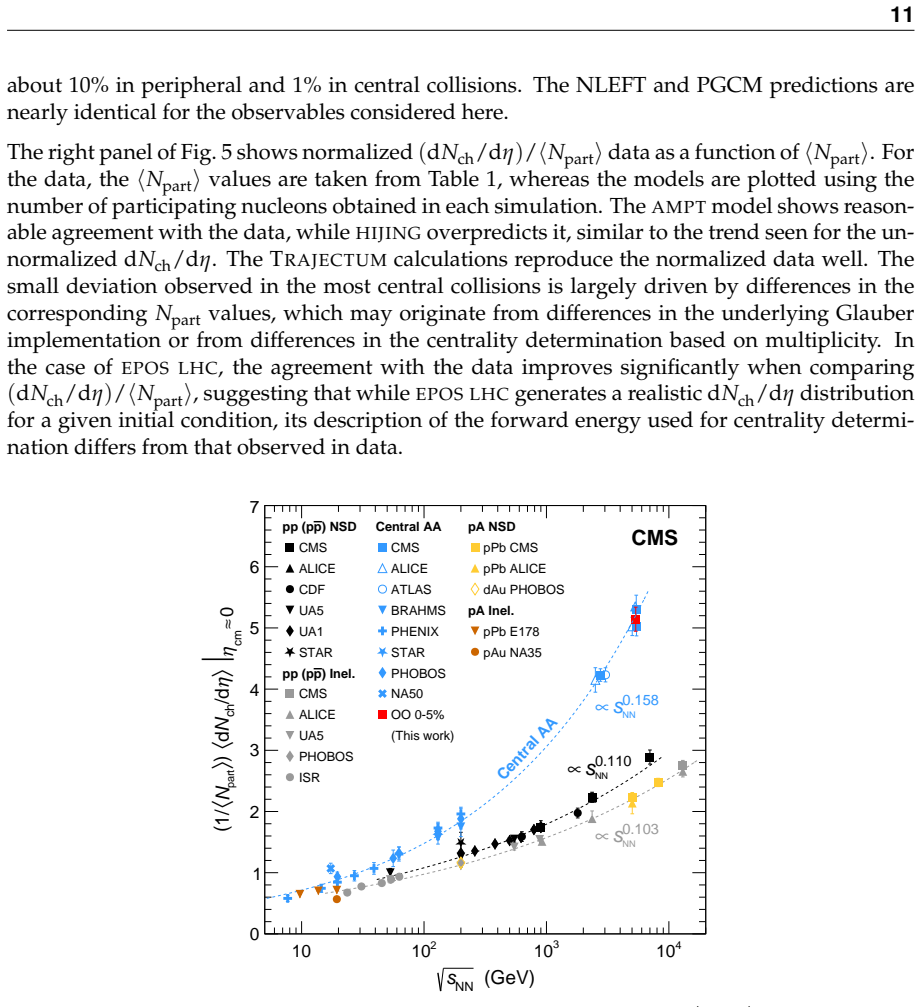
Charged-hadron density per participating nucleon in central OO collisions matches central PbPb at similar energy.
A machine-rendered reading of the paper's core claim, the machinery that carries it, and where it could break.
Core claim
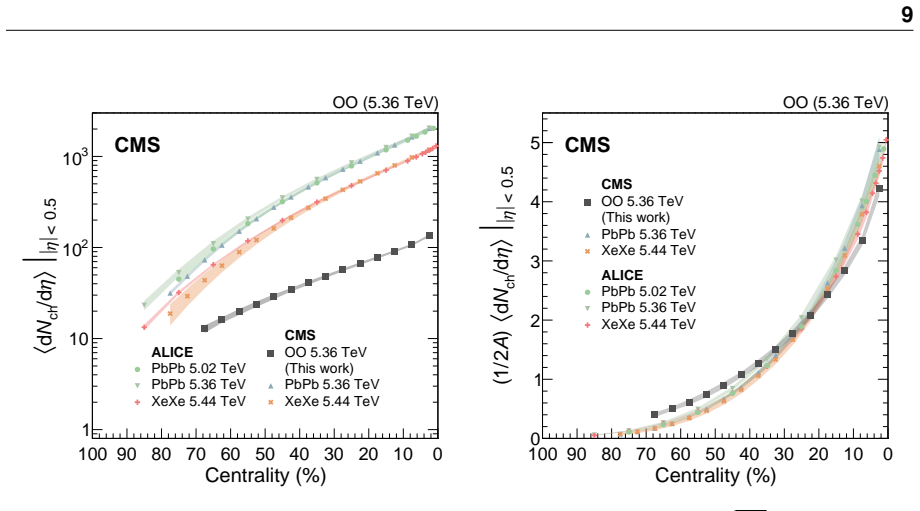
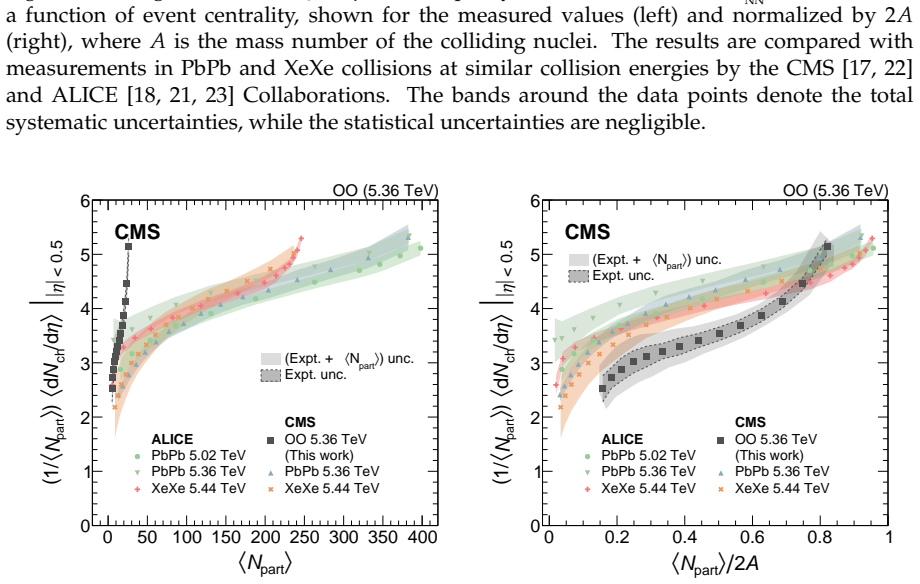
The particle density at midrapidity divided by the number of nucleons participating in the interaction in central OO collisions is consistent with that observed in central PbPb collisions at similar collision energy. While the overall energy-scaling behavior observed in other nucleus-nucleus collisions is preserved, the data exhibit deviations from simple participant and system-size scaling, highlighting the role of collision geometry and finite-size effects in light ion collisions.
What carries the argument
Centrality classes based on nuclear overlap geometry to extract dNch/dη distributions and participant-normalized yields.
If this is right
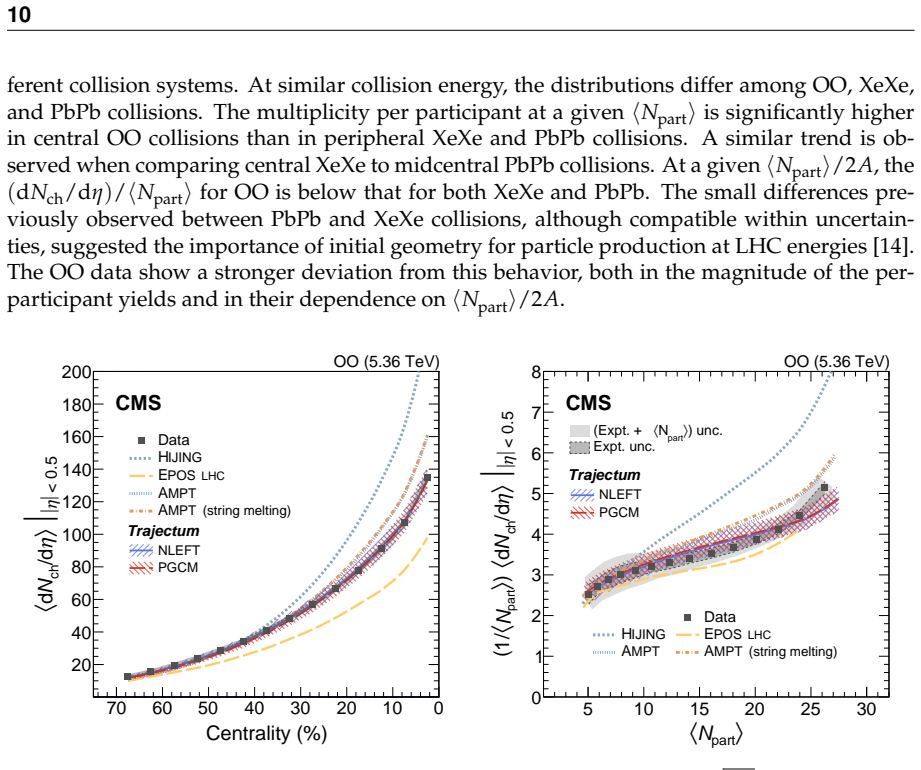
- The TRAJECTUM hydrodynamic model provides the best overall description of the data, particularly in central collisions.
- The energy-scaling behavior observed in other nucleus-nucleus collisions is preserved in OO collisions.
- Deviations from simple participant and system-size scaling appear, indicating the role of collision geometry and finite-size effects.
Where Pith is reading between the lines
- The per-participant consistency points to a particle-production mechanism that is largely independent of overall system size at this energy.
- Light-ion data may require refined modeling of geometry fluctuations to explain the observed deviations from simple scaling.
- Similar measurements in other light systems could test whether finite-size effects grow systematically with decreasing nuclear mass.
Load-bearing premise
The Glauber-model determination of participating nucleons for each centrality class is accurate enough that its uncertainties do not change the reported scaling conclusions.
What would settle it
A clear difference between the midrapidity density per participating nucleon in central OO collisions and the corresponding value in central PbPb collisions at the same energy would falsify the consistency claim.
Figures
read the original abstract
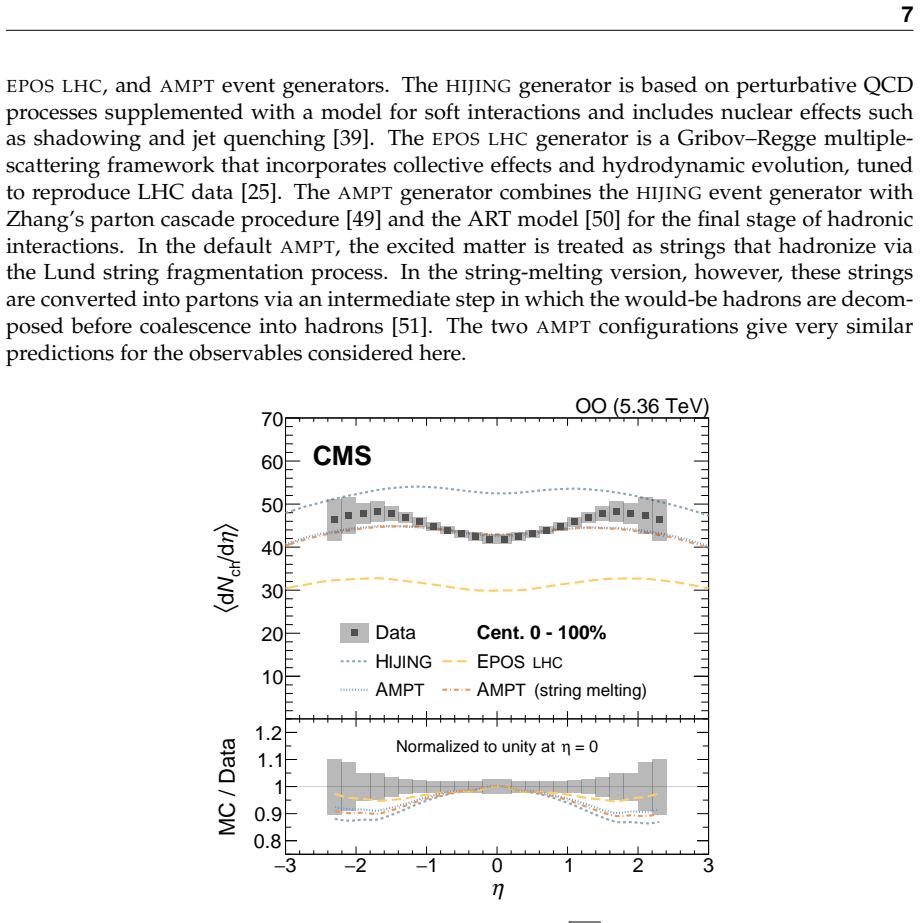
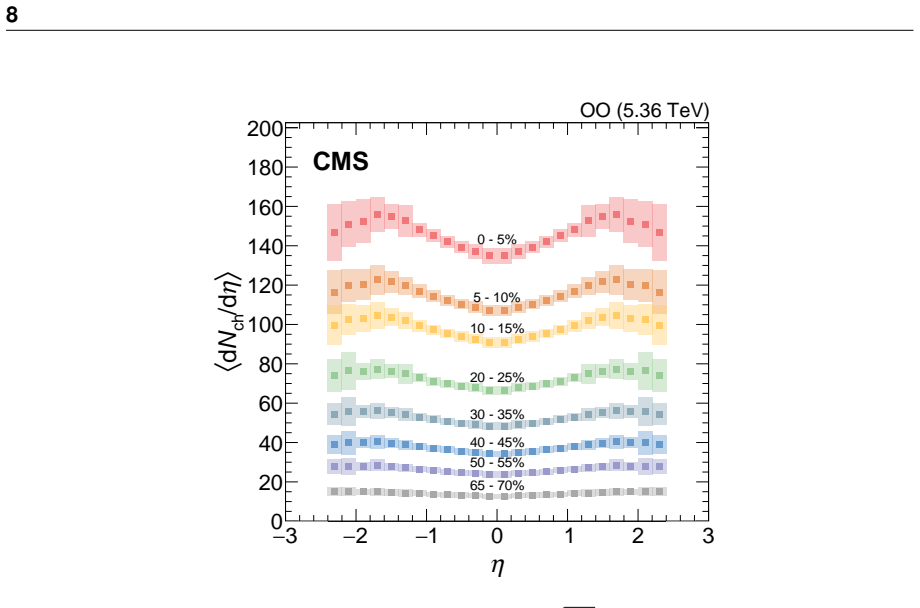
We report the first measurement of charged-hadron pseudorapidity ($\eta$) distributions in oxygen-oxygen (OO) collisions at a nucleon-nucleon center-of-mass energy of $\sqrt{s_\mathrm{NN}}$ = 5.36 TeV. The data were recorded by the CMS experiment at the LHC in 2025. Primary charged-hadron yields are measured in the range $|\eta|$ $\lt$ 2.4 as a function of centrality (the overlap of the two nuclei). The results are compared with previous measurements in lead-lead (PbPb) and xenon-xenon collisions at similar energies, as well as predictions from several Monte Carlo event generators and a hydrodynamic model. The charged-hadron pseudorapidity density in the midrapidity region ($|\eta|$ $\lt$ 0.5) is $\langle$dN$_{\text{ch}}$/d$\eta\rangle$ = 41.8 $\pm$ 1.1 (syst) integrated over centrality and 135.0 $\pm$ 4.0 (syst) for the most central (i.e., largest nuclear overlap) events. The hydrodynamic model TRAJECTUM provides the best overall description of the data, particularly in central collisions. The particle density at midrapidity divided by the number of nucleons participating in the interaction in central OO collisions is consistent with that observed in central PbPb collisions at similar collision energy. While the overall energy-scaling behavior observed in other nucleus-nucleus collisions is preserved, the data exhibit deviations from simple participant and system-size scaling, highlighting the role of collision geometry and finite-size effects in light ion collisions.
Editorial analysis
A structured set of objections, weighed in public.
Referee Report
Summary. The manuscript reports the first measurement of charged-hadron pseudorapidity distributions in oxygen-oxygen collisions at √s_NN = 5.36 TeV with the CMS experiment. It gives the midrapidity density ⟨dN_ch/dη⟩ = 41.8 ± 1.1 (syst) integrated over centrality and 135.0 ± 4.0 (syst) for the most central events, compares the centrality dependence to PbPb and XeXe data at similar energies, to several Monte Carlo generators, and to the TRAJECTUM hydrodynamic model, and states that dN_ch/dη / N_part for central OO is consistent with central PbPb while noting deviations from simple participant scaling.
Significance. This supplies the first light-ion (oxygen) data at LHC energies, enabling direct tests of system-size and geometry dependence in particle production. The observation that TRAJECTUM provides the best description, particularly centrally, and that overall energy scaling is preserved offers concrete benchmarks for models of heavy-ion collisions. The N_part-normalized consistency with PbPb, if the associated uncertainties are robust, would support universality of midrapidity yields across system sizes.
major comments (1)
- [Centrality determination and N_part scaling discussion] The headline consistency statement that dN_ch/dη / N_part in central OO matches central PbPb depends on Glauber Monte Carlo values of N_part for the OO centrality classes. The manuscript must quantify and propagate the systematic uncertainty on these N_part values arising from the nuclear density profile, nucleon-nucleon cross section, and fluctuation model for oxygen (as opposed to heavier systems); a shift exceeding ~5 % in the most-central bin would move the scaled density outside the quoted ±4.0 systematic band and alter the conclusion. This uncertainty budget should be shown explicitly alongside the PbPb comparison.
minor comments (2)
- [Abstract and results section] The abstract refers to comparisons with Monte Carlo event generators without naming them; the results section and figure captions should list the specific generators and their versions or tunes.
- [Results and uncertainty sections] Figure captions and text should clarify whether the quoted systematic uncertainties on ⟨dN_ch/dη⟩ already incorporate the full Glauber-related component or only detector-related contributions.
Simulated Author's Rebuttal
We thank the referee for the constructive comment on the N_part uncertainty. We agree that this requires explicit quantification for the oxygen system and will revise the manuscript to address it.
read point-by-point responses
-
Referee: [Centrality determination and N_part scaling discussion] The headline consistency statement that dN_ch/dη / N_part in central OO matches central PbPb depends on Glauber Monte Carlo values of N_part for the OO centrality classes. The manuscript must quantify and propagate the systematic uncertainty on these N_part values arising from the nuclear density profile, nucleon-nucleon cross section, and fluctuation model for oxygen (as opposed to heavier systems); a shift exceeding ~5 % in the most-central bin would move the scaled density outside the quoted ±4.0 systematic band and alter the conclusion. This uncertainty budget should be shown explicitly alongside the PbPb comparison.
Authors: We agree that the consistency statement relies on the Glauber-derived N_part values and that the specific uncertainties for the lighter oxygen system (nuclear density profile, NN cross section, and fluctuations) were not separately quantified in the original submission. In the revised manuscript we will add an explicit uncertainty budget obtained by varying the Woods-Saxon parameters for oxygen, the NN inelastic cross section within its uncertainty, and the fluctuation model. This additional systematic will be propagated to the dN_ch/dη / N_part ratio in the most-central bin and displayed as a separate uncertainty band in the PbPb comparison figure. We have performed the variations and find the resulting shift on N_part to be below 4 % in the 0–5 % centrality class, but the full budget will be documented so that readers can judge whether the conclusion remains robust. revision: yes
Circularity Check
Primary experimental measurements; no derivation reduces to self-inputs or self-citations
full rationale
The paper reports direct measurements of dNch/dη versus centrality in OO collisions, with quoted values obtained from detector data. Centrality binning employs a standard Glauber Monte Carlo for N_part, but this is an external modeling step whose outputs are not redefined or fitted inside the paper's own equations to produce the reported yields. The scaling comparison to PbPb data is an external benchmark, not a self-derived quantity. No self-citation chain, ansatz smuggling, or fitted-input-as-prediction pattern appears in the abstract or described results. The work is self-contained as a measurement paper against external references.
Axiom & Free-Parameter Ledger
Forward citations
Cited by 1 Pith paper
-
Event-by-event fluctuations of elliptic flow in ultrarelativistic O+O collisions
In O+O collisions, initial eccentricity and elliptic flow are fluctuation-driven and can be reproduced from a small set of uncorrelated modes.
Reference graph
Works this paper leans on
-
[1]
Heavy Ion Collisions: The Big Picture, and the Big Questions
W. Busza, K. Rajagopal, and W. van der Schee, “Heavy ion collisions: The big picture, and the big questions”,Ann. Rev. of Nucl. Part Sci.68(2018) 339, doi:10.1146/annurev-nucl-101917-020852,arXiv:1802.04801
work page internal anchor Pith review Pith/arXiv arXiv doi:10.1146/annurev-nucl-101917-020852 2018
-
[2]
Relativistic fluid dynamics in and out of equilibrium
P . Romatschke and U. Romatschke, “Relativistic fluid dynamics in and out of equilibrium”. Cambridge Monographs on Mathematical Physics. Cambridge University Press, 2019.doi:10.1017/9781108651998, ISBN 978-1-108-48368-1, 978-1-108-75002-8
-
[3]
Gluon saturation and initial conditions for relativistic heavy ion collisions
J. L. Albacete and C. Marquet, “Gluon saturation and initial conditions for relativistic heavy ion collisions”,Prog. Part. Nucl. Phys.76(2014) 1, doi:10.1016/j.ppnp.2014.01.004,arXiv:1401.4866
work page internal anchor Pith review Pith/arXiv arXiv doi:10.1016/j.ppnp.2014.01.004 2014
-
[4]
Hadron production in nuclear collisions at RHIC and high density QCD
D. Kharzeev and M. Nardi, “Hadron production in nuclear collisions at RHIC and high density QCD”,Phys. Lett. B507(2001) 121, doi:10.1016/S0370-2693(01)00457-9,arXiv:nucl-th/0012025
work page internal anchor Pith review Pith/arXiv arXiv doi:10.1016/s0370-2693(01)00457-9 2001
-
[5]
D. d’Enterria et al., “Constraints from the first LHC data on hadronic event generators for ultra-high energy cosmic-ray physics”,Astropart. Phys.35(2011) 98, doi:10.1016/j.astropartphys.2011.05.002,arXiv:1101.5596
work page internal anchor Pith review Pith/arXiv arXiv doi:10.1016/j.astropartphys.2011.05.002 2011
-
[6]
Overview of high-density QCD studies with the CMS experiment at the LHC
CMS Collaboration, “Overview of high-density QCD studies with the CMS experiment at the LHC”,Phys. Rept.1115(2025) 219,doi:10.1016/j.physrep.2024.11.007, arXiv:2405.10785
-
[7]
Heavy quarks and jets as probes of the QGP
L. Apolin ´ario, Y.-J. Lee, and M. Winn, “Heavy quarks and jets as probes of the QGP”, Prog. Part. Nucl. Phys.127(2022) 103990,doi:10.1016/j.ppnp.2022.103990, arXiv:2203.16352
-
[8]
D. Sharma et al., “Effect ofαclusters on particle production in OO and pO collisions at energies available at the CERN Large Hadron Collider”,Phys. Rev. C112(2025) 034905, doi:10.1103/l6mj-sgrn,arXiv:2503.20339
-
[9]
Future physics opportunities for high-density QCD at the LHC with heavy-ion and proton beams
Z. Citron et al., “Future physics opportunities for high-density QCD at the LHC with heavy-ion and proton beams”,CERN Y ellow Rep. Monogr.7(2019) 1159, doi:10.23731/CYRM-2019-007.1159,arXiv:1812.06772
work page internal anchor Pith review Pith/arXiv arXiv doi:10.23731/cyrm-2019-007.1159 2019
-
[10]
Ab-initio nucleon-nucleon correlations and their impact on high energy 16O+16O collisions
C. Zhang et al., “Ab-initio nucleon-nucleon correlations and their impact on high energy 16O+16O collisions”,Phys. Lett. B862(2025) 139322, doi:10.1016/j.physletb.2025.139322,arXiv:2404.08385
-
[11]
Evidence of nuclear geometry-driven anisotropic flow in OO and Ne−Ne collisions at √sNN = 5.36 TeV
ALICE Collaboration, “Evidence of nuclear geometry-driven anisotropic flow in OO and Ne−Ne collisions at √sNN = 5.36 TeV”, 9, 2025.arXiv:2509.06428. Submitted toPhys. Rev. Lett.. References 15
arXiv 2025
-
[12]
ATLAS Collaboration, “Measurement of the azimuthal anisotropy of charged particles in√sNN =5.36 TeV 16O+16O and 20Ne+20Ne collisions with the ATLAS detector”,Phys. Rev. C113(2026) 045205,doi:10.1103/xqxz-8bhf,arXiv:2509.05171
work page internal anchor Pith review Pith/arXiv arXiv doi:10.1103/xqxz-8bhf 2026
-
[13]
CMS Collaboration, “Observation of long-range collective flow in OO and NeNe collisions and implications for nuclear structure studies”, 10, 2025.arXiv:2510.02580. Submitted toPhys. Rev. Lett
arXiv 2025
-
[14]
PHOBOS Collaboration, “System size, energy and centrality dependence of pseudorapidity distributions of charged particles in relativistic heavy ion collisions”, Phys. Rev. Lett.102(2009) 142301,doi:10.1103/PhysRevLett.102.142301, arXiv:0709.4008
work page internal anchor Pith review Pith/arXiv arXiv doi:10.1103/physrevlett.102.142301 2009
-
[15]
Charged-Particle Pseudorapidity Distributions in Au+Au Collisions at sqrt(s_NN)=62.4 GeV
PHOBOS Collaboration, “Charged-particle pseudorapidity distributions in Au+Au collisions at √sNN =62.4 GeV”,Phys. Rev. C74(2006) 021901, doi:10.1103/PhysRevC.74.021901,arXiv:nucl-ex/0509034
work page internal anchor Pith review Pith/arXiv arXiv doi:10.1103/physrevc.74.021901 2006
-
[16]
BRAHMS Collaboration, “Pseudorapidity distributions of charged particles from Au+Au collisions at the maximum RHIC energy”,Phys. Rev. Lett.88(2002) 202301, doi:10.1103/PhysRevLett.88.202301,arXiv:nucl-ex/0112001
work page internal anchor Pith review Pith/arXiv arXiv doi:10.1103/physrevlett.88.202301 2002
-
[17]
Pseudorapidity distributions of charged hadrons in xenon-xenon collisions at √sNN =5.44 TeV
CMS Collaboration, “Pseudorapidity distributions of charged hadrons in xenon-xenon collisions at √sNN =5.44 TeV”,Phys. Lett. B799(2019) 135049, doi:10.1016/j.physletb.2019.135049,arXiv:1902.03603
-
[18]
ALICE Collaboration, “Centrality and pseudorapidity dependence of the charged-particle multiplicity density in Xe–Xe collisions at √sNN =5.44 TeV”,Phys. Lett. B 790(2019) 35,doi:10.1016/j.physletb.2018.12.048,arXiv:1805.04432
work page internal anchor Pith review Pith/arXiv arXiv doi:10.1016/j.physletb.2018.12.048 2019
-
[19]
ALICE Collaboration, “Centrality dependence of the charged-particle multiplicity density at mid-rapidity in Pb-Pb collisions at √sNN =2.76 TeV”,Phys. Rev. Lett.106 (2011) 032301,doi:10.1103/PhysRevLett.106.032301,arXiv:1012.1657
work page internal anchor Pith review Pith/arXiv arXiv doi:10.1103/physrevlett.106.032301 2011
-
[20]
CMS Collaboration, “Dependence on pseudorapidity and on centrality of charged hadron production in PbPb collisions at √sNN =2.76 TeV”,JHEP08(2011) 141, doi:10.1007/JHEP08(2011)141,arXiv:1107.4800
work page internal anchor Pith review Pith/arXiv arXiv doi:10.1007/jhep08(2011)141 2011
-
[21]
ALICE Collaboration, “Centrality dependence of the charged-particle multiplicity density at midrapidity in Pb-Pb collisions at √sNN =5.02 TeV”,Phys. Rev. Lett.116(2016) 222302,doi:10.1103/PhysRevLett.116.222302,arXiv:1512.06104
work page internal anchor Pith review Pith/arXiv arXiv doi:10.1103/physrevlett.116.222302 2016
-
[22]
Pseudorapidity distributions of charged hadrons in lead-lead collisions at √sNN =5.36 TeV
CMS Collaboration, “Pseudorapidity distributions of charged hadrons in lead-lead collisions at √sNN =5.36 TeV”,Phys. Lett. B861(2025) 139279, doi:10.1016/j.physletb.2025.139279,arXiv:2409.00838
-
[23]
ALICE Collaboration, “Centrality dependence of charged-particle pseudorapidity density at midrapidity in Pb-Pb collisions at √sNN =5.36 TeV”, 4, 2025. arXiv:2504.02505. Submitted toPhys. Lett. B
arXiv 2025
-
[24]
Gluon shadowing and hadron production in heavy-ion collisions at LHC
W.-T. Deng, X.-N. Wang, and R. Xu, “Gluon shadowing and hadron production in heavy-ion collisions at LHC”,Phys. Lett. B701(2011) 133, doi:10.1016/j.physletb.2011.05.040,arXiv:1011.5907. 16
work page internal anchor Pith review Pith/arXiv arXiv doi:10.1016/j.physletb.2011.05.040 2011
-
[25]
EPOS LHC : test of collective hadronization with LHC data
T. Pierog et al., “EPOS LHC: Test of collective hadronization with data measured at the CERN Large Hadron Collider”,Phys. Rev. C92(2015) 034906, doi:10.1103/PhysRevC.92.034906,arXiv:1306.0121
work page internal anchor Pith review Pith/arXiv arXiv doi:10.1103/physrevc.92.034906 2015
-
[26]
I. P . Lokhtin and A. M. Snigirev, “A model of jet quenching in ultrarelativistic heavy ion collisions and high-pT hadron spectra at RHIC”,Eur. Phys. J. C45(2006) 211, doi:10.1140/epjc/s2005-02426-3,arXiv:hep-ph/0506189
work page internal anchor Pith review Pith/arXiv arXiv doi:10.1140/epjc/s2005-02426-3 2006
-
[27]
CMS Collaboration, “Transverse momentum and pseudorapidity distributions of charged hadrons in pp collisions at √s=0.9 and 2.36 TeV”,JHEP02(2010) 041, doi:10.1007/JHEP02(2010)041,arXiv:1002.0621
work page internal anchor Pith review Pith/arXiv arXiv doi:10.1007/jhep02(2010)041 2010
-
[28]
CMS Collaboration, “Transverse-momentum and pseudorapidity distributions of charged hadrons in pp collisions at √s=7 TeV”,Phys. Rev. Lett.105(2010) 022002, doi:10.1103/PhysRevLett.105.022002,arXiv:1005.3299
work page internal anchor Pith review Pith/arXiv arXiv doi:10.1103/physrevlett.105.022002 2010
-
[29]
Charged particle multiplicities in pp interactions at sqrt(s) = 0.9, 2.36, and 7 TeV
CMS Collaboration, “Charged particle multiplicities in pp interactions at √s=0.9, 2.36, and 7 TeV”,JHEP01(2011) 079,doi:10.1007/JHEP01(2011)079, arXiv:1011.5531
work page internal anchor Pith review Pith/arXiv arXiv doi:10.1007/jhep01(2011)079 2011
-
[30]
CMS and TOTEM Collaborations, “Measurement of pseudorapidity distributions of charged particles in proton-proton collisions at √s=8 TeV by the CMS and TOTEM experiments”,Eur. Phys. J. C74(2014) 3053, doi:10.1140/epjc/s10052-014-3053-6,arXiv:1405.0722
work page internal anchor Pith review Pith/arXiv arXiv doi:10.1140/epjc/s10052-014-3053-6 2014
-
[31]
Pseudorapidity distribution of charged hadrons in proton-proton collisions at sqrt(s) = 13 TeV
CMS Collaboration, “Pseudorapidity distribution of charged hadrons in proton-proton collisions at √s=13 TeV”,Phys. Lett. B751(2015) 143, doi:10.1016/j.physletb.2015.10.004,arXiv:1507.05915
work page internal anchor Pith review Pith/arXiv arXiv doi:10.1016/j.physletb.2015.10.004 2015
-
[32]
CMS Collaboration, “Pseudorapidity distributions of charged hadrons in proton-lead collisions at √sNN =5.02 and 8.16 TeV”,JHEP01(2018) 045, doi:10.1007/JHEP01(2018)045,arXiv:1710.09355
work page internal anchor Pith review Pith/arXiv arXiv doi:10.1007/jhep01(2018)045 2018
-
[33]
Glauber modeling in high energy nuclear collisions
M. L. Miller, K. Reygers, S. J. Sanders, and P . Steinberg, “Glauber modeling in high energy nuclear collisions”,Ann. Rev. Nucl. Part. Sci.57(2007) 205, doi:10.1146/annurev.nucl.57.090506.123020,arXiv:nucl-ex/0701025
-
[34]
Progress in the Glauber model at collider energies
D. d’Enterria and C. Loizides, “Progress in the Glauber model at collider energies”,Ann. Rev. Nucl. Part. Sci.71(2021) 315,doi:10.1146/annurev-nucl-102419-060007, arXiv:2011.14909
-
[35]
HEPData record for this analysis, 2026.doi:10.17182/hepdata.172783
-
[36]
The CMS experiment at the CERN LHC
CMS Collaboration, “The CMS experiment at the CERN LHC”,JINST3(2008) S08004, doi:10.1088/1748-0221/3/08/S08004
-
[37]
Development of the CMS detector for the CERN LHC Run 3
CMS Collaboration, “Development of the CMS detector for the CERN LHC Run 3”, JINST19(2024) P05064,doi:10.1088/1748-0221/19/05/P05064, arXiv:2309.05466
-
[38]
CMS technical design report for the pixel detector upgrade
CMS Collaboration, “CMS technical design report for the pixel detector upgrade”, technical report, 2012.doi:10.2172/1151650. References 17
-
[39]
HIJING: A Monte Carlo model for multiple jet production in pp, pA and AA collisions
X.-N. Wang and M. Gyulassy, “HIJING: A Monte Carlo model for multiple jet production in pp, pA and AA collisions”,Phys. Rev. D44(1991) 3501, doi:10.1103/PhysRevD.44.3501
-
[40]
K. Werner, F.-M. Liu, and T. Pierog, “Parton ladder splitting and the rapidity dependence of transverse momentum spectra in deuteron-gold collisions at the BNL Relativistic Heavy Ion Collider”,Phys. Rev. C74(2006) 044902, doi:10.1103/PhysRevC.74.044902,arXiv:hep-ph/0506232
work page internal anchor Pith review Pith/arXiv arXiv doi:10.1103/physrevc.74.044902 2006
-
[41]
STARlight: A Monte Carlo simulation program for ultra-peripheral collisions of relativistic ions
S. R. Klein et al., “STARlight: A Monte Carlo simulation program for ultra-peripheral collisions of relativistic ions”,Comput. Phys. Commun.212(2017) 258, doi:10.1016/j.cpc.2016.10.016,arXiv:1607.03838
work page internal anchor Pith review Pith/arXiv arXiv doi:10.1016/j.cpc.2016.10.016 2017
-
[42]
The Monte Carlo Event Generator DPMJET-III
S. Roesler, R. Engel, and J. Ranft, “The Monte Carlo event generator DPMJET-III”, Advanced Monte Carlo for radiation physics, particle transport simulation and applications. Proceedings, Conference, MC2000, Lisbon, Portugal, October 23-26, 2000(2000) 1033, doi:10.1007/978-3-642-18211-2_166,arXiv:hep-ph/0012252
work page internal anchor Pith review Pith/arXiv arXiv doi:10.1007/978-3-642-18211-2_166 2000
-
[43]
Data-driven method to estimate contamination from light ion beam transmutation at colliders
S. J. Das and A. Baty, “Data-driven method to estimate contamination from light ion beam transmutation at colliders”,Phys. Rev. C113(2026) 044907, doi:10.1103/f4c5-yys5,arXiv:2509.09736
work page internal anchor Pith review Pith/arXiv arXiv doi:10.1103/f4c5-yys5 2026
-
[44]
CMS Collaboration, “Observation and studies of jet quenching in PbPb collisions at√sNN =2.76 TeV”,Phys. Rev. C84(2011) 024906, doi:10.1103/PhysRevC.84.024906,arXiv:1102.1957
work page internal anchor Pith review Pith/arXiv arXiv doi:10.1103/physrevc.84.024906 2011
-
[45]
C. Loizides, “Glauber predictions for oxygen and neon collisions at energies available at the CERN Large Hadron Collider”,Phys. Rev. C113(2026) 014914, doi:10.1103/mkp8-zgxh,arXiv:2507.05853
-
[46]
GEANT4 Collaboration, “GEANT4—a simulation toolkit”,Nucl. Instrum. Meth. A506 (2003) 250,doi:10.1016/S0168-9002(03)01368-8
-
[47]
A Multi-Phase Transport Model for Relativistic Heavy Ion Collisions
Z.-W. Lin et al., “A multi-phase transport model for relativistic heavy ion collisions”, Phys. Rev. C72(2005) 064901,doi:10.1103/PhysRevC.72.064901, arXiv:nucl-th/0411110
work page internal anchor Pith review Pith/arXiv arXiv doi:10.1103/physrevc.72.064901 2005
-
[48]
The Angantyr model for Heavy-Ion Collisions in PYTHIA8
C. Bierlich, G. Gustafson, L. L ¨onnblad, and H. Shah, “The Angantyr model for heavy-ion collisions in PYTHIA8”,JHEP10(2018) 134,doi:10.1007/JHEP10(2018)134, arXiv:1806.10820
work page internal anchor Pith review Pith/arXiv arXiv doi:10.1007/jhep10(2018)134 2018
-
[49]
ZPC 1.0.1: a parton cascade for ultrarelativistic heavy ion collisions
B. Zhang, “ZPC 1.0.1: A parton cascade for ultrarelativistic heavy ion collisions”, Comput. Phys. Commun.109(1998) 193,doi:10.1016/S0010-4655(98)00010-1, arXiv:nucl-th/9709009
work page internal anchor Pith review Pith/arXiv arXiv doi:10.1016/s0010-4655(98)00010-1 1998
-
[50]
Formation of superdense hadronic matter in high energy heavy-ion collisions
B.-A. Li and C. M. Ko, “Formation of superdense hadronic matter in high energy heavy-ion collisions”,Phys. Rev. C52(1995) 2037,doi:10.1103/PhysRevC.52.2037, arXiv:nucl-th/9505016
work page internal anchor Pith review Pith/arXiv arXiv doi:10.1103/physrevc.52.2037 1995
-
[51]
Z.-W. Lin, “Evolution of transverse flow and effective temperatures in the parton phase from a multi-phase transport model”,Phys. Rev. C90(2014) 014904, doi:10.1103/PhysRevC.90.014904,arXiv:1403.6321. 18
work page internal anchor Pith review Pith/arXiv arXiv doi:10.1103/physrevc.90.014904 2014
-
[52]
Exploiting 20Ne Isotopes for Precision Characterizations of Collectivity in Small Systems
G. Giacalone et al., “Exploiting 20Ne Isotopes for Precision Characterizations of Collectivity in Small Systems”,Phys. Rev. Lett.135(2025) 012302, doi:10.1103/k8rb-jgvq,arXiv:2402.05995
-
[53]
Pseudorapidity density of charged particles in p-Pb collisions at $\sqrt{s_{\rm NN}} = 5.02$ TeV
ALICE Collaboration, “Pseudorapidity density of charged particles in p+Pb collisions at√sNN =5.02 TeV”,Phys. Rev. Lett.110(2013) 032301, doi:10.1103/PhysRevLett.110.032301,arXiv:1210.3615
work page internal anchor Pith review Pith/arXiv arXiv doi:10.1103/physrevlett.110.032301 2013
-
[54]
NA35 Collaboration, “Charged particle production in proton-, deuteron-, oxygen- and sulphur-nucleus collisions at 200 GeV per nucleon”,Eur. Phys. J. C2(1998) 643, doi:10.1007/s100520050167,arXiv:hep-ex/9711001
work page internal anchor Pith review Pith/arXiv arXiv doi:10.1007/s100520050167 1998
-
[55]
Pseudorapidity Distribution of Charged Particles in d + Au Collisions at $\sqrt{s_{_{NN}}$ = 200 GeV
PHOBOS Collaboration, “Pseudorapidity distribution of charged particles in d+Au collisions at √sNN =200 GeV”,Phys. Rev. Lett.93(2004) 082301, doi:10.1103/PhysRevLett.93.082301,arXiv:nucl-ex/0311009
work page internal anchor Pith review Pith/arXiv arXiv doi:10.1103/physrevlett.93.082301 2004
-
[56]
PHENIX Collaboration, “Transverse energy production and charged-particle multiplicity at midrapidity in various systems from √sNN =7.7 to 200 GeV”,Phys. Rev. C93(2016) 024901,doi:10.1103/PhysRevC.93.024901,arXiv:1509.06727
work page internal anchor Pith review Pith/arXiv arXiv doi:10.1103/physrevc.93.024901 2016
-
[57]
PHENIX Collaboration, “Measurements of azimuthal anisotropy and charged-particle multiplicity in d+Au collisions at √sNN =200, 62.4, 39, and 19.6 GeV”,Phys. Rev. C96 (2017) 064905,doi:10.1103/PhysRevC.96.064905,arXiv:1708.06983
work page internal anchor Pith review Pith/arXiv arXiv doi:10.1103/physrevc.96.064905 2017
-
[58]
PHOBOS Collaboration, “Phobos results on charged particle multiplicity and pseudorapidity distributions in Au+Au, Cu+Cu, d+Au, and p+p collisions at ultra-relativistic energies”,Phys. Rev. C83(2011) 024913, doi:10.1103/PhysRevC.83.024913,arXiv:1011.1940
work page internal anchor Pith review Pith/arXiv arXiv doi:10.1103/physrevc.83.024913 2011
-
[59]
Scaling of charged particle multiplicity in PbPb collisions at SPS energies
NA50 Collaboration, “Scaling of charged particle multiplicity in PbPb collisions at SPS energies”,Phys. Lett. B530(2002) 43,doi:10.1016/S0370-2693(02)01353-9
-
[60]
STAR Collaboration, “Multiplicity distribution and spectra of negatively charged hadrons in Au+Au collisions at √sNN =130 GeV”,Phys. Rev. Lett.87(2001) 112303, doi:10.1103/PhysRevLett.87.112303,arXiv:nucl-ex/0106004
work page internal anchor Pith review Pith/arXiv arXiv doi:10.1103/physrevlett.87.112303 2001
-
[61]
Charged particle densities from Au+Au collisions at sqrt{s_{NN}}=130 GeV
BRAHMS Collaboration, “Charged particle densities from Au+Au collisions at√sNN =130 GeV”,Phys. Lett. B523(2001) 227, doi:10.1016/S0370-2693(01)01333-8,arXiv:nucl-ex/0108016
work page internal anchor Pith review Pith/arXiv arXiv doi:10.1016/s0370-2693(01)01333-8 2001
-
[62]
Centrality Dependence of Charged Particle Multiplicity in Au-Au Collisions at sqrt(s_NN)=130 GeV
PHENIX Collaboration, “Centrality dependence of charged particle multiplicity in Au-Au collisions at √sNN =130 GeV”,Phys. Rev. Lett.86(2001) 3500, doi:10.1103/PhysRevLett.86.3500,arXiv:nucl-ex/0012008
work page internal anchor Pith review Pith/arXiv arXiv doi:10.1103/physrevlett.86.3500 2001
-
[63]
PHOBOS Collaboration, “Charged-particle multiplicity near midrapidity in central Au+Au collisions at √sNN =56 and 130 GeV”,Phys. Rev. Lett.85(2000) 3100, doi:10.1103/PhysRevLett.85.3100,arXiv:hep-ex/0007036
work page internal anchor Pith review Pith/arXiv arXiv doi:10.1103/physrevlett.85.3100 2000
-
[64]
Charged-particle pseudorapidity density distributions from Au+Au collisions at sqrt(sNN)=130 GeV
PHOBOS Collaboration, “Charged-particle pseudorapidity density distributions from Au+Au collisions at √sNN =130 GeV”,Phys. Rev. Lett.87(2001) 102303, doi:10.1103/PhysRevLett.87.102303,arXiv:nucl-ex/0106006
work page internal anchor Pith review Pith/arXiv arXiv doi:10.1103/physrevlett.87.102303 2001
-
[65]
ALICE Collaboration, “Charged-particle multiplicity density at midrapidity in central Pb-Pb collisions at √sNN =2.76 TeV”,Phys. Rev. Lett.105(2010) 252301, doi:10.1103/PhysRevLett.105.252301,arXiv:1011.3916. References 19
work page internal anchor Pith review Pith/arXiv arXiv doi:10.1103/physrevlett.105.252301 2010
-
[66]
ATLAS Collaboration, “Measurement of the centrality dependence of the charged particle pseudorapidity distribution in lead-lead collisions at √sNN =2.76 TeV with the ATLAS detector”,Phys. Lett. B710(2012) 363, doi:10.1016/j.physletb.2012.02.045,arXiv:1108.6027
work page internal anchor Pith review Pith/arXiv arXiv doi:10.1016/j.physletb.2012.02.045 2012
-
[67]
STAR Collaboration, “Identified particle production, azimuthal anisotropy, and interferometry measurements in Au+Au collisions at √sNN =9.2 GeV”,Phys. Rev. C81 (2010) 024911,doi:10.1103/PhysRevC.81.024911,arXiv:0909.4131
work page internal anchor Pith review Pith/arXiv arXiv doi:10.1103/physrevc.81.024911 2010
-
[68]
Systematic Measurements of Identified Particle Spectra in pp, d+Au and Au+Au Collisions from STAR
STAR Collaboration, “Systematic measurements of identified particle spectra in pp, d+Au and Au+Au collisions from STAR”,Phys. Rev. C79(2009) 034909, doi:10.1103/PhysRevC.79.034909,arXiv:0808.2041
work page internal anchor Pith review Pith/arXiv arXiv doi:10.1103/physrevc.79.034909 2009
-
[69]
A study of the general characteristics of p ¯p collisions at√s=0.2 TeV to 0.9 TeV
UA1 Collaboration, “A study of the general characteristics of p ¯p collisions at√s=0.2 TeV to 0.9 TeV”,Nucl. Phys. B335(1990) 261, doi:10.1016/0550-3213(90)90493-W
-
[70]
Particle multiplicities in p ¯p interactions at √s=540 GeV
UA5 Collaboration, “Particle multiplicities in p ¯p interactions at √s=540 GeV”,Phys. Lett. B121(1983) 209,doi:10.1016/0370-2693(83)90916-4
-
[71]
CDF Collaboration, “Pseudorapidity distributions of charged particles produced in ¯pp interactions at √s=630 GeV and 1800 GeV”,Phys. Rev. D41(1990) 2330, doi:10.1103/PhysRevD.41.2330
-
[72]
Charged particle multiplicity distributions in pp collisions at ISR Energies
Aachen-CERN-Heidelberg-Munich Collaboration, “Charged particle multiplicity distributions in pp collisions at ISR Energies”,Nucl. Phys. B129(1977) 365, doi:10.1016/0550-3213(77)90122-5
-
[73]
ALICE Collaboration, “Charged-particle multiplicity measurement in proton-proton collisions at √s=0.9 and 2.36 TeV with ALICE at LHC”,Eur. Phys. J. C68(2010) 89, doi:10.1140/epjc/s10052-010-1339-x,arXiv:1004.3034. 20 21 A The CMS Collaboration Yerevan Physics Institute, Yerevan, Armenia A. Belyaev , A. Gevorgyan , A. Hayrapetyan, A. Tumasyan1 Marietta Bla...
work page internal anchor Pith review Pith/arXiv arXiv doi:10.1140/epjc/s10052-010-1339-x 2010
discussion (0)
Sign in with ORCID, Apple, or X to comment. Anyone can read and Pith papers without signing in.