REVIEW 5 major objections 6 minor 43 references
Temporal Object Captioning for Street Scene Videos from LiDAR Tracks
T0 review · 5 major / 6 minor · reviewed 2026-08-07 · deepseek-v4-flash
Pith's one-line read Training a video captioning model on template captions generated automatically from LiDAR tracks improves temporal understanding and reduces visual bias across three driving-scene datasets.
desk verdict Useful automated LiDAR-to-caption pipeline, but the central claim about reduced visual bias rests on an unvalidated, self-referential metric. read the letter →
The pith
A machine-rendered reading of the paper's core claim, the machinery that carries it, and where it could break.
The reading
What carries the argument
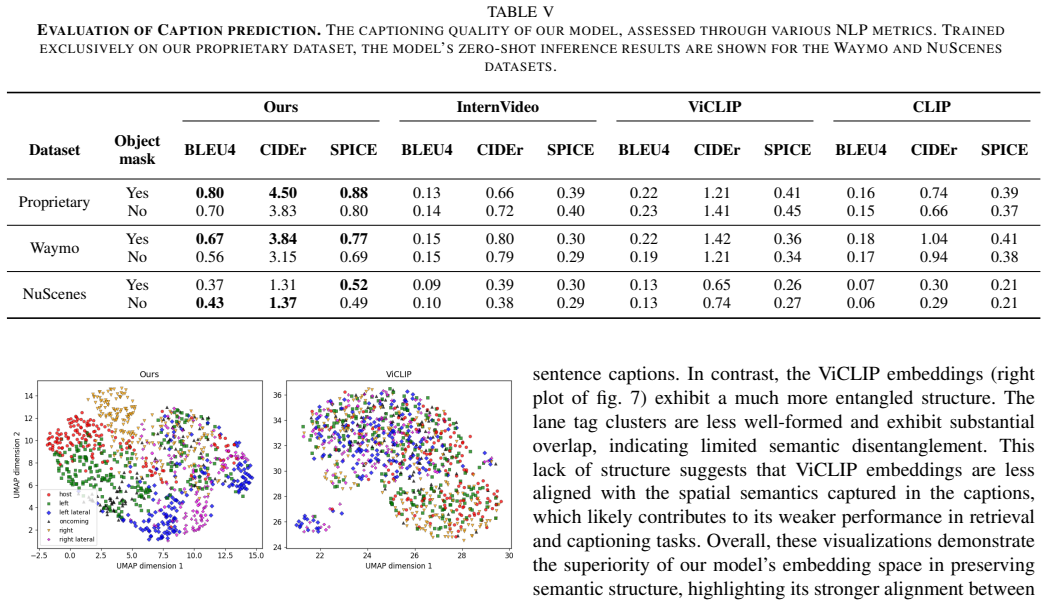
The load-bearing mechanism is the rule-based captioning pipeline paired with the Visual Bias Measure. From LiDAR tracks, each neighbor object receives a concatenated tag combining object class, lane tag, and motion tag at every timestamp; the tag time series is collapsed into a unified sequence of distinct behavioral states, and each state is rendered as a sentence from a template pool with 63 first-sentence options and 78 follow-up options. The Visual Bias Measure, VBM = 100*(B_k - C_k)/B_k, is the percentage drop in retrieval BLEU4 when top-k neighbors recorded within a predefined time window of the query are excluded, with lower VBM taken to indicate reliance on temporal semantics rather than visual similarity. As an auxiliary mechanism, LiDAR-derived object masks are produced by projecting points inside each bounding box onto the image plane and wrapping them with a convex-hull algorithm, which further lowers VBM, especially on Waymo and NuScenes.
What would settle it
Compute the Visual Bias Measure for a model trained on the same front-camera clips but with captions randomly reassigned to different clips, destroying the caption-motion correspondence; if the shuffled model's VBM is as low as the trained model's, the metric is not detecting temporal understanding. A complementary check is to have human raters judge whether retrieved neighbors share the action described and compare those ratings with VBM rankings: low correlation would invalidate the metric.
Extended reading notes
Core claim
The paper's central claim is that LiDAR-derived template captions, used as supervision for a video captioning model, reduce the visual/static bias in the model's embedding space and improve its temporal understanding. The procedure extracts object tracks from raw LiDAR with an off-the-shelf 3D detector and tracker, assigns each tracked object lane and motion tags by thresholding yaw, lateral position, and relative distance changes, compresses the resulting tag time series into a unified sequence of discrete behavioral states, and maps each state to a sentence from a template pool. Training SwinBERT with masked language modeling on front-camera RGB frames and these captions yields the lowest Visual Bias Measure across the proprietary, Waymo, and NuScenes datasets and the highest captioning scores against InternVideo, ViCLIP, CLIP, and VGG19. The authors interpret this as evidence that the model's embeddings organize by action semantics such as lane, approach, and away rather than by static appearance, supported by UMAP cluster structure and qualitative retrieval examples.
Load-bearing premise
The load-bearing premise is that the Visual Bias Measure, a relative drop in retrieval BLEU4 when nearby-in-time videos are excluded, genuinely measures temporal understanding rather than some other property of the embedding space; a second fragile link is that the off-the-shelf 3D tracker used to build the captions is accurate enough that its errors do not dominate the labels.
Editorial extensions
If this is right
- Training on LiDAR-derived template captions improves captioning quality and lowers visual bias on datasets with camera setups different from the training data, so the method should transfer to any LiDAR-plus-camera driving dataset.
- Because LiDAR is used only for label generation and not at inference, the resulting captioning model can run on camera-only systems.
- Mask-augmented frames built from LiDAR point clouds improve the Visual Bias Measure by roughly 5 percentage points on Waymo and 2 percentage points on NuScenes, providing a cheap additional supervision signal.
- The template space is combinatorial, yielding thousands of distinct multi-sentence captions from a small set of rules, so the pipeline can generate large pseudo-ground-truth datasets without human annotation.
- A model trained only on single-sentence captions retrieves videos described by two-sentence captions better than the baselines, indicating zero-shot generalization to more complex temporal descriptions.
Reading between the lines
- The Visual Bias Measure, if validated against human judgments or downstream tasks, could become a general diagnostic for temporal bias in any video-language model, not just captioning models.
- The same rule-based captioning pipeline could be applied to other sensor modalities, such as radar or stereo depth, whenever object tracks are available, extending it beyond LiDAR-equipped datasets.
- A testable extension is to add an LLM paraphrasing stage to the template captions and check whether linguistic diversity improves without lowering temporal grounding or worsening VBM.
- The claim that template captions are sufficient for action semantics suggests that linguistic variety may matter less than precise, structured supervision for ADAS-oriented video understanding.
Editorial analysis
A structured set of objections, weighed in public.
Referee Report
Summary. The paper presents an automated LiDAR-based caption generation pipeline for street-scene videos. A 3D detector/tracker extracts object tracks from LiDAR, and a rule-based system assigns lane and motion tags, which are converted into template captions. SwinBERT is trained on front-camera RGB frames supervised by these captions, using only single-sentence captions from a proprietary dataset. The authors evaluate zero-shot caption prediction on proprietary data, Waymo, and NuScenes (Table V), and propose a new Visual Bias Measure (VBM, Eq. 2) to claim reduced visual bias and improved temporal understanding. The paper also studies an automated LiDAR-based object-masking augmentation and provides qualitative embedding analyses.
Significance. The proposed pipeline is fully automated and scalable, and the zero-shot evaluation on two public datasets is a useful methodological choice. If the claims were supported, the work would contribute a practical way to generate temporally grounded driving captions without human annotation. However, the central evidence is not conclusive: the headline comparison in Table V uses different protocols for the proposed model and the baselines, and the VBM metric is unvalidated and confounded by candidate-pool changes. These issues prevent the paper from establishing the claimed reduction in visual bias.
major comments (5)
- [Section IV-B, Table V] The headline captioning comparison is not apples-to-apples. The proposed model generates captions, whereas InternVideo, ViCLIP, and CLIP are evaluated by selecting the best match from the caption pool (as the text states: 'the baseline models were not required to generate captions'). BLEU4, CIDEr, and SPICE computed against the template captions therefore mix a generation task with a retrieval task. The reported margins (e.g., '3x in BLEU4') do not establish that the proposed model is a better captioner. Please re-run the baselines under an identical generation protocol, or evaluate all methods by retrieval from an identical candidate set, and report both settings separately.
- [Section III-C, Eq. (2), Section IV-C] The Visual Bias Measure is confounded by the retrieval pool change. In the constrained setting, temporally nearby videos are excluded, so C_k is computed over a smaller and likely differently distributed set of template captions; any retrieval method would show some BLEU4 drop under this change. The paper does not report chance-level BLEU4, a pool-size-matched random baseline, or any normalization. Moreover, VBM is never validated against human judgments, established bias metrics, or downstream tasks. Without these controls, the claim that LiDAR-supervised training 'addresses and reduces visual bias' is not supported by Eq. (2).
- [Section III-A and III-C] The evaluation is circular in an important sense. The same rule-based pipeline generates the captions used for training, for retrieval ground truth, and for the VBM diagnostic. A low VBM may therefore simply indicate that the model aligns with the authors' own tag distribution (lane, motion, object class) rather than with human-meaningful temporal semantics. The paper should anchor the evaluation with independent human annotations or with a model trained on independently labeled captions.
- [Section III-A] The 3D detector and tracker used to generate all tracks are never named, and no accuracy or failure-mode analysis is given. Since tracking errors propagate directly into the training labels and the evaluation ground truth, every reported number depends on this unspecified component. Please specify the detector/tracker, report its performance (or use dataset ground-truth annotations where available), and assess how caption quality and VBM change with tracking noise.
- [Section IV-A, Table IV, Eqs. (3)-(8)] The pipeline depends on many hand-set thresholds (T_x, T_y, T_s, T_m, T_h, T_v, T_a, T_w, the lane yaw thresholds, and the VBM exclusion window), and no sensitivity analysis is provided. Because these thresholds fully determine the caption distribution, the paper should demonstrate that the main conclusions are robust to reasonable variations of these parameters.
minor comments (6)
- [Section III-B] The word 'extrtacted' should be 'extracted'.
- [Table II] The header repeats 'Differs in motion tag' for both columns; the second column should read 'Differs in lane tag'.
- [Figure 5, Eq. (2)] The temporal exclusion window used in the VBM computation is not specified, and the figure shows no error bars or significance information.
- [Figure 8 caption] The caption refers to 'Figure 1a and Figure 1b'; these should be Figure 8a and Figure 8b.
- [Section IV-B] The claim that evaluation uses the 'entire Waymo and NuScenes datasets' is ambiguous: it should state whether captions are generated by the same detector/tracker pipeline or taken from dataset ground truth, and how the candidate caption pool is constructed.
- [Table V] The candidate pool size for the baseline best-match selection is not given; report it for each dataset so the reader can gauge the difficulty of the retrieval task.
Circularity Check
No substantial circularity: the central claims are empirical, benchmarked against external models and cross-dataset zero-shot transfer; VBM validity is a measurement concern, not a definitional reduction.
full rationale
The paper's derivation chain is not circular. Captions are generated from LiDAR tracks by a rule-based system (Section III-A), and SwinBERT is trained on front-camera frames to predict those captions (Section III-B). The evaluation is anchored to external, unmodified baselines (InternVideo, ViCLIP, CLIP, VGG19) and to zero-shot transfer on Waymo and NuScenes with different camera configurations, so the headline captioning and retrieval results are externally falsifiable rather than forced by construction. The Visual Bias Measure (Eq. 2) is a newly introduced operational metric, defined as the relative BLEU4 drop when temporally nearby videos are excluded from retrieval; interpreting lower VBM as reduced visual bias is an assumption about the metric's validity, not a derivation in which the predicted quantity equals an input by construction. The same template captions serve as training labels and as retrieval ground truth, but the model must generalize to unseen datasets and clips, and the baselines were not trained on those captions, so the evaluation does not reduce to reproducing the training distribution. Concerns about VBM not being validated against human judgments or downstream tasks, and about the unnamed LiDAR detector/tracker, are correctness and robustness risks, not circularity. There are no load-bearing self-citations or imported uniqueness theorems.
Assumptions & free parameters
free parameters (7)
- Neighborhood thresholds Tx, Ty =
Tx: 30 m (pedestrian), 40 m (car/truck/bike); Ty: 15 m (pedestrian), 20 m (car/truck/bike)
- Stationary threshold Ts =
0.1 (pedestrian/bike), 0.15 (car/truck)
- Motion tag threshold Tm =
0.01 (pedestrian), 0.1 (car/truck/bike)
- Lane lateral threshold Th =
2.5
- Host velocity/acceleration/yaw-rate thresholds Tv, Ta, Tw =
not reported numerically
- Baseline lane yaw thresholds phi_ol, phi_ou, phi_ll, phi_lu =
not reported numerically
- VBM temporal exclusion window =
not specified
assumptions (5)
- domain assumption Lane position is determinable from yaw angle and lateral position thresholds, Eqs. (6)-(7).
- domain assumption Neighbor motion is adequately described by the sign and magnitude of the lateral relative velocity, Eq. (8).
- ad hoc to paper BLEU4 drop under temporal exclusion (VBM) quantifies visual bias and temporal understanding, Eq. (2).
- domain assumption The LiDAR 3D detector and tracker produce accurate tracks.
- domain assumption Single-sentence captions from a 63-sentence pool suffice to learn temporal understanding.
invented entities (1)
-
Visual Bias Measure (VBM)
Cite this review
Pith. "Pith review of Temporal Object Captioning for Street Scene Videos from LiDAR Tracks." pith.science (2026). https://pith.science/paper/6EPXRTO3
@misc{pith2026250516594,
  author       = {Pith},
  title        = {Pith review of: Temporal Object Captioning for Street Scene Videos from LiDAR Tracks},
  year         = {2026},
  howpublished = {\url{https://pith.science/paper/6EPXRTO3}},
  note         = {Machine review of arXiv:2505.16594}
}
read the original abstract
Video captioning models have seen notable advancements in recent years, especially with regard to their ability to capture temporal information. While many research efforts have focused on architectural advancements, such as temporal attention mechanisms, there remains a notable gap in understanding how models capture and utilize temporal semantics for effective temporal feature extraction, especially in the context of Advanced Driver Assistance Systems. We propose an automated LiDAR-based captioning procedure that focuses on the temporal dynamics of traffic participants. Our approach uses a rule-based system to extract essential details such as lane position and relative motion from object tracks, followed by a template-based caption generation. Our findings show that training SwinBERT, a video captioning model, using only front camera images and supervised with our template-based captions, specifically designed to encapsulate fine-grained temporal behavior, leads to improved temporal understanding consistently across three datasets. In conclusion, our results clearly demonstrate that integrating LiDAR-based caption supervision significantly enhances temporal understanding, effectively addressing and reducing the inherent visual/static biases prevalent in current state-of-the-art model architectures.
Figures


Figures from the paper (4 more)



Reference graph
Works this paper leans on
-
[1]
Mammut: A simple architecture for joint learning for multimodal tasks,
W. Kuo, A. Piergiovanni, D. Kim, X. Luo, B. Caine, W. Li, A. Ogale, L. Zhou, A. Dai, Z. Chen, C. Cui, and A. Angelova, “Mammut: A simple architecture for joint learning for multimodal tasks,” 2023. [Online]. Available: https://arxiv.org/abs/2303.16839
arXiv 2023
-
[2]
Vlab: Enhancing video language pre- training by feature adapting and blending,
X. He, S. Chen, F. Ma, Z. Huang, X. Jin, Z. Liu, D. Fu, Y . Yang, J. Liu, and J. Feng, “Vlab: Enhancing video language pre- training by feature adapting and blending,” 2023. [Online]. Available: https://arxiv.org/abs/2305.13167
arXiv 2023
-
[3]
Valor: Vision-audio-language omni-perception pretraining model and dataset,
S. Chen, X. He, L. Guo, X. Zhu, W. Wang, J. Tang, and J. Liu, “Valor: Vision-audio-language omni-perception pretraining model and dataset,”
-
[4]
J. Wang, J. Jiao, L. Bao, S. He, Y . Liu, and W. Liu, “Self- supervised spatio-temporal representation learning for videos by predicting motion and appearance statistics,” 2019. [Online]. Available: https://arxiv.org/abs/1904.03597
work page Pith review arXiv 2019
-
[5]
Unsupervised Pre-Training of Image Features on Non-Curated Data
M. Caron, P. Bojanowski, J. Mairal, and A. Joulin, “Unsupervised pre-training of image features on non-curated data,” 2019. [Online]. Available: https://arxiv.org/abs/1905.01278
work page Pith review arXiv 2019
-
[6]
J. Jaworek-Korjakowska, P. Kleczek, and M. Gorgon, “Melanoma thick- ness prediction based on convolutional neural network with vgg-19 model transfer learning,” inProceedings of the IEEE/CVF Conference on Computer Vision and Pattern Recognition Workshops, 2019, pp. 0–0
work page 2019
-
[7]
Pre-training on grayscale imagenet improves medical image classification,
Y . Xie and D. Richmond, “Pre-training on grayscale imagenet improves medical image classification,” inProceedings of the European confer- ence on computer vision (ECCV) workshops, 2018, pp. 0–0
work page 2018
-
[8]
Low-Rank HOCA: Efficient High-Order Cross-Modal Attention for Video Captioning
T. Jin, S. Huang, Y . Li, and Z. Zhang, “Low-rank hoca: Efficient high-order cross-modal attention for video captioning,”arXiv preprint arXiv:1911.00212, 2019
work page Pith review arXiv 1911
Show all 43 references
-
[9]
Sensor-augmented egocentric- video captioning with dynamic modal attention,
K. Nakamura, H. Ohashi, and M. Okada, “Sensor-augmented egocentric- video captioning with dynamic modal attention,” inProceedings of the 29th ACM International Conference on Multimedia, 2021, pp. 4220– 4229
2021
-
[10]
Boosting video captioning with dynamic loss network,
N. Ullah and P. P. Mohanta, “Boosting video captioning with dynamic loss network,”arXiv preprint arXiv:2107.11707, 2021
2021 arXiv
-
[11]
Panoptic segmentation,
A. Kirillov, K. He, R. Girshick, C. Rother, and P. Doll ´ar, “Panoptic segmentation,” inProceedings of the IEEE/CVF conference on computer vision and pattern recognition, 2019, pp. 9404–9413
2019
-
[12]
An empirical study of context in object detection,
S. K. Divvala, D. Hoiem, J. H. Hays, A. A. Efros, and M. Hebert, “An empirical study of context in object detection,” in2009 IEEE Conference on computer vision and Pattern Recognition. IEEE, 2009, pp. 1271– 1278
2009
-
[13]
End-to-end object detection with transformers,
N. Carion, F. Massa, G. Synnaeve, N. Usunier, A. Kirillov, and S. Zagoruyko, “End-to-end object detection with transformers,” in European conference on computer vision. Springer, 2020, pp. 213– 229
2020
-
[14]
Internvideo: General video foundation models via gen- erative and discriminative learning,
Y . Wang, K. Li, Y . Li, Y . He, B. Huang, Z. Zhao, H. Zhang, J. Xu, Y . Liu, Z. Wanget al., “Internvideo: General video foundation models via gen- erative and discriminative learning,”arXiv preprint arXiv:2212.03191, 2022
2022 arXiv
-
[15]
Internvideo2: Scaling video foundation models for multimodal video understanding,
Y . Wang, K. Li, X. Li, J. Yu, Y . He, G. Chen, B. Pei, R. Zheng, J. Xu, Z. Wanget al., “Internvideo2: Scaling video foundation models for multimodal video understanding,”arXiv preprint arXiv:2403.15377, 2024
2024 arXiv
-
[16]
Videollama 2: Advancing spatial- temporal modeling and audio understanding in video-llms,
Z. Cheng, S. Leng, H. Zhang, Y . Xin, X. Li, G. Chen, Y . Zhu, W. Zhang, Z. Luo, D. Zhaoet al., “Videollama 2: Advancing spatial- temporal modeling and audio understanding in video-llms,”arXiv preprint arXiv:2406.07476, 2024
2024 arXiv
-
[17]
Swinbert: End-to-end transformers with sparse attention for video captioning,
K. Lin, L. Li, C.-C. Lin, F. Ahmed, Z. Gan, Z. Liu, Y . Lu, and L. Wang, “Swinbert: End-to-end transformers with sparse attention for video captioning,” inProceedings of the IEEE/CVF Conference on Computer Vision and Pattern Recognition, 2022, pp. 17 949–17 958
2022
-
[18]
Lingoqa: Visual question answering for autonomous driving
A.-M. Marcu, L. Chen, J. H ¨unermann, A. Karnsund, B. Hanotte, P. Chidananda, S. Nair, V . Badrinarayanan, A. Kendall, J. Shottonet al., “Lingoqa: Visual question answering for autonomous driving.”
-
[19]
Nuscenes-qa: A multi-modal visual question answering benchmark for autonomous driving scenario,
T. Qian, J. Chen, L. Zhuo, Y . Jiao, and Y .-G. Jiang, “Nuscenes-qa: A multi-modal visual question answering benchmark for autonomous driving scenario,” inProceedings of the AAAI Conference on Artificial Intelligence, vol. 38, no. 5, 2024, pp. 4542–4550
2024
-
[20]
Nuscenes-mqa: Integrated evaluation of captions and qa for autonomous driving datasets using markup annotations,
Y . Inoue, Y . Yada, K. Tanahashi, and Y . Yamaguchi, “Nuscenes-mqa: Integrated evaluation of captions and qa for autonomous driving datasets using markup annotations,” inProceedings of the IEEE/CVF Winter Conference on Applications of Computer Vision, 2024, pp. 930–938
2024
-
[21]
Language prompt for autonomous driving,
D. Wu, W. Han, T. Wang, Y . Liu, X. Zhang, and J. Shen, “Language prompt for autonomous driving,”arXiv preprint arXiv:2309.04379, 2023
2023 arXiv
-
[22]
Covla: Comprehensive vision-language-action dataset for autonomous driving,
H. Arai, K. Miwa, K. Sasaki, Y . Yamaguchi, K. Watanabe, S. Aoki, and I. Yamamoto, “Covla: Comprehensive vision-language-action dataset for autonomous driving,”arXiv preprint arXiv:2408.10845, 2024
2024
-
[23]
nuscenes: A multimodal dataset for autonomous driving,
H. Caesar, V . Bankiti, A. H. Lang, S. V ora, V . E. Liong, Q. Xu, A. Krishnan, Y . Pan, G. Baldan, and O. Beijbom, “nuscenes: A multimodal dataset for autonomous driving,” inProceedings of the IEEE/CVF conference on computer vision and pattern recognition, 2020, pp. 11 621–11 631
2020
-
[24]
Scalability in perception for autonomous driving: Waymo open dataset,
P. Sun, H. Kretzschmar, X. Dotiwalla, A. Chouard, V . Patnaik, P. Tsui, J. Guo, Y . Zhou, Y . Chai, B. Caineet al., “Scalability in perception for autonomous driving: Waymo open dataset,” inProceedings of the IEEE/CVF conference on computer vision and pattern recognition, 2020...
2020
-
[25]
Kitti-360: A novel dataset and bench- marks for urban scene understanding in 2d and 3d,
Y . Liao, J. Xie, and A. Geiger, “Kitti-360: A novel dataset and bench- marks for urban scene understanding in 2d and 3d,”IEEE Transactions on Pattern Analysis and Machine Intelligence, vol. 45, no. 3, pp. 3292– 3310, 2022
2022
-
[26]
An image is worth 16x16 words: Transformers for image recognition at scale,
D. Alexey, “An image is worth 16x16 words: Transformers for image recognition at scale,”arXiv preprint arXiv: 2010.11929, 2020
2010 arXiv
-
[27]
Swin transformer: Hierarchical vision transformer using shifted windows,
Z. Liu, Y . Lin, Y . Cao, H. Hu, Y . Wei, Z. Zhang, S. Lin, and B. Guo, “Swin transformer: Hierarchical vision transformer using shifted windows,” inProceedings of the IEEE/CVF international conference on computer vision, 2021, pp. 10 012–10 022
2021
-
[28]
Training data-efficient image transformers & distillation through attention,
H. Touvron, M. Cord, M. Douze, F. Massa, A. Sablayrolles, and H. J ´egou, “Training data-efficient image transformers & distillation through attention,” inInternational conference on machine learning. PMLR, 2021, pp. 10 347–10 357
2021
-
[29]
Is space-time attention all you need for video understanding?
G. Bertasius, H. Wang, and L. Torresani, “Is space-time attention all you need for video understanding?” inICML, vol. 2, no. 3, 2021, p. 4
2021
-
[30]
Vivit: A video vision transformer,
A. Arnab, M. Dehghani, G. Heigold, C. Sun, M. Lu ˇci´c, and C. Schmid, “Vivit: A video vision transformer,” inProceedings of the IEEE/CVF international conference on computer vision, 2021, pp. 6836–6846
2021
-
[31]
Tuber: Tubelet transformer for video action detection,
J. Zhao, Y . Zhang, X. Li, H. Chen, B. Shuai, M. Xu, C. Liu, K. Kundu, Y . Xiong, D. Modoloet al., “Tuber: Tubelet transformer for video action detection,” inProceedings of the IEEE/CVF Conference on Computer Vision and Pattern Recognition, 2022, pp. 13 598–13 607
2022
-
[32]
End-to-end video instance segmentation with transformers,
Y . Wang, Z. Xu, X. Wang, C. Shen, B. Cheng, H. Shen, and H. Xia, “End-to-end video instance segmentation with transformers,” inPro- ceedings of the IEEE/CVF conference on computer vision and pattern recognition, 2021, pp. 8741–8750
2021
-
[33]
Video-llama: An instruction-tuned audio-visual language model for video understanding,
H. Zhang, X. Li, and L. Bing, “Video-llama: An instruction-tuned audio-visual language model for video understanding,”arXiv preprint arXiv:2306.02858, 2023
2023 arXiv
-
[34]
Video-llava: Learning united visual representation by alignment before projection,
B. Lin, Y . Ye, B. Zhu, J. Cui, M. Ning, P. Jin, and L. Yuan, “Video-llava: Learning united visual representation by alignment before projection,” arXiv preprint arXiv:2311.10122, 2023
2023 arXiv
-
[35]
Adapt: Action-aware driving caption transformer,
B. Jin, X. Liu, Y . Zheng, P. Li, H. Zhao, T. Zhang, Y . Zheng, G. Zhou, and J. Liu, “Adapt: Action-aware driving caption transformer,” in2023 IEEE International Conference on Robotics and Automation (ICRA). IEEE, 2023, pp. 7554–7561
2023
-
[36]
Textual explanations for self-driving vehicles,
J. Kim, A. Rohrbach, T. Darrell, J. Canny, and Z. Akata, “Textual explanations for self-driving vehicles,” inProceedings of the European conference on computer vision (ECCV), 2018, pp. 563–578
2018
-
[37]
Internvid: A large-scale video-text dataset for multi- modal understanding and generation,
Y . Wang, Y . He, Y . Li, K. Li, J. Yu, X. Ma, X. Li, G. Chen, X. Chen, Y . Wanget al., “Internvid: A large-scale video-text dataset for multi- modal understanding and generation,”arXiv preprint arXiv:2307.06942, 2023
2023 arXiv
-
[38]
Learning transferable visual models from natural language supervision,
A. Radford, J. W. Kim, C. Hallacy, A. Ramesh, G. Goh, S. Agarwal, G. Sastry, A. Askell, P. Mishkin, J. Clarket al., “Learning transferable visual models from natural language supervision,” inInternational conference on machine learning. PMLR, 2021, pp. 8748–8763
2021
-
[39]
Very deep convolutional networks for large-scale image recognition,
K. Simonyan and A. Zisserman, “Very deep convolutional networks for large-scale image recognition,”arXiv preprint arXiv:1409.1556, 2014
2014 arXiv
-
[40]
Can masking back- ground and object reduce static bias for zero-shot action recognition?
T. Fukuzawa, K. Hara, H. Kataoka, and T. Tamaki, “Can masking back- ground and object reduce static bias for zero-shot action recognition?” inInternational Conference on Multimedia Modeling. Springer, 2025, pp. 366–379
2025
-
[41]
Another efficient algorithm for convex hulls in two dimensions,
A. M. Andrew, “Another efficient algorithm for convex hulls in two dimensions,”Information Processing Letters, vol. 9, no. 5, pp. 216–219, 1979
1979
-
[42]
Bleu: a method for automatic evaluation of machine translation,
K. Papineni, S. Roukos, T. Ward, and W.-J. Zhu, “Bleu: a method for automatic evaluation of machine translation,” inProceedings of the 40th annual meeting of the Association for Computational Linguistics, 2002, pp. 311–318. VI. SUPPLEMENTARYMATERIAL In the next section, we det...
2002
-
[2023]
Available: https://arxiv.org/abs/2304.08345
[Online]. Available: https://arxiv.org/abs/2304.08345
Reviewed August 7, 2026 · model on record in the stance chip above.
Discussion (0). Sign in to comment.