REVIEW 5 major objections 5 minor 1 cited by
Hard Negative Mining for Domain-Specific Retrieval in Enterprise Systems
T0 review · 5 major / 5 minor · reviewed 2026-08-07 · deepseek-v4-flash
Pith's one-line read The paper claims that a two-condition semantic filter for hard negatives—documents closer to the query than the positive but still far from it—raises enterprise reranking MRR by 15% at rank 3 and 19% at rank 10, with gains that transfer…
desk verdict A useful, well-ablated hard-negative recipe whose headline overstates the gains and whose mining pool may leak test positives; worth a serious referee. read the letter →
The pith
A machine-rendered reading of the paper's core claim, the machinery that carries it, and where it could break.
The reading
What carries the argument
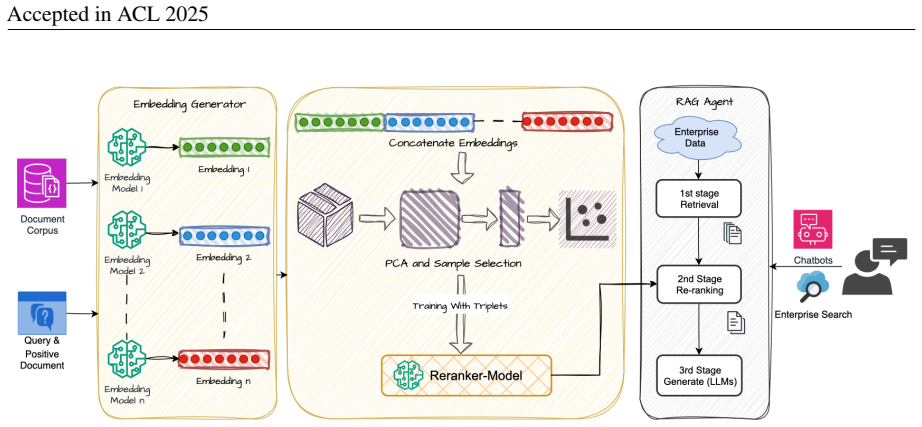
The load-bearing object is the pair of selection conditions in Equations (5) and (6), applied in the space of $X_{\mathrm{concat}}$, the concatenated output of six bi-encoder embedding models projected with PCA to preserve 95% of the variance. These conditions turn an unlabeled 36,871-document corpus into training triples $(Q, PD, D_{HN})$, and the reranker is trained with the unified contrastive loss of Equation (7), which pulls positive documents closer to the query than hard negatives by a margin. The two inequalities do the work: they force the mined negatives to be semantically close to the query while remaining contextually distinct from the positive, which is what pushes the reranker to separate overlapping acronyms and domain terminology.
What would settle it
Hold out a subset of the 5,250 query-positive pairs as test queries, mine hard negatives with the paper's two conditions, and check whether any held-out positive documents appear among the selected negatives; if they do, reported gains would be inflated. Then fine-tune identical rerankers on negatives chosen by the static conditions and by the reranker's own confidence scores; if the static negatives do not beat reranker-chosen ones, the transfer premise fails.
Extended reading notes
Core claim
The central claim is that hard negatives for re-ranker training should satisfy two semantic inequalities in embedding space. For a query $Q$, a positive document $PD$, and a candidate negative $D$, the authors select $D$ only when $d(Q,D) < d(Q,PD)$ and $d(Q,D) < d(PD,D)$. The first inequality makes the negative semantically closer to the query than the correct answer is, so it is genuinely confusing; the second keeps it contextually distinct from the positive, so it is not a mislabeled duplicate. Distances are cosine distances computed on the PCA-reduced concatenation of six bi-encoder embeddings, and the reranker is fine-tuned with a margin triplet loss. On the internal cloud-services corpus the paper reports MRR@3 rising from 0.42 to 0.57 and MRR@10 from 0.45 to 0.64, with consistent gains on FiQA, Climate-FEVER, and TechQA.
Load-bearing premise
The hard negatives are mined once with fixed bi-encoder embeddings, and the paper assumes those embeddings mark the same documents a cross-encoder reranker finds hard, while also assuming the unlabeled corpus contains no positive documents, including test positives, that end up selected as training negatives.
Editorial extensions
If this is right
- Fine-tuning with these negatives improves MRR@3 from 0.42 to 0.57 and MRR@10 from 0.45 to 0.64 on the internal cloud-services corpus.
- The same negatives transfer: the reranker gains on FiQA, Climate-FEVER, and TechQA, so the selection rule is not overfit to the proprietary corpus.
- The benefit is model-agnostic: every reranker and embedding model tested in Table 4 improves when fine-tuned with the proposed negatives instead of ADORE+STAR negatives.
- Training with hard negatives helps even when annotated data is scarce; MRR@3 reaches 0.50 with 300 training examples and 0.57 by 900, which matters for enterprise domains with little labeled data.
- Short documents benefit more than long documents, indicating that truncation and semantic redundancy in long documents are the next bottleneck.
Reading between the lines
- The selection rule is parameter-free and uses only static embeddings, so it could be reused as a cheap audit of corpus coverage: enterprise teams can inspect which documents are chosen as hard negatives for each query and see whether those documents reveal missing topics or ambiguous terminology.
- A direct test of the paper's transfer assumption would be to mine negatives with the static cosine conditions and separately with the reranker's own relevance scores, then fine-tune identical rerankers on each set; that comparison would separate the value of the rule from the general value of harder negatives.
- Because PCA and the distance conditions are recomputed from the corpus, incremental knowledge-base updates would require rerunning the mining step; a testable extension is to measure how often hard negatives change after adding documents and whether the MRR gain degrades when stale negatives are reused.
- The reported short-document advantage suggests a concrete next experiment: chunk long documents, apply the same two conditions at chunk level, and see whether long-document MRR closes the gap.
Editorial analysis
A structured set of objections, weighed in public.
Referee Report
Summary. The paper proposes a hard-negative mining framework for fine-tuning cross-encoder rerankers in domain-specific retrieval. The method concatenates embeddings from six bi-encoders, applies PCA to reduce dimensionality, and selects hard negatives using two cosine-distance conditions relative to the query and the positive document. The authors report MRR@3 and MRR@10 gains on an internal cloud-services corpus and on FiQA, Climate-FEVER, and TechQA, together with ablations over embedding models, PCA variance thresholds, training-set size, and document length.
Significance. If the reported effects are clean, the paper offers a simple, model-agnostic recipe that is plausible for enterprise deployment: static embedding ensemble, PCA, distance-based hard-negative selection, and triplet fine-tuning. Strengths include the consistent direction of results across multiple reranker models, the public-domain transfer experiments, and the ablation over training-set size. The central empirical claim is currently overstated, and the mining procedure has a validity risk that must be resolved before the significance can be assessed.
major comments (5)
- [Section 3.1 and 3.4] The paper does not establish that the hard-negative mining pool excludes labeled positives or held-out test positives. Section 3.1 introduces a 36,871-document unannotated corpus and 5,250 annotated query-positive pairs without stating whether the positive documents are drawn from that corpus. Section 3.4 then mines hard negatives from the full corpus using only the distance conditions in Eqs. (5) and (6), which never consult relevance labels. As a result, a positive document for a held-out test query could be selected as a training hard negative for another query, and for FiQA, Climate-FEVER, and TechQA the paper gives no statement that labeled relevant documents were removed from the candidate pool. The reported MRR improvements therefore cannot currently be attributed to the proposed criteria.
- [Table 3 and Abstract] The headline '15% and 19% improvements' are absolute percentage-point increases over the no-fine-tuning baseline, not relative gains over the best competitor. In Table 3, MRR@3 rises from 0.42 (baseline) to 0.57 (ours), while ADORE+STAR reaches 0.54; the relative gain over ADORE+STAR is about 5.6%, not 15%. For MRR@10, the relative gain over ADORE+STAR is about 12.3%, not 19%. The abstract and conclusion should be reworded to compare against the strongest baseline, and the tables should report both absolute and relative differences so readers can verify the claimed margins.
- [Section 3.4] Equations (5) and (6) select documents that are close to the query and far from the positive document, but these conditions do not establish contextual irrelevance. A document that is genuinely relevant to the query but was not selected as the labeled positive can satisfy both conditions and be used as a hard negative, corrupting the triplet loss. The paper should either filter candidates by relevance labels or provide evidence, such as manual annotation or retrieval checks, that the selected documents are true negatives.
- [Appendix A.3 and Tables 2-4] The empirical comparisons lack error bars and significance tests. The appendix states that each reported metric is averaged over three runs, but no variance or confidence interval is reported anywhere, and with only 1,000 training queries, differences between adjacent table rows, such as 0.54 versus 0.57 MRR@3 in Table 3, may be within run-to-run noise. Reporting standard deviations and paired significance tests is necessary to support the 'substantial improvements' conclusion.
- [Section 2 and Table 3] The claim of outperforming state-of-the-art negative sampling techniques is stronger than what Table 3 demonstrates, because several methods discussed in the text, including ANCE, LCE, TriSampler, and NV-Retriever, are not included in the experimental comparison. Adding at least one recent dynamic hard-negative baseline and one cross-encoder-specific negative sampling method would make the comparison more convincing.
minor comments (5)
- [Section 4.1] There is a typo in 'comparison of of our negative sampling technique'; it should read 'comparison of our negative sampling technique'.
- [Section 3.4] The word 'dynamically' is misleading because the embeddings and negative selections are computed once from fixed bi-encoders and are not updated during reranker training; consider using 'precomputed' or clarifying that the selection is dynamic with respect to each query only.
- [Appendix A.2.3, Eq. (9)] For cross-encoders, the distance is defined as the negative relevance score, so the margin m in Eq. (7) has no natural scale across different score distributions; the paper should state how m is chosen and whether it is tuned per model.
- [Table 7] The table labels 'all-mpnet-base-v2' as multilingual, but this model is an English sentence embedder; the label appears incorrect and should be corrected.
- [Sections 2.1 and A.1] The related work and appendix describe clustering-based negative identification, but the method section uses only distance conditions and PCA; please align the description so that the method and the surrounding text do not disagree.
Circularity Check
No significant circularity: the hard-negative selection rule is not fitted to the evaluation metric, and the reported MRR gains come from held-out queries.
full rationale
The paper's central derivation chain is empirical rather than definitional. Hard negatives are selected by two cosine-distance conditions (Eqs. 5 and 6) in a static bi-encoder embedding space, then used to fine-tune a cross-encoder reranker, whose MRR@3 and MRR@10 are measured on test queries. The selection criteria never consult the test metric or the reranker's own scores, so no result is forced by construction. The single self-citation to Meghwani (2024) appears only as related work ('Further studies have explored advanced methods for negative sampling in cross-encoder models (Meghwani, 2024)') and is not load-bearing for the proposed criteria or the experimental claims. The possible contamination of the mining pool with test positives, noted by the skeptic, would be a data-leakage or experimental-validity concern, not a circularity: it does not make the reported improvements true by definition or by reduction to the method's inputs. The paper is self-contained against external benchmarks and reports held-out evaluations, so no circular step is exhibited.
Assumptions & free parameters
free parameters (3)
- triplet margin m =
not reported
- PCA variance threshold =
95%
- number of hard negatives per query =
not reported
assumptions (4)
- ad hoc to paper The two distance conditions d(Q,D) < d(Q,PD) and d(Q,D) < d(PD,D) define useful hard negatives.
- domain assumption Static general-purpose bi-encoder embeddings, after PCA, capture the semantic distinctions that a separately trained cross-encoder reranker needs to learn.
- domain assumption The unlabeled 36,871-document corpus contains no false negatives for the training queries beyond those guarded by Eq. (6).
- standard math PCA and cosine distance are appropriate similarity measures for this domain.
Cite this review
Pith. "Pith review of Hard Negative Mining for Domain-Specific Retrieval in Enterprise Systems." pith.science (2026). https://pith.science/paper/6EXQ3SQF
@misc{pith2026250518366,
  author       = {Pith},
  title        = {Pith review of: Hard Negative Mining for Domain-Specific Retrieval in Enterprise Systems},
  year         = {2026},
  howpublished = {\url{https://pith.science/paper/6EXQ3SQF}},
  note         = {Machine review of arXiv:2505.18366}
}
read the original abstract
Enterprise search systems often struggle to retrieve accurate, domain-specific information due to semantic mismatches and overlapping terminologies. These issues can degrade the performance of downstream applications such as knowledge management, customer support, and retrieval-augmented generation agents. To address this challenge, we propose a scalable hard-negative mining framework tailored specifically for domain-specific enterprise data. Our approach dynamically selects semantically challenging but contextually irrelevant documents to enhance deployed re-ranking models. Our method integrates diverse embedding models, performs dimensionality reduction, and uniquely selects hard negatives, ensuring computational efficiency and semantic precision. Evaluation on our proprietary enterprise corpus (cloud services domain) demonstrates substantial improvements of 15\% in MRR@3 and 19\% in MRR@10 compared to state-of-the-art baselines and other negative sampling techniques. Further validation on public domain-specific datasets (FiQA, Climate Fever, TechQA) confirms our method's generalizability and readiness for real-world applications.
Figures


Figures from the paper (2 more)


Forward citations
Cited by 1 Pith paper
-
Hybrid AI for Responsive Multi-Turn Online Conversations with Novel Dynamic Routing and Feedback Adaptation
A hybrid chatbot that routes easy queries to canned responses and complex queries to RAG reports 95% accuracy and 180ms latency on an internal support dataset.
Reference graph
Works this paper leans on
- [1]
-
[2]
Amit Agarwal, Srikant Panda, and Kulbhushan Pachauri. 2024 a . Synthetic document generation pipeline for training artificial intelligence models. US Patent App. 17/994,712
work page 2024
-
[3]
Amit Agarwal, Srikant Panda, and Kulbhushan Pachauri. 2025. https://aclanthology.org/2025.coling-industry.9/ FS - DAG : Few shot domain adapting graph networks for visually rich document understanding . In Proceedings of the 31st International Conference on Computational Linguistics: Industry Track, pages 100--114, Abu Dhabi, UAE. Association for Computat...
work page 2025
-
[4]
Amit Agarwal, Hitesh Patel, Priyaranjan Pattnayak, Srikant Panda, Bhargava Kumar, and Tejaswini Kumar. 2024 b . Enhancing document ai data generation through graph-based synthetic layouts. arXiv preprint arXiv:2412.03590
arXiv 2024
-
[5]
Jina AI. 2023. https://huggingface.co/jinaai/jina-reranker-v2-base-multilingual jina-reranker-v2-base-multilingual
work page 2023
-
[6]
Arian Askari, Mohammad Aliannejadi, Evangelos Kanoulas, and Suzan Verberne. 2023. http://arxiv.org/abs/2305.02320 Generating synthetic documents for cross-encoder re-rankers: A comparative study of chatgpt and human experts
work page Pith review arXiv 2023
-
[7]
Jiaqi Bai, Hongcheng Guo, Jiaheng Liu, Jian Yang, Xinnian Liang, Zhao Yan, and Zhoujun Li. 2023. https://arxiv.org/abs/2305.18144 Griprank: Bridging the gap between retrieval and generation via the generative knowledge improved passage ranking . Preprint, arXiv:2305.18144
work page Pith review arXiv 2023
-
[8]
Vittorio Castelli, Rishav Chakravarti, Saswati Dana, Anthony Ferritto, Radu Florian, Martin Franz, Dinesh Garg, Dinesh Khandelwal, Scott McCarley, Mike McCawley, Mohamed Nasr, Lin Pan, Cezar Pendus, John Pitrelli, Saurabh Pujar, Salim Roukos, Andrzej Sakrajda, Avirup Sil, Rosario Uceda-Sosa, Todd Ward, and Rong Zhang. 2019. https://arxiv.org/abs/1911.0298...
arXiv 2019
Show all 63 references
-
[9]
Cohere. 2023 a . Cohere-embed-multilingual-v3.0. Available at: https://cohere.com/blog/introducing-embed-v3
2023
-
[10]
Cohere. 2023 b . Reranker model. Available at: https://docs.cohere.com/v2/docs/reranking-with-cohere
2023
-
[11]
Moreira, Radek Osmulski, Mengyao Xu, Ronay Ak, Benedikt Schifferer, and Even Oldridge
Gabriel de Souza P. Moreira, Radek Osmulski, Mengyao Xu, Ronay Ak, Benedikt Schifferer, and Even Oldridge. 2024. https://arxiv.org/abs/2407.15831 Nv-retriever: Improving text embedding models with effective hard-negative mining . Preprint, arXiv:2407.15831
2024 arXiv
-
[12]
Thomas Diggelmann, Jordan Boyd-Graber, Jannis Bulian, Massimiliano Ciaramita, and Markus Leippold. 2021. https://arxiv.org/abs/2012.00614 Climate-fever: A dataset for verification of real-world climate claims . Preprint, arXiv:2012.00614
2021 arXiv
-
[13]
Karan Dua, Praneet Pabolu, and Mengqing Guo. 2024. Generating templates for use in synthetic document generation processes. US Patent App. 18/295,765
2024
-
[14]
Karan Dua, Praneet Pabolu, and Ranjeet Kumar Gupta. 2025. Generation of synthetic doctor-patient conversations. US Patent App. 18/495,966
2025
-
[15]
Fangxiaoyu Feng, Yinfei Yang, Daniel Cer, Naveen Arivazhagan, and Wei Wang. 2022. https://arxiv.org/abs/2007.01852 Language-agnostic bert sentence embedding . Preprint, arXiv:2007.01852
2022 arXiv
-
[16]
Luyu Gao and Jamie Callan. 2021. https://doi.org/10.18653/V1/2021.EMNLP-MAIN.75 Condenser: a pre-training architecture for dense retrieval . EMNLP 2021 - 2021 Conference on Empirical Methods in Natural Language Processing, Proceedings, pages 981--993
2021 doi
-
[17]
Michael Glass, Gaetano Rossiello, Md Faisal Mahbub Chowdhury, Ankita Naik, Pengshan Cai, and Alfio Gliozzo. 2022. https://doi.org/10.18653/v1/2022.naacl-main.194 R e2 G : Retrieve, rerank, generate . In Proceedings of the 2022 Conference of the North American Chapter of the As...
2022 doi
-
[18]
Biyang Guo, Xin Zhang, Ziyuan Wang, Minqi Jiang, Jinran Nie, Yuxuan Ding, Jianwei Yue, and Yupeng Wu. 2023. https://arxiv.org/abs/2301.07597v1 How close is chatgpt to human experts? comparison corpus, evaluation, and detection
2023 arXiv
-
[19]
Kelvin Guu, Kenton Lee, Zora Tung, Panupong Pasupat, and Ming-Wei Chang. 2020. Realm: Retrieval-augmented language model pre-training
2020
-
[20]
EK Jasila, N Saleena, and KA Abdul Nazeer. 2023. An efficient document clustering approach for devising semantic clusters. Cybernetics and Systems, pages 1--18
2023
-
[21]
Vladimir Karpukhin, Barlas Oğuz, Sewon Min, Patrick Lewis, Ledell Wu, Sergey Edunov, Danqi Chen, and Wen Tau Yih. 2020. https://doi.org/10.18653/V1/2020.EMNLP-MAIN.550 Dense passage retrieval for open-domain question answering . EMNLP 2020 - 2020 Conference on Empirical Method...
2020 doi
-
[22]
Chankyu Lee, Rajarshi Roy, Mengyao Xu, Jonathan Raiman, Mohammad Shoeybi, Bryan Catanzaro, and Wei Ping. 2024. Nv-embed: Improved techniques for training llms as generalist embedding models. arXiv preprint arXiv:2405.17428
2024 arXiv
-
[23]
Fulu Li, Zhiwen Xie, and Guangyou Zhou. 2024. https://doi.org/10.1109/ICASSP48485.2024.10446388 Theme-enhanced hard negative sample mining for open-domain question answering . In ICASSP 2024 - 2024 IEEE International Conference on Acoustics, Speech and Signal Processing (ICASS...
2024
-
[24]
Xianming Li and Jing Li. 2023. Angle-optimized text embeddings. arXiv preprint arXiv:2309.12871
2023 arXiv
-
[25]
Ye Liu, Kazuma Hashimoto, Yingbo Zhou, Semih Yavuz, Caiming Xiong, and Philip S. Yu. 2021. https://api.semanticscholar.org/CorpusID:240288895 Dense hierarchical retrieval for open-domain question answering . In Conference on Empirical Methods in Natural Language Processing
2021
-
[26]
Sean MacAvaney, Andrew Yates, Arman Cohan, and Nazli Goharian. 2019. https://doi.org/10.1145/3331184.3331317 Cedr: Contextualized embeddings for document ranking . SIGIR 2019 - Proceedings of the 42nd International ACM SIGIR Conference on Research and Development in Informatio...
2019
-
[27]
Andrzej Ma \'c kiewicz and Waldemar Ratajczak. 1993. Principal components analysis (pca). Computers & Geosciences, 19(3):303--342
1993
-
[28]
Leland McInnes, John Healy, and James Melville. 2020. https://arxiv.org/abs/1802.03426 Umap: Uniform manifold approximation and projection for dimension reduction . Preprint, arXiv:1802.03426
2020 arXiv
-
[29]
Hansa Meghwani. 2024. https://arxiv.org/abs/2411.02404 Enhancing retrieval performance: An ensemble approach for hard negative mining . Preprint, arXiv:2411.02404
2024 arXiv
-
[30]
Vivek Mehta, Mohit Agarwal, and Rohit Kumar Kaliyar. 2024. A comprehensive and analytical review of text clustering techniques. International Journal of Data Science and Analytics, pages 1--20
2024
-
[31]
Rui Meng, Ye Liu, Shafiq Rayhan Joty, Caiming Xiong, Yingbo Zhou, and Semih Yavuz. 2024 a . https://huggingface.co/Salesforce/SFR-Embedding-2_R Sfr-embedding-2: Advanced text embedding with multi-stage training
2024
-
[32]
Rui Meng, Ye Liu, Shafiq Rayhan Joty, Caiming Xiong, Yingbo Zhou, and Semih Yavuz. 2024 b . https://blog.salesforceairesearch.com/sfr-embedded-mistral/ Sfr-embedding-mistral: Enhance text retrieval with transfer learning . Salesforce AI Research Blog
2024
-
[33]
Thanh-Do Nguyen, Chi Minh Bui, Thi-Hai-Yen Vuong, and Xuan-Hieu Phan. 2022. Passage-based bm25 hard negatives: A simple and effective negative sampling strategy for dense retrieval
2022
-
[34]
Rodrigo Nogueira and Kyunghyun Cho. 2019. https://arxiv.org/abs/1901.04085v5 Passage re-ranking with bert
2019 arXiv
-
[35]
Rodrigo Nogueira, Wei Yang, Kyunghyun Cho, and Jimmy Lin. 2019. Multi-stage document ranking with bert
2019
-
[36]
Morris, Brandon Duderstadt, and Andriy Mulyar
Zach Nussbaum, John X. Morris, Brandon Duderstadt, and Andriy Mulyar. 2024. https://arxiv.org/abs/2402.01613 Nomic embed: Training a reproducible long context text embedder . Preprint, arXiv:2402.01613
2024 arXiv
-
[37]
Praneet Pabolu, Karan Dua, and Sriram Chaudhury. 2024 a . Multi-lingual natural language generation. US Patent App. 18/318,315
2024
-
[38]
Praneet Pabolu, Karan Dua, and Sriram Chaudhury. 2024 b . Multi-lingual natural language generation. US Patent App. 18/318,327
2024
-
[39]
Srikant Panda, Amit Agarwal, Gouttham Nambirajan, and Kulbhushan Pachauri. 2025 a . Out of distribution element detection for information extraction. US Patent App. 18/347,983
2025
-
[40]
Srikant Panda, Amit Agarwal, and Kulbhushan Pachauri. 2025 b . Techniques of information extraction for selection marks. US Patent App. 18/240,344
2025
-
[41]
Hitesh Laxmichand Patel, Amit Agarwal, Arion Das, Bhargava Kumar, Srikant Panda, Priyaranjan Pattnayak, Taki Hasan Rafi, Tejaswini Kumar, and Dong-Kyu Chae. 2025. Sweeval: Do llms really swear? a safety benchmark for testing limits for enterprise use. In Proceedings of the 202...
2025
-
[42]
Hitesh Laxmichand Patel, Amit Agarwal, Bhargava Kumar, Karan Gupta, and Priyaranjan Pattnayak. 2024. Llm for barcodes: Generating diverse synthetic data for identity documents. arXiv preprint arXiv:2411.14962
2024 arXiv
-
[43]
Priyaranjan Pattnayak, Amit Agarwal, Hansa Meghwani, Hitesh Laxmichand Patel, and Srikant Panda. 2025 a . Hybrid ai for responsive multi-turn online conversations with novel dynamic routing and feedback adaptation. In Proceedings of the 4th International Workshop on Knowledge-...
2025
-
[44]
Priyaranjan Pattnayak, Hitesh Laxmichand Patel, and Amit Agarwal. 2025 b . https://arxiv.org/abs/2504.16977 Tokenization matters: Improving zero-shot ner for indic languages . Preprint, arXiv:2504.16977
2025 arXiv
-
[45]
Priyaranjan Pattnayak, Hitesh Laxmichand Patel, Amit Agarwal, Bhargava Kumar, Srikant Panda, and Tejaswini Kumar. 2025 c . https://arxiv.org/abs/2502.13108 Clinical qa 2.0: Multi-task learning for answer extraction and categorization . Preprint, arXiv:2502.13108
2025 arXiv
-
[46]
Ronak Pradeep, Yuqi Liu, Xinyu Zhang, Yilin Li, Andrew Yates, and Jimmy Lin. 2022. https://doi.org/10.1007/978-3-030-99736-6_44 Squeezing water from a stone: A bag of tricks for further improving cross-encoder effectiveness for reranking . In Lecture Notes in Computer Science ...
2022 doi
-
[47]
Yingqi Qu, Yuchen Ding, Jing Liu, Kai Liu, Ruiyang Ren, Wayne Xin Zhao, Daxiang Dong, Hua Wu, and Haifeng Wang. 2020. Rocketqa: An optimized training approach to dense passage retrieval for open-domain question answering
2020
-
[48]
Colin Raffel, Noam Shazeer, Adam Roberts, Katherine Lee, Sharan Narang, Michael Matena, Yanqi Zhou, Wei Li, and Peter J. Liu. 2020. http://jmlr.org/papers/v21/20-074.html Exploring the limits of transfer learning with a unified text-to-text transformer . Journal of Machine Lea...
2020
-
[49]
Nils Reimers and Iryna Gurevych. 2019. https://huggingface.co/sentence-transformers/all-mpnet-base-v2 Sentence-bert: Sentence embeddings using siamese bert-networks . In Proceedings of the 2019 Conference on Empirical Methods in Natural Language Processing
2019
-
[50]
S. E. Robertson and S. Walker. 1994. https://doi.org/10.1007/978-1-4471-2099-5_24 Some Simple Effective Approximations to the 2-Poisson Model for Probabilistic Weighted Retrieval , pages 232--241. Springer London
1994 doi
-
[51]
Saba Sturua, Isabelle Mohr, Mohammad Kalim Akram, Michael Günther, Bo Wang, Markus Krimmel, Feng Wang, Georgios Mastrapas, Andreas Koukounas, Andreas Koukounas, Nan Wang, and Han Xiao. 2024. https://arxiv.org/abs/2409.10173 jina-embeddings-v3: Multilingual embeddings with task...
2024 arXiv
-
[52]
TheFinAI. 2018. https://huggingface.co/datasets/TheFinAI/fiqa-sentiment-classification Fiqa: A financial question answering dataset . Available at Hugging Face
2018
-
[53]
Laurens Van der Maaten and Geoffrey Hinton. 2008. Visualizing data using t-sne. Journal of machine learning research, 9(11)
2008
-
[54]
Liang Wang, Nan Yang, Xiaolong Huang, Linjun Yang, Rangan Majumder, and Furu Wei. 2023. Improving text embeddings with large language models. arXiv preprint arXiv:2401.00368
2023 arXiv
-
[55]
Esbensen, Kim H
Svante Wold, Kim H. Esbensen, Kim H. Esbensen, Paul Geladi, and Paul Geladi. 1987. https://doi.org/10.1016/0169-7439(87)80084-9 Principal component analysis . Chemometrics and Intelligent Laboratory Systems, 2:37--52
1987 doi
-
[56]
Shitao Xiao, Zheng Liu, Peitian Zhang, and Niklas Muennighoff. 2023. https://arxiv.org/abs/2309.07597 C-pack: Packaged resources to advance general chinese embedding . Preprint, arXiv:2309.07597
2023 arXiv
-
[57]
Bennett, Junaid Ahmed, and Arnold Overwijk
Lee Xiong, Chenyan Xiong, Ye Li, Kwok-Fung Tang, Jialin Liu, Paul N. Bennett, Junaid Ahmed, and Arnold Overwijk. 2020. http://aka.ms/ance. Approximate nearest neighbor negative contrastive learning for dense text retrieval
2020
-
[58]
Zhen Yang, Zhou Shao, Yuxiao Dong, and Jie Tang. 2024. https://arxiv.org/abs/2402.11855 Trisampler: A better negative sampling principle for dense retrieval . Preprint, arXiv:2402.11855
2024 arXiv
-
[59]
Jingtao Zhan, Jiaxin Mao, Yiqun Liu, Jiafeng Guo, Min Zhang, and Shaoping Ma. 2021. https://doi.org/10.1145/3404835.3462880 Optimizing dense retrieval model training with hard negatives . SIGIR 2021 - Proceedings of the 44th International ACM SIGIR Conference on Research and D...
2021
-
[60]
Dun Zhang. 2024. https://huggingface.co/dunzhang/stella_en_400M_v5 stella-embedding-model-2024
2024
-
[61]
Xin Zhang, Yanzhao Zhang, Dingkun Long, Wen Xie, Ziqi Dai, Jialong Tang, Huan Lin, Baosong Yang, Pengjun Xie, Fei Huang, et al. 2024. mgte: Generalized long-context text representation and reranking models for multilingual text retrieval. arXiv preprint arXiv:2407.19669
2024 arXiv
-
[62]
online" 'onlinestring :=
ENTRY address archivePrefix author booktitle chapter edition editor eid eprint eprinttype howpublished institution journal key month note number organization pages publisher school series title type volume year doi pubmed url lastchecked label extra.label sort.label short.list...
-
[63]
write newline
" write newline "" before.all 'output.state := FUNCTION n.dashify 't := "" t empty not t #1 #1 substring "-" = t #1 #2 substring "--" = not "--" * t #2 global.max substring 't := t #1 #1 substring "-" = "-" * t #2 global.max substring 't := while if t #1 #1 substring * t #2 gl...
Reviewed August 7, 2026 · model on record in the stance chip above.
Discussion (0). Sign in to comment.