REVIEW 3 major objections 5 minor 1 cited by
TrainVerify: Equivalence-Based Verification for Distributed LLM Training
T0 review · 3 major / 5 minor · reviewed 2026-08-15 · deepseek-v4-flash
Pith's one-line read TrainVerify claims to be the first system to formally verify that a distributed LLM execution plan is mathematically equivalent to the model's logical definition, scaling to Llama3-405B and DeepSeek-V3-671B.
desk verdict Nice systems idea, but the shape-reduction soundness proof is false, so the 'provably correct' claim does not stand; worth refereeing as a systems paper, not as a formal-methods result. read the letter →
The pith
A machine-rendered reading of the paper's core claim, the machinery that carries it, and where it could break.
The reading
What carries the argument
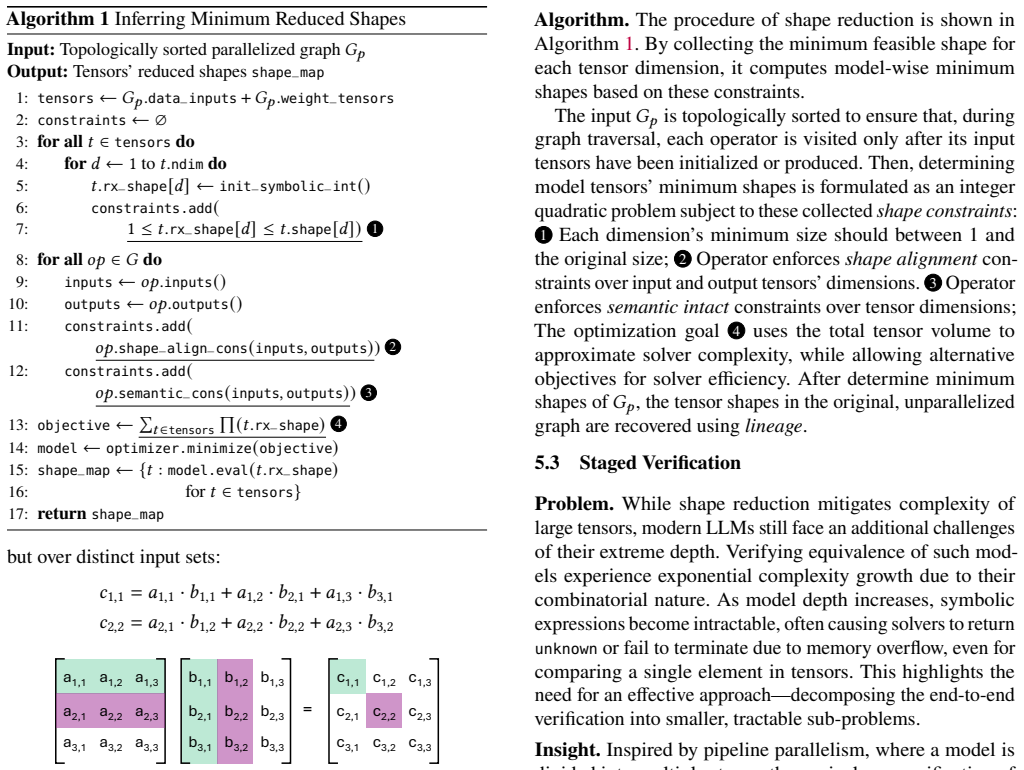
The load-bearing machinery is the shape-reduction theorem, Theorem C.12: for SIMD functions composed from LLM operators, equality at a single output element for every input implies equality at all output elements. The proof chains two relations: kernel permutation-set equivalence ($\theta_f \sim_Q \theta_g$, kernels agree up to a permutation of arguments) and mapping permutation equivalence ($\tau_f \sim_P \tau_g$, linear dependency maps agree up to a permutation), which together give full equality by Lemma C.9. Complementing this, staged verification partitions the logical and parallelized graphs so that each stage's input-output equivalence is checked concurrently and then chained into an end-to-end proof.
What would settle it
Feed TrainVerify two SIMD functions that agree at one output position for all inputs but differ elsewhere, such as $f(x) = [x_0, x_0]$ and $g(x) = [x_0, x_1]$, and check whether it reports full equivalence.
Extended reading notes
Core claim
TrainVerify's central claim is that parallelization equivalence can be formally proven: for every admissible input, a distributed execution plan produces exactly the output of the original logical model, with both represented as dataflow graphs over symbolic reals. The proof rests on showing that the operators in transformer stacks are SIMD functions whose dependency mappings are linear index maps, which permits shape reduction, and on showing that stages of the dual graphs can be verified separately and composed. If successful, the method eliminates entire categories of silent parallelization bugs, including missing communication, wrong rank assignment, and incorrect gradient scaling, at scales up to DeepSeek-V3 (671B parameters) and Llama3-405B.
Load-bearing premise
The load-bearing premise is that equivalence verified on a reduced-shape graph, by checking a single output element, carries over to the original full-size graphs.
Editorial extensions
If this is right
- Any execution plan that passes verification is functionally indistinguishable from the logical model, so the major silent-error classes in communication, partitioning, and scaling are provably absent from the plan.
- Verification cost is independent of original tensor shapes and scales roughly linearly with parallelism degree, so verifying a 671B-parameter plan takes hours, not weeks of training.
- The method plugs into graph-based parallelization frameworks that expose lineage, meaning existing training stacks can adopt it without rewriting the whole stack.
- Because verification works symbolically over real arithmetic, it is immune to the floating-point drift that makes differential testing of parallel training unreliable.
Reading between the lines
- If Theorem C.12 is sound, the single-index check becomes a general certificate for SIMD program rewrites, potentially applicable to verifying inference serving plans, model compression transforms, and tensor compiler optimizations beyond training.
- The staging machinery could be reused to certify each plan a planner generates, turning fast but heuristic parallelization search into a pipeline that emits provably correct plans.
- A stress test for the shape-reduction theorem is to apply it to broadcasts or reductions with non-bijective dependency mappings, where the linear-mapping assumption is most likely to fail.
Signed reviews
Editorial analysis
A structured set of objections, weighed in public.
Referee Report
Summary. The paper presents TrainVerify, a system for verifying that a distributed execution plan for LLM training is functionally equivalent to the logical model definition. TrainVerify represents both the logical model and the parallelized plan as symbolic data flow graphs (sDFGs), uses lineage information to relate tensors across the two graphs, reduces tensor shapes to small representative dimensions, and partitions verification into stages solved in parallel with an SMT solver (Z3). The paper claims that reduced-shape verification provably extends to full-shape models, and reports successful verification of training plans for Llama3 (8B/70B/405B) and DeepSeek-V3 (16B/236B/671B) along with detection of 14 injected bug cases. The central formal claim is that parallelization equivalence can be verified at frontier scale while preserving formal correctness.
Significance. If the formal results were valid, this would be a substantial systems contribution: parallelization equivalence is a crisp and practically motivated correctness property, the lineage-based staged verification design is reasonable, and the scale of the reported evaluations is well beyond prior neural-network equivalence checkers. The paper also honestly documents several limitations, including manual shape-reduction rules and current support for only ZeRO Stage 1. However, the headline promise of provably correct execution plans rests on Theorem 6.9/C.12, which is false as stated. Since shape reduction is the mechanism that makes verification of 671B-parameter plans tractable, the formal guarantee that reduced-shape verification extends to full-size models is unsupported. The paper may still be of interest as an empirical systems study, but as written its central claim is not established.
major comments (3)
- [§6, Theorem 6.9; Appendix C, Theorem C.12] Theorem C.12 (and its main-text version Theorem 6.9) is false. The theorem asserts that if f and g agree at a single output index i for every input, then they agree at every output index for every input. This is not true even for SIMD functions with affine dependency mappings and well-formed kernels, all within the paper's definitions. For example, let f(x) = [x0+x1, x0+x1] and g(x) = [x0+x1, 2*x0]. Both are SIMD functions with the same kernel θ(a,b)=a+b and affine dependency mappings: τ_f(0)=τ_f(1)=[0,1]; τ_g(0)=[0,1], τ_g(1)=[0,0]. At index 0, f(x)[0]=g(x)[0] for all x, satisfying the precondition. At index 1, f(x)[1]=x0+x1 while g(x)[1]=2*x0, which differ at e.g. x0=0, x1=1. The precondition therefore does not imply full equivalence, and the soundness of shape reduction as stated in Section 5.2 is not established.
- [Appendix C, Theorem C.12, proof step 2] The proof step from the single-index precondition to global mapping permutation equivalence is invalid. The text says 'From the precondition, we can derive that ∃P, τ_f(i) ≡_P τ_g(i). By observation 2, we know that the P applies to all dimensions (i.e., τ_f ≡_P τ_g) due to the linear transformation.' This is a non-sequitur: two affine maps can agree at one point without being identical, and a permutation that works at one output index need not extend to all output indices. The counterexample in the previous comment satisfies Observation 2 (both dependency mappings are affine) and still violates the conclusion. The phrase 'due to the linear algebra' does not supply the missing argument, and no such argument appears elsewhere in the appendix.
- [§7, §4] The 'ground truth' logical model is not an independent specification: Section 7 states that the logical model is obtained by invoking nnScaler to emit a single-GPU execution plan, whose correctness is guaranteed by nnScaler, and the parallelized graph is also produced by nnScaler. Both graphs therefore share the same code path, lineage inference, and graph-construction logic. The paper acknowledges in Section 4 that the logical model is assumed correct, but the headline claim of 'provably correct execution plans' is broader than what this setup can establish: verification here checks consistency between two artifacts generated by the same framework, not conformance to an independent model definition.
minor comments (5)
- [§5.2, Algorithm 1; Appendix A] The optimization objective is described inconsistently: Algorithm 1 line 4 minimizes total tensor volume, while Appendix A says TrainVerify minimizes the L1 norm across input dimensions to avoid quadratic solving. The main text should state which objective is actually used.
- [§8.3] The 14 reproduced cases are author-mutated versions of known historical bugs rather than organically discovered failures; this is acceptable for a bug-injection study, but the claim that TrainVerify 'eliminates major classes of real-world parallelization bugs' would be better phrased as detecting representative injected instances of those classes.
- [Appendix C] The appendix contains several typos that should be fixed, including 'opreations', 'dimention reduction', and 'Consdier this x′' in the proof of Theorem C.12.
- [§8.1, Table 3] The end-to-end verification times for the largest models (L3, D3) are reported as single numbers without repeated runs or variance; given the acknowledged seed-dependent variance of Z3 in shape-reduction solving, a brief statement about run-to-run variability would strengthen the scalability claims.
- [Figure 7 caption] The caption reads 'The y-axes use alog2 scale'; this should be 'a log2 scale'.
Circularity Check
No circular derivation found; the verification chain is self-contained relative to its explicit logical-model assumption, though the shape-reduction proof has a serious correctness gap.
full rationale
The central derivation is not circular. TrainVerify's guarantee is explicitly conditional: the logical model is taken as the ground-truth specification, and parallelization equivalence is checked between the logical sDFG and the parallelized sDFG. The lineage information defines how partitioned tensors reconstruct the logical tensors, and the SMT solver checks the resulting algebraic identities; this is a self-contained equivalence argument, not a reduction of the conclusion to the premise. The fact that both graphs are emitted by nnScaler, with overlapping authors, and that the logical model's correctness is attributed to nnScaler, is a scoping assumption rather than a load-bearing derivation: even if the logical model were wrong, the equivalence proof itself would not be circular, only the external meaning of the guarantee would be weakened. The hand-mutated bug cases are evaluation artifacts, not inputs to the derivation. The most significant concern is a correctness gap, not circularity: Theorem C.12 asserts that agreement of two SIMD functions at a single output index for all inputs implies agreement at all output indices, and the proof step deriving global mapping-permutation equivalence 'due to the linear algebra' is mathematically invalid; two linear dependency mappings can agree at one index while disagreeing elsewhere (e.g., f(x)=[[1,1],[1,1]]x and g(x)=[[1,1],[2,0]]x agree at index 0 for all x but differ at index 1). This invalidates the claimed soundness of shape reduction as presented, but it is an unsound inference, not a circular one: the theorem's conclusion is not equivalent to its premise by construction. Therefore, the appropriate finding under the circularity rubric is no significant circularity.
Assumptions & free parameters
assumptions (5)
- domain assumption The logical model emitted by nnScaler is the correct specification.
- ad hoc to paper All LLM operators under verification are SIMD functions with dependency mappings expressible as linear combinations.
- domain assumption Kernel functions are well-formed: every input element influences the output.
- ad hoc to paper User-configured approximation overrides preserve the meaning of verification.
- domain assumption Correctness of nnScaler's single-device execution plan.
Cite this review
Pith. "Pith review of TrainVerify: Equivalence-Based Verification for Distributed LLM Training." pith.science (2026). https://pith.science/paper/6GKIUJ46
@misc{pith2026250615961,
  author       = {Pith},
  title        = {Pith review of: TrainVerify: Equivalence-Based Verification for Distributed LLM Training},
  year         = {2026},
  howpublished = {\url{https://pith.science/paper/6GKIUJ46}},
  note         = {Machine review of arXiv:2506.15961}
}
read the original abstract
Training large language models (LLMs) at scale requires parallel execution across thousands of devices, incurring enormous computational costs. Yet, these costly distributed trainings are rarely verified, leaving them prone to silent errors and potentially wasting millions of GPU hours. We introduce TrainVerify, a system for verifiable distributed training of LLMs. Given a deep learning model's logical specification as the ground truth, TrainVerify formally verifies that a distributed parallel execution plan is mathematically equivalent to it. Direct verification is notoriously difficult due to the sheer scale of LLMs which often involves billions of variables and highly intricate computation graphs. Therefore, TrainVerify introduces shape-reduction techniques and a stage-wise parallel verification algorithm that significantly reduces complexity while preserving formal correctness. TrainVerify scales to frontier LLMs, including the successful verification of the Llama3 (405B) and DeepSeek-V3 (671B) training plans.
Figures


Figures from the paper (6 more)


Forward citations
Cited by 1 Pith paper
-
Verifying Computational Graphs in Production-Grade Distributed Machine Learning Frameworks
Scalify verifies semantic equivalence of baseline and distributed ML computational graphs using equality saturation and relational reasoning, finding real silent errors in production frameworks.
Reference graph
Works this paper leans on
- [1]
-
[2]
CUTLASS: CUDA Templates for Linear Algebra Subroutines.https: //github.com/NVIDIA/cutlass
-
[3]
https://github.com/microsoft/DeepSpeed/commit/a85b6e472534d2e 0b61fe234fae4f6a2332c95bf
DeepSpeed: fix bug where ZeRO2 never uses the reduce method. https://github.com/microsoft/DeepSpeed/commit/a85b6e472534d2e 0b61fe234fae4f6a2332c95bf
-
[4]
DeepSpeed: fix EP grad_scale/grad_norm fix.https://github.com/mic rosoft/DeepSpeed/commit/e5dd5501c10227ae33dce7d5bdd897741dd 3adb7
-
[5]
DeepSpeed: partition balanced return wrong result.https://github.com /deepspeedai/DeepSpeed/commit/2bdf061f4dc8be70878f032d2e48 d2130514f991
-
[6]
Distributed Data Parallelism.https://pytorch.org/docs/stable/notes/ ddp.html
-
[7]
A gentle introduction to torch.autograd.https://pytorch.org/tutorials/ beginner/blitz/autograd_tutorial.html#computational-graph
-
[9]
Llama3: Model Details.https://github.com/meta-llama/llama3/blob/ main/MODEL_CARD.md
Show all 77 references
-
[10]
Megatron Core.https://developer.nvidia.com/megatron-core
-
[11]
Megatron: fix cross entropy loss averaging.https://github.com/NVIDI A/Megatron-LM/commit/adfa873d965b240962be6539cb5d387c5084 16b9
-
[12]
https://github.com/NVIDIA/Megatron-LM/commit/32bbb76d5767fd bf8dc60d4ef07d103cef8aca02
Megatron: fix distopt allgathers with interleaved pipeline parallelism. https://github.com/NVIDIA/Megatron-LM/commit/32bbb76d5767fd bf8dc60d4ef07d103cef8aca02
-
[13]
https://github.com/N VIDIA/Megatron-LM/commit/9ad1944db1f97000377dc5aee36dcd65 6b1ae4a2
Megatron: fix𝑔𝑒𝑡_𝑑𝑎𝑡𝑎_𝑝𝑎𝑟𝑎𝑙𝑙𝑒𝑙 _𝑠𝑟𝑐_𝑟𝑎𝑛𝑘. https://github.com/N VIDIA/Megatron-LM/commit/9ad1944db1f97000377dc5aee36dcd65 6b1ae4a2
-
[14]
https://github.com/NVIDIA/Megatron-LM/commit/6bd7 4b0e84577317c06c303f4dae26d249ab55d1#diff-c27f9f2765a43b5c78 1756ce9fe4b9abcc3618ec96157f5dc67c4a00a7900b73R777
Megatron: fix interleaved schedule with sequence-parallel and overlap- p2p-comm. https://github.com/NVIDIA/Megatron-LM/commit/6bd7 4b0e84577317c06c303f4dae26d249ab55d1#diff-c27f9f2765a43b5c78 1756ce9fe4b9abcc3618ec96157f5dc67c4a00a7900b73R777
-
[15]
Megatron: fix no-interleave pipeline schedule.https://github.com/NVI DIA/Megatron-LM/commit/1f387c2cbdb4ce93f0c885862d570efb66 dca4a4
-
[16]
Megatron: fix scaling down expert grads.https://github.com/NVIDIA/ Megatron-LM/commit/3373641ff1093073181e219265e8c8ee58d858 7c
-
[17]
Megatron: fix tiling, use correct input size for splits.https://github.c om/microsoft/DeepSpeed/commit/c543a41b154a991d50cb6cc8c07db f46b0d2bdf6
-
[18]
https://github.com/NVIDIA/Megatron-LM/issues/673
Megatron issue: Incorrect loss scaling in context parallel code logic. https://github.com/NVIDIA/Megatron-LM/issues/673
-
[19]
Megatron: LinearWithFrozenWeight backward fix when TP > 1.https: //github.com/NVIDIA/Megatron-LM/commit/5fffdfc737f14297bc378 1dfc9e273199d1df52e
-
[20]
https: //github.com/deepspeedai/DeepSpeed/issues/6714
Megatron:MoEdistributedsetupinvokesunnecessaryall-reduce. https: //github.com/deepspeedai/DeepSpeed/issues/6714
-
[21]
https://numpy.org/
NumPy. https://numpy.org/. 13
-
[22]
NVIDIA collective communications library.https://developer.nvidia.c om/nccl
-
[23]
PyTorch: Loss Functions.https://pytorch.org/docs/stable/nn.html#lo ss-functions
-
[24]
Z3 Tactic Online Guide.https://microsoft.github.io/z3guide/docs/str ategies/tactics/
-
[25]
Gpt-4 technical report.arXiv preprint arXiv:2303.08774, 2023
Josh Achiam, Steven Adler, Sandhini Agarwal, Lama Ahmad, Ilge Akkaya, Florencia Leoni Aleman, Diogo Almeida, Janko Altenschmidt, Sam Altman, Shyamal Anadkat, et al. Gpt-4 technical report.arXiv preprint arXiv:2303.08774, 2023
2023 arXiv
-
[26]
Gemini: A family of highly capable multimodal models
Rohan Anil, Sebastian Borgeaud, Yonghui Wu, Jean-Baptiste Alayrac, JiahuiYu,RaduSoricut,JohanSchalkwyk,AndrewMDai,AnjaHauth, Katie Millican, et al. Gemini: A family of highly capable multimodal models. arXiv preprint arXiv:2312.11805, 1, 2023
2023 arXiv
-
[27]
Tensorright: Auto- mated verification of tensor graph rewrites
Jai Arora, Sirui Lu, Devansh Jain, Tianfan Xu, Farzin Houshmand, PhitchayaMangpoPhothilimthana,MohsenLesani,PraveenNarayanan, Karthik Srinivasa Murthy, Rastislav Bodik, et al. Tensorright: Auto- mated verification of tensor graph rewrites. InProceedings of the 52nd ACM SIGPLAN...
2025
-
[28]
Automaticdifferentiationinmachinelearning: a survey.Journal of machine learning research, 18(153):1–43, 2018
Atilim Gunes Baydin, Barak A Pearlmutter, Alexey Andreyevich Radul, andJeffreyMarkSiskind. Automaticdifferentiationinmachinelearning: a survey.Journal of machine learning research, 18(153):1–43, 2018
2018
-
[29]
Maximizing parallelism in distributed training for huge neural networks.arXiv preprint arXiv:2105.14450, 2021
Zhengda Bian, Qifan Xu, Boxiang Wang, and Yang You. Maximizing parallelism in distributed training for huge neural networks.arXiv preprint arXiv:2105.14450, 2021
2021 arXiv
-
[30]
Language models are few-shot learners
Tom Brown, Benjamin Mann, Nick Ryder, Melanie Subbiah, Jared D Kaplan, Prafulla Dhariwal, Arvind Neelakantan, Pranav Shyam, Girish Sastry, Amanda Askell, et al. Language models are few-shot learners. Advances in neural information processing systems, 2020
2020
-
[31]
Tvm: An automated end-to-end optimizing compiler for deep learning
Tianqi Chen, Thierry Moreau, Ziheng Jiang, Lianmin Zheng, Eddie Yan, Haichen Shen, Meghan Cowan, Leyuan Wang, Yuwei Hu, Luis Ceze, et al. Tvm: An automated end-to-end optimizing compiler for deep learning. In 13th USENIX Symposium on Operating Systems Design and Implementation...
2018
-
[32]
The rising costs of training frontier ai models
Ben Cottier, Robi Rahman, Loredana Fattorini, Nestor Maslej, Tamay Besiroglu, and David Owen. The rising costs of training frontier ai models. arXiv preprint arXiv:2405.21015, 2024
2024 arXiv
-
[33]
Z3:Anefficientsmtsolver
LeonardoDeMouraandNikolajBjørner. Z3:Anefficientsmtsolver. In International conference on Tools and Algorithms for the Construction and Analysis of Systems, pages 337–340. Springer, 2008
2008
-
[34]
Deepseek-v3 technical report, 2025
DeepSeek-AI, Aixin Liu, Bei Feng, Bing Xue, Bochao Wu, et al. Deepseek-v3 technical report, 2025
2025
-
[35]
Real-timeself-drivingcarnavigationusingdeepneuralnetwork.In 2018 4th International Conference on Green Technology and Sustainable Development (GTSD), pages 7–12, 2018
Truong-Dong Do, Minh-Thien Duong, Quoc-Vu Dang, and My-Ha Le. Real-timeself-drivingcarnavigationusingdeepneuralnetwork.In 2018 4th International Conference on Green Technology and Sustainable Development (GTSD), pages 7–12, 2018
2018
-
[36]
The llama 3 herd of models.arXiv preprint arXiv:2407.21783, 2024
AbhimanyuDubey,AbhinavJauhri,AbhinavPandey,AbhishekKadian, Ahmad Al-Dahle, Aiesha Letman, Akhil Mathur, Alan Schelten, Amy Yang, Angela Fan, et al. The llama 3 herd of models.arXiv preprint arXiv:2407.21783, 2024
2024 arXiv
-
[37]
On neural network equivalence checking using smt solvers, 2022
CharisEleftheriadis,NikolaosKekatos,PanagiotisKatsaros,andStavros Tripakis. On neural network equivalence checking using smt solvers, 2022
2022
-
[38]
Gpipe: Efficient training of giant neural networks using pipeline parallelism
Yanping Huang, Youlong Cheng, Ankur Bapna, Orhan Firat, Dehao Chen,MiaChen,HyoukJoongLee,JiquanNgiam,QuocVLe,Yonghui Wu, et al. Gpipe: Efficient training of giant neural networks using pipeline parallelism. InAdvances in Neural Information Processing Systems, pages 103–112, 2019
2019
-
[39]
Oobleck: Resilient distributed training of large models using pipelinetemplates
Insu Jang, Zhenning Yang, Zhen Zhang, Xin Jin, and Mosharaf Chowd- hury. Oobleck: Resilient distributed training of large models using pipelinetemplates. InProceedingsofthe29thSymposiumonOperating Systems Principles, SOSP ’23, page 382–395, New York, NY, USA,
-
[40]
Taso: optimizing deep learning computation with automatic generation of graph substitutions
Zhihao Jia, Oded Padon, James Thomas, Todd Warszawski, Matei Zaharia, and Alex Aiken. Taso: optimizing deep learning computation with automatic generation of graph substitutions. InProceedings of the 27th ACM Symposium on Operating Systems Principles, pages 47–62, 2019
2019
-
[41]
John Jumper, Richard Evans, Alexander Pritzel, Tim Green, Michael Figurnov, Olaf Ronneberger, Kathryn Tunyasuvunakool, Russ Bates, AugustinŽídek,AnnaPotapenko,etal.Highlyaccurateproteinstructure prediction with alphafold.Nature, 596(7873):583–589, 2021
2021
-
[42]
Scalinglawsforneurallanguagemodels
Jared Kaplan, Sam McCandlish, Tom Henighan, Tom B Brown, Ben- jamin Chess, Rewon Child, Scott Gray, Alec Radford, Jeffrey Wu, and DarioAmodei. Scalinglawsforneurallanguagemodels. arXivpreprint arXiv:2001.08361, 2020
2001 arXiv
-
[43]
Reluplex: An efficient smt solver for verifying deep neural networks
Guy Katz, Clark Barrett, David L Dill, Kyle Julian, and Mykel J Kochenderfer. Reluplex: An efficient smt solver for verifying deep neural networks. In International Conference on Computer Aided Verification, pages 97–117. Springer, 2017
2017
-
[44]
Reducing activation recomputation in large transformer models
Vijay Anand Korthikanti, Jared Casper, Sangkug Lym, Lawrence McAfee, Michael Andersch, Mohammad Shoeybi, and Bryan Catan- zaro. Reducing activation recomputation in large transformer models. Proceedings of Machine Learning and Systems, 2023
2023
-
[45]
Se- quence parallelism: Making 4d parallelism possible.arXiv preprint arXiv:2105.13120, 2021
Shenggui Li, Fuzhao Xue, Yongbin Li, and Yang You. Se- quence parallelism: Making 4d parallelism possible.arXiv preprint arXiv:2105.13120, 2021
2021 arXiv
-
[46]
nnScaler: Constraint-guided parallelization plan generation for deep learning training
Zhiqi Lin, Youshan Miao, Quanlu Zhang, Fan Yang, Yi Zhu, Cheng Li, Saeed Maleki, Xu Cao, Ning Shang, Yilei Yang, Weijiang Xu, Mao Yang, Lintao Zhang, and Lidong Zhou. nnScaler: Constraint-guided parallelization plan generation for deep learning training. In18th USENIX Symposiu...
2024
-
[47]
Kochenderfer
Changliu Liu, Tomer Arnon, Christopher Lazarus, Clark Barrett, and Mykel J. Kochenderfer. Algorithms for verifying deep neural networks. arXiv:1903.06758, 2019
1903 arXiv
-
[48]
Aceso: Efficient parallel DNN training through iterative bottleneck alleviation
Guodong Liu, Youshan Miao, Zhiqi Lin, Xiaoxiang Shi, Saeed Maleki, Fan Yang, Yungang Bao, and Sa Wang. Aceso: Efficient parallel DNN training through iterative bottleneck alleviation. InProceedings of the Nineteenth European Conference on Computer Systems, EuroSys ’24, page 16...
2024
-
[49]
Ring attention with blockwise transformers for near-infinite context
Hao Liu, Matei Zaharia, and Pieter Abbeel. Ring attention with blockwise transformers for near-infinite context. arXiv preprint arXiv:2310.01889, 2023
2023 arXiv
-
[50]
Nnsmith: Generating diverse and valid test cases for deep learning compilers
Jiawei Liu, Jinkun Lin, Fabian Ruffy, Cheng Tan, Jinyang Li, Aurojit Panda, and Lingming Zhang. Nnsmith: Generating diverse and valid test cases for deep learning compilers. InProceedings of the 28th ACM International Conference on Architectural Support for Programming Languag...
2023
-
[51]
Uncovering nested data parallelism and data reuse in dnn computation with fractaltensor
SiranLiu,ChengxiangQi,YingCao,ChaoYang,WeifangHu,Xuanhua Shi, Fan Yang, and Mao Yang. Uncovering nested data parallelism and data reuse in dnn computation with fractaltensor. InProceedings of the ACM SIGOPS 30th Symposium on Operating Systems Principles, pages 160–177, 2024
2024
-
[52]
Differential testing for software
William M McKeeman. Differential testing for software. Digital Technical Journal, 10(1):100–107, 1998
1998
-
[53]
Smith, Mateusz Paprocki, Ondřej Čertík, Sergey B
Aaron Meurer, Christopher P. Smith, Mateusz Paprocki, Ondřej Čertík, Sergey B. Kirpichev, Matthew Rocklin, AMiT Kumar, Sergiu Ivanov, Jason K. Moore, Sartaj Singh, Thilina Rathnayake, Sean Vig, Brian E. Granger, Richard P. Muller, Francesco Bonazzi, Harsh Gupta, Shivam Vats, F...
2017
-
[54]
Towardsformalrepairandverificationofindustry-scaledeep 14 neural networks
Satoshi Munakata, Susumu Tokumoto, Koji Yamamoto, and Kazuki Munakata. Towardsformalrepairandverificationofindustry-scaledeep 14 neural networks. In2023 IEEE/ACM 45th International Conference on Software Engineering: Companion Proceedings (ICSE-Companion), pages 360–364. IEEE, 2023
2023
-
[55]
Pipedream: generalized pipeline parallelism for dnn training
Deepak Narayanan, Aaron Harlap, Amar Phanishayee, Vivek Seshadri, Nikhil R Devanur, Gregory R Ganger, Phillip B Gibbons, and Matei Zaharia. Pipedream: generalized pipeline parallelism for dnn training. In Proceedings of the 27th ACM Symposium on Operating Systems Principles, p...
2019
-
[56]
Automatic differentiation in pytorch
Adam Paszke, Sam Gross, Soumith Chintala, Gregory Chanan, Edward Yang, Zachary DeVito, Zeming Lin, Alban Desmaison, Luca Antiga, and Adam Lerer. Automatic differentiation in pytorch. 2017
2017
-
[57]
PyTorch.https://pytorch.org//
PyTorch Team. PyTorch.https://pytorch.org//
-
[58]
Deepspeed-moe: Advancing mixture-of-experts infer- ence and training to power next-generation ai scale
Samyam Rajbhandari, Conglong Li, Zhewei Yao, Minjia Zhang, Reza Yazdani Aminabadi, Ammar Ahmad Awan, Jeff Rasley, and Yuxiong He. Deepspeed-moe: Advancing mixture-of-experts infer- ence and training to power next-generation ai scale. InInternational conference on machine learn...
2022
-
[59]
Zero:Memoryoptimizationtowardstrainingatrillionparametermodels
Samyam Rajbhandari, Jeff Rasley, Olatunji Ruwase, and Yuxiong He. Zero:Memoryoptimizationtowardstrainingatrillionparametermodels. arXiv preprint arXiv:1910.02054, 2019
1910 arXiv
-
[60]
Deepspeed: System optimizations enable training deep learning models with over 100 billion parameters
Jeff Rasley, Samyam Rajbhandari, Olatunji Ruwase, and Yuxiong He. Deepspeed: System optimizations enable training deep learning models with over 100 billion parameters. InProceedings of the 26th ACM SIGKDD International Conference on Knowledge Discovery & Data Mining, pages 35...
2020
-
[61]
Megatron-LM: Training multi- billion parameter language models using gpu model parallelism.arXiv preprint arXiv:1909.08053, 2019
Mohammad Shoeybi, Mostofa Patwary, Raul Puri, Patrick LeGresley, Jared Casper, and Bryan Catanzaro. Megatron-LM: Training multi- billion parameter language models using gpu model parallelism.arXiv preprint arXiv:1909.08053, 2019
1909 arXiv
-
[62]
Deepid3: Face recognition with very deep neural networks, 2015
Yi Sun, Ding Liang, Xiaogang Wang, and Xiaoou Tang. Deepid3: Face recognition with very deep neural networks, 2015
2015
-
[63]
Perturbing numerical calculations for statistical analysis of floating-point program (in) stability
Enyi Tang, Earl Barr, Xuandong Li, and Zhendong Su. Perturbing numerical calculations for statistical analysis of floating-point program (in) stability. InProceedings of the 19th international symposium on Software testing and analysis, pages 131–142, 2010
2010
-
[64]
PyTorch DistributedTensor (DTensor).https://github.c om/pytorch/pytorch/tree/master/torch/distributed/_tensor
PyTorch Team. PyTorch DistributedTensor (DTensor).https://github.c om/pytorch/pytorch/tree/master/torch/distributed/_tensor
-
[65]
TorchFX.https://pytorch.org/docs/stable/fx.html
PyTorch Team. TorchFX.https://pytorch.org/docs/stable/fx.html
-
[66]
TorchScript.https://pytorch.org/docs/stable/jit.html
PyTorch Team. TorchScript.https://pytorch.org/docs/stable/jit.html
-
[67]
Revisiting differential verification: Equivalence verification with confidence
Samuel Teuber, Philipp Kern, Marvin Janzen, and Bernhard Beck- ert. Revisiting differential verification: Equivalence verification with confidence. arXiv preprint arXiv:2410.20207, 2024
2024 arXiv
-
[68]
Llama 2: Open foundation and fine- tuned chat models.arXiv preprint arXiv:2307.09288, 2023
Hugo Touvron, Louis Martin, Kevin Stone, Peter Albert, Amjad Alma- hairi, Yasmine Babaei, Nikolay Bashlykov, Soumya Batra, Prajjwal Bhargava, Shruti Bhosale, et al. Llama 2: Open foundation and fine- tuned chat models.arXiv preprint arXiv:2307.09288, 2023
2023 arXiv
-
[69]
Attention is all you need.Advances in neural information processing systems, 30, 2017
Ashish Vaswani, Noam Shazeer, Niki Parmar, Jakob Uszkoreit, Llion Jones, Aidan N Gomez, Łukasz Kaiser, and Illia Polosukhin. Attention is all you need.Advances in neural information processing systems, 30, 2017
2017
-
[70]
{PET}: Optimizing tensor programs with partially equivalent transformationsandautomatedcorrections
Haojie Wang, Jidong Zhai, Mingyu Gao, Zixuan Ma, Shizhi Tang, Liyan Zheng, Yuanzhi Li, Kaiyuan Rong, Yuanyong Chen, and Zhihao Jia. {PET}: Optimizing tensor programs with partially equivalent transformationsandautomatedcorrections. In 15thUSENIXSymposium on Operating Systems D...
2021
-
[71]
Beta-CROWN: Efficient bound propagation with per-neuron split constraints for complete and incomplete neural network verification
Shiqi Wang, Huan Zhang, Kaidi Xu, Xue Lin, Suman Jana, Cho-Jui Hsieh, and J Zico Kolter. Beta-CROWN: Efficient bound propagation with per-neuron split constraints for complete and incomplete neural network verification. Advances in Neural Information Processing Systems, 34, 2021
2021
-
[72]
Program slicing.IEEE Transactions on software engi- neering, (4):352–357, 1984
Mark Weiser. Program slicing.IEEE Transactions on software engi- neering, (4):352–357, 1984
1984
-
[73]
XLA — TensorFlow, compiled.https: //developers.googleblog.com/2017/03/xla-tensorflow-compiled.html
XLA and TensorFlow teams. XLA — TensorFlow, compiled.https: //developers.googleblog.com/2017/03/xla-tensorflow-compiled.html
2017
-
[74]
Oneflow: Redesign the distributed deep learning framework from scratch.arXiv preprint arXiv:2110.15032, 2021
Jinhui Yuan, Xinqi Li, Cheng Cheng, Juncheng Liu, Ran Guo, Sheng- hang Cai, Chi Yao, Fei Yang, Xiaodong Yi, Chuan Wu, et al. Oneflow: Redesign the distributed deep learning framework from scratch.arXiv preprint arXiv:2110.15032, 2021
-
[75]
Gonzalez, and Ion Stoica
Lianmin Zheng, Chengfan Jia, Minmin Sun, Zhao Wu, Cody Hao Yu, Ameer Haj-Ali, Yida Wang, Jun Yang, Danyang Zhuo, Koushik Sen, Joseph E. Gonzalez, and Ion Stoica. Ansor: Generating High- Performance tensor programs for deep learning. In14th USENIX Symposium on Operating Systems...
2020
-
[76]
Alpa: Automating inter-and{Intra-Operator} parallelism for distributed deep learning
Lianmin Zheng, Zhuohan Li, Hao Zhang, Yonghao Zhuang, Zhifeng Chen, Yanping Huang, Yida Wang, Yuanzhong Xu, Danyang Zhuo, Eric P Xing, et al. Alpa: Automating inter-and{Intra-Operator} parallelism for distributed deep learning. In16th USENIX Symposium on Operating Systems Desi...
2022
-
[77]
striding
In this case, the combination of1 and 4 results in the final gradients being over-scaled by a factor ofCP. TrainVerifyeliminatessuchbugsbycomparingdataflow of shape-reduced symbolic tensors. While the violation could be detected earlier via𝐿 == 𝐿0, practical implementations ty...
-
[2023]
Association for Computing Machinery
Reviewed August 15, 2026 · model on record in the stance chip above.
Discussion (0). Continue with ORCID to comment.