REVIEW 3 major objections 8 minor 93 references
An intrinsic magnetic field in Ernst black-hole spacetime imprints characteristic phase, amplitude, and spectral features on gravitational waves from zoom–whirl EMRI orbits.
Reviewed by Pith at T0; open to challenge. T0 means a machine referee read the full paper against a public rubric. the ladder, T0–T4 →
T0 review · grok-4.5
2026-07-31 22:25 UTC pith:6GSBXPTS
load-bearing objection Clean zoom-whirl/kludge application to Ernst; the orbit maps are fine, but the LISA-detectability claim rests on a flat-space radiation map the geometry does not support. the 3 major comments →
Gravitational wave signatures of magnetized Ernst black hole
The pith
A machine-rendered reading of the paper's core claim, the machinery that carries it, and where it could break.
Core claim
In the magnetized Ernst geometry, an intrinsic magnetic field parameter B changes the structure of periodic timelike orbits and imprints measurable features—phase shifts, amplitude changes, and rearranged harmonic peaks—on the gravitational waves those orbits emit, so that space-based detectors could in principle distinguish magnetized black-hole spacetimes from ordinary Schwarzschild ones.
What carries the argument
Zoom–whirl classification of periodic orbits by the rational frequency ratio q = w + v/z, combined with exact geodesic integration in the Ernst metric and the quadrupole numerical-kludge map from trajectory to h+ and h×. That pipeline turns B-dependent orbital dynamics into time-domain waveforms, Fourier spectra, and characteristic strain curves.
Load-bearing premise
The flat-space quadrupole formula with a simple luminosity distance is assumed to give a reliable waveform even though the Ernst spacetime is not asymptotically flat.
What would settle it
Recompute the same (z, w, v) orbits with a wave-extraction method valid in non-asymptotically flat magnetized geometries; if the B-dependent phase, amplitude, and spectral-peak shifts disappear or fall below LISA/Taiji/Tianqin sensitivity for the plotted B values, the central claim fails.
If this is right
- GW templates for EMRIs around magnetized black holes must include B as a parameter that shifts phase and spectral peaks.
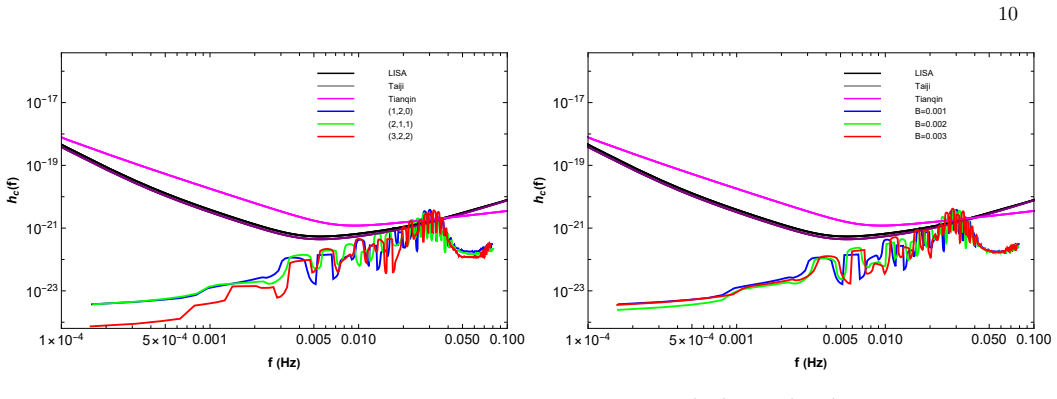
- Portions of the characteristic strain for the studied (z, w, v) orbits lie above LISA, Taiji, and Tianqin noise curves, so detection is in principle possible.
- Higher zoom number z produces more intricate waveform substructure that tracks the leafed orbital geometry.
- Comparing observed millihertz EMRI signals with pure Schwarzschild templates could constrain or reveal an intrinsic magnetic field near the central black hole.
Where Pith is reading between the lines
- Because Ernst spacetime is not asymptotically flat, any real data analysis would still need matched filters or self-force waveforms built in that geometry before B could be claimed from a detection.
- The same (z, w, v) pipeline could be repeated for rotating or charged magnetized solutions to test whether spin and B leave degenerate or separable imprints.
- If B mainly rescales effective energy and angular momentum at fixed q, multi-orbit Bayesian inference on frequency ratios might separate magnetic effects from mass and spin more cleanly than amplitude alone.
Editorial analysis
A structured set of objections, weighed in public.
Referee Report
Summary. The manuscript studies gravitational-wave emission from periodic timelike equatorial orbits of a neutral test particle around a magnetized Ernst (Schwarzschild–Melvin) black hole. Bound geodesics are classified with the Levin–Perez-Giz (z,w,v) zoom–whirl scheme, trajectories are integrated numerically, and waveforms are constructed with the standard numerical-kludge prescription: flat-space quadrupole formula, TT projection onto a detector frame, DFT spectra, and characteristic strains compared against LISA/Taiji/TianQin sensitivity curves. The authors find that the magnetic parameter B shifts waveform phase/amplitude and spectral peaks, and that portions of the characteristic-strain spectra lie above detector noise curves, which they interpret as evidence that magnetic-field imprints could be detectable. The geodesic machinery (§III) and the kludge waveform pipeline (§IV) follow standard, established practice; the novel element is applying them to this particular non-asymptotically-flat background.
Significance. If the analysis holds up in its domain of validity, the paper provides concrete, reproducible waveform templates for zoom–whirl EMRI orbits in a magnetized background, with clearly identified free parameters (B, E, L, mass ratio, distance, sky angles) and an explicit comparison against named future detectors — a falsifiable, testable setup. The (z,w,v) classification for this spacetime is a modest but useful extension of existing periodic-orbit catalogues. However, the significance is presently capped by two issues: the radiation-extraction step assumes asymptotic flatness in a spacetime that the paper itself states is not asymptotically flat, so the absolute strain levels in Figs. 4–8 lack a defined meaning as predictions of the Ernst solution; and the dimensionless B values used correspond to physical field strengths orders of magnitude above the astrophysical estimates the introduction itself cites, which undercuts the "potentially detectable" framing.
major comments (3)
- [§IV, Eqs. (4.1)–(4.4); Fig. 8] The waveform model uses the flat-space quadrupole formula with a luminosity distance D_L and standard TT projection. The Ernst spacetime is explicitly stated to be non-asymptotically flat (§II), and indeed on the equator g_ϕϕ = r²/(1+B²r²)² decreases at large r; there is no asymptotic Minkowski region, no Bondi frame, and no invariant meaning for D_L or for flux fall-off ∝ 1/D_L². The entire detector-level conclusion — the absolute strain amplitudes in Figs. 4–5 and the above-threshold portions of Fig. 8 — depends on this map. This is not fatal if the authors restrict the claim to the regime where the near-orbit zone is approximately flat (B²r² ≪ 1; for BM = 0.001 and orbital radii r ≲ 30M this is well satisfied), but the manuscript must (i) state this validity regime explicitly, (ii) verify numerically that all plotted orbits satisfy B²r² ≪ 1 at all turning points, and (iii) qualify the
- [§III, text after Eq. (3.12)] The statement 'V_eff(r) → 1 as r → +∞, as expected for an asymptotically flat spacetime' is incorrect for this metric. With Λ(r) = 1 + B²r² (equatorial), V_eff = f(r)Λ²(1 + L²Λ²/r²) grows like B⁴r⁴ for any B ≠ 0: the potential diverges at large r and there is no escape to infinity at E > 1. The bound-state structure is in fact effective confinement, standard for Melvin-type geometries. This error does not corrupt the small-r orbit numerics used later, but the discussion of bound vs. unbound orbits and the claim that 'particles with energy E > 1 can escape to infinity' must be corrected, since the classification of bound orbits is part of the paper's load-bearing machinery.
- [§I and §IV (parameter choice B = 0.001–0.003, M = 1); Figs. 5, 7, 8] For M = 10⁶ M_⊙, the geometrized values BM = 10⁻³–3×10⁻³ correspond to physical field strengths of order 10¹⁰–10¹¹ G (B_phys ≈ 2.4×10¹⁹ G × BM × M_⊙/M), roughly six orders of magnitude above the ∼10⁴ G the introduction itself quotes for SMBHs (and far above the M87*/Sgr A* and V404 Cygni values also cited). The detectability claim in Fig. 8 is driven by these large-B cases; at astrophysically realistic B the waveform modifications would be undetectably small. The paper should either (i) add the conversion to physical units and an honest assessment of which B values are astrophysically motivated, or (ii) reframe the result as a proof-of-principle for strong fields (e.g., primordial or magnetar-scale environments) rather than generic EMRI sources. As written, the abstract's 'potentially detectable' language is not supported for realistic field strengths.
minor comments (8)
- [§IV, Eq. (4.1)] The normalization A = c⁴D_L/(2G) written with 'G = c = 1' is confusing: if geometrized units are used, A should just be 2D_L... rather the formula reads h_ij = (2/D_L) Ï_ij. The mixed-unit definition and the reciprocal notation 1/A obscure the standard form; please rewrite cleanly and state the units used in the numerical pipeline.
- [§V] The text states the geodesics 'were solved analytically,' but §III (Eq. 3.13) describes numerical integration, and no closed-form solution is given. Please correct.
- [§III, Eqs. (3.7)–(3.8)] Notation is inconsistent: A(r,θ) in Eq. (2.3) becomes A(r) without noting the equatorial restriction; also f(r,θ) is written where f depends only on r. Minor, but worth tidying.
- [§III] It should be stated explicitly that the test particle is neutral (geodesic motion). In a magnetized background a charged EMRI secondary would experience the Lorentz force, and readers may assume otherwise.
- [§III, Eq. (3.11)] The restriction to equatorial orbits (θ = π/2, θ̇ = 0) is an assumption, not a derived property; non-equatorial orbits are generically expected in an axially symmetric spacetime and could carry qualitatively different waveform content. A sentence justifying (or flagging) this restriction is needed.
- [Fig. 5 caption] Caption punctuation is garbled: 'magnetic field parameter B=0.001: blue, 0.002: green, and 0.003: red'. Also the caption omits the D_L, ι, ζ values used (they appear only in the body text).
- [Fig. 8] The 30-bin running-average smoothing of h_c(f) is a cosmetic choice; please state whether smoothing affects any above/below-threshold conclusion, and ideally show unsmoothed curves or note the smoothing window in detector-relevant bandwidths.
- [References] The bibliography leans heavily on the authors' own related magnetized/periodic-orbit work (e.g., [29],[30],[39],[41],[42],[76]–[80]). Some of these are appropriate, but a few appear peripheral; consider trimming to the directly relevant subset and adding literature on radiation in non-asymptotically-flat (Melvin/Ernst) spacetimes, which is directly relevant to the main caveat above.
Circularity Check
No significant circularity: forward geodesic-plus-quadrupole computation with chosen inputs, not a result forced by definition or self-citation.
full rationale
The paper’s load-bearing chain is: (i) adopt the known magnetized Ernst metric; (ii) integrate timelike geodesics and classify bound orbits by the external Levin–Perez-Giz (z,w,v) scheme; (iii) map those trajectories to h+× via the standard numerical-kludge quadrupole formula; (iv) Fourier-transform and compare characteristic strain to published LISA/Taiji/Tianqin curves. B, E, L, and (z,w,v) are free inputs chosen by the authors; the waveforms and spectral shifts are outputs of that forward map, not algebraic restatements of fitted targets. Self-citations (Shaymatov et al. on magnetized geometries) supply background context and do not underwrite a uniqueness theorem or force the GW result. Methodological concerns about applying a flat-space 1/DL quadrupole map in a non-asymptotically flat Melvin-type spacetime are correctness/validity issues, not circularity. The derivation is self-contained against its own stated inputs; score 0.
Axiom & Free-Parameter Ledger
free parameters (4)
- Magnetic field parameter B =
0.001–0.003 (geometric, M=1)
- Orbital energy E and angular momentum L =
E≈0.95–0.96; L≈3.65–3.7
- EMRI masses, distance, and sky angles =
m=10 M⊙, M=10^6 M⊙, DL=200 Mpc, ι=ζ=π/4
- Characteristic-strain smoothing window =
30 bins
axioms (5)
- domain assumption Magnetized Ernst metric (Eqs. 2.1–2.3) correctly describes the background including electromagnetic field (2.4).
- domain assumption Test-particle timelike geodesics with conserved E,L adequately model short-term EMRI motion (adiabatic, neglect back-reaction).
- standard math Periodic orbits are classified by rational frequency ratio q=w+v/z (Levin & Perez-Giz).
- domain assumption Gravitational radiation is adequately given by the flat-space quadrupole/numerical-kludge formula projected into a detector frame (Eqs. 4.1–4.14).
- ad hoc to paper Equatorial motion (θ=π/2, θ̇=0) captures the relevant GW signatures for this study.
read the original abstract
We investigate gravitational wave (GW) emission from periodic timelike orbits of a test particle around a magnetized Ernst black hole and the gravitational waveforms generated by their orbital dynamics. The bound geodesics are systematically classified using the zoom-whirl representation labeled with three integers $(z,w,v)$. Gravitational waveforms are computed within a numerical framework that combines exact geodesic motion with the quadrupole approximation, which is well-suited to extreme mass-ratio inspirals (EMRIs). This analysis is particularly relevant for assessing the capability of future gravitational-wave observations to detect the effects of magnetic fields. Our results show that an intrinsic magnetic field imprints characteristic features on the GW signal, highlighting GW astronomy as a promising avenue for probing magnetized black hole spacetimes.
Figures


Reference graph
Works this paper leans on
-
[1]
B. P. Abbottet al.(LIGO Scientific, Virgo), Phys. Rev. Lett.116, 061102 (2016), arXiv:1602.03837 [gr-qc]
Pith/arXiv arXiv 2016
-
[2]
B. P. Abbottet al.(LIGO Scientific, Virgo), Phys. Rev. D93, 122003 (2016), arXiv:1602.03839 [gr-qc]
Pith/arXiv arXiv 2016
-
[3]
B. P. Abbottet al.(LIGO Scientific, Virgo), Phys. Rev. Lett.116, 241102 (2016), arXiv:1602.03840 [gr-qc]
Pith/arXiv arXiv 2016
-
[4]
B. P. Abbottet al.(LIGO Scientific, Virgo), Phys. Rev. Lett.116, 131103 (2016), arXiv:1602.03838 [gr-qc]
Pith/arXiv arXiv 2016
-
[5]
In this framework, each periodic orbit is characterized by the parameters (z, w, v)
was employed to distinguish different types of peri- odic orbits around the magnetized black hole. In this framework, each periodic orbit is characterized by the parameters (z, w, v). These results may provide a means to distinguish between magnetized black holes and the Schwarzschild black hole. An EMRI system was ana- lyzed, consisting of a test object ...
-
[6]
J. Levin and G. Perez-Giz, Phys. Rev. D77, 103005 (2008), arXiv:0802.0459 [gr-qc]
Pith/arXiv arXiv 2008
-
[7]
J. Levin, Class. Quant. Grav.26, 235010 (2009), arXiv:0907.5195 [gr-qc]
Pith/arXiv arXiv 2009
-
[8]
V. Misra and J. Levin, Phys. Rev. D82, 083001 (2010), arXiv:1007.2699 [gr-qc]
Pith/arXiv arXiv 2010
-
[9]
G. Z. Babar, A. Z. Babar, and Y.-K. Lim, Phys. Rev. D 96, 084052 (2017), arXiv:1710.09581 [gr-qc]
Pith/arXiv arXiv 2017
-
[10]
Hu and Y.-L
W.-R. Hu and Y.-L. Wu, Natl. Sci. Rev.4, 685 (2017)
2017
-
[11]
J. Luoet al.(TianQin), Class. Quant. Grav.33, 035010 (2016), arXiv:1512.02076 [astro-ph.IM]
Pith/arXiv arXiv 2016
-
[12]
Y. Gong, J. Luo, and B. Wang, Nature Astron.5, 881 (2021), arXiv:2109.07442 [astro-ph.IM]
Pith/arXiv arXiv 2021
-
[13]
Danzmann, Class
K. Danzmann, Class. Quant. Grav.14, 1399 (1997)
1997
-
[14]
B. F. Schutz, Class. Quant. Grav.16, A131 (1999), arXiv:gr-qc/9911034
Pith/arXiv arXiv 1999
-
[15]
J. R. Gair, L. Barack, T. Creighton, C. Cutler, S. L. Larson, E. S. Phinney, and M. Vallisneri, Class. Quant. Grav.21, S1595 (2004), arXiv:gr-qc/0405137
Pith/arXiv arXiv 2004
-
[16]
Amaro-Seoaneet al.(LISA), (2017), arXiv:1702.00786 [astro-ph.IM]
P. Amaro-Seoaneet al.(LISA), (2017), arXiv:1702.00786 [astro-ph.IM]
Pith/arXiv arXiv 2017
-
[17]
A. Maselli, N. Franchini, L. Gualtieri, T. P. Sotiriou, S. Barsanti, and P. Pani, Nature Astron.6, 464 (2022), arXiv:2106.11325 [gr-qc]
Pith/arXiv arXiv 2022
-
[18]
L. Bianet al., Sci. China Phys. Mech. Astron.69, 210401 (2026), arXiv:2505.19747 [gr-qc]
arXiv 2026
-
[19]
W.-T. Ni, Sci. Sin. Phys. Mech. Astro.54, 270402 (2024), arXiv:2409.00927 [gr-qc]
Pith/arXiv arXiv 2024
-
[20]
E. Barausse, V. Cardoso, and P. Pani, Phys. Rev. D89, 104059 (2014), arXiv:1404.7149 [gr-qc]
Pith/arXiv arXiv 2014
-
[21]
V. Cardoso, K. Destounis, F. Duque, R. P. Macedo, and A. Maselli, Phys. Rev. D105, L061501 (2022), arXiv:2109.00005 [gr-qc]
Pith/arXiv arXiv 2022
-
[22]
C. Zhang and T. Zhu, Eur. Phys. J. C86(2026), 10.1140/epjc/s10052-026-15606-2
-
[23]
S. Yang, Y.-P. Zhang, T. Zhu, L. Zhao, and Y.-X. Liu, JCAP01, 091 (2025), arXiv:2407.00283 [gr-qc]
Pith/arXiv arXiv 2025
-
[24]
O. Shabbir, M. Jamil, and M. Azreg-A ¨ ınou, Phys. Dark Univ.47, 101816 (2025), arXiv:2501.04367 [gr-qc]
Pith/arXiv arXiv 2025
-
[25]
E. L. B. Junior, J. T. S. S. Junior, F. S. N. Lobo, M. E. Rodrigues, D. Rubiera-Garcia, L. F. D. da Silva, and H. A. Vieira, Eur. Phys. J. C85, 557 (2025), arXiv:2412.00769 [gr-qc]
Pith/arXiv arXiv 2025
-
[26]
S. Haroon and T. Zhu, Phys. Rev. D112, 044046 (2025), arXiv:2502.09171 [gr-qc]
Pith/arXiv arXiv 2025
-
[27]
M. Alloqulov, T. Xamidov, S. Shaymatov, and B. Ahme- dov, Eur. Phys. J. C85, 798 (2025), arXiv:2504.05236 [gr-qc]
Pith/arXiv arXiv 2025
-
[28]
Wang, X.-C
C.-H. Wang, X.-C. Meng, Y.-P. Zhang, T. Zhu, and S.- W. Wei, J. Cosmol. Astropart. Phys.2025, 021 (2025)
2025
-
[29]
S. Lu and T. Zhu, Phys. Dark Universe50, 102141 (2025), arXiv:2505.00294 [gr-qc]
Pith/arXiv arXiv 2025
-
[30]
Ahmed, Q
F. Ahmed, Q. Wu, S. G. Ghosh, and T. Zhu, J. Cosmol. Astropart. Phys.2026, 004 (2026)
2026
-
[31]
Signatures of quantum-corrected black holes in gravitational waves from periodic orbits,
F. Ahmed, Q. Wu, S. G. Ghosh, and T. Zhu, “Signatures of quantum-corrected black holes in gravitational waves from periodic orbits,” (2025), arXiv:2512.24036 [gr-qc]
arXiv 2025
-
[32]
J. Healy, J. Levin, and D. Shoemaker, Phys. Rev. Lett. 103, 131101 (2009), arXiv:0907.0671 [gr-qc]
Pith/arXiv arXiv 2009
-
[33]
D. Pugliese, H. Quevedo, and R. Ruffini, Eur. Phys. J. C77, 206 (2017), arXiv:1304.2940 [gr-qc]
Pith/arXiv arXiv 2017
-
[34]
Lin and X.-M
H.-Y. Lin and X.-M. Deng, Eur. Phys. J. C83, 311 (2023)
2023
-
[35]
Yao and X
J.-T. Yao and X. Li, Phys. Rev. D108, 084067 (2023)
2023
-
[36]
Lin and X.-M
H.-Y. Lin and X.-M. Deng, Phys. Dark Univ.31, 100745 (2021)
2021
-
[37]
Z.-Y. Tu, T. Zhu, and A. Wang, Phys. Rev. D108, 024035 (2023)
2023
-
[38]
Deng, Eur
X.-M. Deng, Eur. Phys. J. C80, 489 (2020)
2020
-
[39]
S.-W. Wei, J. Yang, and Y.-X. Liu, Phys. Rev. D99, 11 104016 (2019), arXiv:1904.03129 [gr-qc]
Pith/arXiv arXiv 2019
-
[40]
Jiang, M
H. Jiang, M. Alloqulov, Q. Wu, S. Shaymatov, and T. Zhu, Phys. Dark Universe46, 101627 (2024)
2024
-
[41]
Z.-L. Wei, J. Zhang, Y. Xie, and P.-L. Yin, Eur. Phys. J. C85, 698 (2025)
2025
-
[42]
Alloqulov, S
M. Alloqulov, S. Shaymatov, B. Ahmedov, and T. Zhu, Eur. Phys. J. C86, 117 (2026)
2026
-
[43]
J. Sharipov, T. Xamidov, Q. Wu, S. Shaymatov, and T. Zhu, (2025), arXiv:2511.10043 [gr-qc]
arXiv 2025
-
[44]
O. L. M. Ginzburg V. L., Zh. Eksp. Teor. Fiz.47, 1030 (1964)
1964
-
[45]
J. L. Anderson and J. M. Cohen, Astrophys. Space Sci. 9, 146 (1970)
1970
-
[46]
R. M. Wald, Phys. Rev. D10, 1680 (1974)
1974
-
[47]
L. Rezzolla, B. J. Ahmedov, and J. C. Miller, Mon. Not. R. Astron. Soc.322, 723 (2001), arXiv:astro-ph/0011316 [astro-ph]
Pith/arXiv arXiv 2001
-
[48]
de Felice and F
F. de Felice and F. Sorge, Class. Quantum Grav.20, 469 (2003)
2003
-
[49]
V. P. Frolov and A. A. Shoom, Phys. Rev. D82, 084034 (2010), arXiv:1008.2985 [gr-qc]
Pith/arXiv arXiv 2010
-
[50]
A. N. Aliev and N. ¨Ozdemir, Mon. Not. R. Astron. Soc. 336, 241 (2002), gr-qc/0208025
Pith/arXiv arXiv 2002
-
[51]
A. Abdujabbarov and B. Ahmedov, Phys. Rev. D81, 044022 (2010), arXiv:0905.2730 [gr-qc]
Pith/arXiv arXiv 2010
-
[52]
Shaymatov, F
S. Shaymatov, F. Atamurotov, and B. Ahmedov, Astro- phys Space Sci350, 413 (2014)
2014
-
[53]
M. Jamil, S. Hussain, and B. Majeed, Eur. Phys. J. C 75, 24 (2015), arXiv:1404.7123 [gr-qc]
Pith/arXiv arXiv 2015
-
[54]
A. Tursunov, Z. Stuchl ´ ık, and M. Koloˇ s, Phys. Rev. D 93, 084012 (2016), arXiv:1603.07264 [gr-qc]
Pith/arXiv arXiv 2016
-
[55]
S. Hussain and M. Jamil, Phys. Rev. D92, 043008 (2015), arXiv:1508.02123 [gr-qc]
Pith/arXiv arXiv 2015
-
[56]
S. Shaymatov, M. Patil, B. Ahmedov, and P. S. Joshi, Phys. Rev. D91, 064025 (2015), arXiv:1409.3018 [gr-qc]
Pith/arXiv arXiv 2015
-
[57]
S. Shaymatov, D. Malafarina, and B. Ahmedov, Phys. Dark Universe34, 100891 (2021), arXiv:2004.06811 [gr- qc]
Pith/arXiv arXiv 2021
-
[58]
Shaymatov, B
S. Shaymatov, B. Ahmedov, and M. Jamil, Eur. Phys. J. C81, 588 (2021)
2021
-
[59]
S. Shaymatov, Phys. Rev. D110, 044042 (2024), arXiv:2402.02471 [gr-qc]
Pith/arXiv arXiv 2024
-
[60]
M. Y. Piotrovich, N. A. Silant’ev, Y. N. Gnedin, and T. M. Natsvlishvili, ArXiv e-prints (2010), arXiv:1002.4948 [astro-ph.CO]
Pith/arXiv arXiv 2010
-
[61]
R. P. Eatough and et al., Nature501, 391 (2013), arXiv:1308.3147 [astro-ph.GA]
Pith/arXiv arXiv 2013
-
[62]
R. M. Shannon and S. Johnston, Mon. Not. R. Astron. Soc.435, L29 (2013), arXiv:1305.3036 [astro-ph.HE]
Pith/arXiv arXiv 2013
-
[63]
A.-K. Baczko, R. Schulz, and et al., Astron. Astrophys. 593, A47 (2016), arXiv:1605.07100
Pith/arXiv arXiv 2016
-
[64]
Dallilar and et al., Science358, 1299 (2017)
Y. Dallilar and et al., Science358, 1299 (2017)
2017
-
[65]
Akiyamaet al.(Event Horizon Telescope), Astrophys
K. Akiyamaet al.(Event Horizon Telescope), Astrophys. J. Lett.910, L13 (2021), arXiv:2105.01173 [astro-ph.HE]
Pith/arXiv arXiv 2021
-
[66]
Akiyamaet al.(Event Horizon Telescope), Astrophys
K. Akiyamaet al.(Event Horizon Telescope), Astrophys. J. Lett.910, L12 (2021), arXiv:2105.01169 [astro-ph.HE]
Pith/arXiv arXiv 2021
-
[67]
A. N. Aliev and D. V. Gal’tsov, Soviet Physics Uspekhi 32, 75 (1989)
1989
-
[68]
F. J. Ernst, Journal of Mathematical Physics17, 54 (1976)
1976
-
[69]
G. W. Gibbons, A. H. Mujtaba, and C. N. Pope, Class. Quantum Grav.30, 125008 (2013)
2013
-
[70]
F. Ernst and W. Wild, Journal of Mathematical Physics 17, 182 (1976), https://doi.org/10.1063/1.522875
doi:10.1063/1.522875 1976
-
[71]
A. N. Aliev and D. V. Galtsov, Astrophys. Space Sci. 155, 181 (1989)
1989
-
[72]
Garc ´ ıa D ´ ıaz, Journal of Mathematical Physics26, 155 (1985)
A. Garc ´ ıa D ´ ıaz, Journal of Mathematical Physics26, 155 (1985)
1985
-
[73]
G. W. Gibbons, Y. Pang, and C. N. Pope, Phys. Rev. D 89, 044029 (2014)
2014
-
[74]
Astorino, G
M. Astorino, G. Comp` ere, R. Oliveri, and N. Vandevo- orde, Phys. Rev. D94, 024019 (2016)
2016
-
[75]
R. A. Konoplya and R. D. B. Fontana, Phys. Lett. B659, 375 (2008), arXiv:0707.1156 [hep-th]
Pith/arXiv arXiv 2008
-
[76]
R. A. Konoplya, Phys. Lett. B666, 283 (2008), arXiv:0801.0846 [hep-th]
Pith/arXiv arXiv 2008
-
[77]
S. Shaymatov, B. Narzilloev, A. Abdujabbarov, and C. Bambi, Phys. Rev. D103, 124066 (2021), arXiv:2105.00342 [gr-qc]
Pith/arXiv arXiv 2021
-
[78]
Shaymatov, P
S. Shaymatov, P. Sheoran, R. Becerril, U. Nucamendi, and B. Ahmedov, Phys. Rev. D106, 024039 (2022)
2022
-
[79]
M. Mirkhaydarov, T. Xamidov, P. Sheoran, S. Shayma- tov, and H. Nandan, “Non-monotonic enhancement of the magnetic penrose process in kerr-bertotti-robinson spacetime and its implication for electron acceleration,” (2026), arXiv:2601.09919 [gr-qc]
arXiv 2026
-
[80]
S. Shaymatov and B. Ahmedov, Gen. Relativ. Gravit. 55, 36 (2023), arXiv:2301.08569 [gr-qc]
Pith/arXiv arXiv 2023
discussion (0)
Sign in with ORCID, Apple, or X to comment. Anyone can read and Pith papers without signing in.