REVIEW 3 major objections 6 minor 57 references
A Modular Agentic Framework for Synthetically Constrained Multi-Objective Hit-to-Lead Optimization
T0 review · 3 major / 6 minor · reviewed 2026-08-15 · deepseek-v4-flash
Pith's one-line read SABLE shows that an LLM-orchestrated ligand-optimization workflow can improve every tracked objective while keeping every proposed molecule synthesizable from commercial building blocks.
desk verdict Solid framework paper with a real gap: no random-sampling baseline, so enrichment is asserted rather than demonstrated. read the letter →
The pith
A machine-rendered reading of the paper's core claim, the machinery that carries it, and where it could break.
The reading
What carries the argument
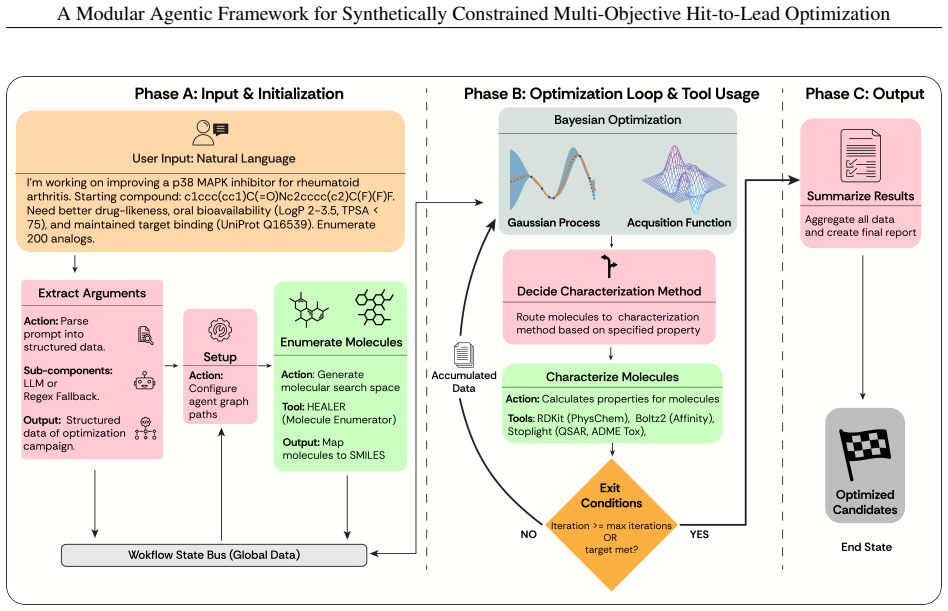
The load-bearing mechanism is the separation of the language model from quantitative tools. The LLM only parses the user request into an optimization configuration (seed molecule, protein target, objectives, iteration count) and summarizes results; it never proposes analogs, scores affinity, or judges quantitative outcomes. Candidate enumeration is delegated to HEALER, a retrosynthetic reaction-templated enumerator that assembles analogs from commercially available building blocks, making synthetic feasibility a property of the search space rather than a post hoc filter. Selection is delegated to Bayesian optimization with a Gaussian-process surrogate and the qLogEI (single-objective) or qLogNEHVI (multi-objective) acquisition functions, which balances exploration and exploitation and returns batch recommendations that are validated against the search space and the experiment ledger. Characterization is delegated to purpose-built predictors: Boltz-2 for structure-based affinity scores, RDKit for physicochemical descriptors and QED, and STOPLIGHT for ADMET-related liabilities. The modular design, with tools registered through configuration files and state managed by a checkpointed workflow graph, is what makes the pipeline swappable and traceable.
What would settle it
Synthesize a handful of the top-ranked SABLE analogs from the METTL3 and Boltz-2-validated-target campaigns and measure their IC50s in the corresponding assays; if most fail to beat the seed by a meaningful margin, the enrichment claim would be shown to be an artifact of the Boltz-2 objective rather than genuine lead improvement.
Extended reading notes
Core claim
The paper's central claim is that a language model can orchestrate, but not dominate, scientific decision-making in molecular optimization: SABLE separates intent translation from candidate generation, quantitative characterization, and selection. Starting from a user's seed compound, HEALER builds a search space of analogs that are guaranteed to be synthesizable from purchasable building blocks through known reaction templates; a Bayesian optimization loop then selects small batches of unevaluated molecules to be scored by Boltz-2 for affinity, RDKit for physicochemical descriptors, and STOPLIGHT for ADMET-related properties. Across single-objective (affinity), dual-objective (affinity plus QED), and multi-objective (affinity, QED, and CNS activity) campaigns, the evaluated candidates improved on the seed for every tracked objective, and the best-observed candidates formed a Pareto frontier of nondominated trade-offs. In retrospective case studies on METTL3 and on four Boltz-2-validated targets, SABLE moved from experimentally weak seed compounds to analogs with substantially lower predicted concentrations, in the same range as the best compounds in the experimental series. The authors state the intended scope explicitly: SABLE enriches against the computational objectives, not against unmeasured biochemical truth, and is designed as a prioritization engine to support medicinal chemistry review and eventual experimental closed-loop deployment.
Load-bearing premise
The entire affinity optimization signal rests on the assumption that Boltz-2's predicted scores correctly rank true binding affinity within each chemical series, and the paper never tests that assumption against experimental measurements, so if that ranking is wrong, the reported affinity improvements are improvements only against a miscalibrated oracle.
Editorial extensions
If this is right
- Because every enumerated analog is assembled from purchasable building blocks via reaction templates, the top-ranked candidates can be ordered for synthesis without a separate synthetic-feasibility triage step.
- Replacing the affinity oracle with a wet-lab assay or a better predictor requires only a node-level adapter, so the same orchestration logic can drive experimental closed-loop design-make-test-analyze cycles as robotic infrastructure matures.
- The Pareto-frontier output gives medicinal chemists a set of trade-off alternatives rather than a single candidate, so campaign-specific priorities can be applied after optimization.
- Because only a subset of the enumerated space is evaluated before convergence, the framework's computational cost scales more gently than exhaustive screening, with savings growing roughly linearly with library size in the tested regime.
Reading between the lines
- Beyond the paper: the same 'LLM as translator, specialists as judges' split could transfer to other closed-loop design tasks, such as reaction-condition optimization or materials formulation, where a language model interfaces with quantitative simulators; the paper's evidence is limited to ligand optimization, so this is an extrapolation.
- Beyond the paper: because the search space is determined by HEALER's reaction templates, the ceiling of SABLE's performance is set by the enumerator's coverage; expanding the template set or adding a second enumerator would likely widen the Pareto frontier, and comparing frontier sizes across enumerators would test this.
- Beyond the paper: a direct experimental follow-up would be to synthesize the top-ranked METTL3 analog (predicted 102 nM) and measure its IC50; if it lands within an order of magnitude of the prediction, that would support Boltz-2 as a viable ranking oracle for prioritization within HEALER's space.
Signed reviews
Editorial analysis
A structured set of objections, weighed in public.
Referee Report
Summary. The paper introduces SABLE, an open-source agentic framework for synthetically constrained hit-to-lead optimization. An LLM orchestrates a workflow in which HEALER enumerates reaction-templated analogs from Enamine building blocks, RDKit/STOPLIGHT compute physicochemical and ADMET properties, Boltz-2 predicts binding affinity, and Bayesian optimization (qLogEI or qLogNEHVI) selects batches for evaluation. The authors report single-, dual-, and multi-objective campaigns showing improvements over seed compounds in predicted logIC50, QED, and CNS activity; a QED benchmark on one-million-compound libraries; and retrospective case studies on METTL3 and four Boltz-2 validation targets. The paper claims that SABLE enriches candidate sets for user-defined computational objectives while evaluating only a subset of the enumerated space, and that all proposed molecules are constructible from commercially available building blocks under known reaction templates.
Significance. If the enrichment and efficiency claims survive proper baseline testing, SABLE would be a valuable open-source contribution: it cleanly separates LLM-based intent parsing from quantitative model computation, restricts the search space to synthetically tractable analogs, provides provenance of each numerical output, and ships with Dockerfiles, Apptainer definitions, prompts, and JSON state dumps for reproduction. The modular BYOT architecture is a genuine strength and distinguishes SABLE from monolithic LLM-as-scientist systems. However, the current empirical evidence is too weak to establish the central 'enrichment' claim: there are no random-sampling or alternative-acquisition baselines, no repeated runs or error bars, and the primary affinity objective is the same Boltz-2 oracle being optimized. The paper is transparent about several limitations, but the Results sections present the oracle-score improvements as validation rather than as an internal-consistency check.
major comments (3)
- [§2.2, §2.5, Figs. 2–3, S3–S4] The central enrichment claim lacks any random or non-agentic baseline. In every single- and multi-objective campaign, the only quantitative evidence is the best-observed score relative to the seed compound, and in the QED benchmark it is recovery of a known global maximum. Because HEALER is explicitly designed to generate close, synthetically feasible analogs of an active seed (§5.3), the unconditional probability that a randomly drawn analog improves predicted affinity or QED may be high. The paper should compare SABLE's selected batches to random sampling of the same enumerated library, to an uncertainty-agnostic acquisition (e.g., greedy selection by surrogate mean), and, for multi-objective campaigns, to a random-sampling hypervolume baseline. Without these comparisons, the stated conclusions that SABLE 'enriches candidate sets' and 'produces useful enrichment after evaluating only a small fraction of the enumerated space' are underdetermined.
- [§2.2–§2.4, Figs. 2–3] Every campaign is a single unrepeated run without error bars or variance estimates. The claim that the cumulative distribution of the 20 best candidates 'plateaus' after approximately five iterations (§2.2) is a qualitative reading of one trajectory. Repeated runs with different random seeds are needed to show that the plateau is systematic and that reported improvements (e.g., the 1.03 log-unit improvement in §2.2) are not within run-to-run noise. Similarly, the Pareto-frontier claims in §2.3 and §2.4 would be substantially strengthened by reporting hypervolume or dominated-volume statistics averaged over repeated runs, with standard deviations.
- [§2.2, §2.7, Discussion] The primary demonstration is self-referential: the acquisition function maximizes the same Boltz-2 score that is later reported as the 'improvement,' so the best-observed oracle value is guaranteed to improve by construction. The paper correctly acknowledges this in the Discussion, but the Results sections present these improvements as evidence of SABLE's value. To make the value claim load-bearing, the paper should include a control in which the same enumerated library is optimized by a cheap baseline (e.g., selecting the top-k candidates by the surrogate mean without acquisition exploration, or random selection) and compare oracle-score improvement per evaluation. Without such a control, the framework's contribution reduces to implementing a standard Bayesian optimizer, which is not the paper's stated novelty.
minor comments (6)
- [Abstract and §2.1] The phrase 'Across single, and multi-objective optimization studies' contains a stylistic comma error; it should read 'Across single- and multi-objective optimization studies.'
- [§5.4] There is a typo in 'SubstanceParamaterobjects'; it should be 'SubstanceParameter objects.' Also, the expansion 'qLogNoisyExpectedHypervolumeImprovement' should be written as 'qLogNEHVI' consistently, including the parenthetical.
- [§2.5] The sentence 'The relative savings in oracle or experimentation calls, grow approximately linearly with library size in the regime of〈10 3 to 106)' has broken math formatting and grammar; please rewrite to specify the regime clearly, e.g., 'library sizes from 10^3 to 10^6.'
- [§5.10] The text says all experiments were performed 'in a Dockerized environment on a single laptop,' but Boltz-2 inference was carried out on a GPU node with four NVIDIA L40 GPUs; please clarify which components ran on the laptop and which ran on the remote compute node.
- [Fig. 2B] The t-SNE visualization lacks axis labels, a stated perplexity value, and a random seed; without these details, the visualization cannot be reproduced or compared across runs.
- [§2.7 and Table 1] The paper reports predicted concentrations in µM and nM units (e.g., '58.88 µM' and '370 nM') as if they were quantitative IC50 estimates. Given that the authors acknowledge Boltz-2 is not calibrated in absolute terms, the P00519 row (seed predicted at 97.72 nM versus ChEMBL 2.95 µM) should be discussed explicitly as evidence that these values should not be interpreted as absolute affinity predictions, and the table caption should state this caveat.
Circularity Check
Oracle-enrichment results reduce to the BO objective by construction; modularity and HEALER claims remain independent.
-
self definitional
[Section 2.2 (Fig. 2A); cf. Sections 2.3-2.4, 2.7, 5.4, S.3-S.4]
"Across the campaign, the best-observed predicted logIC50 improved by 1.03 log units relative to the seed, while the cumulative distribution of the 20 best-observed candidates plateaued after approximately five iterations (Fig. 2A). ... SABLE enriches compounds against the Boltz-2 objective, and not against unmeasured biochemical truth."
The quantity reported as 'improvement' and 'enrichment' is the same Boltz-2 logIC50 (or QED/CNS) score that the qLogEI/qLogNEHVI acquisition functions are constructed to maximize or minimize (S.3, S.4). The best-observed value after a BO run is therefore the optimizer's own objective value, not an independent prediction; the observed gain is what the acquisition loop was designed to produce. The paper's own caveat confirms that enrichment is defined against the selection oracle, so the headline result is a restatement of the BO loop's aim rather than an independent test of SABLE's selection mechanism. The absence of a random-sampling or uncertainty-agnostic acquisition baseline leaves the agent-specific contribution underdetermined.
full rationale
SABLE's central 'enrichment' demonstrations are partially circular: the objective used for Bayesian optimization is identical to the metric used to measure success, so the reported improvements over the seed are the direct output of the optimizer's own objective, not an externally validated prediction. The paper explicitly acknowledges this for Boltz-2 ('SABLE enriches compounds against the Boltz-2 objective, and not against unmeasured biochemical truth'), which lowers the severity. The independent content—LLM argument extraction, modular tool integration, HEALER reaction-templated enumeration, provenance tracking, and the released code and state dumps—does not reduce to the optimization objective and is externally checkable. The HEALER self-citation is not load-bearing in the circularity sense because HEALER's behavior is reproducible from released software and the paper treats synthetic accessibility as a necessary-but-insufficient condition. Overall circularity is partial, not total: the framework's architectural claims stand, but the headline empirical claim that SABLE 'enriches' candidate sets needs a random or non-BO baseline to distinguish optimizer behavior from agentic selection.
Assumptions & free parameters
free parameters (5)
- max_retrosynthesis_steps =
2
- iteration_count_default =
5
- batch_size_default =
10
- descriptor_correlation_threshold =
0.7
- gaussian_perturbation =
small (unspecified)
assumptions (5)
- domain assumption Boltz-2 predicted affinity is a meaningful proxy for true binding affinity within a chemical series.
- domain assumption HEALER reaction templates plus Enamine building-block stock imply experimental synthetic accessibility.
- domain assumption STOPLIGHT, RDKit, and QED computational endpoints are valid objective values for optimization.
- domain assumption A Matérn 5/2 kernel with ARD and a Gaussian likelihood adequately models molecular property surfaces.
- domain assumption LLM argument extraction and name-to-entity resolution correctly capture user intent.
Cite this review
Pith. "Pith review of A Modular Agentic Framework for Synthetically Constrained Multi-Objective Hit-to-Lead Optimization." pith.science (2026). https://pith.science/paper/6GWG476W
@misc{pith2026260811483,
  author       = {Pith},
  title        = {Pith review of: A Modular Agentic Framework for Synthetically Constrained Multi-Objective Hit-to-Lead Optimization},
  year         = {2026},
  howpublished = {\url{https://pith.science/paper/6GWG476W}},
  note         = {Machine review of arXiv:2608.11483}
}
read the original abstract
Hit-to-lead optimization requires iterative design of hit analogs across competing potency, selectivity, physicochemical, pharmacokinetic, safety, and synthetic constraints. We present SABLE (Synthetically-accessible Agentic Bayesian Ligand Exploration), an open-source framework that employs natural-language orchestration to guide chemical structure optimization. SABLE uses an LLM to interpret user-defined goals and route tasks, while specialized tools perform reaction-templated analog enumeration, physicochemical and ADMET property prediction, structure-based affinity scoring, and Bayesian optimization. The resulting workflow is a computational twin of the analytical and prioritization stages of the design-make-test-analyze cycle, providing provenance of each numerical output. Across single, and multi-objective optimization studies, SABLE enriches candidate sets for user-defined computational objectives while evaluating only a subset of the enumerated search space. Its modular architecture allows tools and characterization backends to be replaced by editing a simple config file, without modifying operational logic. SABLE provides an extensible decision-support framework for prioritizing synthetically constrained analogs in early-stage drug discovery.
Figures


Figures from the paper (2 more)


Reference graph
Works this paper leans on
-
[1]
Akke, Mattias and Yang, Soojung and Ruza, Jurgis and Song, Jinyeop and Pan, Elton and. Bayesian. ChemRxiv , volume =. doi:10.26434/chemrxiv-2025-w1wsh , urldate =
-
[2]
Ali, Mohamad Abou and Dornaika, Fadi , year = 2025, month = nov, journal =. Agentic. doi:10.1007/s10462-025-11422-4 , urldate =. arXiv , keywords =:2510.25445 , primaryclass =
arXiv 2025
-
[3]
Ament, Sebastian and Daulton, Samuel and Eriksson, David and Balandat, Maximilian and Bakshy, Eytan , year = 2025, month = jan, number =. Unexpected. doi:10.48550/arXiv.2310.20708 , urldate =. arXiv , keywords =:2310.20708 , primaryclass =
-
[4]
Averly, Reza and Baker, Frazier N. and Watson, Ian A. and Ning, Xia , year = 2025, month = oct, number =. doi:10.48550/arXiv.2502.13959 , urldate =. arXiv , keywords =:2502.13959 , primaryclass =
-
[5]
Quantifying the Chemical Beauty of Drugs , author =. Nature Chemistry , volume =. doi:10.1038/nchem.1243 , urldate =
-
[6]
Autonomous Chemical Research with Large Language Models , author =. Nature , volume =. doi:10.1038/s41586-023-06792-0 , urldate =
-
[7]
Bret, Guillaume and Sindt, Fran. Assessing. Journal of Chemical Information and Modeling , volume =. doi:10.1021/acs.jcim.5c02630 , urldate =
-
[8]
Brown, Nathan and Fiscato, Marco and Segler, Marwin H.S. and Vaucher, Alain C. , year = 2019, month = mar, journal =. doi:10.1021/acs.jcim.8b00839 , urldate =
Show all 57 references
-
[9]
doi:10.1038/srep42717 , urldate =
Daina, Antoine and Michielin, Olivier and Zoete, Vincent , year = 2017, month = mar, journal =. doi:10.1038/srep42717 , urldate =
2017 doi
- [10]
-
[11]
Journal of Clinical Epidemiology , volume =
Tutorial on Directed Acyclic Graphs , author =. Journal of Clinical Epidemiology , volume =. doi:10.1016/j.jclinepi.2021.08.001 , urldate =
2021 doi
-
[12]
and Bochenkova, Elena and M
Dolbois, Aymeric and Bedi, Rajiv K. and Bochenkova, Elena and M. 1,4,9-. Journal of Medicinal Chemistry , volume =. doi:10.1021/acs.jmedchem.1c00773 , urldate =
-
[13]
, year = 2018, month = jul, journal =
Frazier, Peter I. , year = 2018, month = jul, journal =. A
2018
-
[14]
doi:10.1093/nar/gkae236 , urldate =
Fu, Li and Shi, Shaohua and Yi, Jiacai and Wang, Ningning and He, Yuanhang and Wu, Zhenxing and Peng, Jinfu and Deng, Youchao and Wang, Wenxuan and Wu, Chengkun and Lyu, Aiping and Zeng, Xiangxiang and Zhao, Wentao and Hou, Tingjun and Cao, Dongsheng , year = 2024, month = jul...
2024 doi
-
[15]
, year = 2025, month = oct, journal =
Gao, Wenhao and Luo, Shitong and Coley, Connor W. , year = 2025, month = oct, journal =. Generative. doi:10.1073/pnas.2415665122 , urldate =
2025 doi
- [16]
-
[17]
, year = 2020, month = dec, journal =
Gao, Wenhao and Coley, Connor W. , year = 2020, month = dec, journal =. The. doi:10.1021/acs.jcim.0c00174 , urldate =
2020 doi
-
[18]
Bidirectional
Grisoni, Francesca and Moret, Michael and Lingwood, Robin and Schneider, Gisbert , year = 2020, month = mar, journal =. Bidirectional. doi:10.1021/acs.jcim.9b00943 , urldate =
2020 doi
-
[19]
MedChemComm , volume =
Molecular Obesity, Potency and Other Addictions in Drug Discovery , author =. MedChemComm , volume =. doi:10.1039/c1md00017a , urldate =
- [20]
-
[21]
14 Examples of How
Jablonka, Kevin Maik and Ai, Qianxiang and. 14 Examples of How. Digital Discovery , volume =. doi:10.1039/D3DD00113J , urldate =
-
[22]
doi:10.1186/s13321-023-00703-1 , urldate =
Jung, Sascha and Vatheuer, Helge and Czodrowski, Paul , year = 2023, month = mar, journal =. doi:10.1186/s13321-023-00703-1 , urldate =
2023 doi
-
[23]
Nucleic Acids Research , volume =
Kanev, Georgi K and. Nucleic Acids Research , volume =. doi:10.1093/nar/gkaa895 , urldate =
-
[24]
and Zakharov, Alexey V
Kelestemur, Enes and Muratov, Eugene N. and Zakharov, Alexey V. and Tropsha, Alexander , journal =. doi:10.26434/chemrxiv.15003011/v1 , urldate =
-
[25]
Proceedings of the
Korovina, Ksenia and Xu, Sailun and Kandasamy, Kirthevasan and Neiswanger, Willie and Poczos, Barnabas and Schneider, Jeff and Xing, Eric , year = 2020, month = jun, pages =. Proceedings of the
2020
-
[26]
A Sober Look at
Kristiadi, Agustinus and. A Sober Look at. Proceedings of the 41st
- [27]
-
[28]
Docs by LangChain , urldate =
-
[29]
and Gabriel, Thomas and O'Donnell, T
Lee, Man-Ling and Aliagas, Ignacio and Feng, Jianwen A. and Gabriel, Thomas and O'Donnell, T. J. and Sellers, Benjamin D. and Wiswedel, Bernd and Gobbi, Alberto , year = 2017, month = jun, journal =. Chemalot and Chemalot\_knime:. doi:10.1186/s13321-017-0228-9 , urldate =
2017 doi
- [30]
- [31]
-
[32]
and He, Jiazhen and Tibo, Alessandro and Janet, Jon Paul and Voronov, Alexey and Mervin, Lewis H
Loeffler, Hannes H. and He, Jiazhen and Tibo, Alessandro and Janet, Jon Paul and Voronov, Alexey and Mervin, Lewis H. and Engkvist, Ola , year = 2024, month = feb, journal =. Reinvent 4:. doi:10.1186/s13321-024-00812-5 , urldate =
2024 doi
-
[33]
and Ma, Jianzhu , year = 2024, month = jun, number =
Luo, Shitong and Gao, Wenhao and Wu, Zuofan and Peng, Jian and Coley, Connor W. and Ma, Jianzhu , year = 2024, month = jun, number =. Projecting. doi:10.48550/arXiv.2406.04628 , urldate =. arXiv , keywords =:2406.04628 , primaryclass =
2024 doi
-
[34]
Nature Machine Intelligence , volume =
Augmenting Large Language Models with Chemistry Tools , author =. Nature Machine Intelligence , volume =. doi:10.1038/s42256-024-00832-8 , urldate =
-
[35]
and Barabasi, Daniel L
Mitchener, Ludovico and Yiu, Angela and Chang, Benjamin and Bourdenx, Mathieu and Nadolski, Tyler and Sulovari, Arvis and Landsness, Eric C. and Barabasi, Daniel L. and Narayanan, Siddharth and Evans, Nicky and Reddy, Shriya and Foiani, Martha and Kamal, Aizad and Shriver, Lea...
-
[36]
and Banck, Michael and James, Craig A
O'Boyle, Noel M. and Banck, Michael and James, Craig A. and Morley, Chris and Vandermeersch, Tim and Hutchison, Geoffrey R. , year = 2011, month = oct, journal =. Open. doi:10.1186/1758-2946-3-33 , urldate =
2011 doi
-
[37]
Pang, Chao and Qiao, Jianbo and Zeng, Xiangxiang and Zou, Quan and Wei, Leyi , year = 2024, month = apr, journal =. Deep. doi:10.1021/acs.jcim.3c01496 , urldate =
2024 doi
-
[38]
and Willett, Peter and Kadirkamanathan, Visakan and Luscombe, Christopher N
Papadatos, George and Alkarouri, Muhammad and Gillet, Valerie J. and Willett, Peter and Kadirkamanathan, Visakan and Luscombe, Christopher N. and Bravi, Gianpaolo and Richmond, Nicola J. and Pickett, Stephen D. and Hussain, Jameed and Pritchard, John M. and Cooper, Anthony W. ...
2010 doi
-
[39]
Boltz-2:
Passaro, Saro and Corso, Gabriele and Wohlwend, Jeremy and Reveiz, Mateo and Thaler, Stephan and Somnath, Vignesh Ram and Getz, Noah and Portnoi, Tally and Roy, Julien and Stark, Hannes and. Boltz-2:. doi:10.1101/2025.06.14.659707 , urldate =
2025 doi
-
[40]
Science Advances , volume =
Deep Reinforcement Learning for de Novo Drug Design , author =. Science Advances , volume =. doi:10.1126/sciadv.aap7885 , urldate =
- [41]
-
[42]
Greg, Landrum , doi =
-
[43]
Nature Reviews Drug Discovery , doi =
Rethinking Drug Design in the Artificial Intelligence Era , author =. Nature Reviews Drug Discovery , doi =
-
[44]
and Parikh, Ayaan and Vijayan, Rahul and Kasbekar, Shoman and Reid, Dylan and Bender, Andreas and Spjuth, Ola , year = 2025, month = oct, number =
Seal, Srijit and Huynh, Dinh Long and Chelbi, Moudather and Khosravi, Sara and Kumar, Ankur and Thieme, Mattson and Wilks, Isaac and Davies, Mark and Mustali, Jessica and Sun, Yannick and Edwards, Nick and Boiko, Daniil and Tyrin, Andrei and Selinger, Douglas W. and Parikh, Ay...
2025 doi
- [45]
-
[46]
and Edwards, Carl and Agarwal, Khushbu and Olarte, Mariefel V
Sprueill, Henry W. and Edwards, Carl and Agarwal, Khushbu and Olarte, Mariefel V. and Sanyal, Udishnu and Johnston, Conrad and Liu, Hongbin and Ji, Heng and Choudhury, Sutanay , year = 2024, month = dec, number =. doi:10.48550/arXiv.2402.10980 , urldate =. arXiv , keywords =:2...
-
[47]
Acta Pharmaceutica Sinica B , volume =
Why 90\ author =. Acta Pharmaceutica Sinica B , volume =. doi:10.1016/j.apsb.2022.02.002 , urldate =
2022 doi
-
[48]
Tripp, Austin and Simm, Gregor N. C. and. A
-
[49]
doi:10.1021/jm400378w , urldate =
Journal of Medicinal Chemistry , volume =. doi:10.1021/jm400378w , urldate =
- [50]
-
[51]
, year = 2026, month = mar, number =
Wan, Shunzhou and Zhang, Xibei and Xue, Xiao and Coveney, Peter V. , year = 2026, month = mar, number =. On the. doi:10.48550/arXiv.2603.05532 , urldate =. arXiv , keywords =:2603.05532 , primaryclass =
2026 doi
-
[52]
Chemical Science , volume =
Model Agnostic Generation of Counterfactual Explanations for Molecules , author =. Chemical Science , volume =. doi:10.1039/D1SC05259D , urldate =
-
[53]
and Willson, Timothy M
Wellnitz, James and Martin, Holli-Joi and Anwar Hossain, Mohammad and Rath, Marielle and Fox, Colton and Popov, Konstantin I. and Willson, Timothy M. and Muratov, Eugene N. and Tropsha, Alexander , year = 2024, month = jun, journal =. doi:10.1021/acs.jcim.4c00412 , urldate =
2024 doi
-
[54]
Model Context Protocol , urldate =
What Is the. Model Context Protocol , urldate =
- [55]
-
[56]
doi:10.1021/acs.jcim.6c00148 , urldate =
Zhang, Yiming and Choong, Jun Jin and Madhawa, Kaushalya and Ozawa, Keisuke , year = 2026, month = apr, journal =. doi:10.1021/acs.jcim.6c00148 , urldate =
2026 doi
-
[57]
and Vadgama, Sharvaree and Varambally, Sumanth and Eckmann, Peter and Gilson, Michael K
Zhou, Andrew Y. and Vadgama, Sharvaree and Varambally, Sumanth and Eckmann, Peter and Gilson, Michael K. and Yu, Rose , year = 2026, month = may, number =. doi:10.48550/arXiv.2605.12784 , urldate =. arXiv , keywords =:2605.12784 , primaryclass =
Reviewed August 15, 2026 · model on record in the stance chip above.
Discussion (0). Continue with ORCID to comment.