Diffeomorphic Optimization
Pith reviewed 2026-07-02 15:36 UTC · model grok-4.3
The pith
Diffeomorphic optimization performs gradient descent in the base space of flow models, equivalent to Riemannian gradient descent on the data manifold up to O(λ²) corrections.
A machine-rendered reading of the paper's core claim, the machinery that carries it, and where it could break.
Core claim
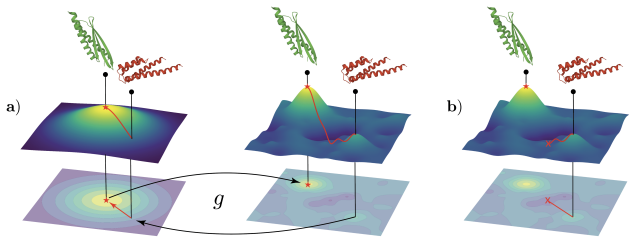
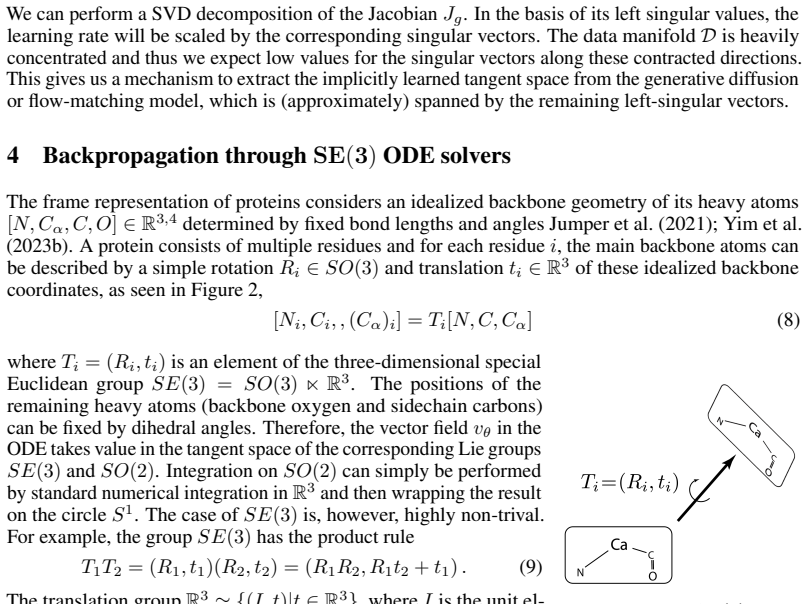
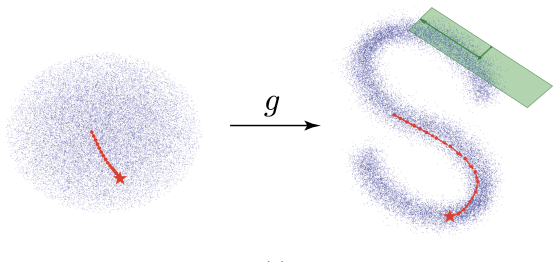
Diffeomorphic optimization starts from the observation that diffusion and flow models provide a map from the data manifold to a much simpler base space in which we perform gradient descent. Using differential geometry, we show this is equivalent to Riemannian gradient descent on the data manifold up to O(λ²) corrections, keeping trajectories on-manifold by construction and yielding a smoother optimization surface. For protein design, we extend diffeomorphic optimization to the matrix Lie groups SO(3) and SE(3), deriving an autograd-compatible SO(3) gradient and a generalized adjoint-state method for backpropagation through Lie-group ODE solvers.
What carries the argument
The diffeomorphic map supplied by a diffusion or flow model that sends the data manifold to a simpler base space for gradient descent.
If this is right
- Optimization trajectories remain on the data manifold by construction rather than drifting off it.
- The effective loss surface is smoother than the ambient high-dimensional landscape.
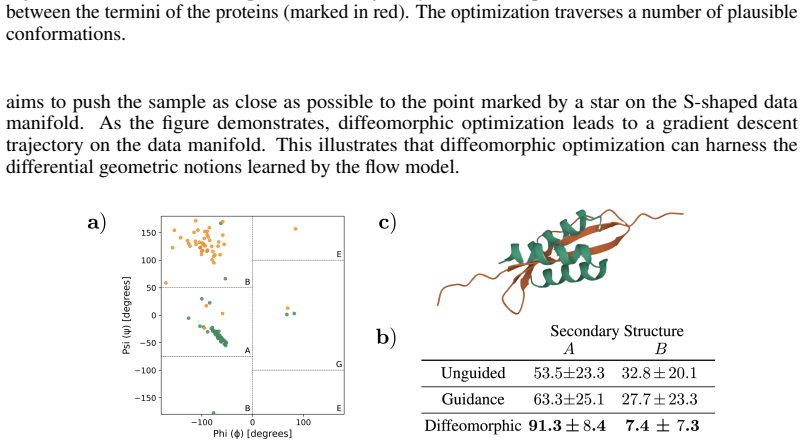
- The method yields 91.3 percent of residues in the target Ramachandran region versus 63.3 percent for tuned guidance on FrameFlow.
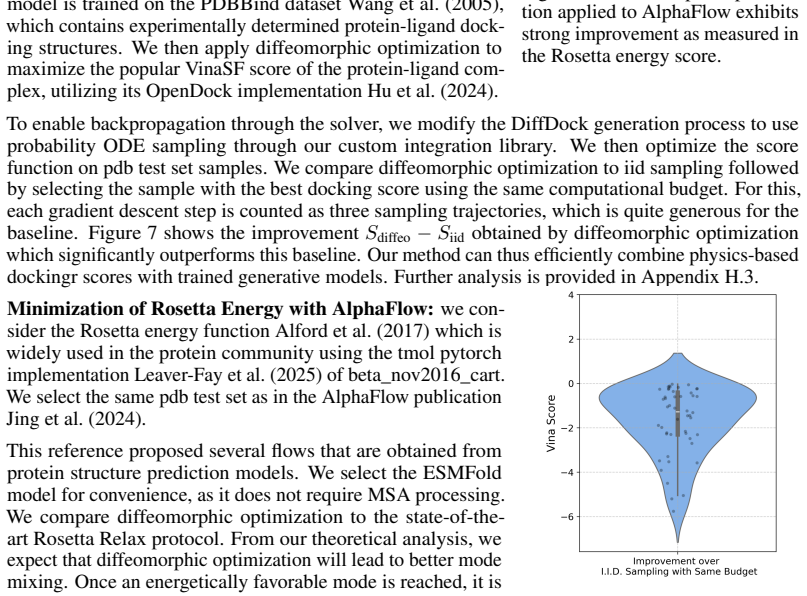
- It outperforms OC-Flow on peptide binding affinity while running at twice the speed.
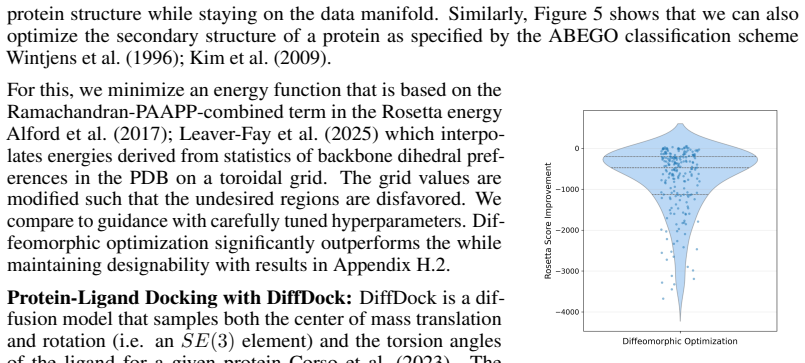
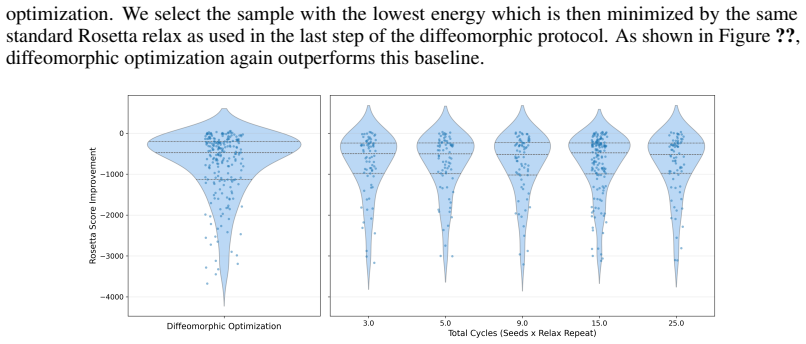
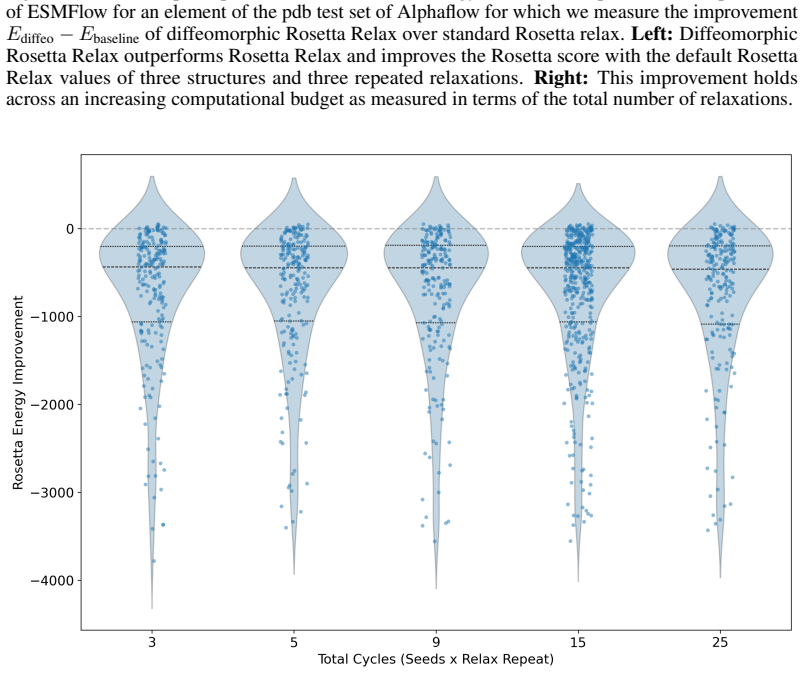
- Rosetta energies drop by thousands of units on PDB test structures containing hundreds of residues.
Where Pith is reading between the lines
- The same base-space trick could be applied to other classes of generative models that learn manifold-to-base maps.
- The O(λ²) error term could be bounded or corrected explicitly to enlarge the regime where the equivalence holds.
- The Lie-group extensions might transfer to other robotics or molecular tasks that already use SO(3) or SE(3) representations.
- Because the method is autograd-compatible, it could be dropped into existing differentiable simulators without custom manifold layers.
Load-bearing premise
The diffusion and flow models supply an accurate enough map from the data manifold to the base space that the O(λ²) corrections stay negligible for the protein design tasks considered.
What would settle it
Run the same optimization objective once with the diffeomorphic procedure and once with explicit Riemannian gradient descent on the manifold; the trajectories should agree up to O(λ²) differences.
Figures

read the original abstract
Generative models learn data distributions that reside on a low-dimensional manifold within a higher-dimensional ambient space. Optimizing differentiable objectives on this manifold is challenging: the ambient loss landscape is high-dimensional, rugged, and non-convex. Direct gradient descent, blind to the manifold's geometry, quickly drifts off it. Diffeomorphic optimization starts from the observation that diffusion and flow models provide a map from the data manifold to a much simpler base space in which we perform gradient descent. Using differential geometry, we show this is equivalent to Riemannian gradient descent on the data manifold up to $\mathcal{O}(\lambda^2)$ corrections, keeping trajectories on-manifold by construction and yielding a smoother optimization surface. For protein design, we extend diffeomorphic optimization to the matrix Lie groups $\mathrm{SO}(3)$ and $\mathrm{SE}(3)$, deriving an autograd-compatible $\mathrm{SO}(3)$ gradient and a generalized adjoint-state method for backpropagation through Lie-group ODE solvers. Diffeomorphic optimization improves over tuned guidance on secondary-structure targeting with FrameFlow ($91.3\%$ vs. $63.3\%$ of residues in the Ramachandran target), outperforms OC-Flow on peptide binding affinity at $2\times$ the speed, and reduces Rosetta energies by thousands of units across the PDB test set for structures with hundreds of residues.
Editorial analysis
A structured set of objections, weighed in public.
Referee Report
Summary. The manuscript introduces diffeomorphic optimization, which uses diffusion and flow models to map data-manifold optimization problems into a simpler base space where gradient descent is performed. Using differential geometry, it claims this procedure is equivalent to Riemannian gradient descent on the data manifold up to O(λ²) corrections, thereby keeping trajectories on-manifold by construction and producing a smoother loss landscape. The method is extended to the Lie groups SO(3) and SE(3) for protein design, with derivations of an autograd-compatible SO(3) gradient and a generalized adjoint-state method for backpropagation through Lie-group ODE solvers. Empirical results are reported for FrameFlow on secondary-structure targeting (91.3% vs. 63.3% Ramachandran compliance), OC-Flow on peptide binding affinity (outperformance at 2× speed), and Rosetta energy minimization across a PDB test set.
Significance. If the O(λ²) approximation is shown to be negligible in the operating regimes of the cited generative models, the framework supplies a geometrically grounded alternative to guidance-based or projection-based manifold optimization that could improve stability and sample quality in generative modeling for structural biology. The explicit Lie-group extensions and autograd-compatible adjoint methods constitute concrete implementation contributions that lower the barrier to adoption.
major comments (2)
- [Abstract and theoretical derivation section] Abstract and the differential-geometry derivation (the section establishing the Riemannian equivalence): the central claim that trajectories remain on-manifold by construction rests on the O(λ²) corrections being negligible, yet no bounds on λ, no numerical estimates of the higher-order terms, and no sensitivity analysis are supplied for the FrameFlow or OC-Flow models used in the protein-design experiments. This directly affects whether the reported gains (e.g., Ramachandran compliance and energy reductions) can be attributed to the claimed geometric property.
- [Protein-design experimental section] Protein-design experimental section (the paragraphs reporting 91.3% Ramachandran compliance and energy reductions): the comparisons to tuned guidance and OC-Flow are presented without any verification that the diffusion/flow map remains sufficiently accurate for the O(λ²) remainder to stay small across the tested λ schedules or residue lengths; absent such checks, the on-manifold-by-construction advantage is not yet demonstrated in the reported regimes.
minor comments (1)
- [Notation and setup] The notation for the base-space map and the precise definition of λ should be introduced with an explicit equation reference before the equivalence statement to aid readers who are not already familiar with the underlying differential-geometry construction.
Simulated Author's Rebuttal
We thank the referee for the constructive comments. We agree that additional validation of the O(λ²) approximation is needed to fully support the claims and will incorporate the suggested analyses in the revised manuscript.
read point-by-point responses
-
Referee: [Abstract and theoretical derivation section] Abstract and the differential-geometry derivation (the section establishing the Riemannian equivalence): the central claim that trajectories remain on-manifold by construction rests on the O(λ²) corrections being negligible, yet no bounds on λ, no numerical estimates of the higher-order terms, and no sensitivity analysis are supplied for the FrameFlow or OC-Flow models used in the protein-design experiments. This directly affects whether the reported gains (e.g., Ramachandran compliance and energy reductions) can be attributed to the claimed geometric property.
Authors: We concur that the manuscript lacks explicit bounds, numerical estimates, and sensitivity analysis for the O(λ²) terms in the cited models. While the theoretical derivation establishes the equivalence, empirical validation of the approximation's accuracy is indeed absent. In the revision, we will add numerical estimates of the higher-order terms and a sensitivity analysis for the λ schedules and residue lengths in the FrameFlow and OC-Flow experiments. This will help attribute the reported gains to the geometric properties. revision: yes
-
Referee: [Protein-design experimental section] Protein-design experimental section (the paragraphs reporting 91.3% Ramachandran compliance and energy reductions): the comparisons to tuned guidance and OC-Flow are presented without any verification that the diffusion/flow map remains sufficiently accurate for the O(λ²) remainder to stay small across the tested λ schedules or residue lengths; absent such checks, the on-manifold-by-construction advantage is not yet demonstrated in the reported regimes.
Authors: We acknowledge that the experimental section does not include explicit verification of the flow map accuracy or the size of the O(λ²) remainder for the tested conditions. The reported improvements are observed, but to demonstrate the on-manifold advantage specifically, we will include in the revision the requested checks on the approximation across the λ schedules and residue lengths used. revision: yes
Circularity Check
No significant circularity; central equivalence is a differential-geometry derivation independent of fitting
full rationale
The paper states it uses differential geometry to establish equivalence to Riemannian gradient descent up to O(λ²) corrections. This is presented as a mathematical result, not a fit or self-citation reduction. No equations, parameters, or load-bearing steps in the abstract or described claims reduce by construction to inputs, fitted quantities, or prior self-citations. The Lie-group extensions (autograd-compatible SO(3) gradient, adjoint method) are described as derivations. Empirical results are reported separately and do not serve as the justification for the equivalence. The derivation chain is therefore self-contained against external mathematical benchmarks.
Axiom & Free-Parameter Ledger
Reference graph
Works this paper leans on
-
[1]
Proceedings of the National Academy of Sciences , volume=
Explaining neural scaling laws , author=. Proceedings of the National Academy of Sciences , volume=. 2024 , publisher=
2024
-
[2]
Journal of the American Mathematical Society , volume=
Testing the manifold hypothesis , author=. Journal of the American Mathematical Society , volume=
-
[3]
arXiv preprint arXiv:2207.02862 , year=
Verifying the union of manifolds hypothesis for image data , author=. arXiv preprint arXiv:2207.02862 , year=
-
[4]
Advances in Neural Information Processing Systems , volume=
Hardness of Learning Neural Networks Under the Manifold Hypothesis , author=. Advances in Neural Information Processing Systems , volume=
-
[5]
arXiv preprint arXiv:2310.05297 , year=
Fast protein backbone generation with se (3) flow matching , author=. arXiv preprint arXiv:2310.05297 , year=
-
[6]
Advances in Neural Information Processing Systems , volume=
Abdiffuser: full-atom generation of in-vitro functioning antibodies , author=. Advances in Neural Information Processing Systems , volume=
-
[7]
arXiv preprint arXiv:2302.02277 , year=
SE (3) diffusion model with application to protein backbone generation , author=. arXiv preprint arXiv:2302.02277 , year=
-
[8]
2024 , booktitle=
AlphaFold Meets Flow Matching for Generating Protein Ensembles , author=. 2024 , booktitle=
2024
-
[9]
International Conference on Learning Representations (ICLR) , year=
DiffDock: Diffusion Steps, Twists, and Turns for Molecular Docking , author =. International Conference on Learning Representations (ICLR) , year=
-
[10]
Journal of Computational Chemistry , volume=
AutoDock Vina: Improving the speed and accuracy of docking with a new scoring function, efficient optimization, and multithreading , author=. Journal of Computational Chemistry , volume=. 2010 , publisher=
2010
-
[11]
Building Normalizing Flows with Stochastic Interpolants
Building Normalizing Flows with Stochastic Interpolants , author=. arXiv preprint arXiv:2209.15571 , year=
work page internal anchor Pith review Pith/arXiv arXiv
-
[12]
Flow Matching for Generative Modeling
Flow Matching for Generative Modeling , author=. arXiv preprint arXiv:2210.02747 , year=
work page internal anchor Pith review Pith/arXiv arXiv
-
[13]
Advances in neural information processing systems , volume=
Denoising diffusion probabilistic models , author=. Advances in neural information processing systems , volume=
-
[14]
Score-Based Generative Modeling through Stochastic Differential Equations
Score-based generative modeling through stochastic differential equations , author=. arXiv preprint arXiv:2011.13456 , year=
work page internal anchor Pith review Pith/arXiv arXiv 2011
-
[15]
Journal of Machine Learning Research , volume=
Normalizing flows for probabilistic modeling and inference , author=. Journal of Machine Learning Research , volume=
-
[16]
nature , volume=
Highly accurate protein structure prediction with AlphaFold , author=. nature , volume=. 2021 , publisher=
2021
-
[17]
2025 , url =
Peter Holderrieth and Ezra Erives , title =. 2025 , url =
2025
-
[18]
2025 , url =
Leaver-Fay, Andrew and Flatten, Jeff and Ford, Alex and Kleinhenz, Joseph and Solberg, Henry amd Baker, David and Watkins, Andrew M and Kuhlman, Brian and DiMaio, Frank , title =. 2025 , url =
2025
-
[19]
2018 , publisher=
Introduction to Riemannian manifolds , author=. 2018 , publisher=
2018
-
[20]
Advances in neural information processing systems , volume=
Neural ordinary differential equations , author=. Advances in neural information processing systems , volume=
-
[21]
Journal of chemical theory and computation , volume=
The Rosetta all-atom energy function for macromolecular modeling and design , author=. Journal of chemical theory and computation , volume=. 2017 , publisher=
2017
-
[22]
Journal of molecular biology , volume=
Automatic classification and analysis of -turn motifs in proteins , author=. Journal of molecular biology , volume=. 1996 , publisher=
1996
-
[23]
Journal of medicinal chemistry , volume=
The PDBbind database: methodologies and updates , author=. Journal of medicinal chemistry , volume=. 2005 , publisher=
2005
-
[24]
Hu, Qiuyue and Wang, Zechen and Meng, Jintao and Li, Weifeng and Guo, Jingjing and Mu, Yuguang and Wang, Sheng and Liangzhen, Zheng and Wei, Yanjie , title = ". Bioinformatics , pages =. 2024 , month =. doi:10.1093/bioinformatics/btae628 , url =
-
[25]
Advances in Neural Information Processing Systems , volume=
Neural manifold ordinary differential equations , author=. Advances in Neural Information Processing Systems , volume=
-
[26]
Advances in Neural Information Processing Systems , volume=
Riemannian continuous normalizing flows , author=. Advances in Neural Information Processing Systems , volume=
-
[27]
Physical Review D , volume=
Learning trivializing gradient flows for lattice gauge theories , author=. Physical Review D , volume=. 2023 , publisher=
2023
-
[28]
arXiv preprint arXiv:2302.03660 , year=
Flow matching on general geometries , author=. arXiv preprint arXiv:2302.03660 , year=
-
[29]
arXiv preprint arXiv:2006.06663 , year=
Neural ordinary differential equations on manifolds , author=. arXiv preprint arXiv:2006.06663 , year=
-
[30]
International Conference on Machine Learning , pages=
Normalizing Flows on Tori and Spheres , author=. International Conference on Machine Learning , pages=
-
[31]
arXiv preprint arXiv:2305.02402 , year=
Normalizing flows for lattice gauge theory in arbitrary space-time dimension , author=. arXiv preprint arXiv:2305.02402 , year=
-
[32]
arXiv preprint arXiv:2402.14017 , year=
D-flow: Differentiating through flows for controlled generation , author=. arXiv preprint arXiv:2402.14017 , year=
-
[33]
ICML Workshop on Invertible Neural Networks, Normalizing Flows, and Explicit Likelihood Models , year=
Diffeomorphic explanations with normalizing flows , author=. ICML Workshop on Invertible Neural Networks, Normalizing Flows, and Explicit Likelihood Models , year=
-
[34]
IEEE Transactions on Pattern Analysis and Machine Intelligence , volume=
Diffeomorphic counterfactuals with generative models , author=. IEEE Transactions on Pattern Analysis and Machine Intelligence , volume=. 2023 , publisher=
2023
-
[35]
Nature , volume=
Accurate structure prediction of biomolecular interactions with AlphaFold 3 , author=. Nature , volume=. 2024 , publisher=
2024
-
[36]
Journal of molecular biology , volume=
Sampling bottlenecks in de novo protein structure prediction , author=. Journal of molecular biology , volume=. 2009 , publisher=
2009
-
[37]
biorxiv , year=
Atomically accurate de novo design of single-domain antibodies , author=. biorxiv , year=
-
[38]
Nature , volume=
De novo design of protein structure and function with RFdiffusion , author=. Nature , volume=. 2023 , publisher=
2023
-
[39]
bioRxiv , pages=
Lab-in-the-loop therapeutic antibody design with deep learning , author=. bioRxiv , pages=. 2025 , publisher=
2025
-
[40]
Towards realistic individual recourse and actionable explanations in black-box decision making systems , author=. arXiv preprint arXiv:1907.09615 , year=
work page internal anchor Pith review Pith/arXiv arXiv 1907
-
[41]
Advances in neural information processing systems , volume=
Explanations based on the missing: Towards contrastive explanations with pertinent negatives , author=. Advances in neural information processing systems , volume=
-
[42]
bioRxiv , pages=
BindCraft: one-shot design of functional protein binders , author=. bioRxiv , pages=. 2024 , publisher=
2024
-
[43]
bioRxiv , pages=
BoltzDesign1: Inverting All-Atom Structure Prediction Model for Generalized Biomolecular Binder Design , author=. bioRxiv , pages=. 2025 , publisher=
2025
-
[44]
Nature , volume=
De novo protein design by deep network hallucination , author=. Nature , volume=. 2021 , publisher=
2021
-
[45]
Protein Science , volume=
De novo protein design by inversion of the AlphaFold structure prediction network , author=. Protein Science , volume=. 2023 , publisher=
2023
-
[46]
Biomedicines , volume=
Solubility-aware protein binding peptide design using AlphaFold , author=. Biomedicines , volume=. 2022 , publisher=
2022
-
[47]
Advances in neural information processing systems , volume=
Diffusion models beat gans on image synthesis , author=. Advances in neural information processing systems , volume=
-
[48]
Classifier-Free Diffusion Guidance
Classifier-free diffusion guidance , author=. arXiv preprint arXiv:2207.12598 , year=
work page internal anchor Pith review Pith/arXiv arXiv
-
[49]
Proceedings of the IEEE/CVF Conference on Computer Vision and Pattern Recognition , pages=
Universal guidance for diffusion models , author=. Proceedings of the IEEE/CVF Conference on Computer Vision and Pattern Recognition , pages=
-
[50]
Advances in Neural Information Processing Systems , volume=
Practical and asymptotically exact conditional sampling in diffusion models , author=. Advances in Neural Information Processing Systems , volume=
-
[51]
arXiv preprint arXiv:2206.04119 , year=
Diffusion probabilistic modeling of protein backbones in 3d for the motif-scaffolding problem , author=. arXiv preprint arXiv:2206.04119 , year=
-
[52]
arXiv preprint arXiv:2308.07983 , year=
Monte Carlo guided diffusion for Bayesian linear inverse problems , author=. arXiv preprint arXiv:2308.07983 , year=
-
[53]
The Twelfth International Conference on Learning Representations , year=
Diffusion posterior sampling for linear inverse problem solving: A filtering perspective , author=. The Twelfth International Conference on Learning Representations , year=
-
[54]
arXiv preprint arXiv:2501.06848 , year=
A general framework for inference-time scaling and steering of diffusion models , author=. arXiv preprint arXiv:2501.06848 , year=
-
[55]
Entropy , volume=
Stochastic control for bayesian neural network training , author=. Entropy , volume=. 2022 , publisher=
2022
-
[56]
Flow matching guide and code , author=. arXiv preprint arXiv:2412.06264 , year=
work page internal anchor Pith review Pith/arXiv arXiv
-
[57]
Advances in Neural Information Processing Systems , volume=
Efficient and accurate gradients for neural sdes , author=. Advances in Neural Information Processing Systems , volume=
-
[58]
International Conference on Machine Learning , pages=
Bridging discrete and continuous state spaces: Exploring the Ehrenfest process in time-continuous diffusion models , author=. International Conference on Machine Learning , pages=. 2024 , organization=
2024
-
[59]
Symposium on Advances in Approximate Bayesian Inference , pages=
Scalable gradients and variational inference for stochastic differential equations , author=. Symposium on Advances in Approximate Bayesian Inference , pages=. 2020 , organization=
2020
-
[60]
arXiv preprint arXiv:2410.18070 , year=
Training free guided flow matching with optimal control , author=. arXiv preprint arXiv:2410.18070 , year=
-
[61]
Proceedings of the IEEE/CVF Conference on Computer Vision and Pattern Recognition , pages=
Flowgrad: Controlling the output of generative odes with gradients , author=. Proceedings of the IEEE/CVF Conference on Computer Vision and Pattern Recognition , pages=
-
[62]
ICML 2026 Workshop on Structured Probabilistic Inference \ & \ Generative Modeling , year=
Enhanced Diffusion Sampling: Efficient Rare Event Sampling and Free Energy Calculation with Diffusion Models , author=. ICML 2026 Workshop on Structured Probabilistic Inference \ & \ Generative Modeling , year=
2026
-
[63]
Directly Fine-Tuning Diffusion Models on Differentiable Rewards
Directly fine-tuning diffusion models on differentiable rewards , author=. arXiv preprint arXiv:2309.17400 , year=
work page internal anchor Pith review Pith/arXiv arXiv
discussion (0)
Sign in with ORCID, Apple, or X to comment. Anyone can read and Pith papers without signing in.