REVIEW 5 major objections 5 minor 43 references
Graph Attention Hamiltonian Neural Networks: A Lattice System Analysis Model Based on Structural Learning
T0 review · 5 major / 5 minor · reviewed 2026-08-11 · deepseek-v4-flash
Pith's one-line read A neural network recovers lattice interaction structure from trajectories alone.
desk verdict A promising method for learning lattice interactions from trajectories, with strong trajectory-prediction numbers, but the central structure-recovery claim is still qualitative and the key graph-learning loss is undefined in the main text. read the letter →
The pith
A machine-rendered reading of the paper's core claim, the machinery that carries it, and where it could break.
The reading
What carries the argument
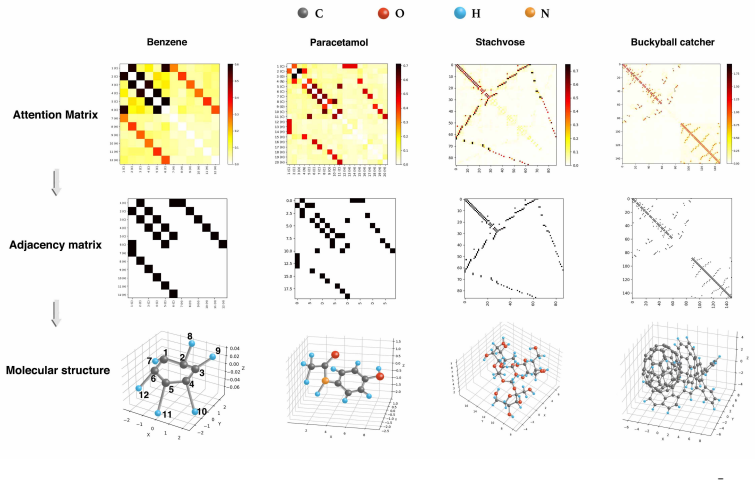
The central object is the learned attention matrix $A=(a_{ij})$, indexed by particles in the order they arrive in the data. It is trained jointly with the Hamiltonian dynamics through a dedicated graph learning loss $L_{GL}$; a threshold (0.001 for the lattice experiments, 35% of the maximum attention value for molecules) converts $A$ into an adjacency structure. Every structural inference — which pairs interact, the relative strengths, even symmetry, defects, or chemical bonds — is read directly from the entries of $A$, and trajectory prediction then freezes $A$ and trains the rest of the network around it. The matrix is the load-bearing object because it is where the paper's central interpretation lives.
What would settle it
Feed GAHN trajectory data from a Hamiltonian with an explicit three-body potential, such as $V(q_i,q_j,q_k)=c(q_i+q_j+q_k)^3$, which no pairwise sum can represent; if the learned attention matrix still presents a clean set of pair links and the pairwise model reproduces the dynamics, the pairwise readout is falsified. A cheaper test is a molecule with strong angle-bending or torsional force-field terms: the matrix should fail to reveal those multi-atom interactions or should misattribute them to pairs.
Extended reading notes
Core claim
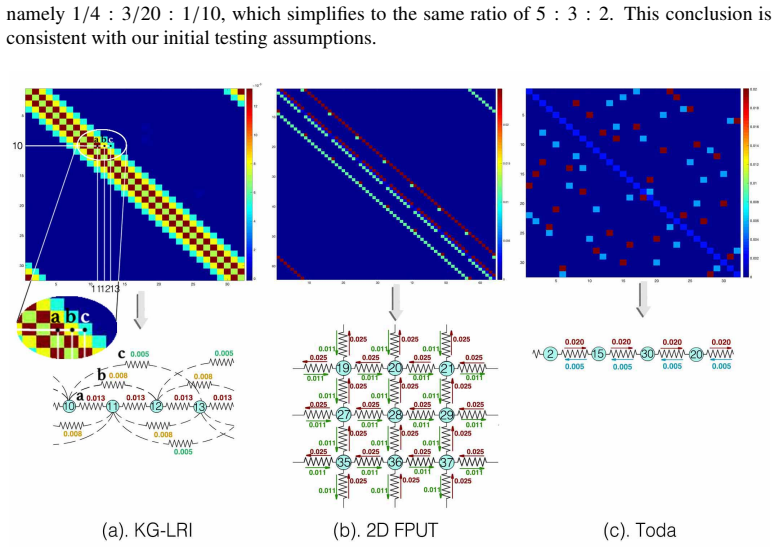
GAHN initializes a fully connected directed graph over $N$ particles and learns an attention matrix $A=(a_{ij})$ using a graph learning loss $L_{GL}$; the entry $a_{ij}$ encodes the effective interaction between particles $i$ and $j$, while the diagonal carries single-particle energy. In the three test Hamiltonians — the 1D Klein-Gordon lattice with second- and third-neighbor couplings (KG-LRI), the 2D Fermi-Pasta-Ulam-Tsingou system (FPUT), and the Toda chain — the learned matrix reproduces the generator's coupling pattern, including periodic boundary conditions and, for Toda, a deliberately shuffled particle ordering. For KG-LRI the matrix is symmetric and the nonzero couplings appear in the ratio 5:3:2, exactly the ratio of $1/4$, $3/20$, and $1/10$ in the Hamiltonian. The paper also shows that injected defects (a removed link, a doubled long-range coefficient, an extra link) appear as localized changes in $A$, and that on MD17 and MD22 molecular trajectories, thresholding the average attention matrix yields chemical bond connectivity consistent with established references. When the learned structure is fixed and used for prediction, GAHN's energy and trajectory errors on the three lattice systems are several orders of magnitude below the MLP, HNN, and SympNet baselines.
Load-bearing premise
The load-bearing premise is that the Hamiltonian is a weighted sum of pairwise interactions, so a single matrix entry $a_{ij}$ can stand for the entire interaction between two particles; if genuine three-body, angle, or torsional terms dominate, the attention-matrix readout has no place to put them.
Editorial extensions
If this is right
- Graph neural network methods, which normally require the interaction graph as prior knowledge, can take their edges from GAHN's attention matrix instead.
- Hidden long-range interactions, such as the third-neighbor couplings in KG-LRI, become visible from trajectory data alone.
- Lattice defects — a severed link, a changed coupling strength, or an extra long-range link — appear as localized anomalies in the learned matrix.
- The same structural readout transfers to molecular dynamics benchmarks, where the inferred adjacency matrix matches known chemical bond connectivity.
- With the learned structure in place, predicted energies and trajectories on the three test systems are several orders of magnitude more accurate than the MLP, HNN, and SympNet baselines.
Reading between the lines
- The pairwise ansatz means the matrix cannot represent genuine many-body, angle, or torsional terms, so applying the same readout to general molecular force fields is an extension the paper does not demonstrate.
- If the structural readout works on experimental trajectories, defect detection could become a monitoring tool for aging materials; the paper only tests simulated data.
- The threshold separating existing from absent edges is chosen from a visible gap in the learned weights; trajectories with more uniform interaction strengths would need a less ad hoc criterion.
- Because the attention matrix is learned jointly with the dynamics, it may absorb unmodeled effects such as external fields or dissipation as apparent pair interactions; testing on driven or damped systems would clarify the limits of the structural interpretation.
Signed reviews
Editorial analysis
A structured set of objections, weighed in public.
Referee Report
Summary. The paper proposes Graph Attention Hamiltonian Neural Networks (GAHN), a method that learns an attention matrix A from particle trajectory data and claims that A encodes the interaction structure of lattice Hamiltonian systems: which particles interact, relative interaction strengths, even/odd symmetry of the interaction potential, and structural anomalies such as broken or extra links. The method is tested on three synthetic systems (1D KG-LRI, 2D FPUT, 1D Toda) with known ground-truth Hamiltonians, and on molecular bond inference using MD17 and MD22 datasets. Trajectory and energy prediction are compared against MLP, HNN, and SympNet baselines, with GAHN reporting substantially lower MSE in all cases. The structural claims, however, are supported mainly by visual inspection of heatmaps rather than by quantitative edge-recovery metrics.
Significance. If the structural interpretability claims were fully established, the paper would offer a practically useful capability: inferring interaction graphs directly from trajectory data without prior structural knowledge, which would also supply graph structure to graph neural networks and enable defect detection. The trajectory-prediction results are strong and reproducible in form: Tables 2 and 3 report GAHN error orders of magnitude below the baselines on all three synthetic systems, with standard deviations that do not overlap the baselines. The paper also explicitly tests permutation invariance of the learned structure on the Toda system and compares against classical GAT, which are useful sanity checks. However, the central claim that the attention matrix A 'encodes the strength of the interaction potential energy' is currently an interpretation rather than a demonstrated result: the loss LGL that shapes A is not defined in the main text, no quantitative edge-recovery metrics are reported for the known synthetic graphs, and the molecular bond results are read off visually.
major comments (5)
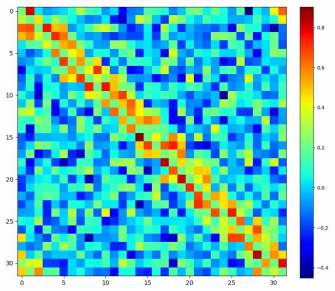
- [§2.1.1, §2.1.2] The claim that off-diagonal entries a_ij encode pairwise interaction strengths is load-bearing, but the mechanism that produces this behavior, the graph learning loss LGL, is not defined anywhere in the main text. Section 2.1.2 merely shows a heatmap of A without LGL and states that it 'will not be able to correctly capture the interaction relationship,' without specifying the loss or the training objective. Because LGL could, in principle, inject the known graph sparsity, the central interpretability claim cannot be evaluated from the information given. The authors should present the full loss definition, its gradient effect on A, and an ablation study (including random or otherwise uninformative LGL) to show that the structure in A arises from trajectory information.
- [§2.1.1, Fig. 2(a)] The quantitative support for structure recovery on the KG-LRI system is limited to a qualitative '5 : 3 : 2' ratio read from a single heatmap. Since the synthetic Hamiltonians provide exact ground-truth edge sets and exact coefficient ratios (1/4 : 3/20 : 1/10), the authors should report edge-level precision, recall, and F1 against the known graph, the mean and standard deviation of the recovered ratios across independent training runs, and the distribution of a_ij values to justify the threshold choice. As written, the claim that the ratio is 'roughly 5 : 3 : 2' is an assertion from color intensities, not a measured result.
- [§2.1.4, Fig. 4] The anomaly detection results are presented as three single heatmaps with the text 'it can be inferred' for each scenario. No quantitative measure of detection accuracy is reported: there are no statistics over many perturbed instances, no confusion matrices, no comparison of the learned A under perturbation against the original A, and no thresholds for declaring a link broken, doubled, or redundant. The central claim of detecting lattice defects therefore lacks quantitative validation. The authors should report detection rates, false-positive rates, or AUC-like metrics over an ensemble of random defect configurations.
- [§2.2, Figs. 5-6] The molecular bond inference is evaluated only by visual comparison 'consistent with the reference chemical bonds provided by some current chemistry textbooks.' No quantitative edge-recovery metrics are reported against the reference bond set, and no variance is reported across the 10 training runs beyond the averaged matrix. More importantly, the pairwise-additive ansatz, in which a single scalar a_ij stands for the full interaction between particles i and j, is not justified for MD17/MD22 force fields, which contain angle, torsion, and many-body terms. Even if the learned A correlates with bond presence, the paper does not show that A faithfully encodes the Hamiltonian's interaction terms. The authors should quantify bond-inference accuracy and explicitly discuss the limitations of the pairwise ansatz for molecular systems.
- [§2.1.3, §2.2] The thresholds used to convert A into a graph are selected in an ad hoc manner: 0.001 for KG-LRI and 35% of the maximum element for the molecules. The paper asserts that the threshold choice is 'straightforward' because of a disparity in weights, but no gap analysis, no sensitivity study, and no training-variance analysis are provided. Since the structural interpretation of A depends on these thresholds, the authors should report the distribution of a_ij values, demonstrate the presence of a clear gap, and show that the inferred edges are stable over a range of thresholds and across random seeds.
minor comments (5)
- [References] Several citations are incomplete or contain placeholder question marks, e.g., '[11 ? ]' and '[32, 33 ? ]' in Section 2.1; these should be resolved before publication.
- [§2.3] The text says a GAT layer with '60 hidden layers' was used, which is likely a typo or imprecise phrasing; the number of layers or hidden units should be stated accurately.
- [§2.1.3] The abstract and some text refer to 'root mean square errors,' but Tables 2 and 3 report MSE; the notation should be made consistent.
- [§2.1] The terms 'LA-type' and 'G-type' SympNet configurations are used without definition; a brief explanation of these configurations would help readers who are not familiar with SympNet.
- [Fig. 2 and Fig. 4] The heatmaps are informative, but the color scales are not provided. Adding color bars and numeric axis labels would allow readers to distinguish 'near zero' from small-but-nonzero values, which is crucial for the structural claims.
Circularity Check
No significant circularity: the interaction-structure claims are validated against external ground-truth Hamiltonians and chemical bond references, and no load-bearing step reduces to its inputs.
full rationale
The paper's central claims are checked against independently specified generating Hamiltonians (Table 1) and standard chemical bond structures, making the attention-matrix interpretations externally validated rather than equivalent to the model's inputs by construction. The reported 5:3:2 interaction ratio is a measured match to the known coefficient ratio 1/4:3/20:1/10 of the KG-LRI test Hamiltonian, so it is a validation result, not a fitted parameter renamed as a prediction. Trajectory prediction is evaluated on held-out test trajectories, and the learned graph structure is fixed before prediction, so there is no forced statistical coupling between the structure-inference claim and the prediction metric. The only citation to prior work by overlapping authors is reference [25], which appears in a survey list of graph-neural-network lattice models and is not load-bearing for any derivation. The paper's failure to define the graph learning loss LGL in the main text and its reliance on visual heatmap comparisons are genuine evidence-quality and completeness concerns, but the circularity rules require quoting a specific reduction by construction; without a definition of LGL one cannot show that it injects the known graph structure, and speculation to that effect is prohibited. Thus the honest finding is no circularity, with score 0.
Assumptions & free parameters
free parameters (3)
- Attention matrix A = (a_ij), N x N =
Learned in training; heatmaps shown in Figs. 2, 4-6
- Edge-pruning threshold for trajectory prediction =
0.001
- Adjacency-matrix threshold for molecule bonds =
35% of maximum element of average attention matrix
assumptions (4)
- standard math The system evolves according to Hamilton's equations (Eq. 1).
- domain assumption Total Hamiltonian can be split into per-particle functions of neighbors, H = sum_i F_i(q_{N_k(i)}, p_i).
- ad hoc to paper The graph learning loss LGL, defined only in supplementary material, encourages A to reveal the true interaction graph without being handed that graph.
- domain assumption MD17/MD22 trajectories are consistent with a Hamiltonian in which chemical bonds correspond to the strongest pairwise attention weights.
Cite this review
Pith. "Pith review of Graph Attention Hamiltonian Neural Networks: A Lattice System Analysis Model Based on Structural Learning." pith.science (2026). https://pith.science/paper/6HFFHETX
@misc{pith2026241210821,
  author       = {Pith},
  title        = {Pith review of: Graph Attention Hamiltonian Neural Networks: A Lattice System Analysis Model Based on Structural Learning},
  year         = {2026},
  howpublished = {\url{https://pith.science/paper/6HFFHETX}},
  note         = {Machine review of arXiv:2412.10821}
}
read the original abstract
A deep understanding of the intricate interactions between particles within a system is a key approach to revealing the essential characteristics of the system, whether it is an in-depth analysis of molecular properties in the field of chemistry or the design of new materials for specific performance requirements in materials science. To this end, we propose Graph Attention Hamiltonian Neural Network (GAHN), a neural network method that can understand the underlying structure of lattice Hamiltonian systems solely through the dynamic trajectories of particles. We can determine which particles in the system interact with each other, the proportion of interactions between different particles, and whether the potential energy of interactions between particles exhibits even symmetry or not. The obtained structure helps the neural network model to continue predicting the trajectory of the system and further understand the dynamic properties of the system. In addition to understanding the underlying structure of the system, it can be used for detecting lattice structural abnormalities, such as link defects, abnormal interactions, etc. These insights benefit system optimization, design, and detection of aging or damage. Moreover, this approach can integrate other components to deduce the link structure needed for specific parts, showcasing its scalability and potential. We tested it on a challenging molecular dynamics dataset, and the results proved its ability to accurately infer molecular bond connectivity, highlighting its scientific research potential.
Figures

Figures from the paper (4 more)



Reference graph
Works this paper leans on
-
[1]
M. Lewenstein, A. Sanpera, V . Ahufinger, B. Damski, A. Sen , U. Sen, Ultracold atomic gases in opti- cal lattices: mimicking condensed matter physics and beyon d, Advances in Physics 56 (2) (2006) 243–379. doi:10.1080/00018730701223200
-
[2]
S. Curtarolo, W. Setyawan, S. Wang, J. Xue, K. Y ang, R. H. T aylor, L. J. Nelson, G. L. Hart, S. San- vito, M. Buongiorno-Nardelli, N. Mingo, O. Levy, Aflowlib.o rg: A distributed materials properties repos- itory from high-throughput ab initio calculations, Comput ational Materials Science 58 (2012) 227–235. doi:10.1016/j.commatsci.2012.02.002
-
[3]
J. P . Coe, Lattice density-functional theory for quantu m chemistry, Physical Review B 99 (2019) 165118. doi:10.1103/PhysRevB.99.165118
-
[4]
Y . J. Mark S. Alber, Maria Kiskowski, S. Newman, Biologic al lattice gas models, Dynamics and bifurcation of patterns in dissipative systems (2004) 274–291 doi:10.1142/9789812567840\_0014
-
[5]
S. E. I. Abkevich V I, Gutin A M, Specific nucleus as the tran sition state for protein folding: evidence from the lattice model, Biochemistry 33 (33) (1994) 10026–10036. doi:10.1021/bi00199a029
-
[6]
L. P . Hu J, Chen D, A novel interval three-way concept latt ice model with its application in medical diagnosis, Mathematics 7 (1) (2019) 103. doi:10.3390/math7010103
-
[7]
V . Y . Friedli S, Statistical Mechanics of Lattice System s: A Concrete Mathematical Introduction, Cambridge Uni- versity Press, 2017
work page 2017
-
[8]
Toda, Theory of Nonlinear Lattices, Springer Science & Business Media,, 2012
M. Toda, Theory of Nonlinear Lattices, Springer Science & Business Media,, 2012
work page 2012
Show all 43 references
-
[9]
A. M. Glazer, Crystallography: A V ery Short Introductio n, V ol. 469, Oxford University Press, 2016
2016
-
[10]
A. R. Oganov, C. J. Pickard, Q. Zhu, R. J. Needs, Structur e prediction drives materials discovery, Nature Reviews Materials 4 (5) (2019) 331–348. doi:10.1038/s41578-019-0101-8
2019 doi
-
[11]
Datta, D
S. Datta, D. J. Grant, Crystal structures of drugs: adva nces in determination, prediction and engineering, Nature Reviews Drug Discovery 3 (1) (2004) 42–57. doi:10.1038/nrd1280. 13
2004 doi
-
[12]
P . G. Kevrekidis, J. Cuevas-Maraver, A. Saxena, Emergi ng Frontiers in Nonlinear Science, Springer, 2020. doi:10.1007/978-3-030-44992-6
2020 doi
-
[13]
Teki´ c, P
J. Teki´ c, P . Mali, D. Kapor, Z. Ivi´ c, M. Rakovi´ c, A. Rockov, The Ac Driven Frenkel-Kontorova Model, Institut za nuklearne nauke VIN ˇCA, 2016
2016
-
[14]
P . G. Kevrekidis, J. Cuevas-Maraver, A dynamical persp ective on the ϕ4 model past, present and future, Nonlinear Systems and Complexity 26 (2019). doi:10.1007/978-3-030-11839-6
2019 doi
-
[15]
Maci´ a, Charge transfer in DNA: e ffective Hamiltonian approaches, Zeitschrift f¨ ur Kristallographie-Crystalline Materials 224 (1-2) (2009) 91–95
E. Maci´ a, Charge transfer in DNA: e ffective Hamiltonian approaches, Zeitschrift f¨ ur Kristallographie-Crystalline Materials 224 (1-2) (2009) 91–95. doi:10.1524/zkri.2009.1123
2009
-
[16]
Saqlain, W
S. Saqlain, W. Zhu, E. G. Charalampidis, P . G. Kevrekidi s, Discovering governing equations in discrete sys- tems using PINNs, Communications in Nonlinear Science and N umerical Simulation 126 (2023) 107498. doi:10.1016/j.cnsns.2023.107498
2023
-
[17]
Zvyagintseva, H
D. Zvyagintseva, H. Sigurdsson, V . K. Kozin, I. Iorsh, I . A. Shelykh, V . Ulyantsev, O. Kyriienko, Ma- chine learning of phase transitions in nonlinear polariton lattices, Communications Physics 5 (1) (2022) 8. doi:10.1038/s42005-021-00755-5
2022 doi
-
[18]
J. Li, J. Chen, B. Li, Gradient-optimized physics-info rmed neural networks (gopinns): a deep learn- ing method for solving the complex modified kdv equation, Non linear Dynamics 107 (2022) 781–792. doi:10.1007/s11071-021-06996-x
2022 doi
-
[19]
W. Zhu, W. Khademi, E. G. Charalampidis, P . G. Kevrekidi s, Neural networks enforcing physical symmetries in nonlinear dynamical lattices: The case example of the Ablow itz–Ladik model, Physica D: Nonlinear Phenomena 434 (2022) 133264. doi:10.1016/j.physd.2022.133264
2022
-
[20]
P . Jin, Z. Zhang, I. G. Kevrekidis, G. E. Karniadakis, Le arning Poisson systems and trajectories of autonomous systems via Poisson neural networks, IEEE Transactions on N eural Networks and Learning Systems (2022). doi:10.1109/TNNLS.2022.3148734
2022
- [21]
-
[22]
Kochkov, T
D. Kochkov, T. Pfa ff, A. Sanchez-Gonzalez, P . Battaglia, B. K. Clark, Learning ground states of quantum Hamilto- nians with graph networks, arXiv preprint arXiv:2110.0639 0 (2021). doi:10.48550/arXiv.2110.06390
2021 doi
-
[23]
Bishnoi, R
S. Bishnoi, R. Bhattoo, J. Jayadeva, S. Ranu, N. A. Krish nan, Learning the dynamics of physical systems with Hamiltonian graph neural networks, ICLR 2023 Workshop on Ph ysics for Machine Learning (2023)
2023
- [24]
-
[25]
R. Geng, J. Zu, Y . Gao, H.-K. Zhang, Separable graph hami ltonian network: A graph deep learning model for lattice systems, Physical Review Research 6 (1) (2024) 0131 76
2024
-
[26]
V eliˇ ckovi´ c, G
P . V eliˇ ckovi´ c, G. Cucurull, A. Casanova, A. Romero, P. Lio, Y . Bengio, Graph attention networks, in: ICLR 2018 Conference, V ol. 1050, ICLR, 2018, pp. 10–48550
2018
- [27]
-
[28]
R. L. Haber E, Stable architectures for deep neural netw orks, Inverse problems 34 (1) (2017) 014004. doi:10.1088/1361-6420/aa9a90
2017 doi
-
[29]
Penati, V
T. Penati, V . Koukouloyannis, M. Sansottera, P . Kevrek idis, S. Paleari, On the nonexistence of degenerate phase- shift multibreathers in Klein-Gordon models with interact ions beyond nearest neighbors, Physica D: Nonlinear Phenomena 398 (2019) 92–114. doi:10.1016/j.physd.20...
2019 doi
-
[30]
Koukouloyannis, P
V . Koukouloyannis, P . G. Kevrekidis, J. Cuevas, V . Roth os, Multibreathers in Klein-Gordon chains with interactions beyond nearest neighbors, Physica D: Non linear Phenomena 242 (1) (2013) 16–29. doi:10.1016/j.physd.2012.08.011
2013 doi
-
[31]
N. K. Efremidis, D. N. Christodoulides, Discrete solit ons in nonlinear zigzag optical waveguide arrays with tailored diffraction properties, Physical Review E 65 (5) (2002) 056607. doi:10.1103/PhysRevE.65.056607
2002 doi
-
[32]
Dauxois, R
T. Dauxois, R. Khomeriki, F. Piazza, S. Ru ffo, The anti-FPU problem, Chaos: An Interdisciplinary Journ al of Nonlinear Science 15 (1) (2005) 015110. doi:10.1063/1.1854273
2005 doi
- [33]
-
[34]
J. Ford, S. D. Stoddard, J. S. Turner, On the integrabili ty of the toda lattice, Progress of Theoretical Physics 50 (5 ) (1973) 1547–1560. doi:10.1143/PTP.50.1547
1973 doi
-
[35]
Montavon, G
G. Montavon, G. Orr, K.-R. M¨ uller, Neural Networks: Tr icks of the Trade, V ol. 7700, springer, 2012. doi:10.1007/3-540-49430-8
2012 doi
-
[36]
Popescu, V
M.-C. Popescu, V . E. Balas, L. Perescu-Popescu, N. Mast orakis, Multilayer perceptron and neural networks, WSEAS Transactions on Circuits and Systems 8 (7) (2009) 579– 588
2009
- [37]
-
[38]
P . Jin, Z. Zhang, A. Zhu, Y . Tang, G. E. Karniadakis, Symp nets: Intrinsic structure-preserving symplectic networks for identifying Hamiltonian systems, Neural Networks 132 (2020) 166–179. doi:10.1016/j.neunet.2020.08.017
2020 doi
-
[39]
Chmiela, A
S. Chmiela, A. Tkatchenko, H. E. Sauceda, I. Poltavsky, K. T. Sch¨ utt, K.-R. M¨ uller, Machine learn- ing of accurate energy-conserving molecular force fields, S cience advances 3 (5) (2017) e1603015. doi:10.1126/sciadv.16030
2017 doi
-
[40]
Chmiela, V
S. Chmiela, V . V assilev-Galindo, O. T. Unke, A. Kabylda , H. E. Sauceda, A. Tkatchenko, K.-R. M¨ uller, Accu- rate global machine learning force fields for molecules with hundreds of atoms, Science Advances 9 (2) (2023) eadf0873. doi:10.1126/sciadv.adf0873
2023 doi
-
[41]
K. T. Sch¨ utt, H. E. Sauceda, P .-J. Kindermans, A. Tkatc henko, K.-R. M¨ uller, Schnet–a deep learning architecture for molecules and materials, The Journal of Chemical Physic s 148 (24) (2018). doi:10.1063/1.5019779
2018 doi
-
[42]
K. T. Sch¨ utt, F. Arbabzadah, S. Chmiela, K. R. M¨ uller, A. Tkatchenko, Quantum-chemical insights from deep tensor neural networks, Nature communications 8 (1) (2017) 13890. doi:10.1038/ncomms13890
2017 doi
-
[43]
Chmiela, H
S. Chmiela, H. E. Sauceda, K.-R. M¨ uller, A. Tkatchenko , Towards exact molecular dynamics simulations with machine-learned force fields, Nature communications 9 (1) ( 2018) 3887. doi:10.1038/s41467-018-06169-2 . 15
2018 doi
Reviewed August 11, 2026 · model on record in the stance chip above.
Discussion (0). Continue with ORCID to comment.