REVIEW 4 major objections 5 minor 1 cited by
Domain-Enhanced Dual-Branch Model for Efficient and Interpretable Accident Anticipation
T0 review · 4 major / 5 minor · reviewed 2026-08-06 · deepseek-v4-flash
Pith's one-line read A dual-branch model that aligns dashcam video features with embeddings of accident reports predicts crashes earlier and more accurately, reaching 87.7% average precision on the DAD benchmark.
desk verdict A genuinely new text-prior idea for accident anticipation with a large but not-yet-trustworthy DAD gain; needs protocol controls before the numbers are cited. read the letter →
The pith
A machine-rendered reading of the paper's core claim, the machinery that carries it, and where it could break.
The reading
What carries the argument
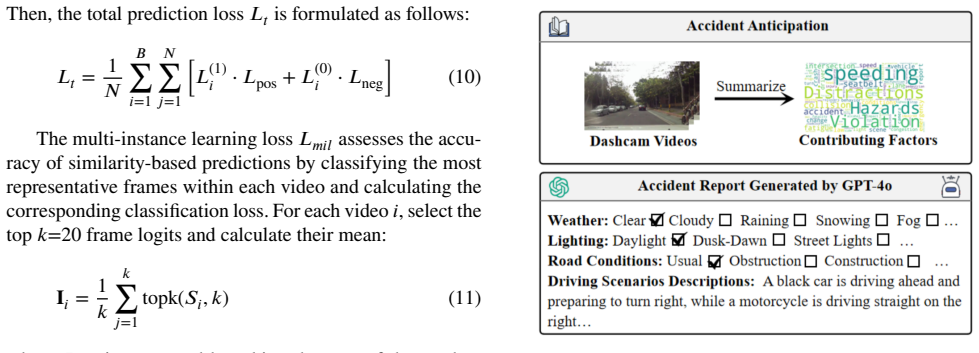
The load-bearing object is the dual-branch multimodal architecture. The visual branch runs VGG-16 on dashcam frames and applies multi-head attention to produce frame features; the textual branch encodes accident and non-accident reports with Long-CLIP followed by max-pooling and normalization, producing text prototypes $X=\{X_{\mathrm{pos}},X_{\mathrm{neg}}\}$. An anomaly-focused visual prompt aggregates visual embeddings weighted by the prediction logits (Eq. 4), is added to the text prototypes, and a temperature-scaled dot product (Eq. 5) gives per-frame similarity scores $S$. These scores are supervised by a multi-instance learning loss (Eqs. 10-12) that aligns risky frames with accident-report embeddings and safe frames with non-accident embeddings, while a learnable threshold (Eqs. 13-15) adapts the decision boundary during training.
What would settle it
Train the same dual-branch model with the text branch fed embeddings of 573 random matched-length paragraphs from an unrelated corpus (or of GPT-4o-generated fake accident reports that describe no real scenes). If DAD AP stays near 87.7% instead of falling toward the 74.3% no-text baseline, the claimed gain is not due to domain knowledge from genuine accident reports.
Extended reading notes
Core claim
On its own terms, the paper's central discovery is that structured text from accident reports can be treated as class prototypes for dashcam scenes, and aligning visual features to those prototypes with a multi-instance loss improves both accuracy and earliness of accident anticipation. The reported numbers on DAD are an AP of 87.7% versus 77.8% for the previous best method THAT-NET, and a mean time-to-accident of 4.47 seconds; the text branch alone accounts for a 13.4-point AP gain in the ablation. The paper further claims the same architecture holds its own on CCD and A3D, and that its scene-level, detector-free design explains the low FLOP count and stable inference time as scene complexity grows.
Load-bearing premise
The improvement rests on the assumption that Long-CLIP embeddings of 573 California DMV regulatory accident reports and 500 GPT-4o-generated safe-driving reports are semantically representative of the visual crash and non-crash scenes in the DAD, CCD, and A3D dashcam videos.
Editorial extensions
If this is right
- If the central claim holds, accident anticipation can be improved by mining existing regulatory and police accident reports instead of requiring new manual video annotations.
- The 42.90M FLOP visual branch can run on embedded vehicle hardware, with the LLM-based feedback offloaded to the cloud, making real-time deployment feasible in dense urban scenes.
- The learnable threshold should lower false positive rates on imbalanced dashcam data relative to the fixed 0.5 threshold used by earlier systems.
- The reported mTTA of 4.47 s is tied to the test-set threshold that maximizes AP, so future comparisons should adopt the same threshold-selection protocol to be directly comparable.
Reading between the lines
- A test the paper leaves implicit: replace the California DMV reports with reports from the same regions as the dashcam datasets (e.g., Taiwan or YouTube sources) and measure whether the DAD gain grows or shrinks; this would separate genuine domain transfer from a generic 'extra text helps' regularization effect.
- Because mTTA is evaluated at the test-set AP-optimal threshold, the 4.47 s figure likely overstates the lead time achievable under a fixed operating point; a deployed system would need to pick the threshold on a calibration set before deployment.
- The non-accident reports are synthetic and describe idealized safe behavior, so the model may be learning to flag deviations from that idealized text type rather than traffic risk itself; testing with hand-written non-accident narratives would clarify.
- The similarity scores could double as a retrieval index: for a new risky frame, retrieve the most similar archived accident report and use its contributing factors as an explanation, turning the model into a case-based reasoner.
Editorial analysis
A structured set of objections, weighed in public.
Referee Report
Summary. The paper proposes a dual-branch accident anticipation framework for dashcam videos: a VGG-16 visual branch extracts scene-level features, and a Long-CLIP textual branch encodes 573 California DMV autonomous-vehicle accident reports together with 500 GPT-4o-generated non-accident reports. These text embeddings are used as class prototypes and aligned with visual features through a multi-instance learning loss (Eqs. 10–12), while a learnable threshold (Sec. 3.8) is introduced to replace fixed-threshold decision rules. The model is evaluated on DAD, CCD, and A3D, reporting 87.7% AP and 4.47 s mTTA on DAD, along with 42.90 M FLOPs and 11.58 ms inference time in Tables 5 and 6. An LLM feedback module (Sec. 3.6) generates interpretable warnings and driving advice. Ablations in Table 7 show that removing the text branch lowers DAD AP from 87.7% to 74.3%, which the paper attributes to domain knowledge from accident reports.
Significance. If the claims are substantiated, the work would be a useful contribution: it is among the first to inject structured accident-report text into video-based accident anticipation, and the reported efficiency is attractive for onboard deployment. The AP measure is threshold-independent and relies on external training labels, which gives the core accuracy result independent grounding. The paper also provides a clear architecture, an interpretable LLM feedback component, and a reproducible training recipe. However, the current manuscript does not yet support the strongest claims about the domain-knowledge contribution, the early-warning advantage, or the computational efficiency; these require the additional controls and clarifications described below.
major comments (4)
- [Sec. 4.2, Fig. 6] The mTTA is reported at a threshold chosen by exhaustive search on the test set: the caption of Fig. 6 states 'Best Threshold represents the threshold with the highest F1 score selected by exhaustive method during the testing process,' while Sec. 4.2 says TTA values are reported 'when the highest AP is attained.' The claimed 4.47 s mTTA is therefore an oracle-threshold result, not a property of a fixed operating rule, and it is not comparable to baseline mTTA values unless the baselines used the identical test-set threshold selection protocol. Please report mTTA at a threshold fixed before seeing test labels (for example 0.5 or a validation-selected threshold) and give the corresponding AP at that threshold, or explicitly justify comparability with each cited baseline by stating which threshold protocol was used for every method in Table 3.
- [Sec. 3.4, Table 7] Table 7 shows that removing the text branch lowers DAD AP from 87.7% to 74.3%, yet this ablation does not establish that the specific report corpus causes the gain. The text branch could contribute through generic accident-vs-normal semantics encoded in any text prototype, and the paper's Sec. 4.5 only varies presence/absence of the branch, never its content. To support the central 'domain-enhanced' claim, please add a control experiment that keeps the text branch and MIL loss unchanged but replaces the CA DMV/GPT-4o report embeddings with simple generic class prototypes (e.g., the words 'accident scene' vs 'normal scene'), and compare the resulting AP against the current 87.7%.
- [Sec. 4.3, Table 5] Table 5 reports 42.90 M FLOPs for a VGG-16-based model. This is three orders of magnitude lower than typical VGG-16 inference FLOPs for a single 224x224 frame (several GFLOPs), and the table also lists 421.06 M FLOPs for the VGG-16-based DSA baseline, which is itself far below standard VGG-16 counts. The current numbers suggest that the FLOPs definition excludes the visual backbone or uses a non-standard counting method. Please state precisely which operations are counted, the input resolution, whether the backbone's full convolutional FLOPs are included, and how the FLOPs were measured or computed; otherwise the 'reduced computational overhead' claim is not verifiable against the baselines.
- [Sec. 4.3, Table 7] All results in Tables 3, 4, and 7 are reported as single runs without variance or significance testing. Given that the DAD AP margin over the strongest baseline (THAT-NET, 77.8%) is 9.9 points and several mTTA differences are fractions of a second, please provide mean and standard deviation over at least three training seeds for the main results and the ablations, and include a statistical comparison (e.g., a paired significance test) for the central DAD claims.
minor comments (5)
- [Table 3] The CCD entry for CCAF-Net reads '93.94.94'; this appears to be a formatting typo, likely intended as AP 93.9 and mTTA 4.94.
- [Sec. 4.2 vs. Fig. 6] The main text states that TTA is reported 'when the highest AP is attained,' whereas the Fig. 6 caption says the best threshold is selected by the highest F1 score; please align these definitions.
- [Sec. 3.1] The notation uses both T (sequence length) and τ (accident frame); please define them consistently in one place to avoid confusion with the threshold parameter τ introduced in Sec. 3.8.
- [References] The reference list contains a duplicate: Liao et al. (2024a) and (2024b) are identical entries for 'Real-time accident anticipation for autonomous driving through monocular depth-enhanced 3d modeling.' Please merge them and renumber citations accordingly.
- [Code availability] The code availability statement points to an 'ETS data platform' with an ID; please provide a direct, stable link (e.g., a public repository) so that reviewers and readers can access the code.
Circularity Check
Partial circularity: the headline mTTA is an oracle-selected operating point on the test set, while the AP result remains externally grounded.
-
fitted input called prediction
[Section 4.2 (Evaluation Metrics) and Figure 6 caption]
"Nonetheless, it is crucial to recognize that a high TTA might be misleading if the model overfits the dashcam data, resulting in indiscriminate positive predictions. Hence, a high TTA value is ineffective without considering the AP. This study reports the TTA values when the highest AP is attained, ensuring a comprehensive evaluation of the model’s predictive performance. ... Best Threshold represents the threshold with the highest F1 score selected by exhaustive method during the testing process."
The reported mean time-to-accident (4.47 s on DAD) is not the behavior of the proposed learnable threshold or of any fixed decision rule: it is the TTA measured at the threshold chosen by exhaustive search over the test set to maximize AP/F1. Thus the 'enhanced responsiveness' component of the central claim is not predicted by the model but is selected post hoc from the test data. This is a fitted operating point presented as a system property, so that part of the claimed SOTA margin reduces to test-set threshold selection. The AP figure itself is threshold-independent and trained on external labels, so the core accuracy result is not circular.
full rationale
The paper's strongest independent result is the 87.7% AP on DAD, which is an integral over all thresholds and is supervised by external video-level labels; the visual branch and the fixed text prototypes trained under the MIL loss do not reduce to the evaluation metric. The learnable threshold is trained on the training split, and the AP ablation (Table 7) is a legitimate presence/absence study. The main circularity is confined to the mTTA reporting protocol: the paper explicitly reports TTA at the test-set threshold attaining the highest AP (Section 4.2) and defines the 'Best Threshold' as the one selected by exhaustive search on the DAD testing set (Figure 6). Consequently, the 4.47 s responsiveness claim is an oracle-fitted number rather than a fixed decision-rule property, and it is not comparable to baselines using their own fixed or learned thresholds. No load-bearing self-citation chain is used: the comparisons to the authors' earlier WWW and AccNet are external benchmark numbers, not assumptions that force the result. The domain-knowledge text branch is not shown to depend on the specific CA DMV/GPT-4o corpus rather than generic accident semantics, but that is a missing control, not a circular derivation. Overall score is therefore moderate: one headline metric is effectively fitted to the test set, while the central AP claim retains independent empirical content.
Assumptions & free parameters
free parameters (4)
- Learnable threshold tau =
trained, initialized 0
- Test-time threshold selection =
unknown; chosen by exhaustive search to maximize AP on the test set
- Loss weights =
learnable tensor, initialized 1:1:1
- Top-k for MIL =
20
assumptions (5)
- domain assumption CA DMV autonomous-vehicle accident reports are representative of the dashcam accident scenes in DAD/CCD/A3D.
- domain assumption Long-CLIP embeddings can be linearly compared with VGG-16 frame features after a shared-space projection.
- domain assumption GPT-4o-generated non-accident reports are valid and unbiased negative prototypes.
- ad hoc to paper Time-based penalty with exponential decay (Eq. 7) is a reasonable surrogate for early-warning value.
- ad hoc to paper The mTTA-at-best-AP protocol is comparable to prior baseline measurements.
Cite this review
Pith. "Pith review of Domain-Enhanced Dual-Branch Model for Efficient and Interpretable Accident Anticipation." pith.science (2026). https://pith.science/paper/6MA4ASWP
@misc{pith2026250712755,
  author       = {Pith},
  title        = {Pith review of: Domain-Enhanced Dual-Branch Model for Efficient and Interpretable Accident Anticipation},
  year         = {2026},
  howpublished = {\url{https://pith.science/paper/6MA4ASWP}},
  note         = {Machine review of arXiv:2507.12755}
}
read the original abstract
Developing precise and computationally efficient traffic accident anticipation system is crucial for contemporary autonomous driving technologies, enabling timely intervention and loss prevention. In this paper, we propose an accident anticipation framework employing a dual-branch architecture that effectively integrates visual information from dashcam videos with structured textual data derived from accident reports. Furthermore, we introduce a feature aggregation method that facilitates seamless integration of multimodal inputs through large models (GPT-4o, Long-CLIP), complemented by targeted prompt engineering strategies to produce actionable feedback and standardized accident archives. Comprehensive evaluations conducted on benchmark datasets (DAD, CCD, and A3D) validate the superior predictive accuracy, enhanced responsiveness, reduced computational overhead, and improved interpretability of our approach, thus establishing a new benchmark for state-of-the-art performance in traffic accident anticipation.
Figures


Figures from the paper (8 more)



Forward citations
Cited by 1 Pith paper
-
CARA: Concept-Aware Risk Attention for Interpretable Collision Anticipation
CARA turns accident-report concepts into CLIP-scored trajectories that guide spatial and temporal attention, improving collision-anticipation accuracy and earliness while emitting a human-readable concept trace.
Reference graph
Works this paper leans on
-
[1]
Abdel-Aty, M. and Ding, S. (2024). A matched case-control analysis of autonomous vs human-driven vehicle accidents. Nature Communications , 15(1):4931
work page 2024
-
[2]
L., Almeida, D., Altenschmidt, J., Altman, S., Anadkat, S., et al
Achiam, J., Adler, S., Agarwal, S., Ahmad, L., Akkaya, I., Aleman, F. L., Almeida, D., Altenschmidt, J., Altman, S., Anadkat, S., et al. (2023). Gpt-4 technical report. arXiv preprint arXiv:2303.08774
arXiv 2023
-
[3]
Ahmed, S. K., Mohammed, M. G., Abdulqadir, S. O., El-Kader, R. G. A., El-Shall, N. A., Chandran, D., Rehman, M. E. U., and Dhama, K. (2023). Road traffic accidental injuries and deaths: A neglected global health issue. Health science reports , 6(5):e1240
work page 2023
-
[4]
Bao, W., Yu, Q., and Kong, Y. (2020). Uncertainty-based traffic accident anticipation with spatio-temporal relational learning. In ACM Multimedia Conference
work page 2020
-
[5]
Bao, W., Yu, Q., and Kong, Y. (2021). Drive: Deep reinforced accident anticipation with visual explanation. In Proceedings of the IEEE/CVF International Conference on Computer Vision , pages 7619--7628
work page 2021
-
[6]
Chan, F.-H., Chen, Y.-T., Xiang, Y., and Sun, M. (2017). Anticipating accidents in dashcam videos. In Computer Vision--ACCV 2016: 13th Asian Conference on Computer Vision, Taipei, Taiwan, November 20-24, 2016, Revised Selected Papers, Part IV 13 , pages 136--153. Springer
work page 2017
-
[7]
Chen, J., Wang, Q., Cheng, H. H., Peng, W., and Xu, W. (2022). A review of vision-based traffic semantic understanding in itss. IEEE Transactions on Intelligent Transportation Systems
work page 2022
-
[8]
Collingwood, L. (2017). Privacy implications and liability issues of autonomous vehicles. Information & Communications Technology Law , 26(1):32--45
work page 2017
Show all 53 references
-
[9]
Da, L., Liou, K., Chen, T., Zhou, X., Luo, X., Yang, Y., and Wei, H. (2024). Open-ti: Open traffic intelligence with augmented language model. International Journal of Machine Learning and Cybernetics , pages 1--26
2024
-
[10]
Dan, C., Ueli, M., Jonathan, M., and J \"u rgen, S.-h. (2012). Multi-column deep neural network for traffic sign classification. Neural networks , 32(1):333--338
2012
-
[11]
Dash, T., Chitlangia, S., Ahuja, A., and Srinivasan, A. (2022). A review of some techniques for inclusion of domain-knowledge into deep neural networks. Scientific Reports , 12(1):1040
2022
-
[12]
Devlin, J., Chang, M.-W., Lee, K., and Toutanova, K. (2019). Bert: Pre-training of deep bidirectional transformers for language understanding. In Proceedings of the 2019 conference of the North American chapter of the association for computational linguistics: human language t...
2019
-
[13]
Fang, J., Qiao, J., Bai, J., Yu, H., and Xue, J. (2022). Traffic accident detection via self-supervised consistency learning in driving scenarios. IEEE Transactions on Intelligent Transportation Systems , 23(7):9601--9614
2022
-
[14]
Fang, J., Qiao, J., Xue, J., and Li, Z. (2023). Vision-based traffic accident detection and anticipation: A survey. IEEE Transactions on Circuits and Systems for Video Technology
2023
-
[15]
Fang, J., Yan, D., Qiao, J., Xue, J., Wang, H., and Li, S. (2019). Dada-2000: Can driving accident be predicted by driver attentionƒ analyzed by a benchmark. In 2019 IEEE Intelligent Transportation Systems Conference (ITSC) , pages 4303--4309. IEEE
2019
-
[16]
Fang, J., Yan, D., Qiao, J., Xue, J., and Yu, H. (2021). Dada: Driver attention prediction in driving accident scenarios. IEEE transactions on intelligent transportation systems , 23(6):4959--4971
2021
-
[17]
Fatima, M., Khan, M. U. K., and Kyung, C.-M. (2021). Global feature aggregation for accident anticipation. In 2020 25th International Conference on Pattern Recognition (ICPR) , pages 2809--2816. IEEE
2021
-
[18]
GDPR, E. (2018). General data protection regulation (gdpr)
2018
-
[19]
M., Li, Y., Qin, R., and Yin, Z
Karim, M. M., Li, Y., Qin, R., and Yin, Z. (2022). A dynamic spatial-temporal attention network for early anticipation of traffic accidents. IEEE Transactions on Intelligent Transportation Systems , 23(7):9590--9600
2022
-
[20]
Kumar, N., Acharya, D., and Lohani, D. (2020). An iot-based vehicle accident detection and classification system using sensor fusion. IEEE Internet of Things Journal , 8(2):869--880
2020
-
[21]
Le, T.-N., Ono, S., Sugimoto, A., and Kawasaki, H. (2020). Attention r-cnn for accident detection. In 2020 IEEE intelligent vehicles symposium (IV) , pages 313--320. IEEE
2020
-
[22]
Li, J., Xie, N., Zhang, K., Guo, F., Hu, S., and Chen, X. M. (2022). Network-scale traffic prediction via knowledge transfer and regional mfd analysis. Transportation research part C: emerging technologies , 141:103719
2022
-
[23]
Li, L.-L., Fang, J., and Xue, J. (2024). Cognitive traffic accident anticipation. IEEE Intelligent Transportation Systems Magazine
2024
-
[24]
Liao, H., Li, Y., Li, Z., Bian, Z., Lee, J., Cui, Z., Zhang, G., and Xu, C. (2024a). Real-time accident anticipation for autonomous driving through monocular depth-enhanced 3d modeling. Accident Analysis & Prevention , 207:107760
2024
-
[25]
Liao, H., Li, Y., Li, Z., Bian, Z., Lee, J., Cui, Z., Zhang, G., and Xu, C. (2024b). Real-time accident anticipation for autonomous driving through monocular depth-enhanced 3d modeling. Accident Analysis & Prevention , 207:107760
2024
-
[26]
Liao, H., Li, Y., Li, Z., Wang, C., Guan, Y., Tam, K., Tian, C., Li, L., and zhong Xu, C. (2024c). When, where, and what? a benchmark for accident anticipation and localization with large language models. In ACM Multimedia 2024
2024
-
[27]
Liao, H., Shen, H., Li, Z., Wang, C., Li, G., Bie, Y., and Xu, C. (2024d). Gpt-4 enhanced multimodal grounding for autonomous driving: Leveraging cross-modal attention with large language models. Communications in Transportation Research , 4:100116
2024
-
[28]
Liu, W., Li, Y., Zhang, T., Gao, Y., Wei, L., and Chen, J. (2025). Ccaf-net: Cascade complementarity-aware fusion network for traffic accident prediction in dashcam videos. Neurocomputing , 624:129285
2025
-
[29]
Liu, W., Zhang, T., Lu, Y., Chen, J., and Wei, L. (2023). That-net: Two-layer hidden state aggregation based two-stream network for traffic accident prediction. Information Sciences , 634:744--760
2023
-
[30]
K., Vecchietti, L
Mishra, S., Rajendran, P. K., Vecchietti, L. F., and Har, D. (2023). Sensing accident-prone features in urban scenes for proactive driving and accident prevention. IEEE Transactions on Intelligent Transportation Systems , 24(9):9401--9414
2023
-
[31]
Nie, J., Jiang, J., Li, Y., Wang, H., Ercisli, S., and Lv, L. (2025). Data and domain knowledge dual-driven artificial intelligence: Survey, applications, and challenges. Expert Systems , 42(1):e13425
2025
-
[32]
B., Taghipour, H., Derrible, S., and Mohammadian, A
Parsa, A. B., Taghipour, H., Derrible, S., and Mohammadian, A. K. (2019). Real-time accident detection: Coping with imbalanced data. Accident Analysis & Prevention , 129:202--210
2019
-
[33]
W., Hallacy, C., Ramesh, A., Goh, G., Agarwal, S., Sastry, G., Askell, A., Mishkin, P., Clark, J., et al
Radford, A., Kim, J. W., Hallacy, C., Ramesh, A., Goh, G., Agarwal, S., Sastry, G., Askell, A., Mishkin, P., Clark, J., et al. (2021). Learning transferable visual models from natural language supervision. In International conference on machine learning , pages 8748--8763. PMLR
2021
-
[34]
Radford, A., Narasimhan, K., Salimans, T., Sutskever, I., et al. (2018). Improving language understanding by generative pre-training
2018
-
[35]
and Zisserman, A
Simonyan, K. and Zisserman, A. (2014). Very deep convolutional networks for large-scale image recognition. arXiv preprint arXiv:1409.1556
2014 arXiv
-
[36]
and Zisserman, A
Simonyan, K. and Zisserman, A. (2015). Very deep convolutional networks for large-scale image recognition. In International Conference on Learning Representations
2015
-
[37]
Song, W., Li, S., Chang, T., Xie, K., Hao, A., and Qin, H. (2024). Dynamic attention augmented graph network for video accident anticipation. Pattern Recognition , 147:110071
2024
-
[38]
Suzuki, T., Kataoka, H., Aoki, Y., and Satoh, Y. (2018). Anticipating traffic accidents with adaptive loss and large-scale incident db. In Proceedings of the IEEE conference on computer vision and pattern recognition , pages 3521--3529
2018
-
[39]
Thakur, N., Gouripeddi, P., and Li, B. (2024). Graph (graph): A nested graph-based framework for early accident anticipation. In Proceedings of the IEEE/CVF Winter Conference on Applications of Computer Vision , pages 7533--7541
2024
-
[40]
N., Kaiser, ., and Polosukhin, I
Vaswani, A., Shazeer, N., Parmar, N., Uszkoreit, J., Jones, L., Gomez, A. N., Kaiser, ., and Polosukhin, I. (2017). Attention is all you need. Advances in neural information processing systems , 30
2017
-
[41]
Wang, L., Ren, Y., Jiang, H., Cai, P., Fu, D., Wang, T., Cui, Z., Yu, H., Wang, X., Zhou, H., et al. (2024). Accidentgpt: A v2x environmental perception multi-modal large model for accident analysis and prevention. In 2024 IEEE Intelligent Vehicles Symposium (IV) , pages 472--...
2024
-
[42]
Wang, T., Chen, K., Chen, G., Li, B., Li, Z., Liu, Z., and Jiang, C. (2023). Gsc: A graph and spatio-temporal continuity based framework for accident anticipation. IEEE Transactions on Intelligent Vehicles , 9(1):2249--2261
2023
-
[43]
Wu, P., Zhou, X., Pang, G., Zhou, L., Yan, Q., Wang, P., and Zhang, Y. (2024). Vadclip: Adapting vision-language models for weakly supervised video anomaly detection. In Proceedings of the AAAI Conference on Artificial Intelligence , volume 38, pages 6074--6082
2024
-
[44]
Xu, X., Liu, W., and Yu, L. (2022). Trajectory prediction for heterogeneous traffic-agents using knowledge correction data-driven model. Information Sciences , 608:375--391
2022
-
[45]
J., and Atkins, E
Yao, Y., Xu, M., Wang, Y., Crandall, D. J., and Atkins, E. M. (2019). Unsupervised traffic accident detection in first-person videos. In 2019 IEEE/RSJ International Conference on Intelligent Robots and Systems (IROS) , pages 273--280. IEEE
2019
-
[46]
Yu, F., Chen, H., Wang, X., Xian, W., Chen, Y., Liu, F., Madhavan, V., and Darrell, T. (2020). Bdd100k: A diverse driving dataset for heterogeneous multitask learning. In Proceedings of the IEEE/CVF conference on computer vision and pattern recognition , pages 2636--2645
2020
-
[47]
Yuan, Y., Ding, J., Feng, J., Jin, D., and Li, Y. (2024). Unist: A prompt-empowered universal model for urban spatio-temporal prediction. In Proceedings of the 30th ACM SIGKDD Conference on Knowledge Discovery and Data Mining , pages 4095--4106
2024
-
[48]
Zeng, K.-H., Chou, S.-H., Chan, F.-H., Carlos Niebles, J., and Sun, M. (2017). Agent-centric risk assessment: Accident anticipation and risky region localization. In Proceedings of the IEEE Conference on Computer Vision and Pattern Recognition , pages 2222--2230
2017
-
[49]
Zhang, B., Zhang, P., Dong, X., Zang, Y., and Wang, J. (2024). Long-clip: Unlocking the long-text capability of clip. arXiv preprint arXiv:2403.15378
2024 arXiv
-
[50]
Zhang, S., Tong, H., Xu, J., and Maciejewski, R. (2019). Graph convolutional networks: a comprehensive review. Computational Social Networks , 6(1):1--23
2019
-
[51]
Zhao, L., Song, Y., Zhang, C., Liu, Y., Wang, P., Lin, T., Deng, M., and Li, H. (2019). T-gcn: A temporal graph convolutional network for traffic prediction. IEEE transactions on intelligent transportation systems , 21(9):3848--3858
2019
-
[52]
and Knoll, A
Zhou, X. and Knoll, A. C. (2024). Gpt-4v as traffic assistant: An in-depth look at vision language model on complex traffic events. arXiv preprint arXiv:2402.02205
2024 arXiv
-
[53]
write newline
" write newline "" before.all 'output.state := FUNCTION n.dashify 't := "" t empty not t #1 #1 substring "-" = t #1 #2 substring "--" = not "--" * t #2 global.max substring 't := t #1 #1 substring "-" = "-" * t #2 global.max substring 't := while if t #1 #1 substring * t #2 gl...
Reviewed August 6, 2026 · model on record in the stance chip above.
Discussion (0). Sign in to comment.