REVIEW 3 major objections 4 minor 46 references
A Robust Prototype-Based Network with Interpretable RBF Classifier Foundations
T0 review · 3 major / 4 minor · reviewed 2026-08-11 · deepseek-v4-flash
Pith's one-line read A rebuilt prototype classifier gains certified robustness and a sound explanation of its own decisions.
desk verdict A genuinely interesting interpretable-prototype paper whose central robustness theorem is stated with a sign error—fixable, but as printed the certificate is undefined. read the letter →
The pith
A machine-rendered reading of the paper's core claim, the machinery that carries it, and where it could break.
The reading
What carries the argument
The carrying object is the probability-tree model of CBC, simplified to a per-class linear combination of detection and non-detection probabilities: each class $c$ has a component prior vector $b_c$ and a requiredness vector $r_c$, the input has a detection vector $d(x)$ with entries $\exp(-d_E(x,w_k)/\sigma_k)$, and the class score is $p_c(x) = (r_c \circ d(x) + (1-r_c)\circ(1-d(x)))^T b_c$. Rewriting this as $\sum_k \alpha_k P(D|x,k) + \beta$ exhibits it as an RBF network with weights constrained to probability vectors, which is what lets the robustness proof apply to RBF classifiers. The proof machinery itself is a triangle-inequality lower and upper bounding of the detection kernel under perturbation, yielding a monotonically decreasing function of perturbation norm whose root is the certified radius; the same root expression, with sign tracking correct classification, becomes the proposed robustness loss.
What would settle it
For a shallow CBC, take a correctly classified test sample, compute the exact minimal adversarial perturbation by direct constrained optimization (or a tight attack), and compare it with the Theorem 1 bound; finding any sample whose true minimal perturbation is smaller than the bound would disprove it. For the deep claim, run a standard input-space attack on the deep CBC: if any input that is certified in latent space is flipped by a perturbation smaller than the certified latent radius, the transfer claim is not a complete input-space guarantee.
Extended reading notes
Core claim
On the paper's own terms, the central discovery is that a small modification to CBC repairs both its interpretability and its training behavior while making provable robustness possible. Removing the binary "importance" variable and replacing it with class-wise component priors $P(k|c)$ eliminates a scaling invariance that let confident predictions arise from near-zero reasoning evidence; the resulting output probability $p_c(x) = (r_c \circ d(x) + (1-r_c)\circ(1-d(x)))^T b_c$ is a probability-constrained RBF classifier that uses absence of features as evidence. Theorem 1 gives a certified lower bound $\|\varepsilon^*\| \ge \kappa \min_{c'\ne y} \ln(( -B_{c'} + \sqrt{B_{c'}^2 - 4A_{c'}C_{c'}})/(2A_{c'}))$ for any correctly classified sample, with identical structure for Gaussian kernels (Theorem 2) and tangent-distance components (Theorem 3), and the same expression is proposed as a margin-style robustness loss. The authors claim this yields the first loss that optimizes robustness of Gaussian RBF classifiers and, combined with the RBF relation, explains why prototype-based networks detect out-of-distribution data.
Load-bearing premise
For the deep network, the robustness guarantee is stated inside the learned feature space, and the paper gives no proven bound connecting a change in the input image to a change in that feature space.
Editorial extensions
If this is right
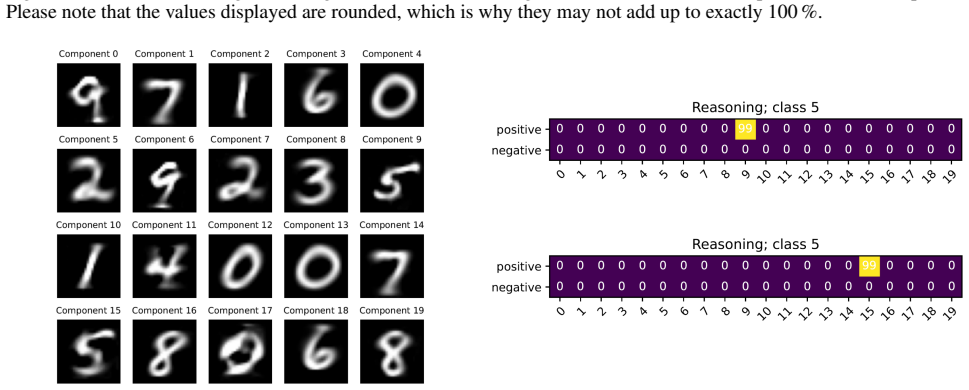
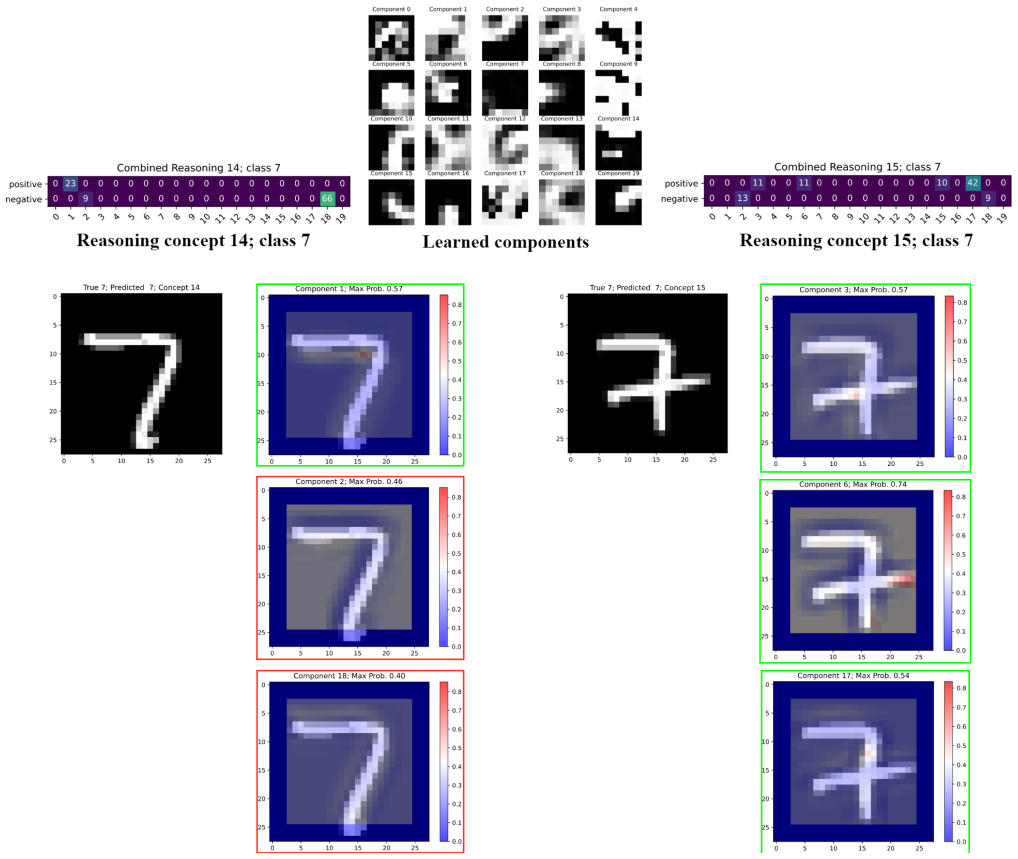
- A shallow CBC is inherently interpretable: each class score is a weighted sum of positive evidence (component present and required) and negative evidence (component absent and not required), with all weights normalized as probabilities, so the most similar components always dominate the class decision.
- Because the head is a probability-constrained RBF network, the proven robustness bounds transfer to shallow Gaussian RBF classifiers, giving the first robustness-optimizing loss for such networks.
- Robustified shallow CBC training produces non-trivial certified robustness on MNIST at $\|\varepsilon\|=1$ (15.2% certified, 62.8% empirical), outperforming GLVQ in accuracy and empirical robustness while remaining interpretable.
- On CUB, CARS, and PETS, the deep CBC with a ConvNeXt-tiny backbone reaches 87.8%, 93.0%, and 93.9%, above the compared deep prototype networks, and ablations attribute much of the gain to negative reasoning.
- The original CBC's bad local minima are explained by a scaling redundancy in its importance variable; removing that variable makes training converge to diverse, class-specific components rather than repeated ones.
Reading between the lines
- The paper's robustness certificate is proven only for the shallow model; extending it to deep PBNs would require a Lipschitz or distortion bound on the feature extractor that maps input-space perturbations to latent-space perturbations, which the paper does not provide.
- The equivalence between CBC and GLVQ when reasoning is crisp suggests that the new robustness loss may be a probabilistic generalization of the hypothesis-margin loss; exploring that limit could yield tighter certificates for LVQ-style classifiers.
- The unexplained observation that plain margin training also confers non-trivial empirical robustness hints at a geometric property of the probability-gap loss; if identified, it could lead to certificates that do not require the robustified loss.
- Since components in the deep model live in a black-box latent space, the paper's own discussion implies that interpretability claims for deep PBNs should be treated as partial and user-dependent, motivating quantitative evaluation of explanations.
Signed reviews
Editorial analysis
A structured set of objections, weighed in public.
Referee Report
Summary. The paper proposes an extension of the Classification-by-Components (CBC) prototype-based network, replacing the importance variable with trainable class-wise component priors so that negative reasoning is handled probabilistically and the model becomes a constrained RBF classifier. It argues that deep prototype-based networks are deep RBF classifiers, critiques the interpretability of existing prototype heads, and derives certified robustness lower bounds for shallow CBC models under exponential detection functions (Theorems 1 and 3) and squared-norm Gaussian RBF kernels (Theorem 2). The same bound is proposed as a robustness loss. Experiments report state-of-the-art accuracy for deep CBC on CUB, CARS, and PETS, and show that shallow CBC with tangent distance is highly accurate while robustness-trained variants improve certified robustness on MNIST.
Significance. If the technical issues below are corrected, the paper makes a valuable contribution: it provides a certified robustness bound that doubles as a training loss for an interpretable shallow classifier, and it connects prototype-based networks to RBF classifiers, giving the first robustness-optimizing loss for Gaussian RBF networks. The paper is also useful for its comparative table of deep PBN architectures, its empirical evidence that negative reasoning improves accuracy, and its extensive MNIST robustness evaluation. The source code is provided, and the robustness evaluation uses standard tools such as AutoAttack. The use of the derived bound as both loss and certificate is not circular, because the bound is an analytic consequence of the model equations rather than a fitted quantity.
major comments (3)
- [Appendix B, Lemma 4, Eqs. (23)-(24); Theorem 1, Eq. (8)] The printed certified-bound formula is undefined for the cases it is intended to cover. In Lemma 4, the proof derives the positive root as (B + sqrt(B^2 - 4AC))/(2|A|) (see Eq. (19) and the following lines), but Eqs. (23)-(24) and Theorem 1's Eq. (8) print (−B + sqrt(B^2 - 4AC))/(2A). Since A = ((r_y−1)∘b_y − r_c'∘b_c')^T d(x) ≤ 0 by construction and the proof itself shows the numerator is non-negative for correctly classified samples, the logarithm's argument is non-positive and δ is not a real number. Consequently the robustness certificate, the claim that δ is negative for incorrectly classified samples, and the robustness loss based on δ are not evaluable as printed. The intended theorem is recoverable by replacing 2A with 2|A| (or equivalently −2A) in Eq. (8), Eq. (23), Eq. (24), and the loss definition; the authors must make this correction and ensure all subsequent uses of δ are based on the corrected expression.
- [Section 3, paragraph before Theorem 1] The sentence 'with a feature extractor, the same stability analysis applies in the latent space' is not supported by any Lipschitz or distortion bound that relates perturbations in the input space to perturbations in the latent space. Therefore, Theorem 1 as stated does not establish input-space certified robustness for deep PBNs; it only certifies robustness in the model's own latent space. This is a scope limitation that should be stated explicitly in the abstract and in the robustness section, or else a concrete bound connecting input perturbations to latent perturbations must be supplied.
- [Section 4, Table 3 and Appendix D.3] The certified-robustness numbers are computed from the same formula that is misprinted in Eq. (8) and Eq. (23). The paper should state explicitly which expression was actually implemented in the code, and if the corrected 2|A| denominator was used, all certified-robustness tables and the robust-loss training results should be recomputed and reported with the corrected formula. As printed, the numerical certified values cannot be reproduced from the displayed equations.
minor comments (4)
- [Appendix B.3] The restated theorem in the proof of Theorem 2 is labeled 'Theorem 5' instead of 'Theorem 2'; this renumbering should be fixed.
- [Theorem 2 and Eq. (9)] The relationship between δ in the statement of Theorem 2, the intermediate quantity ∥ε0∥ in Eq. (32), and the simplified expression in Eq. (9) is unclear; in particular, the factor σmin/6 in Eq. (9) is introduced without derivation. Please define each quantity consistently so that the squared-norm bound can be evaluated from the printed formulas.
- [Section 4, Table 3] Several certified-robustness entries are reported as 0.0 ± 0.0; please report these values at higher precision or explicitly state that they are exactly zero, since values such as 0.04 and 0.00 would both round to 0.0 at one decimal place.
- [Throughout] The new model and the original CBC are both referred to as 'CBC', which is confusing in several passages (e.g., 'In CBC, both problems mentioned above are caused...'). Consider using distinct names, such as 'CBC+', throughout the paper and in tables.
Circularity Check
No significant circularity: the robustness certificate and loss are derived from the model equations, not fitted, and self-citations are background material rather than load-bearing.
full rationale
The derivation chain is self-contained. The model output (Eq. 4) is a probabilistic agreement over components, and Appendix B derives the robustness lower bound from that equation using only the triangle inequality, the monotonicity of the resulting lower-bounding function, and its quadratic root. The certified radius in Theorem 1 is a closed-form function of the model parameters and the input; it is not obtained by fitting any parameter to data and then renaming that fit as a prediction. The robustness loss is the logarithm of that same certified bound, so training with it directly optimizes the certificate; this is standard certified-robustness practice and does not constitute a fitted-input-called-prediction pattern. The claimed relation to RBF networks is an analytic observation, namely that a linear prediction head over RBF similarities is an RBF network, and the extensions for squared norms and tangent distances are proved in Appendix B.4 rather than imported from prior work. Self-citations to the original CBC and to tangent-distance LVQ provide background, a margin-loss setting, and a point of comparison; none of Thm. 1-3 is justified by an unverified self-citation. The paper also acknowledges genuine scope limitations, notably that deep models are only partially interpretable and that the robustness analysis for deep models lives in the latent space without an input-space distortion bound; this is a limitation, not a circular step. A sign anomaly in the printed Eq. (8)/(23) is a correctness concern, not circularity: with A <= 0 the printed logarithm is undefined, whereas the proof's own quadratic-root derivation uses the positive denominator 2|A|, so the theorem is not being assumed by construction.
Assumptions & free parameters
free parameters (8)
- Detection temperature sigma_k =
trainable, initialized via Eq. (34)
- Reasoning probability vector v_c =
softmax-normalized over 2K entries
- Component prior b_c =
class-wise, sums to 1
- Component centers w_k =
learned in input or latent space
- Requiredness vector r_c =
derived from v_c or learned
- Tangent subspace basis W =
orthonormal r-dimensional basis, r=12 in experiments
- Robustness loss scaling lambda =
0.09 or 1
- Margin gamma =
0.025 (deep), 0.3 or 1.58 (shallow)
assumptions (5)
- domain assumption Detection probability P(D|x,k) is a similarity measure taking values in [0,1] with d(x,x)=1 and is of the form exp(-d(x,w_k)/sigma_k) where d is induced by a norm.
- domain assumption The reasoning and detection events are conditionally independent given class and component: P(R,D|x,c,k)=P(R|c,k)P(D|x,k).
- standard math Triangle inequality for the chosen norm.
- domain assumption For deep models, robustness in latent space is equivalent to input-space robustness under the feature extractor.
- standard math The probability gap py(x) - pc'(x) is positive for correctly classified samples.
Cite this review
Pith. "Pith review of A Robust Prototype-Based Network with Interpretable RBF Classifier Foundations." pith.science (2026). https://pith.science/paper/6NCWMGGW
@misc{pith2026241215499,
  author       = {Pith},
  title        = {Pith review of: A Robust Prototype-Based Network with Interpretable RBF Classifier Foundations},
  year         = {2026},
  howpublished = {\url{https://pith.science/paper/6NCWMGGW}},
  note         = {Machine review of arXiv:2412.15499}
}
read the original abstract
Prototype-based classification learning methods are known to be inherently interpretable. However, this paradigm suffers from major limitations compared to deep models, such as lower performance. This led to the development of the so-called deep Prototype-Based Networks (PBNs), also known as prototypical parts models. In this work, we analyze these models with respect to different properties, including interpretability. In particular, we focus on the Classification-by-Components (CBC) approach, which uses a probabilistic model to ensure interpretability and can be used as a shallow or deep architecture. We show that this model has several shortcomings, like creating contradicting explanations. Based on these findings, we propose an extension of CBC that solves these issues. Moreover, we prove that this extension has robustness guarantees and derive a loss that optimizes robustness. Additionally, our analysis shows that most (deep) PBNs are related to (deep) RBF classifiers, which implies that our robustness guarantees generalize to shallow RBF classifiers. The empirical evaluation demonstrates that our deep PBN yields state-of-the-art classification accuracy on different benchmarks while resolving the interpretability shortcomings of other approaches. Further, our shallow PBN variant outperforms other shallow PBNs while being inherently interpretable and exhibiting provable robustness guarantees.
Figures


Figures from the paper (14 more)





Reference graph
Works this paper leans on
-
[1]
Arik, S. O.; and Pfister, T. 2020. ProtoAttend: Attention-Based Prototypical Learning. Journal of Machine Learning Research, 21(210): 1--35
work page 2020
-
[2]
Asadi, K.; Parikh, N.; Parr, R. E.; Konidaris, G. D.; and Littman, M. L. 2021. Deep Radial-Basis Value Functions for Continuous Control. In Proceedings of the Thirty-Fifth AAAI Conference on Artificial Intelligence -- AAAI 2021 , 6696--6704. AAAI Press
work page 2021
-
[3]
Bancos, I.; Taylor, A. E.; Chortis, V.; Sitch, A. J.; Jenkinson, C.; Davidge-Pitts, C. J.; Lang, K.; Tsagarakis, S.; Macech, M.; Riester, A.; et al. 2020. Urine steroid metabolomics for the differential diagnosis of adrenal incidentalomas in the EURINE-ACT study: A prospective test validation study. The Lancet Diabetes & Endocrinology, 8(9): 773--781
work page 2020
-
[4]
Biehl, M.; Hammer, B.; and Villmann, T. 2016. Prototype-based models in machine learning. Wiley Interdisciplinary Reviews Cognitive Science , 7(2): 92--111
work page 2016
-
[5]
Broomhead, D. S.; and Lowe, D. 1988. Multivariable Functional Interpolation and Adaptive Networks. Complex Systems, 2(3)
work page 1988
-
[6]
Chen, C.; Li, O.; Tao, D.; Barnett, A.; Su, J.; and Rudin, C. 2019. This Looks Like That: Deep Learning for Interpretable Image Recognition. In Wallach, H.; Larochelle, H.; Beygelzimer, A.; d Alch\' e -Buc, F.; Fox, E.; and Garnett, R., eds., Advances in Neural Information Processing Systems 32: Proceedings of the Neural Information Processing Systems Con...
work page 2019
-
[7]
Croce, F.; and Hein, M. 2020. Reliable evaluation of adversarial robustness with an ensemble of diverse parameter-free attacks. In Proceedings of the 37th International Conference on Machine Learning -- ICML 2020 , volume 119 of Proceedings of Machine Learning Research, 2206--2216. Vienna, Austria: PMLR
work page 2020
-
[8]
Donnelly, J.; Barnett, A. J.; and Chen, C. 2022. Deformable ProtoPNet: An Interpretable Image Classifier Using Deformable Prototypes. In IEEE/CVF Conference on Computer Vision and Pattern Recognition -- CVPR 2022 , 10255--10265. New Orleans, LA, USA: IEEE
work page 2022
Show all 46 references
-
[9]
Ghiasi-Shirazi, K. 2019. Generalizing the Convolution Operator in Convolutional Neural Networks. Neural Processing Letters, 50(3): 2627--2646
2019
-
[10]
Haasdonk, B.; and Keysers, D. 2002. Tangent distance kernels for support vector machines. In Proceedings of the 16th International Conference on Pattern Recognition -- ICPR 2002 , 864--868. Qu \' e bec City, QC, Canada: IEEE
2002
-
[11]
Hase, P.; Chen, C.; Li, O.; and Rudin, C. 2019. Interpretable Image Recognition with Hierarchical Prototypes. In Law, E.; and Vaughan, J. W., eds., Proceedings of the Seventh AAAI Conference on Human Computation and Crowdsourcing, -- HCOMP 2019 , 32--40. Stevenson, WA, USA: AAAI Press
2019
-
[12]
Hastie, T.; Simard, P.; and Säckinger, E. 1995. Learning Prototype Models for Tangent Distance. In Tesauro, G.; Touretzky, D. S.; and Leen, T. K., eds., Advances in Neural Information Processing Systems 7: Proceedings of the Neural Information Processing Systems Conference -- ...
1995
-
[13]
Hein, M.; Andriushchenko, M.; and Bitterwolf, J. 2019. Why ReLU networks yield high-confidence predictions far away from the training data and how to mitigate the problem. In Proceedings of the 2019 IEEE/CVF Conference on Computer Vision and Pattern Recognition -- CVPR 2019 , ...
2019
-
[14]
Hoffmann, A.; Fanconi, C.; Rade, R.; and Kohler, J. 2021. This Looks Like That... Does it? Shortcomings of Latent Space Prototype Interpretability in Deep Networks. ICML 2021 Workshop on Theoretic Foundation, Criticism, and Application Trend of Explainable AI
2021
-
[15]
S.; Horng, A.; Griffiths, T
Hsu, A. S.; Horng, A.; Griffiths, T. L.; and Chater, N. 2017. When Absence of Evidence Is Evidence of Absence: Rational Inferences From Absent Data. Cognitive Science, 41(S5): 1155--1167
2017
-
[16]
P.; and Ba, J
Kingma, D. P.; and Ba, J. 2015. Adam: A Method for Stochastic Optimization. In Bengio, Y.; and LeCun, Y., eds., Proceedings of the 3rd International Conference on Learning Representations -- ICLR 2015 . San Diego, CA, USA
2015
-
[17]
Krause, J.; Stark, M.; Deng, J.; and Fei - Fei, L. 2013. 3D Object Representations for Fine-Grained Categorization. In 2013 IEEE International Conference on Computer Vision Workshops, ICCV Workshops 2013, Sydney, Australia, December 1-8, 2013 , 554--561. IEEE Computer Society
2013
-
[18]
LeCun, Y.; Bottou, L.; Bengio, Y.; and Haffner, P. 1998. Gradient-based learning applied to document recognition. Proceedings of the IEEE, 86(11): 2278--2324
1998
-
[19]
LeCun, Y.; Cortes, C.; and Burges, C. J. 1998. The MNIST database of handwritten digits. http://yann.lecun.com/exdb/mnist/
1998
-
[20]
Liu, Z.; Mao, H.; Wu, C.; Feichtenhofer, C.; Darrell, T.; and Xie, S. 2022. A ConvNet for the 2020s. In IEEE/CVF Conference on Computer Vision and Pattern Recognition -- CVPR 2022 , 11966--11976. New Orleans, LA, USA: IEEE
2022
-
[21]
Ma, C.; Donnelly, J.; Liu, W.; Vosoughi, S.; Rudin, C.; and Chen, C. 2024. Interpretable Image Classification with Adaptive Prototype-based Vision Transformers. In arXiv:2410.20722. Accepted at NeurIPS 2024
2024 arXiv
-
[22]
Marcinkevi c s, R.; and Vogt, J. E. 2023. Interpretable and explainable machine learning: A methods-centric overview with concrete examples. WIREs Data Mining and Knowledge Discovery, 13(3): e1493
2023
-
[23]
R.; Nasery, A.; and Mottin, D
Mathiasen, A.; Hvilsh j, F.; J rgensen, J. R.; Nasery, A.; and Mottin, D. 2020. What if Neural Networks had SVDs? In Larochelle, H.; Ranzato, M.; Hadsell, R.; Balcan, M.; and Lin, H., eds., Advances in Neural Information Processing Systems 33: Proceedings of the Neural Informa...
2020
-
[24]
Molnar, C. 2022. Interpretable machine learning - A Guide for Making Black Box Models Explainable. 2 edition
2022
-
[25]
Nauta, M.; Schl \" o tterer, J.; van Keulen, M.; and Seifert, C. 2023. PIP-Net: Patch-Based Intuitive Prototypes for Interpretable Image Classification. In IEEE/CVF Conference on Computer Vision and Pattern Recognition -- CVPR 2023 , 2744--2753. IEEE
2023
-
[26]
Nauta, M.; van Bree, R.; and Seifert, C. 2021. Neural Prototype Trees for Interpretable Fine-grained Image Recognition. In Proceedings of the 2021 IEEE/CVF Conference on Computer Vision and Pattern Recognition -- CVPR 2021 , 14933--14943. Nashville, TN, USA: IEEE
2021
-
[27]
Pach, M.; Rymarczyk, D.; Lewandowska, K.; Tabor, J.; and Zielinski, B. 2024. LucidPPN: Unambiguous Prototypical Parts Network for User-centric Interpretable Computer Vision. In arXiv:2405.14331
2024 arXiv
-
[28]
M.; Vedaldi, A.; Zisserman, A.; and Jawahar, C
Parkhi, O. M.; Vedaldi, A.; Zisserman, A.; and Jawahar, C. V. 2012. Cats and dogs. In Proceedings of the 2012 IEEE Computer Society Conference on Computer Vision and Pattern Recognition -- CVPR 2012 , 3498--3505. Providence, RI, USA: IEEE
2012
-
[29]
J.; Soltani, S.; Kaufman, R.; Qian, S.; and Hsiao, A
Pazzani, M. J.; Soltani, S.; Kaufman, R.; Qian, S.; and Hsiao, A. 2022. Expert-Informed, User-Centric Explanations for Machine Learning. In Proceedings of the Thirty-Sixth AAAI Conference on Artificial Intelligence -- AAAI 2022 , 12280--12286. AAAI Press
2022
-
[30]
Why Should I Trust You?
Ribeiro, M. T.; Singh, S.; and Guestrin, C. 2016. "Why Should I Trust You?": Explaining the Predictions of Any Classifier. In Proceedings of the 22nd ACM SIGKDD International Conference on Knowledge Discovery and Data Mining , 1135--1144. ACM
2016
-
[31]
Rudin, C. 2019. Stop explaining black box machine learning models for high stakes decisions and use interpretable models instead. Nature Machine Intelligence, 1: 206--215
2019
-
[32]
Rymarczyk, D.; Struski, L.; G \' o rszczak, M.; Lewandowska, K.; Tabor, J.; and Zielinski, B. 2022. Interpretable Image Classification with Differentiable Prototypes Assignment. In Avidan, S.; Brostow, G. J.; Ciss \' e , M.; Farinella, G. M.; and Hassner, T., eds., Proceedings...
2022
-
[33]
Sacha, M.; Jura, B.; Rymarczyk, D.; Struski, L.; Tabor, J.; and Zielinski, B. 2024. Interpretability Benchmark for Evaluating Spatial Misalignment of Prototypical Parts Explanations. In Wooldridge, M. J.; Dy, J. G.; and Natarajan, S., eds., Proceedings of the Thirty-Eighth Con...
2024
-
[34]
Saralajew, S.; Holdijk, L.; Rees, M.; Asan, E.; and Villmann, T. 2019. Classification-by-components: P robabilistic modeling of reasoning over a set of components. In Wallach, H.; Larochelle, H.; Beygelzimer, A.; d Alch\' e -Buc, F.; Fox, E.; and Garnett, R., eds., Advances in...
2019
-
[35]
Saralajew, S.; Holdijk, L.; and Villmann, T. 2020. Fast Adversarial Robustness Certification of Nearest Prototype Classifiers for Arbitrary Seminorms. In Larochelle, H.; Ranzato, M.; Hadsell, R.; Balcan, M.; and Lin, H., eds., Advances in Neural Information Processing Systems ...
2020
-
[36]
Saralajew, S.; and Villmann, T. 2016. Adaptive tangent distances in generalized learning vector quantization for transformation and distortion invariant classification learning. In Proceedings of the 2016 International Joint Conference on Neural Networks -- IJCNN 2016 , 2672--...
2016
-
[37]
Sato, A.; and Yamada, K. 1996. Generalized Learning Vector Quantization. In Touretzky, D. S.; Mozer, M.; and Hasselmo, M. E., eds., Advances in Neural Information Processing Systems 8: Proceedings of the Neural Information Processing Systems Conference -- NIPS 1995 , 423--429....
1996
-
[38]
Seo, S.; and Obermayer, K. 2003. Soft Learning Vector Quantization. Neural Computation, 15(7): 1589--1604
2003
-
[39]
W.; and Gal, Y
van Amersfoort, J.; Smith, L.; Teh, Y. W.; and Gal, Y. 2020. Uncertainty Estimation Using a Single Deep Deterministic Neural Network. In Proceedings of the 37th International Conference on Machine Learning -- ICML 2020 , volume 119 of Proceedings of Machine Learning Research, ...
2020
-
[40]
Villmann, T.; Bohnsack, A.; and Kaden, M. 2017. Can Learning Vector Quantization be an Alternative to SVM and Deep Learning? - Recent Trends and Advanced Variants of Learning Vector Quantization for Classification Learning. Journal of Artificial Intelligence and Soft Computing...
2017
-
[41]
Vor \' a cek, V.; and Hein, M. 2022. Provably Adversarially Robust Nearest Prototype Classifiers. In Chaudhuri, K.; Jegelka, S.; Song, L.; Szepesv \' a ri, C.; Niu, G.; and Sabato, S., eds., Proceedings of the 39th International Conference on Machine Learning -- ICML 2022 , vo...
2022
-
[42]
Wah, C.; Branson, S.; Welinder, P.; Perona, P.; and Belongie, S. 2011. Caltech-UCSD Birds-200-2011 (CUB-200-2011). Technical Report CNS-TR-2011-001
2011
-
[43]
Wang, J.; Liu, H.; Wang, X.; and Jing, L. 2021. Interpretable Image Recognition by Constructing Transparent Embedding Space. In 2021 IEEE/CVF International Conference on Computer Vision, ICCV 2021, Montreal, QC, Canada, October 10-17, 2021 , 875--884. IEEE
2021
-
[44]
N.; Bongratz, F.; Rickmann, A.; P \" o lsterl, S.; and Wachinger, C
Wolf, T. N.; Bongratz, F.; Rickmann, A.; P \" o lsterl, S.; and Wachinger, C. 2024. Keep the Faith: Faithful Explanations in Convolutional Neural Networks for Case-Based Reasoning. In Wooldridge, M. J.; Dy, J. G.; and Natarajan, S., eds., Proceedings of the Thirty-Eighth Confe...
2024
-
[45]
, " * write output.state after.block = add.period write newline
ENTRY address archivePrefix author booktitle chapter edition editor eid eprint howpublished institution isbn journal key month note number organization pages publisher school series title type volume year label extra.label sort.label short.list INTEGERS output.state before.all...
-
[46]
write newline
" write newline "" before.all 'output.state := FUNCTION n.dashify 't := "" t empty not t #1 #1 substring "-" = t #1 #2 substring "--" = not "--" * t #2 global.max substring 't := t #1 #1 substring "-" = "-" * t #2 global.max substring 't := while if t #1 #1 substring * t #2 gl...
Reviewed August 11, 2026 · model on record in the stance chip above.
Discussion (0). Continue with ORCID to comment.