REVIEW 2 major objections 6 minor 41 references
Diffusion ReRoll makes robotic sequence generation revisable by selectively re-noising locally stable regions, so earlier and later segments can refine one another during denoising, and reports consistent success gains over monotonic and ca
Reviewed by Pith at T0; open to challenge. T0 means a machine referee read the full paper against a public rubric. the ladder, T0–T4 →
2026-08-01 11:17 UTC pith:6NXA5PUX
load-bearing objection Solid empirical paper with a real new mechanism; the core ablation doesn't fully separate re-noising from extra DDIM budget, but the compute-matched baseline gains hold up. the 2 major comments →
Diffusion ReRoll: Revisable Denoising for Robotic Sequential Prediction
The pith
A machine-rendered reading of the paper's core claim, the machinery that carries it, and where it could break.
Core claim
The central claim is that revisability can be engineered directly into the diffusion schedule. A schedule matrix assigns each sequence token a noise level at every denoising row; downward rows are denoising updates, while scheduled upward rows are explicit forward noising that resets a token region to full noise. These reset transitions—ReRoll events—let a locally stable segment be re-generated under the updated context of the rest of the horizon. The paper shows that training on randomized linear noise chunks, rather than independent per-token noise, is what makes this work: applying the ReRoll matrix to a Diffusion-Forcing-trained model does not reliably improve success, and adding a causa
What carries the argument
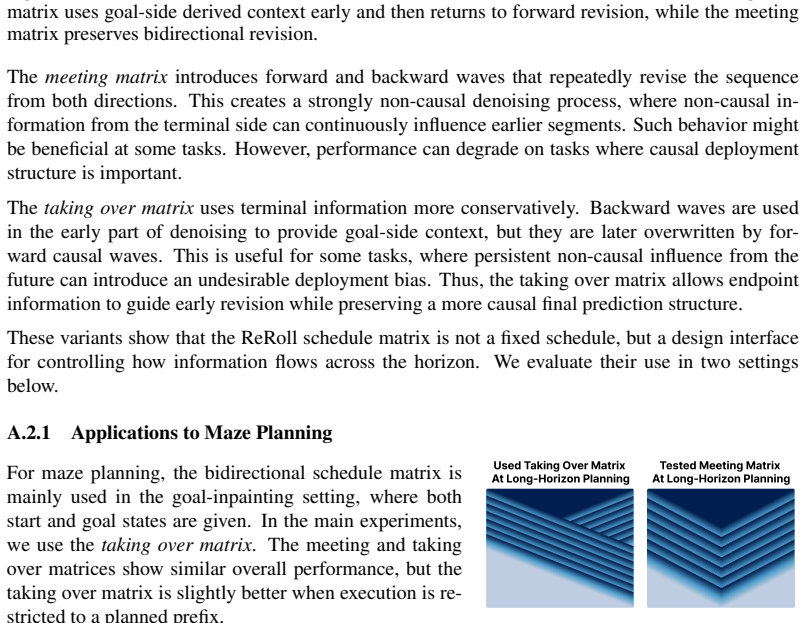
The load-bearing object is the schedule matrix with virtual linear chunks. Each entry is the noise level assigned to a token at a given denoising row; linear chunks are piecewise-linear noise profiles across the horizon, so denoising proceeds as waves rather than at a single global level. A ReRoll event is a scheduled upward transition that re-injects full noise into a chunk of tokens, attaching it to the next wave. The matrix alone is not enough: the paper also changes the training noise distribution to randomized linear chunks, and the deployment matrix controls whether information flows forward, from both ends, or mostly from the terminal side.
Load-bearing premise
ReRoll's gains rest on the model being trained with randomized linear noise chunks and without causal masking; if that training alignment is absent, the schedule matrix alone does not reliably beat causal denoising, and the headline LIBERO gain also narrows under the open-gripper reset protocol.
What would settle it
Take a denoiser trained with independently sampled per-token noise and deploy the exact ReRoll schedule matrix on AntMaze Giant guidance planning and LIBERO-10; if its success matches the linear-chunk-trained ReRoll model, the paper's claim that structured chunk training is necessary would be refuted. A second decisive check: on the same trained model, compare zero ReRoll events against six; if success does not rise with event count, the gains would come from something other than re-noising.
If this is right
- Long-horizon planning should improve most where early mistakes are hard to reverse; the largest reported maze gains are in Large and Giant variants, with ReRoll recovering paths that full-sequence diffusion commits to incorrectly.
- The same trained model can change its information-flow pattern by swapping the schedule matrix, so forward, backward, and endpoint-conditioned revision become deployment-time choices rather than architecture changes.
- Multi-task action-chunk prediction improves across all evaluated horizons and observation histories on LIBERO-10; the paper hypothesizes the gain is largest when multiple plausible action structures compete, which is consistent with the smaller single-task RoboCasa gains.
- Unified video-action models gain in out-of-distribution joint-policy success and show the lowest zero-action error, indicating stronger action-video consistency than monotonic or causal variants.
- ReRoll's benefit is conditional on training with randomized linear chunks and non-causal attention; the schedule matrix alone, applied to independently noised training, is not enough.
Where Pith is reading between the lines
- Left implicit is that the schedule matrix could be adapted per rollout—e.g., increasing ReRoll events in regions flagged as high-risk—without retraining, since the model already saw variable chunk slopes; this would be a cheap test of the revisability interface.
- The two-protocol LIBERO results imply that absolute gains depend on evaluation reset details; future comparisons should report the gripper-reset protocol, and the true advantage of re-noising may be smaller under easier resets.
- If ReRoll's benefit is an inductive bias from structured noise, then other per-token diffusion backbones, including larger robot models, might inherit it simply by changing their training noise distribution without adding the schedule machinery.
- The zero-action diagnostic offers a reusable metric: action-video consistency can serve as an early signal for downstream control robustness under out-of-distribution visual changes, before full policy rollouts are run.
Editorial analysis
A structured set of objections, weighed in public.
Referee Report
Summary. Diffusion ReRoll (DR) is a scheme for robotic sequential prediction that generalizes per-token noise conditioning à la Diffusion Forcing. The schedule matrix is organized into virtual piecewise-linear 'chunks'; when a chunk's leading edge reaches a reset noise level, a ReRoll event re-noises that region to full noise and attaches it to an adjacent chunk, while other regions continue denoising. Training uses randomized linear-chunk noise profiles, and the paper introduces forward and bidirectional schedule variants. The method is evaluated on OGBench maze planning, LIBERO-10 and RoboCasa policy learning, and UWM unified video-action prediction, reporting large relative gains over Diffuser, Diffusion Forcing, and Diffusion Policy, plus schedule ablations and an analysis of two LIBERO-10 reset protocols.
Significance. If the reported results hold, DR identifies a new and potentially useful design axis for diffusion sequence predictors—non-monotonic, structured re-noising—and demonstrates gains across three diverse robotics benchmarks. The paper's transparency is a notable strength: matched DF/DR architectures, the zero-event ablation, the action-representation control, the causal-masking control, and the explicit reporting of two LIBERO-10 reset protocols. However, the central mechanistic attribution is currently weakened by a compute confound: the ReRoll-event ablation varies both the number of re-noising events and the number of DDIM updates. Thus, the empirical contribution is solid as a system-level result, but the claim that 'revisable denoising' is the active ingredient needs an additional control experiment before it can be regarded as established.
major comments (2)
- [Sec. 4.1, Fig. 7, Table 7] The central attribution claim—'DR's gains are largely driven by selective re-noising'—is not yet isolated from inference compute. In the ReRoll-event ablation, increasing Nroll from 0 to 6 changes the schedule matrix from 124 to 202 DDIM rows in planning and from 11/23/31 to 29/53/85 updates in policy settings (Table 7). The zero-event condition is therefore not a same-budget no-reset control; a monotonic causal schedule with the same number of rows might recapture most of the gain. Please add a control that matches the total DDIM update count while keeping the schedule monotonic (e.g., a slower causal ramp with the same number of rows, or additional intermediate rows), and re-evaluate the conclusion in Sec. 4.1. Without this control, the reported gains remain consistent with 'more denoising steps' as an alternative explanation.
- [Abstract and Sec. 4.3, Table 2, Appendix C.3.2] The abstract's headline '56.5% relative gain' over Diffusion Policy on LIBERO-10 is based on the official gripper-reset protocol. Under the open-gripper protocol reported in Table 2, the same 2/16/8 comparison is 82.5% vs. 76.2% (about 8% relative), and the average improvement over the five settings drops to roughly 18% relative. The official 2/16/8 ReRoll result also has a very large standard deviation (51.0 ±24.1). The paper does transparently report both protocols and discusses the reset discrepancy, but the summary and conclusion select the most favorable number. Please add a protocol caveat in the abstract/conclusion, or report the average across both protocols, so the reader is not left with an overstatement of the policy-learning gain.
minor comments (6)
- [Abstract] 'Relative gains' are defined only in Appendix C.1; consider a parenthetical in the abstract (e.g., 'relative to the baseline average') to avoid misreading as absolute percentage-point gains.
- [Table 2] Please add a footnote to Table 2 pointing to Appendix C.3.2 and D.3 for the reset-protocol sensitivity and the per-seed results behind the large standard deviation.
- [Fig. 7] Ensure the y-axis label ('Success rate') is visible in the final figure; the text references fractions but the figure axes are not labeled in the submitted version.
- [Sec. 2.2, Eq. (2)] M is undefined when introduced. Define M as the number of schedule rows (denoising steps).
- [Appendix A.1] The forward noising transition in Eq. (6) uses the same alpha-bar scaling; a short derivation or reference to standard forward diffusion would help readers verify the variance.
- [Sec. 4.2] The Diffuser guidance results in Table 1 are very low (e.g., 16% on AntMaze Giant). Please state whether this reflects the re-enabled OGBench start-goal randomization and whether the Diffuser model was trained with the same guidance objective, so readers can compare with other Diffuser evaluations.
Circularity Check
No significant circularity; ReRoll's gains are empirical and not forced by construction.
full rationale
The paper's central claims are empirical comparisons against external baselines (Diffuser, Diffusion Forcing, Diffusion Policy, UWM) on OGBench, LIBERO-10, RoboCasa, and LIBERO-90/10 video-action benchmarks. Neither the schedule-matrix construction (Sec. 3.1) nor the linear-chunk training loss (Sec. 3.2, Eqs. 7-8) contains the reported success rates as inputs. The only fitted quantities, the horizon-dependent cumulative-action scaling exponents alpha_p and alpha_r (Appendix B.3), are fitted to training-set statistics, and the paper provides an ablation (Fig. 19) showing that applying the same action representation to vanilla Diffusion Policy does not reproduce the gains, so the representation is not an output disguised as a prediction. The method depends on co-designed non-causal training (Fig. 18) and linear-chunk training (Fig. 15), but this dependency is empirical and explicitly ablated, not a definitional equivalence. The ReRoll-event ablation in Sec. 4.1 is confounded by increasing DDIM update counts (Table 7: 124 to 202 rows for planning; 11 to 29 for the 16/8 policy), so the inference that 'gains are largely driven by selective re-noising' is not fully controlled; this is an experimental-design weakness rather than circularity, because the schedule-to-success relationship is not asserted by construction. The Limitations section candidly states that 'ReRoll still requires schedule tuning for new tasks,' which further indicates that schedule parameters are not a hidden fit to the evaluation results. The only self-citation, [11], appears in a survey sentence about stitching methods ('CompDiffuser [10, 11]') and is not load-bearing for ReRoll's mechanism. No equation in the paper reduces a predicted quantity to a fitted input, and no uniqueness or ansatz is imported from the authors' prior work; therefore no circular step can be exhibited, and the paper is self-contained against external benchmarks.
Axiom & Free-Parameter Ledger
free parameters (7)
- denoising slope s_dns =
4 for planning and policy; 3.78/3.56 for unified video-action
- reset noise level k_reset =
0.52K (maze planning), 0.5K (policy), 0.412K (video-action)
- number of ReRoll events N_roll =
6 forward (6/9 for video-action); zero-event ablation uses 0
- training chunk hyperparameters: N_max, chunk slope range, starting-level range =
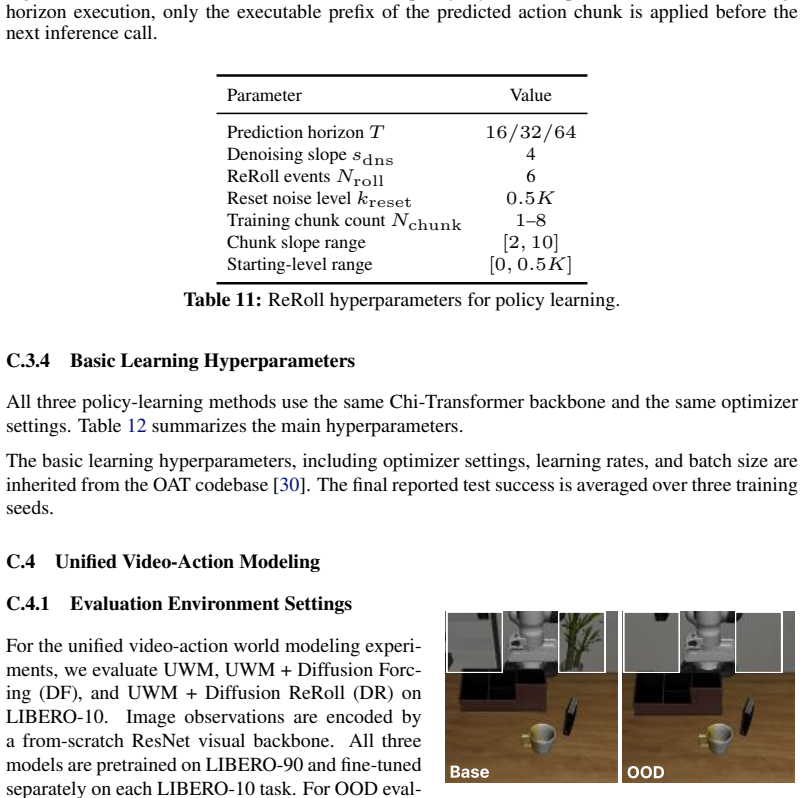
N_max=8, slope range [2,10], start range [0,0.5K]
- meeting point in bidirectional UWM schedule =
0.765 T_joint / 0.75 T_a
- action representation scaling exponents alpha_p, alpha_r, c_r =
derived from empirical std of cumulative targets on training set
- min-SNR clipping gamma and image-loss weight =
gamma=2.5 for actions (5.0 for image branch), w_img=1.5
axioms (5)
- standard math DDIM update equations (Eq. 4-6) correctly approximate the reverse diffusion process when token noise levels are heterogeneous.
- domain assumption Per-token noise-level conditioning is a sufficient interface for the transformer to learn the intended denoising schedule.
- ad hoc to paper Non-causal attention is both permissible and necessary for ReRoll deployment.
- ad hoc to paper Anchor-relative cumulative action representation with horizon-dependent normalization is a valid and useful action parameterization for ReRoll.
- domain assumption The benchmark protocols (OGBench, LIBERO-10, RoboCasa, UWM) are meaningful proxies for robotic sequential prediction performance.
invented entities (1)
-
Linear chunks and ReRoll events
no independent evidence
read the original abstract
We propose Diffusion ReRoll, a diffusion-based framework for robotic sequential prediction that enables revisable denoising over horizons. Existing diffusion-based sequence predictors typically perform a single monotonic denoising process. In contrast, Diffusion ReRoll selectively re-noises regions that have become locally stable while the remaining regions continue denoising, so the re-noised regions can be refined again using context from the rest of the horizon. This structured re-noising enables iterative cross-horizon revision, allowing earlier and later segments to revise one another, while maintaining local consistency. We evaluate Diffusion ReRoll against full-sequence diffusion and causal denoising based on Diffusion Forcing across long-horizon planning, policy learning, and unified video-action modeling. On OGBench PointMaze and AntMaze, Diffusion ReRoll achieves relative gains in average success rate of 21% over Diffusion Forcing in matched guidance-based planning and 23% over Diffuser in matched goal-inpainting. In diffusion-policy-style action prediction, Diffusion ReRoll improves average success by 56.5% relative to Diffusion Policy across different prediction horizons and history lengths on the LIBERO-10 multi-task benchmark. In unified video-action prediction, Diffusion ReRoll improves policy and inverse dynamics performance, especially under out-of-distribution evaluation, and achieves the best action-video consistency. These results support structured re-noising as an effective mechanism for revisable robotic sequence generation.
Figures






Reference graph
Works this paper leans on
-
[1]
Sohl-Dickstein, E
J. Sohl-Dickstein, E. Weiss, N. Maheswaranathan, and S. Ganguli. Deep unsupervised learn- ing using nonequilibrium thermodynamics. InInternational conference on machine learning, pages 2256–2265. pmlr, 2015
2015
-
[2]
J. Ho, A. Jain, and P. Abbeel. Denoising diffusion probabilistic models.Advances in neural information processing systems, 33:6840–6851, 2020
2020
-
[3]
A. Ajay, Y . Du, A. Gupta, J. Tenenbaum, T. Jaakkola, and P. Agrawal. Is conditional generative modeling all you need for decision-making?arXiv preprint arXiv:2211.15657, 2022
Pith/arXiv arXiv 2022
-
[4]
C. Chi, Z. Xu, S. Feng, E. Cousineau, Y . Du, B. Burchfiel, R. Tedrake, and S. Song. Diffusion policy: Visuomotor policy learning via action diffusion.The International Journal of Robotics Research, 44(10-11):1684–1704, 2025
2025
-
[5]
J. Ho, T. Salimans, A. Gritsenko, W. Chan, M. Norouzi, and D. J. Fleet. Video diffusion models.Advances in neural information processing systems, 35:8633–8646, 2022
2022
-
[6]
Janner, Y
M. Janner, Y . Du, J. Tenenbaum, and S. Levine. Planning with diffusion for flexible behavior synthesis. InInternational Conference on Machine Learning, 2022
2022
-
[7]
S. Li, Y . Gao, D. Sadigh, and S. Song. Unified video action model.arXiv preprint arXiv:2503.00200, 2025
Pith/arXiv arXiv 2025
-
[8]
B. Chen, T. Zhang, H. Geng, C. Zhang, P. Li, K. Song, W. T. Freeman, J. Malik, P. Abbeel, R. Tedrake, V . Sitzmann, and Y . Du. Large video planner enables generalizable robot control. arXiv preprint arXiv:2512.15840, 2025
Pith/arXiv arXiv 2025
-
[9]
U. A. Mishra, S. Xue, Y . Chen, and D. Xu. Generative skill chaining: Long-horizon skill planning with diffusion models. In7th Annual Conference on Robot Learning, 2023
2023
-
[10]
Y . Luo, U. A. Mishra, Y . Du, and D. Xu. Generative trajectory stitching through diffusion composition.arXiv preprint arXiv:2503.05153, 2025
Pith/arXiv arXiv 2025
-
[11]
S. Kim, Y . Choi, D. E. Matsunaga, and K.-E. Kim. Stitching sub-trajectories with conditional diffusion model for goal-conditioned offline rl. InProceedings of the AAAI Conference on Artificial Intelligence, volume 38, pages 13160–13167, 2024
2024
-
[12]
T. Wu, Z. Fan, X. Liu, H.-T. Zheng, Y . Gong, J. Jiao, J. Li, J. Guo, N. Duan, W. Chen, et al. Ar-diffusion: Auto-regressive diffusion model for text generation.Advances in Neural Infor- mation Processing Systems, 36:39957–39974, 2023
2023
-
[13]
D. Ruhe, J. Heek, T. Salimans, and E. Hoogeboom. Rolling diffusion models.arXiv preprint arXiv:2402.09470, 2024
Pith/arXiv arXiv 2024
-
[14]
B. Chen, D. Mart ´ı Mons ´o, Y . Du, M. Simchowitz, R. Tedrake, and V . Sitzmann. Diffusion forcing: Next-token prediction meets full-sequence diffusion.Advances in Neural Information Processing Systems, 37:24081–24125, 2024
2024
-
[15]
C. Meng, Y . He, Y . Song, J. Song, J. Wu, J.-Y . Zhu, and S. Ermon. SDEdit: Guided image synthesis and editing with stochastic differential equations. InInternational Conference on Learning Representations, 2022. 9
2022
-
[16]
Lugmayr, M
A. Lugmayr, M. Danelljan, A. Romero, F. Yu, R. Timofte, and L. Van Gool. Repaint: In- painting using denoising diffusion probabilistic models. InProceedings of the IEEE/CVF conference on computer vision and pattern recognition, pages 11461–11471, 2022
2022
-
[17]
Chang, H
H. Chang, H. Zhang, L. Jiang, C. Liu, and W. T. Freeman. Maskgit: Masked generative image transformer. InProceedings of the IEEE/CVF conference on computer vision and pattern recognition, pages 11315–11325, 2022
2022
- [18]
-
[19]
K. Lee, S. Kim, and J. Choi. Refining diffusion planner for reliable behavior synthesis by automatic detection of infeasible plans.Advances in Neural Information Processing Systems, 36:24223–24246, 2023
2023
-
[20]
C. Pan, G. Anantharaman, N.-C. Huang, C. Jin, D. Pfrommer, C. Yuan, F. Permenter, G. Qu, N. Boffi, G. Shi, and M. Simchowitz. Much ado about noising: Dispelling the myths of generative robotic control.arXiv preprint arXiv:2512.01809, 2025
arXiv 2025
-
[21]
Pfrommer, Z
D. Pfrommer, Z. Dou, C. Scarvelis, M. Simchowitz, and A. Jadbabaie. Is your diffusion model actually denoising?Advances in Neural Information Processing Systems, 38:94380–94420, 2026
2026
-
[22]
R. Wang, Z. Cai, F. Pu, J. Xu, W. Yin, M. Wang, R. Ji, C. Gu, B. Li, Z. Huang, H. Deng, D. Lin, Z. Liu, and L. Yang. Demystifying video reasoning.arXiv preprint arXiv:2603.16870, 2026
Pith/arXiv arXiv 2026
-
[23]
S. Park, K. Frans, B. Eysenbach, and S. Levine. Ogbench: Benchmarking offline goal- conditioned rl. InInternational Conference on Learning Representations (ICLR), 2025
2025
-
[24]
B. Liu, Y . Zhu, C. Gao, Y . Feng, Q. Liu, Y . Zhu, and P. Stone. Libero: Benchmarking knowl- edge transfer for lifelong robot learning.Advances in Neural Information Processing Systems, 36:44776–44791, 2023
2023
-
[25]
C. Zhu, R. Yu, S. Feng, B. Burchfiel, P. Shah, and A. Gupta. Unified world models: Coupling video and action diffusion for pretraining on large robotic datasets. InProceedings of Robotics: Science and Systems (RSS), 2025
2025
-
[26]
K. Song, B. Chen, M. Simchowitz, Y . Du, R. Tedrake, and V . Sitzmann. History-guided video diffusion.arXiv preprint arXiv:2502.06764, 2025
Pith/arXiv arXiv 2025
-
[27]
T. Yin, Q. Zhang, R. Zhang, W. T. Freeman, F. Durand, E. Shechtman, and X. Huang. From slow bidirectional to fast autoregressive video diffusion models. InProceedings of the IEEE/CVF Conference on Computer Vision and Pattern Recognition, pages 22963–22974, 2025
2025
-
[28]
J. Song, C. Meng, and S. Ermon. Denoising diffusion implicit models.arXiv preprint arXiv:2010.02502, 2020
Pith/arXiv arXiv 2010
-
[29]
J. Yoon, H. Cho, D. Baek, Y . Bengio, and S. Ahn. Monte carlo tree diffusion for system 2 planning.arXiv preprint arXiv:2502.07202, 2025
arXiv 2025
-
[30]
C. Liu, X. Han, J. Gao, Y . Zhao, H. Chen, and Y . Du. Oat: Ordered action tokenization. In Proceedings of Robotics: Science and Systems, 2026
2026
-
[31]
J. Ho and T. Salimans. Classifier-free diffusion guidance.arXiv preprint arXiv:2207.12598, 2022
Pith/arXiv arXiv 2022
-
[32]
Dhariwal and A
P. Dhariwal and A. Nichol. Diffusion models beat gans on image synthesis.Advances in neural information processing systems, 34:8780–8794, 2021. 10
2021
-
[33]
Nasiriany, A
S. Nasiriany, A. Maddukuri, L. Zhang, A. Parikh, A. Lo, A. Joshi, A. Mandlekar, and Y . Zhu. Robocasa: Large-scale simulation of everyday tasks for generalist robots. InRobotics: Science and Systems (RSS), 2024
2024
-
[34]
T. Wiedemer, Y . Li, P. Vicol, S. S. Gu, N. Matarese, K. Swersky, B. Kim, P. Jaini, and R. Geirhos. Video models are zero-shot learners and reasoners.arXiv preprint arXiv:2509.20328, 2025
Pith/arXiv arXiv 2025
-
[35]
J. Liang, P. Tokmakov, R. Liu, S. Sudhakar, P. Shah, R. Ambrus, and C. V ondrick. Video generators are robot policies.arXiv preprint arXiv:2508.00795, 2025
Pith/arXiv arXiv 2025
-
[36]
T. Hang, S. Gu, C. Li, J. Bao, D. Chen, H. Hu, X. Geng, and B. Guo. Efficient diffusion training via min-snr weighting strategy. InProceedings of the IEEE/CVF international conference on computer vision, pages 7441–7451, 2023
2023
-
[37]
C. Chi, Z. Xu, C. Pan, E. Cousineau, B. Burchfiel, S. Feng, R. Tedrake, and S. Song. Universal manipulation interface: In-the-wild robot teaching without in-the-wild robots. InProceedings of Robotics: Science and Systems (RSS), 2024
2024
-
[38]
K. Black, N. Brown, D. Driess, A. Esmail, M. Equi, C. Finn, N. Fusai, L. Groom, K. Hausman, B. Ichter, et al. Pi zero: a vision-language-action flow model for general robot control.arXiv preprint arXiv:2410.24164, 2024
Pith/arXiv arXiv 2024
-
[39]
C. Chen, J. Baek, F. Deng, K. Kawaguchi, C. Gulcehre, and S. Ahn. Plandq: Hierarchical plan orchestration via d-conductor and q-performer.arXiv preprint arXiv:2406.06793, 2024
Pith/arXiv arXiv 2024
-
[40]
A. Mandlekar, D. Xu, J. Wong, S. Nasiriany, C. Wang, R. Kulkarni, L. Fei-Fei, S. Savarese, Y . Zhu, and R. Mart´ın-Mart´ın. What matters in learning from offline human demonstrations for robot manipulation.arXiv preprint arXiv:2108.03298, 2021
Pith/arXiv arXiv 2021
-
[41]
Mandlekar, S
A. Mandlekar, S. Nasiriany, B. Wen, I. Akinola, Y . Narang, L. Fan, Y . Zhu, and D. Fox. Mimicgen: A data generation system for scalable robot learning using human demonstrations. In7th Annual Conference on Robot Learning, 2023. 11 Appendix A Choosing the Schedule Matrix A.1 DDIM Updates with Schedule Matrices This section describes the schedule-matrix sa...
2023
This paper was first reviewed by deepseek-v4-flash on August 1, 2026.
discussion (0)
Sign in with ORCID, Apple, or X to comment. Anyone can read and Pith papers without signing in.