From Awareness to Action: Understanding and Overcoming the Research-Practice Gap in Algorithmic Fairness for Public Health
Pith reviewed 2026-07-01 00:44 UTC · model grok-4.3
The pith
A Fairness-to-Action framework shows where algorithmic fairness knowledge stalls in public health ML practice.
A machine-rendered reading of the paper's core claim, the machinery that carries it, and where it could break.
Core claim
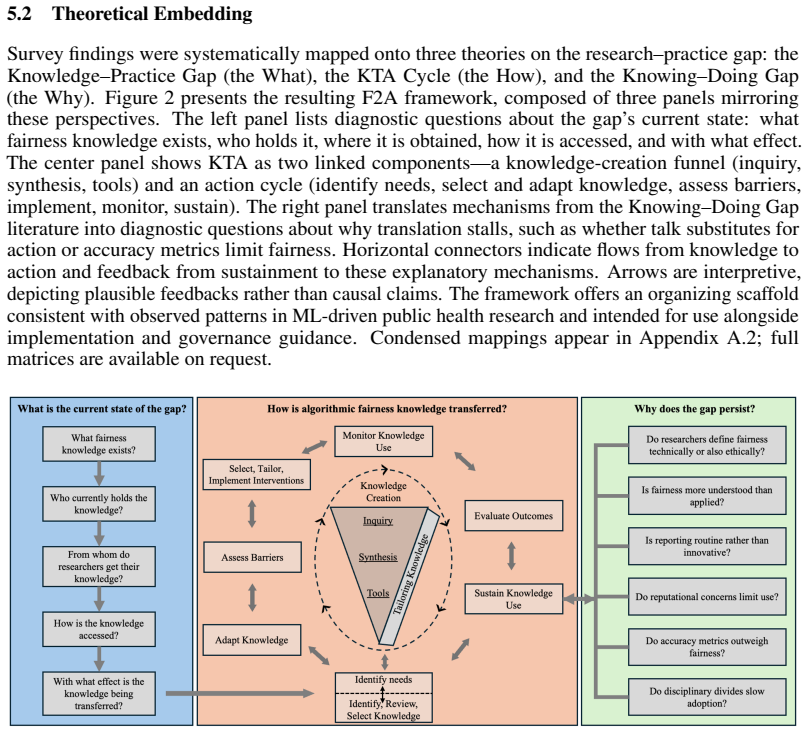
Through interviews, survey responses, and systematic mapping onto the Knowledge-Practice Gap, Knowledge-to-Action Cycle, and Knowing-Doing Gap lenses, the study concludes that fairness remains weakly institutionalized, translation mechanisms are externally driven, and system-level priorities continue to emphasize accuracy over fairness. These patterns are synthesized into the Fairness-to-Action framework that integrates methodological, organizational, and systemic dimensions to locate where translation stalls.
What carries the argument
The Fairness-to-Action framework, which combines methodological, organizational, and systemic dimensions to locate stalls in translating algorithmic fairness knowledge into public health practice.
If this is right
- Public health organizations must embed fairness requirements into standard workflows and incentives.
- Training and guidance on fairness should be developed and maintained internally rather than sourced externally.
- System-level evaluation metrics must treat fairness as a core requirement alongside accuracy.
- Ongoing monitoring of fairness in deployed models should become standard practice.
Where Pith is reading between the lines
- The same dimensions could be used to diagnose translation gaps in other high-stakes domains such as education or criminal justice.
- Policymakers might design funding or regulatory requirements that strengthen internal translation mechanisms identified by the framework.
- Longitudinal tracking of organizations after targeted interventions could test whether changes at the three dimensions actually increase fairness practice.
Load-bearing premise
The sequential mixed-methods design and mapping onto three gap lenses yields representative findings sufficient to build a valid new integrative framework.
What would settle it
A follow-up census of deployed public health ML systems that shows routine internal use of formal fairness assessment, mitigation, and monitoring would falsify the reported translation stalls.
Figures
read the original abstract
Algorithmic fairness is essential for responsible ML-driven public health research, yet its practical implementation remains limited. To investigate this awareness-action gap, we conducted a sequential mixed-methods study comprising expert interviews, an online survey, and systematic mapping. The expert interviews informed the design of the survey, which in turn revealed fragmented definitions of fairness, limited training and guidance, reliance on external sources, and rare use of formal assessment, mitigation, or monitoring. These findings were subsequently mapped onto three established research-practice gap lenses: the Knowledge-Practice Gap, the Knowledge-to-Action Cycle, and the Knowing-Doing Gap, each offering complementary perspectives. Building on this synthesis, we introduce the Fairness-to-Action framework, which integrates methodological, organizational, and systemic dimensions to identify where translation of algorithmic fairness knowledge stalls. Our analysis shows that fairness remains weakly institutionalized, translation mechanisms are externally driven, and system-level priorities continue to emphasize accuracy over fairness. These insights suggest critical leverage points for advancing safe, fair, and ethical ML-driven public health research practice.
Editorial analysis
A structured set of objections, weighed in public.
Referee Report
Summary. The paper claims that a sequential mixed-methods study (expert interviews informing an online survey) reveals fragmented definitions of algorithmic fairness, limited training, reliance on external sources, and rare use of formal assessment in public health ML. Mapping these findings onto the Knowledge-Practice Gap, Knowledge-to-Action Cycle, and Knowing-Doing Gap lenses leads to the introduction of the Fairness-to-Action framework, which shows that fairness is weakly institutionalized, translation mechanisms are externally driven, and system-level priorities emphasize accuracy over fairness.
Significance. If the empirical findings and framework hold, this work provides a novel integrative framework for identifying leverage points in translating algorithmic fairness research to public health practice. It highlights critical barriers at methodological, organizational, and systemic levels, potentially guiding future interventions to improve ethical ML deployment in health contexts.
major comments (1)
- [Framework Derivation] The introduction of the Fairness-to-Action framework via systematic mapping of interview and survey data onto the three gap lenses lacks any reported validation steps such as inter-rater reliability for coding or external benchmarking. This is load-bearing for the central claims regarding weak institutionalization and external drivers, as alternative interpretations of the raw data could alter the identified leverage points.
minor comments (1)
- [Abstract] Sample sizes, response rates, exact survey items, and quantitative results are not reported in the abstract, hindering immediate assessment of the empirical support for the findings.
Simulated Author's Rebuttal
We thank the referee for their detailed and constructive review. The single major comment raises an important point about transparency in our framework derivation process. We address it below and commit to revisions that strengthen the manuscript without altering its core contributions.
read point-by-point responses
-
Referee: [Framework Derivation] The introduction of the Fairness-to-Action framework via systematic mapping of interview and survey data onto the three gap lenses lacks any reported validation steps such as inter-rater reliability for coding or external benchmarking. This is load-bearing for the central claims regarding weak institutionalization and external drivers, as alternative interpretations of the raw data could alter the identified leverage points.
Authors: We agree that greater transparency in the mapping process is warranted. The synthesis involved iterative team discussions to align the empirical themes (fragmented definitions, limited training, external reliance, and rare formal assessment) with the three established theoretical lenses. However, the manuscript does not currently report the specific procedural steps or any validation measures. We will revise the Methods and Results sections to add a dedicated subsection detailing the systematic mapping procedure, including how data excerpts were iteratively assigned to the Knowledge-Practice Gap, Knowledge-to-Action Cycle, and Knowing-Doing Gap dimensions, and how consensus was reached within the research team. This addition will clarify the derivation of the Fairness-to-Action framework's three dimensions (methodological, organizational, systemic) and the claims about weak institutionalization and external drivers. We note that, as a small-team qualitative synthesis rather than a large-scale coded content analysis, formal inter-rater reliability statistics were not computed; the process relied on documented team consensus. No external benchmarking was performed, as the lenses are established in the literature and the mapping is interpretive. These revisions will allow readers to evaluate alternative interpretations while preserving the framework's value as an integrative synthesis. revision: yes
Circularity Check
No circularity: empirical mixed-methods study with external data collection and mapping to prior frameworks
full rationale
The paper describes a sequential mixed-methods design: expert interviews informing survey design, survey results revealing specific practices, followed by mapping of those results onto three pre-existing external gap lenses (Knowledge-Practice Gap, Knowledge-to-Action Cycle, Knowing-Doing Gap) and synthesis into a new integrative framework. No equations, parameters, fitted values, or derivations appear anywhere in the manuscript. The central claims rest on newly collected interview and survey responses rather than any reduction to the paper's own inputs by construction. Self-citations, if present, are not load-bearing for the core synthesis step, which draws on established external lenses. This is a standard empirical qualitative/quantitative study whose findings are falsifiable against the raw data and external benchmarks; no pattern from the enumerated circularity kinds applies.
Axiom & Free-Parameter Ledger
axioms (1)
- domain assumption The Knowledge-Practice Gap, Knowledge-to-Action Cycle, and Knowing-Doing Gap lenses are suitable and complementary for interpreting the collected fairness data.
invented entities (1)
-
Fairness-to-Action framework
no independent evidence
Reference graph
Works this paper leans on
-
[1]
Artificial Intelligence and Big Data in Public Health.International Journal of Environmental Research and Public Health, 15(12):2796, December 2018
Kurt Benke and Geza Benke. Artificial Intelligence and Big Data in Public Health.International Journal of Environmental Research and Public Health, 15(12):2796, December 2018
2018
-
[2]
Predicting population health with machine learning: a scoping review.BMJ Open, 10(10):e037860, October 2020
Jason Denzil Morgenstern, Emmalin Buajitti, Meghan O’Neill, Thomas Piggott, Vivek Goel, Daniel Fridman, Kathy Kornas, and Laura C Rosella. Predicting population health with machine learning: a scoping review.BMJ Open, 10(10):e037860, October 2020
2020
-
[3]
Wiemken and Robert R
Timothy L. Wiemken and Robert R. Kelley. Machine Learning in Epidemiology and Health Outcomes Research.Annual Review of Public Health, 41(1):21–36, April 2020
2020
-
[4]
Machine learning and algorithmic fairness in public and population health.Nature Machine Intelligence, 3(8):659–666, July 2021
Vishwali Mhasawade, Yuan Zhao, and Rumi Chunara. Machine learning and algorithmic fairness in public and population health.Nature Machine Intelligence, 3(8):659–666, July 2021
2021
-
[5]
Olawade, Ojima J
David B. Olawade, Ojima J. Wada, Aanuoluwapo Clement David-Olawade, Edward Kunonga, Olawale Abaire, and Jonathan Ling. Using artificial intelligence to improve public health: a narrative review. Frontiers in Public Health, 11:1196397, October 2023
2023
-
[6]
Artificial Intelligence and Public Health: An Exploratory Study
David Jungwirth and Daniela Haluza. Artificial Intelligence and Public Health: An Exploratory Study. International Journal of Environmental Research and Public Health, 20(5):4541, March 2023
2023
-
[7]
Dissecting racial bias in an algorithm used to manage the health of populations.Science, 366(6464):447–453, October 2019
Ziad Obermeyer, Brian Powers, Christine V ogeli, and Sendhil Mullainathan. Dissecting racial bias in an algorithm used to manage the health of populations.Science, 366(6464):447–453, October 2019
2019
-
[8]
Addressing Fairness, Bias, and Appropriate Use of Artificial Intelligence and Machine Learning in Global Health.Frontiers in Artificial Intelligence, 3:561802, April 2021
Richard Ribón Fletcher, Audace Nakeshimana, and Olusubomi Olubeko. Addressing Fairness, Bias, and Appropriate Use of Artificial Intelligence and Machine Learning in Global Health.Frontiers in Artificial Intelligence, 3:561802, April 2021
2021
-
[9]
Addressing bias in artificial intelligence for public health surveillance.Journal of Medical Ethics, 50(3):190–194, March 2024
Lidia Flores, Seungjun Kim, and Sean D Young. Addressing bias in artificial intelligence for public health surveillance.Journal of Medical Ethics, 50(3):190–194, March 2024
2024
-
[10]
Paul Wesson, Yulin Hswen, Gilmer Valdes, Kristefer Stojanovski, and Margaret A. Handley. Risks and Opportunities to Ensure Equity in the Application of Big Data Research in Public Health.Annual Review of Public Health, 43(1):59–78, April 2022
2022
-
[11]
Tsai, Sercan Arik, Benjamin H
Thomas C. Tsai, Sercan Arik, Benjamin H. Jacobson, Jinsung Yoon, Nate Yoder, Dario Sava, Margaret Mitchell, Garth Graham, and Tomas Pfister. Algorithmic fairness in pandemic forecasting: lessons from COVID-19.npj Digital Medicine, 5(1):59, May 2022
2022
-
[12]
Chin, Nasim Afsar-Manesh, Arlene S
Marshall H. Chin, Nasim Afsar-Manesh, Arlene S. Bierman, Christine Chang, Caleb J. Colón-Rodríguez, Prashila Dullabh, Deborah Guadalupe Duran, Malika Fair, Tina Hernandez-Boussard, Maia Hightower, Anjali Jain, William B. Jordan, Stephen Konya, Roslyn Holliday Moore, Tamra Tyree Moore, Richard Rodriguez, Gauher Shaheen, Lynne Page Snyder, Mithuna Srinivasa...
2023
-
[13]
Thomasian, Carsten Eickhoff, and Eli Y
Nicole M. Thomasian, Carsten Eickhoff, and Eli Y . Adashi. Advancing health equity with artificial intelligence.Journal of Public Health Policy, 42(4):602–611, December 2021
2021
-
[14]
Nazer, Razan Zatarah, Shai Waldrip, Janny Xue Chen Ke, Mira Moukheiber, Ashish K
Lama H. Nazer, Razan Zatarah, Shai Waldrip, Janny Xue Chen Ke, Mira Moukheiber, Ashish K. Khanna, Rachel S. Hicklen, Lama Moukheiber, Dana Moukheiber, Haobo Ma, and Piyush Mathur. Bias in artificial intelligence algorithms and recommendations for mitigation.PLOS Digital Health, 2(6):e0000278, June 2023
2023
-
[15]
Friedler, John Moeller, Carlos Scheidegger, and Suresh Venkatasubramanian
Michael Feldman, Sorelle A. Friedler, John Moeller, Carlos Scheidegger, and Suresh Venkatasubramanian. Certifying and Removing Disparate Impact. InProceedings of the 21th ACM SIGKDD International Conference on Knowledge Discovery and Data Mining, pages 259–268, Sydney NSW Australia, August
-
[16]
Equality of Opportunity in Supervised Learning
Moritz Hardt, Eric Price, and Nathan Srebro. Equality of Opportunity in Supervised Learning. arXiv:1610.02413 [cs], October 2016. arXiv: 1610.02413
work page internal anchor Pith review Pith/arXiv arXiv 2016
-
[17]
Fairness through awareness
Cynthia Dwork, Moritz Hardt, Toniann Pitassi, Omer Reingold, and Richard Zemel. Fairness through awareness. InProceedings of the 3rd Innovations in Theoretical Computer Science Conference, pages 214–226, Cambridge Massachusetts, January 2012. ACM
2012
-
[18]
MIT Press, 2023
Solon Barocas, Moritz Hardt, and Arvind Narayanan.Fairness and Machine Learning: Limitations and Opportunities. MIT Press, 2023
2023
-
[19]
Fairness in Machine Learning: A Survey.ACM Computing Surveys, 56(7):1–38, July 2024
Simon Caton and Christian Haas. Fairness in Machine Learning: A Survey.ACM Computing Surveys, 56(7):1–38, July 2024
2024
-
[20]
Kenneth Holstein, Jennifer Wortman Vaughan, Hal Daumé, Miro Dudik, and Hanna Wallach. Improving Fairness in Machine Learning Systems: What Do Industry Practitioners Need? InProceedings of the 2019 CHI Conference on Human Factors in Computing Systems, pages 1–16, Glasgow Scotland Uk, May 2019. ACM
2019
-
[21]
Madaio, Luke Stark, Jennifer Wortman Vaughan, and Hanna Wallach
Michael A. Madaio, Luke Stark, Jennifer Wortman Vaughan, and Hanna Wallach. Co-Designing Checklists to Understand Organizational Challenges and Opportunities around Fairness in AI. InProceedings of the 2020 CHI Conference on Human Factors in Computing Systems, pages 1–14, Honolulu HI USA, April
2020
-
[22]
Unmasking bias in artificial intelligence: a systematic review of bias detection and mitigation strategies in electronic health record-based models
Feng Chen, Liqin Wang, Julie Hong, Jiaqi Jiang, and Li Zhou. Unmasking bias in artificial intelligence: a systematic review of bias detection and mitigation strategies in electronic health record-based models. Journal of the American Medical Informatics Association, 31(5):1172–1183, April 2024
2024
-
[23]
Managing the Development of Large Software Systems
Dr Winston W Royce. Managing the Development of Large Software Systems. InIEEE WESCON, pages 328–338, Los Angeles, 1970
1970
-
[24]
In Search of the Elusive ADDIE Model: Performance Improvement.Performance Improvement, 54(2):40–42, February 2015
Michael Molenda. In Search of the Elusive ADDIE Model: Performance Improvement.Performance Improvement, 54(2):40–42, February 2015
2015
-
[25]
A Framework for Understanding Sources of Harm throughout the Machine Learning Life Cycle
Harini Suresh and John Guttag. A Framework for Understanding Sources of Harm throughout the Machine Learning Life Cycle. InEquity and Access in Algorithms, Mechanisms, and Optimization, pages 1–9, – NY USA, October 2021. ACM
2021
-
[26]
Knowledge translation of research findings.Implementation Science, 7(1):50, December 2012
Jeremy M Grimshaw, Martin P Eccles, John N Lavis, Sophie J Hill, and Janet E Squires. Knowledge translation of research findings.Implementation Science, 7(1):50, December 2012
2012
-
[27]
Graham, Jo Logan, Margaret B
Ian D. Graham, Jo Logan, Margaret B. Harrison, Sharon E. Straus, Jacqueline Tetroe, Wenda Caswell, and Nicole Robinson. Lost in knowledge translation: Time for a map?Journal of Continuing Education in the Health Professions, 26(1):13–24, 2006
2006
-
[28]
Sutton.The knowing-doing gap: how smart companies turn knowledge into action
Jeffrey Pfeffer and Robert I. Sutton.The knowing-doing gap: how smart companies turn knowledge into action. Harvard Business School Press, Boston, Mass, 2000
2000
-
[29]
Ikram, Anton E
Umar Z. Ikram, Anton E. Kunst, Majda Lamkaddem, and Karien Stronks. The disease burden across different ethnic groups in Amsterdam, the Netherlands, 2011–2030.European Journal of Public Health, 24(4):600–605, August 2014
2011
-
[30]
Kroneman, W
M. Kroneman, W. Boerma, M. van den Berg, P. Groenewegen, J. de Jong, and E. van Ginneken.The Netherlands: Health System Review, volume 18 ofHealth Systems in Transition. European Observatory on Health Systems and Policies, Copenhagen, 2016
2016
-
[31]
Ethnic minority experiences of mental health services in the Netherlands: an exploratory study.BMC Research Notes, 15(1):266, July 2022
Onaedo Ilozumba, Tirsah S Koster, Elena V Syurina, and Ikenna Ebuenyi. Ethnic minority experiences of mental health services in the Netherlands: an exploratory study.BMC Research Notes, 15(1):266, July 2022
2022
-
[32]
Strategies to Improve the Impact of Artificial Intelligence on Health Equity: Scoping Review.JMIR AI, 2:e42936, February 2023
Carl Thomas Berdahl, Lawrence Baker, Sean Mann, Osonde Osoba, and Federico Girosi. Strategies to Improve the Impact of Artificial Intelligence on Health Equity: Scoping Review.JMIR AI, 2:e42936, February 2023
2023
-
[33]
Laleh Seyyed-Kalantari, Haoran Zhang, Matthew B. A. McDermott, Irene Y . Chen, and Marzyeh Ghassemi. Underdiagnosis bias of artificial intelligence algorithms applied to chest radiographs in under-served patient populations.Nature Medicine, 27(12):2176–2182, December 2021
2021
-
[34]
Zech, Marcus A
John R. Zech, Marcus A. Badgeley, Manway Liu, Anthony B. Costa, Joseph J. Titano, and Eric Karl Oermann. Variable generalization performance of a deep learning model to detect pneumonia in chest radiographs: A cross-sectional study.PLOS Medicine, 15(11):e1002683, November 2018
2018
-
[35]
Larrazabal, Nicolás Nieto, Victoria Peterson, Diego H
Agostina J. Larrazabal, Nicolás Nieto, Victoria Peterson, Diego H. Milone, and Enzo Ferrante. Gender im- balance in medical imaging datasets produces biased classifiers for computer-aided diagnosis.Proceedings of the National Academy of Sciences, 117(23):12592–12594, June 2020
2020
-
[36]
Vyas, Leo G
Darshali A. Vyas, Leo G. Eisenstein, and David S. Jones. Hidden in Plain Sight: Reconsidering the Use of Race Correction in Clinical Algorithms.The New England Journal of Medicine, 383(9):874–882, August 2020
2020
-
[37]
Chen, Emma Pierson, Sherri Rose, Shalmali Joshi, Kadija Ferryman, and Marzyeh Ghassemi
Irene Y . Chen, Emma Pierson, Sherri Rose, Shalmali Joshi, Kadija Ferryman, and Marzyeh Ghassemi. Ethical Machine Learning in Healthcare.Annual Review of Biomedical Data Science, 4(1):123–144, July 2021
2021
-
[38]
On Algorithmic Fairness in Medical Practice.Cambridge Quarterly of Healthcare Ethics, 31(1):83–94, January 2022
Thomas Grote and Geoff Keeling. On Algorithmic Fairness in Medical Practice.Cambridge Quarterly of Healthcare Ethics, 31(1):83–94, January 2022
2022
-
[39]
Guidelines for clinical trial protocols for interventions involving artificial intelligence: the SPIRIT-AI extension.The Lancet Digital Health, 2(10):e549–e560, October 2020
Samantha Cruz Rivera, Xiaoxuan Liu, An-Wen Chan, Alastair K Denniston, Melanie J Calvert, Hutan Ashrafian, Andrew L Beam, Gary S Collins, Ara Darzi, Jonathan J Deeks, M Khair ElZarrad, Cyrus Espinoza, Andre Esteva, Livia Faes, Lavinia Ferrante Di Ruffano, John Fletcher, Robert Golub, Hugh Harvey, Charlotte Haug, Christopher Holmes, Adrian Jonas, Pearse A ...
2020
-
[40]
Xiaoxuan Liu, Samantha Cruz Rivera, David Moher, Melanie J Calvert, Alastair K Denniston, Hutan Ashrafian, Andrew L Beam, An-Wen Chan, Gary S Collins, Ara DarziJonathan J Deeks, M Khair ElZarrad, Cyrus Espinoza, Andre Esteva, Livia Faes, Lavinia Ferrante Di Ruffano, John Fletcher, Robert Golub, Hugh Harvey, Charlotte Haug, Christopher Holmes, Adrian Jonas...
2020
-
[41]
Tina Hernandez-Boussard, Selen Bozkurt, John P A Ioannidis, and Nigam H Shah. MINIMAR (MINimum Information for Medical AI Reporting): Developing reporting standards for artificial intelligence in health care.Journal of the American Medical Informatics Association, 27(12):2011–2015, December 2020
2011
-
[42]
TRIPOD+AI statement: updated guidance for reporting clinical prediction models that use regression or machine learning methods.BMJ, page e078378, April 2024
Gary S Collins, Karel G M Moons, Paula Dhiman, Richard D Riley, Andrew L Beam, Ben Van Calster, Marzyeh Ghassemi, Xiaoxuan Liu, Johannes B Reitsma, Maarten Van Smeden, Anne-Laure Boulesteix, Jennifer Catherine Camaradou, Leo Anthony Celi, Spiros Denaxas, Alastair K Denniston, Ben Glocker, Robert M Golub, Hugh Harvey, Georg Heinze, Michael M Hoffman, André...
2024
-
[43]
Karel G M Moons, Johanna A A Damen, Tabea Kaul, Lotty Hooft, Constanza Andaur Navarro, Paula Dhiman, Andrew L Beam, Ben Van Calster, Leo Anthony Celi, Spiros Denaxas, Alastair K Denniston, Marzyeh Ghassemi, Georg Heinze, André Pascal Kengne, Lena Maier-Hein, Xiaoxuan Liu, Patricia Logullo, Melissa D McCradden, Nan Liu, Lauren Oakden-Rayner, Karandeep Sing...
2025
-
[44]
Equity in essence: a call for operationalising fairness in machine learning for healthcare.BMJ Health & Care Informatics, 28(1):e100289, April 2021
Judy Wawira Gichoya, Liam G McCoy, Leo Anthony Celi, and Marzyeh Ghassemi. Equity in essence: a call for operationalising fairness in machine learning for healthcare.BMJ Health & Care Informatics, 28(1):e100289, April 2021
2021
-
[45]
Concep- tualising fairness: three pillars for medical algorithms and health equity.BMJ Health & Care Informatics, 29(1):e100459, January 2022
Laura Sikstrom, Marta M Maslej, Katrina Hui, Zoe Findlay, Daniel Z Buchman, and Sean L Hill. Concep- tualising fairness: three pillars for medical algorithms and health equity.BMJ Health & Care Informatics, 29(1):e100459, January 2022
2022
-
[46]
Ethical limitations of algorithmic fairness solutions in health care machine learning.The Lancet Digital Health, 2(5):e221–e223, May 2020
Melissa D McCradden, Shalmali Joshi, Mjaye Mazwi, and James A Anderson. Ethical limitations of algorithmic fairness solutions in health care machine learning.The Lancet Digital Health, 2(5):e221–e223, May 2020
2020
-
[47]
Artificial intelligence in public health: promises, challenges, and an agenda for policy makers and public health institutions.The Lancet Public Health, 10(5):e428–e432, May 2025
Dimitra Panteli, Keyrellous Adib, Stefan Buttigieg, Francisco Goiana-da Silva, Katharina Ladewig, Natasha Azzopardi-Muscat, Josep Figueras, David Novillo-Ortiz, and Martin McKee. Artificial intelligence in public health: promises, challenges, and an agenda for policy makers and public health institutions.The Lancet Public Health, 10(5):e428–e432, May 2025
2025
-
[48]
The public perceptions of algorithmic decision- making systems: Results from a large-scale survey.Telematics and Informatics, 79:101954, April 2023
Banu Aysolmaz, Rudolf Müller, and Darian Meacham. The public perceptions of algorithmic decision- making systems: Results from a large-scale survey.Telematics and Informatics, 79:101954, April 2023
2023
-
[49]
Model Cards for Model Reporting
Margaret Mitchell, Simone Wu, Andrew Zaldivar, Parker Barnes, Lucy Vasserman, Ben Hutchinson, Elena Spitzer, Inioluwa Deborah Raji, and Timnit Gebru. Model Cards for Model Reporting. InProceedings of the Conference on Fairness, Accountability, and Transparency, pages 220–229, Atlanta GA USA, January
-
[50]
Datasheets for datasets.Communications of the ACM, 64(12):86–92, December 2021
Timnit Gebru, Jamie Morgenstern, Briana Vecchione, Jennifer Wortman Vaughan, Hanna Wallach, Hal Daumé Iii, and Kate Crawford. Datasheets for datasets.Communications of the ACM, 64(12):86–92, December 2021
2021
-
[51]
Artificial Intelligence Bias in Health Care: Web-Based Survey.Journal of Medical Internet Research, 25:e41089, June 2023
Carina Nina V orisek, Caroline Stellmach, Paula Josephine Mayer, Sophie Anne Ines Klopfenstein, Do- minik Martin Bures, Anke Diehl, Maike Henningsen, Kerstin Ritter, and Sylvia Thun. Artificial Intelligence Bias in Health Care: Web-Based Survey.Journal of Medical Internet Research, 25:e41089, June 2023
2023
-
[52]
Fairness perceptions of algorithmic decision-making: A systematic review of the empirical literature.Big Data & Society, 9(2):20539517221115189, July 2022
Christopher Starke, Janine Baleis, Birte Keller, and Frank Marcinkowski. Fairness perceptions of algorithmic decision-making: A systematic review of the empirical literature.Big Data & Society, 9(2):20539517221115189, July 2022
2022
-
[53]
Max Kasun, Katie Ryan, Jodi Paik, Kyle Lane-McKinley, Laura Bodin Dunn, Laura Weiss Roberts, and Jane Paik Kim. Academic machine learning researchers’ ethical perspectives on algorithm development for health care: a qualitative study.Journal of the American Medical Informatics Association, 31(3):563–573, February 2024
2024
-
[54]
Kellogg, William Ratliff, Sara G
Jee Young Kim, Alifia Hasan, Katherine C. Kellogg, William Ratliff, Sara G. Murray, Harini Suresh, Alexandra Valladares, Keo Shaw, Danny Tobey, David E. Vidal, Mark A. Lifson, Manesh Patel, In- ioluwa Deborah Raji, Michael Gao, William Knechtle, Linda Tang, Suresh Balu, and Mark P. Sendak. Development and preliminary testing of Health Equity Across the AI...
2024
-
[55]
Algorithm register (algoritmeregister), 2023
Dutch Government. Algorithm register (algoritmeregister), 2023. Accessed 9 June 2025
2023
-
[56]
CBS introduces new population classification by origin, 2022
Statistics Netherlands (CBS). CBS introduces new population classification by origin, 2022. Accessed 9 June 2025
2022
-
[57]
Machine Learning and Public Health: Identifying and Mitigating Algorithmic Bias through a Systematic Review
Sara Altamirano, Arjan Vreeken, and Sennay Ghebreab. Machine Learning and Public Health: Identifying and Mitigating Algorithmic Bias through a Systematic Review. InProceedings of the AAAI/ACM Con- ference on AI, Ethics, and Society (AIES 2025), New York, NY , USA, 2025. Association for Computing Machinery (ACM)
2025
-
[58]
L., Naoom, S
Fixsen, D. L., Naoom, S. F., Blase, K. A., Friedman, R. M. & Wallace, F. Implementation Research: A Synthesis of the Literature. Technical report, University of South Florida, Louis de la Parte Florida Mental Health Institute, National Implementation Research Network, Tampa, FL, 2005
2005
-
[59]
Diffusion of Innovations in Service Organizations: Systematic Review and Recommendations.The Milbank Quarterly, 82(4):581–629, December 2004
Trisha Greenhalgh, Glenn Robert, Fraser Macfarlane, Paul Bate, and Olivia Kyriakidou. Diffusion of Innovations in Service Organizations: Systematic Review and Recommendations.The Milbank Quarterly, 82(4):581–629, December 2004
2004
-
[60]
Enola Proctor, Hiie Silmere, Ramesh Raghavan, Peter Hovmand, Greg Aarons, Alicia Bunger, Richard Griffey, and Melissa Hensley. Outcomes for Implementation Research: Conceptual Distinctions, Measure- ment Challenges, and Research Agenda.Administration and Policy in Mental Health and Mental Health Services Research, 38(2):65–76, March 2011
2011
-
[61]
Trends in guideline implementation: an updated scoping review.Implementation Science, 17:50, December 2022
Sanne Peters, Krithika Sukumar, Sophie Blanchard, Akilesh Ramasamy, Jennifer Malinowski, Pamela Ginex, Emily Senerth, Marleen Corremans, Zachary Munn, Tamara Kredo, Lucia Prieto Remon, Etienne Ngeh, Lisa Kalman, Samia Alhabib, Yasser Sami Amer, and Anna Gagliardi. Trends in guideline implementation: an updated scoping review.Implementation Science, 17:50,...
2022
-
[62]
Laura J Damschroder, David C Aron, Rosalind E Keith, Susan R Kirsh, Jeffery A Alexander, and Julie C Lowery. Fostering implementation of health services research findings into practice: a consolidated framework for advancing implementation science.Implementation Science, 4(1):50, December 2009
2009
-
[63]
Applying the Knowledge to Action (K2A) Framework: Questions to Guide Planning.Centers for Disease Control and Prevention, US Dept of Health and Human Services, 2014
Centers for Disease Control and Prevention. Applying the Knowledge to Action (K2A) Framework: Questions to Guide Planning.Centers for Disease Control and Prevention, US Dept of Health and Human Services, 2014
2014
-
[64]
A framework for collaborative improvement: lessons from the Institute for Healthcare Improvement’s Breakthrough Series.Quality Management in Healthcare, 6(4):1–14, 1998
Kilo, Charles M. A framework for collaborative improvement: lessons from the Institute for Healthcare Improvement’s Breakthrough Series.Quality Management in Healthcare, 6(4):1–14, 1998
1998
-
[65]
Brown, Jesmin Antony, Charlene Soobiah, Michelle Simeoni, Thomas A
Noah Ivers, Sharlini Yogasingam, Meagan Lacroix, Kevin A. Brown, Jesmin Antony, Charlene Soobiah, Michelle Simeoni, Thomas A. Willis, Jacob Crawshaw, Vivi Antonopoulou, Carly Meyer, Nathan M. Solbak, Brenna J. Murray, Emily-Ann Butler, Simone Lepage, Martina Giltenane, Mary D. Carter, Guillaume Fontaine, Michael Sykes, Michael Halasy, Abdalla Bazazo, Sama...
2025
-
[66]
Creswell and Cheryl N
John W. Creswell and Cheryl N. Poth.Qualitative inquiry & research design: choosing among five approaches. SAGE, Los Angeles, fourth edition edition, 2018
2018
-
[67]
Woodruff, Philippe Lambin, and Luis Martí-Bonmatí
Karim Lekadir, Richard Osuala, Catherine Gallin, Noussair Lazrak, Kaisar Kushibar, Gianna Tsakou, Susanna Aussó, Leonor Cerdá Alberich, Kostas Marias, Manolis Tsiknakis, Sara Colantonio, Nicko- las Papanikolaou, Zohaib Salahuddin, Henry C. Woodruff, Philippe Lambin, and Luis Martí-Bonmatí. FUTURE-AI: Guiding Principles and Consensus Recommendations for Tr...
-
[68]
Paul, Janette Kwok, Juntra Karbwang, Chiara De Waure, Frances J
Akash Sharma, Nguyen Tran Minh Duc, Tai Luu Lam Thang, Nguyen Hai Nam, Sze Jia Ng, Kirellos Said Abbas, Nguyen Tien Huy, Ana Maruši ´c, Christine L. Paul, Janette Kwok, Juntra Karbwang, Chiara De Waure, Frances J. Drummond, Yoshiyuki Kizawa, Erik Taal, Joeri Vermeulen, Gillian H. M. Lee, Adam Gyedu, Kien Gia To, Martin L. Verra, Évelyne M. Jacqz-Aigrain, ...
2021
-
[69]
Improving the Quality of Web Surveys: The Checklist for Reporting Results of Internet E-Surveys (CHERRIES).Journal of Medical Internet Research, 6(3):e34, September 2004
Gunther Eysenbach. Improving the Quality of Web Surveys: The Checklist for Reporting Results of Internet E-Surveys (CHERRIES).Journal of Medical Internet Research, 6(3):e34, September 2004. A Appendix A.1 Full Survey Questionnaire A.1.1 Introduction Welcome, and thank you for participating in this survey on Algorithmic Fairness in Dutch Public Health Rese...
2004
-
[70]
Ensure all income groups receive equal recommendations (equality)
-
[71]
Ensure recommendations are not worse for any income group (equity)
-
[72]
Ensure people with similar health needs receive similar recommendations
-
[73]
Prioritize the most urgent health needs, even if recommendations are not equally distributed
-
[74]
Regularly update recommendations to improve fairness over time
-
[75]
Other (please specify)
Other (please specify) S5.Q2 Would you be willing to reduce accuracy in the app’s recommendations to ensure equal access to all income groups? • No reduction in accuracy • Small reduction • Moderate reduction • Significant reduction • Severe reduction S5.Q3How would you report the discovered bias against lower-income users in your scientific paper? • Deci...
discussion (0)
Sign in with ORCID, Apple, or X to comment. Anyone can read and Pith papers without signing in.