REVIEW 3 major objections 4 minor 1 cited by
Tightening the Lieb-Robinson Bound in Locally-Interacting Systems
T0 review · 3 major / 4 minor · reviewed 2026-08-14 · deepseek-v4-flash
Pith's one-line read A commutativity-graph method tightens Lieb-Robinson bounds, making light-cone speeds finite where older bounds diverged.
desk verdict The commutativity graph is a real new tool for LR bounds, but the large-S Heisenberg derivation contains a false Hamiltonian (Eq. (59)) that must be fixed before the flagship finite-velocity claim is taken as proven. read the letter →
The pith
A machine-rendered reading of the paper's core claim, the machinery that carries it, and where it could break.
The reading
What carries the argument
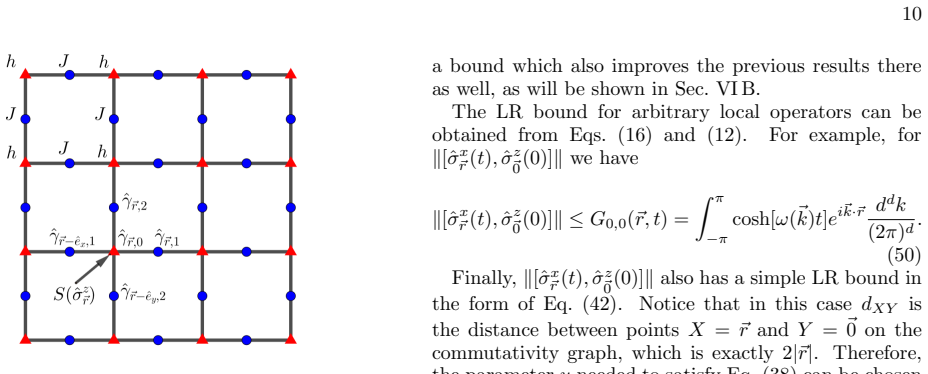
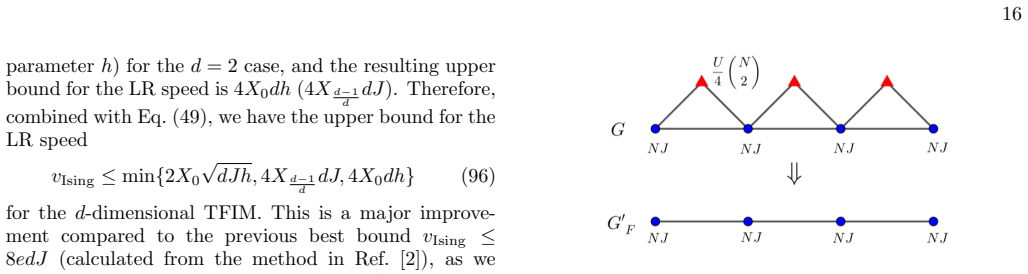
The commutativity graph: a graph whose vertices are the unit-norm local Hermitian operators gamma_i in a chosen decomposition of the Hamiltonian, with an edge between i and j exactly when [gamma_i, gamma_j] ≠ 0. The argument's engine is Eq. (10), a first-order linear differential equation for the norm of the commutator [gamma_i(t), B(0)], whose coefficients are the coupling strengths on the graph edges; its solution upper-bounds the commutator via a Gronwall inequality. In translation-invariant systems the equation diagonalizes in Fourier space, and the bound on the Green's function becomes an integral whose large-momentum behavior yields the speed formula v_LR ≤ min_kappa omega_m(i kappa)/kappa. A power-series solution in arbitrary graphs gives the superexponential bound C (u|t|/d_XY)^{d_XY}. The paper also uses a minimal Clifford decomposition (every pair of terms commutes or anticommutes) to saturate the triangle inequality, and a graph-reduction step that removes mutually commuting terms with large coefficients by rotating them away unitarily.
What would settle it
Examine whether the enlarged-space Heisenberg evolution generated by Eq. (54) maps the fully symmetric subspace to itself for all times; a single explicit counterexample — such as a symmetric initial two-spin state evolving into a state with nonzero antisymmetric component, or a physical operator whose norm grows under projection — would invalidate the S→∞ transfer. Alternatively, compute the exact or high-precision numerical Lieb-Robinson velocity of the S=2 or S=3 Heisenberg XYZ chain and check whether it approaches the finite bound 4dJ_m X_{1−1/(2Sd)} or instead grows with S.
Extended reading notes
Core claim
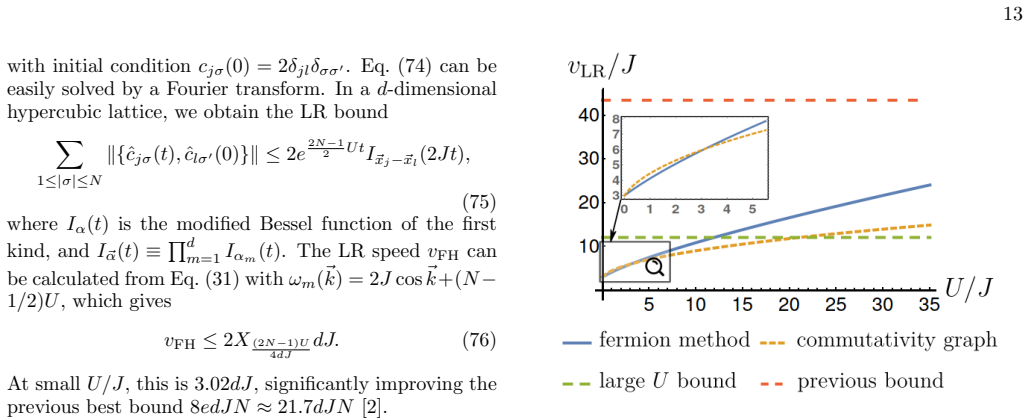
The paper's central discovery is that the speed of information propagation in a locally interacting quantum system is controlled by the largest eigenvalue of a linear operator built from the Hamiltonian's commutativity graph. Each local term of the Hamiltonian becomes a vertex, and edges connect non-commuting terms. The norm of an unequal-time commutator is bounded by the solution of a first-order linear differential equation on this graph; in translation-invariant systems the solution is a Fourier integral, and the Lieb-Robinson velocity is the minimum over imaginary momentum shifts of omega_m(i kappa)/kappa. Applying this recipe to concrete models yields the scalings summarized in the abstract and Table II: finite velocity at large S for Heisenberg XYZ, v ∝ √N for SU(N) Fermi-Hubbard, v ∝ √d for TFIM, and similar improvements for truncated Bose-Hubbard and Wen's rotor model. A separate graph-reduction step removes large commuting coupling constants, giving finite speeds in large-J, large-h, and large-U limits and a theorem that perturbed exactly solvable models have velocity at most linear in the perturbation strength.
Load-bearing premise
For the large-spin results the paper decomposes each spin-S operator into 2S spin-1/2 Pauli operators and asserts that bounds derived in the enlarged Hilbert space transfer unchanged to the physical symmetric subspace; this transfer is stated without a detailed proof, and if the enlarged evolution leaked out of the physical subspace or introduced extra norm factors, the claimed finite large-S velocity would not follow.
Editorial extensions
If this is right
- The spin-S Heisenberg XYZ model has an upper bound on its Lieb-Robinson velocity that remains finite as S→∞, so information propagation speed does not diverge with local Hilbert space size.
- The SU(N) Fermi-Hubbard model has LR velocity growing like √(NdUJ) rather than linearly in N, so the large-N classical limit has finite speed.
- The d-dimensional transverse-field Ising model has velocity growing like √(dJh), the first sublinear-in-dimension LR bound; combined with large-coupling eliminations it is bounded by min{2X0√(dJh), 4X_{d−1/d}dJ, 4X0dh}.
- The bounds have superexponential tails (u|t|/d_XY)^{d_XY} and tight short-time exponents, improving the large-distance and early-time behavior over previous bounds.
- For perturbed exactly solvable commuting models such as the toric code with a small local perturbation, the LR velocity vanishes linearly with perturbation strength, and the ground-state correlation length vanishes at least as 1/|ln J| as the perturbation goes to zero.
Reading between the lines
- The same machinery should yield model-specific power-law LR bounds for commuting long-range interactions such as Coulomb, dipolar, or Rydberg interactions, where the paper only sketches the generalization; if the large-commuting-block advantage persists, light cones in those systems could be much tighter than current generic bounds.
- Because the differential equations are linear and few in number, the method can be used as a numerical routine to certify error bars in small quantum simulations, not just as an analytic proof tool.
- The finite large-S velocity for Heisenberg XYZ suggests that cold-atom or ion-trap simulators using large effective spins should exhibit light-cone spreading at a speed nearly independent of S, a prediction that could be checked in experiment.
- The criterion that a semiclassical approximation predicting a speed above the bound is invalid could be turned into a general diagnostic for mean-field and truncated-Wigner methods.
Signed reviews
Editorial analysis
A structured set of objections, weighed in public.
Referee Report
Summary. The paper develops a method for obtaining Lieb-Robinson bounds that exploit the commutativity structure of the Hamiltonian. The Hamiltonian terms are represented as vertices of a commutativity graph, and the unequal-time commutator is bounded by solutions of linear differential equations on that graph. In translation-invariant systems the equations are solved by Fourier transform, and the Lieb-Robinson velocity is extracted from the maximum eigenfrequency of the Fourier-transformed matrix. The method is applied to the transverse-field Ising model, the spin-S Heisenberg XYZ model, the truncated Bose-Hubbard model, the SU(N) Fermi-Hubbard model, and Wen's quantum rotor model. The central claimed improvements are qualitative: finite velocity as S goes to infinity in the Heisenberg model, sqrt(N) rather than N growth in the SU(N) Hubbard model, sqrt(d) rather than d growth in large spatial dimension, and finite velocities for certain perturbed commuting models. The authors also use the improved bounds to derive tighter exponential clustering results and correlation-length bounds.
Significance. If the proofs are correct, the paper gives a substantial and general advance in Lieb-Robinson bounds. The qualitative improvements in the large-S, large-N, and large-d limits address long-standing limitations of previous bounds, and the claims are supported by independent exact checks at free-fermion and transverse-field-Ising points. A notable strength is that no parameters are fitted: the constants X_y and Z_y come from closed-form minimizations, and the tightness checks compare against exact Bessel-function solutions and the exact TFIM correlation length. The general commutativity-graph framework is likely to be useful beyond the specific examples treated. However, two load-bearing technical points need to be repaired before the central claims can be accepted as stated.
major comments (3)
- [Section III, Eq. (28)] The inequality |[e^{H(i kappa) t}]_{alpha beta}| <= c_kappa e^{omega_m(i kappa) t} with c_kappa independent of t does not follow from diagonalizing H(i kappa) into Jordan canonical form. A nontrivial Jordan block of size m gives a factor t^{m-1} multiplying e^{omega_m t}, so in general c_kappa must be allowed to depend on t polynomially. Unless H(i kappa) is proved diagonalizable for every model used in the paper, Eq. (29) as stated is not a theorem. The velocity formula Eq. (31) is probably salvageable because a polynomial prefactor is subexponential, but the proof needs to be amended, for example by replacing c_kappa with a polynomial in t or by proving diagonalizability in the cases where the formula is applied.
- [Section V B, Eq. (59)] The enlarged Hamiltonian in Eq. (59) is not the spin-S Heisenberg Hamiltonian obtained from the decomposition S^alpha = (1/2) sum_a sigma^alpha_a. Substitution into Eq. (58) gives H = (1/(2S)) sum_{<ij>, 1<=a,b<=2S} (J_x X^{ab}_{ij} + J_y Y^{ab}_{ij} + J_z Z^{ab}_{ij}) with a sum over all ordered color pairs. The restriction to 1<=a<b<=2S in Eq. (59) omits the diagonal color terms and half of the off-diagonal terms; for S=1/2 the sum is empty and the Hamiltonian vanishes, and for S=1 it does not reproduce the physical model. Because the fully symmetric subspace is invariant only for the all-pairs Hamiltonian, the transfer argument given after Eq. (53) does not apply to Eq. (59) as written. The differential equations Eqs. (60)-(61) appear to have been derived from the all-pairs Hamiltonian, so the most plausible reading is that Eq. (59) contains a typographical error, but this is a load-bearing false intermediate statement: Eq. (63) cannot be accepted until Eq. (59) is corrected and the sums leading to Eqs. (60)-(61) are re-derived from the corrected Hamiltonian.
- [Section V A 2, after Eq. (53)] The claim that a Lieb-Robinson bound in the enlarged Hilbert space 'automatically gives a bound on operators acting on the physical Hilbert space' is asserted but not proved. Individual color Pauli operators sigma^alpha_{i,a} do not preserve the fully symmetric subspace; it is only the summed operators such as sum_a sigma^alpha_{i,a} that act within it. The authors should state and prove the transfer lemma explicitly: if H_enh leaves the physical subspace invariant and the physical operators are obtained by projection from the enlarged-space operators, then the physical commutator norm is bounded by the enlarged-space commutator norm. Without such a lemma, the large-S transverse-field Ising and Heisenberg results are not fully established even after Eq. (59) is corrected.
minor comments (4)
- [Section V D, Eq. (75)] The notation sum_{1<=|sigma|<=N} in Eq. (75) is confusing; it appears to sum over the 2N Majorana indices sigma, but the range should be defined explicitly.
- [Table I] The caption and table layout mix analytic expressions and numerical values without making clear which rows correspond to which method of elimination; a sentence explaining the row structure would improve readability.
- [Section IV, Eq. (39)] The proof of the arbitrary-graph bound uses the inequality n! >= (n/e)^n but does not state the resulting constants for small n; the conclusion is correct, but a brief comment on how the n<d_{ij} terms are absorbed would make the argument easier to follow.
- [Section VII, Eq. (103)] The Lambert W function is introduced correctly, but the two regimes in Eq. (103) are not derived in full detail; a short derivation or reference would help the reader verify the crossover at Delta = u.
Circularity Check
No significant circularity: the LR bounds are derived from a self-contained commutativity-graph differential-equation method, with no fitted parameters or load-bearing self-citations.
full rationale
The paper's central derivations are self-contained. The commutativity graph method in Sec. II derives Eq. (10) from the Heisenberg equation, Jacobi identity, and triangle inequality, and the bound Eq. (17) follows without invoking any result equivalent to the target LR velocity. The velocity formula Eq. (31) is a minimization over the largest eigenvalue of the explicitly computed matrix H(i kappa); constants such as X_y are defined as the solution of x arcsinh(x)=sqrt(x^2+1)+y, not fitted to any data. The large-S, large-N and large-d scalings in Table II are obtained by solving these linear equations with substituted parameters (e.g., h -> 2hS in Eq. (56), and sqrt(N) behavior from Eqs. (79)-(81)), so the claimed scalings are consequences of the closed-form eigenvalues, not restatements of inputs. The only self-citation to Hazzard et al. (Ref. [5]) is contextual and not load-bearing. The potential issue in Eq. (59) flagged by a skeptical reviewer, an apparent omission of ordered pairs in the spin decomposition, is a mathematical correctness concern about whether the enlarged-space Hamiltonian matches the physical one, not a circularity: it is not a case of a prediction reducing to a fitted input or to a self-citation chain. Tightness checks use independent exact solutions, including the free-fermion Bessel functions in Eq. (85) and the exact 1D TFIM correlation length in Fig. 8. Accordingly, the derivation chain is not circular; the appropriate score is 0.
Assumptions & free parameters
assumptions (5)
- standard math Generalized Gronwall inequality for linear integral inequalities (Ref. [63])
- standard math Perron-Frobenius theorem applied to the non-negative matrix H(i kappa)
- domain assumption Existence of a minimal Clifford decomposition for spin-1/2 and fermionic Hamiltonians into unit-norm terms that either commute or anticommute
- ad hoc to paper For spin-S models, decomposing each spin into 2S spin-1/2 Pauli operators and deriving bounds on the enlarged Hilbert space transfers to the physical symmetric subspace
- ad hoc to paper The bound ||e^{H(i kappa) t}|| <= c_kappa e^{omega_m(i kappa) t} holds with c_kappa independent of t
invented entities (1)
-
Enlarged Hilbert space with 2S spin-1/2 colors per physical site for spin-S models
Cite this review
Pith. "Pith review of Tightening the Lieb-Robinson Bound in Locally-Interacting Systems." pith.science (2026). https://pith.science/paper/6P6KQUSB
@misc{pith2026190803997,
  author       = {Pith},
  title        = {Pith review of: Tightening the Lieb-Robinson Bound in Locally-Interacting Systems},
  year         = {2026},
  howpublished = {\url{https://pith.science/paper/6P6KQUSB}},
  note         = {Machine review of arXiv:1908.03997}
}
abstract
The Lieb-Robinson (LR) bound rigorously shows that in quantum systems with short-range interactions, the maximum amount of information that travels beyond an effective "light cone" decays exponentially with distance from the light-cone front, which expands at finite velocity. Despite being a fundamental result, existing bounds are often extremely loose, limiting their applications. We introduce a method that dramatically and qualitatively improves LR bounds in models with finite-range interactions. Most prominently, in systems with a large local Hilbert space dimension $D$, our method gives an LR velocity that grows much slower than previous bounds with $D$ as $D\to \infty$. For example, in the Heisenberg model with spin $S$, we find $v\leq$ const. compared to the previous $v\propto S$ which diverges at large $S$, and in multiorbital Hubbard models with $N$ orbitals, we find $v\propto \sqrt{N}$ instead of previous $v\propto N$, and similarly in the $N$-state truncated Bose-Hubbard model and Wen's quantum rotor model. Our bounds also scale qualitatively better in some systems when the spatial dimension or certain model parameters become large, for example in the $d$-dimensional quantum Ising model and perturbed toric code models. Even in spin-1/2 Ising and Fermi-Hubbard models, our method improves the LR velocity by an order of magnitude with typical model parameters, and significantly improves the LR bound at large distance and early time.
Figures


Figures from the paper (5 more)



Forward citations
Cited by 1 Pith paper
-
Logarithmic lightcones in the multiparticle Anderson model with sparse interactions
A single strong ZZ interaction in the 1D XY/Anderson model yields Lieb-Robinson bounds with a logarithmic lightcone and amplitude suppressed as 1/Δ.
Reference graph
Works this paper leans on
-
[53]
Lieb– robinson bounds for open quantum systems with long- ranged interactions,
Ryan Sweke, Jens Eisert, and Michael Kastner, “Lieb– robinson bounds for open quantum systems with long- ranged interactions,” J. Phys. A 52, 424003 (2019)
work page 2019
-
[1]
We will assume J ≥ 0, h ≥ 0 (the resulting LR bound only depends on |J| and|h|)
Spin-1/2 case The Hamiltonian for thed-dimensional hypercubic lat- tice Ising model with a transverse field is ˆH =−J ∑ ⃗ r,1≤j≤d ˆγ⃗ r,j−h ∑ ⃗ r ˆγ⃗ r,0, (44) with ˆγ⃗ r,j= ˆσz ⃗ rˆσz ⃗ r+ˆej where ˆej is the unit vector in the jth direction, and ˆγ⃗ r,0 = ˆσx ⃗ r. We will assume J ≥ 0, h ≥ 0 (the resulting LR bound only depends on |J| and|h|). We have wr...
-
[2]
rotated away
Extending to arbitrary spin The d-dimensional spin- S TFIM is defined by the Hamiltonian ˆH =−4J ∑ ⟨ij⟩ ˆSz i ˆSz j− 2h ∑ j ˆSx j, (52) where ˆSα is the spin- S operator satisfying [ ˆSα, ˆSβ] = i∑ γϵαβγ ˆSγ, α,β,γ ∈{x,y,z}. Eq. (52) is a direct gen- eralization of the spin-1/2 case Eq. (44), so in this case we can simply set ˆγ⃗ r,j= 1 S2 ˆSz ⃗ rˆSz ⃗ r+ˆ...
-
[3]
Lieb- Robinson bounds and the generation of correlations and topological quantum order,
S Bravyi, Matthew B Hastings, and F Verstraete, “Lieb- Robinson bounds and the generation of correlations and topological quantum order,” Phys. Rev. Lett. 97, 050401 (2006)
2006
-
[4]
The finite group velocity of quantum spin systems,
Elliott H Lieb and Derek W Robinson, “The finite group velocity of quantum spin systems,” Commun. Math. Phys. 28, 251–257 (1972)
1972
-
[5]
Matthew B Hastings, “Locality in quantum systems,” arXiv:1008.5137 (2010)
arXiv 2010
-
[6]
Equilibration, ther- malisation, and the emergence of statistical mechanics in closed quantum systems,
Christian Gogolin and Jens Eisert, “Equilibration, ther- malisation, and the emergence of statistical mechanics in closed quantum systems,” Rep. Prog. Phys. 79, 056001 (2016)
2016
-
[7]
General entangle- ment scaling laws from time evolution,
Jens Eisert and Tobias J Osborne, “General entangle- ment scaling laws from time evolution,” Phys. Rev. Lett. 97, 150404 (2006). 21
2006
Show all 98 references
-
[8]
Quantum correlations and entangle- ment in far-from-equilibrium spin systems,
Kaden R A Hazzard, Mauritz van den Worm, Michael Foss-Feig, Salvatore R Manmana, Emanuele G Dalla Torre, Tilman Pfau, Michael Kastner, and Ana Maria Rey, “Quantum correlations and entangle- ment in far-from-equilibrium spin systems,” Phys. Rev. A 90, 063622 (2014)
2014
-
[9]
Time dependence of correlation functions following a quantum quench,
Pasquale Calabrese and John Cardy, “Time dependence of correlation functions following a quantum quench,” Phys. Rev. Lett. 96, 136801 (2006)
2006
-
[10]
Quantum communication through spin chain dynamics: an introductory overview,
Sougato Bose, “Quantum communication through spin chain dynamics: an introductory overview,” Contemp. Phys. 48, 13–30 (2007)
2007
-
[11]
Quantum speed limits for quantum-information-processing tasks,
Jeffrey M Epstein and K Birgitta Whaley, “Quantum speed limits for quantum-information-processing tasks,” Phys. Rev. A 95, 042314 (2017)
2017
-
[12]
Quantum many-body systems out of equilibrium,
Jens Eisert, Mathis Friesdorf, and Christian Gogolin, “Quantum many-body systems out of equilibrium,” Na- ture Physics 11, 124 (2015)
2015
-
[13]
Relaxation in a completely integrable many-body quantum system: An ab initio study of the dynamics of the highly excited states of 1D lattice hard- core bosons,
Marcos Rigol, Vanja Dunjko, Vladimir Yurovsky, and Maxim Olshanii, “Relaxation in a completely integrable many-body quantum system: An ab initio study of the dynamics of the highly excited states of 1D lattice hard- core bosons,” Phys. Rev. Lett. 98, 050405 (2007)
2007
-
[14]
Prethermalization and dynamic phase transition in an isolated trapped ion spin chain,
Zhe-Xuan Gong and Lu-Ming Duan, “Prethermalization and dynamic phase transition in an isolated trapped ion spin chain,” New J. Phys. 15, 113051 (2013)
2013
-
[15]
Lieb-Robinson bounds and the exponential clustering theorem,
Bruno Nachtergaele and Robert Sims, “Lieb-Robinson bounds and the exponential clustering theorem,” Com- mun. Math. Phys. 265, 119–130 (2006)
2006
-
[16]
Decay of correlations in Fermi systems at nonzero temperature,
Matthew B Hastings, “Decay of correlations in Fermi systems at nonzero temperature,” Phys. Rev. Lett. 93, 126402 (2004)
2004
-
[17]
Spectral gap and exponential decay of correlations,
Matthew B Hastings and Tohru Koma, “Spectral gap and exponential decay of correlations,” Commun. Math. Phys. 265, 781–804 (2006)
2006
-
[18]
Elementary excitations in gapped quantum spin systems,
Jutho Haegeman, Spyridon Michalakis, Bruno Nachter- gaele, Tobias J Osborne, Norbert Schuch, and Frank Verstraete, “Elementary excitations in gapped quantum spin systems,” Phys. Rev. Lett. 111, 080401 (2013)
2013
-
[19]
Correlations, spectral gap and entanglement in harmonic quantum systems on generic lattices,
Marcus Cramer and Jens Eisert, “Correlations, spectral gap and entanglement in harmonic quantum systems on generic lattices,” New J. Phys. 8, 71 (2006)
2006
-
[20]
Solving gapped Hamiltonians lo- cally,
Matthew B Hastings, “Solving gapped Hamiltonians lo- cally,” Phys. Rev. B 73, 085115 (2006)
2006
-
[21]
Lieb-Schultz-Mattis in higher di- mensions,
Matthew B Hastings, “Lieb-Schultz-Mattis in higher di- mensions,” Phys. Rev. B 69, 104431 (2004)
2004
-
[22]
Locality of temperature,
Martin Kliesch, Christian Gogolin, M J Kastoryano, A Riera, and J Eisert, “Locality of temperature,” Phys. Rev. X 4, 031019 (2014)
2014
-
[23]
Two soluble models of an antiferromagnetic chain,
Elliott Lieb, Theodore Schultz, and Daniel Mattis, “Two soluble models of an antiferromagnetic chain,” Ann. Phys. 16, 407–466 (1961)
1961
-
[24]
An area law for one-dimensional quantum systems,
Matthew B Hastings, “An area law for one-dimensional quantum systems,” J. Stat. Mech.: Theory Exp. 2007, P08024 (2007)
2007
-
[25]
A multi- dimensional Lieb-Schultz-Mattis theorem,
Bruno Nachtergaele and Robert Sims, “A multi- dimensional Lieb-Schultz-Mattis theorem,” Commun. Math. Phys. 276, 437–472 (2007)
2007
-
[26]
Entropy and entanglement in quantum ground states,
Matthew B Hastings, “Entropy and entanglement in quantum ground states,” Phys. Rev. B76, 035114 (2007)
2007
-
[27]
Topological quantum order: stability under local perturbations,
Sergey Bravyi, Matthew B Hastings, and Spyridon Michalakis, “Topological quantum order: stability under local perturbations,” J. Math. Phys. 51, 093512 (2010)
2010
-
[28]
Col- loquium: Area laws for the entanglement entropy,
Jens Eisert, Marcus Cramer, and Martin B Plenio, “Col- loquium: Area laws for the entanglement entropy,” Rev. Mod. Phys. 82, 277 (2010)
2010
-
[29]
Quasiadia- batic continuation of quantum states: The stability of topological ground-state degeneracy and emergent gauge invariance,
Matthew B Hastings and Xiao-Gang Wen, “Quasiadia- batic continuation of quantum states: The stability of topological ground-state degeneracy and emergent gauge invariance,” Phys. Rev. B 72, 045141 (2005)
2005
-
[30]
Quanti- zation of Hall conductance for interacting electrons on a torus,
Matthew B Hastings and Spyridon Michalakis, “Quanti- zation of Hall conductance for interacting electrons on a torus,” Commun. Math. Phys. 334, 433–471 (2015)
2015
-
[31]
A short proof of stability of topological order under local perturba- tions,
Sergey Bravyi and Matthew B Hastings, “A short proof of stability of topological order under local perturba- tions,” Commun. Math. Phys. 307, 609 (2011)
2011
-
[32]
Stability of frustration-free hamiltonians,
Spyridon Michalakis and Justyna P Zwolak, “Stability of frustration-free hamiltonians,” Commun. Math. Phys. 322, 277–302 (2013)
2013
-
[33]
Ground state of a class of noncritical one-dimensional quantum spin systems can be approxi- mated efficiently,
Tobias J Osborne, “Ground state of a class of noncritical one-dimensional quantum spin systems can be approxi- mated efficiently,” Phys. Rev. A 75, 042306 (2007)
2007
-
[34]
Efficient approximation of the dy- namics of one-dimensional quantum spin systems,
Tobias J Osborne, “Efficient approximation of the dy- namics of one-dimensional quantum spin systems,” Phys. Rev. Lett. 97, 157202 (2006)
2006
-
[35]
Simulating adiabatic evolution of gapped spin systems,
Tobias J Osborne, “Simulating adiabatic evolution of gapped spin systems,” Phys. Rev. A 75, 032321 (2007)
2007
-
[36]
Locality and digi- tal quantum simulation of power-law interactions,
Minh C Tran, Andrew Y Guo, Yuan Su, James R Gar- rison, Zachary Eldredge, Michael Foss-Feig, Andrew M Childs, and Alexey V Gorshkov, “Locality and digi- tal quantum simulation of power-law interactions,” Phys. Rev. X 9, 031006 (2019)
2019
-
[37]
Sim- ulating bosonic baths with error bars,
Mischa P Woods, M Cramer, and Martin B Plenio, “Sim- ulating bosonic baths with error bars,” Phys. Rev. Lett. 115, 130401 (2015)
2015
-
[38]
Dynamical error bounds for continuum discretisation via Gauss quadra- ture rules–a Lieb-Robinson bound approach,
Mischa P Woods and Martin B Plenio, “Dynamical error bounds for continuum discretisation via Gauss quadra- ture rules–a Lieb-Robinson bound approach,” J. Math. Phys. 57, 022105 (2016)
2016
-
[39]
Persistence of locality in sys- tems with power-law interactions,
Zhe-Xuan Gong, Michael Foss-Feig, Spyridon Michalakis, and Alexey V Gorshkov, “Persistence of locality in sys- tems with power-law interactions,” Phys. Rev. Lett.113, 030602 (2014)
2014
-
[40]
Breakdown of quasilocal- ity in long-range quantum lattice models,
Jens Eisert, Mauritz van den Worm, Salvatore R Man- mana, and Michael Kastner, “Breakdown of quasilocal- ity in long-range quantum lattice models,” Phys. Rev. Lett. 111, 260401 (2013)
2013
-
[41]
Non-local propagation of correlations in quantum sys- tems with long-range interactions,
Philip Richerme, Zhe-Xuan Gong, Aaron Lee, Crystal Senko, Jacob Smith, Michael Foss-Feig, Spyridon Micha- lakis, Alexey V Gorshkov, and Christopher Monroe, “Non-local propagation of correlations in quantum sys- tems with long-range interactions,” Nature 511, 198–201 (2014)
2014
-
[42]
Im- proving the Lieb-Robinson bound for long-range interac- tions,
Takuro Matsuta, Tohru Koma, and Shu Nakamura, “Im- proving the Lieb-Robinson bound for long-range interac- tions,” Ann. Henri Poincar´ e18, 519–528 (2017). 22
2017
-
[43]
Nearly linear light cones in long-range interacting quantum systems,
Michael Foss-Feig, Zhe-Xuan Gong, Charles W Clark, and Alexey V Gorshkov, “Nearly linear light cones in long-range interacting quantum systems,” Phys. Rev. Lett. 114, 157201 (2015)
2015
-
[44]
Causality and quantum criticality in long-range lattice models,
Mohammad F Maghrebi, Zhe-Xuan Gong, Michael Foss- Feig, and Alexey V Gorshkov, “Causality and quantum criticality in long-range lattice models,” Phys. Rev. B93, 125128 (2016)
2016
-
[45]
Finite speed of quantum scrambling with long range interactions,
Chi-Fang Chen and Andrew Lucas, “Finite speed of quantum scrambling with long range interactions,” Phys. Rev. Lett. 123, 250605 (2019)
2019
-
[46]
Improved Lieb-Robinson bound for many-body hamiltonians with power-law interactions,
Dominic V Else, Francisco Machado, Chetan Nayak, and Norman Y Yao, “Improved Lieb-Robinson bound for many-body hamiltonians with power-law interactions,” Phys. Rev. A 101, 022333 (2020)
2020
-
[47]
Signaling and scrambling with strongly long-range interactions,
Andrew Y Guo, Minh C Tran, Andrew M Childs, Alexey V Gorshkov, and Zhe-Xuan Gong, “Signaling and scrambling with strongly long-range interactions,” Phys. Rev. A 102, 010401 (2020)
2020
-
[48]
Locality in quantum and Markov dynamics on lattices and networks,
Matthew B Hastings, “Locality in quantum and Markov dynamics on lattices and networks,” Phys. Rev. Lett. 93, 140402 (2004)
2004
-
[49]
Strictly linear light cones in long-range interacting systems of arbitrary dimensions,
Tomotaka Kuwahara and Keiji Saito, “Strictly linear light cones in long-range interacting systems of arbitrary dimensions,” Phys. Rev. X 10, 031010 (2020)
2020
-
[50]
Lieb-Robinson bounds on n- partite connected correlation functions,
Minh Cong Tran, James R Garrison, Zhe-Xuan Gong, and Alexey V Gorshkov, “Lieb-Robinson bounds on n- partite connected correlation functions,” Phys. Rev. A 96, 052334 (2017)
2017
-
[51]
Light-cone-like spreading of correlations in a quantum many-body system,
Marc Cheneau, Peter Barmettler, Dario Poletti, Manuel Endres, Peter Schauß, Takeshi Fukuhara, Christian Gross, Immanuel Bloch, Corinna Kollath, and Ste- fan Kuhr, “Light-cone-like spreading of correlations in a quantum many-body system,” Nature 481, 484 (2012)
2012
-
[52]
Lieb-Robinson bound and locality for general Markovian quantum dynamics,
David Poulin, “Lieb-Robinson bound and locality for general Markovian quantum dynamics,” Phys. Rev. Lett. 104, 190401 (2010)
2010
-
[54]
Information propagation for interacting-particle systems,
Norbert Schuch, Sarah K Harrison, Tobias J Os- borne, and Jens Eisert, “Information propagation for interacting-particle systems,” Phys. Rev. A 84, 032309 (2011)
2011
-
[55]
Quasiparticle engineering and entanglement prop- agation in a quantum many-body system,
Petar Jurcevic, Ben P Lanyon, Philipp Hauke, Cornelius Hempel, Peter Zoller, Rainer Blatt, and Christian F Roos, “Quasiparticle engineering and entanglement prop- agation in a quantum many-body system,” Nature 511, 202 (2014)
2014
-
[56]
Lieb-Robinson bounds and the speed of light from topological order,
Alioscia Hamma, Fotini Markopoulou, Isabeau Pr´ emont- Schwarz, and Simone Severini, “Lieb-Robinson bounds and the speed of light from topological order,” Phys. Rev. Lett. 102, 017204 (2009)
2009
-
[57]
Lo- cality of dynamics in general harmonic quantum sys- tems,
Marcus Cramer, Alessio Serafini, and Jens Eisert, “Lo- cality of dynamics in general harmonic quantum sys- tems,” arXiv:0803.0890 (2008)
2008 arXiv
-
[58]
Lieb-Robinson bound and the butterfly effect in quantum field theories,
Daniel A Roberts and Brian Swingle, “Lieb-Robinson bound and the butterfly effect in quantum field theories,” Phys. Rev. Lett. 117, 091602 (2016)
2016
-
[59]
Bounds on the speed of information propagation in disordered quan- tum spin chains,
Christian K Burrell and Tobias J Osborne, “Bounds on the speed of information propagation in disordered quan- tum spin chains,” Phys. Rev. Lett. 99, 167201 (2007)
2007
-
[60]
Lieb-Robinson bounds on entan- glement gaps from symmetry-protected topology,
Zongping Gong, Naoto Kura, Masatoshi Sato, and Masahito Ueda, “Lieb-Robinson bounds on entan- glement gaps from symmetry-protected topology,” arXiv:1904.12464 (2019)
2019 arXiv
-
[61]
Information propagation through quantum chains with fluctuating disorder,
Christian K Burrell, Jens Eisert, and Tobias J Osborne, “Information propagation through quantum chains with fluctuating disorder,” Phys. Rev. A 80, 052319 (2009)
2009
-
[62]
New anomalous Lieb-Robinson bounds in quasiperiodic XY chains,
David Damanik, Marius Lemm, Milivoje Lukic, and William Yessen, “New anomalous Lieb-Robinson bounds in quasiperiodic XY chains,” Phys. Rev. Lett. 113, 127202 (2014)
2014
-
[63]
Linear generaliza- tions of Gr¨ onwall’s inequality,
Jagdish Chandra and Paul W Davis, “Linear generaliza- tions of Gr¨ onwall’s inequality,” Proc. Am. Math. Soc60, 157–160 (1976)
1976
-
[64]
Fault-tolerant quantum computation by anyons,
A Yu Kitaev, “Fault-tolerant quantum computation by anyons,” Ann. of Phys. 303, 2–30 (2003)
2003
-
[65]
String-net con- densation: A physical mechanism for topological phases,
Michael A Levin and Xiao-Gang Wen, “String-net con- densation: A physical mechanism for topological phases,” Phys. Rev. B 71, 045110 (2005)
2005
-
[66]
[3, 77, 93, 94] also derived LR bounds which de- cay superexponentially in distance, and have small- t ex- ponents proportional to the Manhattan distance in real space
Refs. [3, 77, 93, 94] also derived LR bounds which de- cay superexponentially in distance, and have small- t ex- ponents proportional to the Manhattan distance in real space. But these bounds are still looser than ours in most cases of TFIM. For example, their small-t exponent...
-
[67]
Bond algebras and exact solvability of Hamiltonians: Spin s = 1/2 multi- layer systems,
Zohar Nussinov and Gerardo Ortiz, “Bond algebras and exact solvability of Hamiltonians: Spin s = 1/2 multi- layer systems,” Phys. Rev. B 79, 214440 (2009)
2009
-
[68]
The bond-algebraic approach to dualities,
Emilio Cobanera, Gerardo Ortiz, and Zohar Nussinov, “The bond-algebraic approach to dualities,” Adv. Phys. 60, 679–798 (2011)
2011
-
[69]
Lieb-robinson bounds for harmonic and anharmonic lattice systems,
Bruno Nachtergaele, Hillel Raz, Benjamin Schlein, and Robert Sims, “Lieb-robinson bounds for harmonic and anharmonic lattice systems,” Commun. Math. Phys. 286, 1073–1098 (2009)
2009
-
[70]
As we will see at the end of Sec
The reason for this is that most of the previous LR bounds are very generic to include a large family of mod- els. As we will see at the end of Sec. V D, the speed of d-dimensional free fermions grows linearly at large d, so v≤ (const.)×d is the best thing a generic bound can do
-
[71]
Nonlinear field theory of large- spin heisenberg antiferromagnets: semiclassically quan- tized solitons of the one-dimensional easy-axis N´ eel state,
F Duncan M Haldane, “Nonlinear field theory of large- spin heisenberg antiferromagnets: semiclassically quan- tized solitons of the one-dimensional easy-axis N´ eel state,” Phys. Rev. Lett. 50, 1153 (1983)
1983
-
[72]
Artificial light and quantum order in systems of screened dipoles,
Xiao-Gang Wen, “Artificial light and quantum order in systems of screened dipoles,” Phys. Rev. B 68, 115413 (2003)
2003
-
[73]
Supersonic quantum com- munication,
Jens Eisert and David Gross, “Supersonic quantum com- munication,” Phys. Rev. Lett. 102, 240501 (2009)
2009
-
[74]
Spectral weight redistribution in strongly correlated bosons in optical lat- tices,
Chiara Menotti and Nandini Trivedi, “Spectral weight redistribution in strongly correlated bosons in optical lat- tices,” Phys. Rev. B 77, 235120 (2008)
2008
-
[75]
Notice that the semiclassical result uses Cartesian dis- tance instead of graph theoretical distance. If we use Cartesian distance as well, then the LR speed in all di- rections is upper bounded by 2 √gJ minκ>0 √3+coshκ κ ≈ 2.396√gJ, which is only a factor of 1.69 larger than ...
-
[76]
Quantum order from string-net con- densations and the origin of light and massless fermions,
Xiao-Gang Wen, “Quantum order from string-net con- densations and the origin of light and massless fermions,” Phys. Rev. D 68, 065003 (2003)
2003
-
[77]
Quantum ether: photons and electrons from a rotor model,
Michael Levin and Xiao-Gang Wen, “Quantum ether: photons and electrons from a rotor model,” Phys. Rev. B 73, 035122 (2006)
2006
-
[78]
(87) we started with the Heisenberg equation for ˆSz ij and ˆWi rather than the Hamiltonian terms ( ˆSz ij)2 and ˆWi as we did in Sec
we used a method which is essentially a mixture of the commutativity graph method and the fermion method, and in Wen’s quantum rotor model Eq. (87) we started with the Heisenberg equation for ˆSz ij and ˆWi rather than the Hamiltonian terms ( ˆSz ij)2 and ˆWi as we did in Sec....
-
[79]
For exam- ple, in the TFIM, both the large-J bound and the large-h bound gives small-t exponent η(⃗ r) =|⃗ r|, which is looser than the bound in Sec
Notice however, that if the methods of this section are used, then the large- x and small-t exponents of the re- sulting bounds would not be tight anymore. For exam- ple, in the TFIM, both the large-J bound and the large-h bound gives small-t exponent η(⃗ r) =|⃗ r|, which is l...
-
[80]
Operator growth bounds from graph theory,
Chi-Fang Chen and Andrew Lucas, “Operator growth bounds from graph theory,” arXiv:1905.03682 (2019)
2019 arXiv
-
[81]
Local stabilizer codes in three dimen- sions without string logical operators,
Jeongwan Haah, “Local stabilizer codes in three dimen- sions without string logical operators,” Physical Review A 83, 042330 (2011)
2011
-
[82]
Fracton topological order, generalized lattice gauge theory, and duality,
Sagar Vijay, Jeongwan Haah, and Liang Fu, “Fracton topological order, generalized lattice gauge theory, and duality,” Phys. Rev. B 94, 235157 (2016)
2016
-
[83]
Fractons,
Rahul M Nandkishore and Michael Hermele, “Fractons,” Annu. Rev. Condens. Matter Phys. 10, 295–313 (2019)
2019
-
[84]
The Ising model with a trans- verse field. II. Ground state properties,
P Pfeuty and R J Elliott, “The Ising model with a trans- verse field. II. Ground state properties,” J. Phys. C 4, 2370 (1971)
1971
-
[85]
decays faster than exponential in finite range interacting sys- tems
Theorem 2 of Ref. [2] upper bounds the ground state cor- relation by c1 exp( r∆ 2vLR ) +c2g(r), where c1,c 2 are some positive constants, and g(r) first appeared in Eq. (30) of the same paper, which, as Ref. [2] claims, “decays faster than exponential in finite range interacting...
-
[86]
Efficient generation of graph states for quantum computation,
S R Clark, C Moura Alves, and D Jaksch, “Efficient generation of graph states for quantum computation,” New J. Phys. 7, 124 (2005)
2005
-
[87]
14-qubit entanglement: Creation and coherence,
Thomas Monz, Philipp Schindler, Julio T Barreiro, Michael Chwalla, Daniel Nigg, William A Coish, Max- imilian Harlander, Wolfgang H¨ ansel, Markus Hennrich, and Rainer Blatt, “14-qubit entanglement: Creation and coherence,” Phys. Rev. Lett. 106, 130506 (2011)
2011
-
[88]
Preparation of Greenberger-Horne- Zeilinger and W states on a one-dimensional Ising chain by global control,
Yanxiang Gao, Hui Zhou, Dong Zou, Xinhua Peng, and Jiangfeng Du, “Preparation of Greenberger-Horne- Zeilinger and W states on a one-dimensional Ising chain by global control,” Phys. Rev. A 87, 032335 (2013)
2013
-
[89]
The trun- cated Wigner method for Bose-condensed gases: limits of validity and applications,
Alice Sinatra, Carlos Lobo, and Yvan Castin, “The trun- cated Wigner method for Bose-condensed gases: limits of validity and applications,” J. Phys. B 35, 3599 (2002)
2002
-
[90]
Phase space representation of quantum dynamics,
Anatoli Polkovnikov, “Phase space representation of quantum dynamics,” Ann. Phys. 325, 1790–1852 (2010)
2010
-
[91]
Semiclassical approach to dynamics of in- teracting fermions,
Shainen M Davidson, Dries Sels, and Anatoli Polkovnikov, “Semiclassical approach to dynamics of in- teracting fermions,” Ann. Phys. 384, 128–141 (2017)
2017
-
[92]
Alexander Altland and Ben D Simons, Condensed matter field theory (Cambridge university press, 2010)
2010
-
[93]
Alex Kamenev, Field theory of non-equilibrium systems (Cambridge University Press, 2011)
2011
-
[94]
John W Negele, Quantum many-particle systems (CRC Press, 2018)
2018
-
[95]
(A3), i.e
One can actually get rid of more general terms of the form ∑ a ˆPa ˆΩB i ˆQa for arbitrary Hermitian operators ˆPa, ˆQa (which are implicitly functions of the basis oper- ators{ˆΩj}) on the RHS of Eq. (A3), i.e. on the RHS of Heisenberg equation for i∂t ˆΩB i one can get rid o...
-
[96]
Simulating evolution of spin sys- tems,
Tobias J Osborne, “Simulating evolution of spin sys- tems,” (2006)
2006
-
[97]
Time- polynomial Lieb-Robinson bounds for finite-range spin- network models,
Stefano Chessa and Vittorio Giovannetti, “Time- polynomial Lieb-Robinson bounds for finite-range spin- network models,” Phys. Rev. A 100, 052309 (2019)
2019
-
[98]
George Neville Watson, A treatise on the theory of Bessel functions (Cambridge University Press, 1922)
1922
Reviewed August 14, 2026 · model on record in the stance chip above.
Discussion (0). Continue with ORCID to comment.