Parametric Open Source Games
Pith reviewed 2026-06-26 01:57 UTC · model grok-4.3
The pith
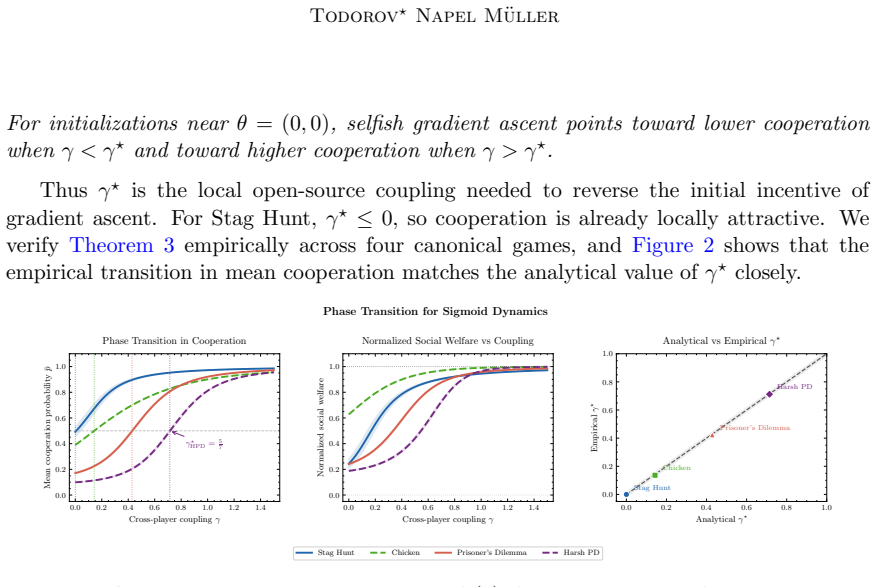
Parametric open-source games yield an exact coupling threshold where selfish gradient ascent switches to cooperation in symmetric 2x2 games.
A machine-rendered reading of the paper's core claim, the machinery that carries it, and where it could break.
Core claim
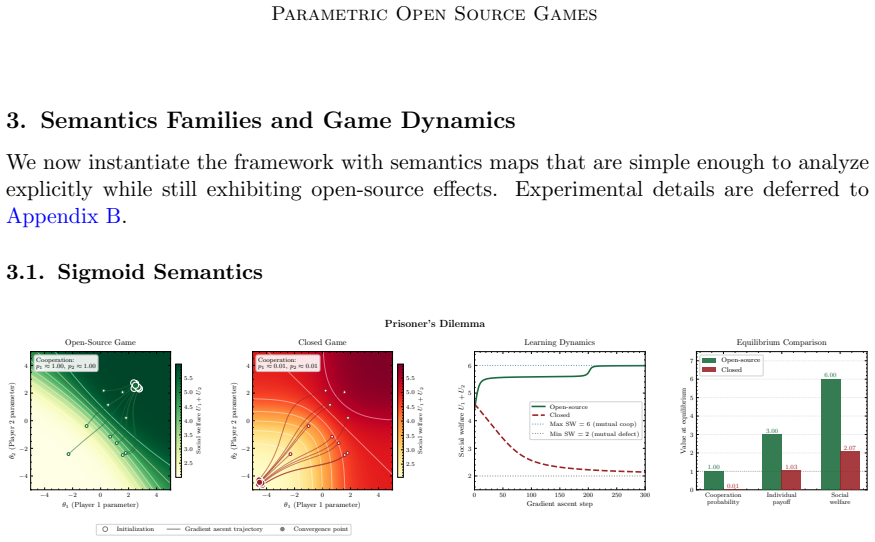
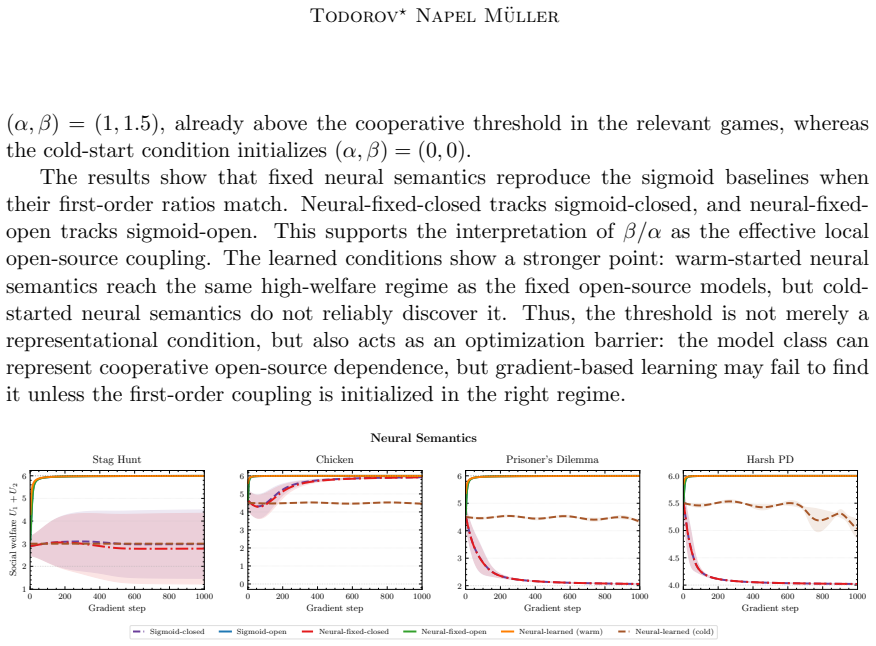
In parametric open-source games, players choose parameter vectors and semantics maps convert the full parameter profile into mixed actions in an underlying finite game. Equilibrium existence results hold, and an exact coupling threshold is derived at which selfish gradient ascent in symmetric 2×2 games switches from defection toward cooperation. A one-dimensional boundary test identifies parametric program Nash equilibria. The framework extends to a neural semantics class whose first-order cooperation condition is governed by the ratio of cross-player to self-player sensitivity, showing how sufficiently strong open-source coupling steers selfish optimization toward cooperative outcomes.
What carries the argument
Semantics maps that convert the full parameter profile into mixed actions, enabling continuous open-source coupling and well-defined gradient-ascent dynamics.
If this is right
- Equilibrium existence results hold for the parametric model.
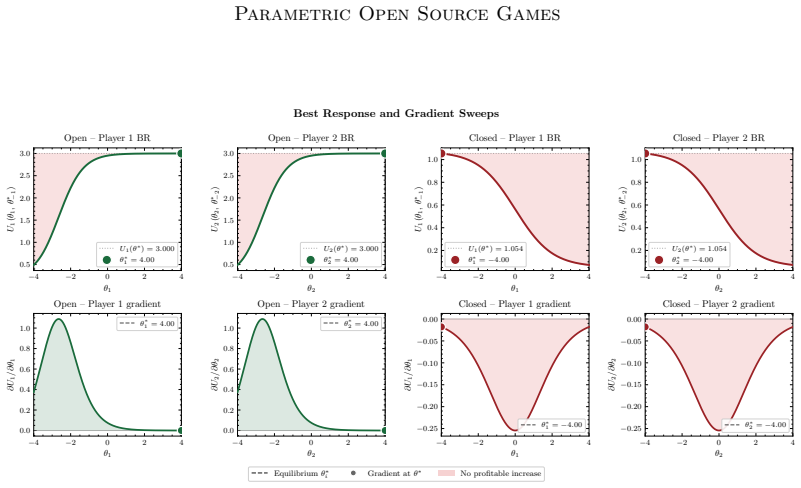
- A one-dimensional boundary test identifies parametric program Nash equilibria.
- Access to internal parameterizations qualitatively reshapes learning dynamics and equilibrium structure.
- Strong open-source coupling steers selfish optimization toward cooperative outcomes across canonical games.
Where Pith is reading between the lines
- The coupling threshold derived for 2x2 symmetric games may extend to asymmetric or multi-player settings under analogous smoothness assumptions on the semantics maps.
- System designers could introduce controlled parameter sharing to induce cooperation in learning agents without altering the underlying payoff matrix.
- Empirical tests of the neural semantics sensitivity ratio in multi-agent reinforcement learning environments could check whether the first-order cooperation condition predicts observed behavior.
Load-bearing premise
The semantics maps that convert the full parameter profile into mixed actions are assumed to exist, be sufficiently smooth, and allow the gradient-ascent dynamics to be well-defined without additional regularity conditions that might alter the threshold.
What would settle it
A numerical simulation of gradient ascent in a symmetric 2x2 game such as the Prisoner's Dilemma in which the switch from defection to cooperation occurs at a coupling value different from the derived threshold.
Figures
read the original abstract
Open-source game theory studies agents whose behavior may depend on one another's decision procedures, but most existing models use discrete or symbolic programs. We introduce parametric open-source games, a continuous analogue of program equilibria in which players choose parameter vectors and semantics maps convert the full parameter profile into mixed actions in an underlying finite game. We establish equilibrium existence results, derive an exact coupling threshold at which selfish gradient ascent in symmetric $2\times2$ games switches from defection toward cooperation, and give a one-dimensional boundary test for parametric program Nash equilibria. We further extend the framework to a neural semantics class whose first-order cooperation condition is governed by the ratio of cross-player to self-player sensitivity. Across canonical games, the framework shows how access to internal parameterizations can qualitatively reshape learning dynamics and equilibrium structure, and how sufficiently strong open-source coupling can steer selfish optimization toward cooperative outcomes.
Editorial analysis
A structured set of objections, weighed in public.
Referee Report
Summary. The manuscript introduces parametric open-source games as a continuous analogue of program equilibria. Players select parameter vectors whose semantics maps convert the full profile into mixed actions of an underlying finite game. The authors establish equilibrium existence, derive an exact coupling threshold at which selfish gradient ascent in symmetric 2×2 games switches from defection to cooperation, supply a one-dimensional boundary test for parametric program Nash equilibria, and extend the framework to a neural-semantics class in which the first-order cooperation condition is governed by the ratio of cross-player to self-player sensitivity. Illustrations across canonical games show how parameter access qualitatively alters learning dynamics and how sufficiently strong coupling can steer selfish optimization toward cooperative outcomes.
Significance. If the derivations are rigorous, the work supplies a continuous, parametric setting for open-source game theory that bridges discrete program equilibria with gradient-based learning. The exact threshold and the sensitivity-ratio condition in the neural extension furnish concrete, testable predictions about when introspective coupling produces cooperation. Equilibrium existence and the boundary test provide foundational results that could support further analysis of multi-agent systems with access to internal parameterizations.
major comments (1)
- [Gradient-ascent analysis / coupling threshold derivation] The derivation of the exact coupling threshold (abstract and gradient-ascent section) rests on the assumption that semantics maps exist, are sufficiently smooth, and permit well-defined gradient-ascent dynamics without further regularity conditions. This assumption is load-bearing for the claimed exactness of the threshold; the manuscript does not state what occurs under weaker continuity or differentiability requirements that might shift or eliminate the switch point in symmetric 2×2 games.
minor comments (2)
- Notation for the semantics maps and the parameter-to-action conversion could be introduced with an explicit diagram or small example early in the text to aid readability.
- The one-dimensional boundary test for parametric program Nash equilibria would benefit from a short pseudocode or algorithmic statement to clarify its computational use.
Simulated Author's Rebuttal
We thank the referee for the careful reading and for identifying the role of regularity assumptions in the gradient-ascent analysis. We respond to the major comment below.
read point-by-point responses
-
Referee: [Gradient-ascent analysis / coupling threshold derivation] The derivation of the exact coupling threshold (abstract and gradient-ascent section) rests on the assumption that semantics maps exist, are sufficiently smooth, and permit well-defined gradient-ascent dynamics without further regularity conditions. This assumption is load-bearing for the claimed exactness of the threshold; the manuscript does not state what occurs under weaker continuity or differentiability requirements that might shift or eliminate the switch point in symmetric 2×2 games.
Authors: We agree that the exact coupling threshold is derived under the assumption that semantics maps are sufficiently smooth to support well-defined gradient-ascent dynamics. Within the parametric open-source framework, semantics maps are constructed as differentiable mappings from parameter vectors to mixed strategies, which is the setting in which the threshold is obtained. Under weaker conditions such as mere continuity, the gradient dynamics are not defined in the same manner and the switch point may not exist or may differ; the result is scoped to the differentiable case. We will revise the gradient-ascent section to state these regularity requirements explicitly and to note their necessity for the claimed exactness. revision: yes
Circularity Check
No significant circularity detected
full rationale
The abstract and provided context describe a new framework for parametric open-source games, equilibrium existence results, and derivation of a coupling threshold for gradient ascent in 2x2 games. No equations, fitted parameters, self-citations, or ansatzes are exhibited that would reduce any claimed prediction or result to its inputs by construction. The derivation chain is presented as building on standard game theory and prior open-source models without visible self-referential reductions, making the paper self-contained against external benchmarks.
Axiom & Free-Parameter Ledger
axioms (1)
- domain assumption Semantics maps exist that convert any parameter profile into a valid mixed-action profile for the underlying finite game.
Reference graph
Works this paper leans on
-
[1]
Cooperative and uncooperative institution designs:
Critch, Andrew and Dennis, Michael and Russell, Stuart , month = aug, year =. Cooperative and uncooperative institution designs:. doi:10.48550/arXiv.2208.07006 , abstract =
-
[2]
Games and Economic Behavior , author =
Program equilibrium , volume =. Games and Economic Behavior , author =. 2004 , pages =. doi:10.1016/j.geb.2004.02.002 , abstract =
-
[3]
Program equilibria and discounted computation time , isbn =
Fortnow, Lance , month = jul, year =. Program equilibria and discounted computation time , isbn =. Proceedings of the 12th. doi:10.1145/1562814.1562833 , abstract =
-
[4]
Theory and Decision , author =
Robust program equilibrium , volume =. Theory and Decision , author =. 2019 , keywords =. doi:10.1007/s11238-018-9679-3 , abstract =
-
[5]
Similarity-based cooperative equilibrium , url =
Oesterheld, Caspar and Treutlein, Johannes and Grosse, Roger and Conitzer, Vincent and Foerster, Jakob , month = nov, year =. Similarity-based cooperative equilibrium , url =. doi:10.48550/arXiv.2211.14468 , abstract =
-
[6]
Program equilibrium in the prisoner’s dilemma via L
LaVictoire, Patrick and Fallenstein, Benja and Yudkowsky, Eliezer and Barasz, Mihaly and Christiano, Paul and Herreshoff, Marcello , booktitle=. Program equilibrium in the prisoner’s dilemma via L
-
[7]
Barasz, Mihaly and Christiano, Paul and Fallenstein, Benja and Herreshoff, Marcello and LaVictoire, Patrick and Yudkowsky, Eliezer , month = apr, year =. Robust. doi:10.48550/arXiv.1401.5577 , abstract =
-
[8]
The Journal of Symbolic Logic , author =
A. The Journal of Symbolic Logic , author =. 2019 , keywords =. doi:10.1017/jsl.2017.42 , abstract =
-
[9]
2020 , eprint=
Embedded Agency , author=. 2020 , eprint=
2020
-
[10]
2025 , eprint=
Contemplative Artificial Intelligence , author=. 2025 , eprint=
2025
-
[11]
2024 , eprint=
Towards Safe and Honest AI Agents with Neural Self-Other Overlap , author=. 2024 , eprint=
2024
-
[12]
2024 , eprint=
Mechanistic Interpretability for AI Safety -- A Review , author=. 2024 , eprint=
2024
-
[13]
2025 , eprint=
Frontier Models are Capable of In-context Scheming , author=. 2025 , eprint=
2025
-
[14]
2026 , eprint=
A Survey of Zero-Knowledge Proof Based Verifiable Machine Learning , author=. 2026 , eprint=
2026
-
[15]
Glicksberg, I. L. , year =. A. Proceedings of the American Mathematical Society , publisher =. doi:10.2307/2032478 , number =
-
[16]
Topological
Berge, Claude , year =. Topological
-
[17]
Games and Economic Behavior , author =
A commitment folk theorem , volume =. Games and Economic Behavior , author =. 2010 , pages =. doi:10.1016/j.geb.2009.09.008 , abstract =
-
[18]
Translucent Players: Explaining Cooperative Behavior in Social Dilemmas
Capraro, Valerio and Halpern, Joseph Y. , month = nov, year =. Translucent. doi:10.48550/arXiv.1410.3363 , abstract =
work page internal anchor Pith review Pith/arXiv arXiv doi:10.48550/arxiv.1410.3363
-
[19]
International Journal of Game Theory , author =
Game theory with translucent players , volume =. International Journal of Game Theory , author =. 2018 , pages =. doi:10.1007/s00182-018-0626-x , abstract =
-
[20]
Rosen, J. B. , year =. Existence and. Econometrica , publisher =. doi:10.2307/1911749 , abstract =
-
[21]
Balduzzi, David and Racaniere, Sebastien and Martens, James and Foerster, Jakob and Tuyls, Karl and Graepel, Thore , month = jun, year =. The. doi:10.48550/arXiv.1802.05642 , abstract =
work page internal anchor Pith review Pith/arXiv arXiv doi:10.48550/arxiv.1802.05642
-
[22]
2021 , eprint=
Stable Opponent Shaping in Differentiable Games , author=. 2021 , eprint=
2021
-
[23]
Learning with Opponent-Learning Awareness
Foerster, Jakob N. and Chen, Richard Y. and Al-Shedivat, Maruan and Whiteson, Shimon and Abbeel, Pieter and Mordatch, Igor , month = sep, year =. Learning with. doi:10.48550/arXiv.1709.04326 , abstract =
work page internal anchor Pith review Pith/arXiv arXiv doi:10.48550/arxiv.1709.04326
-
[24]
Games and Economic Behavior , author =
On. Games and Economic Behavior , author =. 1995 , pages =. doi:10.1006/game.1995.1031 , abstract =
-
[25]
and Ho, Teck-Hua and Chong, Juin Kuan , editor =
Camerer, Colin F. and Ho, Teck-Hua and Chong, Juin Kuan , editor =. Behavioural. Advances in. 2004 , keywords =. doi:10.1057/9780230523371_8 , abstract =
-
[26]
PLoS computational biology , author =
Game theory of mind , volume =. PLoS computational biology , author =. 2008 , keywords =. doi:10.1371/journal.pcbi.1000254 , abstract =
-
[27]
Biologically Inspired Cognitive Architectures , author =
Higher-order theory of mind in the. Biologically Inspired Cognitive Architectures , author =. 2015 , keywords =. doi:10.1016/j.bica.2014.11.010 , abstract =
-
[28]
Current Opinion in Behavioral Sciences , author =
A psychological approach to strategic thinking in games , volume =. Current Opinion in Behavioral Sciences , author =. 2015 , pages =. doi:10.1016/j.cobeha.2015.04.005 , abstract =
-
[29]
and Doshi, Prashant and Young, Diana L
Goodie, Adam S. and Doshi, Prashant and Young, Diana L. , year =. Levels of theory‐of‐mind reasoning in competitive games , volume =. Journal of Behavioral Decision Making , publisher =. doi:10.1002/bdm.717 , abstract =
-
[30]
Journal of Artificial Intelligence Research , author =
A. Journal of Artificial Intelligence Research , author =. 2005 , note =. doi:10.1613/jair.1579 , abstract =
-
[31]
Oguntola, Ini and Campbell, Joseph and Stepputtis, Simon and Sycara, Katia , month = jul, year =. Theory of. doi:10.48550/arXiv.2307.01158 , abstract =
-
[32]
Bonanno, Giacomo , year =. Game. doi:10.13140/RG.2.1.3369.7360 , abstract =
-
[33]
, month = sep, year =
Nisan, Noam and Roughgarden, Tim and Tardos, Eva and Vazirani, Vijay V. , month = sep, year =. Algorithmic
-
[34]
Essentials of
Leyton-Brown, Kevin and Shoham, Yoav , month = jul, year =. Essentials of
-
[35]
Behavioral and Brain Sciences , author =
Does the chimpanzee have a theory of mind? , volume =. Behavioral and Brain Sciences , author =. 1978 , keywords =. doi:10.1017/S0140525X00076512 , abstract =
-
[36]
Does the autistic child have a “theory of mind” ? , volume =. Cognition , author =. 1985 , pages =. doi:10.1016/0010-0277(85)90022-8 , abstract =
-
[37]
Cognitive Psychology , author =
What is theory of mind?. Cognitive Psychology , author =. 2022 , keywords =. doi:10.1016/j.cogpsych.2022.101495 , abstract =
-
[38]
Foundations and Trends® in Machine Learning , author =
An. Foundations and Trends® in Machine Learning , author =. 2018 , pages =. doi:10.1561/2200000071 , abstract =
-
[39]
Human-level control through deep reinforcement learning
Mnih, Volodymyr and Kavukcuoglu, Koray and Silver, David and Rusu, Andrei A. and Veness, Joel and Bellemare, Marc G. and Graves, Alex and Riedmiller, Martin and Fidjeland, Andreas K. and Ostrovski, Georg and Petersen, Stig and Beattie, Charles and Sadik, Amir and Antonoglou, Ioannis and King, Helen and Kumaran, Dharshan and Wierstra, Daan and Legg, Shane ...
-
[40]
doi:10.48550/arXiv.2308.03526 , abstract =
Mathieu, Michaël and Ozair, Sherjil and Srinivasan, Srivatsan and Gulcehre, Caglar and Zhang, Shangtong and Jiang, Ray and Paine, Tom Le and Powell, Richard and Żołna, Konrad and Schrittwieser, Julian and Choi, David and Georgiev, Petko and Toyama, Daniel and Huang, Aja and Ring, Roman and Babuschkin, Igor and Ewalds, Timo and Bordbar, Mahyar and Henderso...
-
[41]
Attention is
Vaswani, Ashish and Shazeer, Noam and Parmar, Niki and Uszkoreit, Jakob and Jones, Llion and Gomez, Aidan N and Kaiser, Ł ukasz and Polosukhin, Illia , year =. Attention is. Advances in
-
[42]
Mastering the game of Go without human knowledge.Nature, 550(7676):354–359, October 2017
Silver, David and Schrittwieser, Julian and Simonyan, Karen and Antonoglou, Ioannis and Huang, Aja and Guez, Arthur and Hubert, Thomas and Baker, Lucas and Lai, Matthew and Bolton, Adrian and Chen, Yutian and Lillicrap, Timothy and Hui, Fan and Sifre, Laurent and van den Driessche, George and Graepel, Thore and Hassabis, Demis , month = oct, year =. Maste...
-
[43]
Convergence
Chasnov, Benjamin and Ratliff, Lillian and Mazumdar, Eric and Burden, Samuel , month = aug, year =. Convergence. Proceedings of
-
[44]
SIAM Journal on Mathematics of Data Science , author =
On. SIAM Journal on Mathematics of Data Science , author =. 2020 , note =. doi:10.1137/18M1231298 , abstract =
-
[45]
Lin, Tianyi and Zhou, Zhengyuan and Mertikopoulos, Panayotis and Jordan, Michael , month = nov, year =. Finite-. Proceedings of the 37th
-
[46]
, year =
Fudenberg, Drew and Levine, David K. , year =. The
-
[47]
and Rubinstein, Ariel , month = jul, year =
Osborne, Martin J. and Rubinstein, Ariel , month = jul, year =. A
-
[48]
Basar, Tamer and Olsder, Geert Jan , year =. Dynamic
-
[49]
Absil, P.-A. and Mahony, R. and Sepulchre, R. , editor =. Optimization. Recent. 2010 , keywords =. doi:10.1007/978-3-642-12598-0_12 , abstract =
-
[50]
Facchinei, Francisco and Pang, Jong-Shi , month = jun, year =. Finite-
-
[51]
Bonnans, J. Frédéric and Shapiro, Alexander , year =. Perturbation. doi:10.1007/978-1-4612-1394-9 , urldate =
-
[52]
Plaat, Aske and Kosters, Walter and Preuss, Mike , month = dec, year =. Deep. doi:10.48550/arXiv.2008.05598 , abstract =
-
[53]
arXiv.org , author =
Opponent. arXiv.org , author =
-
[54]
Theory of. arXiv.org , author =. 2023 , doi =. doi:10.18653/v1/2023.emnlp-main.13 , abstract =
discussion (0)
Sign in with ORCID, Apple, or X to comment. Anyone can read and Pith papers without signing in.