Electrical Spectroscopy of Intervalley Relaxation in WSe₂ Transistors
Pith reviewed 2026-06-27 12:18 UTC · model grok-4.3
The pith
Transconductance of multilayer WSe₂ transistors directly measures intervalley relaxation time τ_iv.
A machine-rendered reading of the paper's core claim, the machinery that carries it, and where it could break.
Core claim
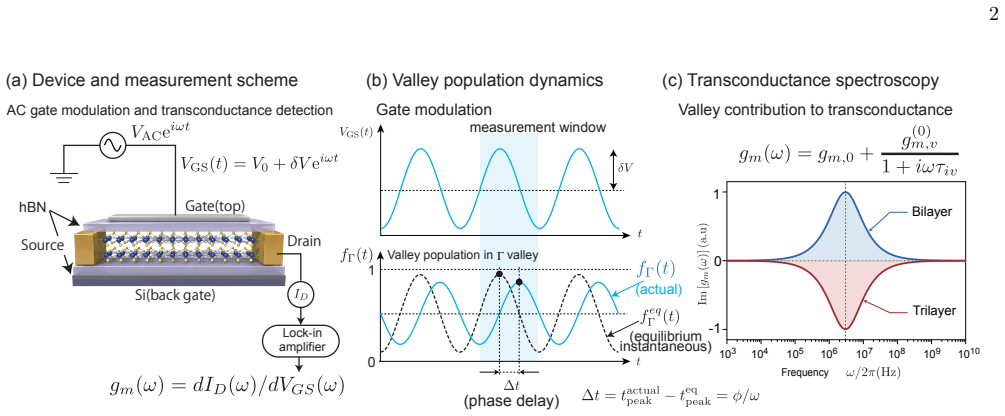
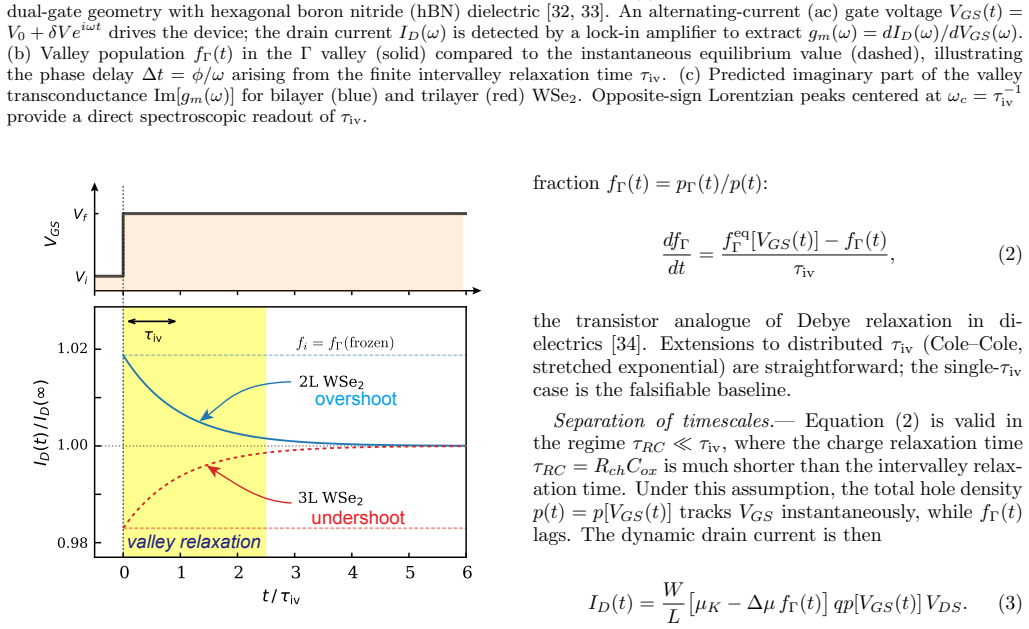
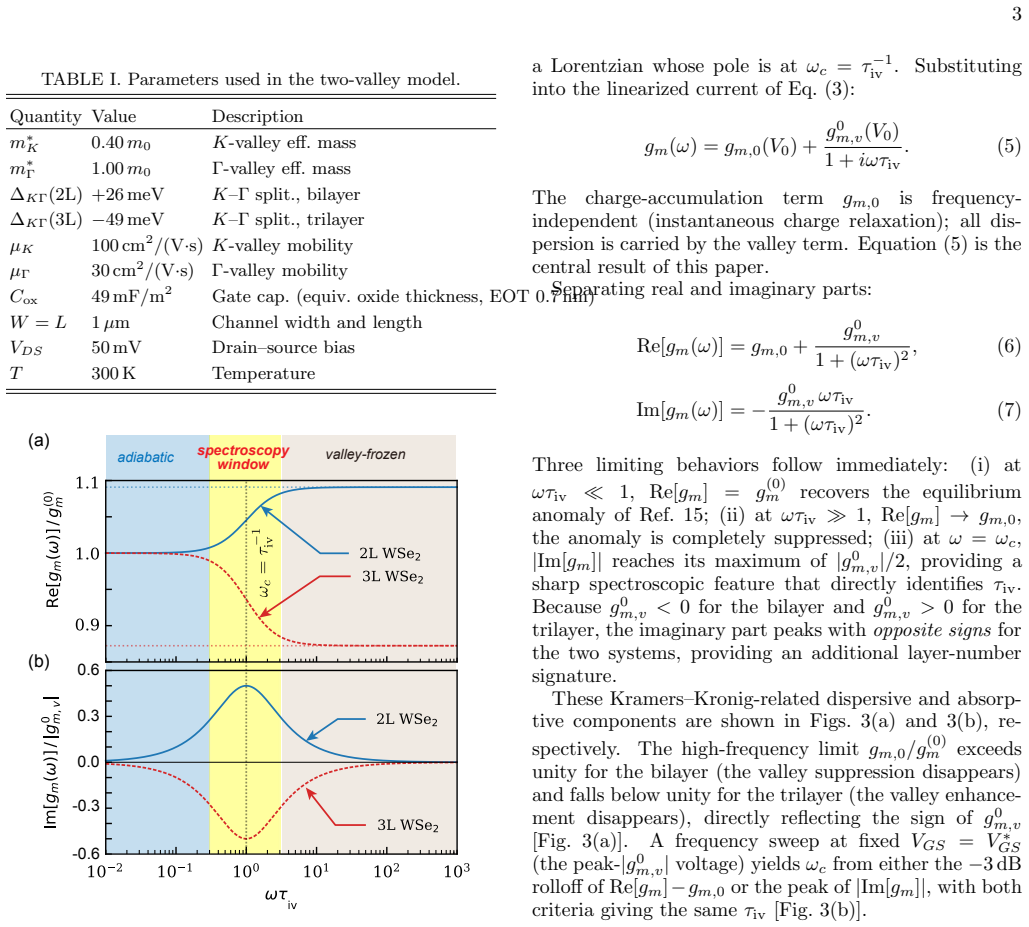
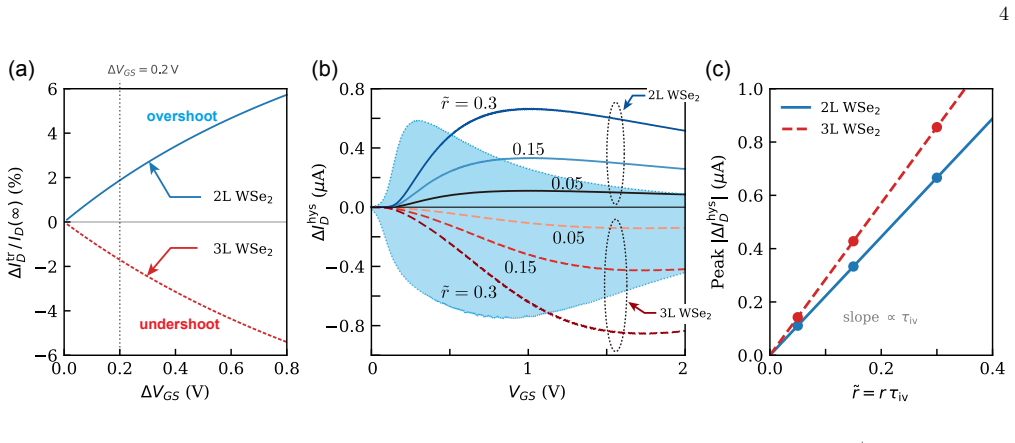
The transconductance of multilayer WSe₂ field-effect transistors serves as a direct electrical spectrometer of the intervalley relaxation time τ_iv. Extending an equilibrium valley-thermodynamics framework with a single relaxation equation for the Γ-valley carrier fraction f_Γ(t) yields a Lorentzian transconductance gm(ω) whose imaginary part peaks at ω_c = τ_iv^{-1} with opposite signs for bilayer and trilayer, two-stage current transients after a gate step that exhibit bilayer overshoot or trilayer undershoot, and sweep-rate-proportional hysteresis whose voltage profile and layer-number sign reversal distinguish valley from trap dynamics.
What carries the argument
Single relaxation equation for the Γ-valley carrier fraction f_Γ(t) inside the valley-thermodynamics framework, which produces the Lorentzian transconductance response and the layer-dependent transient and hysteresis signatures.
If this is right
- The imaginary part of transconductance peaks at frequency 1/τ_iv with opposite signs for bilayer and trilayer.
- Current transients after a gate step display two stages with overshoot in bilayers and undershoot in trilayers.
- Gate-sweep hysteresis scales with rate and reverses sign with layer number, separating valley from trap contributions.
Where Pith is reading between the lines
- Routine transistor testing could replace specialized optical setups for screening valley relaxation in 2D materials.
- The layer-number sign reversal offers an electrical route to confirm layer count without microscopy.
- The same signatures may appear in other transition-metal dichalcogenides that share similar valley structure.
Load-bearing premise
The equilibrium valley-thermodynamics framework plus one relaxation equation for the Γ-valley fraction is enough to predict the three electrical signatures.
What would settle it
Absence of the predicted sign reversal between bilayer and trilayer in either the imaginary part of transconductance or the direction of transient overshoot would show the model does not hold.
Figures
read the original abstract
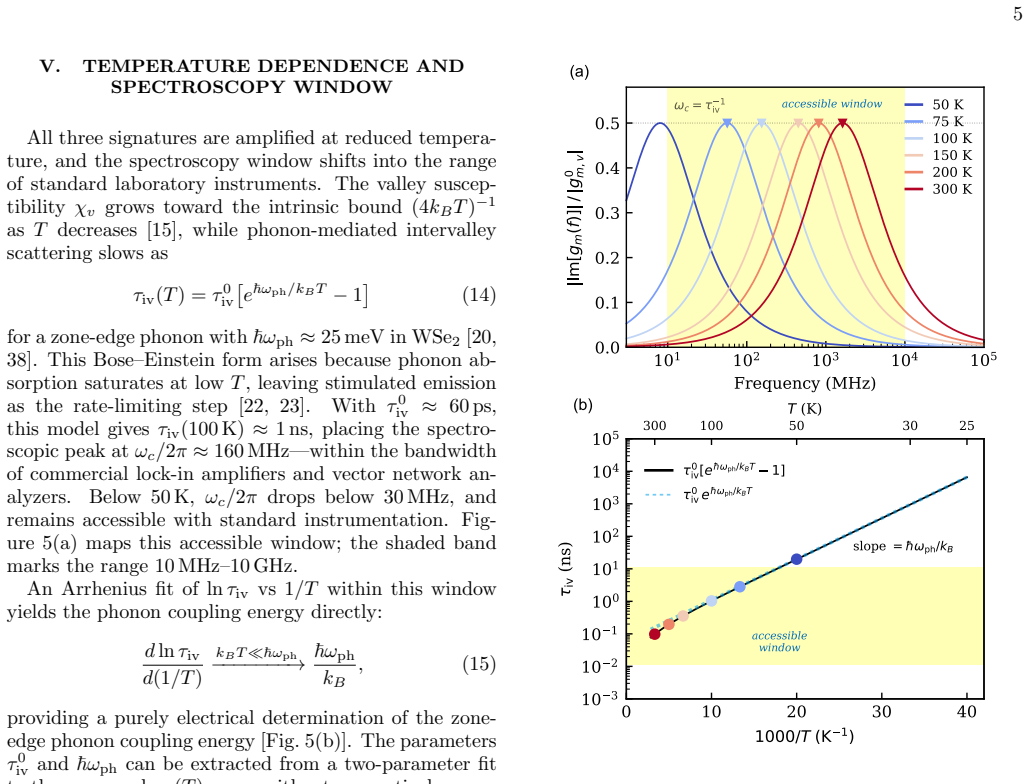
We show that the transconductance of multilayer WSe$_2$ field-effect transistors serves as a direct electrical spectrometer of the intervalley relaxation time $\tau_{\rm iv}$, previously accessible only by ultrafast optical techniques. Extending an equilibrium valley-thermodynamics framework with a single relaxation equation for the $\Gamma$-valley carrier fraction $f_\Gamma(t)$, we predict three signatures: (i)~a Lorentzian transconductance $g_m(\omega)=g_{m,0}+g_{m,v}^0/(1+i\omega\tau_{\rm iv})$, whose imaginary part peaks at $\omega_c=\tau_{\rm iv}^{-1}$ with opposite signs for bilayer and trilayer; (ii)~a two-stage current transient after a gate step, exhibiting bilayer overshoot or trilayer undershoot; and (iii)~sweep-rate-proportional hysteresis whose gate-voltage profile and layer-number sign reversal distinguish valley from trap-induced dynamics. All three signatures provide quantitative electrical access to $\tau_{\rm iv}$ with standard rf and dc instrumentation.
Editorial analysis
A structured set of objections, weighed in public.
Referee Report
Summary. The paper claims that transconductance gm(ω) in multilayer WSe2 FETs acts as a direct electrical probe of intervalley relaxation time τ_iv. Extending equilibrium valley thermodynamics with one phenomenological relaxation equation for the Γ-valley fraction f_Γ(t), the authors predict (i) a Lorentzian gm(ω) whose imaginary part peaks at ω=1/τ_iv with opposite signs in bilayer vs. trilayer, (ii) two-stage gate-step transients showing overshoot (bilayer) or undershoot (trilayer), and (iii) sweep-rate-dependent hysteresis whose Vg profile and layer-dependent sign reversal distinguish valley from trap dynamics. All signatures are asserted to enable quantitative extraction of τ_iv with standard rf/dc tools.
Significance. If the single-relaxation model is sufficient, the work would convert routine transconductance measurements into a practical electrical spectrometer for τ_iv, previously limited to ultrafast optics. The parameter-free character of the three functional forms (Lorentzian, two-stage transient, hysteresis sign reversal) would be a notable strength, allowing falsifiable tests without additional fitting parameters.
major comments (2)
- [Abstract / model framework] Abstract and model description: the central claim that the three signatures (exact Lorentzian gm(ω), layer-dependent overshoot/undershoot, and unique hysteresis profile) follow directly from equilibrium thermodynamics plus one relaxation equation for f_Γ(t) is load-bearing. No derivation is supplied showing that density-dependent scattering rates, multiple independent timescales, or coupling to other non-equilibrium channels would not alter the functional forms; if they do, quantitative extraction of τ_iv ceases to be direct.
- [Abstract] Abstract: the manuscript states model predictions but supplies neither experimental data, detailed derivations of the Lorentzian or transient forms, nor error analysis. Without these, the soundness of the mapping from observed signatures to τ_iv cannot be assessed.
minor comments (1)
- [Abstract] Notation: the definition of the valley contribution gm,v^0 and its relation to the equilibrium valley thermodynamics should be stated explicitly before the relaxation equation is introduced.
Simulated Author's Rebuttal
We thank the referee for the careful reading and constructive feedback. Our manuscript is a theoretical proposal deriving three falsifiable signatures from equilibrium valley thermodynamics plus a single relaxation equation. We address the two major comments below and will revise the manuscript to strengthen the derivations and discussion of model assumptions.
read point-by-point responses
-
Referee: [Abstract / model framework] Abstract and model description: the central claim that the three signatures (exact Lorentzian gm(ω), layer-dependent overshoot/undershoot, and unique hysteresis profile) follow directly from equilibrium thermodynamics plus one relaxation equation for f_Γ(t) is load-bearing. No derivation is supplied showing that density-dependent scattering rates, multiple independent timescales, or coupling to other non-equilibrium channels would not alter the functional forms; if they do, quantitative extraction of τ_iv ceases to be direct.
Authors: We agree that explicit demonstration of robustness is needed for the claim to be load-bearing. The full manuscript derives the Lorentzian, transient, and hysteresis forms from the thermodynamic equilibrium condition plus the single phenomenological equation df_Γ/dt = -(f_Γ - f_Γ^eq)/τ_iv, but does not yet include a dedicated section on higher-order corrections. In revision we will add an appendix deriving the functional forms step-by-step from the valley chemical potentials and showing under what conditions (e.g., low density, dominant intervalley scattering) density-dependent rates or additional channels leave the Lorentzian and sign-reversal features intact; we will also estimate the density range where the single-τ_iv approximation holds. revision: yes
-
Referee: [Abstract] Abstract: the manuscript states model predictions but supplies neither experimental data, detailed derivations of the Lorentzian or transient forms, nor error analysis. Without these, the soundness of the mapping from observed signatures to τ_iv cannot be assessed.
Authors: The work is a theoretical prediction of measurable signatures rather than an experimental demonstration; therefore no device data appear. Detailed derivations of the Lorentzian gm(ω) and the two-stage transients are present in the main text but are concise. In revision we will move the full algebraic steps to a methods appendix, add a quantitative error-propagation analysis (including sensitivity to contact resistance and parasitic capacitance), and explicitly state the conditions under which the extracted τ_iv would remain reliable. revision: yes
Circularity Check
No significant circularity; derivation is self-contained forward modeling
full rationale
The paper introduces an equilibrium valley-thermodynamics framework and augments it with a single phenomenological relaxation equation for f_Γ(t) as an explicit modeling assumption. It then derives three functional signatures (Lorentzian g_m(ω) with peak at 1/τ_iv, two-stage transients with layer-dependent overshoot/undershoot, and sweep-rate hysteresis with sign reversal) directly from this assumed dynamics. These are forward predictions whose forms follow from solving the relaxation equation under the stated conditions; τ_iv enters as an input parameter whose value is to be extracted from data, not fitted to the same signatures in a way that forces the outputs. No self-citations, uniqueness theorems, or ansatzes from prior author work are invoked in the provided text to justify the framework. The derivation chain therefore remains independent of its target observables.
Axiom & Free-Parameter Ledger
axioms (1)
- domain assumption equilibrium valley-thermodynamics framework
Reference graph
Works this paper leans on
-
[1]
Trap hysteresis follows the trap energy distribution and need not correlate with χv(VGS)
and reverse (r <0) sweeps at the sameV GS—is ∆Ihys D (VGS) = 2 W L qp VDS ∆µ τiv |r|χ v(VGS).(12) Equation (12) encodes several signatures that distin- guish valley-origin hysteresis from trap-induced effects: (i) Profile.∆I hys D ∝qp χ v(VGS) activates only above threshold (whereχ v ̸= 0) and tracks the gate-voltage shape of the valley susceptibility. Tr...
-
[2]
Q. H. Wang, K. Kalantar-Zadeh, A. Kis, J. N. Coleman, and M. S. Strano, Electronics and optoelectronics of two- dimensional transition metal dichalcogenides, Nat. Nan- otechnol.7, 699 (2012)
2012
-
[3]
Manzeli, D
S. Manzeli, D. Ovchinnikov, D. Pasquier, O. V. Yazyev, and A. Kis, 2D transition metal dichalcogenides, Nat. Rev. Mater.2, 17033 (2017)
2017
-
[4]
K. F. Mak, D. Xiao, and J. Shan, Light–valley interac- tions in 2d semiconductors, Nat. Photon.12, 451 (2018)
2018
-
[5]
J. R. Schaibley, H. Yu, G. Clark, P. Rivera, J. S. Ross, K. L. Seyler, W. Yao, and X. Xu, Valleytronics in 2d materials, Nat. Rev. Mater.1, 16055 (2016)
2016
-
[6]
Radisavljevic, A
B. Radisavljevic, A. Radenovic, J. Brivio, V. Giacometti, and A. Kis, Single-layer MoS2 transistors, Nat. Nanotech- nol.6, 147 (2011)
2011
-
[7]
H. Fang, S. Chuang, T. C. Chang, K. Takei, T. Taka- hashi, and A. Javey, High-performance single layered WSe2 p-FETs with chemically doped contacts, Nano Lett.12, 3788 (2012)
2012
-
[8]
H. C. P. Movva, A. Rai, S. Kang, K. Kim, B. Fallahazad, T. Taniguchi, K. Watanabe, E. Tutuc, and S. K. Baner- jee, High-mobility holes in dual-gated WSe 2 field-effect transistors, ACS Nano9, 10402 (2015)
2015
-
[9]
I. Kim, N. Higashitarumizu, I. K. M. R. Rahman, S. Wang, H. M. Kim, J. Geng, R. R. Prabhakar, J. W. Ager, and A. Javey, Low contact resistance WSe 2 p- type transistors with highly stable, CMOS-compatible dopants, Nano Lett.24, 13528 (2024)
2024
-
[10]
W. Zhao, Z. Ghorannevis, L. Chu, M. Toh, C. Kloc, P.- H. Tan, and G. Eda, Evolution of electronic structure in atomically thin sheets of WS 2 and WSe2, ACS Nano7, 791 (2013)
2013
-
[11]
Zhang, T.-R
Y. Zhang, T.-R. Chang, B. Zhou, Y.-T. Cui, H. Yan, Z. Liu, F. Schmitt, J. Lee, R. Moore, Y. Chen, H. Lin, H.-T. Jeng, S.-K. Mo, Z. Hussain, A. Bansil, and Z.-X. Shen, Direct observation of the transition from indirect to direct bandgap in atomically thin epitaxial MoSe 2, Nat. Nanotechnol.9, 111 (2014)
2014
-
[12]
Wickramaratne, F
D. Wickramaratne, F. Zahid, and R. K. Lake, Elec- tronic and thermoelectric properties of few-layer transi- tion metal dichalcogenides, J. Chem. Phys.140, 124710 (2014)
2014
-
[13]
Z. Zhu, Y. Cheng, and U. Schwingenschl¨ ogl, Gi- ant spin-orbit-induced spin splitting in two-dimensional transition-metal dichalcogenide semiconductors, Phys. Rev. B84, 153402 (2011)
2011
-
[14]
Liu, W.-Y
G.-B. Liu, W.-Y. Shan, Y. Yao, W. Yao, and D. Xiao, Three-band tight-binding model for monolayers of group- VIB transition metal dichalcogenides, Phys. Rev. B88, 085433 (2013)
2013
-
[15]
K. Wakabayashi, S. Adhikary, and K. Tsukagoshi, Valley engineering in bilayer WSe 2 gate-all-around transistors, Phys. Rev. Appl. (2026), submitted, arXiv:2606.08955 [cond-mat.mes-hall]
Pith/arXiv arXiv 2026
-
[16]
K. Wakabayashi, S. Adhikary, and T. Kameda, Transcon- ductance as a probe of valley thermodynamics in mul- tilayer WSe2, (2026), arXiv:2605.19212 [cond-mat.mes- hall]
Pith/arXiv arXiv 2026
-
[17]
Xiao, G.-B
D. Xiao, G.-B. Liu, W. Feng, X. Xu, and W. Yao, Cou- pled spin and valley physics in monolayers of MoS 2 and 7 other group-VI dichalcogenides, Phys. Rev. Lett.108, 196802 (2012)
2012
-
[18]
K. F. Mak, K. He, J. Shan, and T. F. Heinz, Control of valley polarization in monolayer MoS2 by optical helicity, Nat. Nanotechnol.7, 494 (2012)
2012
-
[19]
H. Zeng, J. Dai, W. Yao, D. Xiao, and X. Cui, Valley po- larization in MoS 2 monolayers by optical pumping, Nat. Nanotechnol.7, 490 (2012)
2012
-
[20]
K. F. Mak, K. L. McGill, J. Park, and P. L. McEuen, The valley Hall effect in MoS 2 transistors, Science344, 1489 (2014)
2014
-
[21]
D. H. Lee, S.-J. Choi, H. Kim, Y.-S. Kim, and S. Jung, Direct probing of phonon mode specific electron–phonon scatterings in two-dimensional semiconductor transition metal dichalcogenides, Nat. Commun.12, 4520 (2021)
2021
-
[22]
S. Bae, K. Matsumoto, H. Raebiger, K.-i. Shudo, Y.-H. Kim, Ø. S. Handeg˚ ard, T. Nagao, M. Kitajima, Y. Sakai, X. Zhang, R. Vajtai, P. Ajayan, J. Kono, J. Takeda, and I. Katayama, K-point longitudinal acoustic phonons are responsible for ultrafast intervalley scattering in mono- layer MoSe2, Nat. Commun.13, 4279 (2022)
2022
-
[23]
Kioseoglou, A
G. Kioseoglou, A. T. Hanbicki, M. Currie, A. L. Fried- man, D. Gunlycke, and B. T. Jonker, Valley polariza- tion and intervalley scattering in monolayer MoS2, Appl. Phys. Lett.101, 221907 (2012)
2012
-
[24]
Schmidt, G
R. Schmidt, G. Bergh¨ auser, R. Schneider, M. Selig, P. Tonndorf, E. Mali´ c, A. Knorr, S. Michaelis de Vascon- cellos, and R. Bratschitsch, Ultrafast Coulomb-induced intervalley coupling in atomically thin WS 2, Nano Lett. 16, 2945 (2016)
2016
-
[25]
Dal Conte, F
S. Dal Conte, F. Bottegoni, E. A. A. Pogna, D. De Fazio, S. Ambrogio, I. Bargigia, C. D’Andrea, A. Lombardo, M. Bruna, F. Ciccacci, A. C. Ferrari, G. Cerullo, and M. Finazzi, Ultrafast valley relaxation dynamics in mono- layer MoS2 probed by nonequilibrium optical techniques, Phys. Rev. B92, 235425 (2015)
2015
-
[26]
Oh, H.-T
J. Oh, H.-T. Chang, C. T. Chen, S. Aloni, A. Schwartzberg, and S. R. Leone, Carrier and phonon dynamics in multilayer WSe2 captured by extreme ultra- violet transient absorption spectroscopy, J. Phys. Chem. C127, 5004 (2023)
2023
-
[27]
Dogadov, H
O. Dogadov, H. Mittenzwey, M. Bertolotti, N. Olsen, T. Deckert, C. Trovatello, X. Zhu, D. Brida, G. Cerullo, A. Knorr, and S. Dal Conte, Dissecting intervalley cou- pling mechanisms in monolayer transition metal dichalco- genides, npj 2D Mater. Appl.10, 21 (2026)
2026
-
[28]
G. Wang, X. Marie, B. L. Liu, T. Amand, C. Robert, F. Cadiz, P. Renucci, and B. Urbaszek, Control of exci- ton valley coherence in transition metal dichalcogenide monolayers, Phys. Rev. Lett.117, 187401 (2016)
2016
-
[29]
Bertoni, C
R. Bertoni, C. W. Nicholson, L. Waldecker, H. H¨ ubener, C. Monney, U. De Giovannini, M. Puppin, M. Hoesch, E. Springate, R. T. Chapman, C. Cacho, M. Wolf, A. Ru- bio, and R. Ernstorfer, Generation and evolution of spin-, valley-, and layer-polarized excited carriers in inversion- symmetric WSe2, Phys. Rev. Lett.117, 277201 (2016)
2016
-
[30]
M. M. Glazov, T. Amand, X. Marie, D. Lagarde, L. Bouet, and B. Urbaszek, Exciton fine structure and spin decoherence in monolayers of transition metal dichalcogenides, Phys. Rev. B89, 201302 (2014)
2014
-
[31]
Mad´ eo, M
J. Mad´ eo, M. K. L. Man, C. Sahoo, M. Campbell, V. Pa- reek, E. L. Wong, A. Al-Mahboob, N. S. Chan, A. Kar- makar, B. M. K. Mariserla, X. Li, T. F. Heinz, T. Cao, and K. M. Dani, Directly visualizing the momentum- forbidden dark excitons and their dynamics in atomically thin semiconductors, Science370, 1199 (2020)
2020
-
[32]
Wallauer, R
R. Wallauer, R. Perea-Caus´ ın, L. M¨ unster, S. Zajusch, S. Brem, J. G¨ udde, K. Tanimura, K.-Q. Lin, R. Huber, E. Malic, and U. H¨ ofer, Momentum-resolved observation of exciton formation dynamics in monolayer WS 2, Nano Lett.21, 5867 (2021)
2021
-
[33]
A. K. Geim and I. V. Grigorieva, Van der Waals het- erostructures, Nature499, 419 (2013)
2013
-
[34]
C. R. Dean, A. F. Young, I. Meric, C. Lee, L. Wang, S. Sorgenfrei, K. Watanabe, T. Taniguchi, P. Kim, K. L. Shepard, and J. Hone, Boron nitride substrates for high- quality graphene electronics, Nat. Nanotechnol.5, 722 (2010)
2010
-
[35]
K. S. Cole and R. H. Cole, Dispersion and absorption in dielectrics I. alternating current characteristics, J. Chem. Phys.9, 341 (1941)
1941
-
[36]
Ghatak, A
S. Ghatak, A. N. Pal, and A. Ghosh, Nature of elec- tronic states in atomically thin MoS 2 field-effect transis- tors, ACS Nano5, 7707 (2011)
2011
-
[37]
Y. Y. Illarionov, T. Knobloch, M. Jech, M. Lanza, D. Akinwande, M. I. Vexler, T. Mueller, M. C. Lemme, G. Fiori, F. Schwierz, and T. Grasser, Insulators for 2d nanoelectronics: The gap to bridge, Nat. Commun.11, 3385 (2020)
2020
-
[38]
A. Karl, A. Verdianu, D. Waldhoer, T. Knobloch, J. Kurzweil, M. Bahrami, M. R. Davoudi, P. Khak- baz, B. Stampfer, S. M. Sattari-Esfahlan, Y. Illarionov, A. Nazir, C. Liu, Y. Zheng, L. Pettorosso, D. Polyushkin, T. M¨ uller, S. Das, X. R. Wang, J. Tang, Y. Zhang, C. Tan, Y. Li, H. Peng, M. Waltl, and T. Grasser, A standardized approach to characterize hys...
2026
-
[39]
Z. Jin, X. Li, J. T. Mullen, and K. W. Kim, Intrin- sic transport properties of electrons and holes in mono- layer transition-metal dichalcogenides, Phys. Rev. B90, 045422 (2014)
2014
-
[40]
Kaasbjerg, K
K. Kaasbjerg, K. S. Thygesen, and K. W. Jacobsen, Phonon-limited mobility inn-type single-layer MoS 2 from first principles, Phys. Rev. B85, 115317 (2012)
2012
-
[41]
Mukesh and J
S. Mukesh and J. Zhang, A review of the gate-all-around nanosheet FET process opportunities, Electronics11, 3589 (2022)
2022
-
[42]
Knobloch, G
T. Knobloch, G. Rzepa, Y. Y. Illarionov, M. Waltl, F. Schanovsky, B. Stampfer, M. M. Furchi, T. Mueller, and T. Grasser, A physical model for the hysteresis in MoS2 transistors, IEEE J. Electron Devices Soc.8, 300 (2020)
2020
-
[43]
Johari and V
P. Johari and V. B. Shenoy, Tuning the electronic prop- erties of semiconducting transition metal dichalcogenides by applying mechanical strains, ACS Nano6, 5449 (2012)
2012
discussion (0)
Sign in with ORCID, Apple, or X to comment. Anyone can read and Pith papers without signing in.