REVIEW 2 major objections 4 minor 94 references
Extreme-Value Statistics of Stochastic Transport Processes: Applications to Molecular Motors and Sports
T0 review · 2 major / 4 minor · reviewed 2026-08-14 · deepseek-v4-flash
Pith's one-line read This paper shows that the complete finite-time statistics of the maximum and minimum of a biased random walk's position and entropy production are encoded in a single generating function, whose relaxation spectrum is the Marchenko-Pastur…
desk verdict The exact finite-time extrema statistics for the 1D biased random walk are the real prize here; the molecular-motor application rests on an under-validated effective reduction and the sports section is illustrative only. read the letter →
The pith
A machine-rendered reading of the paper's core claim, the machinery that carries it, and where it could break.
The reading
What carries the argument
The central object is the generating function $G_{\min}(z;t)$ of the minimum distribution, expressed as an integral against the Marchenko-Pastur law—the limiting eigenvalue density of Wishart-Laguerre random matrices—on the relaxation-time interval $[\tau_0,\tau_\infty]$, with $\tau_0=(\sqrt{k_+}+\sqrt{k_-})^{-2}$ and $\tau_\infty=(\sqrt{k_+}-\sqrt{k_-})^{-2}$. The machinery is the Laplace transform of the first-passage-time density, $\hat P_{\rm fpt}(s;x)=e^{Ax/2}e^{-|x|\cosh^{-1}(s/2\nu+\cosh(A/2))}$, whose algebraic form turns the convolution over repeated first passages into the Marchenko-Pastur integral. The same first-passage duality $\tilde P_{\rm fpt}(T;x)=P_{\rm fpt}(T;-x)$ produces the max-min symmetry, and the effective-parameter formulas $\nu_{\rm eff}=\sum_\alpha\nu_\alpha$, $A_{\rm eff}=2\cosh^{-1}\left(\sum_\alpha\frac{\nu_\alpha}{\nu_{\rm eff}}\cosh\frac{A_\alpha}{2}\right)$ extend the 1D result to the 2D molecular-motor model.
What would settle it
Perform a high-precision simulation of a 1D biased random walk at, say, $A=1$, $\nu=1$, and compare the empirical distributions of $-S_{\min}(t)$ and $S_{\max}(t)-S(t)$ at $t=0.1, 1, 10$ against the paper's integral formula and the symmetry relation. Any statistically significant violation of the mirror symmetry, or a relaxation spectrum estimated from the time series that fails to match the Marchenko-Pastur density with parameter $\delta=e^{-A}$, would falsify the central claim.
Extended reading notes
Core claim
The paper's central claim is that for a 1D continuous-time biased random walk with rates $k_\pm=\nu e^{\pm A/2}$, the generating function of the finite-time minimum is exactly $G_{\min}(z;t)=1+\frac{1-z}{e^A-1}\int_{\tau_0}^{\tau_\infty}\frac{1-e^{-t/\tau}}{1+f(z)\,\tau}\rho(\tau/\bar\tau)\,\frac{d\tau}{\bar\tau}$, with $f(z)=k_+(z-1)+k_-(z^{-1}-1)$ and $\rho$ the Marchenko-Pastur density. All moments and probabilities of the minimum, and by a mirror symmetry likewise of the maximum, follow by differentiating this expression. The paper proves $P(S(0)-S_{\min}(t)=s)=P(S_{\max}(t)-S(t)=s)$ and derives the supremal bound $\langle S_{\max}(t)\rangle-\langle S(t)\rangle\le 1$, generalizing the infimum law of stochastic thermodynamics. It further shows that the finite-time average minimum relaxes through the Marchenko-Pastur spectrum, so the extreme-value statistics of the walk can be estimated from the eigenvalues of a single Wishart or $\beta$-Laguerre random matrix.
Load-bearing premise
The motor and sports conclusions depend on compressing a genuinely multidimensional, time-varying process into a one-dimensional biased walk with fixed rates; the compression is exact for the 1D model, but for the molecular motor it is an unproven approximation checked at only one parameter set.
Editorial extensions
If this is right
- Exact finite-time probabilities and moments for the extrema of any 1D biased random walk can be computed directly from the generating function, so no simulation is needed for the idealized model.
- The distribution of the maximum of entropy production above its running value is the mirror image of the distribution of the minimum below its initial value at every time; measuring one gives the other.
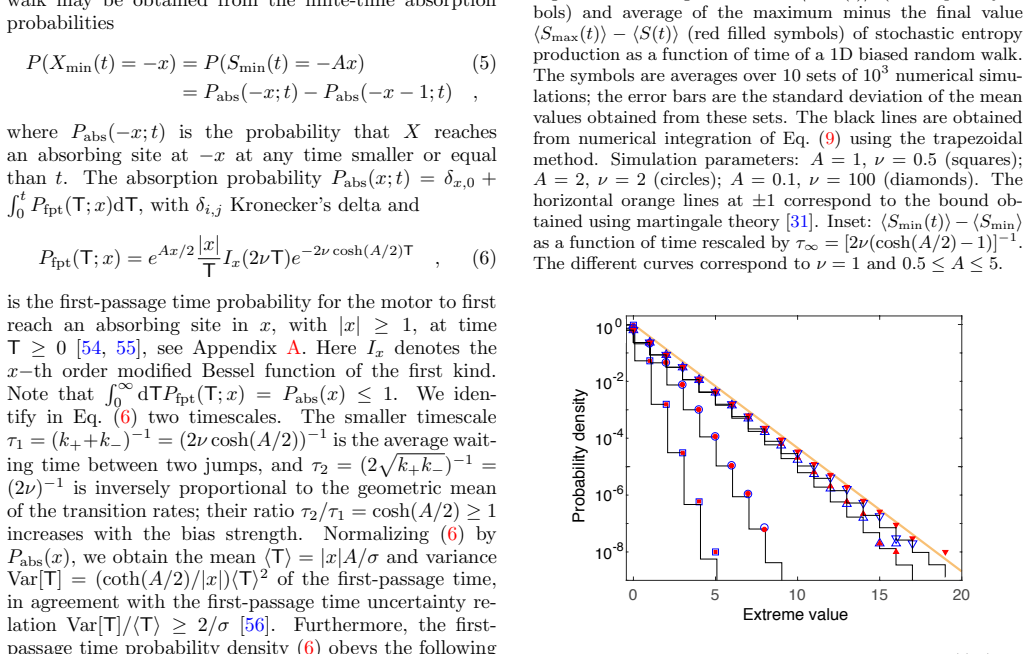
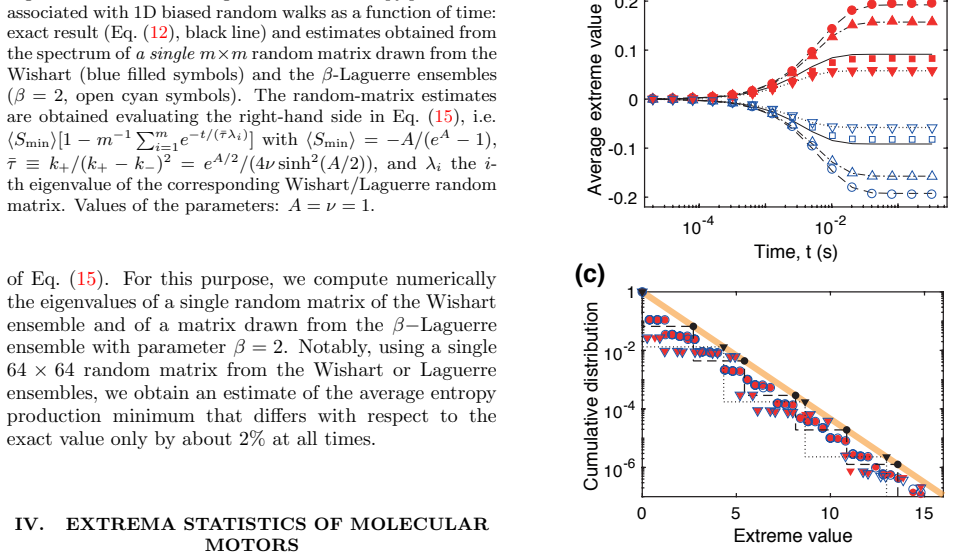
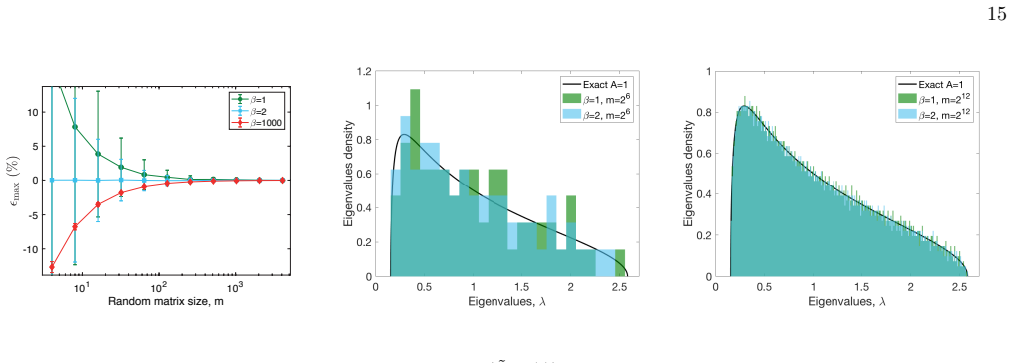
- A single sufficiently large Wishart or $\beta$-Laguerre random matrix with rectangularity $e^{-A}$ estimates the full time dependence of the average minimum to within a few percent in the tested cases.
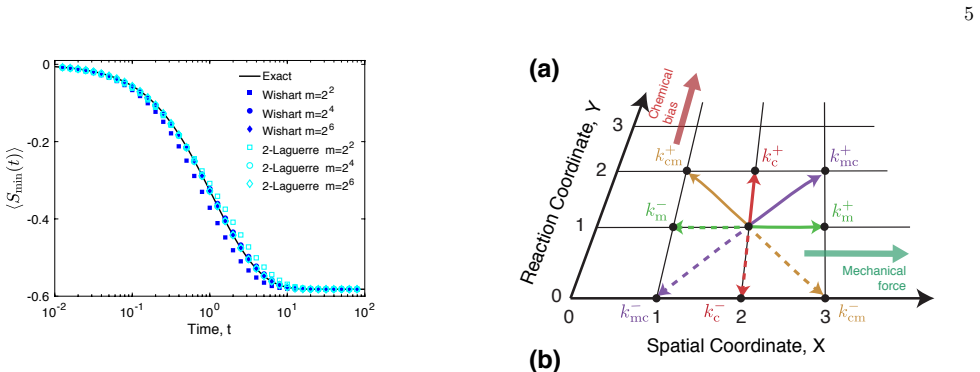
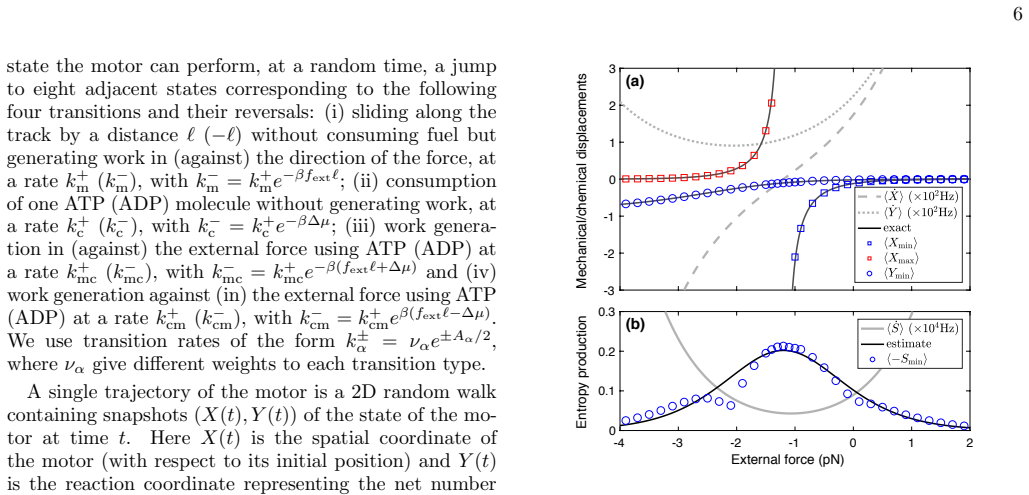
- For the two-dimensional motor model, the effective parameters of Eqs. (17)-(18) reproduce the simulated distributions of entropy extrema, and the average extreme displacements grow as the external force approaches the stall force while entropy extremes remain bounded.
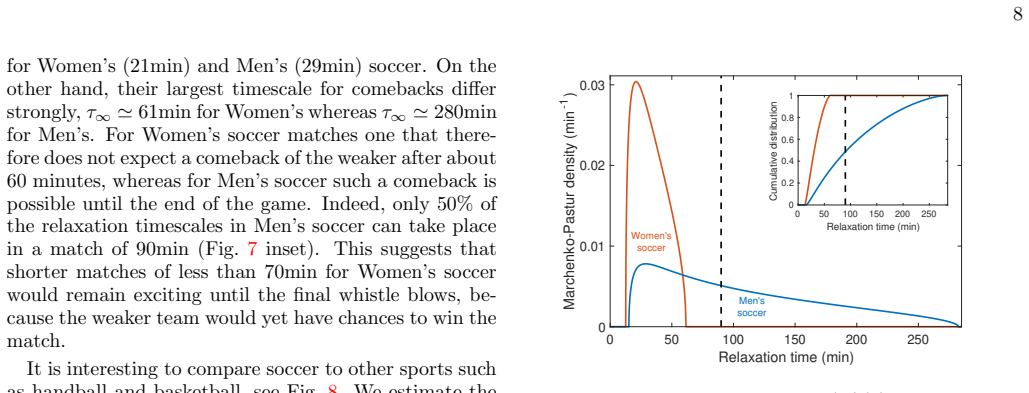
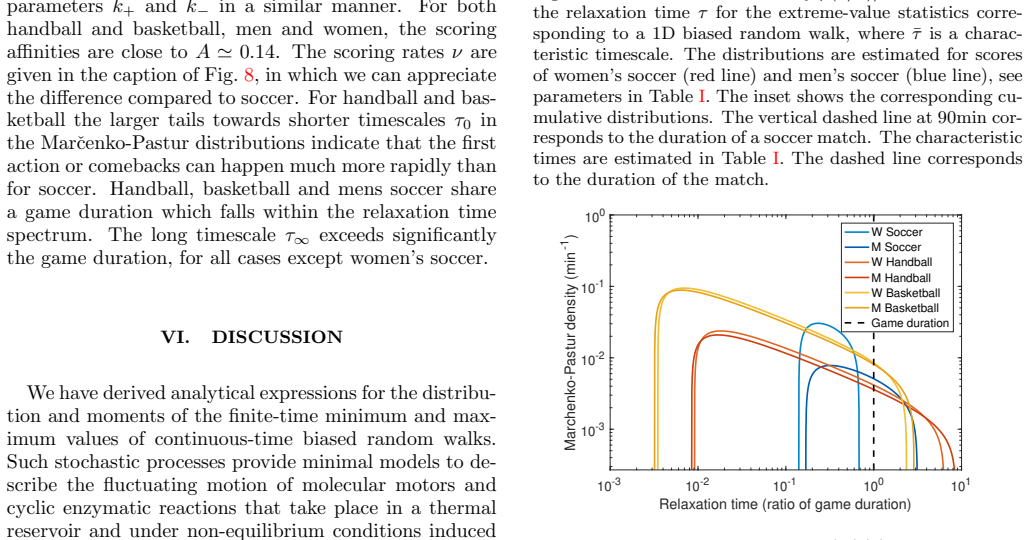
- For sports scores, the comeback window for the weaker team is bounded by $\tau_0\le t\le \tau_\infty$; the data suggest that in the 2018-19 Women's Champions League this window closes at roughly 60 minutes, while for Men's it extends past the 90-minute match.
Reading between the lines
- The same Marchenko-Pastur structure should reappear for any Markov process whose Laplace-transformed first-passage density is an algebraic function of one master quantity, which would make extreme-value statistics of a broader class of currents estimable from random-matrix spectra.
- The mirror symmetry could be tested experimentally as an extremal fluctuation theorem: recording only minima in single-molecule trajectories would predict the distribution of maxima above the running value, and deviations would flag non-Markovian effects.
- The sports analysis is testable with play-by-play score data: if real scoring rates are time-dependent, the empirical extrema should deviate systematically from the Poisson fixed-rate prediction, and the deviation would quantify the minimal model's limits.
- Near stall, the predicted divergence of average extreme spatial steps could be probed in single-motor assays, since the divergence timescale depends on $A_{\rm eff}$ in a specific way and load-dependent measurements would discriminate the effective 1D mapping from alternative multi-state descriptions.
Signed reviews
Editorial analysis
A structured set of objections, weighed in public.
Referee Report
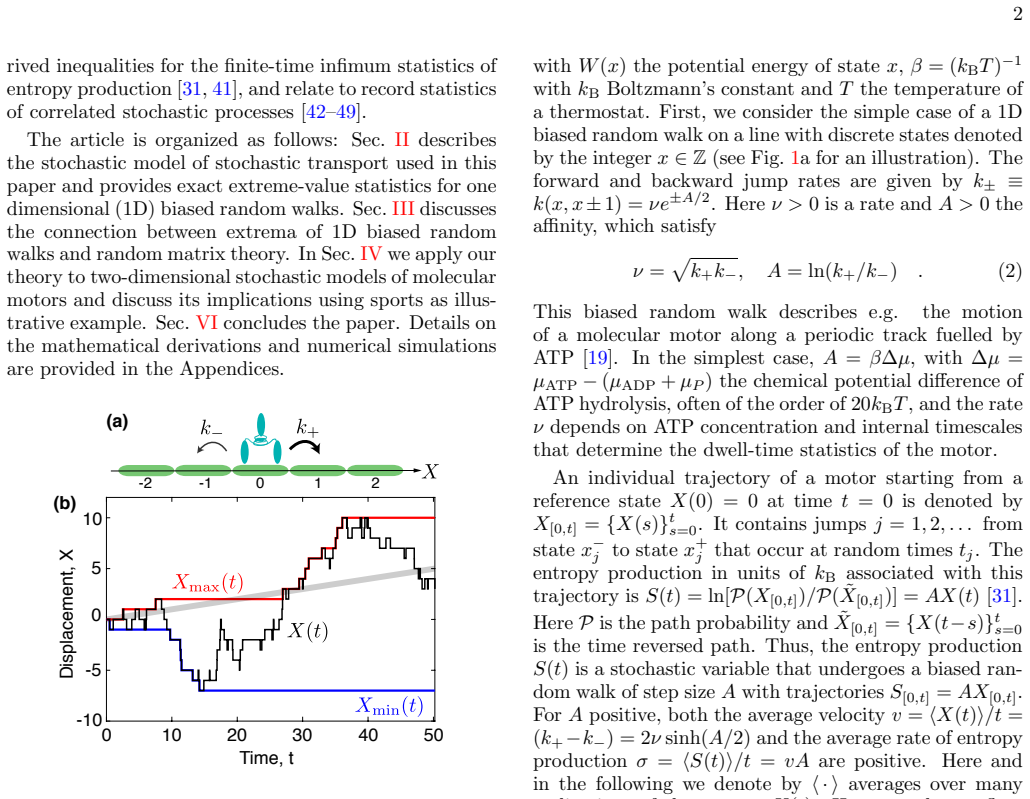
Summary. The manuscript derives exact finite-time statistics of the extrema (maximum and minimum) of the position and of the entropy production of a one-dimensional continuous-time biased random walk. Starting from the first-passage-time distribution, the authors obtain generating functions and integral representations for the average extrema (Eqs. (9), (12), (14)), show that the relaxation spectrum is the Marchenko-Pastur law, and use this to propose Wishart/Laguerre random-matrix estimators. They then apply the 1D formulas to a two-dimensional stochastic model of a molecular motor through effective parameters (Eqs. (17)-(18)) and illustrate the relaxation-time spectra with scoring data from soccer, handball, and basketball.
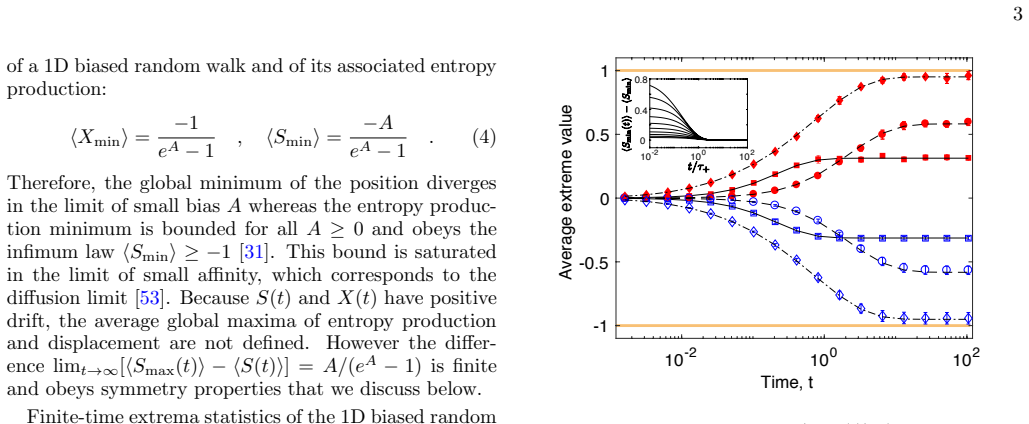
Significance. If the 1D derivation is correct, this is a valuable exact contribution: it generalizes the infimum law for entropy production, establishes a symmetry between the distributions of minima and maxima (Eq. (11)), provides a finite-time supremum bound (Eq. (21)), and connects finite-time extreme-value statistics to random-matrix theory. The 1D derivations are largely self-contained and internally consistent; I verified the t->0 and t->infinity limits of Eq. (12), the change of variables leading to the Marchenko-Pastur integral in Appendix C, and the duality argument behind Eq. (11). The Gillespie simulations in Figs. 2 and 3 support the 1D results. The main weakness is the transfer to the 2D molecular-motor model: the effective-1D reduction is heuristic and is validated for a single parameter set, so the abstract-level claim that the approach captures key features of motor extreme events is not yet established. The sports section is explicitly illustrative and is not the main scientific claim.
major comments (2)
- [IV, Eqs. (17)-(18)] The reduction of the 2D molecular-motor model to an effective 1D biased walk is not derived from the 2D master equation. In the 2D model S(t)=A_m X(t)+A_c Y(t) changes by four step affinities A_m, A_c, A_m+A_c, and A_c-A_m, with mean entropy current sigma_2D = sum_alpha 2 nu_alpha A_alpha sinh(A_alpha/2) and entropy diffusivity D_2D = sum_alpha nu_alpha A_alpha^2 cosh(A_alpha/2). Equations (17)-(18) match only the total jump rate k_eff^+ + k_eff^- = sum_alpha (k_alpha^+ + k_alpha^-); they impose no matching of sigma_2D or D_2D. Since finite-time extrema are controlled by both drift and fluctuations, the effective model cannot be exact for generic parameters. The validation in Fig. 5 is a single Gillespie parameter set, and no comparison of sigma_eff and D_eff with sigma_2D and D_2D is reported. I ask the authors to derive or justify the reduction, to report these cumulant comparisons for the parameters used, and to test the approximation over a range of affinities; without this, the abstract's claim about molecular-motor extreme events is not supported.
- [IV, Fig. 5(c)] The distribution comparison in Fig. 5(c) uses Eq. (3), which is the infinite-time global minimum distribution, to validate simulation data at t=50 ms. The paper's central exact result is the finite-time statistics encoded in Eqs. (5) and (9); Fig. 5(b) tests only the average finite-time behavior, while Fig. 5(c) tests only the long-time limit. Please compare the motor simulations to the finite-time distribution (5) or the corresponding generating function, and state the relevant relaxation times for the motor parameters so the reader can judge whether t=50 ms is indeed in the asymptotic regime. As written, the finite-time distribution claim for the motor model is not validated.
minor comments (4)
- [Fig. 4 caption] The caption states that a single 64x64 random matrix is used, while the legend and text report m=22, 24, and 26; please reconcile these numbers.
- [Appendix E, Eq. (E5)] The notation for the Kampe de Feriet function in Eq. (E5), written as '2+0F1+1', is very hard to parse; please give the explicit parameter vectors or a reference with the exact convention used.
- [Fig. 2 inset] The inset shows curves for 0.5 <= A <= 5 with nu=1, but there is no legend identifying which curve corresponds to which A; add a legend or a color scale.
- [Sec. V] The sentence 'For women's soccer matches one that therefore does not expect a comeback' contains a typo ('one that' should be 'one does'), and 'the weaker time falls behind' should read 'the weaker team'; also, the sports conclusions should explicitly remind the reader that the model assumes fixed Poisson scoring rates with no correlations or non-stationarity, as this assumption is not tested against within-match data.
Circularity Check
No circularity: the exact 1D extremal statistics are derived from the master equation; the Marchenko-Pastur representation is an explicit change of variables, and the motor application is an underived but non-circular effective approximation.
full rationale
The central derivation is self-contained. The finite-time extrema statistics of the 1D biased random walk follow from the first-passage-time density (Eq. A19), obtained by solving the master equation via renewal and Laplace transforms, and the integral representation (Eq. B16) is an exact manipulation of Bessel-function identities. No parameter is fitted to the predicted quantity: A and nu are model inputs, and all moments and probabilities of the extrema are computed from them. The Marchenko-Pastur representation (Eqs. C6-C7) is an explicit change of variables in the exact integral, so the random-matrix estimators (Eqs. D2-D3) are numerical quadrature of the same exact result, not independently fitted predictions. The citations to Refs. [31] and [84] supply standard martingale absorption facts that are re-derived in Appendix A and are not used to define the finite-time extrema being predicted. The motor section's effective-1D reduction (Eqs. 17-18) is a heuristic approximation validated by Gillespie simulations, but it is not circular: it does not define the 2D result as the 1D answer by construction, and the exact 1D formulas remain independently derived. The sports application is an illustrative Poisson model with rates estimated from data, which is legitimate calibration rather than circularity.
Assumptions & free parameters
free parameters (2)
- k+, stronger-team scoring rate (sports application) =
women: 0.042 +/- 0.006 goals/min; men: 0.025 +/- 0.010 goals/min
- k-, weaker-team scoring rate (sports application) =
women: 0.006 +/- 0.002 goals/min; men: 0.009 +/- 0.002 goals/min
assumptions (6)
- domain assumption Transition rates factor as k(x,y) = nu(x,y) exp[A(x,y)/2] with A antisymmetric, identifying A with per-jump entropy production (Eq. 1).
- standard math First-passage-time Laplace transform to site -x equals the x-th power of the transform to site -1 (Eq. B7).
- standard math Empirical spectral density of Wishart and Laguerre-L matrices converges to the Marchenko-Pastur law with parameter delta = e^{-A} (Appendix D).
- ad hoc to paper A 2D molecular motor can be reduced to an effective 1D biased walk with parameters (17)-(18).
- ad hoc to paper Sports score differences are modeled as biased random walks with fixed Poisson scoring rates k+ and k- (Sec. V).
- standard math e^{-S(t)} is a martingale and integral fluctuation relations hold at stopping times (Appendix A3).
Cite this review
Pith. "Pith review of Extreme-Value Statistics of Stochastic Transport Processes: Applications to Molecular Motors and Sports." pith.science (2026). https://pith.science/paper/6T5VMGTB
@misc{pith2026190803499,
  author       = {Pith},
  title        = {Pith review of: Extreme-Value Statistics of Stochastic Transport Processes: Applications to Molecular Motors and Sports},
  year         = {2026},
  howpublished = {\url{https://pith.science/paper/6T5VMGTB}},
  note         = {Machine review of arXiv:1908.03499}
}
read the original abstract
We derive exact expressions for the finite-time statistics of extrema (maximum and minimum) of the spatial displacement and the fluctuating entropy flow of biased random walks. Our approach captures key features of extreme events in molecular motor motion along linear filaments. Our results generalize the infimum law for entropy production and reveal a symmetry of the distribution of its maxima and minima. We also show that the relaxation spectrum of the full generating function, and hence of any moment, of the finite-time extrema distributions can be written in terms of the Mar{\v{c}}enko-Pastur distribution of random-matrix theory. Using this result, we obtain estimates for the extreme-value statistics of stochastic transport from the eigenvalue distributions of suitable Wishart and Laguerre random matrices. We confirm our results by numerical simulations of stochastic models of molecular motors and discuss as illustrative example our theory in the context of sports.
Figures
Figures from the paper (6 more)
Reference graph
Works this paper leans on
-
[31]
Kinetic characterization of heat bath and the energetics of thermal ratchet models,
Ken Sekimoto, “Kinetic characterization of heat bath and the energetics of thermal ratchet models,” J. Phys. Soc. Jap. 66, 1234–1237 (1997)
work page 1997
-
[1]
} denotes the position of the walker at time t≥ 0
Model and solution of the Master equation We consider a continuous-time biased random walk in a discrete one-dimensional lattice, where X(t) = {0,±1,±2,... } denotes the position of the walker at time t≥ 0. We assume that X(0) = 0 and that the walker can jump from state X(t) = x to x + 1 (x− 1) at a rate k+ (k−). The waiting time at any site is exponentia...
-
[2]
For this purpose we consider the scaling limit of Px(t) given by Eq
Large deviation and diffusion limit We now discuss and review large deviation properties of the 1D biased random walk [80, 81] and relate them to the statistics of 1D drift diffusion process. For this purpose we consider the scaling limit of Px(t) given by Eq. (A2) for largex∼vt, withv =k+−k− the net veloc- ity of the walker. We assume a large deviation pri...
-
[3]
We first show explicitly thate−S(t) is a martingale pro- cess with respect to X(t), i.e
Martingales and absorption probabilities In this subsection we employ martingale theory to de- rive an analytical expression of the absorption probability Pabs(−x) for a 1D biased random walk starting at x = 0 to ever reach an absorbing boundary located at −x< 0. We first show explicitly thate−S(t) is a martingale pro- cess with respect to X(t), i.e. ⟨e−S(...
-
[4]
It can also be derived from the distribu- tion of the walker using Laplace transforms through the renewal equation: Px(t) = ∫ t 0 Pfpt(t′;x)P0(t−t′)dt′
First-passage-time distribution The first-passage-time density Pfpt(t′;x) can be de- rived from the solution of the Master equation (A1) with an absorbing boundary at site x⁄= 0, with x an integer number [54]. It can also be derived from the distribu- tion of the walker using Laplace transforms through the renewal equation: Px(t) = ∫ t 0 Pfpt(t′;x)P0(t−t′)...
-
[5]
First we use the fact the the first-passage-time density is the derivative of the absorption probability, ˆPfpt(s;x) = s ˆPabs(x;s)−δx,0, which holds for anyx
Finite time statistics in the Laplace domain We rewrite the probability-generating function Gmin using the first-passage-time density derived above (A18). First we use the fact the the first-passage-time density is the derivative of the absorption probability, ˆPfpt(s;x) = s ˆPabs(x;s)−δx,0, which holds for anyx. Equation (A19) implies that the Laplace tran...
-
[6]
Integral representations of extreme value statistics We start from the first-passage-time density for- mula (A19) and we exploit two properties of the mod- ified Bessel function of the first kind. This allows us to rewrite the absorption probability as a definite integral of trigonometric and hyperbolic functions and the parame- ters A and ν: Pabs(x;t) = ∫ t ...
-
[7]
Average value of the finite-time minimum of entropy production Performing the changes of variablek = 2ν(cosh(A/2)− y), as well as τ = 1/k, in Eq. (B16) we obtain ⟨Smin(t)⟩ =−A 2π ∫ k∞ k0 1−e−kt k √ (k∞−k)(k−k0)dk k (C2) =−A 2π ∫ τ∞ τ0 ( 1−e−t/τ )√ (τ∞−τ)(τ−τ0) τ∞τ0 dτ τ (C3) where we have introduced the variables k∞/0≡ ( √ k+± √ k−)2 , (C4) τ∞/0≡ 1 k0/∞ . ...
Show all 94 references
-
[8]
Using the same method as described above for Eq
Generating functions of the absorption probability and the minimum The generating function for the absorption probability can also be expressed using Marˇ cenko-Pastur distribu- tions. Using the same method as described above for Eq. (B14), we find Gabs(z;t) =k− ∫ k∞ k0 1−e−kt ...
-
[9]
(C11), we obtain s ˆGabs(z;s) =k− ∫ k∞ k0 k k +s ρ(k/¯k) k +f(z) dk ¯k
Laplace transforms Taking the Laplace transform of Eq. (C11), we obtain s ˆGabs(z;s) =k− ∫ k∞ k0 k k +s ρ(k/¯k) k +f(z) dk ¯k . (C15) Equations (C15) and (B6) imply that the Laplace trans- form of the average minimum can be written as a Stieltjes-like transform of the Marˇ cen...
2018
-
[10]
Modeling molecular motors,
Frank J¨ ulicher, Armand Ajdari, and Jacques Prost, “Modeling molecular motors,” Rev. Mod. Phys. 69, 1269 (1997)
1997
-
[11]
Jonathon Howard et al., Mechanics of motor proteins and the cytoskeleton (2001)
2001
-
[12]
Direct observation of the rotation of f1-atpase,
Hiroyuki Noji, Ryohei Yasuda, Masasuke Yoshida, and Kazuhiko Kinosita Jr, “Direct observation of the rotation of f1-atpase,” Nature 386, 299 (1997)
1997
-
[13]
Grabbing the cat by the tail: manipulating molecules one by one,
Carlos Bustamante, Jed C Macosko, and Gijs JL Wuite, “Grabbing the cat by the tail: manipulating molecules one by one,” Nature Rev. Mol. Cell Biol. 1, 130 (2000)
2000
-
[14]
Force production by single kinesin motors,
Mark J Schnitzer, Koen Visscher, and Steven M Block, “Force production by single kinesin motors,” Nature Cell Biol. 2, 718 (2000)
2000
-
[15]
Single molecule detection in life sciences,
Yoshiharu Ishii and Toshio Yanagida, “Single molecule detection in life sciences,” Single Mol. 1, 5–16 (2000)
2000
-
[16]
The depolymerizing kinesin mcak uses lattice diffusion to rapidly target mi- crotubule ends,
Jonne Helenius, Gary Brouhard, Yannis Kalaidzidis, Ste- fan Diez, and Jonathon Howard, “The depolymerizing kinesin mcak uses lattice diffusion to rapidly target mi- crotubule ends,” Nature 441, 115 (2006)
2006
-
[17]
Single-molecule experiments in biological physics: methods and applications,
Felix Ritort, “Single-molecule experiments in biological physics: methods and applications,” J. Phys.: Condens. Matter 18, R531 (2006)
2006
-
[18]
Self-organization of dynein motors generates meiotic nuclear oscillations,
Sven K Vogel, Nenad Pavin, Nicola Maghelli, Frank J¨ ulicher, and Iva M Toli´ c-Nørrelykke, “Self-organization of dynein motors generates meiotic nuclear oscillations,” PLoS Biol. 7, e1000087 (2009)
2009
-
[19]
Substrate interactions and promiscuity in a viral dna packaging mo- tor,
K Aathavan, Adam T Politzer, Ariel Kaplan, Jeffrey R Moffitt, Yann R Chemla, Shelley Grimes, Paul J Jardine, Dwight L Anderson, and Carlos Bustamante, “Substrate interactions and promiscuity in a viral dna packaging mo- tor,” Nature 461, 669 (2009)
2009
-
[20]
Dynein motion switches from diffusive to directed upon cortical anchoring,
Vaishnavi Ananthanarayanan, Martin Schattat, Sven K Vogel, Alexander Krull, Nenad Pavin, and Iva M Toli´ c- Nørrelykke, “Dynein motion switches from diffusive to directed upon cortical anchoring,” Cell 153, 1526–1536 (2013)
2013
-
[21]
High-resolution mapping of intracellular fluctuations using carbon nan- otubes,
Nikta Fakhri, Alok D Wessel, Charlotte Willms, Mat- teo Pasquali, Dieter R Klopfenstein, Frederick C MacK- intosh, and Christoph F Schmidt, “High-resolution mapping of intracellular fluctuations using carbon nan- otubes,” Science 344, 1031–1035 (2014)
2014
-
[22]
Actomyosin- driven left-right asymmetry: from molecular torques to chiral self organization,
Sundar Ram Naganathan, Teije C Middelkoop, Sebas- tian F¨ urthauer, and Stephan W Grill, “Actomyosin- driven left-right asymmetry: from molecular torques to chiral self organization,” Curr. Opin. Cell Biol. 38, 24–30 (2016)
2016
-
[23]
Self-organization of microtubules and motors,
FJ Ndlec, Thomas Surrey, Anthony C Maggs, and Stanislas Leibler, “Self-organization of microtubules and motors,” Nature 389, 305 (1997)
1997
-
[24]
The mechanochemistry of molecular motors,
David Keller and Carlos Bustamante, “The mechanochemistry of molecular motors,” Biophys. J. 78, 541–556 (2000)
2000
-
[25]
Cycle kinetics, steady state thermodynam- ics and motors: a paradigm for living matter physics,
Hong Qian, “Cycle kinetics, steady state thermodynam- ics and motors: a paradigm for living matter physics,” J. Phys.: Condens. Matter 17, S3783 (2005)
2005
-
[26]
Cooperative cargo transport by several molecular motors,
Stefan Klumpp and Reinhard Lipowsky, “Cooperative cargo transport by several molecular motors,” Proc. Natl. Acad. Sci. U.S.A. 102, 17284–17289 (2005)
2005
-
[27]
Collective dynamics of interacting molecu- lar motors,
O Campas, Y Kafri, KB Zeldovich, J Casademunt, and J-F Joanny, “Collective dynamics of interacting molecu- lar motors,” Phys. Rev. Lett. 97, 038101 (2006)
2006
-
[28]
Molecu- lar motors: a theorist’s perspective,
Anatoly B Kolomeisky and Michael E Fisher, “Molecu- lar motors: a theorist’s perspective,” Annu. Rev. Phys. Chem. 58, 675–695 (2007)
2007
-
[29]
Cytoplasmic diffusion: molecular motors mix it up,
Clifford P Brangwynne, Gijsje H Koenderink, Freder- ick C MacKintosh, and David A Weitz, “Cytoplasmic diffusion: molecular motors mix it up,” J. Cell. Biol. 183, 583–587 (2008)
2008
-
[30]
Template-directed copolymerization, random walks along disordered tracks, and fractals,
Pierre Gaspard, “Template-directed copolymerization, random walks along disordered tracks, and fractals,” Phys. Rev. Lett. 117, 238101 (2016)
2016
-
[32]
Nonequilibrium fluctuations and mechanochemical cou- plings of a molecular motor,
AWC Lau, David Lacoste, and Kirone Mallick, “Nonequilibrium fluctuations and mechanochemical cou- plings of a molecular motor,” Phys. Rev. Lett.99, 158102 (2007)
2007
-
[33]
Exact solutions for kinetic models of macro- molecular dynamics,
Yann R Chemla, Jeffrey R Moffitt, and Carlos Bus- tamante, “Exact solutions for kinetic models of macro- molecular dynamics,” J. Phys. Chem. B 112, 6025–6044 (2008)
2008
-
[34]
Nonequilibrium energetics of a single f 1- atpase molecule,
Shoichi Toyabe, Tetsuaki Okamoto, Takahiro Watanabe- Nakayama, Hiroshi Taketani, Seishi Kudo, and Eiro Muneyuki, “Nonequilibrium energetics of a single f 1- atpase molecule,” Phys. Rev. Lett. 104, 198103 (2010)
2010
-
[35]
Universal bound on the efficiency of molecular motors,
Patrick Pietzonka, Andre C Barato, and Udo Seifert, “Universal bound on the efficiency of molecular motors,” J. Stat. Mech. 2016, 124004 (2016)
2016
-
[36]
Reaction-rate theory: fifty years after kramers,
Peter H¨ anggi, Peter Talkner, and Michal Borkovec, “Reaction-rate theory: fifty years after kramers,” Rev. Mod. Phys. 62, 251 (1990)
1990
-
[37]
Generalized haldane equation and fluctuation theorem in the steady-state cy- cle kinetics of single enzymes,
Hong Qian and X Sunney Xie, “Generalized haldane equation and fluctuation theorem in the steady-state cy- cle kinetics of single enzymes,” Phys. Rev. E 74, 010902 (2006)
2006
-
[38]
Chemomechanical coupling of the forward and backward steps of single kinesin molecules,
Masayoshi Nishiyama, Hideo Higuchi, and Toshio Yanagida, “Chemomechanical coupling of the forward and backward steps of single kinesin molecules,” Nature Cell Biol. 4, 790 (2002)
2002
-
[39]
Mechanics of the kinesin step,
Nick J Carter and RA Cross, “Mechanics of the kinesin step,” Nature 435, 308 (2005)
2005
-
[40]
Statis- tics of infima and stopping times of entropy production and applications to active molecular processes,
Izaak Neri, ´Edgar Rold´ an, and Frank J¨ ulicher, “Statis- tics of infima and stopping times of entropy production and applications to active molecular processes,” Phys. Rev. X 7, 011019 (2017)
2017
-
[41]
Experimental evidence of symmetry break- ing of transition-path times,
J Gladrow, M Ribezzi-Crivellari, F Ritort, and 18 UF Keyser, “Experimental evidence of symmetry break- ing of transition-path times,” Nature Comms. 10, 55 (2019)
2019
-
[42]
Non-stationary extreme value analysis in a changing climate,
Linyin Cheng, Amir AghaKouchak, Eric Gilleland, and Richard W Katz, “Non-stationary extreme value analysis in a changing climate,” Climatic change 127, 353–369 (2014)
2014
-
[43]
Fine-scale processes regulate the response of extreme events to global climate change,
Noah S Diffenbaugh, Jeremy S Pal, Robert J Trapp, and Filippo Giorgi, “Fine-scale processes regulate the response of extreme events to global climate change,” Proceedings of the National Academy of Sciences 102, 15774–15778 (2005)
2005
-
[44]
Extreme value theory in finance: A sur- vey,
Marco Rocco, “Extreme value theory in finance: A sur- vey,” Journal of Economic Surveys 28, 82–108 (2014)
2014
-
[45]
Extreme value theory in finance,
Erik Brodin and Claudia Kl¨ uppelberg, “Extreme value theory in finance,” Wiley StatsRef: Statistics Reference Online (2014)
2014
-
[46]
Serguei Y Novak, Extreme value methods with applica- tions to finance (CRC Press, 2011)
2011
-
[47]
Long-range correlations in nucleotide sequences,
C-K Peng, Sergej V Buldyrev, Ary L Goldberger, Shlomo Havlin, Francesco Sciortino, Michael Simons, and HE Stanley, “Long-range correlations in nucleotide sequences,” Nature 356, 168 (1992)
1992
-
[48]
Characterizing long-range correlations in dna sequences from wavelet analysis,
Alain Arneodo, Emmanuel Bacry, PV Graves, and Jean- Fran¸ cois Muzy, “Characterizing long-range correlations in dna sequences from wavelet analysis,” Phys. Rev. Lett. 74, 3293 (1995)
1995
-
[49]
How xeno- pus laevis replicates dna reliably even though its origins of replication are located and initiated stochastically,
John Bechhoefer and Brandon Marshall, “How xeno- pus laevis replicates dna reliably even though its origins of replication are located and initiated stochastically,” Phys. Rev. Lett. 98, 098105 (2007)
2007
-
[50]
Two refreshing views of fluctuation theorems through kinematics ele- ments and exponential martingale,
Rapha¨ el Chetrite and Shamik Gupta, “Two refreshing views of fluctuation theorems through kinematics ele- ments and exponential martingale,” J. Stat. Phys. 143, 543 (2011)
2011
-
[51]
Records in a changing world,
Joachim Krug, “Records in a changing world,” J. Stat. Mech. 2007, P07001 (2007)
2007
-
[52]
Universal record statistics of random walks and l´ evy flights,
Satya N Majumdar and Robert M Ziff, “Universal record statistics of random walks and l´ evy flights,” Phys. Rev. Lett. 101, 050601 (2008)
2008
-
[53]
Record statistics for biased random walks, with an ap- plication to financial data,
Gregor Wergen, Miro Bogner, and Joachim Krug, “Record statistics for biased random walks, with an ap- plication to financial data,” Phys. Rev. E 83, 051109 (2011)
2011
-
[54]
Universal statistics of longest lasting records of random walks and l´ evy flights,
Claude Godreche, Satya N Majumdar, and Gr´ egory Schehr, “Universal statistics of longest lasting records of random walks and l´ evy flights,” J. Phys. A 47, 255001 (2014)
2014
-
[55]
Random walkers with extreme value memory: modelling the peak-end rule,
Rosemary J Harris, “Random walkers with extreme value memory: modelling the peak-end rule,” New J. Phys. 17, 053049 (2015)
2015
-
[56]
Temporal correlations of the running maximum of a brownian trajectory,
Olivier B´ enichou, PL Krapivsky, Carlos Mej´ ıa- Monasterio, and Gleb Oshanin, “Temporal correlations of the running maximum of a brownian trajectory,” Phys. Rev. Lett. 117, 080601 (2016)
2016
-
[57]
Extreme value statis- tics of ergodic markov processes from first passage times in the large deviation limit,
David Hartich and Aljaz Godec, “Extreme value statis- tics of ergodic markov processes from first passage times in the large deviation limit,” arXiv:1902.00439 (2019)
2019 arXiv
-
[58]
Extremes and records,
Sanjib Sabhapandit, “Extremes and records,” arXiv:1907.00944 (2019)
2019 arXiv
-
[59]
1 (Elsevier, 1992)
Nicolaas Godfried Van Kampen, Stochastic processes in physics and chemistry , Vol. 1 (Elsevier, 1992)
1992
-
[60]
41 (Springer, 2014)
Paul C Bressloff, Stochastic processes in cell biology , Vol. 41 (Springer, 2014)
2014
-
[61]
Life efficiency does not always increase with the dissipation rate,
Marco Baiesi and Christian Maes, “Life efficiency does not always increase with the dissipation rate,” J. Phys. Commun. 2, 045017 (2018)
2018
-
[62]
Generic properties of stochastic entropy pro- duction,
Simone Pigolotti, Izaak Neri, ´Edgar Rold´ an, and Frank J¨ ulicher, “Generic properties of stochastic entropy pro- duction,” Phys. Rev. Lett. 119, 140604 (2017)
2017
-
[63]
Sidney Redner, A guide to first-passage processes (Cam- bridge University Press, 2001)
2001
-
[64]
Stochastic resetting in backtrack recovery by rna polymerases,
´Edgar Rold´ an, Ana Lisica, Daniel S´ anchez-Taltavull, and Stephan W Grill, “Stochastic resetting in backtrack recovery by rna polymerases,” Phys. Rev. E 93, 062411 (2016)
2016
-
[65]
Fundamental bounds on first passage time fluctuations for currents,
Todd R Gingrich and Jordan M Horowitz, “Fundamental bounds on first passage time fluctuations for currents,” Phys. Rev. Lett. 119, 170601 (2017)
2017
-
[66]
Universal first-passage-time distribution of non-gaussian currents,
Shilpi Singh, Paul Menczel, Dmitry S Golubev, Ivan M Khaymovich, Joonas T Peltonen, Christian Flindt, Keiji Saito, ´Edgar Rold´ an, and Jukka P Pekola, “Universal first-passage-time distribution of non-gaussian currents,” Phys. Rev. Lett. 122, 230602 (2019)
2019
-
[67]
First-passage duality,
PL Krapivsky and S Redner, “First-passage duality,” J. Stat. Mech. 2018, 093208 (2018)
2018
-
[68]
Distribution of eigenvalues for some sets of random ma- trices,
Vladimir A Marˇ cenko and Leonid Andreevich Pastur, “Distribution of eigenvalues for some sets of random ma- trices,” Sbornik: Mathematics 1, 457–483 (1967)
1967
-
[69]
13 (Cambridge Uni- versity Press, 2006)
Alexandru Nica and Roland Speicher, Lectures on the combinatorics of free probability, Vol. 13 (Cambridge Uni- versity Press, 2006)
2006
-
[70]
Measuring maximal eigen- value distribution of wishart random matrices with cou- pled lasers,
Moti Fridman, Rami Pugatch, Micha Nixon, Asher A Friesem, and Nir Davidson, “Measuring maximal eigen- value distribution of wishart random matrices with cou- pled lasers,” Phys. Rev. E 85, 020101 (2012)
2012
-
[71]
26 (Springer, 2018)
Giacomo Livan, Marcel Novaes, and Pierpaolo Vivo, In- troduction to Random Matrices: Theory and Practice , Vol. 26 (Springer, 2018)
2018
-
[72]
Matrix models for beta ensembles,
Ioana Dumitriu and Alan Edelman, “Matrix models for beta ensembles,” J. Math. Phys. 43, 5830–5847 (2002)
2002
-
[73]
Analysis of sports data by using bivariate poisson models,
Dimitris Karlis and Ioannis Ntzoufras, “Analysis of sports data by using bivariate poisson models,” Journal of the Royal Statistical Society: Series D (The Statisti- cian) 52, 381–393 (2003)
2003
-
[74]
Level-spacing distri- butions and the airy kernel,
Craig A Tracy and Harold Widom, “Level-spacing distri- butions and the airy kernel,” Comm. Math. Phys. 159, 151–174 (1994)
1994
-
[75]
On orthogonal and symplectic matrix ensembles,
Craig A Tracy and Harold Widom, “On orthogonal and symplectic matrix ensembles,” Comm. Math. Phys. 177, 727–754 (1996)
1996
-
[76]
Universal distri- butions for growth processes in 1+ 1 dimensions and ran- dom matrices,
Michael Pr¨ ahofer and Herbert Spohn, “Universal distri- butions for growth processes in 1+ 1 dimensions and ran- dom matrices,” Phys. Rev. Lett. 84, 4882 (2000)
2000
-
[77]
Exact ex- tremal statistics in the classical 1d coulomb gas,
Abhishek Dhar, Anupam Kundu, Satya N Majumdar, Sanjib Sabhapandit, and Gr´ egory Schehr, “Exact ex- tremal statistics in the classical 1d coulomb gas,” Phys. Rev. Lett. 119, 060601 (2017)
2017
-
[78]
C. elegans chromosomes connect to centrosomes by anchoring into the spindle net- work,
Stefanie Redemann, Johannes Baumgart, Norbert Lin- dow, Michael Shelley, Ehssan Nazockdast, Andrea Kratz, Steffen Prohaska, Jan Brugu´ es, Sebastian F¨ urthauer, and Thomas M¨ uller-Reichert, “C. elegans chromosomes connect to centrosomes by anchoring into the spindle net- work...
2017
-
[79]
Active cargo positioning in antiparallel trans- port networks,
Mathieu Richard, Carles Blanch-Mercader, Hajer Enno- mani, Wenxiang Cao, Enrique De La Cruz, Jean-Fran¸ cois Joanny, Frank J¨ ulicher, Laurent Blanchoin, and Pascal 19 Martin, “Active cargo positioning in antiparallel trans- port networks,” bioRxiv , 512863 (2019)
2019
-
[80]
Fluctuation theorems for stochastic dynamics,
Rosemary J Harris and Gunther M Sch¨ utz, “Fluctuation theorems for stochastic dynamics,” J. Stat. Mech. 2007, P07020 (2007)
2007
-
[81]
Nonequilibrium thermodynamics in the strong coupling and non-markovian regime based on a reaction coordinate mapping,
Philipp Strasberg, Gernot Schaller, Neill Lambert, and Tobias Brandes, “Nonequilibrium thermodynamics in the strong coupling and non-markovian regime based on a reaction coordinate mapping,” New J. Phys. 18, 073007 (2016)
2016
-
[82]
Thermodynamic uncer- tainty for run-and-tumble type processes,
RJ Harris and M Shreshtha, “Thermodynamic uncer- tainty for run-and-tumble type processes,” EPL 126, 40007 (2019)
2019
-
[83]
Phase transitions in persistent and run-and- tumble walks,
Karel Proesmans, Raul Toral, and Christian Van den Broeck, “Phase transitions in persistent and run-and- tumble walks,” Phys. A , 121934 (2019)
2019
-
[84]
Heat flow due to time-delayed feedback,
Sarah AM Loos and Sabine HL Klapp, “Heat flow due to time-delayed feedback,” Sci. Rep. 9, 2491 (2019)
2019
-
[85]
Subharmonic oscillations in stochastic systems un- der periodic driving,
Lukas Oberreiter, Udo Seifert, and Andre C Barato, “Subharmonic oscillations in stochastic systems un- der periodic driving,” arXiv preprint arXiv:1902.01963 (2019)
2019 arXiv
-
[86]
Effective thermodynamics for a marginal observer,
Matteo Polettini and Massimiliano Esposito, “Effective thermodynamics for a marginal observer,” Physical re- view letters 119, 240601 (2017)
2017
-
[87]
Inferring broken detailed balance in the absence of observable currents,
Ignacio A Mart´ ınez, Gili Bisker, Jordan M Horowitz, and Juan MR Parrondo, “Inferring broken detailed balance in the absence of observable currents,” Nature communica- tions 10 (2019)
2019
-
[88]
The frequency distribution of the dif- ference between two poisson variates belonging to differ- ent populations,
John G Skellam, “The frequency distribution of the dif- ference between two poisson variates belonging to differ- ent populations,” Journal of the Royal Statistical Society: Series A 109, 296 (1946)
1946
-
[89]
The large deviation approach to sta- tistical mechanics,
Hugo Touchette, “The large deviation approach to sta- tistical mechanics,” Physics Reports 478, 1–69 (2009)
2009
-
[90]
The large deviation function for entropy production: the op- timal trajectory and the role of fluctuations,
Thomas Speck, Andreas Engel, and Udo Seifert, “The large deviation function for entropy production: the op- timal trajectory and the role of fluctuations,” J. Stat. Mech. 2012, P12001 (2012)
2012
-
[91]
Nonequilibrium equality for free energy differences,
Christopher Jarzynski, “Nonequilibrium equality for free energy differences,” Phys. Rev. Lett. 78, 2690 (1997)
1997
-
[92]
Entropy production along a stochastic tra- jectory and an integral fluctuation theorem,
Udo Seifert, “Entropy production along a stochastic tra- jectory and an integral fluctuation theorem,” Phys. Rev. Lett. 95, 040602 (2005)
2005
-
[93]
Integral fluctuation relations for en- tropy production at stopping times,
Izaak Neri, Edgar Rold´ an, Simone Pigolotti, and Frank J¨ ulicher, “Integral fluctuation relations for en- tropy production at stopping times,” arXiv preprint arXiv:1903.08115 (2019)
2019 arXiv
-
[94]
Handbook of hypergeometric inte- grals: theory, applications, tables, computer programs,
Harold Exton, “Handbook of hypergeometric inte- grals: theory, applications, tables, computer programs,” (1978)
1978
Reviewed August 14, 2026 · model on record in the stance chip above.
Discussion (0). Continue with ORCID to comment.