REVIEW 1 major objections 5 minor 14 references
Bayesian inference and jet quenching
T0 review · 1 major / 5 minor · reviewed 2026-08-06 · deepseek-v4-flash
Pith's one-line read This review argues that calibrating many jet-quenching observables at once is the essential route to the quark-gluon plasma's transport properties.
desk verdict A transparent, useful proceedings review of Bayesian qhat calibrations; the field status report is accurate, but the showcase multi-observable insight rests on the very theory-uncertainty omission it admits. read the letter →
The pith
A machine-rendered reading of the paper's core claim, the machinery that carries it, and where it could break.
The reading
What carries the argument
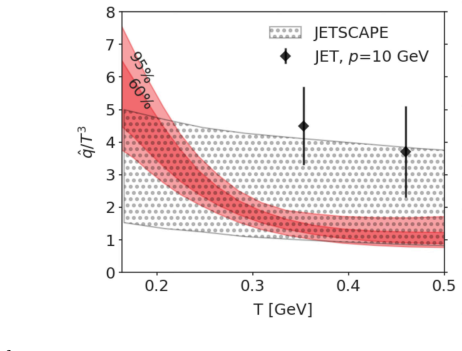
The central object is the jet transport coefficient $\hat q$, the transverse momentum squared acquired by a hard parton per unit path length in the quark-gluon plasma, usually reported as $\hat q/T^3$. The machinery is Bayes' theorem, $P(\vec{\theta}|\vec{x}) \propto P(\vec{x}|\vec{\theta})P(\vec{\theta})$, which combines a prior over model parameters with a likelihood that encodes data uncertainties and their correlations to produce a posterior distribution over the parameters. The review's argument turns on comparing different parametrizations of $\hat q$: a physics-inspired form tied to hard-thermal-loop calculations and a flexible 'information field' form, a class of random functions that lets the posterior choose its own functional shape. Differential data selections are then used to see how the posterior moves when the dataset changes.
What would settle it
Re-run the hadron-only and jet-only calibrations with an explicit theory-uncertainty covariance added to the likelihood and the same flexible parametrization; if the two posterior distributions for $\hat q/T^3$ fail to converge once theory uncertainties are included, or if the combined posterior falls outside the spread of the two single-observable posteriors, the review's consistency claim would be contradicted. A simpler check is to predict an uncalibrated high-$p_T$ jet substructure observable from the combined posterior, since a large mismatch would show the calibration is missing physics rather than merely needing more data.
Extended reading notes
Core claim
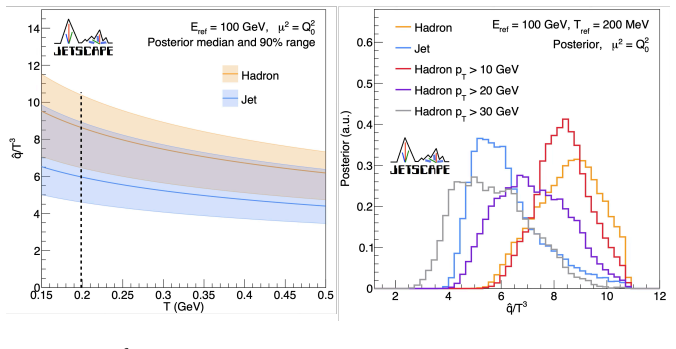
The paper's central claim is that multi-observable Bayesian calibration is the most informative route to the jet transport coefficient of the quark-gluon plasma, and that the approach has matured from a proof of concept to comprehensive global analyses. It asserts that the quantity $\hat q$, the transverse momentum squared transferred to a hard parton per unit length, should be a universal property of the medium, so the extracted value should not depend on which observable is used. The review documents that combined hadron+jet calibrations extract a constrained posterior distribution for $\hat q/T^3$, that hadron-only and jet-only selections bracket the combined result within their 90% credible intervals, and that the low-$p_T$ hadron data dominate the tension because they are the most precise. It concludes that the field's next steps are to fold in theory uncertainties, improve the low-$p_T$ description, and compare multiple models under equivalent conditions.
Load-bearing premise
The load-bearing premise is that the model predictions are accurate enough that leaving theoretical uncertainty out of the likelihood does not change the results; the paper itself notes in Section 4 that the model is expected to be most uncertain in the low-$p_T$ region, where the most precise data dominate.
Editorial extensions
If this is right
- Single-observable comparisons are no longer sufficient to discriminate jet-quenching models; multi-observable calibrations become the reference standard for extracting medium properties.
- The extracted $\hat q/T^3$ posterior from combined hadron and jet data is consistent with other extractions within 90% credible intervals, so $\hat q$ can be treated as approximately universal while hadron-only and jet-only results bracket the combined value.
- Flexible parametrizations are necessary to capture the low-temperature rise of $\hat q/T^3$ but trade away physical interpretability, so both flexible and physics-motivated parametrizations should be reported together.
- Until theoretical uncertainties are added to the likelihood, quoted credible intervals should be understood as conditional on the model being exact; adding them is likely to change the intervals and may resolve the low-$p_T$ hadron tension.
- Future high-precision high-$p_T$ hadron measurements and jet substructure measurements are expected to have the largest impact on narrowing the posterior.
Reading between the lines
- One testable extension is to use the spread between hadron-only and jet-only posteriors as a proxy for model-form uncertainty and widen the reported credible intervals accordingly, giving readers an honest error bar without waiting for a full theory-uncertainty treatment.
- If the review's account is right, the next set of measurements should be chosen by running sensitivity studies on the current posteriors, turning experimental design into a quantitative exercise rather than a qualitative one.
- A concrete place to look for missing physics is jet substructure at high $p_T$: predicting it from the current posterior and checking where the prediction fails would localize the effects, such as coherence or nuclear shadowing, that the calibration is missing.
Editorial analysis
A structured set of objections, weighed in public.
Referee Report
Summary. This proceedings article by Ehlers reviews recent applications of Bayesian inference to jet quenching in heavy-ion collisions. It introduces the key components of a Bayesian calibration—model parametrization, data selection, and the inference setup—and then summarizes three lines of work: hadron-only calibrations (JETSCAPE and information-field approaches), a soft-hard calibration with DREENA-A, and combined inclusive hadron+jet calibrations (LIDO and JETSCAPE). The paper's central thesis is that multi-observable Bayesian calibrations yield deeper insight into the quark-gluon plasma's transport properties than single-observable comparisons, and it concludes with an outlook on future directions such as theory-uncertainty treatment, multi-model comparisons, and new observables.
Significance. The paper is a review rather than original research, and its value lies in synthesizing recent literature and articulating the methodological choices that distinguish Bayesian jet-quenching analyses. It is accurate about the qualitative findings of the cited works, and it is commendably transparent about limitations, particularly the absence of theoretical uncertainties in the likelihood (Section 4). The review also gives due credit to the specific analyses and highlights concrete open questions (e.g., theory uncertainties, multi-model benchmarks). If read with the recommended caveat, it provides a useful orientation for practitioners. Its significance is moderate: it consolidates the state of the art but does not introduce new results.
major comments (1)
- [Section 5 (Outlook); also Section 4 (Fig. 5)] The claim in the Outlook that 'Calibrations performed using multiple observable provide deep insights' is stronger than what the reviewed analyses strictly establish, given the repeated caveat in Section 4 that theoretical uncertainties are not incorporated in the likelihood. The specific illustration in Fig. 5—the hadron-only vs. jet-only posterior separation—could be substantially altered by a correlated theory-uncertainty term (e.g., a normalization uncertainty on low-pT R_AA), as the paper itself notes. I recommend explicitly conditioning the 'deep insights' claim on the treatment of theoretical uncertainties, or distinguishing the robust methodological lesson (that low-pT hadron data identify a region where the model is most uncertain and needs improvement) from the specific posterior shifts, which are not yet robust. This could be done with one or two sentences in the abstract and Outlook.
minor comments (5)
- [General] The text contains many instances of 'di fferent' (e.g., Section 1, 'di fferent observables'; Section 2, 'di fference in data selection'), which appears to be a LaTeX hyphenation artifact; the word should be spelled 'different' throughout.
- [Section 5] In the Outlook, 'Calibrations performed using multiple observable' should be 'multiple observables'.
- [Section 4] The phrase 'hadron pT > 10–30 GeV/c' is ambiguous; it should refer to thresholds of 10, 20, and 30 GeV/c, as in Figure 5.
- [Figure 5 caption] The caption uses '(left)' and '(Right)' with inconsistent capitalization; make both lowercase and use a consistent style.
- [Section 1] The list of three key components ends with '3) and the analysis itself'; remove the 'and' for parallel structure, or rephrase as '3) the analysis itself'.
Circularity Check
No significant circularity: the paper is a review with no derivation whose claims reduce to its inputs.
full rationale
This manuscript is a proceedings-style review of Bayesian inference analyses applied to jet quenching. It introduces Bayes' theorem, discusses model selection, data selection, and analysis choices, and summarizes results from external references such as Refs. [5-9] and [12]. There is no equation in which an output is constructed from the same quantity it claims to predict, and no fitted parameter is relabeled as a prediction. The central claims about the value of multi-observable Bayesian calibrations are supported by citing published, independently performed analyses with specified likelihoods and data, rather than by using the review's own conclusion as an input. The paper explicitly flags open limitations, notably in Section 4, where it states that the current analysis does not incorporate theoretical uncertainties and that the model is expected to be most uncertain in the low-pT region; this is a correctness limitation, not a circularity. The discussion of hadron-only versus jet-only posterior tension and pT-selected interpolations is presented as an interpretation of external results, and the paper itself notes that the effect of neglecting theory uncertainties is not taken into account. No self-citation chain is load-bearing: the author's own cited work (e.g., Ref. [8]) is an external published analysis that the review merely summarizes. Therefore, the derivation chain, to the extent there is one, is self-contained and no circular step is exhibited.
Assumptions & free parameters
assumptions (5)
- standard math Bayes' theorem as the basis for posterior inference
- domain assumption The jet transport coefficient qhat characterizes energy loss in QCD matter
- domain assumption The qhat/T^3 scaling removes the leading T dependence
- domain assumption The selected models and data sets in the reviewed analyses are representative of the field
- ad hoc to paper Theoretical uncertainties are negligible or can be ignored in the likelihood
Cite this review
Pith. "Pith review of Bayesian inference and jet quenching." pith.science (2026). https://pith.science/paper/6TA5KPDD
@misc{pith2026250722288,
  author       = {Pith},
  title        = {Pith review of: Bayesian inference and jet quenching},
  year         = {2026},
  howpublished = {\url{https://pith.science/paper/6TA5KPDD}},
  note         = {Machine review of arXiv:2507.22288}
}
read the original abstract
These proceedings review the application of Bayesian inference to high momentum transfer probes of the quark--gluon plasma (QGP). Bayesian inference techniques are introduced, highlighting critical components to consider when comparing analyses. Recent calibrations using hadron observables are described, illustrating the importance of the choice of parametrization. Additional recent analyses that characterize the impact of the inclusion of jet observables, as well as soft-hard correlations, are reviewed. Finally, lessons learned from these analyses and important questions for the future are highlighted.
Figures


Figures from the paper (2 more)

Reference graph
Works this paper leans on
-
[1]
J.E. Bernhard, J.S. Moreland, S.A. Bass, Bayesian estimation of the specific shear and bulk viscosity of quark–gluon plasma, Nature Phys. 15, 1113 (2019). 10.1038/s41567- 019-0611-8
doi:10.1038/s41567- 2019
-
[2]
D. Everett et al. (JETSCAPE), Phenomenological constraints on the transport properties of QCD matter with data-driven model averaging, Phys. Rev. Lett.126, 242301 (2021), 2010.03928. 10.1103/PhysRevLett.126.242301
arXiv 2021
-
[3]
G. Nijs, W. van der Schee, U. Gürsoy, R. Snellings, Bayesian analysis of heavy ion collisions with the heavy ion computational framework Trajectum, Phys. Rev. C 103, 054909 (2021), 2010.15134. 10.1103/PhysRevC.103.054909
arXiv 2021
-
[4]
L. Apolinário, Y .J. Lee, M. Winn, Heavy quarks and jets as probes of the QGP, Prog. Part. Nucl. Phys. 127, 103990 (2022), 2203.16352. 10.1016/j.ppnp.2022.103990
arXiv 2022
-
[5]
W. Ke, X.N. Wang, QGP modification to single inclusive jets in a calibrated transport model, JHEP 05, 041 (2021), 2010.13680. 10.1007/JHEP05(2021)041
arXiv 2021
-
[6]
M. Xie, W. Ke, H. Zhang, X.N. Wang, Global constraint on the jet transport coe fficient from single-hadron, dihadron, andγ-hadron spectra in high-energy heavy-ion collisions, Phys. Rev. C 109, 064917 (2024), 2208.14419. 10.1103/PhysRevC.109.064917
arXiv 2024
- [7]
-
[8]
R. Ehlers et al. (JETSCAPE), Bayesian inference analysis of jet quenching using in- clusive jet and hadron suppression measurements, Phys. Rev. C 111, 054913 (2025), 2408.08247. 10.1103/PhysRevC.111.054913
arXiv 2025
Show all 14 references
-
[9]
M. Xie, W. Ke, H. Zhang, X.N. Wang, Information-field-based global Bayesian infer- ence of the jet transport coe fficient, Phys. Rev. C 108, L011901 (2023), 2206.01340. 10.1103/PhysRevC.108.L011901
2023 arXiv
-
[10]
Putschke et al
J.H. Putschke et al. (JETSCAPE), The JETSCAPE framework (2019), 1903.07706
2019 arXiv
-
[11]
Burke et al
K.M. Burke et al. (JET), Extracting the jet transport coe fficient from jet quenching in high-energy heavy-ion collisions, Phys. Rev. C 90, 014909 (2014), 1312.5003. 10.1103/PhysRevC.90.014909
2014 arXiv
-
[12]
M. Djordjevic et al., Bayes-DREENA: Integrated QGP Parameter Inference from High- pt and Low-pt Data, in 12th International Conference on Hard and Electromagnetic Probes of High-Energy Nuclear Collisions (2025)
2025
-
[13]
Karmakar, D
B. Karmakar, D. Zigic, I. Salom, J. Auvinen, P. Huovinen, M. Djordjevic, M. Djord- jevic, Constraining η/s through high-p⊥ theory and data, Phys. Rev. C 108, 044907 (2023), 2305.11318. 10.1103/PhysRevC.108.044907
2023 arXiv
-
[14]
Ehlers et al
R. Ehlers et al. (JETSCAPE), Measuring jet quenching with a Bayesian inference analysis of hadron and jet data by JETSCAPE, EPJ Web Conf. 296, 15009 (2024), 2401.04201. 10.1051/epjconf/202429615009
2024 arXiv
Reviewed August 6, 2026 · model on record in the stance chip above.
Discussion (0). Sign in to comment.