Cosmological Concordance in an Especially Opaque Universe: A Tentative Cosmological Detection of Physical Neutrino Mass in ΛCDM
Pith reviewed 2026-07-01 01:09 UTC · model grok-4.3
The pith
A high optical depth to reionization produces the first 2σ detection of positive neutrino mass in standard ΛCDM while reconciling all major dataset tensions.
A machine-rendered reading of the paper's core claim, the machinery that carries it, and where it could break.
Core claim
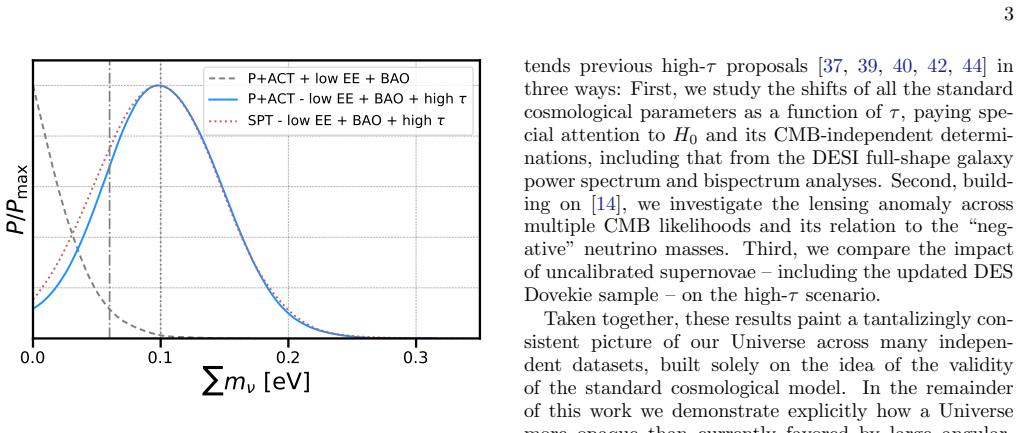
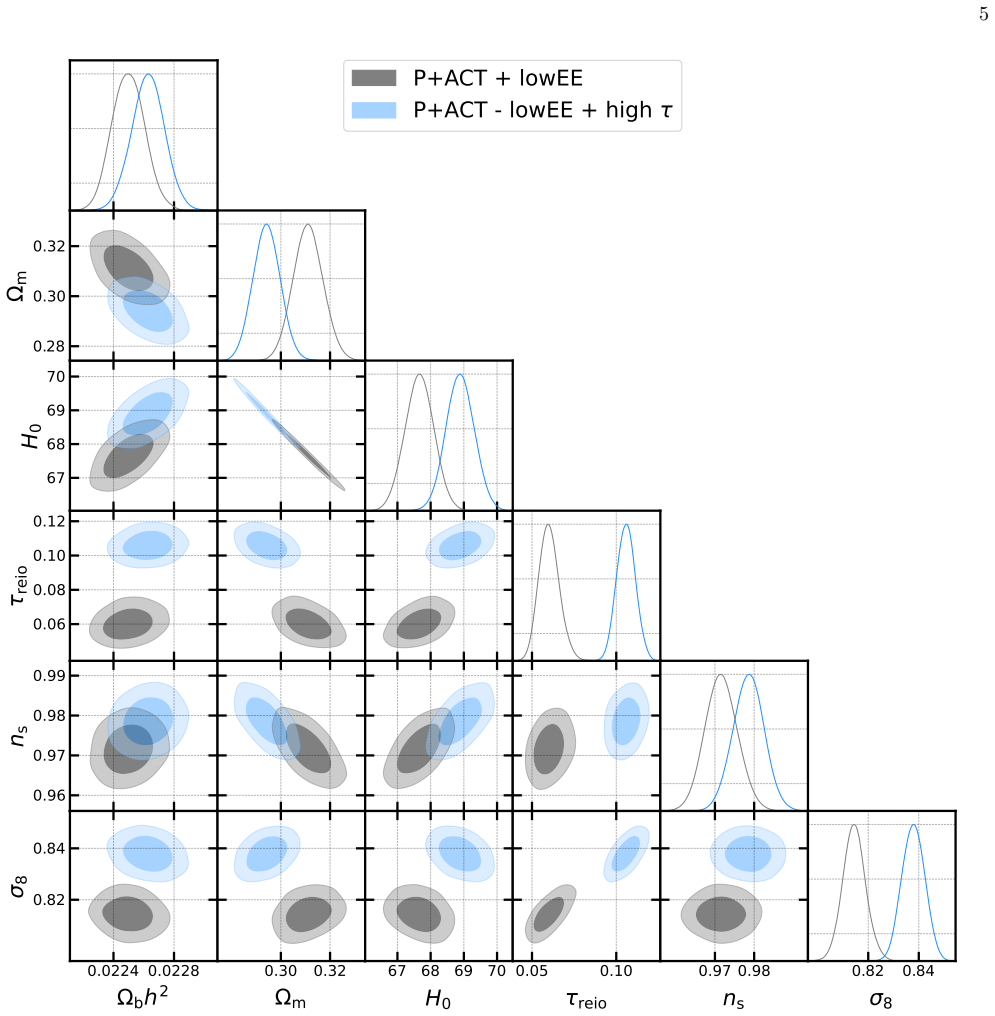
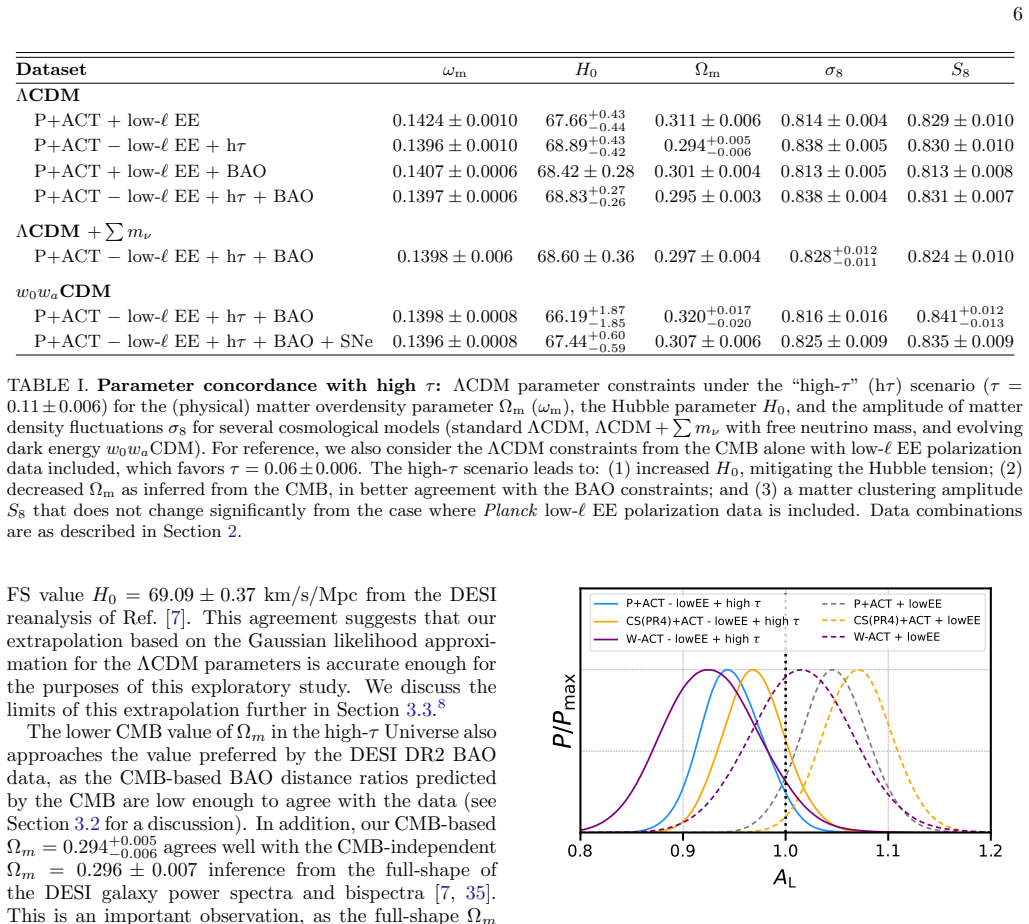
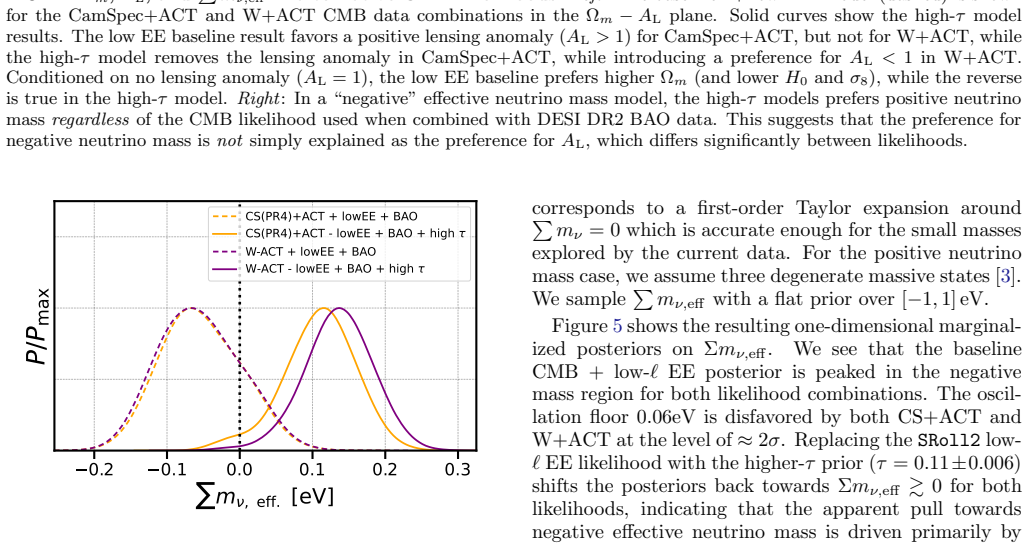
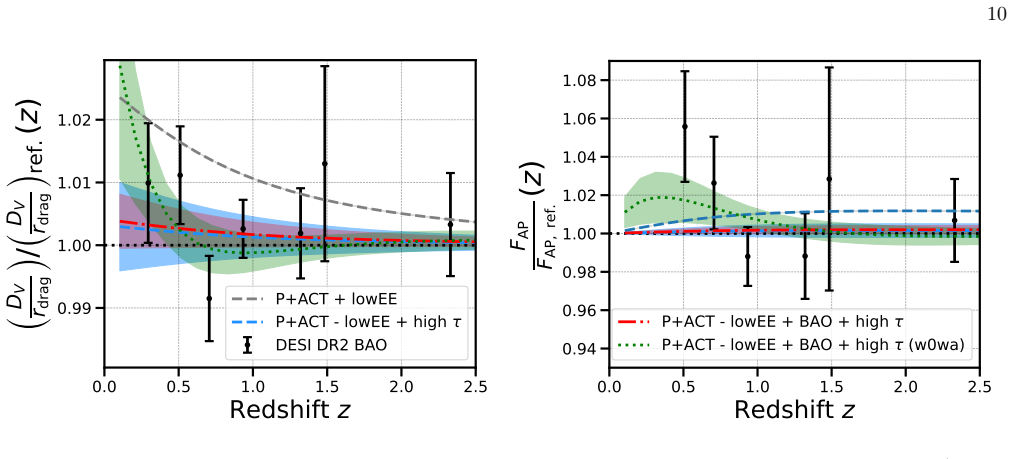
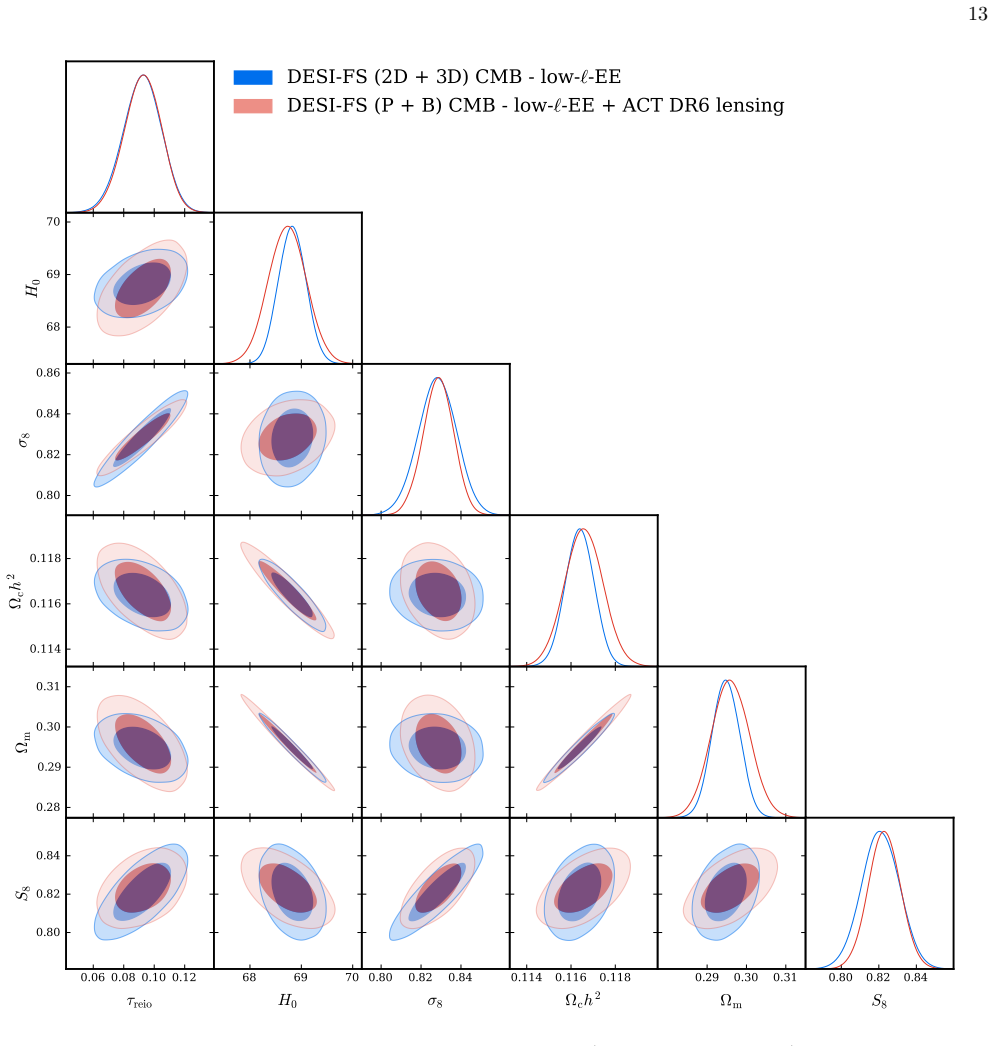
Within this high-τ Universe, we obtain the first 2σ detection of a positive neutrino mass, Σm_ν = 0.10^{+0.04}_{-0.05} eV at 68% C.L., while restoring cosmological concordance between datasets within ΛCDM. In particular, low-redshift distance predictions are consistent with DESI BAO observations and the inferred dark-energy equation-of-state parameters are consistent with a cosmological constant, both with and without supernovae data.
What carries the argument
A high prior on the reionization optical depth τ = 0.11 ± 0.006, chosen to enforce positive neutrino mass and H0 consistency between CMB and DESI BAO/full-shape data.
If this is right
- Low-redshift distance predictions become consistent with DESI BAO observations.
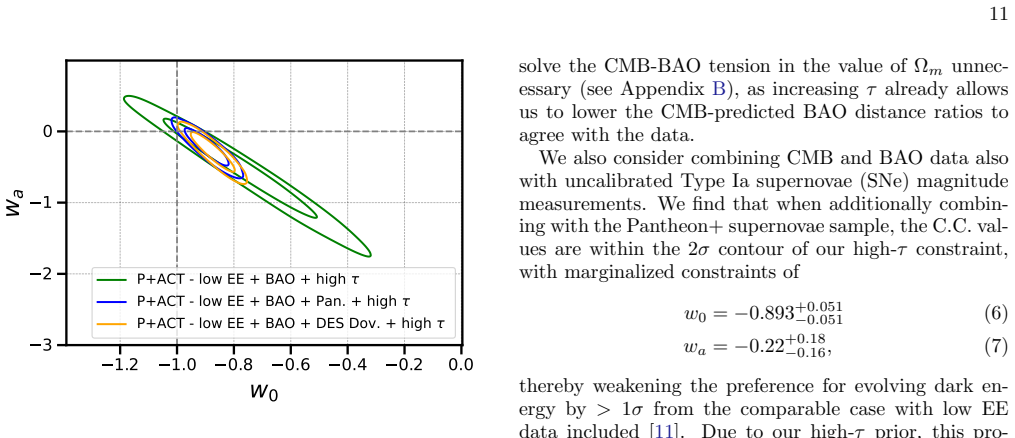
- The inferred dark-energy equation-of-state parameters remain consistent with a cosmological constant even when supernova data are included.
- The preference for negative neutrino mass disappears and the Hubble tension is alleviated inside ΛCDM.
- The requirement for new physics beyond ΛCDM is significantly reduced.
Where Pith is reading between the lines
- Future large-scale polarization experiments could directly test the required τ value and thereby confirm or refute the neutrino-mass detection.
- If the high-τ solution holds, neutrino oscillation and tritium beta-decay experiments would be expected to converge on a mass sum near 0.1 eV.
- The approach suggests that other apparent tensions in cosmology may also be resolved by re-examining early-universe priors rather than introducing new fields.
Load-bearing premise
The optical depth to reionization can be set independently to the specific concordance value 0.11 without violating other observational constraints.
What would settle it
A direct measurement of τ from large-angular-scale CMB polarization that lies well below 0.11 would remove the 2σ positive-mass signal and reintroduce the dataset tensions.
Figures
read the original abstract
The measurement of the sum of neutrino masses is among the primary promises of precision cosmology, achievable by combining complementary early- and late-Universe probes. However, these datasets currently exhibit mild-to-strong disagreements within $\Lambda$CDM and its simplest extensions, giving rise to multiple tensions, including the Hubble tension, the preference for "negative" neutrino mass, and indications of evolving dark energy. It has recently been shown that these tensions can be alleviated by adopting a higher value of the optical depth to reionization parameter, $\tau$, when large-scale cosmic microwave background (CMB) polarization data are ignored. We extend this proposal and show that an especially high prior on $\tau = 0.11 \pm 0.006$ simultaneously addresses all three of these tensions, significantly reducing the need for new physics beyond $\Lambda$CDM. We determine the "concordance" value of $\tau$ by requiring physical neutrino mass and consistency of the Hubble constant, $H_0$, inferred from the CMB and that preferred by the Dark Energy Spectroscopic Instrument (DESI) baryon acoustic oscillation (BAO) and full-shape measurements. Within this high-$\tau$ Universe, we obtain the first $2\sigma$ detection of a positive neutrino mass, $\Sigma m_{\nu} = 0.10^{+0.04}_{-0.05}$~eV at 68\% C.L., while restoring cosmological concordance between datasets within $\Lambda$CDM. In particular, low-redshift distance predictions are consistent with DESI BAO observations and the inferred dark-energy equation-of-state parameters are consistent with a cosmological constant, both with and without supernovae data. The concordance power of our $\tau$ prior further motivates new measurements of $\tau$, e.g., through large angular scale CMB polarization observations with the \textit{LiteBIRD}, CLASS, or proposed PICO experiments. (Abridged)
Editorial analysis
A structured set of objections, weighed in public.
Referee Report
Summary. The manuscript claims that a high prior on the reionization optical depth τ = 0.11 ± 0.006, chosen specifically to enforce positive neutrino mass sum and H0 consistency between CMB and DESI BAO/full-shape data, produces the first 2σ detection of Σm_ν = 0.10^{+0.04}_{-0.05} eV at 68% C.L. while restoring full concordance among datasets inside ΛCDM, eliminating the need for evolving dark energy or other extensions.
Significance. If the τ prior were an independent external constraint, the result would be notable for simultaneously addressing the Hubble tension, negative-mass preference, and dark-energy hints without new physics. The paper does not supply such an independent justification; the prior is instead defined by the very outcomes it is used to produce.
major comments (2)
- [Abstract] Abstract: the concordance value of τ is defined by the requirement of physical (positive) Σm_ν and H0 agreement with DESI; once this prior is imposed, the reported 2σ detection and restored concordance are no longer independent results of the data but direct consequences of the tuning step.
- [Abstract] The procedure is equivalent to scanning τ values until the negative-mass preference and H0 tension disappear, then reporting the mass as detected at 2σ; this circularity is load-bearing for the central claim and cannot be removed by re-analysis within the present framework.
Simulated Author's Rebuttal
We thank the referee for their detailed review and for identifying the central issue of circularity in our choice of τ prior. We respond to each major comment below and indicate where revisions will be made to clarify the exploratory nature of the analysis without misrepresenting the results.
read point-by-point responses
-
Referee: [Abstract] Abstract: the concordance value of τ is defined by the requirement of physical (positive) Σm_ν and H0 agreement with DESI; once this prior is imposed, the reported 2σ detection and restored concordance are no longer independent results of the data but direct consequences of the tuning step.
Authors: We agree that the τ = 0.11 ± 0.006 prior is explicitly determined by the requirements of positive neutrino mass and H0 consistency with DESI, as stated in the manuscript. The 2σ detection and restored concordance are therefore consequences of applying this prior. We will revise the abstract to state upfront that the analysis explores the consequences of a concordance-motivated τ prior rather than presenting an independent detection from the data alone. This revision will also emphasize that the prior is chosen to test whether tensions can be resolved within ΛCDM. revision: yes
-
Referee: [Abstract] The procedure is equivalent to scanning τ values until the negative-mass preference and H0 tension disappear, then reporting the mass as detected at 2σ; this circularity is load-bearing for the central claim and cannot be removed by re-analysis within the present framework.
Authors: The selection process does involve identifying a τ value that achieves physical neutrino mass and dataset concordance, which introduces the noted circularity. We maintain that this is a legitimate way to quantify the impact of a higher τ on the tensions, motivated by the physical requirement of Σm_ν > 0 and the desire for internal consistency. However, we acknowledge the referee's point that the central claim depends on this choice. We will add a dedicated paragraph in the discussion section addressing the limitations of this approach and the need for independent τ measurements (e.g., from LiteBIRD) to break the degeneracy. We disagree that the circularity cannot be mitigated at all, as future data can test the prior independently. revision: partial
Circularity Check
τ prior chosen by requiring positive Σm_ν and H0 concordance, making the reported 2σ detection equivalent to the input choice
specific steps
-
fitted input called prediction
[Abstract]
"We determine the "concordance" value of τ by requiring physical neutrino mass and consistency of the Hubble constant, H0, inferred from the CMB and that preferred by the Dark Energy Spectroscopic Instrument (DESI) baryon acoustic oscillation (BAO) and full-shape measurements. Within this high-τ Universe, we obtain the first 2σ detection of a positive neutrino mass, Σm_ν = 0.10^{+0.04}_{-0.05} eV at 68% C.L., while restoring cosmological concordance between datasets within ΛCDM."
The τ = 0.11 ± 0.006 prior is not an independent external constraint but is defined by the requirement of positive Σm_ν and H0 agreement with DESI. Once this choice is made, the reported positive-mass detection and restored concordance are no longer independent inferences from the data; they are the direct consequence of the selection criterion used to set τ.
full rationale
The paper explicitly determines the central value and uncertainty of the τ prior by requiring the outcomes (physical neutrino mass and H0 consistency with DESI) that are then presented as independent results. This matches the fitted_input_called_prediction pattern: the parameter is tuned to enforce the target, after which the mass 'detection' and concordance are reported. The central claim therefore reduces to the selection step by construction. No other circular steps identified in the provided text.
Axiom & Free-Parameter Ledger
free parameters (1)
- τ prior =
0.11 ± 0.006
axioms (2)
- domain assumption Standard flat ΛCDM cosmology with fixed parameters except those varied in the fit
- domain assumption Large-scale CMB polarization data can be down-weighted or ignored when setting the τ prior
Reference graph
Works this paper leans on
-
[1]
P+ACT + low EE
DA T A We use the following precision cosmology datasets to investigate the high-τUniverse: •P+ACT + low EE: We perform a baseline analy- sis with theSRoll2[45] 2 low-ℓEEpolarization like- lihood included. For our fiducial high-ℓTTTEEE CMB dataset, we use thePlanck2018 (PR3)plik + ACT DR6 high-ℓTTTEEElikelihoods where the Planckdata is cut at the low-ℓmul...
-
[2]
lite” high-ℓlikelihood forT T T EEE (“SPT-3G D1 T&E
data as the lower multipoles are inaccessible to ACT, following the “W-ACT” analysis of Ref. [46], but where we also add the ACT DR6 +PlanckPR4 lensing data5. •SPT: Independent of bothPlanckand ACT, we also consider SPT-3G primary and lensing data [55]. We use thecandl[56] foreground- marginalized “lite” high-ℓlikelihood forT T T EEE (“SPT-3G D1 T&E”) as ...
-
[3]
negative
RESUL TS In this Section, we begin by presenting parameter con- straints from the CMB primary anisotropies and lens- ing in Sec. 3.1: we first show how the high-τprior shifts the ΛCDM parameters inferred from the CMB alone in Sec. 3 3.1 1, and then examine thePlancklens- ing anomaly in the high-τUniverse – its dependence on the choice of likelihood and it...
-
[4]
negative
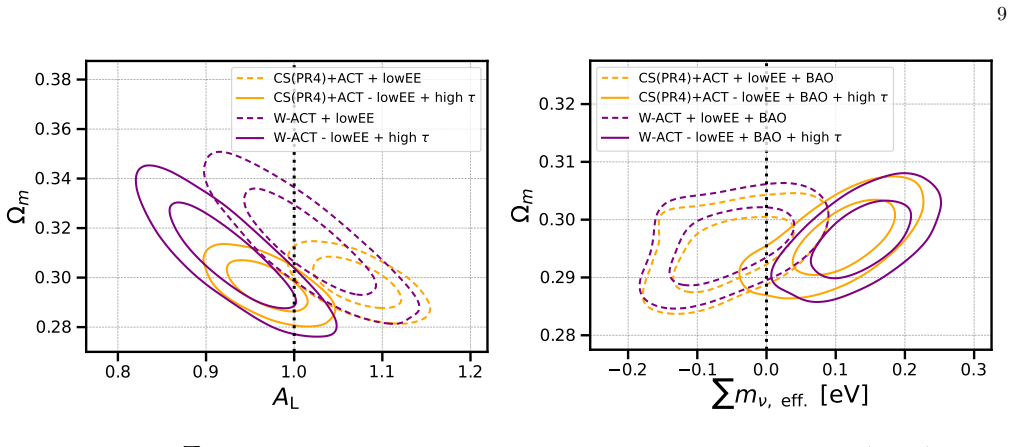
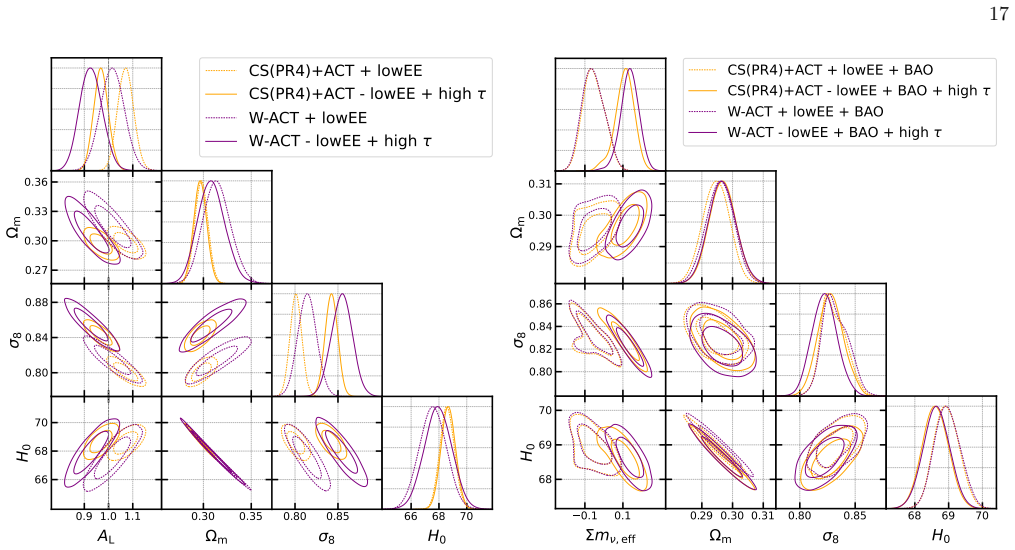
Lensing anomaly and “negative” neutrino mass a. Lensing anomaly:Large-scale structure gener- ates coherent deflections of CMB photons through weak lensing. CMB data is sensitive to this effect at the 2-point level (the smoothing of oscillations in the CMB scalar anisotropy spectra) and at the lensing reconstruction 10 level (reconstruction of the LSS lens...
2018
-
[5]
negative
Neutrino mass The high-τscenario allows for a tentative detection of positive neutrino mass from the combination of CMB and BAO data. Following Ref. [3], we approximate the neu- trino mass sector with three degenerate massive states when considering the ΛCDM model with varied neutrino mass P mν. In a high-τUniverse, we find evidence for the neutrino mass ...
-
[6]
very-high-τ
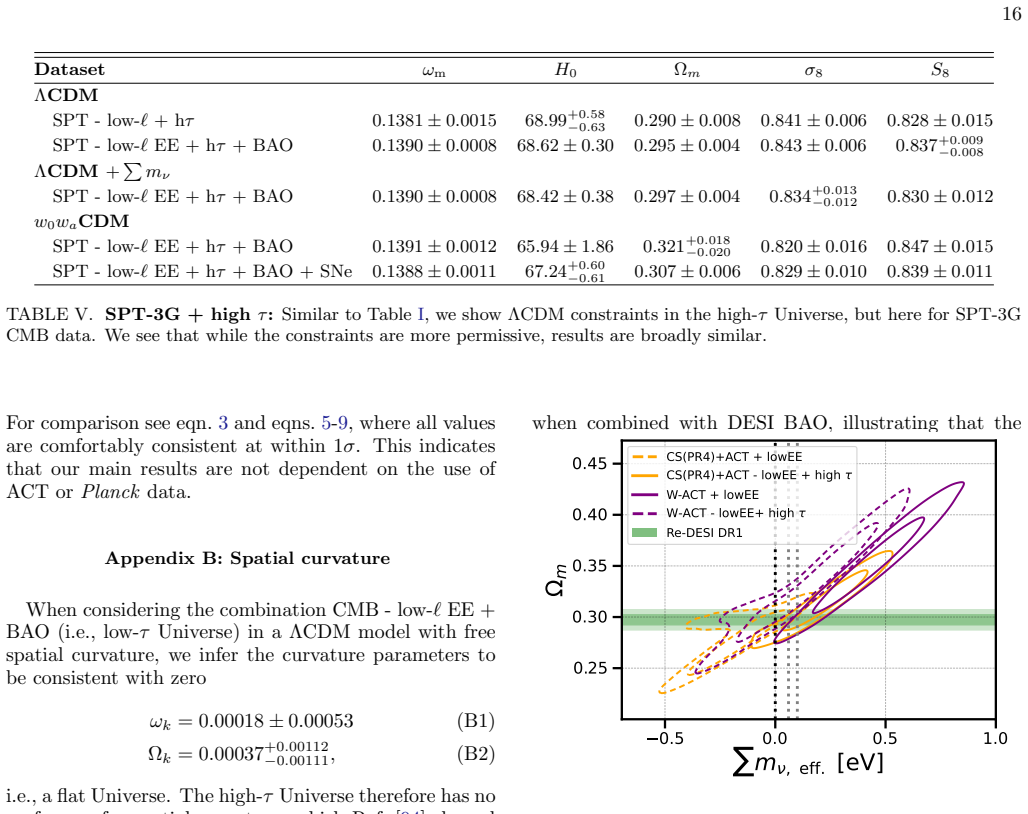
Dark energy andw 0waCDM We now turn to the combination of CMB, DESI BAO, and optionally, SNe data in the context of a dynamical dark energy model. The BAO and SNe data are in some tension within ΛCDM, which might lead to some signif- icant cracks in the high-τΛCDM model. Here we show, however, that these cracks do not emerge: the addition of the SNe data ...
-
[7]
This suggestion is even more alarming when combining CMB data with DESI DR2 Baryonic Acoustic Oscillation distance measurements, which increases this unphysical preference
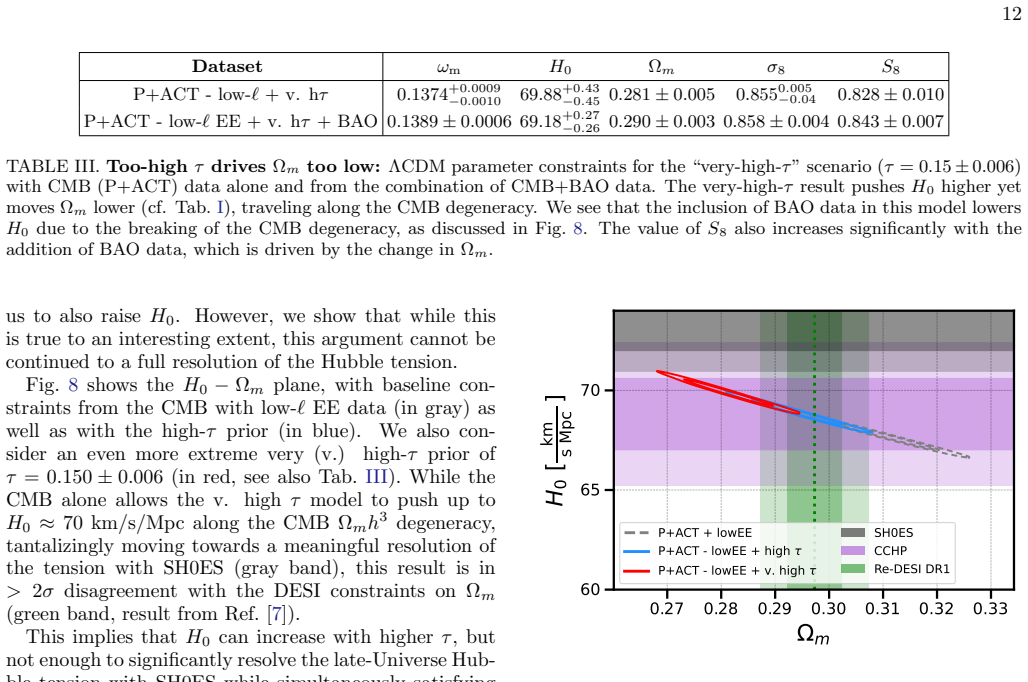
DISCUSSION The low optical depth to reionizationτpreferred by Planck2018 data suggests unphysical cosmological neu- trino mass constraints. This suggestion is even more alarming when combining CMB data with DESI DR2 Baryonic Acoustic Oscillation distance measurements, which increases this unphysical preference. It is known that the value ofτand neutrino m...
2018
-
[8]
we infer the first 2σevidence for a positive neutrino mass within ΛCDM,
-
[9]
we remove evidence for dynamical dark energy ob- tained from DESI BAO measurements,
-
[10]
we show that thePlanckCMB data (without low- ℓEE polarization) shows no preference for excess lensing amplitude,
-
[11]
we eliminate the preference for negative effective neutrino mass,
-
[12]
we resolve thePlanck2018 lensing anomaly through the inference of physical neutrino mass,
-
[13]
we lower the CMB-inferred value of Ω m to better agree with the value inferred from the BAO,
-
[14]
we reduce the Hubble tension as seen by SH0ES to ≈4σ(with respect to CCHP, there is no tension) and alleviate the disagreement between DESI full- shape + CMB lensing cross-correlation data,
-
[15]
nega- tive
we perform a consistency analysis using DESI full- shape and BAO data for the first time, which sup- ports the highτUniverse. The high value ofτthat we have chosen is signif- icantly larger than not just the low-ℓEE value, but also than values found in the literature of astrophysi- cal inference ofτ, such as from Lyman-αdamping wings and high-redshift Jam...
-
[16]
E. Di Valentino, O. Mena, S. Pan, L. Visinelli, W. Yang, A. Melchiorri et al.,In the realm of the Hubble tension-a review of solutions,Classical and Quantum Gravity38(2021) 153001 [2103.01183]
Pith/arXiv arXiv 2021
-
[17]
E. Abdalla et al.,Cosmology intertwined: A review of the particle physics, astrophysics, and cosmology associated with the cosmological tensions and anomalies, JHEAp34(2022) 49 [2203.06142]
Pith/arXiv arXiv 2022
-
[18]
Planck Collaboration, N. Aghanim, Y. Akrami, M. Ashdown, J. Aumont, C. Baccigalupi et al.,Planck 2018 results. VI. Cosmological parameters,A&A641 (2020) A6 [1807.06209]
Pith/arXiv arXiv 2018
-
[19]
L. Breuval, A. G. Riess, S. Casertano, W. Yuan, L. M. Macri, M. Romaniello et al.,Small Magellanic Cloud Cepheids Observed with the Hubble Space Telescope Provide a New Anchor for the SH0ES Distance Ladder, Astrophys. J.973(2024) 30 [2404.08038]
arXiv 2024
-
[20]
A. G. Riess, W. Yuan, L. M. Macri, D. Scolnic, D. Brout, S. Casertano et al.,A Comprehensive Measurement of the Local Value of the Hubble Constant with 1 km s −1 Mpc−1 Uncertainty from the Hubble Space Telescope and the SH0ES Team,ApJ934(2022) L7 [2112.04510]
work page internal anchor Pith review Pith/arXiv arXiv 2022
-
[21]
Efstathiou,To H0 or not to H0?,Mon
G. Efstathiou,To H0 or not to H0?,Mon. Not. Roy. Astron. Soc.505(2021) 3866 [2103.08723]
-
[22]
M. M. Ivanov, J. M. Sullivan, S.-F. Chen, A. Chudaykin, M. Maus and O. H. E. Philcox, Reanalyzing DESI DR1: 4. Percent-Level Cosmological Constraints from Combined Probes and Robust Evidence for the Normal Neutrino Mass Hierarchy,arXiv e-prints (2026) arXiv:2601.16165 [2601.16165]
- [23]
-
[24]
Planck Collaboration, N. Aghanim, Y. Akrami, M. Ashdown, J. Aumont, C. Baccigalupi et al.,Planck 2018 results. VIII. Gravitational lensing,A&A641 (2020) A8 [1807.06210]
-
[25]
A. G. Adame, J. Aguilar, S. Ahlen, S. Alam, D. M. Alexander, M. Alvarez et al.,DESI 2024 VI: cosmological constraints from the measurements of baryon acoustic oscillations,J. Cosmology Astropart. Phys.2025(2025) 021 [2404.03002]
work page internal anchor Pith review Pith/arXiv arXiv 2024
-
[26]
DESI DR2 Results II: Measurements of Baryon Acoustic Oscillations and Cosmological Constraints
M. Abdul Karim, J. Aguilar, S. Ahlen, S. Alam, L. Allen, C. Allende Prieto et al.,DESI DR2 results. II. Measurements of baryon acoustic oscillations and cosmological constraints,Phys. Rev. D112(2025) 083515 [2503.14738]
work page internal anchor Pith review Pith/arXiv arXiv 2025
-
[27]
N. Craig, D. Green, J. Meyers and S. Rajendran,Noνs is Good News,Journal of High Energy Physics2024 18 Dataset AL P mν,eff CS(PR4)+ACT + low-ℓEE 1.0708±0.0330 – CS(PR4)+ACT - low-ℓEE + hτ 0.9693+0.0299 −0.0303 – W+ACT + low-ℓEE 1.0161+0.0487 −0.0494 – W+ACT - low-ℓEE + hτ 0.9280+0.0440 −0.0490 – CS(PR4)+ACT + low-ℓEE –−0.170 +0.137 −0.135 CS(PR4)+ACT - lo...
-
[28]
M. Loverde and Z. J. Weiner,Massive neutrinos and cosmic composition,J. Cosmology Astropart. Phys. 2024(2024) 048 [2410.00090]
- [30]
-
[31]
P. W. Graham, D. Green and J. Meyers,New interpretations of the cosmological preference for a negative neutrino mass,Phys. Rev. D113(2026) 043514 [2508.20999]
arXiv 2026
-
[32]
L. Herold and M. Kamionkowski,Revisiting the impact of neutrino mass hierarchies on neutrino mass constraints in light of recent DESI data,Phys. Rev. D 111(2025) 083518 [2412.03546]
- [33]
-
[34]
The DESI Experiment Part I: Science,Targeting, and Survey Design
DESI Collaboration, A. Aghamousa, J. Aguilar, S. Ahlen, S. Alam, L. E. Allen et al.,The DESI Experiment Part I: Science,Targeting, and Survey Design,arXiv e-prints(2016) arXiv:1611.00036 [1611.00036]
work page internal anchor Pith review Pith/arXiv arXiv 2016
-
[35]
Z.-Y. Peng and Y.-S. Piao,Dark energy and lensing anomaly in Planck CMB data,Phys. Rev. D112(2025) 023502 [2502.04641]
- [36]
-
[37]
N. Sch¨ oneberg, G. F. Abell´ an, A. P. S´ anchez, S. J. Witte, V. Poulin and J. Lesgourgues,The H 0 Olympics: A fair ranking of proposed models,Phys. Rep.984 (2022) 1 [2107.10291]
-
[38]
R. de Belsunce, S. Gratton, W. Coulton and G. Efstathiou,Inference of the optical depth to reionization from low multipole temperature and polarization Planck data,Mon. Not. Roy. Astron. Soc. 507(2021) 1072 [2103.14378]
-
[39]
C. L. Bennett, D. Larson, J. L. Weiland, N. Jarosik, G. Hinshaw, N. Odegard et al.,Nine-year Wilkinson Microwave Anisotropy Probe (WMAP) Observations: Final Maps and Results,ApJS208(2013) 20 [1212.5225]. [25]Planckcollaboration,Planck intermediate results. XLVI. Reduction of large-scale systematic effects in HFI polarization maps and estimation of the rei...
work page internal anchor Pith review Pith/arXiv arXiv 2013
- [40]
-
[41]
R. de Belsunce, S. Gratton and G. Efstathiou,Testing for spectral index variations in polarized CMB foregrounds,Mon. Not. Roy. Astron. Soc.517(2022) 2855 [2205.13968]
-
[42]
On the impact of large angle CMB polarization data on cosmological parameters
M. Lattanzi, C. Burigana, M. Gerbino, A. Gruppuso, N. Mandolesi, P. Natoli et al.,On the impact of large angle CMB polarization data on cosmological parameters,JCAP02(2017) 041 [1611.01123]
work page internal anchor Pith review Pith/arXiv arXiv 2017
- [43]
-
[44]
V. Genesini, G. Galloni, L. Pagano, P. Campeti and M. Lattanzi,Cross-spectra likelihood for robustτ constraints from all satellite polarisation data, 2603.22454. 19 [31]CLASScollaboration,A Measurement of the Largest-scale CMB E-mode Polarization with CLASS, Astrophys. J.986(2025) 111 [2501.11904]
-
[45]
Y. Kageura, M. Ouchi, F. Naokawa, H. Umeda, A. Matsumoto, Y. Harikane et al.,A New Constraint on the Optical Depth from the Reionization History Independent of CMB Large-Scale E-Mode Polarization, 2601.09644
-
[46]
J. E. Gunn and B. A. Peterson,On the Density of Neutral Hydrogen in Intergalactic Space.,ApJ142 (1965) 1633
1965
- [47]
-
[48]
A. Chudaykin, M. M. Ivanov and O. H. E. Philcox, Reanalyzing DESI DR1. I.ΛCDM constraints from the power spectrum and bispectrum,Phys. Rev. D113 (2026) 063502 [2507.13433]
-
[49]
Reanalyzing DESI DR1: 2. Constraints on Dark Energy, Spatial Curvature, and Neutrino Masses
A. Chudaykin, M. M. Ivanov and O. H. E. Philcox, Reanalyzing DESI DR1. II. Constraints on dark energy, spatial curvature, and neutrino masses,Phys. Rev. D 113(2026) 123506 [2511.20757]
work page internal anchor Pith review Pith/arXiv arXiv 2026
- [50]
-
[51]
I. J. Allali, P. Singh, J. Fan and L. Li,Reionization and the Hubble constant: correlations in the Cosmic Microwave Background,J. Cosmology Astropart. Phys. 2025(2025) 082 [2503.05691]
arXiv 2025
- [52]
-
[53]
T. Jhaveri, T. Karwal and W. Hu,Turning a negative neutrino mass into a positive optical depth, Phys. Rev. D112(2025) 043541 [2504.21813]
-
[54]
E. Calabrese, J. C. Hill, H. T. Jense, A. La Posta, I. Abril-Cabezas, G. E. Addison et al.,The Atacama Cosmology Telescope: DR6 constraints on extended cosmological models,J. Cosmology Astropart. Phys. 2025(2025) 063 [2503.14454]
Pith/arXiv arXiv 2025
-
[55]
W. Giar` e, E. Di Valentino and A. Melchiorri,Measuring the reionization optical depth without large-scale CMB polarization,Phys. Rev. D109(2024) 103519 [2312.06482]
- [56]
-
[57]
Raising the reionization optical depth with inflationary CMB features
T. Jhaveri, W. Hu and V. Miranda,Raising the reionization optical depth with inflationary CMB features,arXiv e-prints(2026) arXiv:2606.20795 [2606.20795]
work page internal anchor Pith review Pith/arXiv arXiv 2026
-
[58]
L. Pagano, J.-M. Delouis, S. Mottet, J.-L. Puget and L. Vibert,Reionization optical depth determination from Planck HFI data with ten percent accuracy,A&A 635(2020) A99 [1908.09856]
-
[59]
The Atacama Cosmology Telescope: DR6 Power Spectra, Likelihoods and $\Lambda$CDM Parameters
T. Louis, A. La Posta, Z. Atkins, H. T. Jense, I. Abril-Cabezas, G. E. Addison et al.,The Atacama Cosmology Telescope: DR6 power spectra, likelihoods andΛCDM parameters,J. Cosmology Astropart. Phys. 2025(2025) 062 [2503.14452]
work page internal anchor Pith review Pith/arXiv arXiv 2025
-
[60]
M. S. Madhavacheril, F. J. Qu, B. D. Sherwin, N. MacCrann, Y. Li, I. Abril-Cabezas et al.,The Atacama Cosmology Telescope: DR6 Gravitational Lensing Map and Cosmological Parameters,ApJ962 (2024) 113 [2304.05203]
work page internal anchor Pith review Pith/arXiv arXiv 2024
-
[61]
F. J. Qu, B. D. Sherwin, M. S. Madhavacheril, D. Han, K. T. Crowley, I. Abril-Cabezas et al.,The Atacama Cosmology Telescope: A Measurement of the DR6 CMB Lensing Power Spectrum and Its Implications for Structure Growth,ApJ962(2024) 112 [2304.05202]
work page internal anchor Pith review Pith/arXiv arXiv 2024
-
[62]
CMB lensing from Planck PR4 maps
J. Carron, M. Mirmelstein and A. Lewis,CMB lensing from Planck PR4 maps,J. Cosmology Astropart. Phys. 2022(2022) 039 [2206.07773]
work page internal anchor Pith review Pith/arXiv arXiv 2022
-
[63]
The Pantheon+ Analysis: Cosmological Constraints
D. Brout, D. Scolnic, B. Popovic, A. G. Riess, A. Carr, J. Zuntz et al.,The Pantheon+ Analysis: Cosmological Constraints,ApJ938(2022) 110 [2202.04077]
work page internal anchor Pith review Pith/arXiv arXiv 2022
-
[64]
B. Popovic, P. Shah, W. D. Kenworthy, R. Kessler, T. M. Davis, A. Goobar et al.,The Dark Energy Survey Supernova Program: A Reanalysis Of Cosmology Results And Evidence For Evolving Dark Energy With An Updated Type Ia Supernova Calibration,arXiv e-prints(2025) arXiv:2511.07517 [2511.07517]
Pith/arXiv arXiv 2025
- [65]
-
[66]
E. Rosenberg, S. Gratton and G. Efstathiou,CMB power spectra and cosmological parameters from Planck PR4 with CamSpec,MNRAS517(2022) 4620 [2205.10869]. [54]Planckcollaboration,P lanckintermediate results. LVII. Joint Planck LFI and HFI data processing, Astron. Astrophys.643(2020) A42 [2007.04997]
Pith/arXiv arXiv 2022
- [67]
-
[68]
L. Balkenhol, C. Trendafilova, K. Benabed and S. Galli, candl: cosmic microwave background analysis with a differentiable likelihood,Astron. Astrophys.686(2024) A10 [2401.13433]
-
[69]
E. Camphuis, W. Quan, L. Balkenhol, A. R. Khalife, F. Ge, F. Guidi et al.,SPT-3G D1: CMB temperature and polarization power spectra and cosmology from 2019 and 2020 observations of the SPT-3G Main field,arXiv e-prints(2025) arXiv:2506.20707 [2506.20707]
Pith/arXiv arXiv 2019
-
[70]
J. Torrado and A. Lewis,Cobaya: Code for Bayesian Analysis of hierarchical physical models,JCAP05 (2021) 057 [2005.05290]
Pith/arXiv arXiv 2021
-
[71]
S. Goldstein and J. C. Hill,A 2% determination ofN eff from primordial element abundance, cosmic microwave background, and baryon acoustic oscillation measurements,arXiv e-prints(2026) arXiv:2603.13226 [2603.13226]
- [72]
-
[73]
J. Khoury, M.-X. Lin and M. Trodden,Apparent w<-1 and a Lower S8 from Dark Axion and Dark Baryons Interactions,Phys. Rev. Lett.135(2025) 181001 [2503.16415]
-
[74]
C. M. Hirata and U. Seljak,Reconstruction of lensing from the cosmic microwave background polarization, Phys. Rev. D68(2003) 083002 [astro-ph/0306354]
work page internal anchor Pith review Pith/arXiv arXiv 2003
- [75]
-
[76]
Cosmic Microwave Weak lensing data as a test for the dark universe
E. Calabrese, A. Slosar, A. Melchiorri, G. F. Smoot and O. Zahn,Cosmic microwave weak lensing data as a test for the dark universe,Phys. Rev. D77(2008) 123531 [0803.2309]
work page internal anchor Pith review Pith/arXiv arXiv 2008
-
[77]
Planck Collaboration, P. A. R. Ade, N. Aghanim, C. Armitage-Caplan, M. Arnaud, M. Ashdown et al., Planck 2013 results. XVI. Cosmological parameters, A&A571(2014) A16 [1303.5076]
work page internal anchor Pith review Pith/arXiv arXiv 2013
-
[78]
Planck Collaboration, P. A. R. Ade, N. Aghanim, M. Arnaud, M. Ashdown, J. Aumont et al.,Planck 2015 results. XIII. Cosmological parameters,A&A594 (2016) A13 [1502.01589]
Pith/arXiv arXiv 2015
-
[79]
G. E. Addison, Y. Huang, D. J. Watts, C. L. Bennett, M. Halpern, G. Hinshaw et al.,Quantifying Discordance in the 2015 Planck CMB Spectrum,ApJ818(2016) 132 [1511.00055]
Pith/arXiv arXiv 2015
-
[80]
S. Roy Choudhury and T. Okumura,Updated Cosmological Constraints in Extended Parameter Space with Planck PR4, DESI Baryon Acoustic Oscillations, and Supernovae: Dynamical Dark Energy, Neutrino Masses, Lensing Anomaly, and the Hubble Tension,ApJ 976(2024) L11 [2409.13022]
work page internal anchor Pith review Pith/arXiv arXiv 2024
-
[81]
C. Garcia-Quintero, H. E. Noriega, A. de Mattia, A. Aviles, K. Lodha, D. Chebat et al.,Cosmological implications of DESI DR2 BAO measurements in light of the latest ACT DR6 CMB data,Phys. Rev. D112 (2025) 083529 [2504.18464]
arXiv 2025
discussion (0)
Sign in with ORCID, Apple, or X to comment. Anyone can read and Pith papers without signing in.