REVIEW 4 major objections 4 minor 54 references
A $\pi$-shaped Quantum Device for Implementation of Bell States in Solid State Environment
T0 review · 4 major / 4 minor · reviewed 2026-08-14 · deepseek-v4-flash
Pith's one-line read A π-shaped solid-state device is proposed to entangle two electron spins into Bell states and run universal quantum gates.
desk verdict The gate identities are standard and fine, but the device Hamiltonian's eigenstates don't solve the stated model, leaving the Bell-state claim unsupported. read the letter →
The pith
A machine-rendered reading of the paper's core claim, the machinery that carries it, and where it could break.
The reading
What carries the argument
The load-bearing object is the exchange interaction between the source spin and the channel spin, written as $H_{\mathrm{ex}} = J(t)\mathbf{S}_s\cdot\mathbf{S}_c$, together with the operator identity $\mathbf{S}_s\cdot\mathbf{S}_c = \frac{1}{4}(2U_{\mathrm{SWAP}} - I)$, which ties the physical exchange energy to the SWAP gate. The paper uses this identity to convert a timed exchange pulse into $U_{\mathrm{SWAP}}$ ($\alpha=\pi$) or $U_{\sqrt{\mathrm{SWAP}}}$ ($\alpha=\pi/2$). Electrical control is provided by the Rashba spin-orbit term, which shifts the spin energies and allows the device to select Bell states; the channel energy spectrum is computed by WKB with quasi-linearization to show which levels are available for the injected spins to occupy.
What would settle it
Take the Hamiltonian of Eq. (20) and the wave function of Eq. (22), form the 4×4 matrix of Eq. (23), and check whether it equals its conjugate transpose; if not, the listed eigenstates cannot be the channel states that produce the Bell pairs. Equivalently, numerically diagonalize the channel Hamiltonian and compare the lowest four eigenstates with $|\phi^\pm\rangle$ and $|\psi^\pm\rangle$; a mismatch would falsify the entanglement claim.
Extended reading notes
Core claim
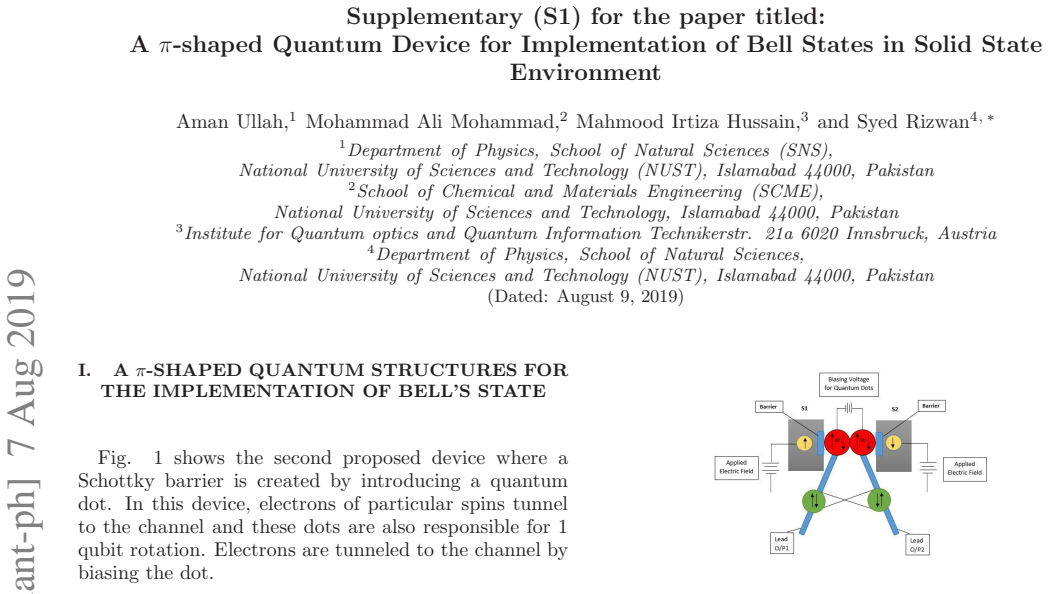
The central claim, stated on the authors' own terms, is that a π-shaped geometry—two spin-polarized sources feeding a channel whose length is kept below the spin coherence length—provides a two-qubit system whose exchange Hamiltonian $H_{\mathrm{ex}} = J(t) \mathbf{S}_s \cdot \mathbf{S}_c$ generates maximal entanglement. The four source–channel spin combinations evolve into the Bell basis, and the Rashba term adds a voltage-tunable energy splitting $\langle H_R\rangle$ that selects which Bell pair appears. Setting the exchange pulse area to $\alpha = \pi$ realizes SWAP; $\alpha=\pi/2$ realizes the square-root of SWAP; and because CNOT is built from two $\sqrt{\mathrm{SWAP}}$ gates and single-qubit rotations, the device is claimed to be universal for quantum computation. The paper also proposes a concrete fabrication flow using nanowire deposition, electron-beam lithography, and magnetic contacts.
Load-bearing premise
The load-bearing assumption is that the four spin-labeled wave functions written in Eqs. (24)–(27) are genuine energy eigenstates of the channel Hamiltonian, but the paper does not show this because the Hamiltonian is written in mismatched coordinates and the coupling matrix does not have the required symmetry.
Editorial extensions
If this is right
- Bell states can be produced on demand by applying a voltage pulse and a detuning magnetic-field pulse to the π-shaped device.
- A single exchange pulse with $\alpha=\pi/2$ implements $U_{\sqrt{\mathrm{SWAP}}}$, and $\alpha=\pi$ gives SWAP; combined with single-qubit rotations this yields CNOT.
- The device could act as a solid-state interconnect that moves entangled pairs between distant parts of a quantum chip without converting to photons.
- Because the channel is a nanowire shorter than the spin coherence length, the short-range-exchange limitation of quantum-dot qubit pairs is avoided.
Reading between the lines
- The gate-construction section is not tied to the nanowire geometry: the identity $\mathbf{S}_s\cdot\mathbf{S}_c = \frac{1}{4}(2U_{\mathrm{SWAP}} - I)$ holds for any two spin-1/2 particles, so the $\alpha=\pi/2$ pulse sequence would transfer directly to donor-spin or gate-defined-dot qubits.
- A numerical solution of the channel Hamiltonian, using the stated quartic potential and 1D Coulomb interaction, would test whether the first four eigenstates really coincide with the Bell states; that is the paper's most direct testable extension.
- If the device is realized, measuring the two-qubit correlator $\langle \sigma_z^{(s)}\sigma_z^{(c)}\rangle$ after a $\pi/2$ pulse would distinguish $|\psi^-\rangle$ (correlator $-1$) from the other Bell states.
Signed reviews
Editorial analysis
A structured set of objections, weighed in public.
Referee Report
Summary. The manuscript proposes a π-shaped solid-state device in which spin-polarized electrons from two sources are tunneled into a channel where an exchange interaction between source and channel spins is claimed to generate Bell states. The authors derive single-particle energy spectra for the source and channel, assert that electrical control of the channel eigenstates yields the Bell states, and show that U_SWAP, U_√SWAP, and CNOT gates follow from the exchange evolution. A fabrication scheme is also described.
Significance. If the device model were sound, a solid-state interconnect that generates Bell states under electrical control and implements √SWAP/CNOT could be a useful contribution. However, the central physical claim depends on channel eigenstates that are not solutions of the stated Hamiltonian, so the device model does not establish the entanglement claim. The gate algebra in Sec. V is correct but standard, and it does not rescue the missing physical derivation.
major comments (4)
- [IV.B.2, Eqs. (20) and (22)] The channel Hamiltonian in Eq. (20) contains a quartic confinement term in x, (m*ω²/8a_B²)(x²−a²)², while the trial wavefunction in Eq. (22) is a product of Gaussians in x and y, exp(−y²/2λ² − x²/2a_B²), times a plane wave. This Gaussian is not an eigenfunction of the quartic potential, and Eq. (12) earlier places the quartic potential in y rather than x, making the model internally inconsistent. Consequently, the states in Eqs. (24)–(27) are not derived from the stated channel Hamiltonian.
- [IV.B.2, Eq. (23)] The 4×4 matrix in Eq. (23) is not Hermitian as printed: for example, the (1,2) element is 0 while the (2,1) element is ⟨H_R⟩, so M_ij ≠ (M_ji)*. Moreover, the vectors in Eqs. (24)–(27) do not satisfy the eigenvalue equation; taking ⟨H_0⟩=1 and ⟨H_R⟩=1/2, the vector φ↓↓ from Eq. (27) does not map to E↓↓ times itself. The listed energy eigenvalues and eigenstates are therefore not actual eigenvalues and eigenvectors of the claimed device Hamiltonian.
- [IV.B.2, Eqs. (20)–(27)] The model uses a single-particle Hamiltonian in Eq. (20) but constructs a 4×4 matrix in the two-spin basis |↑↑⟩, |↑↓⟩, |↓↑⟩, |↓↓⟩ with a single four-component spinor wavefunction. A single-particle Hamiltonian cannot describe two-electron exchange, and the exchange Hamiltonian H_ex in Eq. (30) is introduced without being derived from the device. The connection between the channel electrostatics and the entangling gate is therefore missing.
- [V, Eq. (31)] The expansion of (U_SWAP)^α in the Bell basis is the spectral decomposition of the SWAP operator and holds by construction for any two-qubit system. Using this identity to claim that the device implements the gates presupposes both that the device physically produces the Bell states and that the time evolution is governed by H_ex; neither of these is established by the preceding sections, so the gate implementation follows from assumed input states rather than from the device model.
minor comments (4)
- [IV.B.2, Eq. (22)] The stated normalization constant (1/(a_B²λ²π²))^{1/4} is inconsistent with the product of two one-dimensional Gaussian integrals; for exp(−x²/2a_B² − y²/2λ²) the correct normalization is 1/√(2π a_B λ).
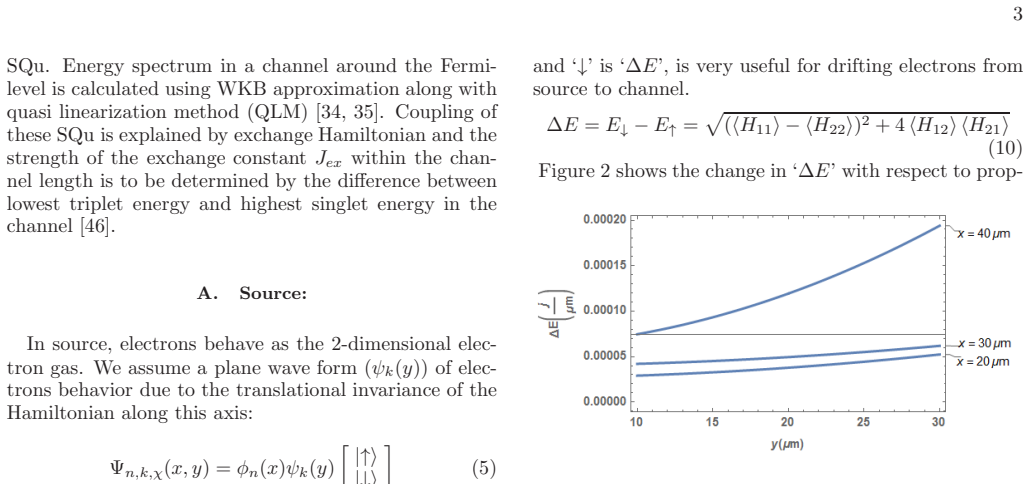
- [IV.A, Eq. (9)] The matrix elements H_{11}, H_{12}, H_{21}, H_{22} are not provided in the main text; the supplementary file repeats only the eigenvalue formulas and does not give these expectation values, so the source-energy calculation cannot be checked.
- [V, Eq. (33)] The parameter α is defined as α = ∫ J(t)dt in Eq. (33), but later in the same section α is set to (1/ℏ)∫ J dt; the factor of 1/ℏ should be handled consistently.
- [I and VII] The abbreviation 'SQu' is used without definition, and the conclusion contains the typo 'acheive'; the manuscript would benefit from a careful proofreading pass.
Circularity Check
No significant circularity: the gate identities are standard mathematical facts, and the device's Bell-state generation is mathematically unsupported rather than derived from its own conclusion.
full rationale
The paper's derivation chain contains no step where a claimed prediction reduces by construction to an input. Equation (31) is the standard spectral decomposition of the fractional SWAP operator in the Bell basis; it is a mathematical identity, not a fitted or assumed result, and the pulse-area parameter α in Eq. (33) comes independently from time evolution under the exchange interaction. Equations (36)-(37) therefore follow from α without assuming the device's Bell-state output. The only self-citation, Ref. [17] (Hussain et al.), appears in the introduction as one of several examples of entanglement-generation approaches and is not load-bearing for the device claim. There are serious correctness problems: the 4x4 matrix in Eq. (23) is not Hermitian, the claimed eigenvectors in Eqs. (24)-(27) do not satisfy the stated eigenvalue equation, and the step from these channel eigenstates to 'desired outputs; |φ±⟩ and |ψ±⟩' in Section IV.B.2 is asserted rather than demonstrated. These are omissions and mathematical errors, not circular reductions: no equation used to support the Bell-state claim is equivalent by construction to the claim itself. A fair circularity analysis therefore returns a score of 0, while leaving the correctness concerns to a separate assessment.
Assumptions & free parameters
free parameters (2)
- g (QLM initial guess parameter)
- λ (Gaussian width in channel wave function)
assumptions (3)
- ad hoc to paper The channel wave function factorizes as a Gaussian in x and y times a plane wave along x (Eq. 22), with independent widths a_B and λ.
- domain assumption The exchange interaction Hex = J(t) S_s·S_c (Eq. 30) can be turned on and off to generate Bell states, with the pulse area α controlled by the time integral of J(t).
- standard math The QLM iteration with zero iterate l0 = -g y converges to the correct ground-state energy E1 of the quartic-plus-Coulomb potential.
Cite this review
Pith. "Pith review of A $\pi$-shaped Quantum Device for Implementation of Bell States in Solid State Environment." pith.science (2026). https://pith.science/paper/6WY6F64N
@misc{pith2026190802855,
  author       = {Pith},
  title        = {Pith review of: A $\pi$-shaped Quantum Device for Implementation of Bell States in Solid State Environment},
  year         = {2026},
  howpublished = {\url{https://pith.science/paper/6WY6F64N}},
  note         = {Machine review of arXiv:1908.02855}
}
abstract
Electronic spin-qubit is key ingredient for quantum information processing in a solid state environment. We present a $\pi$-shaped two-qubit entanglement device capable of measuring the resultant states in Bell basis. In our device, source spins ($\uparrow_s$ or $\downarrow_s$) are electrically generated and tunnelled to channel where they interact with channel spins ($\uparrow_c$ or $\downarrow_c$) via exchange interaction which is responsible for 2-qubit entanglement. Electrical control over spins gives rise to the Bell states. The $U_{\sqrt{SWAP}}$ and CNOT gate operations are implemented through these Bell states for universal quantum computation. $\pi$-shaped quantum device can be used as a solid state interconnect between different parts of the circuit in integrated chips.
Figures

Figures from the paper (1 more)

Reference graph
Works this paper leans on
-
[1]
Energy Spectrum in channel around fermi-level: SQu, drifted from source will interact with SQu avail- able in different energy state in channel around fermi- level. This energy spectrum tells us about which energy states are available for interaction and how much energy of source SQu is needed for exchange interaction. A com- plete wave function representi...
-
[2]
Dynamics for 2 qubit and exchange interaction In the channel, intrinsic potential consists of har- monic and Coulombic potential. Since, the channel is 1-dimensional (spin electrons are propagating along y- direction), there is a strong parabolic confinement along ‘x-’ and ‘y-’ directions. So, quartic harmonic poten- tial is chosen due to merging of two ha...
work page 2016
-
[3]
Tittel, J
W. Tittel, J. Brendel, H. Zbinden, and N. Gisin, Physical Review Letters 84, 4737 (2000)
2000
- [4]
-
[5]
Kloeffel and D
C. Kloeffel and D. Loss, Annu. Rev. Condens. Matter Phys. 4, 51 (2013)
2013
-
[6]
F. A. Mohiyaddin, R. Kalra, A. Laucht, R. Rahman, G. Klimeck, and A. Morello, Physical Review B 94, 045314 (2016)
work page 2016
-
[7]
Loss and D
D. Loss and D. P. DiVincenzo, Physical Review A 57, 120 (1998)
1998
- [8]
Show all 54 references
-
[9]
Horodecki, P
R. Horodecki, P. Horodecki, M. Horodecki, and K. Horodecki, Reviews of modern physics 81, 865 (2009)
2009
-
[10]
Dickel, J
C. Dickel, J. Wesdorp, N. Langford, S. Peiter, R. Sagas- tizabal, A. Bruno, B. Criger, F. Motzoi, and L. DiCarlo, Physical Review B 97, 064508 (2018)
2018
-
[11]
Watson, S
T. Watson, S. Philips, E. Kawakami, D. Ward, P. Scar- lino, M. Veldhorst, D. Savage, M. Lagally, M. Friesen, S. Coppersmith, et al. , Nature (2018)
2018
-
[12]
J. G. Bohnet, B. C. Sawyer, J. W. Britton, M. L. Wall, A. M. Rey, M. Foss-Feig, and J. J. Bollinger, Science 352, 1297 (2016)
2016
-
[13]
J. Coe, V. Fran¸ ca, and I. DAmico, Physical Review A 81, 052321 (2010)
2010
-
[14]
Knill, R
E. Knill, R. Laflamme, and G. J. Milburn, nature 409, 46 (2001)
2001
-
[15]
T. D. Ladd, F. Jelezko, R. Laflamme, Y. Nakamura, C. Monroe, and J. L. OBrien, Nature 464, 45 (2010)
2010
-
[16]
W. G. Van der Wiel, S. De Franceschi, J. M. Elzerman, T. Fujisawa, S. Tarucha, and L. P. Kouwenhoven, Re- views of Modern Physics 75, 1 (2002)
2002
-
[17]
Hayat, H.-Y
A. Hayat, H.-Y. Kee, K. S. Burch, and A. M. Steinberg, Physical Review B 89, 094508 (2014)
2014
-
[18]
Homid, A
A. Homid, A. Abdel-Aty, M. Abdel-Aty, A. Badawi, and A.-S. Obada, JOSA B 32, 2025 (2015)
2015
-
[19]
M. I. Hussain, E. O. Ilo-Okeke, and T. Byrnes, Physical Review A 89, 053607 (2014)
2014
-
[20]
K/suppress lobus, A
W. K/suppress lobus, A. Grudka, A. Baumgartner, D. Tomaszewski, C. Sch¨ onenberger, and J. Mar- tinek, Physical Review B 89, 125404 (2014)
2014
-
[21]
Foxen, J
B. Foxen, J. Mutus, E. Lucero, R. Graff, A. Megrant, Y. Chen, C. Quintana, B. Burkett, J. Kelly, E. Jef- frey, et al. , Quantum Science and Technology 3, 014005 (2017)
2017
-
[22]
Wenner, C
J. Wenner, C. Neill, Z. Chen, B. Chiaro, A. Dunsworth, B. Foxen, C. Quintana, J. M. Martinis, and Q. H. Team, in APS Meeting Abstracts (2017)
2017
-
[23]
J. Wang, D. Bonneau, M. Villa, J. W. Silverstone, R. Santagati, S. Miki, T. Yamashita, M. Fujiwara, M. Sasaki, H. Terai, et al. , Optica 3, 407 (2016)
2016
-
[24]
D. A. Miller, Proceedings of the IEEE 97, 1166 (2009)
2009
-
[25]
Soref, IEEE Journal of selected topics in quantum electronics 12, 1678 (2006)
R. Soref, IEEE Journal of selected topics in quantum electronics 12, 1678 (2006)
2006
-
[26]
D. S. Saraga and D. Loss, Physical review letters 90, 166803 (2003)
2003
-
[27]
Legel, J
S. Legel, J. K¨ onig, G. Burkard, and G. Sch¨ on, Physical Review B 76, 085335 (2007)
2007
-
[28]
Y. D. Han, Y.-b. Lee, S. Park, S. Jeon, A. J. Epstein, J.-H. Kim, J. Kim, K.-S. Lee, and J. Joo, NPG Asia Materials 6, e103 (2014)
2014
-
[29]
Szombati, S
D. Szombati, S. Nadj-Perge, D. Car, S. Plissard, E. Bakkers, and L. Kouwenhoven, Nature Physics 12, 7 568 (2016)
2016
-
[30]
Carvalho, G
C. Carvalho, G. Jalbert, A. Rocha, and H. Brandi, Jour- nal of applied physics 94, 2579 (2003)
2003
-
[31]
Szumniak, J
P. Szumniak, J. Paw/suppress lowski, S. Bednarek, and D. Loss, Physical Review B 92, 035403 (2015)
2015
-
[32]
S. M. Frolov, S. R. Plissard, S. Nadj-Perge, L. P. Kouwen- hoven, and E. P. Bakkers, MRS bulletin 38, 809 (2013)
2013
-
[33]
Bercioux and P
D. Bercioux and P. Lucignano, Reports on Progress in Physics 78, 106001 (2015)
2015
-
[34]
Bandyopadhyay and M
S. Bandyopadhyay and M. Cahay, Superlattices and mi- crostructures 32, 171 (2002)
2002
-
[35]
Bringer and T
A. Bringer and T. Sch¨ apers, Physical Review B 83, 115305 (2011)
2011
-
[36]
Krivec, V
R. Krivec, V. Mandelzweig, and F. Tabakin, Few-Body Systems 34, 57 (2004)
2004
-
[37]
Mandelzweig, Journal of Mathematical Physics 40, 6266 (1999)
V. Mandelzweig, Journal of Mathematical Physics 40, 6266 (1999)
1999
-
[38]
Z. Chen, A. Biswas, I. ˇZuti´ c, T. Wu, S. Ogale, R. Greene, and T. Venkatesan, Physical Review B63, 212508 (2001)
2001
-
[39]
Nadgorny, I
B. Nadgorny, I. Mazin, M. Osofsky, R. Soulen Jr, P. Broussard, R. Stroud, D. Singh, V. Harris, A. Ar- senov, and Y. Mukovskii, Physical Review B 63, 184433 (2001)
2001
-
[40]
Piano, R
S. Piano, R. Grein, C. J. Mellor, K. V` yborn` y, R. Cam- pion, M. Wang, M. Eschrig, and B. Gallagher, Physical Review B 83, 081305 (2011)
2011
-
[41]
Ramos, T
A. Ramos, T. Santos, G. Miao, M.-J. Guittet, J.-B. Moussy, and J. Moodera, Physical Review B 78, 180402 (2008)
2008
-
[42]
Jeon, B.-C
K.-R. Jeon, B.-C. Min, S.-Y. Park, K.-D. Lee, H.-S. Song, Y.-H. Park, Y.-H. Jo, and S.-C. Shin, Scientific reports 2, 962 (2012)
2012
-
[43]
D. Pan, M. Fu, X. Yu, X. Wang, L. Zhu, S. Nie, S. Wang, Q. Chen, P. Xiong, S. von Molnar,et al., Nano letters 14, 1214 (2014)
2014
-
[44]
Hevroni, V
R. Hevroni, V. Shelukhin, M. Karpovski, M. Goldstein, E. Sela, H. Shtrikman, and A. Palevski, Physical Review B 93, 035305 (2016)
2016
-
[45]
A. P. Higginbotham, S. M. Albrecht, G. Kirˇ sanskas, W. Chang, F. Kuemmeth, P. Krogstrup, T. S. Jespersen, J. Nyg ˚ ard, K. Flensberg, and C. M. Marcus, Nature Physics 11, 1017 (2015)
2015
-
[46]
Nenashev, A
A. Nenashev, A. Zinovieva, A. Dvurechenskii, A. Y. Gornov, and T. Zarodnyuk, Journal of Applied Physics 117, 113905 (2015)
2015
-
[47]
Brunner, Y.-S
R. Brunner, Y.-S. Shin, T. Obata, M. Pioro-Ladri` ere, T. Kubo, K. Yoshida, T. Taniyama, Y. Tokura, and S. Tarucha, Physical review letters 107, 146801 (2011)
2011
-
[48]
Hu and S
X. Hu and S. D. Sarma, Physical Review A 61, 062301 (2000)
2000
-
[49]
Osada et al
H. Osada et al. , The Annals of Probability 41, 1 (2013)
2013
-
[50]
Partoens and P
B. Partoens and P. S. Deo, Physical Review B 69, 245415 (2004)
2004
-
[51]
Burkard, D
G. Burkard, D. Loss, and D. P. DiVincenzo, Physical Review B 59, 2070 (1999)
1999
-
[52]
Ceausu-Velcescu, P
A. Ceausu-Velcescu, P. Blaise, and Y. P. Kalmykov, In- ternational Journal of Modern Physics B 28, 1450164 (2014)
2014
-
[53]
Bednarek, B
S. Bednarek, B. Szafran, T. Chwiej, and J. Adamowski, Physical Review B 68, 045328 (2003)
2003
-
[54]
H. Fan, V. Roychowdhury, and T. Szkopek, Physical Review A 72, 052323 (2005). arXiv:1908.02855v1 [quant-ph] 7 Aug 2019 Supplementary (S1) for the paper titled: A π-shaped Quantum Device for Implementation of Bell States in Solid State Environment Aman Ullah, 1 Mohammad Ali Moh...
2005 arXiv
Reviewed August 14, 2026 · model on record in the stance chip above.
Discussion (0). Continue with ORCID to comment.