REVIEW 3 major objections 2 minor 60 references
Optimizing pairwise interactions within the original k-nearest-neighbor graph overcomes the repulsion effect in UMAP out-of-sample embeddings.
Reviewed by Pith at T0; open to challenge. T0 means a machine referee read the full paper against a public rubric. the ladder, T0–T4 →
T0 review · grok-4.3
2026-06-28 07:11 UTC pith:6WZIDCSA
load-bearing objection The paper claims a fix for UMAP's out-of-sample repulsion by optimizing only inside the training kNN graph, plus a parametric advantage on complex data, but the abstract gives too little math or results to judge if it actually works. the 3 major comments →
On Out-of-sample Embedding in UMAP
The pith
A machine-rendered reading of the paper's core claim, the machinery that carries it, and where it could break.
Core claim
The authors establish that the repulsion effect, where new points are placed on cluster peripheries, is overcome by optimizing pairwise interactions within the original k-nearest-neighbor graph. They further show that parameterizing UMAP obtains better embeddings than non-parametric algorithms, particularly as the data gets more complex, and that the repulsion effect is naturally mitigated in parameterized UMAP. The different approaches are characterized using trustworthiness, nearest neighbor classifiers, and analysis of attractive and repulsive forces.
What carries the argument
Optimization of pairwise interactions restricted to the original k-nearest-neighbor graph for out-of-sample points in UMAP.
Load-bearing premise
That restricting the optimization to the original k-nearest-neighbor graph will place new points correctly in cluster interiors without post-hoc tuning or selection effects.
What would settle it
A test case where applying the method still results in out-of-sample points on cluster peripheries or fails to show improved trustworthiness and classification metrics over baseline UMAP.
If this is right
- Out-of-sample points are placed in cluster interiors with their correlated neighbors.
- Parameterized UMAP produces superior embeddings compared to non-parametric UMAP on complex data.
- The repulsion effect is reduced when employing parameterized UMAP.
- Embeddings are evaluated through trustworthiness scores and nearest neighbor classification performance.
Where Pith is reading between the lines
- This optimization strategy may apply to other graph-based embedding methods facing out-of-sample challenges.
- Maintaining the original graph could support applications in online or streaming data embedding without full recomputation.
- The benefits of parameterization indicate that function approximation helps in generalizing embeddings to new points.
Editorial analysis
A structured set of objections, weighed in public.
Referee Report
Summary. The manuscript addresses the repulsion effect in out-of-sample embedding for UMAP, where new points tend to be placed on cluster peripheries rather than interiors. It proposes overcoming this by optimizing pairwise interactions strictly within the original training k-nearest-neighbor graph. It further claims that a parameterized version of UMAP produces superior embeddings compared to non-parametric variants, especially on complex data such as medical images, and that parameterization itself naturally mitigates the repulsion effect. The different approaches are characterized via trustworthiness scores, nearest-neighbor classifier performance, and analysis of attractive/repulsive forces in the embeddings.
Significance. If the proposed optimization and parameterization results hold with rigorous validation, the work could improve the practical utility of UMAP for inductive embedding tasks in domains requiring out-of-sample predictions, such as medical imaging. The force analysis and parametric vs. non-parametric comparison would add mechanistic insight into UMAP behavior beyond standard empirical benchmarks.
major comments (3)
- [Abstract] Abstract: the central claim that restricting optimization to the original kNN graph overcomes the repulsion effect is load-bearing, yet the abstract (and by extension the method description) supplies no derivation, modified force equations, or pseudocode showing how attractive/repulsive terms are altered for out-of-sample points while preventing global repulsion from still acting on them. This makes it impossible to assess whether the mitigation is complete or merely partial.
- [Abstract] Abstract and results sections: performance gains for parameterized UMAP over non-parametric versions (especially on medical images) are asserted without reported quantitative metrics, error bars, dataset sizes, or baseline details in the provided summary. The characterization via trustworthiness and NN classifiers is mentioned but not quantified, undermining the claim that gains increase with data complexity.
- [Abstract] The assumption that holding the training kNN graph fixed during out-of-sample optimization will place new points in cluster interiors (rather than peripheries) requires explicit verification that no implicit global repulsion terms involving new points remain; the skeptic note correctly flags this as the weakest link, and the manuscript must demonstrate it does not reduce to post-hoc tuning.
minor comments (2)
- [Abstract] The abstract refers to 'parameterizing UMAP' without defining the parameterization (e.g., neural network architecture or loss terms), which should be clarified early for readers unfamiliar with parametric extensions of UMAP.
- [Abstract] No mention of how the original kNN graph is constructed or preserved (e.g., fixed vs. updated) during out-of-sample optimization; this notation should be introduced consistently.
Simulated Author's Rebuttal
Thank you for the constructive feedback on our manuscript. We have carefully considered each major comment and provide point-by-point responses below, indicating planned revisions where appropriate.
read point-by-point responses
-
Referee: [Abstract] Abstract: the central claim that restricting optimization to the original kNN graph overcomes the repulsion effect is load-bearing, yet the abstract (and by extension the method description) supplies no derivation, modified force equations, or pseudocode showing how attractive/repulsive terms are altered for out-of-sample points while preventing global repulsion from still acting on them. This makes it impossible to assess whether the mitigation is complete or merely partial.
Authors: We acknowledge that the abstract would benefit from greater explicitness on this point. Section 3 of the manuscript derives the modified force equations, showing that out-of-sample optimization is restricted to attractive and repulsive terms involving only pairs within the fixed training kNN graph; no new repulsive connections to the full dataset are introduced. We will revise the abstract to reference these equations at a high level and add pseudocode to the methods section. revision: yes
-
Referee: [Abstract] Abstract and results sections: performance gains for parameterized UMAP over non-parametric versions (especially on medical images) are asserted without reported quantitative metrics, error bars, dataset sizes, or baseline details in the provided summary. The characterization via trustworthiness and NN classifiers is mentioned but not quantified, undermining the claim that gains increase with data complexity.
Authors: The results section reports quantitative trustworthiness scores, nearest-neighbor classifier accuracies, dataset sizes, and baseline comparisons (with error bars from repeated runs) across datasets including medical images, and shows the trend with increasing complexity. We will add key quantified examples and error-bar details to the abstract to make these gains explicit. revision: yes
-
Referee: [Abstract] The assumption that holding the training kNN graph fixed during out-of-sample optimization will place new points in cluster interiors (rather than peripheries) requires explicit verification that no implicit global repulsion terms involving new points remain; the skeptic note correctly flags this as the weakest link, and the manuscript must demonstrate it does not reduce to post-hoc tuning.
Authors: We will expand the methods section with an explicit force-term breakdown confirming that repulsive forces on out-of-sample points are limited exclusively to the original kNN pairs, with no implicit global repulsion term present. This follows directly from the optimization formulation rather than post-hoc adjustment; we will include supporting force-balance analysis or small-scale verification to address the concern. revision: yes
Circularity Check
No circularity: claims rest on new optimization method and empirical tests
full rationale
The paper proposes a method to mitigate the repulsion effect in out-of-sample UMAP embedding by restricting optimization to the original training kNN graph and compares parameterized vs non-parametric variants via trustworthiness, NN classifiers, and force analysis. No equations, derivations, or self-citations are present in the provided text that reduce any result to its own inputs by construction. The central claims are methodological proposals and empirical characterizations, not self-definitional or fitted-input predictions. This is the expected honest non-finding for a methods paper whose load-bearing steps are external to any closed loop.
Axiom & Free-Parameter Ledger
Cite this review
Pith. "Pith review of On Out-of-sample Embedding in UMAP." pith.science (2026). https://pith.science/paper/6WZIDCSA
@misc{pith2026260604451,
  author       = {Pith},
  title        = {Pith review of: On Out-of-sample Embedding in UMAP},
  year         = {2026},
  howpublished = {\url{https://pith.science/paper/6WZIDCSA}},
  note         = {Machine review of arXiv:2606.04451}
}
read the original abstract
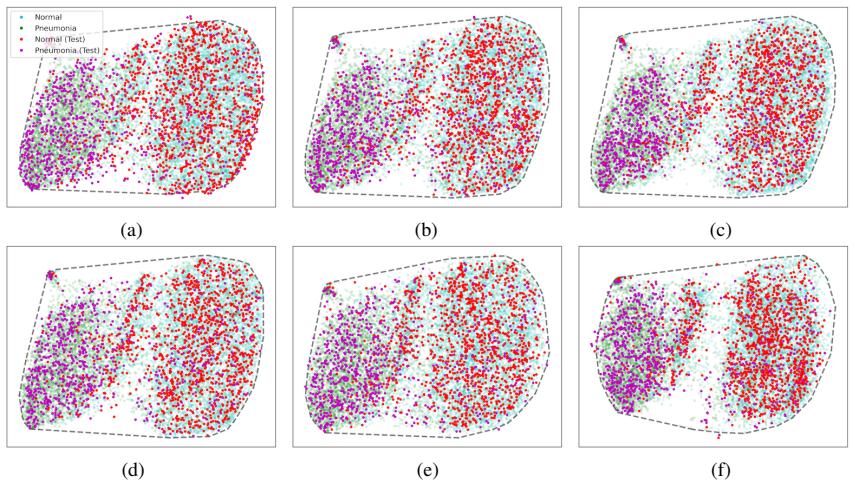
Neighbor embedding algorithms reveal correlations in high-dimensional data by constructing an equivalent graph representation in a lower-dimensional space. An increasingly popular algorithm is Uniform Manifold Learning and Projection (UMAP), which uses algebraic topology to map distances between the two spaces. While it works well on many types of data sets, UMAP has trouble adding out-of-sample points to a pre-existing mapping. In particular, UMAP often places new points on the periphery of the found clusters, rather than in their interiors with their correlated neighbors. Here, we overcome this ``repulsion effect'' by optimizing pairwise interactions within the original k-nearest-neighbor graph. Moreover, we show that parameterizing UMAP obtains better embeddings than non-parametric algorithms, particularly as the data gets more complex (e.g., medical images). We also show that the repulsion effect is naturally mitigated when a parameterized UMAP is employed to embed the data. We characterize different UMAP approaches using trustworthiness, nearest neighbor classifiers, and by analyzing attractive and repulsive forces in the embeddings.
Figures




Reference graph
Works this paper leans on
-
[1]
Visualizing data using t-sne.Journal of machine learning research, 9(Nov):2579–2605, 2008
Laurens van der Maaten and Geoffrey Hinton. Visualizing data using t-sne.Journal of machine learning research, 9(Nov):2579–2605, 2008
2008
-
[2]
UMAP: Uniform Manifold Approximation and Projection for Dimension Reduction
Leland McInnes, John Healy, and James Melville. UMAP: Uniform manifold approximation and projection for dimension reduction.arXiv preprint arXiv:1802.03426, 2018. 14
work page internal anchor Pith review Pith/arXiv arXiv 2018
-
[3]
Stochastic neighbor embedding
Geoffrey Hinton and Sam T Roweis. Stochastic neighbor embedding. InAdvances in Neural Information Processing Systems, volume 15, pages 833–840, 2002
2002
-
[4]
Highly parallel genome-wide expression profiling of individual cells using nanoliter droplets.Cell, 161(5):1202–1214, 2015
Evan Z Macosko, Anindita Basu, Rahul Satija, James Nemesh, Karthik Shekhar, Melissa Goldman, Itay Tirosh, Allison R Bialas, Nolan Kamitaki, Emily M Martersteck, et al. Highly parallel genome-wide expression profiling of individual cells using nanoliter droplets.Cell, 161(5):1202–1214, 2015
2015
-
[5]
The art of using t-sne for single-cell transcriptomics.Nature communications, 10(1):1–14, 2019
Dmitry Kobak and Philipp Berens. The art of using t-sne for single-cell transcriptomics.Nature communications, 10(1):1–14, 2019
2019
-
[6]
The single-cell transcriptional landscape of mammalian organogenesis.Nature, 566(7745):496–502, 2019
Junyue Cao, Malte Spielmann, Xiaojie Qiu, Xingfan Huang, Daniel M Ibrahim, Andrew J Hill, Fan Zhang, Stefan Mundlos, Lena Christiansen, Frank J Steemers, et al. The single-cell transcriptional landscape of mammalian organogenesis.Nature, 566(7745):496–502, 2019
2019
-
[7]
Dimensionality reduction for visualizing single-cell data using umap
Etienne Becht, Leland McInnes, John Healy, Charles-Antoine Dutertre, Immanuel WH Kwok, Lai Guan Ng, Florent Ginhoux, and Evan W Newell. Dimensionality reduction for visualizing single-cell data using umap. Nature biotechnology, 37(1):38–44, 2019
2019
-
[8]
A lineage-resolved molecular atlas of c
Jonathan S Packer, Qin Zhu, Chau Huynh, Priya Sivaramakrishnan, Elicia Preston, Hannah Dueck, Derek Stefanik, Kai Tan, Cole Trapnell, Junhyong Kim, et al. A lineage-resolved molecular atlas of c. elegans embryogenesis at single-cell resolution.Science, 365(6459):eaax1971, 2019
2019
-
[9]
Contrastive learning for unsupervised video highlight detection
Taivanbat Badamdorj, Mrigank Rochan, Yang Wang, and Li Cheng. Contrastive learning for unsupervised video highlight detection. InProceedings of the IEEE/CVF Conference on Computer Vision and Pattern Recognition, pages 14042–14052, 2022
2022
-
[10]
Deciphering the feature representation of deep neural networks for high- performance ai.IEEE Transactions on Pattern Analysis and Machine Intelligence, 2024
Md Tauhidul Islam and Lei Xing. Deciphering the feature representation of deep neural networks for high- performance ai.IEEE Transactions on Pattern Analysis and Machine Intelligence, 2024
2024
-
[11]
Predicting hospital admission at emergency department triage using machine learning.PloS one, 13(7):e0201016, 2018
Woo Suk Hong, Adrian Daniel Haimovich, and R Andrew Taylor. Predicting hospital admission at emergency department triage using machine learning.PloS one, 13(7):e0201016, 2018
2018
-
[12]
Late breaking abstract-identifying and phenotyping COVID-19 patients using machine learning on chest x-rays.European Respiratory Journal, 2020
Jason Fleischer and Mohammad Tariqul Islam. Late breaking abstract-identifying and phenotyping COVID-19 patients using machine learning on chest x-rays.European Respiratory Journal, 2020
2020
-
[13]
MedCLIP: Contrastive learning from unpaired medical images and text
Zifeng Wang, Zhenbang Wu, Dinesh Agarwal, and Jimeng Sun. MedCLIP: Contrastive learning from unpaired medical images and text. InProceedings of the 2022 Conference on Empirical Methods in Natural Language Processing, pages 3876–3887, 2022
2022
-
[14]
Outlier detection in large radiological datasets using umap
Mohammad Tariqul Islam and Jason W Fleischer. Outlier detection in large radiological datasets using umap. In International Workshop on Topology-and Graph-Informed Imaging Informatics, pages 111–121. Springer, 2024
2024
-
[15]
Manifold Learning for Personalized and Label-Free Detection of Cardiac Arrhythmias
Amir Reza Vazifeh and Jason W Fleischer. Manifold learning for personalized and label-free detection of cardiac arrhythmias.arXiv preprint arXiv:2506.16494, 2025
work page internal anchor Pith review Pith/arXiv arXiv 2025
-
[16]
Coverage hole detection for mmwave networks: An unsupervised learning approach.IEEE Communications Letters, 2021
Chethan K Anjinappa and Ismail Güvenç. Coverage hole detection for mmwave networks: An unsupervised learning approach.IEEE Communications Letters, 2021
2021
-
[17]
A boundary aware wifi localization scheme based on umap and knn.IEEE Communications Letters, 2022
Zhendong Xu, Baoqi Huang, Bing Jia, Wuyungerile Li, and Hui Lu. A boundary aware wifi localization scheme based on umap and knn.IEEE Communications Letters, 2022
2022
-
[18]
A nonlinear mapping for data structure analysis.IEEE Transactions on computers, 100(5):401– 409, 1969
John W Sammon. A nonlinear mapping for data structure analysis.IEEE Transactions on computers, 100(5):401– 409, 1969
1969
-
[19]
A global geometric framework for nonlinear dimensionality reduction.science, 290(5500):2319–2323, 2000
Joshua B Tenenbaum, Vin De Silva, and John C Langford. A global geometric framework for nonlinear dimensionality reduction.science, 290(5500):2319–2323, 2000
2000
-
[20]
Nonlinear dimensionality reduction by locally linear embedding.science, 290(5500):2323–2326, 2000
Sam T Roweis and Lawrence K Saul. Nonlinear dimensionality reduction by locally linear embedding.science, 290(5500):2323–2326, 2000
2000
-
[21]
Laplacian eigenmaps and spectral techniques for embedding and clustering
Mikhail Belkin and Partha Niyogi. Laplacian eigenmaps and spectral techniques for embedding and clustering. In Advances in neural information processing systems, pages 585–591, 2002
2002
-
[22]
Visualizing large-scale and high-dimensional data
Jian Tang, Jingzhou Liu, Ming Zhang, and Qiaozhu Mei. Visualizing large-scale and high-dimensional data. In Proceedings of the 25th international conference on world wide web, pages 287–297, 2016
2016
-
[23]
Accelerating t-sne using tree-based algorithms.The Journal of Machine Learning Research, 15(1):3221–3245, 2014
Laurens Van Der Maaten. Accelerating t-sne using tree-based algorithms.The Journal of Machine Learning Research, 15(1):3221–3245, 2014
2014
-
[24]
Scalable optimization of neighbor embedding for visualization
Zhirong Yang, Jaakko Peltonen, and Samuel Kaski. Scalable optimization of neighbor embedding for visualization. InInternational Conference on Machine Learning, pages 127–135, 2013
2013
-
[25]
A hierarchical o (n log n) force-calculation algorithm.nature, 324(6096):446–449, 1986
Josh Barnes and Piet Hut. A hierarchical o (n log n) force-calculation algorithm.nature, 324(6096):446–449, 1986. 15
1986
-
[26]
Distributed representations of words and phrases and their compositionality
Tomas Mikolov, Ilya Sutskever, Kai Chen, Greg S Corrado, and Jeff Dean. Distributed representations of words and phrases and their compositionality. InAdvances in neural information processing systems, pages 3111–3119, 2013
2013
-
[27]
Fast interpolation- based t-sne for improved visualization of single-cell rna-seq data.Nature methods, 16(3):243–245, 2019
George C Linderman, Manas Rachh, Jeremy G Hoskins, Stefan Steinerberger, and Yuval Kluger. Fast interpolation- based t-sne for improved visualization of single-cell rna-seq data.Nature methods, 16(3):243–245, 2019
2019
-
[28]
On UMAP’s true loss function.Advances in Neural Information Processing Systems, 34:5798–5809, 2021
Sebastian Damrich and Fred A Hamprecht. On UMAP’s true loss function.Advances in Neural Information Processing Systems, 34:5798–5809, 2021
2021
-
[29]
The shape of attraction in UMAP: Exploring the embedding forces in dimensionality reduction.Transactions of Machine Learning Research, 2025
Mohammad Tariqul Islam and Jason W Fleischer. The shape of attraction in UMAP: Exploring the embedding forces in dimensionality reduction.Transactions of Machine Learning Research, 2025
2025
-
[30]
Attraction-repulsion spectrum in neighbor embeddings
Jan Niklas Böhm, Philipp Berens, and Dmitry Kobak. Attraction-repulsion spectrum in neighbor embeddings. Journal of Machine Learning Research, 23(95):1–32, 2022
2022
-
[31]
From t-SNE to UMAP with contrastive learning
Sebastian Damrich, Niklas Böhm, Fred A Hamprecht, and Dmitry Kobak. From t-SNE to UMAP with contrastive learning. InThe Eleventh International Conference on Learning Representations, 2023
2023
-
[32]
ActUp: Analyzing and consolidating tSNE and UMAP
Andrew Draganov, Jakob Jørgensen, Katrine Scheel, Davide Mottin, Ira Assent, Tyrus Berry, and Cigdem Aslay. ActUp: Analyzing and consolidating tSNE and UMAP. InProceedings of the Thirty-Second International Joint Conference on Artificial Intelligence, IJCAI-23, pages 3651–3658, 8 2023
2023
-
[33]
Nonlinear dimensionality reduction with q-gaussian distribution
Motoshi Abe, Yuichiro Nomura, and Takio Kurita. Nonlinear dimensionality reduction with q-gaussian distribution. Pattern Analysis and Applications, 27(1):1–12, 2024
2024
-
[34]
Progressive uniform manifold approximation and projection
Hyung-Kwon Ko, Jaemin Jo, and Jinwook Seo. Progressive uniform manifold approximation and projection. In EuroVis (Short Papers), pages 133–137, 2020
2020
-
[35]
Self-organizing nebulous growths for robust and incremental data visualization.IEEE Transactions on Neural Networks and Learning Systems, 32(10):4588–4602, 2020
Damith A Senanayake, Wei Wang, Shalin H Naik, and Saman Halgamuge. Self-organizing nebulous growths for robust and incremental data visualization.IEEE Transactions on Neural Networks and Learning Systems, 32(10):4588–4602, 2020
2020
-
[36]
Manifold-aligned neighbor embedding
Mohammad Tariqul Islam and Jason W Fleischer. Manifold-aligned neighbor embedding. InICLR 2022 Workshop on Geometrical and Topological Representation Learning, 2022
2022
-
[37]
TriMap: Large-scale Dimensionality Reduction Using Triplets
Ehsan Amid and Manfred K Warmuth. TriMap: Large-scale dimensionality reduction using triplets.arXiv preprint arXiv:1910.00204, 2019
work page Pith review arXiv 1910
-
[38]
Understanding how dimension reduction tools work: an empirical approach to deciphering t-SNE, UMAP, TriMAP, and PaCMAP for data visualization
Yingfan Wang, Haiyang Huang, Cynthia Rudin, and Yaron Shaposhnik. Understanding how dimension reduction tools work: an empirical approach to deciphering t-SNE, UMAP, TriMAP, and PaCMAP for data visualization. The Journal of Machine Learning Research, 22(1):9129–9201, 2021
2021
-
[39]
Learning a parametric embedding by preserving local structure
Laurens Van Der Maaten. Learning a parametric embedding by preserving local structure. InArtificial Intelligence and Statistics, pages 384–391, 2009
2009
-
[40]
A general framework for dimensionality-reducing data visualization mapping.Neural Computation, 24(3):771–804, 2012
Kerstin Bunte, Michael Biehl, and Barbara Hammer. A general framework for dimensionality-reducing data visualization mapping.Neural Computation, 24(3):771–804, 2012
2012
-
[41]
Extendable and invertible manifold learning with geometry regularized autoencoders
Andrés F Duque, Sacha Morin, Guy Wolf, and Kevin Moon. Extendable and invertible manifold learning with geometry regularized autoencoders. In2020 IEEE International Conference on Big Data (Big Data), pages 5027–5036. IEEE, 2020
2020
-
[42]
Parametric umap embeddings for representation and semisupervised learning.Neural Computation, 33(11):2881–2907, 2021
Tim Sainburg, Leland McInnes, and Timothy Q Gentner. Parametric umap embeddings for representation and semisupervised learning.Neural Computation, 33(11):2881–2907, 2021
2021
-
[43]
Deep recursive embedding for high-dimensional data.IEEE Transactions on Visualization and Computer Graphics, 28(2):1237–1248, 2021
Zixia Zhou, Xinrui Zu, Yuanyuan Wang, Boudewijn PF Lelieveldt, and Qian Tao. Deep recursive embedding for high-dimensional data.IEEE Transactions on Visualization and Computer Graphics, 28(2):1237–1248, 2021
2021
-
[44]
Navigating the effect of parametrization for dimensionality reduction.Advances in Neural Information Processing Systems, 37:12977–13019, 2024
Haiyang Huang, Yingfan Wang, and Cynthia Rudin. Navigating the effect of parametrization for dimensionality reduction.Advances in Neural Information Processing Systems, 37:12977–13019, 2024
2024
-
[45]
Mapping the stereotyped behaviour of freely moving fruit flies.Journal of The Royal Society Interface, 11(99):20140672, 2014
Gordon J Berman, Daniel M Choi, William Bialek, and Joshua W Shaevitz. Mapping the stereotyped behaviour of freely moving fruit flies.Journal of The Royal Society Interface, 11(99):20140672, 2014
2014
-
[46]
Embedding to reference t-sne space addresses batch effects in single-cell classification
Pavlin G Poliˇcar, Martin Stražar, and Blaž Zupan. Embedding to reference t-sne space addresses batch effects in single-cell classification. InInternational Conference on Discovery Science, pages 246–260. Springer, 2019
2019
-
[47]
UMAP: Uniform manifold approximation and projection.The Journal of Open Source Software, 3(29):861, 2018
Leland McInnes, John Healy, Nathaniel Saul, and Lukas Grossberger. UMAP: Uniform manifold approximation and projection.The Journal of Open Source Software, 3(29):861, 2018
2018
-
[48]
Adam: A method for stochastic optimization
Diederik P Kingma and Jimmy Ba. Adam: A method for stochastic optimization. InInternational Conference on Learning Representations, 2015. 16
2015
-
[49]
Pytorch: An imperative style, high-performance deep learning library.Advances in neural information processing systems, 32, 2019
Adam Paszke, Sam Gross, Francisco Massa, Adam Lerer, James Bradbury, Gregory Chanan, Trevor Killeen, Zeming Lin, Natalia Gimelshein, Luca Antiga, et al. Pytorch: An imperative style, high-performance deep learning library.Advances in neural information processing systems, 32, 2019
2019
-
[50]
Array programming with numpy.Nature, 585(7825):357–362, 2020
Charles R Harris, K Jarrod Millman, Stéfan J Van Der Walt, Ralf Gommers, Pauli Virtanen, David Cournapeau, Eric Wieser, Julian Taylor, Sebastian Berg, Nathaniel J Smith, et al. Array programming with numpy.Nature, 585(7825):357–362, 2020
2020
-
[51]
Numba: A llvm-based python jit compiler
Siu Kwan Lam, Antoine Pitrou, and Stanley Seibert. Numba: A llvm-based python jit compiler. InProceedings of the Second Workshop on the LLVM Compiler Infrastructure in HPC, pages 1–6, 2015
2015
-
[52]
Pedregosa, G
F. Pedregosa, G. Varoquaux, A. Gramfort, V . Michel, B. Thirion, O. Grisel, M. Blondel, P. Prettenhofer, R. Weiss, V . Dubourg, J. Vanderplas, A. Passos, D. Cournapeau, M. Brucher, M. Perrot, and E. Duchesnay. Scikit-learn: Machine learning in Python.Journal of Machine Learning Research, 12:2825–2830, 2011
2011
-
[53]
Neighborhood preservation in nonlinear projection methods: An experimental study
Jarkko Venna and Samuel Kaski. Neighborhood preservation in nonlinear projection methods: An experimental study. InInternational Conference on Artificial Neural Networks, pages 485–491. Springer, 2001
2001
-
[54]
Nearest neighbor pattern classification.IEEE transactions on information theory, 13(1):21–27, 1967
Thomas Cover and Peter Hart. Nearest neighbor pattern classification.IEEE transactions on information theory, 13(1):21–27, 1967
1967
-
[55]
Mnist handwritten digit database.ATT Labs [Online]
Yann LeCun, Corinna Cortes, and CJ Burges. Mnist handwritten digit database.ATT Labs [Online]. Available: http://yann.lecun.com/exdb/mnist, 2, 2010
2010
-
[56]
hdbscan: Hierarchical density based clustering.The Journal of Open Source Software, 2(11):205, 2017
Leland McInnes, John Healy, and Steve Astels. hdbscan: Hierarchical density based clustering.The Journal of Open Source Software, 2(11):205, 2017
2017
-
[57]
RSNA.RSNA pneumonia detection challenge, 2018
2018
-
[58]
Densely connected convolutional networks
Gao Huang, Zhuang Liu, Laurens Van Der Maaten, and Kilian Q Weinberger. Densely connected convolutional networks. InProceedings of the IEEE conference on computer vision and pattern recognition, pages 4700–4708, 2017
2017
-
[59]
Imagenet large scale visual recognition challenge.International journal of computer vision, 115(3):211–252, 2015
Olga Russakovsky, Jia Deng, Hao Su, Jonathan Krause, Sanjeev Satheesh, Sean Ma, Zhiheng Huang, Andrej Karpathy, Aditya Khosla, Michael Bernstein, et al. Imagenet large scale visual recognition challenge.International journal of computer vision, 115(3):211–252, 2015
2015
-
[60]
Visualization of emergency department clinical data for interpretable patient phenotyping
Nathan C Hurley, Adrian D Haimovich, R Andrew Taylor, and Bobak J Mortazavi. Visualization of emergency department clinical data for interpretable patient phenotyping. In2019 4th IEEE/ACM Conference on Connected Health: Applications, Systems and Engineering Technologies, 2019. 17 Appendix In this appendix, first, we further discuss accumulation and the de...
2019
discussion (0)
Sign in with ORCID, Apple, or X to comment. Anyone can read and Pith papers without signing in.