REVIEW 3 major objections 5 minor 100 references
What Is That Talk About? A Video-to-Text Summarization Dataset for Scientific Presentations
T0 review · 3 major / 5 minor · reviewed 2026-08-08 · deepseek-v4-flash
Pith's one-line read This paper introduces VISTA, 18,599 conference talk videos paired with paper abstracts, and shows that an explicit question plan before summarizing improves quality and factual consistency over end-to-end models, with humans still ahead.
desk verdict VISTA is a genuinely useful dataset for scientific video summarization with a solid but not novel plan-based method; the abstract-as-summary proxy needs firmer validation and the zero-shot labeling is misleading, but neither sinks the paper. read the letter →
The pith
A machine-rendered reading of the paper's core claim, the machinery that carries it, and where it could break.
The reading
What carries the argument
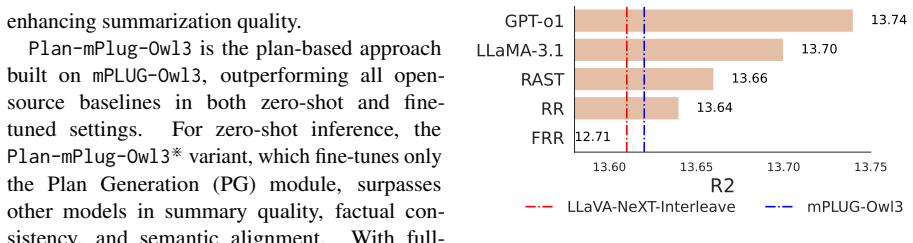
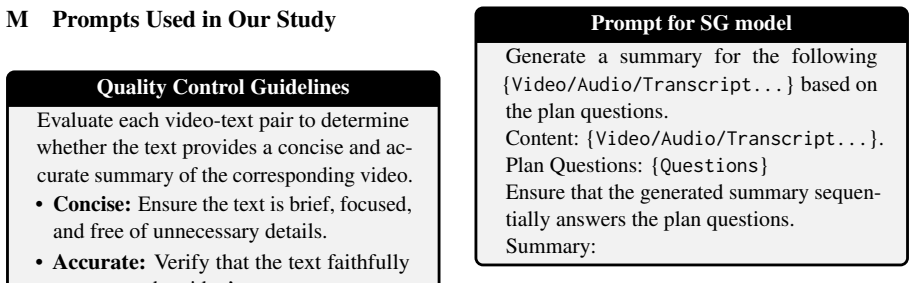
The load-bearing object is the question plan: an ordered list $p = (q_1, \dots, q_m)$ of questions, one per sentence of the target abstract, generated before any summary text is written. The pipeline trains a Plan Generation module to predict $p$ from the input video and a Summary Generation module to learn $P(s \mid v, p)$, so each summary sentence is meant to answer its corresponding question. The plan instantiates Question Under Discussion theory, the view that discourse is organized by the implicit questions it resolves, and silver-standard plans are produced by GPT-o1, one question per reference sentence using that sentence plus its predecessors as context. Plan quality is measurable and consequential: replacing the full set of plan questions with irrelevant ones drops Rouge-2 from 13.74 to 12.71, while deleting up to 60% of plan questions shortens summaries far more controllably than instruction-based prompting does.
What would settle it
Have annotators score a random sample of VISTA pairs for whether the abstract genuinely captures what the talk says, not merely what the paper claims; if a substantial fraction of talks omit, contradict, or go beyond their abstract, the proxy assumption fails. A second check: regenerate the plans with a weaker open-source question generator and rerun the comparison, since the reported gains partly inherit the quality of the GPT-o1 silver plans.
Extended reading notes
Core claim
On VISTA, the paper's central claim is that scientific video summarization is both measurable and unsolved, and that the structure of scientific abstracts is a lever for improving it. The strongest evidence is the plan-based pipeline: Plan-mPlug-Owl3, which first generates a question plan from the video and then produces the summary conditioned on that plan, outperforms the best end-to-end open-source model, mPLUG-Owl3, on every reported metric, with the largest gains in factual consistency (FactVC 75.41 versus 71.94 under full fine-tuning) and quality (Rouge-L 33.25 versus 32.91). Human evaluation confirms the ordering: three annotators rated human-written abstracts highest or lowest 81.7% and 0.1% of the time, respectively, versus 12.4% and 6.6% for Plan-mPlug-Owl3, with the plan-based model significantly better than other neural models on faithfulness, coherence, and informativeness. The same planning scaffold also improves transcript-, OCR-, and audio-only models across all metrics, indicating that the benefit comes from imposing discourse structure rather than from video processing alone.
Load-bearing premise
The premise everything rests on is that a paper's abstract is a faithful summary of what the speaker actually says in the video; if presenters deviate from their abstracts, the labels are noisy and part of the task cannot be learned from the video alone.
Editorial extensions
If this is right
- VISTA gives the field a large public benchmark for scientific video summarization: 18,599 pairs, with in-domain fine-tuning and video input both clearly mattering, since video-based models beat transcript- and audio-only models in every learning setting.
- The regular structure of scientific abstracts is a usable prior: a question-driven plan before generation improves summary quality and factual consistency across zero-shot, QLoRA, and full fine-tuning, with statistical significance.
- Planning generalizes beyond video: the same scaffold improves transcript-, OCR-, and audio-only models on all metrics, so discourse structure helps summarization independently of the input modality.
- The task is far from closed: the best model reaches FactVC 75.41 against 88.54 for human abstracts, and human judges ranked human abstracts best 81.7% of the time.
Reading between the lines
- Read strictly, VISTA measures how well a model can recover a paper's abstract from its talk; a dataset built on independent human summaries of the videos themselves would likely be harder and would test a slightly different skill, and this distinction is left implicit in the paper.
- Because the plan questions are silver labels from a top commercial model, the framework's measured gains inherit the quality of that generator; a cheaper open-source planner would probably narrow the advantage, so the practical value of the method depends on plan-generation cost.
- The controlled-generation results hint at a product-level use the paper only sketches: editing plan questions could let end users steer a summary's reading level, length, and emphasis in a more reliable way than prompting the model to rewrite.
- The same pairs could support neighbouring tasks beyond summarization, such as retrieving talks from abstracts, grounding claims in specific slides, or studying which visual and spoken cues carry the content of the abstract.
Editorial analysis
A structured set of objections, weighed in public.
Referee Report
Summary. The paper introduces VISTA, a large-scale dataset for video-to-text summarization of scientific presentations, containing 18,599 pairs of conference talk videos (from ACL Anthology venues, ICML, and NeurIPS) aligned with the corresponding paper abstracts. The authors benchmark closed- and open-source large multimodal models under zero-shot, QLoRA, and full fine-tuning settings, and propose a plan-based summarization framework in which a question-generation module produces a sequence of QUD-style questions (a plan) and a summary-generation module verbalizes answers to those questions. Automatic metrics and a human evaluation on 50 test instances are used to compare models. The paper reports that the plan-based method consistently improves summary quality and factual consistency over end-to-end baselines, while a considerable gap to human performance remains.
Significance. If the dataset labels are valid, VISTA fills a genuine gap: it is larger and more specialized for scientific talks than prior video-summarization resources, and its domain focus, venue diversity, and long-form summaries make it a potentially useful benchmark. The paper also contributes a transparent planning framework that is evaluated across multiple backbones and learning regimes, with both automatic and human judgments. The experimental design is generally careful—fixed splits, comparable hyperparameters, ablations on plan quality and modality, and human evaluation with reported inter-annotator agreement. The central claims, however, rest on two under-validated points: that a paper abstract is a reliable video-grounded summary, and that the 'zero-shot' plan-based row in Table 3 is a fair comparison. These are fixable within the manuscript's scope, but they affect the benchmark's primary validity and the interpretation of the planning gains.
major comments (3)
- The benchmark's central assumption—that the paper abstract is a faithful summary of the video—is not directly validated. The manual QC in Appendix B asked two annotators for a binary valid/invalid judgment on 500 pairs, and the automated GPT-o1 check flagged only 39 pairs that were later confirmed valid; neither procedure verifies that the content of each abstract sentence is actually grounded in the video. A talk can omit parts of an abstract, include framing absent from the paper, or present formal/theoretical statements only in the paper; the paper itself reports reference abstracts scoring 88.54 FactVC and 4.62 VideoScore (Table 3), which is consistent with imperfect video-grounding of the gold summaries. If a nontrivial fraction of abstract sentences is not recoverable from the video, then the task is partially unlearnable from video alone, the reported upper bounds are miscalibrated, and the relative gains of plan-based models may partly reflect fitting paper-style text rather than video summarization. Because the dataset is the primary contribution, the authors should provide direct sentence-level evidence of video grounding—for example, annotate a stratified sample of test pairs for whether each abstract sentence is stated or clearly implied by the video—and report the fraction of ungrounded sentences, filtering or discussing the ceiling they impose.
- The row labeled 'Plan-mPlug-Owl3⋇' under 'Zero-shot Learning' is not a zero-shot comparison: the footnote states that only the PG module is trained on the training set and then used to predict plans on the test set. This gives the plan-based variant in-domain supervision that the zero-shot baselines do not receive, so the reported improvements (e.g., FactVC 47.37 vs. 42.07 for mPLUG-Owl3) cannot be attributed to planning alone. The authors should either evaluate a truly zero-shot variant in which the PG module is not trained, or relabel this condition (e.g., 'PG-trained, SG zero-shot') and soften the abstract/introduction claim that the plan-based method improves zero-shot performance. This is load-bearing because the paper's central claim that explicit planning enhances summary quality is partly supported by this row.
- The silver-standard plans are generated by GPT-o1 from the reference abstract sentences and their preceding context, and then used to train both PG and SG. The manual validation in Appendix G checks only whether the generated questions are locally coherent and could be answered by the reference sentence; it does not check whether the plan questions can be answered from the video alone. Since the test-time PG is trained to imitate reference-derived plans, any systematic divergence between video content and abstract content (see the first major comment) will propagate through the plan. I would like to see a small analysis of how well PG-predicted plans are answerable from the corresponding video, and how plan quality varies when the reference abstract contains content not present in the talk.
minor comments (5)
- [Table 1, caption] The caption contains a typo: 'Comprison' should be 'Comparison'.
- [§4, Plan Generation] The notation leaves unspecified how the number of plan questions m is determined at inference time; please clarify whether the PG module predicts a variable-length sequence and how the maximum length is set.
- [Appendix D, Table 7] The version table lists 'VideoLLaMA2-7B-16F' while the main text uses 'Video-LLaMA'; please reconcile the model naming for reproducibility.
- [References] GPT-o1 is cited via Achiam et al. (2023), the GPT-4 technical report; if an o1-specific model card or technical report is available, it should be cited instead.
- [Figure 3] The x-axis label 'T okens' has a spacing error; minor but easy to fix.
Circularity Check
No significant circularity: test-time summaries are generated from plans predicted from the video, not from gold abstracts; self-citations are motivational rather than load-bearing.
full rationale
The paper's derivation chain is self-contained. The central claims—(1) VISTA is a challenging video-to-text summarization benchmark and (2) a plan-based framework improves summary quality and factual consistency—are each supported by experiments run on the paper's own dataset with standard external metrics (ROUGE, SacreBLEU, METEOR, BERTScore, CIDEr-D, VideoScore, FactVC) and by human evaluation against gold abstracts. No prediction reduces to its input by construction. Although silver-standard plans are generated from reference abstracts (Section 4, Plan Generation: 'We leverage GPT-o1 (Achiam et al., 2023) to generate silver-standard plans based on reference summary sentences and their preceding context'), the test-time evaluation is clean: 'During inference, the trained PG module predicts plan p-hat for input v, and the tuple [v; p-hat] is fed into the SG module to generate the final summary'—the evaluated summaries depend on the video through a predicted plan, not on the gold abstract. The abstract-as-proxy assumption is stated transparently in the Limitations ('we consider the paper abstract as a proxy for the summary of the corresponding video') and is a data-validity assumption rather than a circular definition; the two-stage QC (Appendix B) validates it externally, and its imperfection is acknowledged in the paper. Self-citations (Liu et al., 2025; Mahon and Lapata, 2024a; Liu et al., 2023a) appear as related-work motivation, but the plan-based framework is attributed primarily to external prior work (Narayan et al., 2021, 2023; Roberts, 2012), and the paper's own experiments and ablations provide the evidence for the planning claim. No uniqueness theorem is imported from the authors' prior work, and no known result is renamed as organization. The principal caveat—that a proxy-validated dataset may underestimate task learnability from video alone—is a correctness/data-quality risk, not circularity.
Assumptions & free parameters
assumptions (3)
- domain assumption The paper abstract is a faithful summary of the corresponding presentation video.
- domain assumption GPT-o1-generated plan questions are well-formed and QUD-aligned with the reference summary sentences.
- standard math Automatic metrics (ROUGE, BERTScore, VideoScore, FactVC) are valid proxies for summary quality and factual consistency in this task.
Cite this review
Pith. "Pith review of What Is That Talk About? A Video-to-Text Summarization Dataset for Scientific Presentations." pith.science (2026). https://pith.science/paper/6XX3AHPI
@misc{pith2026250208279,
  author       = {Pith},
  title        = {Pith review of: What Is That Talk About? A Video-to-Text Summarization Dataset for Scientific Presentations},
  year         = {2026},
  howpublished = {\url{https://pith.science/paper/6XX3AHPI}},
  note         = {Machine review of arXiv:2502.08279}
}
read the original abstract
Transforming recorded videos into concise and accurate textual summaries is a growing challenge in multimodal learning. This paper introduces VISTA, a dataset specifically designed for video-to-text summarization in scientific domains. VISTA contains 18,599 recorded AI conference presentations paired with their corresponding paper abstracts. We benchmark the performance of state-of-the-art large models and apply a plan-based framework to better capture the structured nature of abstracts. Both human and automated evaluations confirm that explicit planning enhances summary quality and factual consistency. However, a considerable gap remains between models and human performance, highlighting the challenges of our dataset. This study aims to pave the way for future research on scientific video-to-text summarization.
Figures


Figures from the paper (13 more)





Reference graph
Works this paper leans on
-
[1]
Josh Achiam, Steven Adler, Sandhini Agarwal, Lama Ahmad, Ilge Akkaya, Florencia Leoni Aleman, Diogo Almeida, Janko Altenschmidt, Sam Altman, Shyamal Anadkat, et al. 2023. https://arxiv.org/abs/2303.08774 Gpt-4 technical report . arXiv preprint arXiv:2303.08774
arXiv 2023
-
[2]
Daechul Ahn, Yura Choi, Youngjae Yu, Dongyeop Kang, and Jonghyun Choi. 2024. https://doi.org/10.18653/v1/2024.acl-long.52 Tuning large multimodal models for videos using reinforcement learning from AI feedback . In Proceedings of the 62nd Annual Meeting of the Association for Computational Linguistics (Volume 1: Long Papers), pages 923--940, Bangkok, Thai...
-
[3]
Reinald Kim Amplayo, Stefanos Angelidis, and Mirella Lapata. 2021. https://ojs.aaai.org/index.php/AAAI/article/view/17481 Unsupervised opinion summarization with content planning . In Proceedings of the AAAI conference on artificial intelligence, volume 35, pages 12489--12497
2021
-
[4]
Anthropic. 2024. Claude 3.5 - sonnet. https://www.anthropic.com/news/claude-3-5-sonnet. Accessed: 2024-12-06
2024
-
[5]
Dawit Mureja Argaw, Seunghyun Yoon, Fabian Caba Heilbron, Hanieh Deilamsalehy, Trung Bui, Zhaowen Wang, Franck Dernoncourt, and Joon Son Chung. 2024. https://ieeexplore.ieee.org/document/10656029/ Scaling up video summarization pretraining with large language models . In Proceedings of the IEEE/CVF Conference on Computer Vision and Pattern Recognition, pa...
-
[6]
Zechen Bai, Pichao Wang, Tianjun Xiao, Tong He, Zongbo Han, Zheng Zhang, and Mike Zheng Shou. 2024. https://arxiv.org/abs/2404.18930 Hallucination of multimodal large language models: A survey . arXiv preprint arXiv:2404.18930
arXiv 2024
-
[7]
Satanjeev Banerjee and Alon Lavie. 2005. https://aclanthology.org/W05-0909 METEOR : An automatic metric for MT evaluation with improved correlation with human judgments . In Proceedings of the ACL Workshop on Intrinsic and Extrinsic Evaluation Measures for Machine Translation and/or Summarization , pages 65--72, Ann Arbor, Michigan. Association for Comput...
2005
-
[8]
Isabel Cachola, Kyle Lo, Arman Cohan, and Daniel Weld. 2020. https://doi.org/10.18653/v1/2020.findings-emnlp.428 TLDR : Extreme summarization of scientific documents . In Findings of the Association for Computational Linguistics: EMNLP 2020, pages 4766--4777, Online. Association for Computational Linguistics
Show all 100 references
-
[9]
Gerard Canal, Senka Krivi \'c , Paul Luff, and Andrew Coles. 2022. Planverb: Domain-independent verbalization and summary of task plans. In Proceedings of the AAAI Conference on Artificial Intelligence, volume 36, pages 9698--9706
2022
-
[10]
Brian Chen, Xiangyuan Zhao, and Yingnan Zhu. 2024 a . Personalized video summarization by multimodal video understanding. In Proceedings of the 33rd ACM International Conference on Information and Knowledge Management, pages 4382--4389
2024
-
[11]
Dongping Chen, Ruoxi Chen, Shilin Zhang, Yaochen Wang, Yinuo Liu, Huichi Zhou, Qihui Zhang, Yao Wan, Pan Zhou, and Lichao Sun. 2024 b . Mllm-as-a-judge: assessing multimodal llm-as-a-judge with vision-language benchmark. In Proceedings of the 41st International Conference on M...
2024
-
[12]
Zhe Chen, Heyang Liu, Wenyi Yu, Guangzhi Sun, Hongcheng Liu, Ji Wu, Chao Zhang, Yu Wang, and Yanfeng Wang. 2024 c . https://doi.org/10.18653/v1/2024.acl-long.489 M ^3 AV : A multimodal, multigenre, and multipurpose audio-visual academic lecture dataset . In Proceedings of the ...
2024 doi
-
[13]
Siyuan Cheng, Bozhong Tian, Qingbin Liu, Xi Chen, Yongheng Wang, Huajun Chen, and Ningyu Zhang. 2023. https://doi.org/10.18653/v1/2023.emnlp-main.856 Can we edit multimodal large language models? In Proceedings of the 2023 Conference on Empirical Methods in Natural Language Pr...
2023 doi
-
[14]
Sangwoo Cho, Franck Dernoncourt, Tim Ganter, Trung Bui, Nedim Lipka, Walter Chang, Hailin Jin, Jonathan Brandt, Hassan Foroosh, and Fei Liu. 2021. https://doi.org/10.18653/v1/2021.emnlp-main.520 S tream H over: Livestream transcript summarization and annotation . In Proceeding...
2021 doi
-
[15]
Yunfei Chu, Jin Xu, Qian Yang, Haojie Wei, Xipin Wei, Zhifang Guo, Yichong Leng, Yuanjun Lv, Jinzheng He, Junyang Lin, et al. 2024. https://arxiv.org/abs/2407.10759 Qwen2-audio technical report . arXiv preprint arXiv:2407.10759
2024 arXiv
-
[16]
Aldan Creo, Manuel Lama, and Juan C Vidal. 2023. https://arxiv.org/abs/2312.08282 Prompting llms with content plans to enhance the summarization of scientific articles . arXiv preprint arXiv:2312.08282
2023 arXiv
-
[17]
Tim Dettmers, Artidoro Pagnoni, Ari Holtzman, and Luke Zettlemoyer. 2024. https://proceedings.neurips.cc/paper_files/paper/2023/file/1feb87871436031bdc0f2beaa62a049b-Paper-Conference.pdf Qlora: Efficient finetuning of quantized llms . Advances in Neural Information Processing ...
2024
-
[18]
Mehwish Fatima and Michael Strube. 2023. https://doi.org/10.18653/v1/2023.acl-long.103 Cross-lingual science journalism: Select, simplify and rewrite summaries for non-expert readers . In Proceedings of the 61st Annual Meeting of the Association for Computational Linguistics (...
2023 doi
-
[19]
Patrick Fernandes, Kayo Yin, Emmy Liu, Andr \'e Martins, and Graham Neubig. 2023. https://doi.org/10.18653/v1/2023.acl-long.36 When does translation require context? a data-driven, multilingual exploration . In Proceedings of the 61st Annual Meeting of the Association for Comp...
2023 doi
-
[20]
Xingyu Fu, Yushi Hu, Bangzheng Li, Yu Feng, Haoyu Wang, Xudong Lin, Dan Roth, Noah A Smith, Wei-Chiu Ma, and Ranjay Krishna. 2025. Blink: Multimodal large language models can see but not perceive. In European Conference on Computer Vision, pages 148--166. Springer
2025
-
[21]
Xiyan Fu, Jun Wang, and Zhenglu Yang. 2021. https://doi.org/10.18653/v1/2021.naacl-main.473 MM - AVS : A full-scale dataset for multi-modal summarization . In Proceedings of the 2021 Conference of the North American Chapter of the Association for Computational Linguistics: Hum...
2021 doi
-
[22]
Qi Gou, Zehua Xia, Bowen Yu, Haiyang Yu, Fei Huang, Yongbin Li, and Nguyen Cam-Tu. 2023. https://doi.org/10.18653/v1/2023.emnlp-main.104 Diversify question generation with retrieval-augmented style transfer . In Proceedings of the 2023 Conference on Empirical Methods in Natura...
2023 doi
-
[23]
Mingfei Han, Linjie Yang, Xiaojun Chang, Lina Yao, and Heng Wang. 2025. https://openreview.net/forum?id=FZv3kPHTtB Shot2story: A new benchmark for comprehensive understanding of multi-shot videos . In The Thirteenth International Conference on Learning Representations
2025
-
[24]
Bo He, Jun Wang, Jielin Qiu, Trung Bui, Abhinav Shrivastava, and Zhaowen Wang. 2023. Align and attend: Multimodal summarization with dual contrastive losses. In Proceedings of the IEEE/CVF conference on computer vision and pattern recognition, pages 14867--14878
2023
-
[25]
Xuan He, Dongfu Jiang, Ge Zhang, Max Ku, Achint Soni, Sherman Siu, Haonan Chen, Abhranil Chandra, Ziyan Jiang, Aaran Arulraj, Kai Wang, Quy Duc Do, Yuansheng Ni, Bohan Lyu, Yaswanth Narsupalli, Rongqi Fan, Zhiheng Lyu, Bill Yuchen Lin, and Wenhu Chen. 2024. https://doi.org/10....
2024 doi
-
[26]
Anwen Hu, Yaya Shi, Haiyang Xu, Jiabo Ye, Qinghao Ye, Ming Yan, Chenliang Li, Qi Qian, Ji Zhang, and Fei Huang. 2024. https://openreview.net/forum?id=S7pieMItch m PLUG -paperowl: Scientific diagram analysis with the multimodal large language model . In ACM Multimedia 2024
2024
-
[27]
Hang Hua, Yunlong Tang, Chenliang Xu, and Jiebo Luo. 2024. V2xum-llm: Cross-modal video summarization with temporal prompt instruction tuning. arXiv preprint arXiv:2404.12353
2024
-
[28]
Kung-Hsiang Huang, Hou Pong Chan, Yi R Fung, Haoyi Qiu, Mingyang Zhou, Shafiq Joty, Shih-Fu Chang, and Heng Ji. 2024. From pixels to insights: A survey on automatic chart understanding in the era of large foundation models. IEEE Transactions on Knowledge and Data Engineering
2024
-
[29]
Fantine Huot, Joshua Maynez, Chris Alberti, Reinald Kim Amplayo, Priyanka Agrawal, Constanza Fierro, Shashi Narayan, and Mirella Lapata. 2024. https://aclanthology.org/2024.eacl-long.131 PLAN : Summarizing using a content plan as cross-lingual bridge . In Proceedings of the 18...
2024
-
[30]
Md Mohaiminul Islam, Ngan Ho, Xitong Yang, Tushar Nagarajan, Lorenzo Torresani, and Gedas Bertasius. 2024. Video recap: Recursive captioning of hour-long videos. In Proceedings of the IEEE/CVF Conference on Computer Vision and Pattern Recognition, pages 18198--18208
2024
-
[31]
Jiaxin Ju, Ming Liu, Huan Yee Koh, Yuan Jin, Lan Du, and Shirui Pan. 2021. https://doi.org/10.18653/v1/2021.findings-emnlp.345 Leveraging information bottleneck for scientific document summarization . In Findings of the Association for Computational Linguistics: EMNLP 2021, pa...
2021 doi
-
[32]
Jing Yu Koh, Ruslan Salakhutdinov, and Daniel Fried. 2023. https://proceedings.mlr.press/v202/koh23a.html Grounding language models to images for multimodal inputs and outputs . In International Conference on Machine Learning, pages 17283--17300. PMLR
2023
-
[33]
Mateusz Krubi \'n ski and Pavel Pecina. 2023. https://doi.org/10.18653/v1/2023.findings-eacl.67 MLASK : Multimodal summarization of video-based news articles . In Findings of the Association for Computational Linguistics: EACL 2023, pages 910--924, Dubrovnik, Croatia. Associat...
2023 doi
-
[34]
Mateusz Krubi \'n ski and Pavel Pecina. 2024. https://aclanthology.org/2024.findings-eacl.30 Towards unified uni- and multi-modal news headline generation . In Findings of the Association for Computational Linguistics: EACL 2024, pages 437--450, St. Julian ' s, Malta. Associat...
2024
-
[35]
u bler, Wittawat Jitkrittum, Bernhard Sch \
Jonas K \"u bler, Wittawat Jitkrittum, Bernhard Sch \"o lkopf, and Krikamol Muandet. 2020. Learning kernel tests without data splitting. Advances in Neural Information Processing Systems, 33:6245--6255
2020
-
[36]
Guy Lev, Michal Shmueli-Scheuer, Jonathan Herzig, Achiya Jerbi, and David Konopnicki. 2019. https://doi.org/10.18653/v1/P19-1204 T alk S umm: A dataset and scalable annotation method for scientific paper summarization based on conference talks . In Proceedings of the 57th Annu...
2019 doi
-
[37]
Bohao Li, Yuying Ge, Yixiao Ge, Guangzhi Wang, Rui Wang, Ruimao Zhang, and Ying Shan. 2024 a . Seed-bench: Benchmarking multimodal large language models. In Proceedings of the IEEE/CVF Conference on Computer Vision and Pattern Recognition, pages 13299--13308
2024
-
[38]
Feng Li, Renrui Zhang, Hao Zhang, Yuanhan Zhang, Bo Li, Wei Li, Zejun MA, and Chunyuan Li. 2025. https://openreview.net/forum?id=oSQiao9GqB LL a VA -ne XT -interleave: Tackling multi-image, video, and 3d in large multimodal models . In The Thirteenth International Conference o...
2025
-
[39]
Haoran Li, Junnan Zhu, Cong Ma, Jiajun Zhang, and Chengqing Zong. 2017. https://doi.org/10.18653/v1/D17-1114 Multi-modal summarization for asynchronous collection of text, image, audio and video . In Proceedings of the 2017 Conference on Empirical Methods in Natural Language P...
2017 doi
-
[40]
Jiwei Li, Michel Galley, Chris Brockett, Jianfeng Gao, and Bill Dolan. 2016. https://doi.org/10.18653/v1/N16-1014 A diversity-promoting objective function for neural conversation models . In Proceedings of the 2016 Conference of the North A merican Chapter of the Association f...
2016 doi
-
[41]
Junnan Li, Yongkang Wong, Qi Zhao, and Mohan S Kankanhalli. 2019. Video storytelling: Textual summaries for events. IEEE Transactions on Multimedia, 22(2):554--565
2019
-
[42]
Lei Li, Yuqi Wang, Runxin Xu, Peiyi Wang, Xiachong Feng, Lingpeng Kong, and Qi Liu. 2024 b . https://doi.org/10.18653/v1/2024.acl-long.775 Multimodal A r X iv: A dataset for improving scientific comprehension of large vision-language models . In Proceedings of the 62nd Annual ...
2024 doi
-
[43]
Mingzhe Li, Xiuying Chen, Shen Gao, Zhangming Chan, Dongyan Zhao, and Rui Yan. 2020. https://doi.org/10.18653/v1/2020.emnlp-main.752 VMSMO : Learning to generate multimodal summary for video-based news articles . In Proceedings of the 2020 Conference on Empirical Methods in Na...
2020 doi
-
[44]
Yanwei Li, Chengyao Wang, and Jiaya Jia. 2024 c . https://doi.org/10.1007/978-3-031-72952-2_19 Llama-vid: An image is worth 2 tokens in large language models . In Computer Vision – ECCV 2024: 18th European Conference, Milan, Italy, September 29–October 4, 2024, Proceedings, Pa...
2024 doi
-
[45]
Paul Pu Liang, Amir Zadeh, and Louis-Philippe Morency. 2024. Foundations & trends in multimodal machine learning: Principles, challenges, and open questions. ACM Computing Surveys, 56(10):1--42
2024
-
[46]
Bin Lin, Yang Ye, Bin Zhu, Jiaxi Cui, Munan Ning, Peng Jin, and Li Yuan. 2024 a . https://doi.org/10.18653/v1/2024.emnlp-main.342 Video- LL a VA : Learning united visual representation by alignment before projection . In Proceedings of the 2024 Conference on Empirical Methods ...
2024 doi
-
[47]
Chin-Yew Lin. 2004. https://www.aclweb.org/anthology/W04-1013 ROUGE : A package for automatic evaluation of summaries . In Text Summarization Branches Out, pages 74--81, Barcelona, Spain. Association for Computational Linguistics
2004
-
[48]
Jingyang Lin, Hang Hua, Ming Chen, Yikang Li, Jenhao Hsiao, Chiuman Ho, and Jiebo Luo. 2023. Videoxum: Cross-modal visual and textural summarization of videos. IEEE Transactions on Multimedia
2023
-
[49]
Jingyang Lin, Hang Hua, Ming Chen, Yikang Li, Jenhao Hsiao, Chiuman Ho, and Jiebo Luo. 2024 b . https://doi.org/10.1109/TMM.2023.3335875 Videoxum: Cross-modal visual and textural summarization of videos . IEEE Transactions on Multimedia, 26:5548--5560
2024
-
[50]
Danyang Liu, Mirella Lapata, and Frank Keller. 2023 a . https://doi.org/10.18653/v1/2023.findings-emnlp.386 Visual storytelling with question-answer plans . In Findings of the Association for Computational Linguistics: EMNLP 2023, pages 5800--5813, Singapore. Association for C...
2023 doi
-
[51]
Dongqi Liu and Vera Demberg. 2023. https://doi.org/10.18653/v1/2023.acl-srw.1 C hat GPT vs human-authored text: Insights into controllable text summarization and sentence style transfer . In Proceedings of the 61st Annual Meeting of the Association for Computational Linguistic...
2023 doi
-
[52]
Dongqi Liu and Vera Demberg. 2024. https://doi.org/10.18653/v1/2024.naacl-long.121 RST - L o RA : A discourse-aware low-rank adaptation for long document abstractive summarization . In Proceedings of the 2024 Conference of the North American Chapter of the Association for Comp...
2024 doi
-
[53]
Dongqi Liu, Xudong Hong, Pin-Jie Lin, Ernie Chang, and Vera Demberg. 2022. https://aclanthology.org/2022.creativesumm-1.9/ Two-stage movie script summarization: An efficient method for low-resource long document summarization . In Proceedings of the Workshop on Automatic Summa...
2022
-
[54]
Dongqi Liu, Yifan Wang, and Vera Demberg. 2023 b . https://doi.org/10.18653/v1/2023.acl-long.306 Incorporating distributions of discourse structure for long document abstractive summarization . In Proceedings of the 61st Annual Meeting of the Association for Computational Ling...
2023 doi
-
[55]
Dongqi Liu, Yifan Wang, Jia Loy, and Vera Demberg. 2024 a . https://aclanthology.org/2024.lrec-main.1258 S ci N ews: From scholarly complexities to public narratives -- a dataset for scientific news report generation . In Proceedings of the 2024 Joint International Conference ...
2024
-
[56]
Dongqi Liu, Xi Yu, Vera Demberg, and Mirella Lapata. 2025. https://arxiv.org/abs/2504.19339 Explanatory summarization with discourse-driven planning . Preprint, arXiv:2504.19339
2025
-
[57]
Hui Liu and Xiaojun Wan. 2021. https://doi.org/10.18653/v1/2021.acl-short.9 Video paragraph captioning as a text summarization task . In Proceedings of the 59th Annual Meeting of the Association for Computational Linguistics and the 11th International Joint Conference on Natur...
2021 doi
-
[58]
Hui Liu and Xiaojun Wan. 2023. https://doi.org/10.18653/v1/2023.emnlp-main.723 Models see hallucinations: Evaluating the factuality in video captioning . In Proceedings of the 2023 Conference on Empirical Methods in Natural Language Processing, pages 11807--11823, Singapore. A...
2023 doi
-
[59]
Ran Liu, Ming Liu, Min Yu, He Zhang, Jianguo Jiang, Gang Li, and Weiqing Huang. 2024 b . https://doi.org/10.18653/v1/2024.findings-acl.574 S um S urvey: An abstractive dataset of scientific survey papers for long document summarization . In Findings of the Association for Comp...
2024 doi
-
[60]
Yinhong Liu, Han Zhou, Zhijiang Guo, Ehsan Shareghi, Ivan Vuli \'c , Anna Korhonen, and Nigel Collier. 2024 c . https://openreview.net/forum?id=9gdZI7c6yr Aligning with human judgement: The role of pairwise preference in large language model evaluators . In First Conference on...
2024
-
[61]
Zhengyuan Liu and Nancy Chen. 2021. https://doi.org/10.18653/v1/2021.emnlp-main.8 Controllable neural dialogue summarization with personal named entity planning . In Proceedings of the 2021 Conference on Empirical Methods in Natural Language Processing, pages 92--106, Online a...
2021 doi
-
[62]
Adian Liusie, Potsawee Manakul, and Mark Gales. 2024. https://aclanthology.org/2024.eacl-long.8 LLM comparative assessment: Zero-shot NLG evaluation through pairwise comparisons using large language models . In Proceedings of the 18th Conference of the European Chapter of the ...
2024
-
[63]
Ilya Loshchilov and Frank Hutter. 2019. https://openreview.net/forum?id=Bkg6RiCqY7 Decoupled weight decay regularization . In International Conference on Learning Representations
2019
-
[64]
Pan Lu, Hritik Bansal, Tony Xia, Jiacheng Liu, Chunyuan Li, Hannaneh Hajishirzi, Hao Cheng, Kai-Wei Chang, Michel Galley, and Jianfeng Gao. 2024. https://openreview.net/forum?id=KUNzEQMWU7 Mathvista: Evaluating mathematical reasoning of foundation models in visual contexts . I...
2024
-
[65]
Muhammad Maaz, Hanoona Rasheed, Salman Khan, and Fahad Khan. 2024. https://doi.org/10.18653/v1/2024.acl-long.679 Video- C hat GPT : Towards detailed video understanding via large vision and language models . In Proceedings of the 62nd Annual Meeting of the Association for Comp...
2024 doi
-
[66]
Louis Mahon and Mirella Lapata. 2024 a . https://doi.org/10.18653/v1/2024.acl-long.450 A modular approach for multimodal summarization of TV shows . In Proceedings of the 62nd Annual Meeting of the Association for Computational Linguistics (Volume 1: Long Papers), pages 8272--...
2024 doi
-
[67]
Louis Mahon and Mirella Lapata. 2024 b . Screenwriter: Automatic screenplay generation and movie summarisation. arXiv preprint arXiv:2410.19809
2024 arXiv
-
[68]
Alex Mallen, Akari Asai, Victor Zhong, Rajarshi Das, Daniel Khashabi, and Hannaneh Hajishirzi. 2023. https://doi.org/10.18653/v1/2023.acl-long.546 When not to trust language models: Investigating effectiveness of parametric and non-parametric memories . In Proceedings of the 6...
2023 doi
-
[69]
Yuning Mao, Ming Zhong, and Jiawei Han. 2022. https://doi.org/10.18653/v1/2022.emnlp-main.750 C ite S um: Citation text-guided scientific extreme summarization and domain adaptation with limited supervision . In Proceedings of the 2022 Conference on Empirical Methods in Natura...
2022 doi
-
[70]
Shashi Narayan, Joshua Maynez, Reinald Kim Amplayo, Kuzman Ganchev, Annie Louis, Fantine Huot, Anders Sandholm, Dipanjan Das, and Mirella Lapata. 2023. https://doi.org/10.1162/tacl_a_00583 Conditional generation with a question-answering blueprint . Transactions of the Associa...
2023 doi
-
[71]
Shashi Narayan, Yao Zhao, Joshua Maynez, Gon c alo Sim \ o es, Vitaly Nikolaev, and Ryan McDonald. 2021. https://doi.org/10.1162/tacl_a_00438 Planning with learned entity prompts for abstractive summarization . Transactions of the Association for Computational Linguistics, 9:1...
2021 doi
-
[72]
Pinelopi Papalampidi and Mirella Lapata. 2023. https://doi.org/10.18653/v1/2023.findings-eacl.96 H ierarchical3 D adapters for long video-to-text summarization . In Findings of the Association for Computational Linguistics: EACL 2023, pages 1297--1320, Dubrovnik, Croatia. Asso...
2023 doi
-
[73]
Vaidehi Patil, Leonardo Ribeiro, Mengwen Liu, Mohit Bansal, and Markus Dreyer. 2024. https://doi.org/10.18653/v1/2024.acl-long.743 REFINESUMM : Self-refining MLLM for generating a multimodal summarization dataset . In Proceedings of the 62nd Annual Meeting of the Association f...
2024 doi
-
[74]
Matt Post. 2018. https://www.aclweb.org/anthology/W18-6319 A call for clarity in reporting BLEU scores . In Proceedings of the Third Conference on Machine Translation: Research Papers, pages 186--191, Belgium, Brussels. Association for Computational Linguistics
2018
-
[75]
Shraman Pramanick, Rama Chellappa, and Subhashini Venugopalan. 2024. https://openreview.net/forum?id=h3lddsY5nf SPIQA : A dataset for multimodal question answering on scientific papers . In The Thirty-eight Conference on Neural Information Processing Systems Datasets and Bench...
2024
-
[76]
Jielin Qiu, Jiacheng Zhu, William Han, Aditesh Kumar, Karthik Mittal, Claire Jin, Zhengyuan Yang, Linjie Li, Jianfeng Wang, Ding Zhao, et al. 2024. Mmsum: A dataset for multimodal summarization and thumbnail generation of videos. In Proceedings of the IEEE/CVF Conference on Co...
2024
-
[77]
Aishwarya Ramakrishnan and Chun-Kit Ngan. 2022. https://doi.org/10.1109/AIKE55402.2022.00012 A hybrid video-to-text summarization framework and algorithm on cascading advanced extractive- and abstractive-based approaches for supporting viewers' video navigation and understandi...
2022
-
[78]
Craige Roberts. 2012. Information structure: Towards an integrated formal theory of pragmatics. Semantics and pragmatics, 5:6--1
2012
-
[79]
Ramon Sanabria, Ozan Caglayan, Shruti Palaskar, Desmond Elliott, Lo \" c Barrault, Lucia Specia, and Florian Metze. 2018. How2: A large-scale dataset for multimodal language understanding. In NeurIPS
2018
-
[80]
Xindi Shang, Zehuan Yuan, Anran Wang, and Changhu Wang. 2021. https://doi.org/10.1145/3474085.3475321 Multimodal video summarization via time-aware transformers . In Proceedings of the 29th ACM International Conference on Multimedia, MM '21, page 1756–1765, New York, NY, USA. ...
2021
-
[81]
Aseem Srivastava, Smriti Joshi, Tanmoy Chakraborty, and Md Shad Akhtar. 2024. https://doi.org/10.18653/v1/2024.emnlp-main.984 Knowledge planning in large language models for domain-aligned counseling summarization . In Proceedings of the 2024 Conference on Empirical Methods in...
2024 doi
-
[82]
Ashima Suvarna, Xiao Liu, Tanmay Parekh, Kai-Wei Chang, and Nanyun Peng. 2024. https://doi.org/10.18653/v1/2024.emnlp-main.76 QUDSELECT : Selective decoding for questions under discussion parsing . In Proceedings of the 2024 Conference on Empirical Methods in Natural Language ...
2024 doi
-
[83]
Sotaro Takeshita, Tommaso Green, Ines Reinig, Kai Eckert, and Simone Ponzetto. 2024. https://doi.org/10.18653/v1/2024.naacl-long.371 ACLS um: A new dataset for aspect-based summarization of scientific publications . In Proceedings of the 2024 Conference of the North American C...
2024 doi
-
[84]
Gemini Team, Rohan Anil, Sebastian Borgeaud, Jean-Baptiste Alayrac, Jiahui Yu, Radu Soricut, Johan Schalkwyk, Andrew M Dai, Anja Hauth, Katie Millican, et al. 2023. Gemini: a family of highly capable multimodal models. arXiv preprint arXiv:2312.11805
2023 arXiv
-
[85]
Hugo Touvron, Thibaut Lavril, Gautier Izacard, Xavier Martinet, Marie-Anne Lachaux, Timoth \'e e Lacroix, Baptiste Rozi \`e re, Naman Goyal, Eric Hambro, Faisal Azhar, et al. 2023. Llama: Open and efficient foundation language models. arXiv preprint arXiv:2302.13971
2023 arXiv
-
[86]
Ramakrishna Vedantam, C Lawrence Zitnick, and Devi Parikh. 2015. Cider: Consensus-based image description evaluation. In Proceedings of the IEEE conference on computer vision and pattern recognition, pages 4566--4575
2015
-
[87]
Ye Wang, Xiaojun Wan, and Zhiping Cai. 2022. https://doi.org/10.18653/v1/2022.findings-emnlp.248 Guiding abstractive dialogue summarization with content planning . In Findings of the Association for Computational Linguistics: EMNLP 2022, pages 3408--3413, Abu Dhabi, United Ara...
2022 doi
-
[88]
Tianhe Wu, Kede Ma, Jie Liang, Yujiu Yang, and Lei Zhang. 2025. A comprehensive study of multimodal large language models for image quality assessment. In European Conference on Computer Vision, pages 143--160. Springer
2025
-
[89]
Yating Wu, Ritika Mangla, Greg Durrett, and Junyi Jessy Li. 2023 a . https://doi.org/10.18653/v1/2023.emnlp-main.325 QUD eval: The evaluation of questions under discussion discourse parsing . In Proceedings of the 2023 Conference on Empirical Methods in Natural Language Proces...
2023 doi
-
[90]
Yating Wu, William Sheffield, Kyle Mahowald, and Junyi Jessy Li. 2023 b . https://doi.org/10.18653/v1/2023.emnlp-main.336 Elaborative simplification as implicit questions under discussion . In Proceedings of the 2023 Conference on Empirical Methods in Natural Language Processi...
2023 doi
-
[91]
Jiabo Ye, Haiyang Xu, Haowei Liu, Anwen Hu, Ming Yan, Qi Qian, Ji Zhang, Fei Huang, and Jingren Zhou. 2025. https://openreview.net/forum?id=pr37sbuhVa m PLUG -owl3: Towards long image-sequence understanding in multi-modal large language models . In The Thirteenth International...
2025
-
[92]
Xiang Yue, Yuansheng Ni, Kai Zhang, Tianyu Zheng, Ruoqi Liu, Ge Zhang, Samuel Stevens, Dongfu Jiang, Weiming Ren, Yuxuan Sun, et al. 2024. Mmmu: A massive multi-discipline multimodal understanding and reasoning benchmark for expert agi. In Proceedings of the IEEE/CVF Conferenc...
2024
-
[93]
Hang Zhang, Xin Li, and Lidong Bing. 2023. https://doi.org/10.18653/v1/2023.emnlp-demo.49 Video- LL a MA : An instruction-tuned audio-visual language model for video understanding . In Proceedings of the 2023 Conference on Empirical Methods in Natural Language Processing: Syst...
2023 doi
-
[94]
Litian Zhang, Xiaoming Zhang, Linfeng Han, Zelong Yu, Yun Liu, and Zhoujun Li. 2024 a . Multi-task hierarchical heterogeneous fusion framework for multimodal summarization. Information Processing & Management, 61(4):103693
2024
-
[95]
Weinberger, and Yoav Artzi
Tianyi Zhang, Varsha Kishore, Felix Wu, Kilian Q. Weinberger, and Yoav Artzi. 2020. https://openreview.net/forum?id=SkeHuCVFDr Bertscore: Evaluating text generation with bert . In International Conference on Learning Representations
2020
-
[96]
Yu Zhang, Xiusi Chen, Bowen Jin, Sheng Wang, Shuiwang Ji, Wei Wang, and Jiawei Han. 2024 b . https://doi.org/10.18653/v1/2024.emnlp-main.498 A comprehensive survey of scientific large language models and their applications in scientific discovery . In Proceedings of the 2024 C...
2024 doi
-
[97]
Xing, Hao Zhang, Joseph E
Lianmin Zheng, Wei-Lin Chiang, Ying Sheng, Siyuan Zhuang, Zhanghao Wu, Yonghao Zhuang, Zi Lin, Zhuohan Li, Dacheng Li, Eric P. Xing, Hao Zhang, Joseph E. Gonzalez, and Ion Stoica. 2024. Judging llm-as-a-judge with mt-bench and chatbot arena. In Proceedings of the 37th Internat...
2024
-
[98]
Luowei Zhou, Chenliang Xu, and Jason Corso. 2018. Towards automatic learning of procedures from web instructional videos. In Proceedings of the AAAI Conference on Artificial Intelligence, volume 32
2018
-
[99]
online" 'onlinestring :=
ENTRY address archivePrefix author booktitle chapter edition editor eid eprint eprinttype howpublished institution journal key month note number organization pages publisher school series title type volume year doi pubmed url lastchecked label extra.label sort.label short.list...
-
[100]
write newline
" write newline "" before.all 'output.state := FUNCTION n.dashify 't := "" t empty not t #1 #1 substring "-" = t #1 #2 substring "--" = not "--" * t #2 global.max substring 't := t #1 #1 substring "-" = "-" * t #2 global.max substring 't := while if t #1 #1 substring * t #2 gl...
Reviewed August 8, 2026 · model on record in the stance chip above.
Discussion (0). Continue with ORCID to comment.