REVIEW 3 major objections 5 minor 4 cited by
SoftVQ-VAE: Efficient 1-Dimensional Continuous Tokenizer
T0 review · 3 major / 5 minor · reviewed 2026-08-11 · deepseek-v4-flash
Pith's one-line read A soft codebook lets 32 tokens match 1024-token image generation
desk verdict Solid systems paper on 1D continuous tokenizers with real efficiency wins; the DINOv2 alignment is doing much of the work behind the headline few-token FIDs, and the KL framing needs a fix. read the letter →
The pith
A machine-rendered reading of the paper's core claim, the machinery that carries it, and where it could break.
The reading
What carries the argument
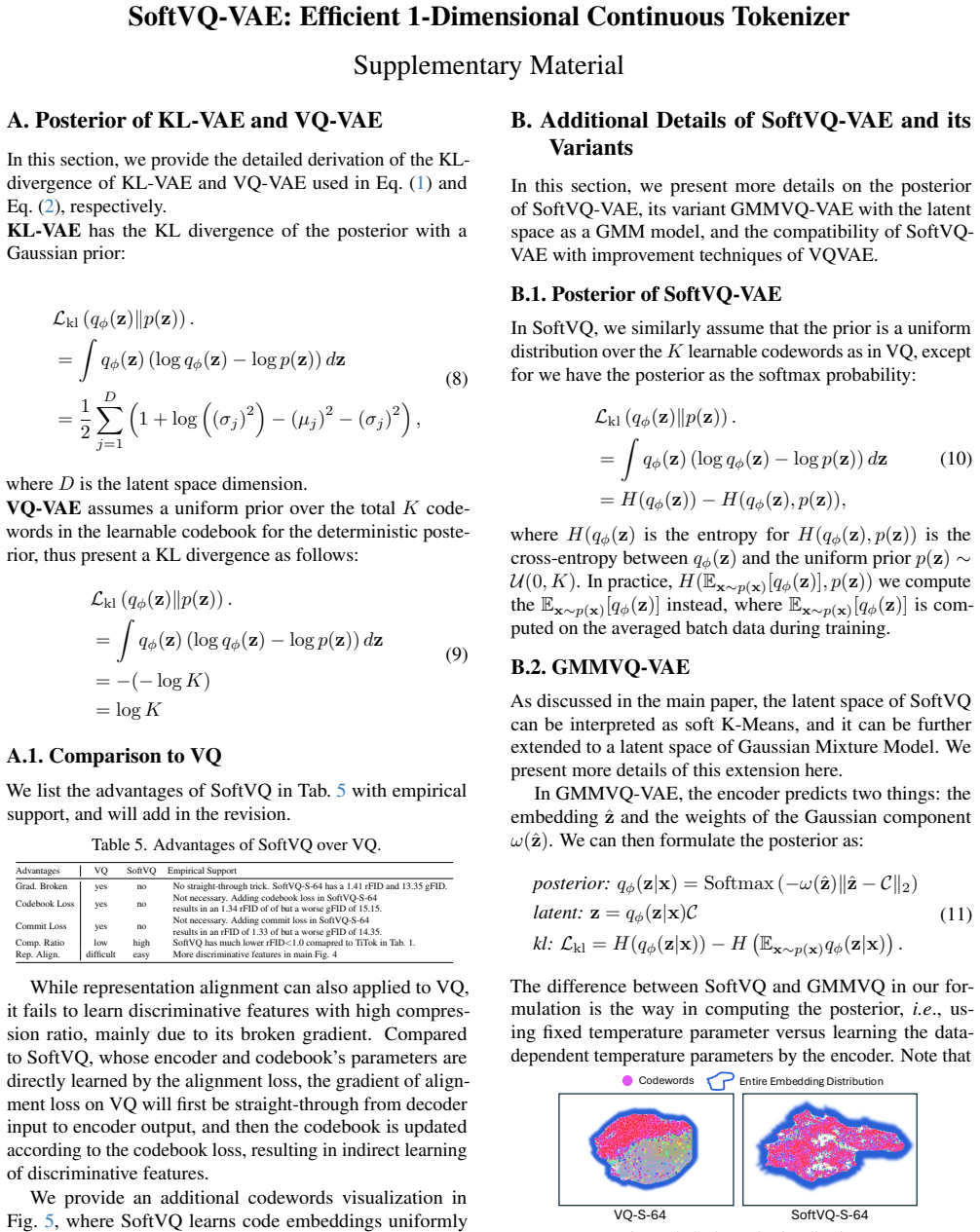
The central object is the soft categorical posterior, $q_{\phi}(z|x) = \operatorname{Softmax}(-\|\hat{z} - C\|^2/\tau)$, which maps the encoder output $\hat{z}$ to a convex combination of codebook vectors $C$. This turns the discrete VQ lookup into soft K-means, makes the whole tokenizer end-to-end differentiable, and — together with the representation-alignment loss of Eq. (6), which replicates each latent token $N/L$ times and matches a pre-trained encoder's patch features through an MLP projector — creates a latent space whose semantics carry the generation task at very few tokens. The KL term is the entropy of the soft posterior minus the entropy of its batch average, regularizing codebook usage without the VQ codebook or commitment losses.
What would settle it
Train the identical SoftVQ-B/64 pipeline on ImageNet with a frozen randomly-initialized or non-semantic alignment target (or with the alignment loss removed and no DINOv2 init), and check whether the final SiT-XL gFID stays near 1.78; a rise above about 5 would confirm that the DINOv2 teacher, not the soft posterior alone, carries the few-token generation quality. A second check: the throughput figures count generative-model FLOPs only, so recompute end-to-end latency including tokenizer decoding; if the 55× advantage shrinks below 10×, the practical speedup claim needs qualification.
Extended reading notes
Core claim
The central claim is that a VQ-VAE can be turned continuous by replacing the arg-min codeword selection with a softmax over negative squared distances to the codebook (temperature τ=0.07), then taking the latent as the probability-weighted sum of codewords. Because every step is differentiable, the codebook and encoder learn directly from reconstruction, perceptual, adversarial, and KL losses without codebook or commit losses, and — crucially — a cosine-similarity loss can align each latent token to the corresponding patch features of a pre-trained self-supervised ViT (DINOv2), with a projector MLP and replicated tokens to match resolution. The paper shows that with this alignment and DINOv2-initialized encoder, SoftVQ variants hold rFID at 0.61–0.89 with only 32–64 tokens, and trained downstream generators (SiT-XL with 64 tokens) obtain gFID 1.78 on ImageNet 256 and 2.21 on 512, using 2.3× fewer training steps than the vanilla baselines.
Load-bearing premise
The headline generation numbers rest on the assumption that aligning the tokenizer's latents to a pre-trained self-supervised vision teacher (DINOv2), and initializing the encoder from it, is a sufficient and transferable inductive bias for downstream generative modeling; Table 4 shows the same 64-token SoftVQ-B drops from gFID 10.13 to 17.20 when the alignment is removed.
Editorial extensions
If this is right
- With 32 and 64 tokens, DiT-XL, SiT-XL, and MAR-H reach generation quality comparable to or better than 256–1024-token baselines on ImageNet 256×256 and 512×512, at a fraction of the GFLOPs.
- Inference throughput for generating a 512×512 image rises up to 55× with 64 tokens, and training iterations drop by roughly 2.3× for comparable FID.
- The soft posterior removes the need for codebook and commitment losses, making the tokenizer a drop-in continuous alternative compatible with existing VQ techniques such as product and residual quantization.
- Reconstruction quality stays high at high compression (rFID 0.61–0.89 at 256×256), unlike hard VQ and plain AE baselines whose rFID degrades sharply when tokens drop below 128.
- The tokenizer's linear-probing accuracy transfers to the trained generative model, indicating that the latent space is semantically organized for downstream generation.
Reading between the lines
- If the alignment premise transfers across domains, the same soft-posterior recipe could push video and audio tokenizers to similarly tiny token budgets, where the quadratic attention cost of transformers is even more prohibitive.
- The paper's Table 4 shows that choosing a different teacher (CLIP or EVA) keeps quality high, suggesting the method may be teacher-agnostic; a testable extension is to see whether a small, task-specific teacher can substitute DINOv2 and reduce tokenizer training cost further.
- Since better reconstruction (rFID) does not track better generation (gFID) here, an implicit design rule for tokenizers is to optimize semantic alignment rather than pixel fidelity at high compression — a principle that, if true, could reshape how tokenizers are evaluated.
- The CFG gains with SoftVQ are smaller than for the REPA baseline, an observation the paper leaves open; investigating why classifier-free guidance saturates at very low token counts could yield methods that further close the gap.
Signed reviews
Editorial analysis
A structured set of objections, weighed in public.
Referee Report
Summary. SoftVQ-VAE proposes replacing VQ-VAE's hard argmin assignment with a soft categorical posterior over a learnable codebook, making the tokenizer fully differentiable and allowing each 1D latent token to aggregate multiple codewords. On ImageNet 256x256 and 512x512, the authors train ViT-based tokenizers with 32 or 64 latent tokens, align the latent space with DINOv2 (or other) features via Eq. (6), and then train DiT, SiT, and MAR generative models on these latents. They report reconstruction rFID around 0.6-0.9 at 32-64 tokens, generation gFID as low as 1.78 (256x256, SiT-XL, CFG) and 2.21 (512x512), and large inference throughput gains (up to 55x), claiming state-of-the-art few-token generation while reducing training iterations. The paper includes extensive system-level tables, tokenizer ablations (codebook size, temperature, PQ/RQ/GMM variants), linear-probing analyses, and visualizations.
Significance. If the results are reproducible and correctly attributed, this is a practically important contribution: it shows that a soft, continuous tokenizer can compress images to 32-64 tokens without collapsing generation quality, directly attacking the token-count bottleneck of transformer-based generative models. The study is unusually thorough on the empirical side, covering two resolutions, three generative backbones, multiple tokenizer scales, and a wide ablation set including codebook size, softmax temperature, product/residual quantization, and GMM variants. The paper also ships code and model releases, and its linear-probing analysis adds evidence about latent-space quality. However, the central attribution of the headline gains to the soft posterior is not yet clean: the few-token FID results are obtained with a DINOv2-initialized encoder and the Eq. (6) alignment loss, and the factorial design in Table 4 shows that this external teacher is load-bearing (gFID moves from 20.33 to 10.13). The scale-matched VQ/AE controls in Table 3 are at the small (46M) scale only. The theoretical framing also needs correction: the quantity called a KL divergence in Eq.
major comments (3)
- [Section 3.2, Eq. (4); Appendix B.1] The term Lkl in Eq. (4), presented as the 'KL divergence term in the ELBO', is not the KL divergence between the posterior and the uniform codebook prior. For a uniform prior over K codewords, KL(q||p) = log K - H(q). The implemented expression H(q) - H(E[q]) is, after batch averaging, approximately the negative of the Jensen gap between the average posterior entropy and the conditional entropy; it is not equal to log K - H(q) and is not even a valid KL divergence as written. The derivation in Appendix B.1 substitutes E[q] into the cross-entropy term without justification, and the first entropy term is not averaged over x. Since the method's core formulation is built on this term, the equation and derivation should be corrected or the term should be explicitly reframed as a diversity regularizer rather than a KL divergence. The empirical results are unlikely to be invalidated because lambda4 is small (0.01), but the description is mathematically incorrect.
- [Section 4.3, Table 3; Section 4.4, Table 4] The headline few-token generation numbers (e.g., FID 1.78 on 256x256 and 2.21 on 512x512) are reported for SoftVQ-B, SoftVQ-BL, and SoftVQ-L with DINOv2 encoder initialization and the Eq. (6) alignment loss, yet the only scale-matched VQ and AE controls are the 46M-parameter SoftVQ-S variants in Table 3. Table 4 shows that DINOv2 initialization plus alignment changes SoftVQ-B 64-token gFID from 20.33 to 10.13, with alignment alone giving 10.96 and initialization alone 17.20. This makes the external teacher load-bearing, and without a VQ-B or AE-B baseline trained with the same DINOv2 initialization and alignment objective, the paper cannot yet attribute the central generation gains to the softness of the posterior. Please add such controlled baselines at the scale of the headline results (or clearly state if the Table 3 controls already include DINOv2 alignment and initialization, in which case that should be stated explicitly in the text).
- [Section 4.1, Tables 1-2; efficiency claims] The throughput speedup claims (up to 18x for 256x256, 55x for 512x512) are presented as system-level comparisons, but the measurement protocol is not fully specified for baseline rows. The text says throughput is measured 'on a single AMD MI250', yet Table 1 includes throughput values for many baseline systems (LDM-4, U-ViT, DiT-XL/2, SiT-XL/2, REPA) that are typically quoted from their original papers, which used different hardware and software stacks. If those baseline numbers are not re-measured on the same MI250 setup, the speedup ratios are not controlled comparisons. Please clarify in the tables or text which throughput values were measured in this work and which are taken from other sources, and if possible report same-hardware measurements for the main baselines.
minor comments (5)
- [Section 4.1 and Appendix C.1] The loss weights are written as 'lambda1 = 1.0, lambda1 = 0.2'; the second should presumably be lambda2 = 0.2, matching Eq. (7). Please fix this typo in both places.
- [Abstract and Introduction, bullet 2] The unqualified phrase 'state-of-the-art generation results' overclaims: in Table 1, SiT-XL/2 + REPA achieves gFID 1.42 with CFG, which is better than the reported SoftVQ best of 1.78. The claim is defensible if restricted to 'with only 32 or 64 tokens' or 'among high-compression tokenizers', and the bullet already includes that qualifier, so please make the abstract and introduction equally precise.
- [Section 3.3, Eq. (6); Section 4.1] The similarity function 'sim' in Eq. (6) is not defined; later text and Table 4 suggest cosine similarity, but the reader should not have to infer this. Also, the notation z_r[n] is garbled in Eq. (5).
- [Throughout] There are several typographical errors: 'Gflops' vs 'GLOPs' (the latter is not a standard unit), 'Similarly to RPEA' should read 'Similarly to REPA' (Appendix C.2), and '1.41 rFID of of' and 'an 1.34 rFID of of' appear in Appendix A.1/Table 5 text.
- [Section 4.4, Table 4] The sentence 'The encoder initialization and alignment with DINOv2-B achieve superior performance with rFID 0.88 and IS 103.4, compared to using either component alone' is accurate, but it could be clearer that CLIP-B and EVA-02-B achieve even better reconstruction and IS; the current wording may mislead readers into thinking DINOv2 is best on all metrics.
Circularity Check
No load-bearing circularity: FID, rFID, and throughput are external measurements; the only overlapping-author citations (ImageFolder) are training-detail references, not the source of the central soft-posterior claim.
full rationale
The paper's central claims are empirical system-level measurements against the external ImageNet benchmark: the gFID values (1.78 / 2.21), rFID values, and throughput numbers are measured outputs of trained tokenizers and generative models, not quantities defined to equal their inputs. The soft categorical posterior in Eq. (4) is a model definition; the paper's experiments then test whether this definition helps, rather than deriving the results from it. Hyperparameters such as the softmax temperature (tau = 0.07), loss weights, and CFG scales are selected by ablation or grid search on validation data, which is standard model selection rather than a fitted parameter being relabeled as a prediction. The strongest dependency, DINOv2 initialization plus the Eq. (6) alignment loss, is external, pretrained, and explicitly ablated in Table 4; the large effect of this component is an attribution gap (no VQ-B/AE-B controls at the 173M-608M scale), not circularity. The paper does cite ImageFolder [62] (overlapping authors) for the PQ/RQ combination and for the frozen DINO discriminator recipe, and it cites it alongside the external works [99] and [116]; these citations concern implementation details and do not supply the central soft-VQ idea, which is introduced and ablated within the paper. Appendix A.1 contains a pipeline artifact stating that Table 5 support 'will add in the revision,' and Appendix C.2 concedes that MAR training used a lower learning rate; these are completeness/limitation caveats, not circular steps. Overall, no derivation reduces to its inputs; score 2 reflects minor overlapping-author citations that are not load-bearing.
Assumptions & free parameters
free parameters (5)
- Softmax temperature tau =
0.07
- CFG guidance scales for DiT and SiT =
1.35/1.45 (DiT, 64/32 tokens), 1.75/2.25 (SiT, 64/32 tokens)
- Loss weights lambda1, lambda2, lambda3, lambda4 =
1.0, 0.2, 0.1, 0.01
- MAR maximum learning rate =
2e-4
- Codebook size K and latent dimension D =
K=8192, D=32 for SoftVQ-S; ablations vary
assumptions (4)
- ad hoc to paper The implemented regularizer H(q) minus H(E[q]) is a valid KL divergence to a uniform codebook prior.
- domain assumption DINOv2 features are a suitable semantic target for generation quality.
- domain assumption A frozen DINO-S discriminator with StyleGAN-style training is an effective adversarial regularizer.
- domain assumption FID on ImageNet is the relevant measure of generation quality.
Cite this review
Pith. "Pith review of SoftVQ-VAE: Efficient 1-Dimensional Continuous Tokenizer." pith.science (2026). https://pith.science/paper/6YELJ4GO
@misc{pith2026241210958,
  author       = {Pith},
  title        = {Pith review of: SoftVQ-VAE: Efficient 1-Dimensional Continuous Tokenizer},
  year         = {2026},
  howpublished = {\url{https://pith.science/paper/6YELJ4GO}},
  note         = {Machine review of arXiv:2412.10958}
}
read the original abstract
Efficient image tokenization with high compression ratios remains a critical challenge for training generative models. We present SoftVQ-VAE, a continuous image tokenizer that leverages soft categorical posteriors to aggregate multiple codewords into each latent token, substantially increasing the representation capacity of the latent space. When applied to Transformer-based architectures, our approach compresses 256x256 and 512x512 images using as few as 32 or 64 1-dimensional tokens. Not only does SoftVQ-VAE show consistent and high-quality reconstruction, more importantly, it also achieves state-of-the-art and significantly faster image generation results across different denoising-based generative models. Remarkably, SoftVQ-VAE improves inference throughput by up to 18x for generating 256x256 images and 55x for 512x512 images while achieving competitive FID scores of 1.78 and 2.21 for SiT-XL. It also improves the training efficiency of the generative models by reducing the number of training iterations by 2.3x while maintaining comparable performance. With its fully-differentiable design and semantic-rich latent space, our experiment demonstrates that SoftVQ-VAE achieves efficient tokenization without compromising generation quality, paving the way for more efficient generative models. Code and model are released.
Figures


Figures from the paper (25 more)





Forward citations
Cited by 4 Pith papers
-
Rethinking Discrete Tokens: Treating Them as Conditions for Continuous Autoregressive Image Synthesis
DisCon treats discrete image tokens as conditioning signals rather than targets, letting a continuous autoregressive model refine details and reach gFID 1.38 on ImageNet-256.
-
Instella-T2I: Pushing the Limits of 1D Discrete Latent Space Image Generation
1D binary image latents reduce a 1024x1024 image to 128 discrete tokens and support text-to-image generation with diffusion and autoregressive models.
-
Masked Autoencoders Are Effective Tokenizers for Diffusion Models
MAETok shows that a masked-autoencoder-trained plain autoencoder, without variational constraints, reaches state-of-the-art ImageNet generation quality using only 128 latent tokens.
-
DC-AR: Efficient Masked Autoregressive Image Generation with Deep Compression Hybrid Tokenizer
DC-AR generates 512x512 images in 12 masked autoregressive steps plus 20 diffusion refinement steps, using a 32x compressed 2D tokenizer, and reports gFID 5.49 on MJHQ-30K.
Reference graph
Works this paper leans on
-
[1]
Stochastic interpolants: A unifying framework for flows and diffusions
Michael S Albergo, Nicholas M Boffi, and Eric Vanden- Eijnden. Stochastic interpolants: A unifying framework for flows and diffusions. arXiv preprint arXiv:2303.08797,
-
[2]
Reverse-time diffusion equation mod- els
Brian DO Anderson. Reverse-time diffusion equation mod- els. Stochastic Processes and their Applications , 12(3): 313–326, 1982. 3
1982
-
[3]
wav2vec 2.0: A framework for self- supervised learning of speech representations
Alexei Baevski, Yuhao Zhou, Abdelrahman Mohamed, and Michael Auli. wav2vec 2.0: A framework for self- supervised learning of speech representations. Advances in neural information processing systems, 33:12449–12460,
-
[4]
All are worth words: A vit backbone for diffusion models
Fan Bao, Shen Nie, Kaiwen Xue, Yue Cao, Chongxuan Li, Hang Su, and Jun Zhu. All are worth words: A vit backbone for diffusion models. In Proceedings of the IEEE/CVF con- ference on computer vision and pattern recognition, pages 22669–22679, 2023. 6, 7, 5
2023
-
[5]
Beit: Bert pre-training of image transformers
Hangbo Bao, Li Dong, Songhao Piao, and Furu Wei. Beit: Bert pre-training of image transformers. arXiv preprint arXiv:2106.08254, 2021. 4
arXiv 2021
-
[6]
Lumiere: A space- time diffusion model for video generation
Omer Bar-Tal, Hila Chefer, Omer Tov, Charles Her- rmann, Roni Paiss, Shiran Zada, Ariel Ephrat, Junhwa Hur, Guanghui Liu, Amit Raj, et al. Lumiere: A space- time diffusion model for video generation. arXiv preprint arXiv:2401.12945, 2024. 1
arXiv 2024
-
[7]
Estimating or propagating gradients through stochastic neurons for conditional computation
Yoshua Bengio, Nicholas L ´eonard, and Aaron Courville. Estimating or propagating gradients through stochastic neurons for conditional computation. arXiv preprint arXiv:1308.3432, 2013. 1, 3
arXiv 2013
-
[8]
Stable video diffusion: Scaling latent video diffusion models to large datasets
Andreas Blattmann, Tim Dockhorn, Sumith Kulal, Daniel Mendelevitch, Maciej Kilian, Dominik Lorenz, Yam Levi, Zion English, Vikram V oleti, Adam Letts, et al. Stable video diffusion: Scaling latent video diffusion models to large datasets. arXiv preprint arXiv:2311.15127, 2023. 1
arXiv 2023
Show all 126 references
-
[9]
Emerg- ing properties in self-supervised vision transformers
Mathilde Caron, Hugo Touvron, Ishan Misra, Herv´e J´egou, Julien Mairal, Piotr Bojanowski, and Armand Joulin. Emerg- ing properties in self-supervised vision transformers. In Proceedings of the IEEE/CVF international conference on computer vision, pages 9650–9660, 2021. 5, 2
2021
-
[10]
Huiwen Chang, Han Zhang, Lu Jiang, Ce Liu, and William T. Freeman. Maskgit: Masked generative image transformer,
-
[11]
Deep compression autoencoder for efficient high-resolution diffu- sion models
Junyu Chen, Han Cai, Junsong Chen, Enze Xie, Shang Yang, Haotian Tang, Muyang Li, Yao Lu, and Song Han. Deep compression autoencoder for efficient high-resolution diffu- sion models. arXiv preprint arXiv:2410.10733, 2024. 1, 6, 7, 5
2024 arXiv
-
[12]
An image is worth 1/2 tokens after layer 2: Plug-and-play inference ac- celeration for large vision-language models
Liang Chen, Haozhe Zhao, Tianyu Liu, Shuai Bai, Jun- yang Lin, Chang Zhou, and Baobao Chang. An image is worth 1/2 tokens after layer 2: Plug-and-play inference ac- celeration for large vision-language models. arXiv preprint arXiv:2403.06764, 2024. 1
2024 arXiv
-
[13]
Variational lossy autoencoder
Xi Chen, Diederik P Kingma, Tim Salimans, Yan Duan, Pra- fulla Dhariwal, John Schulman, Ilya Sutskever, and Pieter Abbeel. Variational lossy autoencoder. arXiv preprint arXiv:1611.02731, 2016. 1, 2, 3
2016 arXiv
-
[14]
De- constructing denoising diffusion models for self-supervised learning
Xinlei Chen, Zhuang Liu, Saining Xie, and Kaiming He. De- constructing denoising diffusion models for self-supervised learning. arXiv preprint arXiv:2401.14404, 2024. 1, 2, 3
2024 arXiv
-
[15]
Imagenet: A large-scale hierarchical image database
Jia Deng, Wei Dong, Richard Socher, Li-Jia Li, Kai Li, and Li Fei-Fei. Imagenet: A large-scale hierarchical image database. In 2009 IEEE conference on computer vision and pattern recognition, pages 248–255. Ieee, 2009. 5, 2
2009
-
[16]
Diffusion models beat gans on image synthesis, 2021
Prafulla Dhariwal and Alex Nichol. Diffusion models beat gans on image synthesis, 2021. 1, 7, 8, 5
2021
-
[17]
Deep unsupervised clustering with gaussian mixture variational autoencoders
Nat Dilokthanakul, Pedro AM Mediano, Marta Garnelo, Matthew CH Lee, Hugh Salimbeni, Kai Arulkumaran, and Murray Shanahan. Deep unsupervised clustering with gaussian mixture variational autoencoders. arXiv preprint arXiv:1611.02648, 2016. 4
2016 arXiv
-
[18]
Cogview: Mastering text-to-image generation via transformers
Ming Ding, Zhuoyi Yang, Wenyi Hong, Wendi Zheng, Chang Zhou, Da Yin, Junyang Lin, Xu Zou, Zhou Shao, Hongxia Yang, et al. Cogview: Mastering text-to-image generation via transformers. Advances in neural information processing systems, 34:19822–19835, 2021. 8
2021
-
[19]
Peco: Perceptual codebook for bert pre-training of vision transformers
Xiaoyi Dong, Jianmin Bao, Ting Zhang, Dongdong Chen, Weiming Zhang, Lu Yuan, Dong Chen, Fang Wen, Nenghai Yu, and Baining Guo. Peco: Perceptual codebook for bert pre-training of vision transformers. In Proceedings of the AAAI Conference on Artificial Intelligence, pages 552–560,
-
[20]
Generating images with perceptual similarity metrics based on deep networks
Alexey Dosovitskiy and Thomas Brox. Generating images with perceptual similarity metrics based on deep networks. Advances in neural information processing systems , 29,
-
[21]
An image is worth 16x16 words: Transformers for image recognition at scale, 2021
Alexey Dosovitskiy, Lucas Beyer, Alexander Kolesnikov, Dirk Weissenborn, Xiaohua Zhai, Thomas Unterthiner, Mostafa Dehghani, Matthias Minderer, Georg Heigold, Syl- vain Gelly, Jakob Uszkoreit, and Neil Houlsby. An image is worth 16x16 words: Transformers for image recognition ...
2021
-
[22]
A fuzzy relative of the isodata process and its use in detecting compact well-separated clusters
Joseph C Dunn. A fuzzy relative of the isodata process and its use in detecting compact well-separated clusters. 1973. 2, 4
1973
-
[23]
Taming transformers for high-resolution image synthesis
Patrick Esser, Robin Rombach, and Bjorn Ommer. Taming transformers for high-resolution image synthesis. In Pro- ceedings of the IEEE/CVF conference on computer vision and pattern recognition, pages 12873–12883, 2021. 1, 2, 3, 5, 6, 8
2021
-
[24]
Fast timing-conditioned latent audio diffusion
Zach Evans, CJ Carr, Josiah Taylor, Scott H Hawley, and Jordi Pons. Fast timing-conditioned latent audio diffusion. arXiv preprint arXiv:2402.04825, 2024. 1
2024 arXiv
-
[25]
Fluid: Scaling autoregressive text-to-image generative models with continuous tokens
Lijie Fan, Tianhong Li, Siyang Qin, Yuanzhen Li, Chen Sun, Michael Rubinstein, Deqing Sun, Kaiming He, and Yonglong Tian. Fluid: Scaling autoregressive text-to-image generative models with continuous tokens. arXiv preprint arXiv:2410.13863, 2024. 1
-
[26]
Eva-02: A visual representation for neon genesis
Yuxin Fang, Quan Sun, Xinggang Wang, Tiejun Huang, Xin- long Wang, and Yue Cao. Eva-02: A visual representation for neon genesis. Image and Vision Computing, 149:105171,
-
[27]
Restructuring vector quantization with the rotation trick
Christopher Fifty, Ronald G Junkins, Dennis Duan, Aniketh Iger, Jerry W Liu, Ehsan Amid, Sebastian Thrun, and Christopher R´e. Restructuring vector quantization with the rotation trick. arXiv preprint arXiv:2410.06424, 2024. 2, 3
2024 arXiv
-
[28]
Make-a-scene: Scene- based text-to-image generation with human priors
Oran Gafni, Adam Polyak, Oron Ashual, Shelly Sheynin, Devi Parikh, and Yaniv Taigman. Make-a-scene: Scene- based text-to-image generation with human priors. In Eu- ropean Conference on Computer Vision , pages 89–106. Springer, 2022. 8
2022
-
[29]
Mdtv2: Masked diffusion transformer is a strong image synthesizer
Shanghua Gao, Pan Zhou, Ming-Ming Cheng, and Shuicheng Yan. Mdtv2: Masked diffusion transformer is a strong image synthesizer. arXiv preprint arXiv:2303.14389,
-
[30]
Planting a seed of vision in large language model,
Yuying Ge, Yixiao Ge, Ziyun Zeng, Xintao Wang, and Ying Shan. Planting a seed of vision in large language model,
-
[31]
Making llama see and draw with seed tokenizer
Yuying Ge, Sijie Zhao, Ziyun Zeng, Yixiao Ge, Chen Li, Xintao Wang, and Ying Shan. Making llama see and draw with seed tokenizer. arXiv preprint arXiv:2310.01218, 2023. 2
2023 arXiv
-
[32]
Diffuseq: Sequence to sequence text generation with diffusion models
Shansan Gong, Mukai Li, Jiangtao Feng, Zhiyong Wu, and LingPeng Kong. Diffuseq: Sequence to sequence text generation with diffusion models. arXiv preprint arXiv:2210.08933, 2022. 1
2022 arXiv
-
[33]
Generative adversarial networks
Ian Goodfellow, Jean Pouget-Abadie, Mehdi Mirza, Bing Xu, David Warde-Farley, Sherjil Ozair, Aaron Courville, and Yoshua Bengio. Generative adversarial networks. Commu- nications of the ACM, 63(11):139–144, 2020. 5
2020
-
[34]
Rethinking the objectives of vector-quantized tokenizers for image synthesis, 2023
Yuchao Gu, Xintao Wang, Yixiao Ge, Ying Shan, Xiaohu Qie, and Mike Zheng Shou. Rethinking the objectives of vector-quantized tokenizers for image synthesis, 2023. 2, 8
2023
-
[35]
Masked autoencoders are scal- able vision learners
Kaiming He, Xinlei Chen, Saining Xie, Yanghao Li, Piotr Doll´ar, and Ross Girshick. Masked autoencoders are scal- able vision learners. In Proceedings of the IEEE/CVF con- ference on computer vision and pattern recognition, pages 16000–16009, 2022. 1, 3, 4
2022
-
[36]
Rotary position embedding for vision transformer
Byeongho Heo, Song Park, Dongyoon Han, and Sangdoo Yun. Rotary position embedding for vision transformer. In European Conference on Computer Vision, pages 289–305. Springer, 2025. 4
2025
-
[37]
Gans trained by a two time-scale update rule converge to a local nash equilibrium
Martin Heusel, Hubert Ramsauer, Thomas Unterthiner, Bern- hard Nessler, and Sepp Hochreiter. Gans trained by a two time-scale update rule converge to a local nash equilibrium. Advances in Neural Information Processing Systems , 30,
-
[38]
beta-vae: Learning basic visual concepts with a constrained variational framework
Irina Higgins, Loic Matthey, Arka Pal, Christopher P Burgess, Xavier Glorot, Matthew M Botvinick, Shakir Mo- hamed, and Alexander Lerchner. beta-vae: Learning basic visual concepts with a constrained variational framework. ICLR, 3, 2017. 1, 2, 3
2017
-
[39]
Reducing the dimensionality of data with neural networks
Geoffrey E Hinton and Ruslan R Salakhutdinov. Reducing the dimensionality of data with neural networks. science, 313(5786):504–507, 2006. 8
2006
-
[40]
Classifier-free diffusion guidance
Jonathan Ho and Tim Salimans. Classifier-free diffusion guidance. arXiv preprint arXiv:2207.12598, 2022. 5
2022 arXiv
-
[41]
Denoising diffu- sion probabilistic models
Jonathan Ho, Ajay Jain, and Pieter Abbeel. Denoising diffu- sion probabilistic models. Advances in neural information processing systems, 33:6840–6851, 2020. 3
2020
-
[42]
Video dif- fusion models
Jonathan Ho, Tim Salimans, Alexey Gritsenko, William Chan, Mohammad Norouzi, and David J Fleet. Video dif- fusion models. Advances in Neural Information Processing Systems, 35:8633–8646, 2022. 1
2022
-
[43]
Straightening out the straight-through estimator: Over- coming optimization challenges in vector quantized net- works
Minyoung Huh, Brian Cheung, Pulkit Agrawal, and Phillip Isola. Straightening out the straight-through estimator: Over- coming optimization challenges in vector quantized net- works. In International Conference on Machine Learning, pages 14096–14113. PMLR, 2023. 3, 4
2023
-
[44]
Phillip Isola, Jun-Yan Zhu, Tinghui Zhou, and Alexei A. Efros. Image-to-image translation with conditional adver- sarial networks, 2018. 5
2018
-
[45]
Product quantization for nearest neighbor search
Herve Jegou, Matthijs Douze, and Cordelia Schmid. Product quantization for nearest neighbor search. IEEE transactions on pattern analysis and machine intelligence , 33(1):117– 128, 2010. 2, 8
2010
-
[46]
Percep- tual losses for real-time style transfer and super-resolution
Justin Johnson, Alexandre Alahi, and Li Fei-Fei. Percep- tual losses for real-time style transfer and super-resolution. In Computer Vision–ECCV 2016: 14th European Confer- ence, Amsterdam, The Netherlands, October 11-14, 2016, Proceedings, Part II 14, pages 694–711. Springer, 2016. 5
2016
-
[47]
Composing graphical models with neural networks for structured representations and fast inference
Matthew J Johnson, David K Duvenaud, Alex Wiltschko, Ryan P Adams, and Sandeep R Datta. Composing graphical models with neural networks for structured representations and fast inference. Advances in neural information process- ing systems, 29, 2016. 4
2016
-
[48]
A style-based generator architecture for generative adversarial networks
Tero Karras, Samuli Laine, and Timo Aila. A style-based generator architecture for generative adversarial networks. In Proceedings of the IEEE/CVF conference on computer vision and pattern recognition, pages 4401–4410, 2019. 5, 7, 2
2019
-
[49]
Analyzing and improv- ing the image quality of stylegan
Tero Karras, Samuli Laine, Miika Aittala, Janne Hellsten, Jaakko Lehtinen, and Timo Aila. Analyzing and improv- ing the image quality of stylegan. In Proceedings of the IEEE/CVF conference on computer vision and pattern recog- nition, pages 8110–8119, 2020. 5, 2
2020
-
[50]
Understanding diffusion objectives as the elbo with simple data augmentation
Diederik Kingma and Ruiqi Gao. Understanding diffusion objectives as the elbo with simple data augmentation. Ad- vances in Neural Information Processing Systems, 36, 2024. 3
2024
-
[51]
Auto-encoding variational bayes
Diederik P Kingma. Auto-encoding variational bayes. arXiv preprint arXiv:1312.6114, 2013. 1, 2, 3
2013 arXiv
-
[52]
Improved precision and recall metric for assessing generative models
Tuomas Kynk¨a¨anniemi, Tero Karras, Samuli Laine, Jaakko Lehtinen, and Timo Aila. Improved precision and recall metric for assessing generative models. Advances in neural information processing systems, 32, 2019. 5
2019
-
[53]
Applying guidance in a limited interval improves sample and distribution quality in diffusion models
Tuomas Kynk¨a¨anniemi, Miika Aittala, Tero Karras, Samuli Laine, Timo Aila, and Jaakko Lehtinen. Applying guidance in a limited interval improves sample and distribution quality in diffusion models. arXiv preprint arXiv:2404.07724, 2024. 2
2024 arXiv
-
[54]
Autoencoding beyond pixels using a learned similarity metric
Anders Boesen Lindbo Larsen, Søren Kaae Sønderby, Hugo Larochelle, and Ole Winther. Autoencoding beyond pixels using a learned similarity metric. InInternational conference on machine learning, pages 1558–1566. PMLR, 2016. 5
2016
-
[55]
Autoregressive image generation using residual quantization
Doyup Lee, Chiheon Kim, Saehoon Kim, Minsu Cho, and Wook-Shin Han. Autoregressive image generation using residual quantization. In Proceedings of the IEEE/CVF Conference on Computer Vision and Pattern Recognition, pages 11523–11532, 2022. 2, 6, 8, 5
2022
-
[56]
Autoregressive image generation using residual quantization, 2022
Doyup Lee, Chiheon Kim, Saehoon Kim, Minsu Cho, and Wook-Shin Han. Autoregressive image generation using residual quantization, 2022. 1
2022
-
[57]
Scalable autoregressive image generation with mamba
Haopeng Li, Jinyue Yang, Kexin Wang, Xuerui Qiu, Yuhong Chou, Xin Li, and Guoqi Li. Scalable autoregressive image generation with mamba. arXiv preprint arXiv:2408.12245,
-
[58]
Blip- 2: Bootstrapping language-image pre-training with frozen image encoders and large language models
Junnan Li, Dongxu Li, Silvio Savarese, and Steven Hoi. Blip- 2: Bootstrapping language-image pre-training with frozen image encoders and large language models. In Interna- tional conference on machine learning, pages 19730–19742. PMLR, 2023. 1, 2
2023
-
[59]
Mage: Masked generative encoder to unify representation learning and im- age synthesis, 2023
Tianhong Li, Huiwen Chang, Shlok Kumar Mishra, Han Zhang, Dina Katabi, and Dilip Krishnan. Mage: Masked generative encoder to unify representation learning and im- age synthesis, 2023. 3, 6, 5
2023
-
[60]
Autoregressive image generation without vec- tor quantization, 2024
Tianhong Li, Yonglong Tian, He Li, Mingyang Deng, and Kaiming He. Autoregressive image generation without vec- tor quantization, 2024. 1, 2, 3, 5, 6, 8
2024
-
[61]
Tokenpacker: Effi- cient visual projector for multimodal llm
Wentong Li, Yuqian Yuan, Jian Liu, Dongqi Tang, Song Wang, Jianke Zhu, and Lei Zhang. Tokenpacker: Effi- cient visual projector for multimodal llm. arXiv preprint arXiv:2407.02392, 2024. 1
2024 arXiv
-
[62]
Imagefolder: Autoregres- sive image generation with folded tokens
Xiang Li, Hao Chen, Kai Qiu, Jason Kuen, Jiuxiang Gu, Bhiksha Raj, and Zhe Lin. Imagefolder: Autoregres- sive image generation with folded tokens. arXiv preprint arXiv:2410.01756, 2024. 1, 2, 4, 5, 8
2024 arXiv
-
[63]
Mini-gemini: Mining the potential of multi-modality vision language models
Yanwei Li, Yuechen Zhang, Chengyao Wang, Zhisheng Zhong, Yixin Chen, Ruihang Chu, Shaoteng Liu, and Jiaya Jia. Mini-gemini: Mining the potential of multi-modality vision language models. arXiv preprint arXiv:2403.18814,
-
[64]
Sphinx: The joint mixing of weights, tasks, and visual embeddings for multi-modal large language models
Ziyi Lin, Chris Liu, Renrui Zhang, Peng Gao, Longtian Qiu, Han Xiao, Han Qiu, Chen Lin, Wenqi Shao, Keqin Chen, et al. Sphinx: The joint mixing of weights, tasks, and visual embeddings for multi-modal large language models. arXiv preprint arXiv:2311.07575, 2023. 2
2023 arXiv
-
[65]
Flow matching for generative modeling
Yaron Lipman, Ricky TQ Chen, Heli Ben-Hamu, Maxim- ilian Nickel, and Matt Le. Flow matching for generative modeling. arXiv preprint arXiv:2210.02747, 2022. 3
2022 arXiv
-
[66]
Customize your visual autoregressive recipe with set autoregressive modeling
Wenze Liu, Le Zhuo, Yi Xin, Sheng Xia, Peng Gao, and Xiangyu Yue. Customize your visual autoregressive recipe with set autoregressive modeling. arXiv preprint arXiv:2410.10511, 2024. 8
2024 arXiv
-
[67]
Least squares quantization in pcm
Stuart Lloyd. Least squares quantization in pcm. IEEE transactions on information theory, 28(2):129–137, 1982. 2, 4
1982
-
[68]
Decoupled weight decay regularization
I Loshchilov. Decoupled weight decay regularization. arXiv preprint arXiv:1711.05101, 2017. 2
2017 arXiv
-
[69]
Simplifying, stabilizing and scaling continuous-time consistency models
Cheng Lu and Yang Song. Simplifying, stabilizing and scaling continuous-time consistency models. arXiv preprint arXiv:2410.11081, 2024. 1
2024 arXiv
-
[70]
Feast your eyes: Mixture-of- resolution adaptation for multimodal large language models
Gen Luo, Yiyi Zhou, Yuxin Zhang, Xiawu Zheng, Xi- aoshuai Sun, and Rongrong Ji. Feast your eyes: Mixture-of- resolution adaptation for multimodal large language models. arXiv preprint arXiv:2403.03003, 2024. 1
2024 arXiv
-
[71]
Open-magvit2: An open-source project toward democratizing auto-regressive visual genera- tion
Zhuoyan Luo, Fengyuan Shi, Yixiao Ge, Yujiu Yang, Limin Wang, and Ying Shan. Open-magvit2: An open-source project toward democratizing auto-regressive visual genera- tion. arXiv preprint arXiv:2409.04410, 2024. 2
2024 arXiv
-
[72]
Sit: Exploring flow and diffusion-based generative models with scalable interpolant transformers
Nanye Ma, Mark Goldstein, Michael S Albergo, Nicholas M Boffi, Eric Vanden-Eijnden, and Saining Xie. Sit: Exploring flow and diffusion-based generative models with scalable interpolant transformers. arXiv preprint arXiv:2401.08740,
-
[73]
Finite scalar quantization: Vq-vae made simple, 2023
Fabian Mentzer, David Minnen, Eirikur Agustsson, and Michael Tschannen. Finite scalar quantization: Vq-vae made simple, 2023. 2, 8
2023
-
[74]
Midjourney
MidJourney Inc. Midjourney. Software available from MidJourney Inc., 2022. 8
2022
-
[75]
Improved denoising diffusion probabilistic models, 2021
Alex Nichol and Prafulla Dhariwal. Improved denoising diffusion probabilistic models, 2021. 8
2021
-
[76]
Glide: Towards photorealistic image genera- tion and editing with text-guided diffusion models
Alex Nichol, Prafulla Dhariwal, Aditya Ramesh, Pranav Shyam, Pamela Mishkin, Bob McGrew, Ilya Sutskever, and Mark Chen. Glide: Towards photorealistic image genera- tion and editing with text-guided diffusion models. arXiv preprint arXiv:2112.10741, 2021. 8
2021 arXiv
-
[77]
Certain topics in telegraph transmission theory
Harry Nyquist. Certain topics in telegraph transmission theory. Transactions of the American Institute of Electrical Engineers, 47(2):617–644, 1928. 2
1928
-
[78]
Video generation models as world simulators
OpenAI. Video generation models as world simulators. Ope- nAI Blog, 2024. 8
2024
-
[79]
Maxime Oquab, Timoth´ee Darcet, Theo Moutakanni, Huy V . V o, Marc Szafraniec, Vasil Khalidov, Pierre Fernandez, Daniel Haziza, Francisco Massa, Alaaeldin El-Nouby, Rus- sell Howes, Po-Yao Huang, Hu Xu, Vasu Sharma, Shang- Wen Li, Wojciech Galuba, Mike Rabbat, Mido Assran, Nic...
2023
-
[80]
Scalable diffusion models with transformers, 2023
William Peebles and Saining Xie. Scalable diffusion models with transformers, 2023. 1, 2, 3, 5, 6, 7, 8
2023
-
[81]
Grad-tts: A diffusion probabilistic model for text-to-speech
Vadim Popov, Ivan V ovk, Vladimir Gogoryan, Tasnima Sadekova, and Mikhail Kudinov. Grad-tts: A diffusion probabilistic model for text-to-speech. In International Con- ference on Machine Learning , pages 8599–8608. PMLR,
-
[82]
Learn- ing transferable visual models from natural language super- vision
Alec Radford, Jong Wook Kim, Chris Hallacy, Aditya Ramesh, Gabriel Goh, Sandhini Agarwal, Girish Sastry, Amanda Askell, Pamela Mishkin, Jack Clark, et al. Learn- ing transferable visual models from natural language super- vision. In International conference on machine learning...
2021
-
[83]
Zero-shot text-to-image generation
Aditya Ramesh, Mikhail Pavlov, Gabriel Goh, Scott Gray, Chelsea V oss, Alec Radford, Mark Chen, and Ilya Sutskever. Zero-shot text-to-image generation. In International confer- ence on machine learning, pages 8821–8831. Pmlr, 2021. 1, 8
2021
-
[84]
Gener- ating diverse high-fidelity images with vq-vae-2
Ali Razavi, Aaron Van den Oord, and Oriol Vinyals. Gener- ating diverse high-fidelity images with vq-vae-2. Advances in neural information processing systems, 32, 2019. 1, 8
2019
-
[85]
Gen- erating diverse high-fidelity images with vq-vae-2, 2019
Ali Razavi, Aaron van den Oord, and Oriol Vinyals. Gen- erating diverse high-fidelity images with vq-vae-2, 2019. 8
2019
-
[86]
Gaussian mixture models
Douglas A Reynolds et al. Gaussian mixture models. Ency- clopedia of biometrics, 741(659-663), 2009. 2, 4
2009
-
[87]
High-resolution image synthesis with latent diffusion models
Robin Rombach, Andreas Blattmann, Dominik Lorenz, Patrick Esser, and Bj ¨orn Ommer. High-resolution image synthesis with latent diffusion models. In Proceedings of the IEEE/CVF conference on computer vision and pattern recognition, pages 10684–10695, 2022. 8
2022
-
[88]
High-resolution image synthesis with latent diffusion models, 2022
Robin Rombach, Andreas Blattmann, Dominik Lorenz, Patrick Esser, and Bj ¨orn Ommer. High-resolution image synthesis with latent diffusion models, 2022. 1, 6, 8, 5
2022
-
[89]
Photorealistic text-to-image diffusion models with deep language understanding
Chitwan Saharia, William Chan, Saurabh Saxena, Lala Li, Jay Whang, Emily L Denton, Kamyar Ghasemipour, Raphael Gontijo Lopes, Burcu Karagol Ayan, Tim Salimans, et al. Photorealistic text-to-image diffusion models with deep language understanding. Advances in neural informa- ti...
2022
-
[90]
Improved techniques for training gans
Tim Salimans, Ian Goodfellow, Wojciech Zaremba, Vicki Cheung, Alec Radford, and Xi Chen. Improved techniques for training gans. Advances in Neural Information Process- ing Systems, 29, 2016. 5
2016
-
[91]
Communication in the presence of noise
Claude Elwood Shannon. Communication in the presence of noise. Proceedings of the IRE, 37(1):10–21, 1949. 2
1949
-
[92]
Deep unsupervised learning using nonequilibrium thermodynamics
Jascha Sohl-Dickstein, Eric Weiss, Niru Maheswaranathan, and Surya Ganguli. Deep unsupervised learning using nonequilibrium thermodynamics. In International confer- ence on machine learning, pages 2256–2265. PMLR, 2015. 3, 8
2015
-
[93]
Weiss, Niru Mah- eswaranathan, and Surya Ganguli
Jascha Sohl-Dickstein, Eric A. Weiss, Niru Mah- eswaranathan, and Surya Ganguli. Deep unsupervised learn- ing using nonequilibrium thermodynamics, 2015. 8
2015
-
[94]
Less is more: A sim- ple yet effective token reduction method for efficient multi- modal llms
Dingjie Song, Wenjun Wang, Shunian Chen, Xidong Wang, Michael Guan, and Benyou Wang. Less is more: A sim- ple yet effective token reduction method for efficient multi- modal llms. arXiv preprint arXiv:2409.10994, 2024. 1
2024 arXiv
-
[95]
Denois- ing diffusion implicit models, 2022
Jiaming Song, Chenlin Meng, and Stefano Ermon. Denois- ing diffusion implicit models, 2022. 8
2022
-
[96]
Sd vae ft ema, 2023
stabilityai. Sd vae ft ema, 2023. Accessed: 2023. 1, 3, 7
2023
-
[97]
Roformer: Enhanced transformer with rotary position embedding
Jianlin Su, Murtadha Ahmed, Yu Lu, Shengfeng Pan, Wen Bo, and Yunfeng Liu. Roformer: Enhanced transformer with rotary position embedding. Neurocomputing, 568:127063,
-
[98]
Autoregressive model beats diffusion: Llama for scalable image generation
Peize Sun, Yi Jiang, Shoufa Chen, Shilong Zhang, Bingyue Peng, Ping Luo, and Zehuan Yuan. Autoregressive model beats diffusion: Llama for scalable image generation. arXiv preprint arXiv:2406.06525, 2024. 1, 5, 6, 8
2024 arXiv
-
[99]
Visual autoregressive modeling: Scalable image generation via next-scale prediction, 2024
Keyu Tian, Yi Jiang, Zehuan Yuan, Bingyue Peng, and Liwei Wang. Visual autoregressive modeling: Scalable image generation via next-scale prediction, 2024. 3, 5, 8, 2
2024
-
[100]
Givt: Generative infinite-vocabulary transformers
Michael Tschannen, Cian Eastwood, and Fabian Mentzer. Givt: Generative infinite-vocabulary transformers. In Eu- ropean Conference on Computer Vision , pages 292–309. Springer, 2025. 3
2025
-
[101]
Regularizing generative adversarial networks under limited data, 2021
Hung-Yu Tseng, Lu Jiang, Ce Liu, Ming-Hsuan Yang, and Weilong Yang. Regularizing generative adversarial networks under limited data, 2021. 5, 2
2021
-
[102]
Score-based generative modeling in latent space, 2021
Arash Vahdat, Karsten Kreis, and Jan Kautz. Score-based generative modeling in latent space, 2021. 8
2021
-
[103]
Conditional image genera- tion with pixelcnn decoders
Aaron Van den Oord, Nal Kalchbrenner, Lasse Espeholt, Oriol Vinyals, Alex Graves, et al. Conditional image genera- tion with pixelcnn decoders. Advances in neural information processing systems, 29, 2016. 8
2016
-
[104]
Neural discrete representation learning
Aaron Van Den Oord, Oriol Vinyals, et al. Neural discrete representation learning. Advances in neural information processing systems, 30, 2017. 1, 2, 3, 8
2017
-
[105]
Gomez, Lukasz Kaiser, and Illia Polosukhin
Ashish Vaswani, Noam Shazeer, Niki Parmar, Jakob Uszko- reit, Llion Jones, Aidan N. Gomez, Lukasz Kaiser, and Illia Polosukhin. Attention is all you need, 2023. 1, 8
2023
-
[106]
Extracting and composing ro- bust features with denoising autoencoders
Pascal Vincent, Hugo Larochelle, Yoshua Bengio, and Pierre-Antoine Manzagol. Extracting and composing ro- bust features with denoising autoencoders. In Proceedings of the 25th international conference on Machine learning, pages 1096–1103, 2008. 8
2008
-
[107]
Emu3: Next-token prediction is all you need
Xinlong Wang, Xiaosong Zhang, Zhengxiong Luo, Quan Sun, Yufeng Cui, Jinsheng Wang, Fan Zhang, Yueze Wang, Zhen Li, Qiying Yu, et al. Emu3: Next-token prediction is all you need. arXiv preprint arXiv:2409.18869, 2024. 1
2024 arXiv
-
[108]
Maskbit: Embedding-free image generation via bit tokens
Mark Weber, Lijun Yu, Qihang Yu, Xueqing Deng, Xiaohui Shen, Daniel Cremers, and Liang-Chieh Chen. Maskbit: Embedding-free image generation via bit tokens. arXiv preprint arXiv:2409.16211, 2024. 2
2024 arXiv
-
[109]
Vila-u: a unified foundation model inte- grating visual understanding and generation
Yecheng Wu, Zhuoyang Zhang, Junyu Chen, Haotian Tang, Dacheng Li, Yunhao Fang, Ligeng Zhu, Enze Xie, Hongxu Yin, Li Yi, et al. Vila-u: a unified foundation model inte- grating visual understanding and generation. arXiv preprint arXiv:2409.04429, 2024. 1, 2, 4, 8
2024 arXiv
-
[110]
Show-o: One single transformer to unify multimodal understanding and generation
Jinheng Xie, Weijia Mao, Zechen Bai, David Junhao Zhang, Weihao Wang, Kevin Qinghong Lin, Yuchao Gu, Zhijie Chen, Zhenheng Yang, and Mike Zheng Shou. Show-o: One single transformer to unify multimodal understanding and generation. arXiv preprint arXiv:2408.12528, 2024. 1
2024 arXiv
-
[111]
Vector-quantized image modeling with improved vqgan
Jiahui Yu, Xin Li, Jing Yu Koh, Han Zhang, Ruoming Pang, James Qin, Alexander Ku, Yuanzhong Xu, Jason Baldridge, and Yonghui Wu. Vector-quantized image modeling with improved vqgan. arXiv preprint arXiv:2110.04627, 2021. 2, 3
2021 arXiv
-
[112]
Language model beats diffusion–tokenizer is key to visual generation
Lijun Yu, Jos´e Lezama, Nitesh B Gundavarapu, Luca Ver- sari, Kihyuk Sohn, David Minnen, Yong Cheng, Vighnesh Birodkar, Agrim Gupta, Xiuye Gu, et al. Language model beats diffusion–tokenizer is key to visual generation. arXiv preprint arXiv:2310.05737, 2023. 1, 2, 8
-
[113]
Spae: Semantic pyramid autoencoder for multimodal generation with frozen llms
Lijun Yu, Yong Cheng, Zhiruo Wang, Vivek Kumar, Wolf- gang Macherey, Yanping Huang, David Ross, Irfan Essa, Yonatan Bisk, Ming-Hsuan Yang, et al. Spae: Semantic pyramid autoencoder for multimodal generation with frozen llms. Advances in Neural Information Processing Systems, 3...
2024
-
[114]
Randomized autoregressive visual generation
Qihang Yu, Ju He, Xueqing Deng, Xiaohui Shen, and Liang- Chieh Chen. Randomized autoregressive visual generation. arXiv preprint arXiv:2411.00776, 2024. 8
2024 arXiv
-
[115]
An image is worth 32 tokens for reconstruction and generation
Qihang Yu, Mark Weber, Xueqing Deng, Xiaohui Shen, Daniel Cremers, and Liang-Chieh Chen. An image is worth 32 tokens for reconstruction and generation. arxiv: 2406.07550, 2024. 1, 2, 4, 6, 7, 8, 5
2024 arXiv
-
[116]
Representation alignment for generation: Training diffu- sion transformers is easier than you think
Sihyun Yu, Sangkyung Kwak, Huiwon Jang, Jongheon Jeong, Jonathan Huang, Jinwoo Shin, and Saining Xie. Representation alignment for generation: Training diffu- sion transformers is easier than you think. arXiv preprint arXiv:2410.06940, 2024. 1, 2, 4, 5, 6
-
[117]
Soundstream: An end-to- end neural audio codec
Neil Zeghidour, Alejandro Luebs, Ahmed Omran, Jan Skoglund, and Marco Tagliasacchi. Soundstream: An end-to- end neural audio codec. IEEE/ACM Transactions on Audio, Speech, and Language Processing, 30:495–507, 2021. 1
2021
-
[118]
Codebook transfer with part-of-speech for vector-quantized image modeling
Baoquan Zhang, Huaibin Wang, Chuyao Luo, Xutao Li, Guotao Liang, Yunming Ye, Xiaochen Qi, and Yao He. Codebook transfer with part-of-speech for vector-quantized image modeling. In Proceedings of the IEEE/CVF Confer- ence on Computer Vision and Pattern Recognition, pages 7757–7...
2024
-
[119]
Consistency regularization for generative adversarial networks
Han Zhang, Zizhao Zhang, Augustus Odena, and Honglak Lee. Consistency regularization for generative adversarial networks. arXiv preprint arXiv:1910.12027, 2019. 5, 2
1910 arXiv
-
[120]
Efros, Eli Shecht- man, and Oliver Wang
Richard Zhang, Phillip Isola, Alexei A. Efros, Eli Shecht- man, and Oliver Wang. The unreasonable effectiveness of deep features as a perceptual metric, 2018. 5
2018
-
[121]
Differentiable augmentation for data-efficient gan training
Shengyu Zhao, Zhijian Liu, Ji Lin, Jun-Yan Zhu, and Song Han. Differentiable augmentation for data-efficient gan training. Advances in neural information processing systems, 33:7559–7570, 2020. 5, 2
2020
-
[122]
A reparameterized discrete diffusion model for text generation
Lin Zheng, Jianbo Yuan, Lei Yu, and Lingpeng Kong. A reparameterized discrete diffusion model for text generation. arXiv preprint arXiv:2302.05737, 2023. 1
2023 arXiv
-
[123]
Transfusion: Pre- dict the next token and diffuse images with one multi-modal model
Chunting Zhou, Lili Yu, Arun Babu, Kushal Tirumala, Michihiro Yasunaga, Leonid Shamis, Jacob Kahn, Xuezhe Ma, Luke Zettlemoyer, and Omer Levy. Transfusion: Pre- dict the next token and diffuse images with one multi-modal model. arXiv preprint arXiv:2408.11039, 2024. 1
2024 arXiv
-
[124]
Scaling the codebook size of vqgan to 100,000 with a utilization rate of 99%
Lei Zhu, Fangyun Wei, Yanye Lu, and Dong Chen. Scaling the codebook size of vqgan to 100,000 with a utilization rate of 99%. arXiv preprint arXiv:2406.11837, 2024. 2, 4, 8
2024 arXiv
-
[125]
Deformable detr: Deformable transformers for end-to-end object detec- tion
X Zhu, W Su, L Lu, B Li, X Wang, and J Dai. Deformable detr: Deformable transformers for end-to-end object detec- tion. arxiv 2020. arXiv preprint arXiv:2010.04159, 2010. 8
2020 arXiv
-
[126]
baseball
Yongxin Zhu, Bocheng Li, Yifei Xin, and Linli Xu. Address- ing representation collapse in vector quantized models with one linear layer. arXiv preprint arXiv:2411.02038, 2024. 2 SoftVQ-V AE: Efficient 1-Dimensional Continuous Tokenizer Supplementary Material A. Posterior of KL...
2024
Reviewed August 11, 2026 · model on record in the stance chip above.
Discussion (0). Continue with ORCID to comment.