Mesh BDF: Barycentric Dominance Field for 3D Native Mesh Generation
Pith reviewed 2026-07-01 06:19 UTC · model grok-4.3
The pith
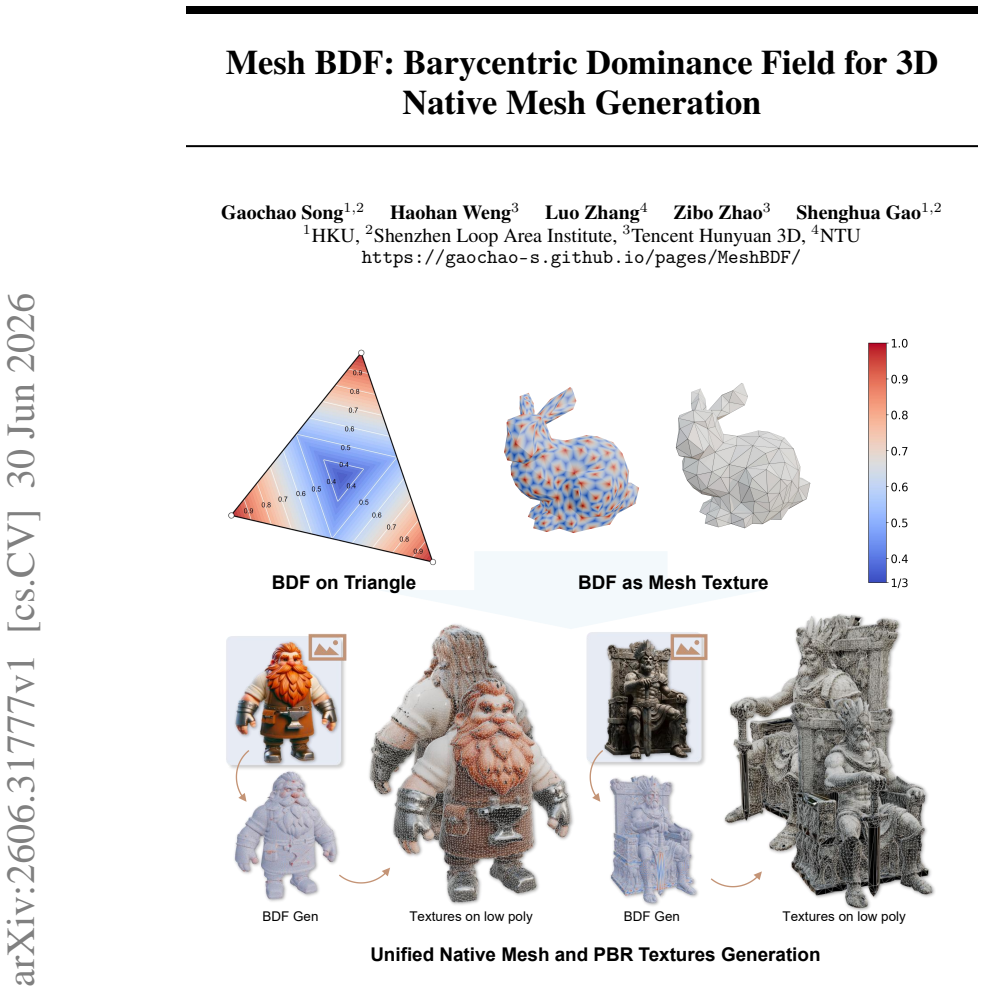
Barycentric Dominance Field encodes mesh connectivity as a continuous surface signal so diffusion models can generate native 3D meshes directly.
A machine-rendered reading of the paper's core claim, the machinery that carries it, and where it could break.
Core claim
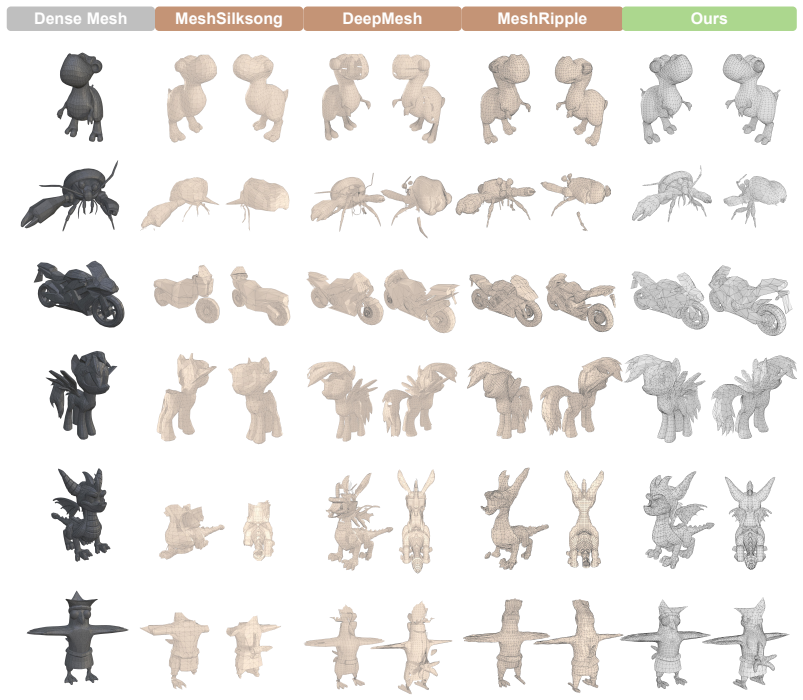
BDF is a continuous representation defined on triangular mesh surfaces that encodes vertex topological connectivity by transforming discrete connectivity into a continuous surface signal. As an intrinsic mesh property that shares strong similarities with texture maps, BDF integrates into existing 3D diffusion pipelines without requiring architectural modifications, enabling these models to generate native meshes with significantly higher quality, greater scalability, and stronger robustness than state-of-the-art autoregressive methods.
What carries the argument
Barycentric Dominance Field (BDF), a continuous field on triangular mesh surfaces that encodes vertex topological connectivity.
If this is right
- Diffusion models can output meshes with substantially higher face counts and vertex resolutions than autoregressive baselines.
- Texture maps integrate naturally because BDF occupies the same surface-signal format.
- Generation becomes more robust to variations in mesh complexity without custom length-handling logic.
- Existing 3D diffusion codebases can adopt native mesh output by adding BDF as an additional channel.
Where Pith is reading between the lines
- The same surface-field idea could let other continuous generators such as score-based or flow models produce meshes without new discrete-handling layers.
- BDF might enable direct optimization of topological properties during generation because connectivity is now a differentiable signal.
- Downstream tasks like mesh editing or animation could read the dominance values to recover adjacency without separate topology files.
- Combining BDF with other surface attributes in one diffusion pass could produce meshes that are simultaneously high-resolution, textured, and topologically consistent.
Load-bearing premise
That BDF behaves enough like a texture map to slot into unchanged diffusion pipelines while still carrying the full connectivity information needed for valid mesh output.
What would settle it
A controlled test in which a standard diffusion model trained with BDF either produces invalid meshes at scale or requires model architecture changes to match autoregressive quality.
Figures
read the original abstract
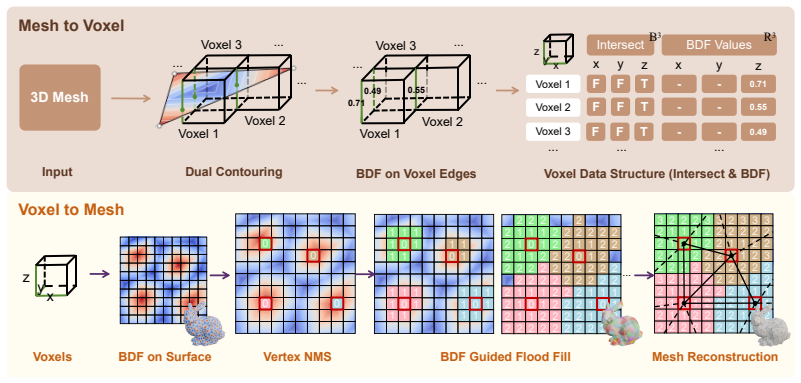
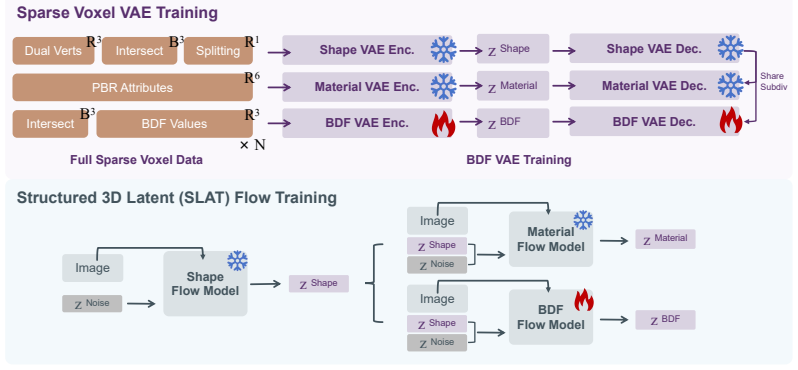
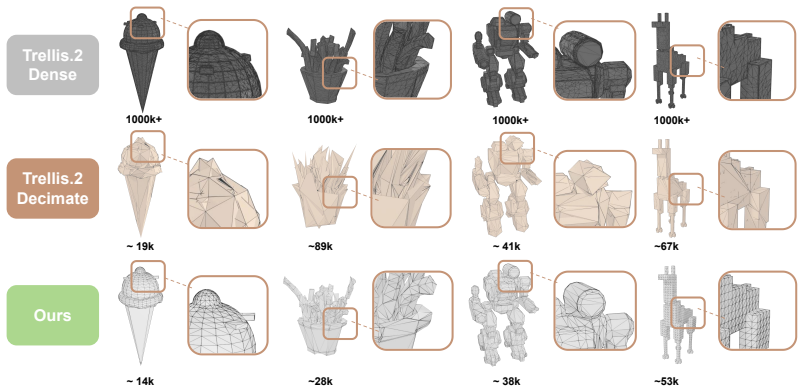
Autoregressive (AR) modeling has recently achieved remarkable progress in native 3D mesh generation, largely due to its natural ability to handle variable-length, discrete data structures. However, the inherent constraints of the AR paradigm severely restrict the generated meshes, leading to limited face counts, bounded vertex resolutions, and difficulties in supporting textures. To overcome these bottlenecks, we propose the Barycentric Dominance Field (BDF), a continuous representation defined on triangular mesh surfaces that elegantly encodes vertex topological connectivity. BDF bridges the fundamental gap between discrete mesh topology and continuous diffusion-based generative modeling by transforming connectivity into a continuous surface signal. As an intrinsic mesh property, BDF shares strong similarities with texture maps, enabling its seamless integration into existing 3D diffusion pipelines without requiring architectural modifications. Extensive experiments demonstrate that BDF empowers diffusion models to generate native meshes with significantly higher quality, greater scalability, and stronger robustness compared to state-of-the-art autoregressive methods.
Editorial analysis
A structured set of objections, weighed in public.
Referee Report
Summary. The paper proposes the Barycentric Dominance Field (BDF), a continuous representation defined on triangular mesh surfaces that encodes vertex topological connectivity. BDF is presented as bridging the gap between discrete mesh topology and continuous diffusion-based generative modeling by transforming connectivity into a surface signal analogous to a texture map, enabling integration into existing 3D diffusion pipelines without architectural modifications and yielding higher-quality, more scalable native meshes than autoregressive methods.
Significance. If the representation and integration claims hold, the work could meaningfully advance 3D generative modeling by extending diffusion pipelines to native meshes while preserving variable topology and supporting textures. The paper highlights BDF as an intrinsic mesh property, which would be a notable strength for reproducibility and compatibility if demonstrated.
major comments (2)
- [Abstract] Abstract: The central claim that BDF 'empowers diffusion models to generate native meshes with significantly higher quality, greater scalability, and stronger robustness' is load-bearing for the contribution but is stated without reference to any quantitative metrics, baselines, datasets, or ablation results; the experiments section must supply these to substantiate the comparison to autoregressive methods.
- [Abstract] Abstract: The assertion that BDF 'shares strong similarities with texture maps' and integrates 'without requiring architectural modifications' is the key practical advantage but lacks any description of the BDF computation, discretization, or encoding procedure; this must be detailed in the method section with pseudocode or equations to allow verification that no pipeline changes are needed.
minor comments (1)
- The abstract is concise but would benefit from one sentence outlining the mathematical definition of BDF (e.g., how barycentric coordinates are aggregated into a dominance field) to orient readers before the claims.
Simulated Author's Rebuttal
We thank the referee for the detailed comments. We address each major point below and will revise the manuscript accordingly to improve clarity and substantiation of the claims.
read point-by-point responses
-
Referee: [Abstract] Abstract: The central claim that BDF 'empowers diffusion models to generate native meshes with significantly higher quality, greater scalability, and stronger robustness' is load-bearing for the contribution but is stated without reference to any quantitative metrics, baselines, datasets, or ablation results; the experiments section must supply these to substantiate the comparison to autoregressive methods.
Authors: The experiments section already contains the requested quantitative metrics, baselines (including direct comparisons to autoregressive methods), datasets, and ablation studies that support the claims. To address the concern about the abstract, we will revise it to include explicit references to the relevant tables, figures, and sections in the experiments. revision: yes
-
Referee: [Abstract] Abstract: The assertion that BDF 'shares strong similarities with texture maps' and integrates 'without requiring architectural modifications' is the key practical advantage but lacks any description of the BDF computation, discretization, or encoding procedure; this must be detailed in the method section with pseudocode or equations to allow verification that no pipeline changes are needed.
Authors: The method section defines BDF as an intrinsic surface signal and explains its analogy to texture maps along with the integration approach. We agree that adding pseudocode and explicit equations for the computation, discretization, and encoding steps will strengthen verifiability. These will be included in the revised method section. revision: yes
Circularity Check
No significant circularity detected
full rationale
The paper introduces BDF as an original continuous representation that encodes mesh connectivity, with the abstract and available text presenting it as a novel construction for bridging discrete topology to diffusion models. No equations, fitting procedures, self-citations, or derivations are shown that reduce a claimed result to its own inputs by construction. The central claim rests on the definition and properties of the proposed field itself rather than any load-bearing self-reference or renamed empirical pattern.
Axiom & Free-Parameter Ledger
invented entities (1)
-
Barycentric Dominance Field (BDF)
no independent evidence
Reference graph
Works this paper leans on
-
[1]
Polydiff: Generating 3d polygonal meshes with diffusion models.arXiv preprint arXiv:2312.11417,
Antonio Alliegro, Yawar Siddiqui, Tatiana Tommasi, and Matthias Nießner. Polydiff: Generating 3d polygonal meshes with diffusion models.arXiv preprint arXiv:2312.11417,
-
[2]
Meshanything v2: Artist-created mesh generation with adjacent mesh tokenization
Yiwen Chen, Yikai Wang, Yihao Luo, Zhengyi Wang, Zilong Chen, Jun Zhu, Chi Zhang, and Guosheng Lin. Meshanything v2: Artist-created mesh generation with adjacent mesh tokenization. InProceedings of the IEEE/CVF International Conference on Computer Vision, pages 13922– 13931, 2025a. Zhaoxi Chen, Jiaxiang Tang, Yuhao Dong, Ziang Cao, Fangzhou Hong, Yushi La...
-
[3]
Xianglong He, Junyi Chen, Di Huang, Zexiang Liu, Xiaoshui Huang, Wanli Ouyang, Chun Yuan, and Yangguang Li. Meshcraft: Exploring efficient and controllable mesh generation with flow-based dits.arXiv preprint arXiv:2503.23022, 2025a. Xianglong He, Zi-Xin Zou, Chia-Hao Chen, Yuan-Chen Guo, Ding Liang, Chun Yuan, Wanli Ouyang, Yan-Pei Cao, and Yangguang Li. ...
-
[4]
Shap-E: Generating Conditional 3D Implicit Functions
Heewoo Jun and Alex Nichol. Shap-e: Generating conditional 3d implicit functions.arXiv preprint arXiv:2305.02463,
work page internal anchor Pith review Pith/arXiv arXiv
-
[5]
Weiyu Li, Jiarui Liu, Rui Chen, Yixun Liang, Xuelin Chen, Ping Tan, and Xiaoxiao Long. Craftsman: High-fidelity mesh generation with 3d native generation and interactive geometry refiner.arXiv preprint arXiv:2405.14979,
-
[6]
Sparc3d: Sparse rep- resentation and construction for high-resolution 3d shapes modeling, 2025
Zhihao Li, Yufei Wang, Heliang Zheng, Yihao Luo, and Bihan Wen. Sparc3d: Sparse representation and construction for high-resolution 3d shapes modeling.arXiv preprint arXiv:2505.14521,
-
[7]
Meshripple: Structured autoregressive generation of artist-meshes.arXiv preprint arXiv:2512.07514,
Junkai Lin, Hang Long, Huipeng Guo, Jielei Zhang, JiaYi Yang, Tianle Guo, Yang Yang, Jianwen Li, Wenxiao Zhang, Matthias Nießner, et al. Meshripple: Structured autoregressive generation of artist-meshes.arXiv preprint arXiv:2512.07514,
-
[8]
Quadgpt: Native quadrilateral mesh generation with autoregressive models
Jian Liu, Chunshi Wang, Song Guo, Haohan Weng, Zhen Zhou, Zhiqi Li, Jiaao Yu, Yiling Zhu, Jing Xu, Biwen Lei, et al. Quadgpt: Native quadrilateral mesh generation with autoregressive models. arXiv preprint arXiv:2509.21420,
-
[9]
Decoupled Weight Decay Regularization
Ilya Loshchilov and Frank Hutter. Decoupled weight decay regularization.arXiv preprint arXiv:1711.05101,
work page internal anchor Pith review Pith/arXiv arXiv
-
[10]
Yihao Luo, Xianglong He, Chuanyu Pan, Yiwen Chen, Jiaqi Wu, Yangguang Li, Wanli Ouyang, Yuanming Hu, Guang Yang, and ChoonHwai Yap. Faithful contouring: Near-lossless 3d voxel representation free from iso-surface.arXiv preprint arXiv:2511.04029,
-
[11]
Point-E: A System for Generating 3D Point Clouds from Complex Prompts
10 Alex Nichol, Heewoo Jun, Prafulla Dhariwal, Pamela Mishkin, and Mark Chen. Point-e: A system for generating 3d point clouds from complex prompts.arXiv preprint arXiv:2212.08751,
work page internal anchor Pith review Pith/arXiv arXiv
-
[12]
Native and Compact Structured Latents for 3D Generation
Jianfeng Xiang, Xiaoxue Chen, Sicheng Xu, Ruicheng Wang, Zelong Lv, Yu Deng, Hongyuan Zhu, Yue Dong, Hao Zhao, Nicholas Jing Yuan, et al. Native and compact structured latents for 3d generation.arXiv preprint arXiv:2512.14692,
work page internal anchor Pith review Pith/arXiv arXiv
-
[13]
Hunyuan3d 1.0: A unified framework for text-to-3d and image-to-3d generation, 2025
Xianghui Yang, Huiwen Shi, Bowen Zhang, Fan Yang, Jiacheng Wang, Hongxu Zhao, Xinhai Liu, Xinzhou Wang, Qingxiang Lin, Jiaao Yu, et al. Hunyuan3d 1.0: A unified framework for text-to-3d and image-to-3d generation.arXiv preprint arXiv:2411.02293,
-
[14]
PartDiffuser: Part-wise 3D Mesh Generation via Discrete Diffusion
Yichen Yang, Hong Li, Haodong Zhu, Linin Yang, Guojun Lei, Sheng Xu, and Baochang Zhang. Partdiffuser: Part-wise 3d mesh generation via discrete diffusion.arXiv preprint arXiv:2511.18801,
work page internal anchor Pith review Pith/arXiv arXiv
-
[15]
arXiv preprint arXiv:2508.10868 (2025) 20 J
11 Yibo Zhang, Li Zhang, Rui Ma, and Nan Cao. Texverse: A universe of 3d objects with high-resolution textures.arXiv preprint arXiv:2508.10868,
-
[16]
Deepmesh: Auto-regressive artist-mesh creation with reinforcement learning
Ruowen Zhao, Junliang Ye, Zhengyi Wang, Guangce Liu, Yiwen Chen, Yikai Wang, and Jun Zhu. Deepmesh: Auto-regressive artist-mesh creation with reinforcement learning. InProceedings of the IEEE/CVF International Conference on Computer Vision, pages 10612–10623, 2025a. Tianhao Zhao, Youjia Zhang, Hang Long, Jinshen Zhang, Wenbing Li, Yang Yang, Gongbo Zhang,...
-
[17]
Hunyuan3D 2.0: Scaling Diffusion Models for High Resolution Textured 3D Assets Generation
Zibo Zhao, Zeqiang Lai, Qingxiang Lin, Yunfei Zhao, Haolin Liu, Shuhui Yang, Yifei Feng, Mingxin Yang, Sheng Zhang, Xianghui Yang, et al. Hunyuan3d 2.0: Scaling diffusion models for high resolution textured 3d assets generation.arXiv preprint arXiv:2501.12202, 2025b. 12 Technical appendices and supplementary material A Proof of BDF Continuity and Lipschit...
work page internal anchor Pith review Pith/arXiv arXiv
discussion (0)
Sign in with ORCID, Apple, or X to comment. Anyone can read and Pith papers without signing in.