REVIEW 2 major objections 3 minor 69 references
Applying the Poisson-bracket formalism in real space directly reproduces the Cauchy stress and odd modulus K_o = τ/4 of chiral active solids, bypassing the Lagrangian stress transform.
Reviewed by Pith at T0; open to challenge. T0 means a machine referee read the full paper against a public rubric. the ladder, T0–T4 →
T0 review · deepseek-v4-flash
2026-08-03 05:19 UTC pith:73Z7YABE
load-bearing objection The formal Eulerian-to-Lagrangian dynamics transformation (Eq. 14) is a genuine methodological step forward; the odd-elasticity recovery is a consistency check that inherits an asserted adiabatic assumption rather than providing a new physical prediction. the 2 major comments →
Elastodynamics from Eulerian Poisson-bracket formalism: application to chiral odd solids
The pith
A machine-rendered reading of the paper's core claim, the machinery that carries it, and where it could break.
Core claim
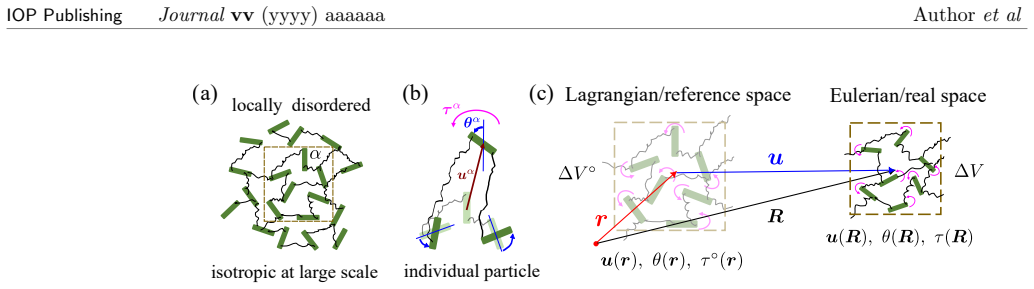
The paper's central claim is that the Eulerian PB formalism, applied to the Eulerian Hamiltonian obtained from the Lagrangian one through the Jacobian factor J, generates the full real-space stress tensor and the odd elastic modulus K_o = τ/4 in a chiral active solid, matching the result of a previous Lagrangian derivation. The key step is the fast-relaxation (adiabatic) elimination of the internal rotation θ, which reduces the rotational dynamics to the algebraic relation ϕ ≈ (τ/2κ_c)(1 + ((λ̃+μ̃)/κ_c) ∇·u). Substituting this into the Eulerian momentum balance (Eq. 25) produces the Cauchy stress with an active prestress and an elasticity tensor that contains the odd modulus proportional to
What carries the argument
The load-bearing object is the Eulerian Poisson bracket, computed with canonical pairs defined in the real/deformed space, so that derivatives of delta functions generate the convective terms that the Lagrangian bracket misses; the most important examples are {g_i^c(R), u_j(R′)} = (δ_ij − ∇′_i u_j) δ(R−R′) and {g_i^c(R), θ(R′)} = −∇′_i θ(R′) δ(R−R′). The second load-bearing identity is Eq. (14), dΨ°/dt = J[∂Ψ/∂t + ∇_j(v_j^c Ψ)], which converts Eulerian dynamics into Lagrangian dynamics, carries the nonlinear streaming and volume-change contributions, and yields the Cauchy-to-first-Piola–Kirchhoff stress relation. In the chiral-solid example, these brackets, combined with the adiabatic elimin
Load-bearing premise
The argument assumes that the internal rotation θ relaxes so quickly that it can be set to local mechanical equilibrium, ∂H/∂θ = 0, turning it into an algebraic function of the displacement gradient; if θ does not relax fast, the quasistatic odd modulus K_o = τ/4 becomes a frequency-dependent quantity and the central stress-strain claim no longer holds as stated.
What would settle it
Measure the shear-stress response of a chiral active solid in the regime |∇u| ≪ θ ≪ 1 as a function of driving frequency, or solve the full coupled dynamics of displacement and internal rotation numerically without imposing ∂H/∂θ = 0: if the effective odd modulus deviates from τ/4 or shows strong frequency dependence where the paper predicts a quasistatic constant, the central reduction is falsified.
If this is right
- The real-space (Cauchy) stress becomes directly accessible from the Eulerian PB formalism, so experimental or computational studies that measure stress in deformed coordinates can compare with theory without reference-frame transformations.
- In any elastic system with large internal rotations, the extra Eulerian nonlinearities—neglected in linear elasticity—must be kept; ignoring them hides the odd response and misstates the stress-strain relation.
- The recovered odd modulus K_o = τ/4 implies non-reciprocal shear coupling: a simple shear strain induces pure shear stress, and a pure shear strain induces negative simple shear stress, with consequences such as tilting under uniaxial compression and growing wave modes as established in the broader odd-elasticity literature.
- The transformation Eq. (14) gives a general dictionary between Eulerian and Lagrangian dynamics, allowing the two formulations to be cross-checked even in systems such as viscoelastic, elastoplastic, or active materials where a fixed reference frame is not always available.
- For three-dimensional micropolar solids, the axis-angle canonical-momentum construction in Appendix A extends the same Eulerian PB scheme, so the approach is not limited to two-dimensional chiral solids.
Where Pith is reading between the lines
- If the fast-variable assumption on θ is relaxed, the quasistatic modulus τ/4 should become a frequency-dependent odd response; measuring the shear modulus as a function of driving frequency in a chiral active solid would provide a clean test the paper does not itself perform.
- Eq. (14) is likely a general tool beyond elasticity: any coarse-grained theory with a dynamic reference configuration, such as plastic flow, growth, or active remodeling, could use this transformation to connect Eulerian observations to Lagrangian material behavior.
- The derivation suggests that odd elastic response does not require a microscopic model of contact forces, only a Hamiltonian with an active torque potential and geometric nonlinearities, so the same Eulerian PB route could predict odd moduli in other torque-driven field theories such as chiral liquid crystal elastomers.
Editorial analysis
A structured set of objections, weighed in public.
Referee Report
Summary. This paper develops a systematic Eulerian Poisson-bracket (PB) formalism for elastic systems whose Hamiltonians are originally written in Lagrangian variables. It derives the transformation between Lagrangian and Eulerian field dynamics (Eq. 14), identifies two sources of additional nonlinearities in the Eulerian description (the Jacobian volume factor in the Hamiltonian and the spatial-gradient terms in Eulerian PBs), and verifies the relation between Cauchy and first Piola–Kirchhoff stresses. As an illustration, the formalism is applied to a 2D chiral active solid with internal particle rotations; the resulting stress and elasticity tensors (Eqs. 28–29) recover the odd elastic modulus K_o=τ/4 of the authors' previous Lagrangian treatment (Ref. [21]).
Significance. If the formal claims hold, Eq. (14) and the PB list in Appendix B provide a useful and clean bridge between Lagrangian and Eulerian descriptions of solids with internal rotation. The derivation of Eq. (14) and its use to recover the standard stress transformation are elegant, and the presentation of the Eulerian PBs with 3D generalization is valuable. However, the illustrative recovery of K_o=τ/4 is a consistency check against Ref. [21] rather than an independent prediction: the input potential Eq. (18) already contains the geometric nonlinearities that produce the odd modulus, and the result depends on an adiabatic elimination of the internal rotation that is asserted rather than derived. These points do not undermine the formal methodology, but they temper the strength of the 'recovering' claim.
major comments (2)
- [§2.3, Eq. (26)] The coefficient of the φ(∇·u) term is printed as λ+μ, but the potential V in Eq. (20) contains −(λ̃+μ̃)φ²(∇·u), whose derivative with respect to φ is −2(λ̃+μ̃)φ(∇·u). Equation (27) then uses λ̃+μ̃, so Eq. (26) as printed is not the equation that yields Eq. (27). Since Eq. (27) is substituted into Eq. (25) to obtain the central stress tensor Eq. (28), please correct the coefficient and check the signs in the intermediate algebra.
- [§2.3, Eqs. (26)–(28)] The central quantitative result K_o=τ/4 is obtained by replacing the full angular-momentum equation by the algebraic relation Eq. (27) (∂H/∂θ=0). This is an adiabatic elimination of the internal rotation θ. The paper asserts that θ relaxes fast and cites Refs. [1,20,63–65], but no timescale separation is derived for the present model, and the reactive PB equations (25)–(26) contain no dissipative relaxation. If the rotational degree of freedom is not fast at the frequencies of interest, the effective modulus is frequency-dependent, K_o(ω), rather than the static τ/4. Please state the validity regime (e.g., damping vs κ_c) or derive the elimination from a dissipative model.
minor comments (3)
- [Abstract and §2.3] The wording 'recovering' and 'demonstrate its ability to capture emergent nonlinear elastic behavior' overstates the example. The potential Eq. (18) already contains the geometric nonlinearities that produce K_o, so the computation is a consistency check of the Eulerian route against Ref. [21], not an independent prediction. Please qualify the language accordingly.
- [§2.2, Eq. (20)] Please show the intermediate steps in transforming V° to V; the origin of the −κ_c ε_li δ_jk term is not transparent from the one-line description following Eq. (20). A fuller derivation would aid reproducibility.
- [§2.1, Eq. (18)] The notation λ, μ versus λ̃, μ̃ is confusing. The tilde coefficients are imported from Ref. [21] but are not defined in this paper; please define them explicitly at the point of introduction.
Circularity Check
No significant circularity: the Eulerian-PB transformation is independently derived and the odd-modulus example is an explicit consistency check with the authors' prior model, not a new prediction forced by the formalism.
full rationale
The load-bearing formal result is Eq. (14), obtained from the field transformation Psi^o = J Psi and d ln J/dt = div v_c; it is not a restatement of any later result. Equations (25)-(28) follow by substituting the Eulerian PBs and the explicit Hamiltonian into Eq. (7), and K_o = tau/4 emerges only after adiabatic elimination of phi, not from a fitted coefficient or from assuming K_o in the input. The potential (18) is imported from Ref. [21] by the same research group, and the paper openly labels the outcome as "recover[ing] the stress and elasticity tensors of Ref. [21]" (Sec. 2.3), so the example is a consistency check rather than an independent prediction. The fast-relaxation condition behind Eq. (27) is an assumption cited to Chaikin-Lubensky and prior work, but it is a stated regime condition and not circular: replacing the angular-momentum balance by an algebraic relation does not reduce the result to its input by construction. The only notable self-citation is Ref. [21] serving as the source of the model potential; because the new derivation follows an independent Eulerian-PB route and the earlier result is peer-reviewed prior work, the central derivation retains independent content. No reduction-by-construction step was found.
Axiom & Free-Parameter Ledger
free parameters (3)
- Active torque density τ
- Cosserat coupling κ_c
- Nonlinear elastic coefficients λ̃, μ̃
axioms (6)
- domain assumption The 2D internal rotation θ and angular momentum ℓ form a canonical pair, {ℓ,θ}=δ(R−R′) (Eq. 24).
- ad hoc to paper The elastic potential has the specific Cosserat form Eq. (18), including geometric nonlinearities with coefficients λ̃, μ̃, κ_c, taken from Ref. [21].
- ad hoc to paper Internal rotation relaxes fast to local torque balance, ∂H/∂θ=0 (Eq. 27).
- domain assumption Small-displacement, small-rotation expansion with |∇u|≪θ≪1; ∇θ and higher-order strain terms are negligible.
- domain assumption The deformation map R=r+u is one-to-one and the reference coordinate r_α is a fixed particle label, so ∂r_α/∂R_α=0 in Eq. (38).
- standard math Piola identity ∇^◦_j(JF^{-1}_{jl})=0 and standard continuum identities are used in Eq. (16).
read the original abstract
The Poisson-bracket (PB) formalism is widely used to derive dynamics of coarse-grained (CG) fields to capture large-scale physics, extending the role of PBs in classical particle mechanics to macroscopic fields. It has been applied to fluctuations in critical phenomena, hydrodynamics of liquid crystals, liquid crystal elastomers, tissues, and the emergence of odd viscosity from spinning particles. The PB formalism can be formulated in either the Lagrangian framework, using reference space, or the Eulerian framework, using real space. Conventionally, the Lagrangian formulation is used for elastic solids, and the Eulerian one for fluids. However, growing interest in Eulerian descriptions of solids has emerged for phenomena naturally defined in real space, such as viscoelastic responses, moving interfaces, and field-induced structural changes in particles. Here we develop a systematic formulation for applying the Eulerian PB formalism to elastic systems with potentials typically written in Lagrangian space, and clarify its consistency with the Lagrangian counterpart. We show that the Eulerian formulation generates additional nonlinearities absent in the Lagrangian framework. Such nonlinearities originate from CG volume changes under coordinate transformation and from particle flow across neighboring CG volumes. They must be retained when nonlinear effects are important. To illustrate, we study chiral active solids of finite-sized particles, where active torques drive internal particle rotations and generate geometric nonlinearities. These nonlinearities give rise to the odd elastic modulus, which non-reciprocally couples two different shear modes in stress-strain response. By recovering this modulus directly from the Eulerian PB formalism, we demonstrate its ability to capture emergent nonlinear elastic behavior in driven active solids, whose stresses are naturally measured in real space.
Figures


Reference graph
Works this paper leans on
-
[1]
Chaikin P M and Lubensky T C 1995Principles of Condensed Matter Physics(New York: Cambridge University Press)
-
[2]
Mazenko G F 2006Nonequilibrium Statistical Mechanics(Weinheim: Wiley-VCH)
-
[3]
Goldstein H, Poole C and Safko J 2002Classical Mechanics(Boston: Addison Wesley)
-
[4]
Phys.64727–742
Lubensky T C 2005Pramana–J. Phys.64727–742
-
[5]
Phys.611–56
Kawasaki K 1970Ann. Phys.611–56
-
[6]
Phys.12567–97
Dzyaloshinskii I E and Volovick G E 1980Ann. Phys.12567–97
-
[7]
Mori H and Fujisaka H 1973Prog. Theor. Phys.49764–775
-
[8]
Hohenberg P C and Halperin B I 1977Rev. Mod. Phys.49435–479
-
[9]
Forster D 1974Phys. Rev. Lett.321161–1164
-
[10]
Kamien R D 2000Phys. Rev. E612888–2894
-
[11]
Lubensky T C, Ramaswamy S and Toner J 1985Phys. Rev. B327444–7452
-
[12]
Martin P C, Parodi O and Pershan P S 1972Phys. Rev. A62401–2420
-
[13]
Stark H and Lubensky T C 2003Phys. Rev. E67061709
-
[14]
Stark H and Lubensky T C 2005Phys. Rev. E72051714
-
[15]
Kung W, Marchetti M C and Saunders K 2006Phys. Rev. E73031708
-
[16]
Stenull O and Lubensky T C 2004Phys. Rev. E69051801
-
[17]
Hernandez A and Marchetti M C 2021Phys. Rev. E103032612
-
[18]
Triguero-Platero G, Ziebert F and Bonilla L L 2023Phys. Rev. E108044118
-
[19]
Markovich T and Lubensky T C 2021Phys. Rev. Lett.127048001
-
[20]
Markovich T and Lubensky T C 2024Proc. Natl. Acad. Sci. USA121e2219385121
-
[21]
Lee C T, Lubensky T C and Markovich T 2026Phys. Rev. Lett.137038301
-
[22]
Kamrin K, Rycroft C H and Nave J C 2012J. Mech. Phys. Solids601952–1969
1969
-
[23]
Valkov B, Rycroft C H and Kamrin K 2015J. Appl. Mech.82041011
-
[24]
Liu C and Walkington N J 2001Arch. Ration. Mech. Anal.159229–252
-
[25]
Snoeijer J H, Pandey A, Herrada M A and Eggers J 2020Proc. R. Soc. A47620200419
-
[26]
Reinken H and Menzel A M 2025Phys. Rev. E112045506
-
[27]
Thermodyn.281759–1780
Ivanova E A and Vilchevskaya E N 2016Continuum Mech. Thermodyn.281759–1780
-
[28]
Rubin M B 2019Philos. Trans. R. Soc. A37720180071 15 IOP PublishingJournalvv(yyyy) aaaaaa Authoret al
-
[29]
Naghibzadeh S K, Walkington N and Dayal K 2021J. Mech. Phys. Solids154104499
-
[30]
Rubin M and Tomassetti G 2025Int. J. Solids Struct.316113364
-
[31]
Shee A, Henkes S and Huepe C 2024Soft Matter207865–7879
-
[32]
Commun.152874
Yang Q, Jiang M, Picano F and Zhu L 2024Nat. Commun.152874
-
[33]
Phys.11111–117
Prost J, J¨ ulicher F and Joanny J F 2015Nat. Phys.11111–117
-
[34]
Chen S, Markovich T and MacKintosh F C 2023Phys. Rev. E108044405
-
[35]
Tan T H, Mietke A, Li J, Chen Y, Higinbotham H, Foster P J, Gokhale S, Dunkel J and Fakhri N 2022Nature607287–293
-
[36]
Marchetti M C, Joanny J F, Ramaswamy S, Liverpool T B, Prost J, Rao M and Simha R A 2013Rev. Mod. Phys.851143–1189
-
[37]
J¨ ulicher F, Grill S W and Salbreux G 2018Rep. Prog. Phys.81076601
-
[38]
Liebchen B and Levis D 2022EPL13967001
-
[39]
Eringen A C 1966J. Math. Mech.15909–923
-
[40]
Eringen A C 1999Microcontinuum Field Theories(New York: Springer)
-
[41]
Eremeyev V A, Lebedev L P and Altenbach H 2013Foundations of Micropolar Mechanics (Berlin: Springer)
-
[42]
Scheibner C, Souslov A, Banerjee D, Sur´ owka P, Irvine W T M and Vitelli V 2020Nat. Phys. 16475–480
-
[43]
Braverman L, Scheibner C, VanSaders B and Vitelli V 2021Phys. Rev. Lett.127268001
-
[44]
Fossati M, Scheibner C, Fruchart M and Vitelli V 2024Phys. Rev. E109024608
-
[45]
Fruchart M, Scheibner C and Vitelli V 2023Annu. Rev. Condens. Matter Phys.14471–510
-
[46]
Banerjee D and Sollich P 2025 Emergent odd viscoelasticity in chiral soft glassy materials (PreprintarXiv:2509.04693)
Pith/arXiv arXiv 2025
-
[47]
Abanov A G, Can T and Ganeshan S 2018SciPost Phys.5010
-
[48]
Souslov A, Dasbiswas K, Fruchart M, Vaikuntanathan S and Vitelli V 2019Phys. Rev. Lett. 122128001
-
[49]
Phys.151188–1194
Soni V, Bililign E S, Magkiriadou S, Sacanna S, Bartolo D, Shelley M J and Irvine W T M 2019Nat. Phys.151188–1194
-
[50]
Scheibner C, Irvine W T M and Vitelli V 2020Phys. Rev. Lett.125118001
-
[51]
Veenstra J, Binysh J, Seinen V, Naber R, Robledo Poisson D, Hunt A, van Saarloos W, Souslov A and Coulais C 2025 Wave coarsening drives time crystallization in active solids (PreprintarXiv:2508.20052)
Pith/arXiv arXiv 2025
-
[52]
Mater.374
Gao P, Qu Y and Christensen J 2022Commun. Mater.374
-
[53]
Phys.27054401
Caprini L and Marini Bettolo Marconi U 2025New J. Phys.27054401
-
[54]
Lee C T and Markovich T 2026 Non-Hermitian chiral surface waves in disordered odd solids (PreprintarXiv:2603.21312)
arXiv 2026
-
[55]
Landau L D, Pitaevskii L P, Kosevich A M and Lifshitz E M 1986Theory of Elasticity, 3rd Edition(New York: Pergamon Press)
-
[56]
Landau L D and Lifshitz E M 1987Fluid Mechanics, 2nd Edition(New York: Pergamon Press)
-
[57]
Gurtin M E 1981An Introduction to Continuum Mechanicsvol 158 (New York: Academic Press) 16 IOP PublishingJournalvv(yyyy) aaaaaa Authoret al
-
[58]
Broedersz C P and MacKintosh F C 2014Rev. Mod. Phys.86995–1036
-
[59]
Struct.279114800
Lucarini S, Hossain M and Garcia-Gonzalez D 2022Compos. Struct.279114800
-
[60]
Mater.8162
Moreno-Mateos M A, Hossain M, Steinmann P and Garcia-Gonzalez D 2022npj Comput. Mater.8162
-
[61]
Eringen A C and Suhubi E S 1964Int. J. Eng. Sci.2189–203
-
[62]
Neff P 2006ZAMM Z. Angew. Math. Mech.86892–912
-
[63]
Markovich T and Lubensky T C 2025Phys. Rev. E112035409
-
[64]
Maitra A and Ramaswamy S 2019Phys. Rev. Lett.123238001
-
[65]
Sur´ owka P, Souslov A, J¨ ulicher F and Banerjee D 2023Phys. Rev. E108064609
-
[66]
Veenstra J, Scheibner C, Brandenbourger M, Binysh J, Souslov A, Vitelli V and Coulais C 2025Nature639935–941
-
[67]
Bauchau O A and Trainelli L 2003Nonlinear Dyn.3271–92
-
[68]
Gallego G and Yezzi A 2015J. Math. Imaging Vis.51378–384
-
[69]
Eremeyev V A and Konopi´ nska-Zmys lowska V 2020Symmetry121632 17
discussion (0)
Sign in with ORCID, Apple, or X to comment. Anyone can read and Pith papers without signing in.