REVIEW 4 major objections 5 minor 2 cited by
Neuro-Symbolic Generative Diffusion Models for Physically Grounded, Robust, and Safe Generation
T0 review · 4 major / 5 minor · reviewed 2026-08-07 · deepseek-v4-flash
Pith's one-line read The paper argues that a diffusion model can be made to obey user-defined physical, structural, and logical constraints at sampling time by projecting every reverse denoising step onto the feasible set, and that this yields certified…
desk verdict A practically useful projection-based recipe for constrained diffusion generation, but the certification theory in Section 6 does not survive contact with the appendix; the proof of Theorem 2 proves a different statement. read the letter →
The pith
A machine-rendered reading of the paper's core claim, the machinery that carries it, and where it could break.
The reading
What carries the argument
The load-bearing mechanism is the projection operator $P_C$, which maps any sample to the nearest feasible point under the modality-appropriate distance: squared Euclidean distance for continuous data and KL divergence for discrete token distributions whose decoded argmax must lie in $C$. The operator is applied after every reverse update $x_t \to x_{t-\Delta}$, so the iterates remain feasible throughout sampling, and it is solved by an augmented Lagrangian scheme that alternates gradient steps on $y$ with dual ascent on the multipliers $\lambda$ and penalty $\mu$. The theoretical engine is the chain of results in Section 6: with $\log p_{\mathrm{data}}$ convex, projected updates stay within a bounded distance of the unconstrained optimum, the expected projection cost is reduced by projecting before rather than after an update, and the projection error converges to zero as the step size $\gamma_t$ decays — which is what converts constraint enforcement into a certificate of feasibility rather than a heuristic post-hoc fix.
What would settle it
On a fixed unconstrained score network, choose a convex constraint set far from the data support and measure the projection cost $\mathrm{Error}(U_\theta(x_t), C)$ versus $\mathrm{Error}(U_\theta(P_C(x_t)), C)$ over many sampling runs; Theorem 2 predicts the projected-start cost is never larger in expectation, so any timestep where the inequality reverses would refute the error-reduction claim. A complementary test compares the FID or log-likelihood of NSD outputs against one-step post-hoc projections on the same constraint, since the paper's fidelity claim requires the per-step-projected samples to stay much closer to the training distribution than the post-hoc-corrected ones.
Extended reading notes
Core claim
The central claim is that each reverse step of a diffusion model is a gradient-ascent step on the log-likelihood of the data distribution, and therefore the step can be replaced by the composition of that gradient update with a projection onto the feasible set $C=\bigcap_{i=1}^{n}\phi_i(x)$. The paper shows, under a convexity assumption on $\log p_{\mathrm{data}}$, that this projected trajectory stays close to the unconstrained score dynamics (Theorem 1), that starting a denoising update from the projected point never increases the expected cost of restoring feasibility (Theorem 2), and that the remaining projection error shrinks to zero as the diffusion step size decreases (Corollary 3). The projection itself is computed by an augmented Lagrangian method that minimizes a modality-specific distance — squared Euclidean distance for continuous samples, KL divergence for discrete token distributions — subject to the constraint residual, with a Gumbel-Softmax relaxation making the discrete argmax differentiable. The paper's claim is that this is the first framework to certify constraint satisfaction at inference time for both standard and discrete diffusion models, and it demonstrates the claim on molecule generation, multi-agent motion planning, microstructure inverse design, and safe text generation.
Load-bearing premise
The argument rests on the unstated premise that the score network, trained on unconstrained data, keeps estimating the data score accurately at points that have been projected into the feasible set, and the formal theorems in Section 6 additionally assume the log data density is convex, which is false for realistic data — if projection pushes samples into low-density regions where the score estimate is unreliable, the distributional-fidelity guarantee breaks down even though constraints are still met by construction.
Editorial extensions
If this is right
- An existing, unmodified diffusion model can be made safety-compliant at inference time: wrap each denoising update with a projection onto the constraint set, and constraint violations are structurally eliminated rather than merely reduced.
- The same recipe transfers from continuous data to discrete sequences, so molecule generators and language models can be constrained by substructure filters or toxicity thresholds while staying within the learned token distribution.
- In data-scarce settings, constraints can substitute for missing training coverage: the porosity-specified microstructure experiment shows that outputs can be forced to hit target properties that the training set does not contain.
- Because constraints are enforced throughout the reverse trajectory, the model can generalize to out-of-distribution conditions — the paper's physics experiment generates gravity-consistent trajectories for environments with no feasible training samples.
Reading between the lines
- Editorial extension: the per-step projection recipe does not depend on the score parametrization, so the same operator could be attached to flow-matching or rectified-flow samplers, which also iterate denoising-like ODE steps, whenever a differentiable residual of the constraint is available.
- Editorial extension: the KL-based projection for discrete data suggests a probabilistic reading of constraints — instead of hard filters on the decoded sequence, one could project onto distributions satisfying a predicate in expectation, yielding soft safety constraints with the same augmented-Lagrangian machinery.
- Editorial extension: a natural stress test separates the two claims — constraint satisfaction (which holds by construction) from distributional fidelity (which relies on the score accuracy premise); running NSD with constraints placed deliberately in low-density regions would reveal how far the fidelity guarantee extends before samples degrade.
Editorial analysis
A structured set of objections, weighed in public.
Referee Report
Summary. The paper proposes Neuro-Symbolic Diffusion (NSD), an inference-time framework that interleaves the reverse sampling steps of continuous and discrete diffusion models with projection onto user-defined constraint sets. The projection is implemented as an augmented-Lagrangian optimization in continuous settings and via Gumbel-Softmax relaxation plus hand-crafted correction rules in discrete settings. The authors claim that this yields “certifiably consistent” samples with minimal deviation from the learned distribution, and they support this with Theorems 1 and 2 and Corollary 3 in Section 6. The experimental sections evaluate NSD on molecule generation with BRENK and novelty constraints, multi-agent motion planning, porosity-targeted microstructure design, ODE-governed video frames, and toxicity-constrained text generation, reporting near-perfect constraint satisfaction and competitive or better distributional quality relative to conditional and post-hoc baselines.
Significance. If the theoretical claims were established, NSD would be a practically valuable general recipe for constrained generation: it is training-free at inference, applies to both continuous and discrete diffusion, and the empirical evaluation is unusually broad, with consistent large margins over conditional and post-processing baselines and using matched architectures. The method's constraint-satisfaction results are credible as engineering outcomes because the projection mechanics directly enforce most constraints. However, the load-bearing theoretical assertions on distributional fidelity and certified convergence are currently unsupported, and the phrase “certifiably consistent” outruns what the proofs and the relaxed discrete projection deliver. With a corrected or appropriately weakened theoretical section, the empirical contribution could stand as a significant systems and application paper. The paper does not provide code or machine-checked proofs, so reproducibility rests on the appendix-level descriptions.
major comments (4)
- [Section 6 / Appendix F] Theorem 2 is not proved as stated. The theorem claims E[Error(U_theta(xt), C)] >= E[Error(U_theta(P_C(xt)), C)], that is, projection before the update reduces the cost of feasibility after the update. The proof, however, compares Error(U_theta(xt), C) with Error(P_C(U_theta(xt)), C) in Equation (10) and the surrounding case analysis, which is projection applied after the update. These quantities are different, and no Lipschitz, smoothness, step-size, or contraction condition on U_theta or the score network s_theta is stated that would allow one to pass from one inequality to the other. In addition, the proof only analyzes deterministic gradient updates and never treats the categorical update in Equation (3) or the KL projection in Equation (5). Consequently, Corollary 3 on convergence to the feasible subdistribution does not follow from the supplied argument. Since the abstract and Sections 1 and 6 advertise “certifiably consistent” generation and “minimal deviation” from the learned dynamics, this is a load-bearing gap.
- [Section 6 / Appendix F] Theorem 1's convexity assumption is not satisfied by real data, and its proof is a placeholder. The theorem assumes log p_data(x0) is convex; natural image, molecule, and trajectory densities are not convex, and the paper offers no argument that the relevant conditional densities or learned score functions are convex. The proof in Appendix F simply invokes “optimization theory of convergence in a convex setting” and takes T to infinity, which does not establish the existence of a finite t with the claimed inequality along the reverse diffusion trajectory. Even under convexity, the update uses a learned approximation s_theta of the score, and no bound on the score estimation error is given. As a result, the “Convergence Proximity” result is unsupported, and the later statements that rely on it are conditional on an unverified assumption.
- [Section 5 / Appendices B, C, E.1, E.5] The discrete and nonconvex projections are not certified, so the “certifiably consistent” claim is overstated as written. Algorithm 1 terminates at tolerance delta or max_inner_iter, and for discrete data the paper uses a Gumbel-Softmax relaxation together with hand-crafted correction rules (Appendix E.1) and a toxicity surrogate classifier (Appendix E.5); none of these provides a certificate that the true constraint is satisfied. A formal certificate is available only for the convex continuous case when the augmented Lagrangian is run to convergence, which is not what is implemented or analyzed. The paper should distinguish between provably exact projections and heuristic relaxations, and it should not call the latter “certified.”
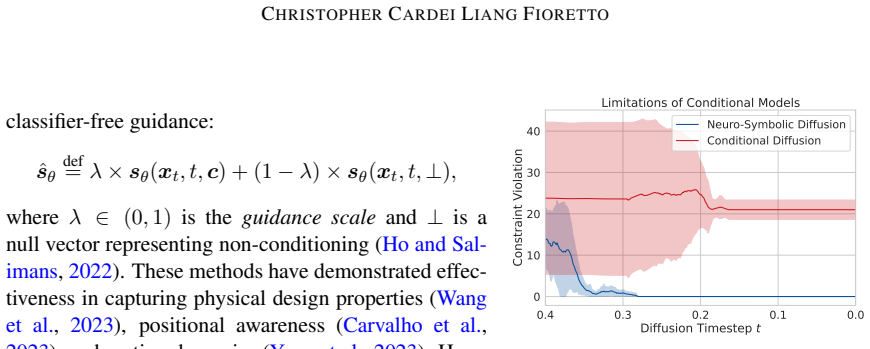
- [Section 7 / Figures 2, 4, 7] The zero-violation results are partly by construction and should be framed as such. For the porosity, ODE-position, and BRENK constraints, the projection operator is applied until the constraint is satisfied, so a violation rate of 0% in Figures 2, 4, and 7 is a property of the algorithm's stopping rule rather than evidence that the diffusion model learned the constraint. This does not invalidate the method or the comparison to baselines, but the text should avoid implying that the zero-violation rows certify the generative model itself. The distributional-fidelity metrics (FID, path length, QED, perplexity) are the informative measurements, and they are reported; the discussion should be built around them.
minor comments (5)
- [Section 6] The update operator is defined as U_theta(xt) = Eq. (1) for continuous data, but Equation (1) is the reverse-time SDE, not the discretized update; the definition should reference Equation (2).
- [Section 5 / Equation (5)] The notation D_cost(x, y) is used in Equation (5) before it is defined in the following paragraph; the definition should be moved before the equation or the equation should be adjusted.
- [Figure 2 / Table 2] There is a typo “diffuison” in the Figure 2 caption, and several table entries use inconsistent punctuation such as “-0.0” or “– 0.0”; these should be cleaned up.
- [Appendix E.2] The benchmark description refers to “NCS” instead of “NSD” in the conditional diffusion baseline definition.
- [Section 7] The text says “Complimenting any domain specific baselines” and later uses “exasperated”; these should be “Complementing” and “exacerbated,” respectively.
Circularity Check
Theorem 2's proof reduces to the definition of the projection operator, so the 'certified minimal deviation' claim is unsupported by the supplied derivation.
-
self definitional
[Section 6 (Theorem 2 statement) and Appendix F (Proof of Theorem 2, Eq. (10))]
"Theorem 2 (Error Reduction via Projection) Let P C be the projection operator onto C. For all t ≤ ¯t, as defined by Theorem 1. Then, E[Error(U θ(xt),C)]≥E[Error(U θ(PC(xt)),C)] ... Hence, we obtain: Error(Uθ(xt)) > Error(PC (Uθ(xt))) .(10)"
The theorem is supposed to show that projecting before a denoising update cannot increase the cost of feasibility, i.e. Error(U(x_t),C) ≥ Error(U(P_C(x_t)),C). The proof, however, displays Error(U(x_t)) > Error(P_C(U(x_t))), applying P_C after the update. By the paper's own definition in Eq. (5), P_C(y) is the nearest feasible point to y, so Error(P_C(U(x_t)),C) is zero by definition (or, for approximate projections, the minimum achievable by construction). The displayed inequality is therefore a tautology that follows from the definition of the projection operator, not from any property of the score dynamics or the diffusion trajectory.
full rationale
The empirical zero-violation results (BRENK, porosity, ODE position, toxicity) are consequences of the algorithm's construction: Eq. (6) defines every denoising output as P_C of the update, so constraint satisfaction is guaranteed whenever the augmented Lagrangian projection converges. That is a design property, not a circular derivation, and I do not penalize it heavily. The load-bearing circular step is in the theory. Theorem 2's proof compares U(x_t) with P_C(U(x_t)) instead of U(x_t) with U(P_C(x_t)); because P_C(U(x_t)) is in C by definition, the displayed inequality is equivalent to the definition of the projection operator. The paper thus supplies no non-tautological argument for the claimed 'minimal deviation' or for convergence to the feasible subdistribution of p_data. The self-citations to Christopher et al. (2025) are present, but the paper also invokes external results (Xu et al., 2018; Boyd, 2004), so I treat the proof gap, not the self-citation chain, as the main reduction-by-construction issue. Score 6: one central theoretical 'prediction' (error reduction / certified minimal deviation) reduces by construction, while the algorithm itself and most empirical demonstrations retain independent content.
Assumptions & free parameters
free parameters (5)
- Constraint tolerance delta =
not reported
- Augmented Lagrangian hyperparameters gamma, alpha, mu_max, max_inner_iter =
not reported
- Gumbel-Softmax temperature T_sample =
not reported
- Toxicity thresholds tau =
0.25, 0.50, 0.75
- Toxicity surrogate classifier parameters =
GPT-Neo 1.3B fine-tuned on Jigsaw
assumptions (5)
- ad hoc to paper log p_data(x0) is convex
- standard math Augmented Lagrangian converges to the exact projection for convex constraint sets
- domain assumption Score network approximates the true score even after projection
- domain assumption Concrete score matching gives the same constrained-optimization interpretation as continuous diffusion
- domain assumption Surrogate toxicity classifier measures text toxicity
Cite this review
Pith. "Pith review of Neuro-Symbolic Generative Diffusion Models for Physically Grounded, Robust, and Safe Generation." pith.science (2026). https://pith.science/paper/74POIUMK
@misc{pith2026250601121,
  author       = {Pith},
  title        = {Pith review of: Neuro-Symbolic Generative Diffusion Models for Physically Grounded, Robust, and Safe Generation},
  year         = {2026},
  howpublished = {\url{https://pith.science/paper/74POIUMK}},
  note         = {Machine review of arXiv:2506.01121}
}
read the original abstract
Despite the remarkable generative capabilities of diffusion models, their integration into safety-critical or scientifically rigorous applications remains hindered by the need to ensure compliance with stringent physical, structural, and operational constraints. To address this challenge, this paper introduces Neuro-Symbolic Diffusion (NSD), a novel framework that interleaves diffusion steps with symbolic optimization, enabling the generation of certifiably consistent samples under user-defined functional and logic constraints. This key feature is provided for both standard and discrete diffusion models, enabling, for the first time, the generation of both continuous (e.g., images and trajectories) and discrete (e.g., molecular structures and natural language) outputs that comply with constraints. This ability is demonstrated on tasks spanning three key challenges: (1) Safety, in the context of non-toxic molecular generation and collision-free trajectory optimization; (2) Data scarcity, in domains such as drug discovery and materials engineering; and (3) Out-of-domain generalization, where enforcing symbolic constraints allows adaptation beyond the training distribution.
Figures


Figures from the paper (4 more)


Forward citations
Cited by 2 Pith papers
-
Symbolic Neural Generation with Applications to Lead Discovery in Drug Design
A hybrid system that learns symbolic interval constraints from a few examples and uses an LLM plus rejection filtering to generate new candidate drug molecules.
-
Discrete-Guided Diffusion for Scalable and Safe Multi-Robot Motion Planning
DGD uses MAPF plans to guide diffusion sampling inside convex regions and claims scalable multi-robot motion planning, but the cross-region collision assumption is not supported.
Reference graph
Works this paper leans on
-
[3]
doi: 10.1007/978-3-030-67670-4\
-
[5]
Giorgio Giannone, Akash Srivastava, Ole Winther, and Faez Ahmed. Aligning optimization trajec- tories with diffusion models for constrained design generation.arXiv preprint arXiv:2305.18470,
-
[8]
URLhttps://doi.org/10.1007/ 978-3-030-67670-4_8. 11 CHRISTOPHERCARDEILIANGFIORETTO Samuel Gehman, Suchin Gururangan, Maarten Sap, Yejin Choi, and Noah A Smith. Real- toxicityprompts: Evaluating neural toxic degeneration in language models.arXiv preprint arXiv:2009.11462,
-
[9]
Categorical reparameterization with gumbel-softmax.arXiv preprint arXiv:1611.01144,
Eric Jang, Shixiang Gu, and Ben Poole. Categorical reparameterization with gumbel-softmax.arXiv preprint arXiv:1611.01144,
-
[11]
Aaron Lou, Chenlin Meng, and Stefano Ermon
URLhttps: //arxiv.org/abs/2402.17177. Aaron Lou, Chenlin Meng, and Stefano Ermon. Discrete diffusion modeling by estimating the ratios of the data distribution. InForty-first International Conference on Machine Learning,
-
[12]
URLhttps://arxiv. org/abs/2501.09038. Alexander Quinn Nichol and Prafulla Dhariwal. Improved denoising diffusion probabilistic models. InInternational conference on machine learning, pages 8162–8171. PMLR,
-
[16]
URLhttps://arxiv.org/abs/2410.13691. R Tyrrell Rockafellar. Convergence of augmented lagrangian methods in extensions beyond non- linear programming.Mathematical Programming, 199(1):375–420,
-
[18]
Simple guidance mechanisms for discrete diffusion models.arXiv preprint arXiv:2412.10193,
Yair Schiff, Subham Sekhar Sahoo, Hao Phung, Guanghan Wang, Sam Boshar, Hugo Dalla-torre, Bernardo P de Almeida, Alexander Rush, Thomas Pierrot, and V olodymyr Kuleshov. Simple guidance mechanisms for discrete diffusion models.arXiv preprint arXiv:2412.10193,
Show all 30 references
-
[19]
Multi-robot motion planning with diffusion models.arXiv preprint arXiv:2410.03072,
Yorai Shaoul, Itamar Mishani, Shivam Vats, Jiaoyang Li, and Maxim Likhachev. Multi-robot motion planning with diffusion models.arXiv preprint arXiv:2410.03072,
-
[20]
Towards safe autonomous driving policies using a neuro-symbolic deep reinforcement learning approach.arXiv preprint arXiv:2307.01316,
Iman Sharifi, Mustafa Yildirim, and Saber Fallah. Towards safe autonomous driving policies using a neuro-symbolic deep reinforcement learning approach.arXiv preprint arXiv:2307.01316,
-
[21]
Simplified and gener- alized masked diffusion for discrete data.arXiv preprint arXiv:2406.04329,
Jiaxin Shi, Kehang Han, Zhe Wang, Arnaud Doucet, and Michalis K Titsias. Simplified and gener- alized masked diffusion for discrete data.arXiv preprint arXiv:2406.04329,
-
[23]
Diffusebot: Breeding soft robots with physics-augmented generative diffusion models.arXiv preprint arXiv:2311.17053,
Tsun-Hsuan Wang, Juntian Zheng, Pingchuan Ma, Yilun Du, Byungchul Kim, Andrew Spiel- berg, Joshua Tenenbaum, Chuang Gan, and Daniela Rus. Diffusebot: Breeding soft robots with physics-augmented generative diffusion models.arXiv preprint arXiv:2311.17053,
-
[24]
Masked diffusion models are secretly time-agnostic masked models and exploit inaccurate categorical sampling.arXiv preprint arXiv:2409.02908,
Kaiwen Zheng, Yongxin Chen, Hanzi Mao, Ming-Yu Liu, Jun Zhu, and Qinsheng Zhang. Masked diffusion models are secretly time-agnostic masked models and exploit inaccurate categorical sampling.arXiv preprint arXiv:2409.02908,
-
[25]
established iterative feedback loops between neural and sym- bolic components, as seen in autonomous driving systems where visual detectors refine predictions via spatial logic rules (Sharifi et al., 2023). Parallel efforts in compiled architectures embedded symbolic operation...
2020
-
[26]
or through predictor- corrector frameworks (Song et al., 2020), can be utilized by discrete diffusion models. Notably, score-based discrete diffusion models leverage a discrete generalization of the score function, re- ferred to as theConcrete score(Meng et al., 2022), to appr...
2024
-
[27]
flip costs
as our underlying diffusion model architecture for NSD for this application. The task is to generate representations of molecule structures using SMILES sequences (Weininger, 1988), human readable strings that can be directly mapped to molecule compounds. We begin with an over...
2024
-
[28]
three-membered heterocycle
which offers various violation alerts which lead to a BRENK flag. While there are many of these poten- tial substructure violations, we cover the five most frequent. For these violation we use RDKit to identify and flag these substructures. Thus, we can defineB={x ⋆ |BRENK Fla...
2009
-
[29]
This is particularly exasperated as we scale the number of agents and obstacles
Again, we see that NSD dramatically outperforms the baselines in its ability to generate feasible motion tra- jectories. This is particularly exasperated as we scale the number of agents and obstacles. Of the baselines, only MMD is able to ever provide feasible solutions for n...
2020
-
[30]
The conditional model is implemented following V oleti et al
The diffusion models are trained on 1000 examples from this dataset, using a 90/10 training and testing split. The conditional model is implemented following V oleti et al. (2022), where we provide two frames illustrating the motion as conditioning. The model then infers futur...
2022
-
[2002]
Motion planning diffusion: Learning and planning of robot motions with diffusion models
Joao Carvalho, An T Le, Mark Baierl, Dorothea Koert, and Jan Peters. Motion planning diffusion: Learning and planning of robot motions with diffusion models. In2023 IEEE/RSJ International Conference on Intelligent Robots and Systems (IROS), pages 1916–1923. IEEE,
1916
-
[2012]
Subham Sekhar Sahoo, Marianne Arriola, Yair Schiff, Aaron Gokaslan, Edgar Marroquin, Justin T Chiu, Alexander Rush, and V olodymyr Kuleshov
doi: 10.1021/ci300415d. Subham Sekhar Sahoo, Marianne Arriola, Yair Schiff, Aaron Gokaslan, Edgar Marroquin, Justin T Chiu, Alexander Rush, and V olodymyr Kuleshov. Simple and effective masked diffusion lan- guage models.arXiv preprint arXiv:2406.07524,
-
[2014]
Alexander Robey, Zachary Ravichandran, Vijay Kumar, Hamed Hassani, and George J
doi: 10.1038/sdata.2014.22. Alexander Robey, Zachary Ravichandran, Vijay Kumar, Hamed Hassani, and George J. Pappas. Jailbreaking llm-controlled robots,
2014 doi
-
[2016]
Scalfani, Rachel Walker, Kazuya Uji- hara, Daniel Probst, Juuso Lehtivarjo, Hussein Faara, guillaume godin, Axel Pahl, and Jeremy Monat
Greg Landrum, Paolo Tosco, Brian Kelley, Ricardo Rodriguez, David Cosgrove, Riccardo Vianello, sriniker, Peter Gedeck, Gareth Jones, NadineSchneider, Eisuke Kawashima, Dan Nealschneider, Andrew Dalke, Matt Swain, Brian Cole, Samo Turk, Aleksandr Savelev, tadhurst cdd, Alain Va...
2024
-
[2019]
Score-based generative modeling through stochastic differential equations.arXiv preprint arXiv:2011.13456,
13 CHRISTOPHERCARDEILIANGFIORETTO Yang Song, Jascha Sohl-Dickstein, Diederik P Kingma, Abhishek Kumar, Stefano Ermon, and Ben Poole. Score-based generative modeling through stochastic differential equations.arXiv preprint arXiv:2011.13456,
2011 arXiv
-
[2020]
Plug and play language models: A simple approach to controlled text generation.arXiv preprint arXiv:1912.02164,
Sumanth Dathathri, Andrea Madotto, Janice Lan, Jane Hung, Eric Frank, Piero Molino, Jason Yosinski, and Rosanne Liu. Plug and play language models: A simple approach to controlled text generation.arXiv preprint arXiv:1912.02164,
1912 arXiv
-
[2021]
Red teaming language models with language mod- els.arXiv preprint arXiv:2202.03286,
12 NEURO-SYMBOLICGENERATIVEDIFFUSIONMODELS Ethan Perez, Saffron Huang, Francis Song, Trevor Cai, Roman Ring, John Aslanides, Amelia Glaese, Nat McAleese, and Geoffrey Irving. Red teaming language models with language mod- els.arXiv preprint arXiv:2202.03286,
-
[2022]
Sampling constrained tra- jectories using composable diffusion models
Thomas Power, Rana Soltani-Zarrin, Soshi Iba, and Dmitry Berenson. Sampling constrained tra- jectories using composable diffusion models. InIROS 2023 Workshop on Differentiable Proba- bilistic Robotics: Emerging Perspectives on Robot Learning,
2023
-
[2023]
Gradient guidance for diffusion models: An optimization perspective.arXiv preprint arXiv:2404.14743,
Yingqing Guo, Hui Yuan, Yukang Yang, Minshuo Chen, and Mengdi Wang. Gradient guidance for diffusion models: An optimization perspective.arXiv preprint arXiv:2404.14743,
-
[2024]
Classifier-free diffusion guidance.arXiv preprint arXiv:2207.12598,
Jonathan Ho and Tim Salimans. Classifier-free diffusion guidance.arXiv preprint arXiv:2207.12598,
-
[2025]
Yixin Liu, Kai Zhang, Yuan Li, Zhiling Yan, Chujie Gao, Ruoxi Chen, Zhengqing Yuan, Yue Huang, Hanchi Sun, Jianfeng Gao, Lifang He, and Lichao Sun
URLhttps://doi.org/ 10.5281/zenodo.14779836. Yixin Liu, Kai Zhang, Yuan Li, Zhiling Yan, Chujie Gao, Ruoxi Chen, Zhengqing Yuan, Yue Huang, Hanchi Sun, Jianfeng Gao, Lifang He, and Lichao Sun. Sora: A review on back- ground, technology, limitations, and opportunities of large ...
Reviewed August 7, 2026 · model on record in the stance chip above.
Discussion (0). Sign in to comment.