REVIEW 4 major objections 5 minor 16 references
Discrete-Guided Diffusion for Scalable and Safe Multi-Robot Motion Planning
T0 review · 4 major / 5 minor · reviewed 2026-08-05 · deepseek-v4-flash
Pith's one-line read DGD, a hybrid of discrete MAPF guidance and constrained diffusion, decomposes multi-robot motion planning into independent convex subproblems and is claimed to be the first diffusion-based planner to scale to 100 robots in cluttered environ
desk verdict Doesn't hold together as a formal feasibility guarantee: Proposition 1(c) is false, but the MAPF-guided decomposition is a real heuristic worth knowing. read the letter →
The pith
A machine-rendered reading of the paper's core claim, the machinery that carries it, and where it could break.
The reading
What carries the argument
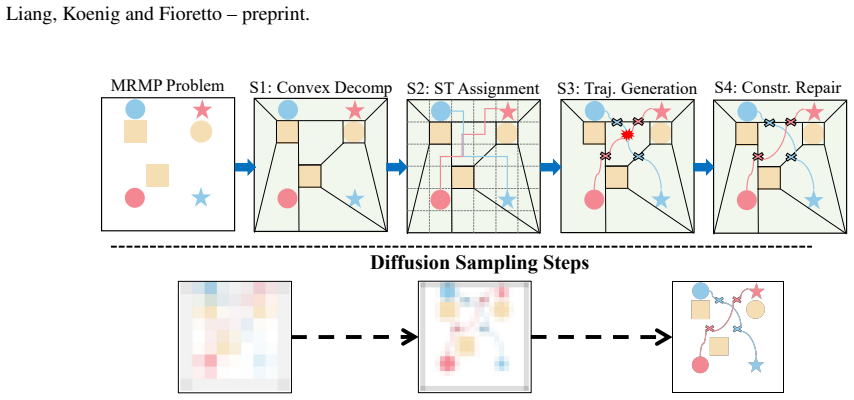
Four components carry the argument: (1) Priority-Based Decomposition (PBD), a greedy Hertel–Mehlhorn-style merge of triangulation cells that produces a non-overlapping convex partition of free space biased toward robot traffic; (2) the transition set T, which records each robot's entry/exit time and position per region from the MAPF solution, converting the spatial partition into temporally independent subproblems; (3) projected score-based diffusion, which uses SGLD updates plus a Euclidean projection onto the subproblem's convex region to maintain obstacle avoidance; and (4) constraint-aware diffusion refinement, an augmented-Lagrangian projection PΠ that enforces inter-robot separation an
What would settle it
Run DGD on a two-region partition where the shared boundary is long, giving robot A an exit event at the boundary of region R1 at time t and robot B an entry event into the neighboring region R2 at the same time t, with their centers closer than the sum of their radii. If the returned trajectories violate constraint (1b), the independence premise is false.
Extended reading notes
Core claim
DGD's central claim is that the MRMP problem can be reduced to independent convex-region subproblems by using a MAPF solution as a spatiotemporal skeleton. Each subproblem is solved by a score-based diffusion model that samples trajectories inside a convex region, guided by entry and exit events extracted from the MAPF plan; a Euclidean projection onto the region's convex set guarantees obstacle avoidance. Inter-robot separation is enforced by a constraint-aware diffusion refinement step that runs an augmented-Lagrangian projection onto the separation and kinematic constraints, but only for subproblems flagged as infeasible. The authors claim this preserves formal feasibility while scaling t
Load-bearing premise
The formal feasibility claim rests on the premise that robots in different convex regions can never collide, so constraint repair can be performed independently region by region; if two robots can sit near a shared boundary at the same time, the per-region check never examines that pair.
Editorial extensions
If this is right
- On the four benchmark map families (basic, dense, room, shelf), DGD maintains near-100% success through 18 robots; on dense maps with 6 robots it matches the SMD baseline's 100% success at roughly 4% of SMD's runtime.
- DGD generates feasible trajectories for 100 robots in a cluttered map with 104 obstacles, a 2.5x increase in robot count over the prior diffusion-based multi-robot baseline.
- Initializing the diffusion reverse process with the MAPF solution rather than noise improves sampling efficiency and lets DGD shorten grid-bound MAPF paths into continuous trajectories.
- The per-region repair step keeps constraint enforcement cheap because the Lagrangian projection runs only on infeasible subproblems in low-dimensional convex spaces, not on the global problem.
- PBD's non-overlapping convex partition eliminates the mode-switch explosion caused by overlapping convex covers such as VCC, reducing the number of diffusion calls.
Reading between the lines
- My inference: the independence guarantee in Proposition 1(c) presupposes that robots in different convex regions can never approach within the sum of their radii across the shared boundary; a partition that merely tiles free space does not ensure that, so the formal feasibility claim may need a boundary-separation condition or a global cross-region verification pass.
- My inference: adding cross-region consistency constraints, such as matching boundary arrival times, would likely remove the sharp velocity discontinuities the paper reports in Section 5.5, at modest additional cost.
- My inference: the same discrete-skeleton-to-diffusion pattern could apply to other high-dimensional coordination tasks, such as warehouse traffic or drone swarms, wherever a coarse discrete schedule exists and continuous refinement is needed.
- My inference: because the MAPF solution fixes the spatiotemporal corridor, DGD's trajectory quality is bounded by MAPF's routing choices; using multiple MAPF skeletons or an iterative refinement loop could further shorten paths.
Editorial analysis
A structured set of objections, weighed in public.
Referee Report
Summary. The paper proposes Discrete-Guided Diffusion (DGD), a multi-robot motion planning framework that combines a discrete MAPF solver with continuous diffusion models. The method has four stages: (S1) a priority-based convex decomposition (PBD) partitions free space into disjoint convex regions; (S2) a MAPF solution is used to extract entry/exit events for each robot and region; (S3) per-region diffusion models generate trajectories guided by this spatiotemporal structure; (S4) a constraint-aware refinement step attempts to repair infeasible trajectories. The central claims are that DGD preserves formal feasibility of constraints (1a)-(1c) and that it scales to 100 robots while achieving state-of-the-art success rates and runtime.
Significance. If the formal guarantees were correct, DGD would be an important step toward making diffusion-based MRMP scalable: the idea of using a MAPF solution only as a spatiotemporal skeleton and then synthesizing continuous trajectories per convex region is attractive, and the PBD algorithm with its O(|V| log |V|) runtime is a reasonable contribution. The empirical comparison against MPD, MMD, and SMD on 3-18 robot benchmarks is useful, and the paper provides trajectory visualizations and an appendix with additional tables. However, the formal core is not sound as written. The decomposition independence claim in Proposition 1(c) is false because the inter-robot separation constraint (1b) is global and couples robots across region boundaries. Since both trajectory generation and repair are performed per region, the claimed safety guarantee is unsupported. The 100-robot scalability claim is also not backed by quantitative results in the manuscript.
major comments (4)
- [Section 4.2, Proposition 1(c), and Appendix A.2] Proposition 1(c) asserts 'There are no inter-region constraints at any time step, so each region defines an independent subproblem.' This is false as stated. Constraint (1b) is a pairwise separation constraint over all robot pairs i<j at every time h, with no dependence on region membership. PBD produces adjacent convex polygons sharing boundaries, so two robots whose centers lie in different regions at the same time can be arbitrarily close across a shared boundary. Neither the per-region generation in Section 4.3 nor the per-region repair in Section 4.4 evaluates or enforces such pairs. The proof in Appendix A.2 simply restates the claim ('collision and feasibility constraints only involve robots sharing the same region'), which is exactly the point at issue. A concatenation of independently feasible per-region trajectories can therefore violate (1b). Section 5.5's acknowledgment of 'a
- [Section 4.4, PΠ and constraint-aware refinement] The feasibility guarantee also depends on the projection PΠ returning a trajectory satisfying (1b)-(1c). The paper does not prove this. PΠ is solved via an augmented Lagrangian dual ascent with a quadratic penalty, but there is no convergence analysis for this nonconvex projection, no theorem that the returned y satisfies the constraints, and the stopping rule is a threshold on the residual, which is an implementation parameter rather than a certificate. Moreover, the refinement is applied per region, so even a converged projection would not repair cross-region violations of (1b). Thus the claimed 'lightweight repair mechanism ensures trajectory feasibility' is not backed by a formal argument.
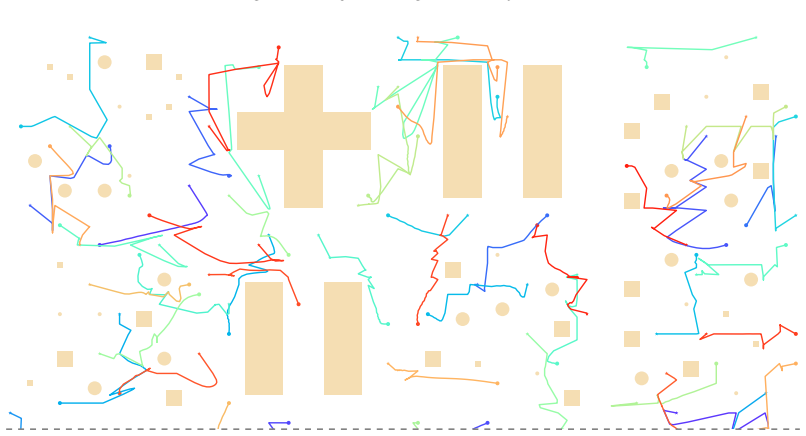
- [Section 5.3, Figure 5] The abstract and Section 5.3 claim that DGD 'scales to 100 robots' and achieves high success rates in large-scale environments, but no quantitative results are provided for that setting. Table 1 and Table 2 report experiments with at most 18 robots, and Section 5.3 includes only representative trajectory plots. Success rate, runtime, and feasibility statistics for the 100-robot instances are absent. This central empirical claim is therefore not evidenced by the manuscript.
- [Theorem 2 and Appendix A.3] The obstacle-avoidance guarantee is not self-contained. The proof invokes Corollary 3 of Christopher et al. [2025], a same-group preprint, without stating or deriving the result. In addition, the theorem statement ('there exist t such that Σ ∇x do ≤ ξ') does not match the proof's conclusion about expected distance to the feasible set. The manuscript should either provide the missing argument or explicitly state the result as an empirical claim rather than a formal guarantee.
minor comments (5)
- [Notation, Section 4.3] CC_f is defined as a set of regions {R1,...,Rk}, but the projection PCc_f(x)=argmin_{y∈Cc_f} ||x-y||^2 should be over the union ∪R∈Cc_f R. Projection onto a nonconvex union is not uniquely defined; clarify the intended operation.
- [Section 4.4, augmented Lagrangian] The augmented Lagrangian is written as Lalm(y,ν)=L(y,ν)+ρ||Σ ∇y da||^2. It is unclear why the linear multiplier term is absent and whether ν is a scalar or a vector. A cleaner formulation would help the reader assess the claimed convergence behavior.
- [Section 5.2 and Table 2] Table 2 includes a method 'DM' that is not listed among the competing methods in Section 5.2. Please add its description to the comparison list.
- [Appendix C.2] The DGD diffusion model is trained using trajectories generated by MMD, which is also a baseline. This potential advantage in the comparison should be discussed explicitly, since it may affect the fairness of the success-rate comparison.
- [Typos and phrasing] There are several typos: 'Diffusion modesl' (Section 4.3), 'obatin' and 'anther' (Section 4.4), 'Beacause' (Appendix A.3), and 'Limitation Anslysis' (Section 5.5). Theorem 1 statement also uses 'S R∈Cc_f R ∈ Cf' where subset inclusion is meant.
Circularity Check
Formal feasibility is not derived: Proposition 1(c) assumes inter-region independence by assertion, and Theorem 2 imports its guarantee from the authors' own prior corollary.
-
self definitional
[Section 4.2, Proposition 1(c); proof in Appendix A.2]
"There are no inter-region constraints at any time step, so each region defines an independent subproblem. ... collision and feasibility constraints only involve robots sharing the same region at the same time."
The MRMP constraints in Eq. (1b) are global pairwise separation constraints over all i<j with no region-membership condition. Because PBD partitions free space into adjacent convex polygons, robots in different regions can be arbitrarily close across a shared boundary at the same time. The proof of (c) does not derive the absence of inter-region constraints from (1b)-(1c); it restates the proposition as its only justification. The independent-subproblem decomposition, on which all per-region generation (S3) and repair (S4) rely, is therefore assumed rather than derived. Section 5.5 later concedes 'the absence of explicit consistency constraints across subproblems,' confirming that the independence is asserted, not enforced.
-
self citation load bearing
[Appendix A.3, proof of Theorem 2]
"Using Corollary 3 in Christopher et al. [2025], for any arbitrarily small ξ > 0, there exists a time t such that after the update: E[Error(U(PCf(x)), Cf)] ≤ ξ."
Theorem 2 is the paper's formal feasibility guarantee for the projected diffusion process, and the proof does not derive the required bound. It imports it from Corollary 3 of Christopher et al. [2025], an arXiv preprint authored by Jinhao Liang and Ferdinando Fioretto (overlapping authors of the present paper). The corollary is not reproduced, proved, or independently verified inside this manuscript, yet it carries the central 'preserves formal feasibility' claim. The invocation is load-bearing because the rest of the constraint-refinement discussion (Section 4.4) assumes this guarantee for the convex subproblems.
full rationale
The empirical evaluation is largely self-contained: the MAPF-guided decomposition is an independent algorithmic contribution, the benchmark comparisons are against external baselines, and the scalability experiments are not fitted to a prediction target. However, the paper's formal-safety argument is circular in two places. First, Proposition 1(c) — the linchpin of the region-decomposition — asserts that inter-region constraints do not exist and proves this by restating the same claim, despite Eq. (1b) being a global pairwise constraint. Second, Theorem 2's feasibility guarantee is not derived in this paper but is inherited from a corollary in the authors' own prior work, making the central 'formal feasibility' statement dependent on a self-citation chain. The training detail (Appendix C.2) that DGD is trained on trajectories generated by the MMD baseline is a comparison-fairness concern but is not itself a circular derivation, since DGD's success is not statistically forced by that training. Overall, the central formal claim partially reduces to an assumption and a self-citation, while the engineering and empirical contributions retain independent content; score 6.
Assumptions & free parameters
free parameters (4)
- augmented Lagrangian penalty coefficient rho
- diffusion guidance step size epsilon
- constraint residual threshold for repair
- PBD priority function p(r)
assumptions (6)
- domain assumption MAPF plan can be embedded into the convex partition; every discrete position pi_M,i(t) lies in exactly one region R_j.
- ad hoc to paper Robots in different regions do not need to respect inter-robot constraint (1b) (Proposition 1(c)).
- ad hoc to paper Augmented Lagrangian dual ascent on P_Pi converges to a trajectory satisfying (1b)-(1c).
- domain assumption Score network s_theta trained on MMD-generated data approximates the conditional distribution of feasible trajectories in each region.
- domain assumption Initializing the reverse process from the MAPF solution x_T = Pi_M is a valid structural prior.
- standard math Euclidean projection onto a convex set is well-defined and can be computed efficiently.
Cite this review
Pith. "Pith review of Discrete-Guided Diffusion for Scalable and Safe Multi-Robot Motion Planning." pith.science (2026). https://pith.science/paper/BW2JXU7F
@misc{pith2026250820095,
  author       = {Pith},
  title        = {Pith review of: Discrete-Guided Diffusion for Scalable and Safe Multi-Robot Motion Planning},
  year         = {2026},
  howpublished = {\url{https://pith.science/paper/BW2JXU7F}},
  note         = {Machine review of arXiv:2508.20095}
}
read the original abstract
Multi-Robot Motion Planning (MRMP) involves generating collision-free trajectories for multiple robots operating in a shared continuous workspace. While discrete multi-agent path finding (MAPF) methods are broadly adopted due to their scalability, their coarse discretization severely limits trajectory quality. In contrast, continuous optimization-based planners offer higher-quality paths but suffer from the curse of dimensionality, resulting in poor scalability with respect to the number of robots. This paper tackles the limitations of these two approaches by introducing a novel framework that integrates discrete MAPF solvers with constrained generative diffusion models. The resulting framework, called Discrete-Guided Diffusion (DGD), has three key characteristics: (1) it decomposes the original nonconvex MRMP problem into tractable subproblems with convex configuration spaces, (2) it combines discrete MAPF solutions with constrained optimization techniques to guide diffusion models capture complex spatiotemporal dependencies among robots, and (3) it incorporates a lightweight constraint repair mechanism to ensure trajectory feasibility. The proposed method sets a new state-of-the-art performance in large-scale, complex environments, scaling to 100 robots while achieving planning efficiency and high success rates.
Figures


Figures from the paper (7 more)



Reference graph
Works this paper leans on
-
[2025]
Jonathan D Gammell, Siddhartha S Srinivasa, and Timothy D Barfoot
Accessed: 2025-05-01. Jonathan D Gammell, Siddhartha S Srinivasa, and Timothy D Barfoot. Informed rrt*: Optimal sampling-based path planning focused via direct sampling of an admissible ellipsoidal heuristic. In 2014 IEEE/RSJ international conference on intelligent robots and systems, pages 2997–3004. IEEE,
work page 2025
-
[1]
Schoellig, and Raffaello D’Andrea
Federico Augugliaro, Angela P. Schoellig, and Raffaello D’Andrea. Generation of collision-free trajectories for a quadrocopter fleet: A sequential convex programming approach. In 2012 IEEE/RSJ International Conference on Intelligent Robots and Systems, pages 1917–1922,
work page 2012
-
[3]
Table 2 presents the success rate (S) and running time (T) across all methods. Across all maps and agent counts, DGD maintains 100% or near-100% success, even in the most challenging Room and Shelf settings with 18 robots. This highlights the strong generalization and feasibility enforcement of our method. DM fails to generate feasible trajectories in all...
work page 2024
-
[8]
Mixed-integer quadratic program trajectory generation for heterogeneous quadrotor teams
Daniel Mellinger, Alex Kushleyev, and Vijay Kumar. Mixed-integer quadratic program trajectory generation for heterogeneous quadrotor teams. In 2012 IEEE International Conference on Robotics and Automation, pages 477–483,
work page 2012
-
[9]
Jungwon Park, Junha Kim, Inkyu Jang, and H. Jin Kim. Efficient multi-agent trajectory planning with feasibility guarantee using relative bernstein polynomial. In 2020 IEEE International Conference on Robotics and Automation (ICRA), pages 434–440,
work page 2020
-
[10]
Multi-robot motion planning with diffusion models
Yorai Shaoul, Itamar Mishani, Shivam Vats, Jiaoyang Li, and Maxim Likhachev. Multi-robot motion planning with diffusion models. arXiv preprint arXiv:2410.03072,
-
[16]
Hardware: For each of our experiments, we used the NVIDIA RTX A6000 GPU
C Implementation Details Software: The software used for experiments is Rocky Linux release 8.9, Python 3.8, Cuda 12.2, and PyTorch 2.1.2. Hardware: For each of our experiments, we used the NVIDIA RTX A6000 GPU. 17 Liang, Koenig and Fioretto – preprint. (a) Basic Maps. (b) Dense Maps. Figure 9: Representative trajectories generated by MMD on basic and den...
work page 2024
-
[2008]
establishes that each strictly y-monotone polygon admits a triangulation in linear time with respect to the number of its vertices. Combining both stages, the overall computational complexity of triangulating Cf is thus asymptotically dominated by the monotone decomposition step, yielding a total time complexity of O(|V| log |V|). (ii) Iterative Merging. ...
work page 2025
Show all 16 references
-
[2012]
Motion planning diffusion: Learning and planning of robot motions with diffusion models
Joao Carvalho, An T Le, Mark Baierl, Dorothea Koert, and Jan Peters. Motion planning diffusion: Learning and planning of robot motions with diffusion models. In 2023 IEEE/RSJ International Conference on Intelligent Robots and Systems (IROS), pages 1916–1923. IEEE,
2023
-
[2013]
A Missing Proof A.1 Proof of Theorem 1 Proof
14 Liang, Koenig and Fioretto – preprint. A Missing Proof A.1 Proof of Theorem 1 Proof. We analyze the time complexity of the algorithm by examining its two main phases: Triangulation and Iterative Merging. Let |V| denote the number of vertices. (i) Triangulation. The main ide...
2008
-
[2014]
Fast triangulation of simple polygons
Stefan Hertel and Kurt Mehlhorn. Fast triangulation of simple polygons. In Foundations of Computation Theory: Proceedings of the 1983 International FCT-Conference Borgholm, Sweden, August 21–27, 1983 4, pages 207–218. Springer,
1983
-
[2015]
Score-based generative modeling through stochastic differential equations
Yang Song, Jascha Sohl-Dickstein, Diederik P Kingma, Abhishek Kumar, Stefano Ermon, and Ben Poole. Score-based generative modeling through stochastic differential equations. arXiv preprint arXiv:2011.13456,
2011 arXiv
-
[2019]
Approximating robot configuration spaces with few convex sets using clique covers of visibility graphs
Peter Werner, Alexandre Amice, Tobia Marcucci, Daniela Rus, and Russ Tedrake. Approximating robot configuration spaces with few convex sets using clique covers of visibility graphs. In 2024 IEEE International Conference on Robotics and Automation (ICRA), pages 10359–10365. IEE...
2024 arXiv
-
[2021]
Simultaneous multi-robot motion planning with projected diffusion models
Jinhao Liang, Jacob K Christopher, Sven Koenig, and Ferdinando Fioretto. Simultaneous multi-robot motion planning with projected diffusion models. arXiv preprint arXiv:2502.03607,
-
[2023]
Gcs*: Forward heuristic search on implicit graphs of convex sets
Shao Yuan Chew Chia, Rebecca H Jiang, Bernhard Paus Graesdal, Leslie Pack Kaelbling, and Russ Tedrake. Gcs*: Forward heuristic search on implicit graphs of convex sets. arXiv preprint arXiv:2407.08848,
-
[2024]
Neuro-symbolic generative diffusion models for physically grounded, robust, and safe generation
Jacob K Christopher, Michael Cardei, Jinhao Liang, and Ferdinando Fioretto. Neuro-symbolic generative diffusion models for physically grounded, robust, and safe generation. arXiv preprint arXiv:2506.01121,
Reviewed August 5, 2026 · model on record in the stance chip above.
Discussion (0). Sign in to comment.